
DIAMOND
Chanaka Wickramasinghe
Undergraduate
Mineral Resources and technology degree program
Uva Wellassa University of Sri Lanka
The physical properties of diamond
Diamond
 Has a very high melting point (almost 4000°C).
 Is very hard. This is again due to the need to break very
strong covalent bonds
 Doesn't conduct electricity.
 Is insoluble in water and organic solvents
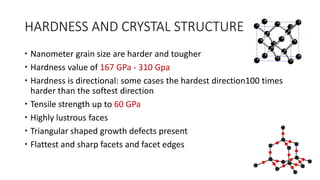
HARDNESS AND CRYSTAL STRUCTURE
 Nanometer grain size are harder and tougher
 Hardness value of 167 GPa - 310 Gpa
 Hardness is directional: some cases the hardest direction100 times
harder than the softest direction
 Tensile strength up to 60 GPa
 Highly lustrous faces
 Triangular shaped growth defects present
 Flattest and sharp facets and facet edges
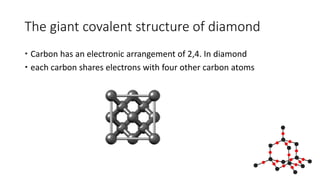
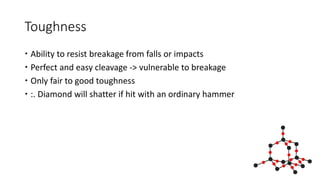
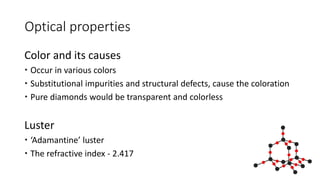
The giant covalent structure of diamond
 Carbon has an electronic arrangement of 2,4. In diamond
 each carbon shares electrons with four other carbon atoms
Toughness
 Ability to resist breakage from falls or impacts
 Perfect and easy cleavage -> vulnerable to breakage
 Only fair to good toughness
 :. Diamond will shatter if hit with an ordinary hammer
Optical properties
Color and its causes
 Occur in various colors
 Substitutional impurities and structural defects, cause the coloration
 Pure diamonds would be transparent and colorless
Luster
 ‘Adamantine’ luster
 The refractive index - 2.417
Optical properties
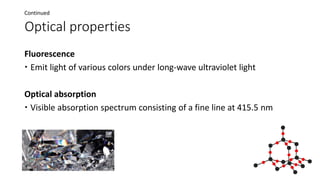
Fluorescence
 Emit light of various colors under long-wave ultraviolet light
Optical absorption
 Visible absorption spectrum consisting of a fine line at 415.5 nm
Continued
Electrical properties
 Semiconductors due to substitutional boron impurities
 Good electrical insulator, resistivity of 1011 to 1018 Ωm-1
 Magnetic properties observed in diamond nanocrystals
Thermal conductivity
• Good conductor of heat
• Thermal conductivity of natural
diamond about 22 W/cm·K
Synthetic diamonds
 A synthetic diamond is a diamond produced through chemical and
physical processes in laboratory conditions
History
 The earliest successes were reported in 1879
 Synthetic diamond is also widely known as HPHT diamond or CVD
diamond
Synthetic diamonds
Manufacturing technologies
 High pressure, high temperature method
 Chemical vapor deposition method
 Detonation of explosives
 Ultrasound cavitation
Applications
Applications are wide range due to the extraordinary properties
 Widely used in oil and gas drills
 ‘window’ material for several industrial, R&D, defence and laser
applications
 Electronic and electrical applications
Applications
 ‘heat sink’ for sensitive components
 Optimum exit windows for CO2 lasers In the production of laser optics
 Industrial and household water treatment
 Advanced healthcare applications
Continued
Applications
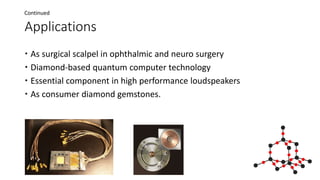
 As surgical scalpel in ophthalmic and neuro surgery
 Diamond-based quantum computer technology
 Essential component in high performance loudspeakers
 As consumer diamond gemstones.
Continued
Diamond as a material

Diamond as a material

  • 1.
    DIAMOND Chanaka Wickramasinghe Undergraduate Mineral Resourcesand technology degree program Uva Wellassa University of Sri Lanka
  • 2.
    The physical propertiesof diamond Diamond  Has a very high melting point (almost 4000°C).  Is very hard. This is again due to the need to break very strong covalent bonds  Doesn't conduct electricity.  Is insoluble in water and organic solvents
  • 3.
    HARDNESS AND CRYSTALSTRUCTURE  Nanometer grain size are harder and tougher  Hardness value of 167 GPa - 310 Gpa  Hardness is directional: some cases the hardest direction100 times harder than the softest direction  Tensile strength up to 60 GPa  Highly lustrous faces  Triangular shaped growth defects present  Flattest and sharp facets and facet edges
  • 4.
    The giant covalentstructure of diamond  Carbon has an electronic arrangement of 2,4. In diamond  each carbon shares electrons with four other carbon atoms
  • 5.
    Toughness  Ability toresist breakage from falls or impacts  Perfect and easy cleavage -> vulnerable to breakage  Only fair to good toughness  :. Diamond will shatter if hit with an ordinary hammer
  • 6.
    Optical properties Color andits causes  Occur in various colors  Substitutional impurities and structural defects, cause the coloration  Pure diamonds would be transparent and colorless Luster  ‘Adamantine’ luster  The refractive index - 2.417
  • 7.
    Optical properties Fluorescence  Emitlight of various colors under long-wave ultraviolet light Optical absorption  Visible absorption spectrum consisting of a fine line at 415.5 nm Continued
  • 8.
    Electrical properties  Semiconductorsdue to substitutional boron impurities  Good electrical insulator, resistivity of 1011 to 1018 Ωm-1  Magnetic properties observed in diamond nanocrystals Thermal conductivity • Good conductor of heat • Thermal conductivity of natural diamond about 22 W/cm·K
  • 9.
    Synthetic diamonds  Asynthetic diamond is a diamond produced through chemical and physical processes in laboratory conditions History  The earliest successes were reported in 1879  Synthetic diamond is also widely known as HPHT diamond or CVD diamond
  • 10.
    Synthetic diamonds Manufacturing technologies High pressure, high temperature method  Chemical vapor deposition method  Detonation of explosives  Ultrasound cavitation
  • 11.
    Applications Applications are widerange due to the extraordinary properties  Widely used in oil and gas drills  ‘window’ material for several industrial, R&D, defence and laser applications  Electronic and electrical applications
  • 12.
    Applications  ‘heat sink’for sensitive components  Optimum exit windows for CO2 lasers In the production of laser optics  Industrial and household water treatment  Advanced healthcare applications Continued
  • 13.
    Applications  As surgicalscalpel in ophthalmic and neuro surgery  Diamond-based quantum computer technology  Essential component in high performance loudspeakers  As consumer diamond gemstones. Continued

Editor's Notes

  • #2 Good morning, let me disscuss the most hardest naturally occaring mineral in the world.. Diamond is the hardest natural substance known. whare formed deep in the mantle, and brought to the surface via kimberlite pipes other rocks that originate deep within the mantle. Also we can found in alluvial deposits, along with quartz, corundum, zircon and other minerals, derived from such rocks, and in certain meteorites. 
  • #3 Diamond is the allotrope of carbon in which the carbon atoms are arranged in the specific type of cubic lattice called diamond cubic. Also Diamond is an optically isotropic crystal that is transparent to opaque. Owing to its strong covalent bonding, diamond is the hardest naturally occurring material known. But, due to important structural weaknesses, diamond's toughness is only fair to good. precise tensile strength of diamond is unknown, however strength up to 60 GPa has been observed, and it could be as high as 90–225 GPa depending on the crystal orientation. Diamond has a high refractive index (2.417) and moderate dispersion (0.044) properties which give cut diamonds their brilliance. Trace impurities substitutionally replacing carbon atoms in a diamond's crystal lattice, and in some cases structural defects, are responsible for the wide range of colors seen in diamond. Most diamonds are electrical insulators but extremely efficient thermal conductors.  Unlike many other minerals, the specific gravity of diamond crystals (3.52) has rather small variation from diamond to diamond.
  • #4 Let me discuss the physical properties of diamond It has very high melting point almost 4000°C degrees due to strong carbon-carbon covalent bonds Same time it is very hard due to the need high energy to break very strong covalent bonds operating in 3-dimensions. because of this hardness diamond scoring 10 on the Mohs scale of mineral hardness. Diamond doesn't conduct electricity because all the electrons are tightly bonded between the atoms. It Is insoluble in water and organic solvents because There are no possible attractions can generate to breakdown strong covalent bonds
  • #5 In some cases diamond aggregates having nanometer grain size are harder and tougher than large diamond crystals, And they perform better as abrasive material. Diamond hardness can be vary form 167GPa to 310 Gpa due to the direction Hardness is directional: some cases the hardest direction100 times harder than the softest direction The precise tensile strength of diamond is unknown, however strength up to 60 GPa has been observed,  The faces of diamond octahedrons are highly lustrous because of there high hardness Also triangular shaped growth defects can be observe. And Because of its great hardness and strong molecular bonding, faces and edges appear the flattest and sharpest in the range
  • #6 When it comes to structure, we can describe it as giant covalent structure of diamond, where Carbon has an electronic arrangement of 2,4. And each carbon shares electrons with four other carbon atoms while forming four single bonds.
  • #7 Toughness relates to the ability to resist breakage from falls or impacts Because of diamond's perfect and easy cleavage, it is vulnerable to break And Unlike hardness, diamond's toughness or tenacity is only fair to good Because of this, diamond can shatter by hiting with an ordinary hammer.
  • #8 When it comes to optical properties, We can observe Diamonds in various colors: black, brown, yellow, gray, white, blue, orange, purple to pink and red likevise. There coloration occurs Cdue to crystallographic defects, including substitutional impurities and structural defects. Anyhow Theoretically, pure diamonds should be transparent and colorless. The luster of a diamond described as 'adamantine', which simply means diamond-like The refractive index is 2.417. Because it is cubic in structure,
  • #9 And, Diamonds exhibit fluorescence, that is, they emit light of various colors and intensities under long-wave ultraviolet light  Also diamonds have a visible absorption spectrum consisting of a fine line in the violet at 415.5 nm range
  • #10 Electrical properties, Except for most natural blue diamonds, most diamonds are semiconductors due to substitutional boron impurities replacing carbon atoms. Diamond is a good electrical insulator, which having resistivity of (1011 to 1018 Ω·m) Theses mineral has Uncommon magnetic properties were we can observed in diamond nanocrystals. Also diamond is a good conductor of heat because of the strong covalent bonding. Thermal conductivity of natural diamond was measured to be about 22 W/(cm·K), which is five times more than copper.
  • #11 A “synthetic diamond” is a diamond, produced through chemical and physical processes in laboratory conditions. After the 1797 discovery that diamond was pure carbon, many attempts were made to convert various cheap forms of carbon into diamond. Anyhow The earliest successes were reported by James Hannay in 1879 Todays world Synthetic diamond is also widely known as HPHT diamond or CVD diamond
  • #12 There are several methods used to produce synthetic diamond. The original method uses high pressure and high temperature (HPHT) and is still widely used because of its relatively low cost. The process involves large presses that can weigh hundreds of tons to produce a pressure of 5 GPa at 1500 °C. The second method, using chemical vapor deposition (CVD), creates a carbon plasma over a substrate onto which the carbon atoms deposit to form diamond. Other methods include explosive formation and sonication of graphite solutions are still in R&D level
  • #13 Due to the extraordinary properties of diamond such as extreme hardness, chemical inertness, optical transparency, high thermal conductivity ,electrical insulation more and more fields of applications recognize the benefits provided by this material. D’s are widely used in oil and gas drills as no other material is capable of handling the extreme conditions such as high P&T. by these diamond bits Large economic benefits are gained by rig drilling operators. And diamonds are Ideal ‘window’ material for industrial applications, R&D, defence and laser applications infrared windows, lenses, X-ray windows Also All types of electronic and electrical applications in which build-up of heat can severely impact or destroy circuits.
  • #14 Also used As a ‘heat sink’ for sensitive components used in the telecommunications industry and in microelectronic devices. In the production of laser optics where synthetic diamond provides optimum exit windows for CO2 lasers, such as those used in automotive cutting applications. Synthetic diamond-based products are being used in industrial and household water treatment plants. And In advanced healthcare applications such as therapy for eye cancer patients where synthetic diamond-based radiation detectors ensure the delivery of the correct dosage to precisely target only the cancer-affected tissue and not the healthy tissue around it.
  • #15 Also diamonds used As surgical scalpel in neuro surgery. And Researchers are trying to develop synthetic diamond-based quantum computer technology that could enable faster data processing and secure communication. Polycrystalline CVDs are an essential component in high performance loudspeakers. And last, not least diamonds use As consumer diamond gemstones. This is the end of my disscution about the diamond in advance in Properties Structure Synthesis and Applications Thank you