Natural Fiber CompositesNatural Fiber Composites
(Hemp)(Hemp)
HistoryHistory
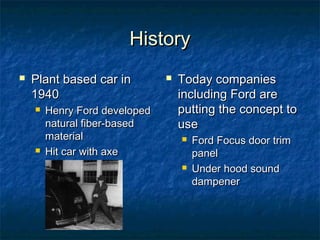
 Plant based car inPlant based car in
19401940
 Henry Ford developedHenry Ford developed
natural fiber-basednatural fiber-based
materialmaterial
 Hit car with axeHit car with axe
 Today companiesToday companies
including Ford areincluding Ford are
putting the concept toputting the concept to
useuse
 Ford Focus door trimFord Focus door trim
panelpanel
 Under hood soundUnder hood sound
dampenerdampener
Method of ProductionMethod of Production
 General processGeneral process
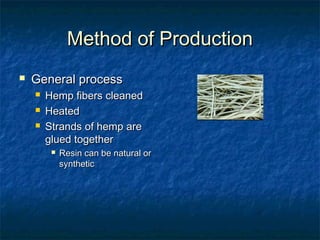
 Hemp fibers cleanedHemp fibers cleaned
 HeatedHeated
 Strands of hemp areStrands of hemp are
glued togetherglued together
 Resin can be natural orResin can be natural or
syntheticsynthetic
AdvantagesAdvantages
 LighterLighter
 30% less than current materials30% less than current materials
 BiodegradableBiodegradable
 Low energy to manufactureLow energy to manufacture
 Excellent energy absorptionExcellent energy absorption
 Replace current plastics and even steelsReplace current plastics and even steels
 Non-ToxicNon-Toxic
AdvantagesAdvantages
 "Hemp fibers have higher strength-to-"Hemp fibers have higher strength-to-
weight ratios than steel and can also beweight ratios than steel and can also be
considerably cheaper to manufacture" -considerably cheaper to manufacture" -
Alan CroskyAlan Crosky
 Only traces of tetrahydrocannabinolOnly traces of tetrahydrocannabinol
UsesUses
 Car bodiesCar bodies
 Less weight = greater fuel economyLess weight = greater fuel economy
 ToysToys
 LuggageLuggage
 Building materialBuilding material
FutureFuture
 By 2010 the New Jersey consulting firmBy 2010 the New Jersey consulting firm
Kline & Company anticipates natural fibersKline & Company anticipates natural fibers
to replace a fifth of the fiberglass in currentto replace a fifth of the fiberglass in current
U.S. car models.U.S. car models.

Natural fibre-composites

  • 1.
    Natural Fiber CompositesNaturalFiber Composites (Hemp)(Hemp)
  • 2.
    HistoryHistory  Plant basedcar inPlant based car in 19401940  Henry Ford developedHenry Ford developed natural fiber-basednatural fiber-based materialmaterial  Hit car with axeHit car with axe  Today companiesToday companies including Ford areincluding Ford are putting the concept toputting the concept to useuse  Ford Focus door trimFord Focus door trim panelpanel  Under hood soundUnder hood sound dampenerdampener
  • 3.
    Method of ProductionMethodof Production  General processGeneral process  Hemp fibers cleanedHemp fibers cleaned  HeatedHeated  Strands of hemp areStrands of hemp are glued togetherglued together  Resin can be natural orResin can be natural or syntheticsynthetic
  • 4.
    AdvantagesAdvantages  LighterLighter  30%less than current materials30% less than current materials  BiodegradableBiodegradable  Low energy to manufactureLow energy to manufacture  Excellent energy absorptionExcellent energy absorption  Replace current plastics and even steelsReplace current plastics and even steels  Non-ToxicNon-Toxic
  • 5.
    AdvantagesAdvantages  "Hemp fibershave higher strength-to-"Hemp fibers have higher strength-to- weight ratios than steel and can also beweight ratios than steel and can also be considerably cheaper to manufacture" -considerably cheaper to manufacture" - Alan CroskyAlan Crosky  Only traces of tetrahydrocannabinolOnly traces of tetrahydrocannabinol
  • 6.
    UsesUses  Car bodiesCarbodies  Less weight = greater fuel economyLess weight = greater fuel economy  ToysToys  LuggageLuggage  Building materialBuilding material
  • 7.
    FutureFuture  By 2010the New Jersey consulting firmBy 2010 the New Jersey consulting firm Kline & Company anticipates natural fibersKline & Company anticipates natural fibers to replace a fifth of the fiberglass in currentto replace a fifth of the fiberglass in current U.S. car models.U.S. car models.