1
AN EMERGING MATERIAL FOR
FUTURE TECHNOLOGY
Guided by Submitted By
Prof. V. C. Renge Rohit D. Sahu
SEMINAR
ON
Content
2
1) Introduction
2) Properties of Graphene
3) Synthesis
4) Advantages and disadvantages
5) Companies in the Graphene Space
6) Applications
7) Conclusion
8) Reference
INTRODUCTION
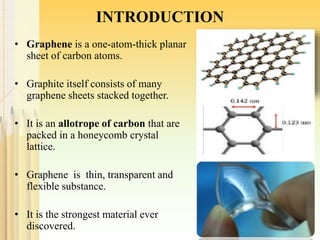
• Graphene is a one-atom-thick planar
sheet of carbon atoms.
• Graphite itself consists of many
graphene sheets stacked together.
• It is an allotrope of carbon that are
packed in a honeycomb crystal
lattice.
• Graphene is thin, transparent and
flexible substance.
• It is the strongest material ever
discovered. 3
PROPERTIES OF GRAPHENE
 C-C bond length is about 0.142nm.
 High tensile strength about 130GPa.
 It is 200 times stronger than steel.
 Graphene absorbs 2.3% of white light; i.e. it is almost
transparent.
 It is Very light material i.e. 0.77mg/sq. m which is 1000
times lighter than same size of paper.
 It is Hexagonal structural element of carbon allotropes.
 Graphene is the highly conductive material then silver and
copper.
4
GRAPHEN : SYNTHESIS
Two basic technique used are :
1. MECHANICAL EXFOLIATION (ME)
2. CHEMICAL VAPOUR DEPOSITON(CVD)
Graphene layer formed using Scotch tape(ME)
5
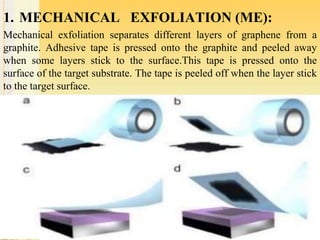
1. MECHANICAL EXFOLIATION (ME):
Mechanical exfoliation separates different layers of graphene from a
graphite. Adhesive tape is pressed onto the graphite and peeled away
when some layers stick to the surface.This tape is pressed onto the
surface of the target substrate. The tape is peeled off when the layer stick
to the target surface.
6
2.CHEMICAL VAPOUR DEPOSITION :
Chemical vapour deposition is a well known process in
which a substrate is exposed to gaseous compounds. These
compounds decompose on the surface in order to grow a
thinfilm . Graphene can be grown by exposing the copper
foil to a gas i.e.CH4 at about 1000°C.The methane
decomposes on the surface, so that the hydrogen
evaporates. The carbon diffuses into cu foil. After cooling
down in an atmosphere, a graphene layer grows on the
surface. These graphene layers can be transferred via
polymer support, which will be attached onto the top of the
graphene. After etching the copper, the graphene can be
stamped onto the required substrate and the polymer
support gets peeled off.
7
1000°C
CH4
8
CONCENTRIC TUBE
c
H2
CABON IS DEPOSITED OVER
THE CU. FOIL
Absence of
Air
Cooling with N2
GRAPHEN IN CU. FOIL
H2
Flow sheet
9Fig. chemical vapour deposition
HOW CVD IS DONE
10
11
ADVANTAGES
 High heat conductivity, greater than copper and silver.
 No heat loss or it gives 100% output.
 It is transparent and lighter material.
 Stronger than diamond & steel.
 Can make very light weight parts for auto bodies.
 Used to make batteries that recharge faster as compare to lithium-
ion battery.
12
DISADVANTAGES
 Single sheet of graphene is hard to produce.
 Research has proven that graphene exhibits some toxic.
13
Companies in the Graphene Space
NAME OF COMPANIES MKT CAPACITY
Applied Graphene Material Ltd. UK 34m Pound
Aixtron SE, Germany E800m
CVD Equipment Corp., US $61m
Graftech International, New York $1bn
Graphene Nanochem , UK E43m
Dongxu Optoelectronics, Beijing $100m
Talga Resources Ltd .,US $40m
14
• Solar panels
• Water purifiction
• Graphene battery
• Super Capacitors
• Automobile sector
• Composites material for cars, airplanes, space shuttles, satellite.
15
16
17
CONCLUSION
1. The quality and availability of “Synthetic graphene”
will continue to improve.
2. Science must have ample access to improve graphene
material & integrate it to the present day gadgets.
REFERENCES
1. Manufacturing of graphene using a CVD method.
Erik S. Polsen1,†, Daniel Q. McNerny1, B. Viswanath2,‡,
Sebastian W. Pattinson2 & A. John Hart1,2
2. www.graphenia.com
3. www.wikipedia.org/wiki/Graphene
4. www.graphene.manchester.ac.uk
5. www.graphenelabs.com
6. www.graphene-info.com
7. www.graphenebatteries.no/
18
19
T H A N K
Y
O U

Seminar on graphene

  • 1.
    1 AN EMERGING MATERIALFOR FUTURE TECHNOLOGY Guided by Submitted By Prof. V. C. Renge Rohit D. Sahu SEMINAR ON
  • 2.
    Content 2 1) Introduction 2) Propertiesof Graphene 3) Synthesis 4) Advantages and disadvantages 5) Companies in the Graphene Space 6) Applications 7) Conclusion 8) Reference
  • 3.
    INTRODUCTION • Graphene isa one-atom-thick planar sheet of carbon atoms. • Graphite itself consists of many graphene sheets stacked together. • It is an allotrope of carbon that are packed in a honeycomb crystal lattice. • Graphene is thin, transparent and flexible substance. • It is the strongest material ever discovered. 3
  • 4.
    PROPERTIES OF GRAPHENE C-C bond length is about 0.142nm.  High tensile strength about 130GPa.  It is 200 times stronger than steel.  Graphene absorbs 2.3% of white light; i.e. it is almost transparent.  It is Very light material i.e. 0.77mg/sq. m which is 1000 times lighter than same size of paper.  It is Hexagonal structural element of carbon allotropes.  Graphene is the highly conductive material then silver and copper. 4
  • 5.
    GRAPHEN : SYNTHESIS Twobasic technique used are : 1. MECHANICAL EXFOLIATION (ME) 2. CHEMICAL VAPOUR DEPOSITON(CVD) Graphene layer formed using Scotch tape(ME) 5
  • 6.
    1. MECHANICAL EXFOLIATION(ME): Mechanical exfoliation separates different layers of graphene from a graphite. Adhesive tape is pressed onto the graphite and peeled away when some layers stick to the surface.This tape is pressed onto the surface of the target substrate. The tape is peeled off when the layer stick to the target surface. 6
  • 7.
    2.CHEMICAL VAPOUR DEPOSITION: Chemical vapour deposition is a well known process in which a substrate is exposed to gaseous compounds. These compounds decompose on the surface in order to grow a thinfilm . Graphene can be grown by exposing the copper foil to a gas i.e.CH4 at about 1000°C.The methane decomposes on the surface, so that the hydrogen evaporates. The carbon diffuses into cu foil. After cooling down in an atmosphere, a graphene layer grows on the surface. These graphene layers can be transferred via polymer support, which will be attached onto the top of the graphene. After etching the copper, the graphene can be stamped onto the required substrate and the polymer support gets peeled off. 7
  • 8.
    1000°C CH4 8 CONCENTRIC TUBE c H2 CABON ISDEPOSITED OVER THE CU. FOIL Absence of Air Cooling with N2 GRAPHEN IN CU. FOIL H2 Flow sheet
  • 9.
  • 10.
    HOW CVD ISDONE 10
  • 11.
  • 12.
    ADVANTAGES  High heatconductivity, greater than copper and silver.  No heat loss or it gives 100% output.  It is transparent and lighter material.  Stronger than diamond & steel.  Can make very light weight parts for auto bodies.  Used to make batteries that recharge faster as compare to lithium- ion battery. 12
  • 13.
    DISADVANTAGES  Single sheetof graphene is hard to produce.  Research has proven that graphene exhibits some toxic. 13
  • 14.
    Companies in theGraphene Space NAME OF COMPANIES MKT CAPACITY Applied Graphene Material Ltd. UK 34m Pound Aixtron SE, Germany E800m CVD Equipment Corp., US $61m Graftech International, New York $1bn Graphene Nanochem , UK E43m Dongxu Optoelectronics, Beijing $100m Talga Resources Ltd .,US $40m 14
  • 15.
    • Solar panels •Water purifiction • Graphene battery • Super Capacitors • Automobile sector • Composites material for cars, airplanes, space shuttles, satellite. 15
  • 16.
  • 17.
    17 CONCLUSION 1. The qualityand availability of “Synthetic graphene” will continue to improve. 2. Science must have ample access to improve graphene material & integrate it to the present day gadgets.
  • 18.
    REFERENCES 1. Manufacturing ofgraphene using a CVD method. Erik S. Polsen1,†, Daniel Q. McNerny1, B. Viswanath2,‡, Sebastian W. Pattinson2 & A. John Hart1,2 2. www.graphenia.com 3. www.wikipedia.org/wiki/Graphene 4. www.graphene.manchester.ac.uk 5. www.graphenelabs.com 6. www.graphene-info.com 7. www.graphenebatteries.no/ 18
  • 19.
    19 T H AN K Y O U