POLYURETHANEPOLYURETHANE
Materials ScienceMaterials Science
What is Polyurethane?What is Polyurethane?
 A type of elastomer which is capable ofA type of elastomer which is capable of
experiencing large and reversible elasticexperiencing large and reversible elastic
deformations.deformations.
 It’s amorphous, having molecular chainsIt’s amorphous, having molecular chains
that are naturally coiled and kinked in itsthat are naturally coiled and kinked in its
unstressed state.unstressed state.
Who Invented it?Who Invented it?
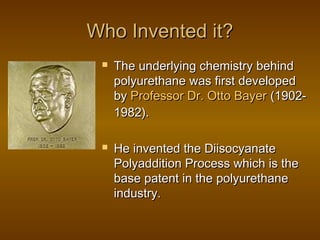
 The underlying chemistry behindThe underlying chemistry behind
polyurethane was first developedpolyurethane was first developed
byby Professor Dr. Otto BayerProfessor Dr. Otto Bayer (1902-(1902-
1982).1982).
 He invented the DiisocyanateHe invented the Diisocyanate
Polyaddition Process which is thePolyaddition Process which is the
base patent in the polyurethanebase patent in the polyurethane
industry.industry.
What is the DiisocyanateWhat is the Diisocyanate
Polyaddition Process ?Polyaddition Process ?
 Polyurethanes are formed by reacting a polyolPolyurethanes are formed by reacting a polyol
(an alcohol with more than two reactive hydroxyl(an alcohol with more than two reactive hydroxyl
groups per molecule) with a diisocyanate or agroups per molecule) with a diisocyanate or a
polymeric isocyanate in the presence of suitablepolymeric isocyanate in the presence of suitable
catalysts and additives.catalysts and additives.
 Since a multitude of different diisocyanates andSince a multitude of different diisocyanates and
polyols can be used to produce polyurethane, apolyols can be used to produce polyurethane, a
broad range of polyurethanesbroad range of polyurethanes can becan be
manufactured to meet the requirements formanufactured to meet the requirements for
specific applications.specific applications.
The Forms of PolyurethaneThe Forms of Polyurethane
FLEXIBLE – Solid &
Foams
REBOND - Foams
RIGID – Resins
(Table-top
covers, furniture
protection, etc)
Where is Polyurethane Used?Where is Polyurethane Used?
Polyurethane-based binders are used in composite
wood products to permanently glue organic materials into
oriented strand board, medium-density fiberboard, long
strand lumber, laminated veneer lumber, strawboard and
particleboard.
Polyurethane-based sealants are used in joints and
openings to help prevent the passage of gases, liquids,
and solids (dust and dirt). Similarly, polyurethane-based
adhesives are used to bond wall and ceiling panels to the
structural frame, and floor joists to the sub-floor decking.
Bonded polyurethane carpet cushion which is made
with re-used flexible polyurethane foam (FPF). With the
ability to be recycled and its high recycle content,
bonded carpet cushion creates a valuable use for a
material that would otherwise require disposal.
Where is Polyurethane Used?Where is Polyurethane Used?
Polyurethane-based binders are used in composite
wood products to permanently glue organic materials into
oriented strand board, medium-density fiberboard, long
strand lumber, laminated veneer lumber, strawboard and
particleboard.
Polyurethane-based sealants are used in joints and
openings to help prevent the passage of gases, liquids,
and solids (dust and dirt). Similarly, polyurethane-based
adhesives are used to bond wall and ceiling panels to the
structural frame, and floor joists to the sub-floor decking.
Bonded polyurethane carpet cushion which is made
with re-used flexible polyurethane foam (FPF). With the
ability to be recycled and its high recycle content,
bonded carpet cushion creates a valuable use for a
material that would otherwise require disposal.

Polyurethane

  • 1.
  • 2.
    What is Polyurethane?Whatis Polyurethane?  A type of elastomer which is capable ofA type of elastomer which is capable of experiencing large and reversible elasticexperiencing large and reversible elastic deformations.deformations.  It’s amorphous, having molecular chainsIt’s amorphous, having molecular chains that are naturally coiled and kinked in itsthat are naturally coiled and kinked in its unstressed state.unstressed state.
  • 3.
    Who Invented it?WhoInvented it?  The underlying chemistry behindThe underlying chemistry behind polyurethane was first developedpolyurethane was first developed byby Professor Dr. Otto BayerProfessor Dr. Otto Bayer (1902-(1902- 1982).1982).  He invented the DiisocyanateHe invented the Diisocyanate Polyaddition Process which is thePolyaddition Process which is the base patent in the polyurethanebase patent in the polyurethane industry.industry.
  • 4.
    What is theDiisocyanateWhat is the Diisocyanate Polyaddition Process ?Polyaddition Process ?  Polyurethanes are formed by reacting a polyolPolyurethanes are formed by reacting a polyol (an alcohol with more than two reactive hydroxyl(an alcohol with more than two reactive hydroxyl groups per molecule) with a diisocyanate or agroups per molecule) with a diisocyanate or a polymeric isocyanate in the presence of suitablepolymeric isocyanate in the presence of suitable catalysts and additives.catalysts and additives.  Since a multitude of different diisocyanates andSince a multitude of different diisocyanates and polyols can be used to produce polyurethane, apolyols can be used to produce polyurethane, a broad range of polyurethanesbroad range of polyurethanes can becan be manufactured to meet the requirements formanufactured to meet the requirements for specific applications.specific applications.
  • 5.
    The Forms ofPolyurethaneThe Forms of Polyurethane FLEXIBLE – Solid & Foams REBOND - Foams RIGID – Resins (Table-top covers, furniture protection, etc)
  • 6.
    Where is PolyurethaneUsed?Where is Polyurethane Used? Polyurethane-based binders are used in composite wood products to permanently glue organic materials into oriented strand board, medium-density fiberboard, long strand lumber, laminated veneer lumber, strawboard and particleboard. Polyurethane-based sealants are used in joints and openings to help prevent the passage of gases, liquids, and solids (dust and dirt). Similarly, polyurethane-based adhesives are used to bond wall and ceiling panels to the structural frame, and floor joists to the sub-floor decking. Bonded polyurethane carpet cushion which is made with re-used flexible polyurethane foam (FPF). With the ability to be recycled and its high recycle content, bonded carpet cushion creates a valuable use for a material that would otherwise require disposal.
  • 7.
    Where is PolyurethaneUsed?Where is Polyurethane Used? Polyurethane-based binders are used in composite wood products to permanently glue organic materials into oriented strand board, medium-density fiberboard, long strand lumber, laminated veneer lumber, strawboard and particleboard. Polyurethane-based sealants are used in joints and openings to help prevent the passage of gases, liquids, and solids (dust and dirt). Similarly, polyurethane-based adhesives are used to bond wall and ceiling panels to the structural frame, and floor joists to the sub-floor decking. Bonded polyurethane carpet cushion which is made with re-used flexible polyurethane foam (FPF). With the ability to be recycled and its high recycle content, bonded carpet cushion creates a valuable use for a material that would otherwise require disposal.