Presented By:
Gautam Yadav
Contents:
 Introduction
 General properties of glass
 Raw materials of glass
 Glass manufacturing
 Melting
• Pot furnace
• Tank furnace
 Forming and Shaping
 Annealing
 Finishing
 Types of glasses and their properties
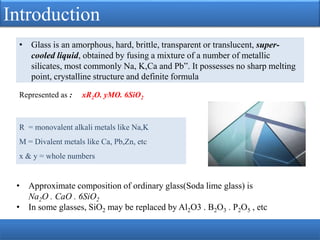
Introduction
• Glass is an amorphous, hard, brittle, transparent or translucent, super-
cooled liquid, obtained by fusing a mixture of a number of metallic
silicates, most commonly Na, K,Ca and Pb”. It possesses no sharp melting
point, crystalline structure and definite formula
Represented as : xR2O. yMO. 6SiO2
R = monovalent alkali metals like Na,K
M = Divalent metals like Ca, Pb,Zn, etc
x & y = whole numbers
• Approximate composition of ordinary glass(Soda lime glass) is
Na2O . CaO . 6SiO2
• In some glasses, SiO2 may be replaced by Al2O3 . B2O3 . P2O5 , etc
4
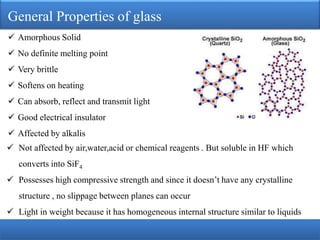
General Properties of glass
 Amorphous Solid
 No definite melting point
 Very brittle
 Softens on heating
 Can absorb, reflect and transmit light
 Good electrical insulator
 Affected by alkalis
 Not affected by air,water,acid or chemical reagents . But soluble in HF which
converts into SiF4
 Possesses high compressive strength and since it doesn’t have any crystalline
structure , no slippage between planes can occur
 Light in weight because it has homogeneous internal structure similar to liquids
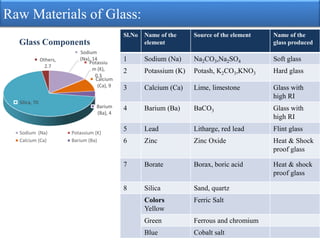
Raw Materials of Glass:
Sodium
(Na), 14
Potassiu
m (K),
0.3
Calcium
(Ca), 9
Barium
(Ba), 4
Silica, 70
Others,
2.7
Sodium (Na) Potassium (K)
Calcium (Ca) Barium (Ba)
Glass Components
Sl.No Name of the
element
Source of the element Name of the
glass produced
1 Sodium (Na) Na2CO3,Na2SO4 Soft glass
2 Potassium (K) Potash, K2CO3,KNO3 Hard glass
3 Calcium (Ca) Lime, limestone Glass with
high RI
4 Barium (Ba) BaCO3 Glass with
high RI
5 Lead Litharge, red lead Flint glass
6 Zinc Zinc Oxide Heat & Shock
proof glass
7 Borate Borax, boric acid Heat & shock
proof glass
8 Silica Sand, quartz
Colors
Yellow
Ferric Salt
Green Ferrous and chromium
Blue Cobalt salt
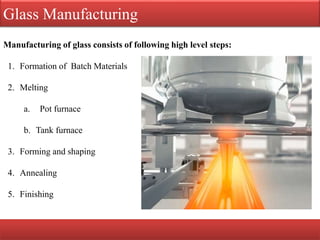
Glass Manufacturing
Manufacturing of glass consists of following high level steps:
1. Formation of Batch Materials
2. Melting
a. Pot furnace
b. Tank furnace
3. Forming and shaping
4. Annealing
5. Finishing
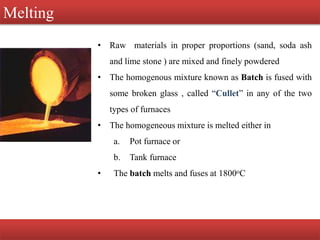
Melting
• Raw materials in proper proportions (sand, soda ash
and lime stone ) are mixed and finely powdered
• The homogenous mixture known as Batch is fused with
some broken glass , called “Cullet” in any of the two
types of furnaces
• The homogeneous mixture is melted either in
a. Pot furnace or
b. Tank furnace
• The batch melts and fuses at 1800oC
8
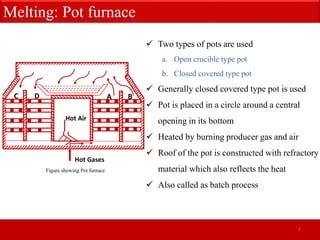
Melting: Pot furnace
Hot Gases
A BDC
Hot Air
Figure showing Pot furnace
 Two types of pots are used
a. Open crucible type pot
b. Closed covered type pot
 Generally closed covered type pot is used
 Pot is placed in a circle around a central
opening in its bottom
 Heated by burning producer gas and air
 Roof of the pot is constructed with refractory
material which also reflects the heat
 Also called as batch process
9
Melting: Tank Furnace
Molten gas
Burning fuel gas
A B C D
Air Fuel gas Fuel gases
Fuel gas and air being
heated by hot checker
work
 The “batch” is melted in the tank using
producer gas and air
 It follows “regenerative system of heat
economy”
 Air and fuel passes through A & B
 The burnt gases are deflected by the roof
and “batch” gets melted
 Hot waste gas escapes through firebricks
C & D
 The direction of the fuel gas & air is reversed through C & D , which absorbs the
heat of the waste gas and burns
 The waste gas now escapes through A & B
Figure showing tank furnace
10
Forming & Shaping, Annealing and Finishing
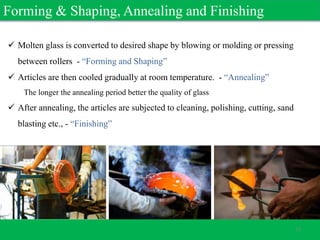
 Molten glass is converted to desired shape by blowing or molding or pressing
between rollers - “Forming and Shaping”
 Articles are then cooled gradually at room temperature. - “Annealing”
The longer the annealing period better the quality of glass
 After annealing, the articles are subjected to cleaning, polishing, cutting, sand
blasting etc., - “Finishing”
Types of glasses
1. Soda-lime or soda glass
2. Potash lime or hard glass
3. Lead glass or Flint glass
4. Borosilicate glass or Pyrex glass or Jena
glass
5. Alumina silicate glass
6. Optical or Crookes glass
7. Glass wool
8. Quartz glass
9. Opal glass
12
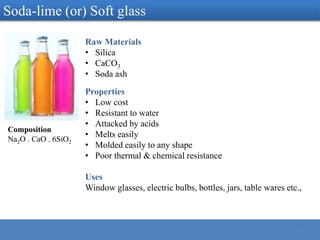
Soda-lime (or) Soft glass
Raw Materials
• Silica
• CaCO3
• Soda ash
Properties
• Low cost
• Resistant to water
• Attacked by acids
• Melts easily
• Molded easily to any shape
• Poor thermal & chemical resistance
Uses
Window glasses, electric bulbs, bottles, jars, table wares etc.,
Composition
Na2O . CaO . 6SiO2
13
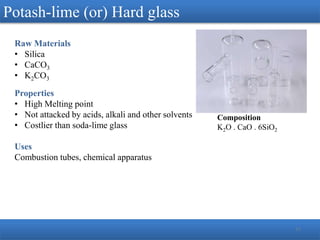
Potash-lime (or) Hard glass
Raw Materials
• Silica
• CaCO3
• K2CO3
Properties
• High Melting point
• Not attacked by acids, alkali and other solvents
• Costlier than soda-lime glass
Uses
Combustion tubes, chemical apparatus
Composition
K2O . CaO . 6SiO2
14
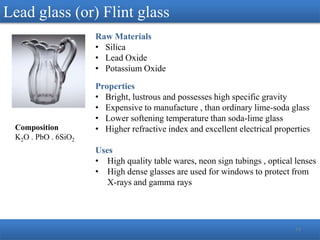
Lead glass (or) Flint glass
Raw Materials
• Silica
• Lead Oxide
• Potassium Oxide
Properties
• Bright, lustrous and possesses high specific gravity
• Expensive to manufacture , than ordinary lime-soda glass
• Lower softening temperature than soda-lime glass
• Higher refractive index and excellent electrical properties
Uses
• High quality table wares, neon sign tubings , optical lenses
• High dense glasses are used for windows to protect from
X-rays and gamma rays
Composition
K2O . PbO . 6SiO2
15
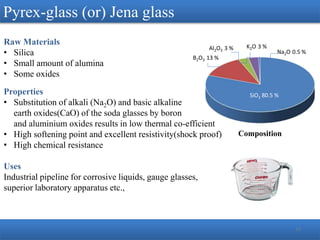
Pyrex-glass (or) Jena glass
Raw Materials
• Silica
• Small amount of alumina
• Some oxides
Properties
• Substitution of alkali (Na2O) and basic alkaline
earth oxides(CaO) of the soda glasses by boron
and aluminium oxides results in low thermal co-efficient
• High softening point and excellent resistivity(shock proof)
• High chemical resistance
Uses
Industrial pipeline for corrosive liquids, gauge glasses,
superior laboratory apparatus etc.,
Composition
SiO2 80.5 %
B2O3 13 %
Al2O3 3 % K2O 3 %
Na2O 0.5 %
16
Alumina Silicate glass
Raw Materials
• 5 % more of alumina
• Addition of alumina makes glass heat resistant
Properties
• Exceptionally high softening temperature
• Chemically durable
• Resistance to hydrolysis
• Affected by moisture due to high surface area
Uses
• High pressure mercury discharge tubes, chemical
combustion tubes, specific domestic equipments
• Fibre glass
Composition
SiO2 55 %
B2O3 7 %
Al2O3 23 %
CaO 5 %
Na2O+ K2O1 %
MgO 9 %
17
Optical, Quartz and Opal Glass
Optical glass Quartz glass Opal glass
Raw Material
• Phosphorous and lead
silicate together with small
amount of cerium oxide
Properties
• Low melting point
• Soft
• Chemical-resistance
• Durability lesser than
ordinary glasses
• Absorbs UV light
Uses
Optical lenses
Raw Material
• Crystalline silica fused at
1900oC
Properties
• Outstanding resistance to
thermal shock and
chemicals
Uses
• Special lab-ware
• Crucibles
• Reaction tubes
Raw Material
• NaF (or) CaF2 (or)
Ca3(PO4)2 (or) SnO2
Properties
• Translucent white or milky
glasses
• Transparent when in liquid
• Opaque when cooled
18
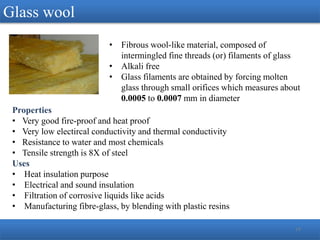
Glass wool
• Fibrous wool-like material, composed of
intermingled fine threads (or) filaments of glass
• Alkali free
• Glass filaments are obtained by forcing molten
glass through small orifices which measures about
0.0005 to 0.0007 mm in diameter
Properties
• Very good fire-proof and heat proof
• Very low electircal conductivity and thermal conductivity
• Resistance to water and most chemicals
• Tensile strength is 8X of steel
Uses
• Heat insulation purpose
• Electrical and sound insulation
• Filtration of corrosive liquids like acids
• Manufacturing fibre-glass, by blending with plastic resins

Glass

  • 1.
  • 2.
    Contents:  Introduction  Generalproperties of glass  Raw materials of glass  Glass manufacturing  Melting • Pot furnace • Tank furnace  Forming and Shaping  Annealing  Finishing  Types of glasses and their properties
  • 3.
    Introduction • Glass isan amorphous, hard, brittle, transparent or translucent, super- cooled liquid, obtained by fusing a mixture of a number of metallic silicates, most commonly Na, K,Ca and Pb”. It possesses no sharp melting point, crystalline structure and definite formula Represented as : xR2O. yMO. 6SiO2 R = monovalent alkali metals like Na,K M = Divalent metals like Ca, Pb,Zn, etc x & y = whole numbers • Approximate composition of ordinary glass(Soda lime glass) is Na2O . CaO . 6SiO2 • In some glasses, SiO2 may be replaced by Al2O3 . B2O3 . P2O5 , etc
  • 4.
    4 General Properties ofglass  Amorphous Solid  No definite melting point  Very brittle  Softens on heating  Can absorb, reflect and transmit light  Good electrical insulator  Affected by alkalis  Not affected by air,water,acid or chemical reagents . But soluble in HF which converts into SiF4  Possesses high compressive strength and since it doesn’t have any crystalline structure , no slippage between planes can occur  Light in weight because it has homogeneous internal structure similar to liquids
  • 5.
    Raw Materials ofGlass: Sodium (Na), 14 Potassiu m (K), 0.3 Calcium (Ca), 9 Barium (Ba), 4 Silica, 70 Others, 2.7 Sodium (Na) Potassium (K) Calcium (Ca) Barium (Ba) Glass Components Sl.No Name of the element Source of the element Name of the glass produced 1 Sodium (Na) Na2CO3,Na2SO4 Soft glass 2 Potassium (K) Potash, K2CO3,KNO3 Hard glass 3 Calcium (Ca) Lime, limestone Glass with high RI 4 Barium (Ba) BaCO3 Glass with high RI 5 Lead Litharge, red lead Flint glass 6 Zinc Zinc Oxide Heat & Shock proof glass 7 Borate Borax, boric acid Heat & shock proof glass 8 Silica Sand, quartz Colors Yellow Ferric Salt Green Ferrous and chromium Blue Cobalt salt
  • 6.
    Glass Manufacturing Manufacturing ofglass consists of following high level steps: 1. Formation of Batch Materials 2. Melting a. Pot furnace b. Tank furnace 3. Forming and shaping 4. Annealing 5. Finishing
  • 7.
    Melting • Raw materialsin proper proportions (sand, soda ash and lime stone ) are mixed and finely powdered • The homogenous mixture known as Batch is fused with some broken glass , called “Cullet” in any of the two types of furnaces • The homogeneous mixture is melted either in a. Pot furnace or b. Tank furnace • The batch melts and fuses at 1800oC
  • 8.
    8 Melting: Pot furnace HotGases A BDC Hot Air Figure showing Pot furnace  Two types of pots are used a. Open crucible type pot b. Closed covered type pot  Generally closed covered type pot is used  Pot is placed in a circle around a central opening in its bottom  Heated by burning producer gas and air  Roof of the pot is constructed with refractory material which also reflects the heat  Also called as batch process
  • 9.
    9 Melting: Tank Furnace Moltengas Burning fuel gas A B C D Air Fuel gas Fuel gases Fuel gas and air being heated by hot checker work  The “batch” is melted in the tank using producer gas and air  It follows “regenerative system of heat economy”  Air and fuel passes through A & B  The burnt gases are deflected by the roof and “batch” gets melted  Hot waste gas escapes through firebricks C & D  The direction of the fuel gas & air is reversed through C & D , which absorbs the heat of the waste gas and burns  The waste gas now escapes through A & B Figure showing tank furnace
  • 10.
    10 Forming & Shaping,Annealing and Finishing  Molten glass is converted to desired shape by blowing or molding or pressing between rollers - “Forming and Shaping”  Articles are then cooled gradually at room temperature. - “Annealing” The longer the annealing period better the quality of glass  After annealing, the articles are subjected to cleaning, polishing, cutting, sand blasting etc., - “Finishing”
  • 11.
    Types of glasses 1.Soda-lime or soda glass 2. Potash lime or hard glass 3. Lead glass or Flint glass 4. Borosilicate glass or Pyrex glass or Jena glass 5. Alumina silicate glass 6. Optical or Crookes glass 7. Glass wool 8. Quartz glass 9. Opal glass
  • 12.
    12 Soda-lime (or) Softglass Raw Materials • Silica • CaCO3 • Soda ash Properties • Low cost • Resistant to water • Attacked by acids • Melts easily • Molded easily to any shape • Poor thermal & chemical resistance Uses Window glasses, electric bulbs, bottles, jars, table wares etc., Composition Na2O . CaO . 6SiO2
  • 13.
    13 Potash-lime (or) Hardglass Raw Materials • Silica • CaCO3 • K2CO3 Properties • High Melting point • Not attacked by acids, alkali and other solvents • Costlier than soda-lime glass Uses Combustion tubes, chemical apparatus Composition K2O . CaO . 6SiO2
  • 14.
    14 Lead glass (or)Flint glass Raw Materials • Silica • Lead Oxide • Potassium Oxide Properties • Bright, lustrous and possesses high specific gravity • Expensive to manufacture , than ordinary lime-soda glass • Lower softening temperature than soda-lime glass • Higher refractive index and excellent electrical properties Uses • High quality table wares, neon sign tubings , optical lenses • High dense glasses are used for windows to protect from X-rays and gamma rays Composition K2O . PbO . 6SiO2
  • 15.
    15 Pyrex-glass (or) Jenaglass Raw Materials • Silica • Small amount of alumina • Some oxides Properties • Substitution of alkali (Na2O) and basic alkaline earth oxides(CaO) of the soda glasses by boron and aluminium oxides results in low thermal co-efficient • High softening point and excellent resistivity(shock proof) • High chemical resistance Uses Industrial pipeline for corrosive liquids, gauge glasses, superior laboratory apparatus etc., Composition SiO2 80.5 % B2O3 13 % Al2O3 3 % K2O 3 % Na2O 0.5 %
  • 16.
    16 Alumina Silicate glass RawMaterials • 5 % more of alumina • Addition of alumina makes glass heat resistant Properties • Exceptionally high softening temperature • Chemically durable • Resistance to hydrolysis • Affected by moisture due to high surface area Uses • High pressure mercury discharge tubes, chemical combustion tubes, specific domestic equipments • Fibre glass Composition SiO2 55 % B2O3 7 % Al2O3 23 % CaO 5 % Na2O+ K2O1 % MgO 9 %
  • 17.
    17 Optical, Quartz andOpal Glass Optical glass Quartz glass Opal glass Raw Material • Phosphorous and lead silicate together with small amount of cerium oxide Properties • Low melting point • Soft • Chemical-resistance • Durability lesser than ordinary glasses • Absorbs UV light Uses Optical lenses Raw Material • Crystalline silica fused at 1900oC Properties • Outstanding resistance to thermal shock and chemicals Uses • Special lab-ware • Crucibles • Reaction tubes Raw Material • NaF (or) CaF2 (or) Ca3(PO4)2 (or) SnO2 Properties • Translucent white or milky glasses • Transparent when in liquid • Opaque when cooled
  • 18.
    18 Glass wool • Fibrouswool-like material, composed of intermingled fine threads (or) filaments of glass • Alkali free • Glass filaments are obtained by forcing molten glass through small orifices which measures about 0.0005 to 0.0007 mm in diameter Properties • Very good fire-proof and heat proof • Very low electircal conductivity and thermal conductivity • Resistance to water and most chemicals • Tensile strength is 8X of steel Uses • Heat insulation purpose • Electrical and sound insulation • Filtration of corrosive liquids like acids • Manufacturing fibre-glass, by blending with plastic resins