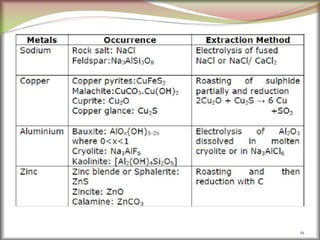
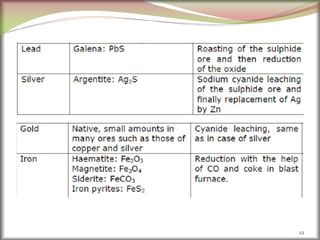
1
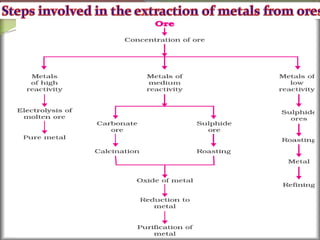
2
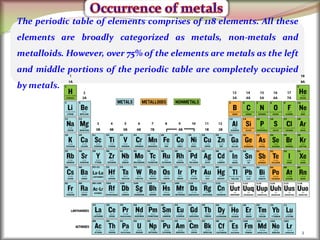
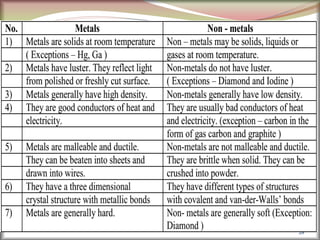
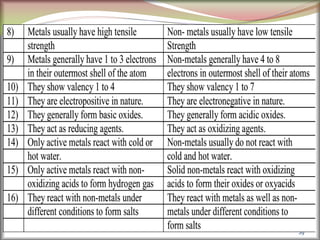
The periodic table of elements comprises of 118 elements. All these
elements are broadly categorized as metals, non-metals and
metalloids. However, over 75% of the elements are metals as the left
and middle portions of the periodic table are completely occupied
by metals.
3
4
5
6
7
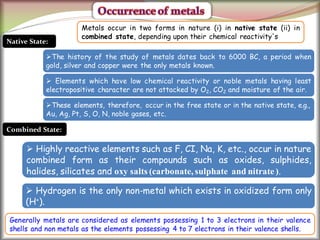
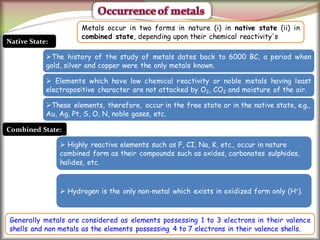
Native State:
The history of the study of metals dates back to 6000 BC, a period when
gold, silver and copper were the only metals known.
 Elements which have low chemical reactivity or noble metals having least
electropositive character are not attacked by O2, CO2 and moisture of the air.
These elements, therefore, occur in the free state or in the native state, e.g.,
Au, Ag, Pt, S, O, N, noble gases, etc.
Combined State:
 Highly reactive elements such as F, CI, Na, K, etc., occur in nature
combined form as their compounds such as oxides, sulphides,
halides, silicates and oxy salts (carbonate, sulphate and nitrate).
 Hydrogen is the only non-metal which exists in oxidized form only
(H+).
Metals occur in two forms in nature (i) in native state (ii) in
combined state, depending upon their chemical reactivity's
Generally metals are considered as elements possessing 1 to 3 electrons in their valence
shells and non metals as the elements possessing 4 to 7 electrons in their valence shells.
8
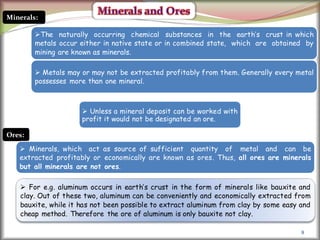
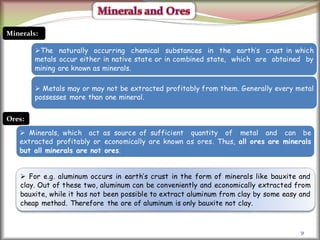
Minerals:
The naturally occurring chemical substances in the earth’s crust in which
metals occur either in native state or in combined state, which are obtained by
mining are known as minerals.
 Metals may or may not be extracted profitably from them. Generally every metal
possesses more than one mineral.
Ores:
 Minerals, which act as source of sufficient quantity of metal and can be
extracted profitably or economically are known as ores. Thus, all ores are minerals
but all minerals are not ores.
 For e.g. aluminum occurs in earth’s crust in the form of minerals like bauxite and
clay. Out of these two, aluminum can be conveniently and economically extracted from
bauxite, while it has not been possible to extract aluminum from clay by some easy and
cheap method. Therefore the ore of aluminum is only bauxite not clay.
9
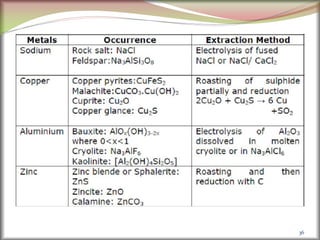
Metals occur mostly as there oxides, carbonates, sulphides, halides, silicates ,sulphates,
and phosphate minerals.
10
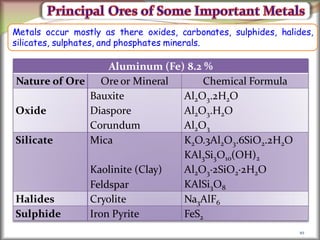
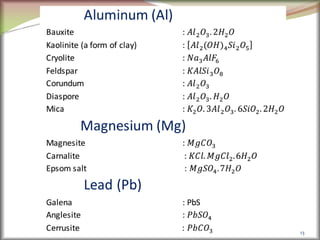
Metals occur mostly as there oxides, carbonates, sulphides, halides,
silicates, sulphates, and phosphates minerals.
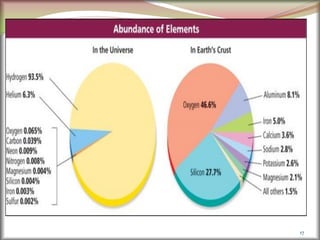
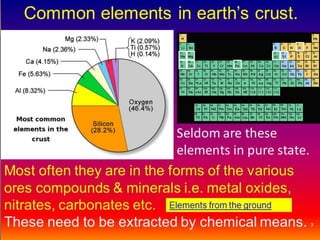
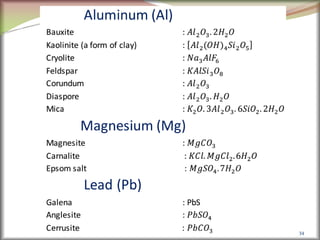
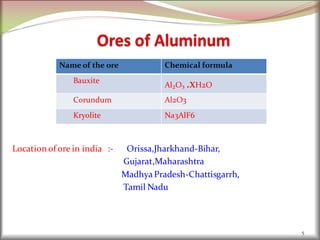
Aluminum (Fe) 8.2 %
Nature of Ore Ore or Mineral Chemical Formula
Oxide
Bauxite
Diaspore
Corundum
Al2O3.2H2O
Al2O3.H2O
Al2O3
Silicate Mica
Kaolinite (Clay)
Feldspar
K2O.3Al2O3.6SiO2.2H2O
KAl3Si3O10(OH)2
Al2O3·2SiO2·2H2O
KAlSi3O8
Halides Cryolite Na3AlF6
Sulphide Iron Pyrite FeS2
11
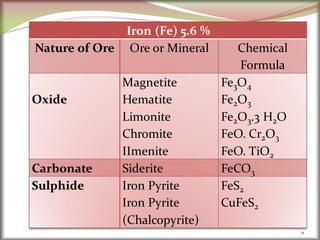
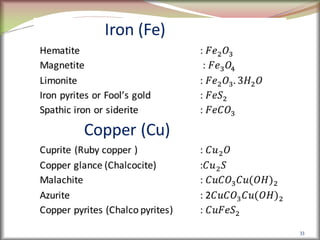
Iron (Fe) 5.6 %
Nature of Ore Ore or Mineral Chemical
Formula
Oxide
Magnetite
Hematite
Limonite
Chromite
IImenite
Fe3O4
Fe2O3
Fe2O3.3 H2O
FeO. Cr2O3
FeO. TiO2
Carbonate Siderite FeCO3
Sulphide Iron Pyrite
Iron Pyrite
(Chalcopyrite)
FeS2
CuFeS2
12
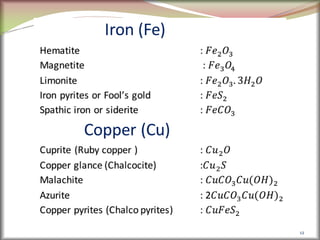
13
14
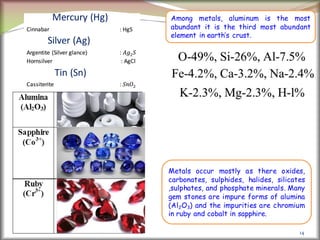
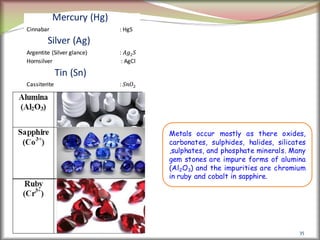
Metals occur mostly as there oxides,
carbonates, sulphides, halides, silicates
,sulphates, and phosphate minerals. Many
gem stones are impure forms of alumina
(Al2O3) and the impurities are chromium
in ruby and cobalt in sapphire.
Among metals, aluminum is the most
abundant it is the third most abundant
element in earth’s crust.
15
16
17
18
19
20
21
22
23
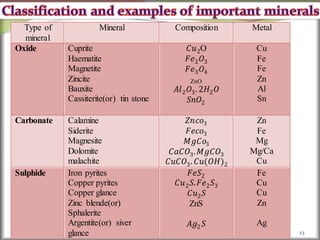
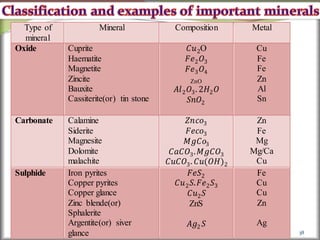
Type of
mineral
Mineral Composition Metal
Oxide Cuprite
Haematite
Magnetite
Zincite
Bauxite
Cassiterite(or) tin stone
𝐶𝑢2O
𝐹𝑒2𝑂3
𝐹𝑒3𝑂4
ZnO
𝐴𝑙2𝑂3. 2𝐻2𝑂
𝑆𝑛𝑂2
Cu
Fe
Fe
Zn
Al
Sn
Carbonate Calamine
Siderite
Magnesite
Dolomite
malachite
𝑍𝑛𝑐𝑜3
𝐹𝑒𝑐𝑜3
𝑀𝑔𝐶𝑜3
𝐶𝑎𝐶𝑂3.𝑀𝑔𝐶𝑂3
𝐶𝑢𝐶𝑂3. 𝐶𝑢(𝑂𝐻)2
Zn
Fe
Mg
Mg/Ca
Cu
Sulphide Iron pyrites
Copper pyrites
Copper glance
Zinc blende(or)
Sphalerite
Argentite(or) siver
glance
𝐹𝑒𝑆2
𝐶𝑢2𝑆.𝐹𝑒2𝑆3
𝐶𝑢2𝑆
ZnS
𝐴𝑔2 𝑆
Fe
Cu
Cu
Zn
Ag
24
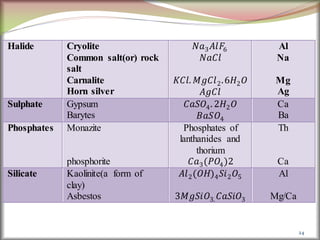
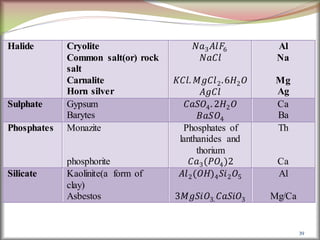
Halide Cryolite
Common salt(or) rock
salt
Carnalite
Horn silver
𝑁𝑎3𝐴𝑙𝐹6
𝑁𝑎𝐶𝑙
𝐾𝐶𝑙. 𝑀𝑔𝐶𝑙2.6𝐻2𝑂
𝐴𝑔𝐶𝑙
Al
Na
Mg
Ag
Sulphate Gypsum
Barytes
𝐶𝑎𝑆𝑂4. 2𝐻2𝑂
𝐵𝑎𝑆𝑂4
Ca
Ba
Phosphates Monazite
phosphorite
Phosphates of
lanthanides and
thorium
𝐶𝑎3(𝑃𝑂4)2
Th
Ca
Silicate Kaolinite(a form of
clay)
Asbestos
𝐴𝑙2(𝑂𝐻)4𝑆𝑖2𝑂5
3𝑀𝑔𝑆𝑖𝑂3. 𝐶𝑎𝑆𝑖𝑂3
Al
Mg/Ca
25
26
In moist air copper corrodes to produce a green layer on the surface.
What is that layer?
Copper, in the presence of moisture, oxygen and carbon dioxide of
atmosphere, is converted into a basic carbonate, called malachite of
composition,CuCo3.Cu(OH)2.This basic carbonate is deposited as
green layer on its surface.
Metal sulphides occur mainly in rocks, but metal halides occur in lakes
and sea. Why?
Metal sulphides have high lattice energy and hence low solubility,
which can remain in rocks. [Sodium and potassium sulphides are
soluble in water so these do not occur in rocks.] But metal halides
have low lattice energy and are generally soluble in water and so
have dissolved out of the rocks and into the lakes/seas over time.
27
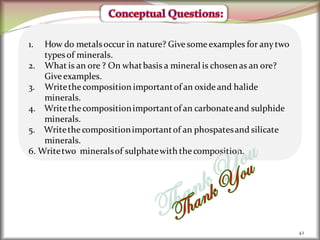
1. How do metalsoccur in nature? Give some examples for anytwo
typesof minerals.
2. What is an ore ? On whatbasis a mineral is chosen as an ore?
Give examples.
3. Writethe composition importantof an oxide and halide
minerals.
4. Write the compositionimportantof an carbonateand sulphide
minerals.
5. Writethe compositionimportantof an phospatesand silicate
minerals.
6. Writetwo mineralsof sulphatewith the composition.
1
2
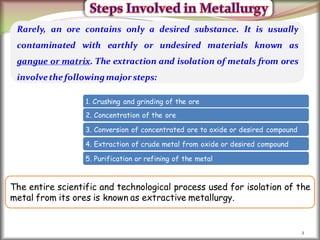
Rarely, an ore contains only a desired substance. It is usually
contaminated with earthly or undesired materials known as
gangue or matrix. The extraction and isolation of metals from ores
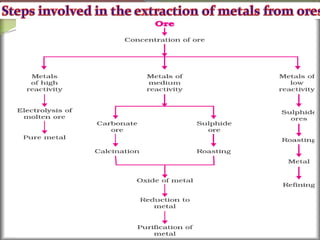
involvethe followingmajor steps:
1. Crushing and grinding of the ore
2. Concentration of the ore
3. Conversion of concentrated ore to oxide or desired compound
4. Extraction of crude metal from oxide or desired compound
5. Purification or refining of the metal
The entire scientific and technological process used for isolation of the
metal from its ores is known as extractive metallurgy.
3
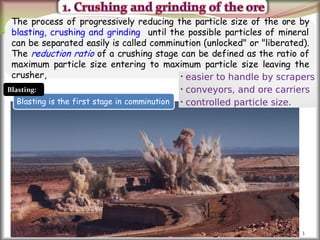
The process of progressively reducing the particle size of the ore by
blasting, crushing and grinding until the possible particles of mineral
can be separated easily is called comminution (unlocked" or "liberated).
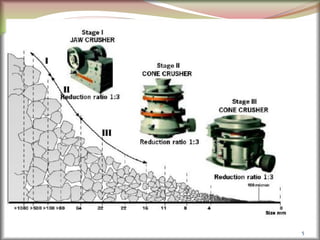
The reduction ratio of a crushing stage can be defined as the ratio of
maximum particle size entering to maximum particle size leaving the
crusher,
Blasting is the first stage in comminution
Blasting:
4
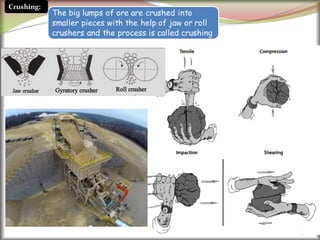
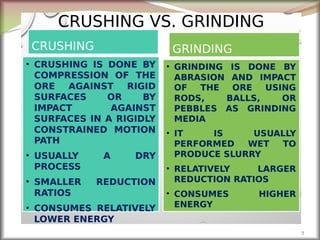
The big lumps of ore are crushed into
smaller pieces with the help of jaw or roll
crushers and the process is called crushing
Crushing:
5
6
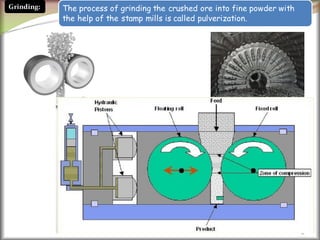
The process of grinding the crushed ore into fine powder with
the help of the stamp mills is called pulverization.
Grinding:
7
8
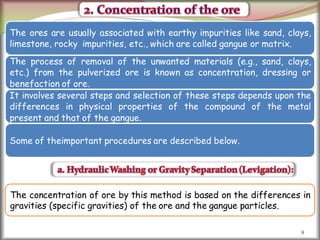
The ores are usually associated with earthy impurities like sand, clays,
limestone, rocky impurities, etc., which are called gangue or matrix.
The process of removal of the unwanted materials (e.g., sand, clays,
etc.) from the pulverized ore is known as concentration, dressing or
benefaction of ore.
It involves several steps and selection of these steps depends upon the
differences in physical properties of the compound of the metal
present and that of the gangue.
Some of theimportant procedures are described below.
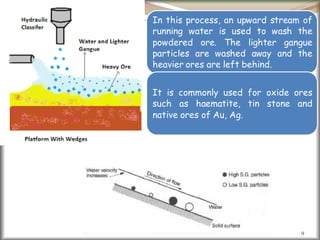
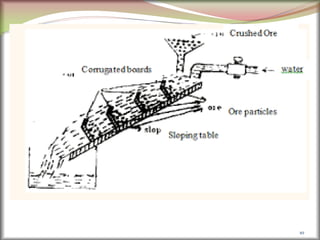
The concentration of ore by this method is based on the differences in
gravities (specific gravities) of the ore and the gangue particles.
9
In this process, an upward stream of
running water is used to wash the
powdered ore. The lighter gangue
particles are washed away and the
heavier ores are left behind.
It is commonly used for oxide ores
such as haematite, tin stone and
native ores of Au, Ag.
10
11
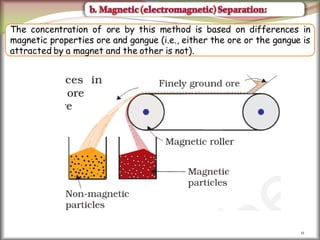
The concentration of ore by this method is based on differences in
magnetic properties ore and gangue (i.e., either the ore or the gangue is
attracted by a magnet and the other is not).
12
 In this method the powdered ore is placed over a leather (rubber) belt
which moves over two rollers (pulleys) one of which is a strong magnetic.
 As the mass passes over the magnetic roller, the magnetic particles are
attracted by it and fall very nearer to it while non magnetic particles fall
away from the magnetic roller as shown in figure.
 For example, cassiterite (SnO2, (tin stone, an ore of tin) which is
non-magnetic, is separated from impurities of ferrous tungstate or
wolframite (FeWO4) , which is magnetic.
 Rutile TiO2 (magnetic) and chlorapatite 3Ca(PO4)2.CaCl2 (non
magnetic) are also separated by this method.
 Similarly chromite (FeCr2O4), an ore of chromium, magnetite (Fe3O4)
an ore of iron ( silica is non magnetic) and pyrolusite (MnO2) an ore of
manganese, all being magnetic are separated from non-magnetic gangue
by this process.
13
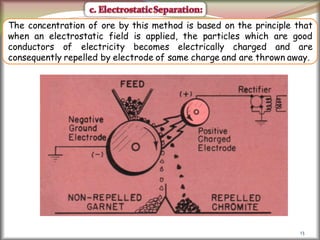
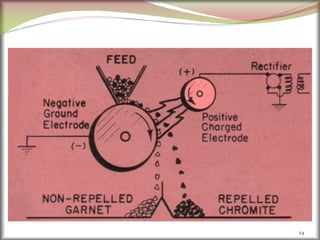
The concentration of ore by this method is based on the principle that
when an electrostatic field is applied, the particles which are good
conductors of electricity becomes electrically charged and are
consequently repelled by electrode of same charge and are thrown away.
14
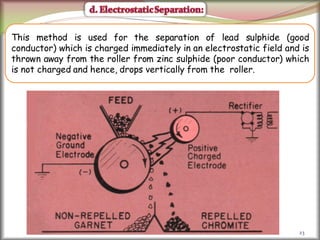
 This method is used for the concentration of PbS and ZnS ores
occurring together in nature.
 The powdered ore is fed up on a roller in a thin layer and
subjected to the influence of an electrostatic field.
 Lead sulphide being a good conductor, gets charged
immediately and is thrown away from the roller.
 ZnS being a poor conductor of electricity, falls vertically
from the roller.
15
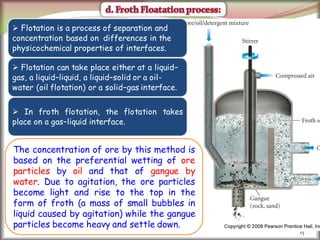
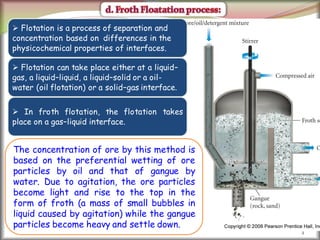
 Flotation is a process of separation and
concentration based on differences in the
physicochemical properties of interfaces.
 Flotation can take place either at a liquid–
gas, a liquid–liquid, a liquid–solid or a oil-
water (oil flotation) or a solid–gas interface.
 In froth flotation, the flotation takes
place on a gas–liquid interface.
The concentration of ore by this method is
based on the preferential wetting of ore
particles by oil and that of gangue by
water. Due to agitation, the ore particles
become light and rise to the top in the
form of froth (a mass of small bubbles in
liquid caused by agitation) while the gangue
particles become heavy and settle down.
16
17
 Froth floatation process is used for the concentration of sulphide ores
like galena, zinc blende, cinnabar, copper pyrites, iron pyrites etc. The
sulphide ores are having lower density than impurities.
 Sometimes, it is possible to separate two sulphide ores by adjusting
proportion of oil to water or by using ‘depressants’.
 A depressants is a chemical substance (NaCN or KCN), which prevent
certain type of particles from forming froth during froth floatation process.
 In froth floatation process, depressants (NaCN) helps to separate two
sulphide ores (zinc blende) by selective prevention of froth formation by one
ore (ZnS) and allowing the other (PbS) to come into froth.
 A depressants is a chemical substance (NaCN), which prevent certain type
of particles from forming froth during froth floatation process.
 A depressants is a chemical substance (NaCN), which prevent certain type
of particles from forming froth during froth floatation process.
18
 Froth floatation process is used for the concentration of sulphide ores
like galena, zinc blende, cinnabar, copper pyrites, iron pyrites etc. The
sulphide ores are having lower density than impurities.
 Sometimes, it is possible to separate two sulphide ores by adjusting
proportion of oil to water or by using ‘depressants’.
 A depressants is a chemical substance (NaCN or KCN), which prevent
certain type of particles from forming froth during froth floatation process.
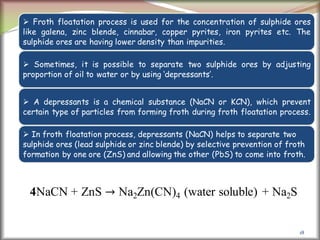
 In froth floatation process, depressants (NaCN) helps to separate two
sulphide ores (lead sulphide or zinc blende) by selective prevention of froth
formation by one ore (ZnS) and allowing the other (PbS) to come into froth.
4NaCN + ZnS → Na2Zn(CN)4 (water soluble) + Na2S
19
 Froth floatation process is used for the concentration of sulphide ores
like galena, zinc blende, cinnabar, copper pyrites, iron pyrites etc. The
sulphide ores are having lower density than impurities.
 Sometimes, it is possible to separate two sulphide ores by adjusting
proportion of oil to water or by using ‘depressants’.
 A depressants is a chemical substance (NaCN or KCN), which prevent
certain type of particles from forming froth during froth floatation process.
 In froth floatation process, depressants (NaCN) helps to separate two
sulphide ores (zinc blende) by selective prevention of froth formation by one
ore (ZnS) and allowing the other (PbS) to come into froth.
 A depressants is a chemical substance (NaCN), which prevent certain type
of particles from forming froth during froth floatation process.
 A depressants is a chemical substance (NaCN), which prevent certain type
of particles from forming froth during froth floatation process.
20
In froth floatation process,depressants
helps to separate two sulphide ores by
selective prevention of froth formation by
one ore and allowing the other to come into
froth. For example, in order to separate two
sulphide ores (ZnS and Pbs), NaCN is
used as a depressant. It selectively allows
PbS form froth, but prevents ZnS
21
22
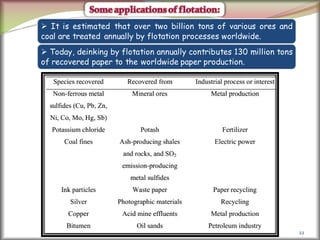
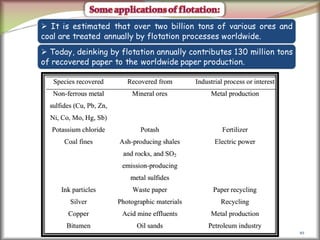
 It is estimated that over two billion tons of various ores and
coal are treated annually by flotation processes worldwide.
 Today, deinking by flotation annually contributes 130 million tons
of recovered paper to the worldwide paper production.
23
This method is used for the separation of lead sulphide (good
conductor) which is charged immediately in an electrostatic field and is
thrown away from the roller from zinc sulphide (poor conductor) which
is not charged and hence, drops vertically from the roller.
24
25
https://books.google.co.in/books?id=ySY8
BAAAQBAJ&pg=SA8-PA27&lpg=SA8-
PA27&dq=Na2Zn(CN)4&source=bl&ots=-
HI2YAPmLh&sig=2kFmsC5KuYBET8OluA
WKyF4k0Mk&hl=en&sa=X&ved=0ahUKEw
jJr-
LXvIzZAhXFwI8KHSu_BAYQ6AEISTAG#v
=onepage&q=Na2Zn(CN)4&f=false
26
 Cu+, Cu2+, Ag+ being soft acids, which can easily combine with soft bases S-
2. that is why sulphides of Cu and Ag are more stable.
 Sometimes, it is possible to separate two sulphide ores by adjusting
proportion of oil to water or by using ‘depressants’.
 A depressants is a chemical substance (NaCN or KCN), which prevent
certain type of particles from forming froth during froth floatation process.
 In froth floatation process, depressants (NaCN) helps to separate two
sulphide ores (zinc blende) by selective prevention of froth formation by one
ore (ZnS) and allowing the other (PbS) to come into froth.
 A depressants is a chemical substance (NaCN), which prevent certain type
of particles from forming froth during froth floatation process.
 A depressants is a chemical substance (NaCN), which prevent certain type
of particles from forming froth during froth floatation process.
27
28
29
30
Native State:
The history of the study of metals dates back to 6000 BC, a period when
gold, silver and copper were the only metals known.
 Elements which have low chemical reactivity or noble metals having least
electropositive character are not attacked by O2, CO2 and moisture of the air.
These elements, therefore, occur in the free state or in the native state, e.g.,
Au, Ag, Pt, S, O, N, noble gases, etc.
Combined State:
 Highly reactive elements such as F, CI, Na, K, etc., occur in nature
combined form as their compounds such as oxides, carbonates sulphides,
halides, etc.
 Hydrogen is the only non-metal which exists in oxidized form only (H+).
Metals occur in two forms in nature (i) in native state (ii) in
combined state, depending upon their chemical reactivity's
Generally metals are considered as elements possessing 1 to 3 electrons in their valence
shells and non metals as the elements possessing 4 to 7 electrons in their valence shells.
31
Minerals:
The naturally occurring chemical substances in the earth’s crust in which
metals occur either in native state or in combined state, which are obtained by
mining are known as minerals.
 Metals may or may not be extracted profitably from them. Generally every metal
possesses more than one mineral.
Ores:
 Minerals, which act as source of sufficient quantity of metal and can be
extracted profitably or economically are known as ores. Thus, all ores are minerals
but all minerals are not ores.
 For e.g. aluminum occurs in earth’s crust in the form of minerals like bauxite and
clay. Out of these two, aluminum can be conveniently and economically extracted from
bauxite, while it has not been possible to extract aluminum from clay by some easy and
cheap method. Therefore the ore of aluminum is only bauxite not clay.
32
Metals occur mostly as there oxides, carbonates, sulphides, halides, silicates ,sulphates,
and phosphate minerals.
33
34
35
Metals occur mostly as there oxides,
carbonates, sulphides, halides, silicates
,sulphates, and phosphate minerals. Many
gem stones are impure forms of alumina
(Al2O3) and the impurities are chromium
in ruby and cobalt in sapphire.
36
37
38
Type of
mineral
Mineral Composition Metal
Oxide Cuprite
Haematite
Magnetite
Zincite
Bauxite
Cassiterite(or) tin stone
𝐶𝑢2O
𝐹𝑒2𝑂3
𝐹𝑒3𝑂4
ZnO
𝐴𝑙2𝑂3. 2𝐻2𝑂
𝑆𝑛𝑂2
Cu
Fe
Fe
Zn
Al
Sn
Carbonate Calamine
Siderite
Magnesite
Dolomite
malachite
𝑍𝑛𝑐𝑜3
𝐹𝑒𝑐𝑜3
𝑀𝑔𝐶𝑜3
𝐶𝑎𝐶𝑂3.𝑀𝑔𝐶𝑂3
𝐶𝑢𝐶𝑂3. 𝐶𝑢(𝑂𝐻)2
Zn
Fe
Mg
Mg/Ca
Cu
Sulphide Iron pyrites
Copper pyrites
Copper glance
Zinc blende(or)
Sphalerite
Argentite(or) siver
glance
𝐹𝑒𝑆2
𝐶𝑢2𝑆.𝐹𝑒2𝑆3
𝐶𝑢2𝑆
ZnS
𝐴𝑔2 𝑆
Fe
Cu
Cu
Zn
Ag
39
Halide Cryolite
Common salt(or) rock
salt
Carnalite
Horn silver
𝑁𝑎3𝐴𝑙𝐹6
𝑁𝑎𝐶𝑙
𝐾𝐶𝑙. 𝑀𝑔𝐶𝑙2.6𝐻2𝑂
𝐴𝑔𝐶𝑙
Al
Na
Mg
Ag
Sulphate Gypsum
Barytes
𝐶𝑎𝑆𝑂4. 2𝐻2𝑂
𝐵𝑎𝑆𝑂4
Ca
Ba
Phosphates Monazite
phosphorite
Phosphates of
lanthanides and
thorium
𝐶𝑎3(𝑃𝑂4)2
Th
Ca
Silicate Kaolinite(a form of
clay)
Asbestos
𝐴𝑙2(𝑂𝐻)4𝑆𝑖2𝑂5
3𝑀𝑔𝑆𝑖𝑂3. 𝐶𝑎𝑆𝑖𝑂3
Al
Mg/Ca
40
41
In moist air copper corrodes to produce a green layer on the surface.
What is that layer?
Copper, in the presence of moisture, oxygen and carbon dioxide of
atmosphere, is converted into a basic carbonate, called malachite of
composition,CuCo3.Cu(OH)2.This basic carbonate is deposited as
green layer on its surface.
Metal sulphides occur mainly in rocks, but metal halides occur in lakes
and sea. Why?
Metal sulphides have high lattice energy and hence low solubility,
which can remain in rocks. [Sodium and potassium sulphides are
soluble in water so these do not occur in rocks.] But metal halides
have low lattice energy and are generally soluble in water and so
have dissolved out of the rocks and into the lakes/seas over time.
42
1. How do metalsoccur in nature? Give some examples for anytwo
typesof minerals.
2. What is an ore ? On whatbasis a mineral is chosen as an ore?
Give examples.
3. Writethe composition importantof an oxide and halide
minerals.
4. Write the compositionimportantof an carbonateand sulphide
minerals.
5. Writethe compositionimportantof an phospatesand silicate
minerals.
6. Writetwo mineralsof sulphatewith the composition.
1
2
 Flotation is a process of separation and
concentration based on differences in the
physicochemical properties of interfaces.
 Flotation can take place either at a liquid–
gas, a liquid–liquid, a liquid–solid or a oil-
water (oil flotation) or a solid–gas interface.
 In froth flotation, the flotation takes
place on a gas–liquid interface.
The concentration of ore by this method is
based on the preferential wetting of ore
particles by oil and that of gangue by
water. Due to agitation, the ore particles
become light and rise to the top in the
form of froth (a mass of small bubbles in
liquid caused by agitation) while the gangue
particles become heavy and settle down.
3
4
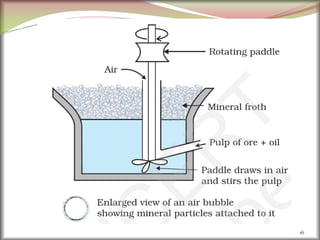
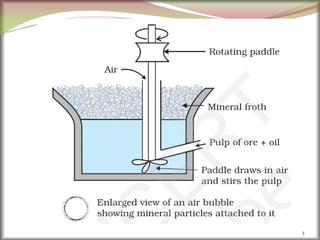
 In this process, a suspension of the powdered ore is made with water in a
large tank called the fort floatation cell as shown in figure. To it, collectors
and froth stabilizers are added. The mineral particles become wet by oils
while the gangue particles by water.
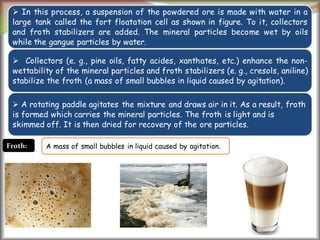
 Collectors (e. g., pine oils, fatty acides, xanthates, etc.) enhance the non-
wettability of the mineral particles and froth stabilizers (e. g., cresols, aniline)
stabilize the froth (a mass of small bubbles in liquid caused by agitation).
 A rotating paddle agitates the mixture and draws air in it. As a result, froth
is formed which carries the mineral particles. The froth is light and is
skimmed off. It is then dried for recovery of the ore particles.
Froth: A mass of small bubbles in liquid caused by agitation.
5
6
 In this process, a suspension of the powdered ore is made with water
in a large tank called the fort floatation cell as shown in figure. To it,
collectors and froth stabilizers are added.
 Collectors (e. g., pine oils, fatty acids, xanthates, etc.) enhance non-
wettability of the mineral particles and froth stabilisers
(e. g., cresols, aniline) stabilise the froth.. .
 This provides the thermodynamic requirement for the particles to bind to
the surface of a bubble (i.e.to make the ore water repellant
). They function as surfactants to selectively isolate and aid adsorption
between the particles of interest and bubbles rising through the slurry.
 In froth floatation process, depressants (NaCN) helps to separate two
sulphide ores (zinc blende) by selective prevention of froth formation by one
ore ( sphalerite, ZnS) and allowing the other (PbS) to come into froth.
 A depressants is a chemical substance (NaCN), which prevent certain type
of particles from forming froth during froth floatation process.
 Froth flotation is a process for selectively separating hydrophobic
materials from hydrophilic. Particles that can be easily wetted by water are
called hydrophilic, while particles that are not easily wetted by water are
called hydrophobic. Hydrophobic particles have a tendency to form a
separate phase in aqueous media.
7
 In this process, a suspension of the powdered ore is made with water
in a large tank called the fort floatation cell as shown in figure. To it,
collectors and froth stabilizers are added.
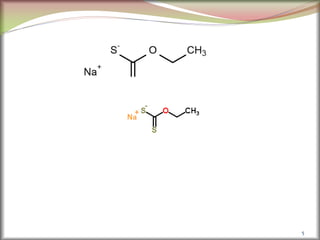
 A collectors are organic compounds, which increases the hydrophobic
nature of ore like pine oil or olive oil, frothing agent like sodium ethyl
xanthate (C3H5NaOS2) and froth stabilizers like cresol or aniline are added.
.
 This provides the thermodynamic requirement for the particles to bind to
the surface of a bubble. They function as surfactants to selectively isolate
and aid adsorption between the particles of interest and bubbles rising
through the slurry.
 In froth floatation process, depressants (NaCN) helps to separate two
sulphide ores (zinc blende) by selective prevention of froth formation by one
ore ( sphalerite, ZnS) and allowing the other (PbS) to come into froth.
 A depressants is a chemical substance (NaCN), which prevent certain type
of particles from forming froth during froth floatation process.
 Froth flotation is a process for selectively separating hydrophobic
materials from hydrophilic. Particles that can be easily wetted by water are
called hydrophilic, while particles that are not easily wetted by water are
called hydrophobic. Hydrophobic particles have a tendency to form a
separate phase in aqueous media.
8
 Froth floatation process is used for the concentration of sulphide ores like
galena, zinc blende, cinnabar, copper pyrites, iron pyrites etc. The sulphide ores
are having lower density than impurities.
 Sometimes, it is possible to separate two sulphide ores by adjusting proportion
of oil to water or by using ‘depressants’.
 A depressants is a chemical substance (NaCN or KCN), which prevent certain
type of particles from forming froth during froth floatation process.
 In froth floatation process, depressants (NaCN) helps to separate mixture two
sulphide ores (galena or zinc blende) by selective prevention of froth formation
by one ore (sphalerite, ZnS) and allowing the other (galena, PbS) to come into
froth.
4NaCN + ZnS → Na2Zn(CN)4 (water soluble) + Na2S
9
10
 It is estimated that over two billion tons of various ores and
coal are treated annually by flotation processes worldwide.
 Today, deinking by flotation annually contributes 130 million tons
of recovered paper to the worldwide paper production.
11
1
2
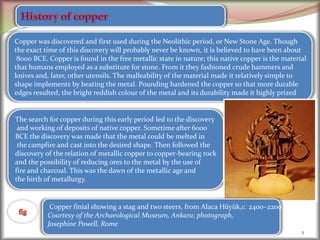
Copper was discovered and first used during the Neolithic period, or New Stone Age. Though
the exact time of this discovery will probably never be known, it is believed to have been about
8000 BCE. Copper is found in the free metallic state in nature; this native copper is the material
that humans employed as a substitute for stone. From it they fashioned crude hammers and
knives and, later, other utensils. The malleability of the material made it relatively simple to
shape implements by beating the metal. Pounding hardened the copper so that more durable
edges resulted; the bright reddish colour of the metal and its durability made it highly prized
The search for copper during this early period led to the discovery
and working of deposits of native copper. Sometime after 6000
BCE the discovery was made that the metal could be melted in
the campfire and cast into the desired shape. Then followed the
discovery of the relation of metallic copper to copper-bearing rock
and the possibility of reducing ores to the metal by the use of
fire and charcoal. This was the dawn of the metallic age and
the birth of metallurgy.
Copper finial showing a stag and two steers, from Alaca Hüyük,c. 2400–2200
Courtesy of the Archaeological Museum, Ankara; photograph,
Josephine Powell, Rome
3
The early development of copper probably was most advanced in Egypt. As early as 5000 BCE,
copper weapons and implements were left in graves for the use of the dead. Definite records have
been found of the working of copper mines on the Sinai Peninsula about 3800 BCE, and the
discovery of crucibles at these mines indicates that the art of extracting the metal included some
refining. Copper was hammered into thin sheets, and the sheets were formed into pipes and other
objects. During this period bronze first appeared. The oldest known piece of this material is a
bronze rod found in the pyramid at Maydūm (Medum), near Memphis in Egypt, the date of origin
being generally accepted as about 3700 BCE.
Bronze, an alloy of copper and tin, is both harder and tougher than either; it was widely employed
to fashion weapons and objects of art. The period of its extensive and characteristic use has been
designated the Bronze Age. From Egypt the use of bronze rapidly spread over the Mediterranean
area: to Crete in 3000 BCE, to Sicily in 2500 BCE, to France and other parts of Europe in 2000 BCE,
and to Britain and the Scandinavian area in 1800 BCE.
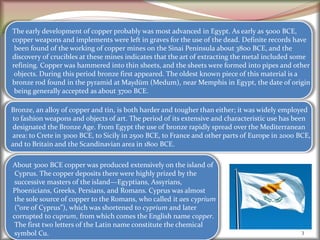
About 3000 BCE copper was produced extensively on the island of
Cyprus. The copper deposits there were highly prized by the
successive masters of the island—Egyptians, Assyrians,
Phoenicians, Greeks, Persians, and Romans. Cyprus was almost
the sole source of copper to the Romans, who called it aes cyprium
(“ore of Cyprus”), which was shortened to cyprium and later
corrupted to cuprum, from which comes the English name copper.
The first two letters of the Latin name constitute the chemical
symbol Cu.
4
When copper and bronze were first used in Asia is not known. The epics of
the Shujing mention the use of copper in China as early as 2500 BCE,
but nothing is known of the state of the art at that time or of the use of
the metal prior to that time. Bronze vessels of great beauty made during
the Shang dynasty, 1766–1122 BCE, have been found, indicating an
advanced art. The source of the metals, however, is unknown.
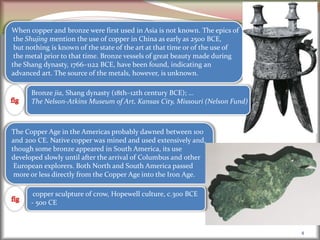
Bronze jia, Shang dynasty (18th–12th century BCE); …
The Nelson-Atkins Museum of Art, Kansas City, Missouri (Nelson Fund)
The Copper Age in the Americas probably dawned between 100
and 200 CE. Native copper was mined and used extensively and,
though some bronze appeared in South America, its use
developed slowly until after the arrival of Columbus and other
European explorers. Both North and South America passed
more or less directly from the Copper Age into the Iron Age.
copper sculpture of crow, Hopewell culture, c.300 BCE
- 500 CE
5
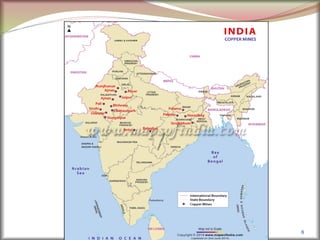
In India, the first record of copper occurrence was made by W. Jones in 1829 and that was in
Singbhum, Jharkhand stat
But the existence was definitely established by J.C. Haughton in 1854 when he came across
some old workings. This led to the first mining of copper in 1857 by Singbhum Copper Company
The Egyptians used the ankh symbol to denote copper in their system of hieroglyphs.
It also represented eternal life.
Copper is one of the oldest metals known to civilization. Its uses and contributions continue
to grow.
Copper is a vital and positive contributor to humankind and has improved our quality
of life for centuries.
Copper is the only metal other than gold that has natural color. Other metals are either gray
or white
Over 400 copper alloys are in use today. Brass is an alloy of copper and zinc. Bronze is an alloy
of copper and tin, aluminum, silicon, and beryllium
Copper is vital to the health of humans, animals and plants and an essential part of the human
diet. Copper-rich foods include dried beans, almonds, broccoli, chocolate, garlic, soybeans,
peas, whole wheat products, and seafood.
Copper maximizes the performance of the products that contain it, helping save energy,
CO2, money and lives.
6
As man learned to fashion weapons from iron and steel, copper began to assume another role.
Being a durable metal and possessed of great beauty, it was used extensively for household
utensils and water pipes and for marine uses and other purposes that required resistance to
corrosion. The unusual ability of this metal to conduct electric current accounts for its
greatest use today.
Property Details
Symbol Cu
Atomic number 29
Standard Atomic weight 63.546
Electronic Configuration [Ar] 3d¹⁰4s¹
Crystal structure FCC
Density 8.96 g/cc
Melting point 1084.32°C (1357.77K)
Boiling point 2562°C (2835K)
Heat of fusion 13.26 KJ/mol
Thermal conductivity 401 W/m K
Electrical conductivity 5.96×10¹⁰ S/m at 20°C
Poisson ration 0.34
7
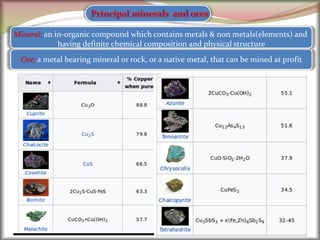
Ore; a metal bearing mineral or rock, or a native metal, that can be mined at profit
Mineral; an in-organic compound which contains metals & non metals(elements) and
having definite chemical composition and physical structure
8
9
2) Oxidized minerals
1) Copper-iron-sulfide and
Copper sulfide minerals
3) A third major source of copper is scrap copper and copper alloys.
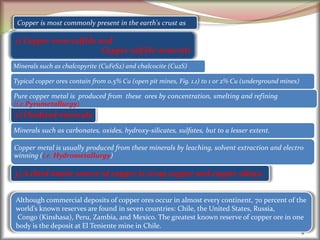
Copper is most commonly present in the earth's crust as
Minerals such as chalcopyrite (CuFeS2) and chalcocite (Cu2S)
Pure copper metal is produced from these ores by concentration, smelting and refining
(i.e.Pyrometallurgy)
Minerals such as carbonates, oxides, hydroxy-silicates, sulfates, but to a lesser extent.
Copper metal is usually produced from these minerals by leaching, solvent extraction and electro
winning (i.e. Hydrometallurgy)
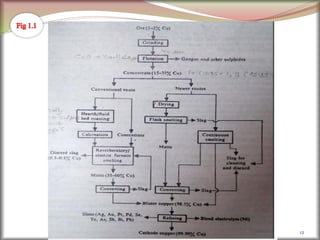
Typical copper ores contain from 0.5% Cu (open pit mines, Fig. 1.1) to 1 or 2% Cu (underground mines)
Although commercial deposits of copper ores occur in almost every continent, 70 percent of the
world’s known reserves are found in seven countries: Chile, the United States, Russia,
Congo (Kinshasa), Peru, Zambia, and Mexico. The greatest known reserve of copper ore in one
body is the deposit at El Teniente mine in Chile.
10
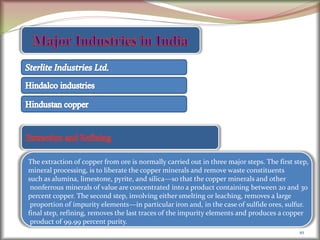
The extraction of copper from ore is normally carried out in three major steps. The first step,
mineral processing, is to liberate the copper minerals and remove waste constituents
such as alumina, limestone, pyrite, and silica—so that the copper minerals and other
nonferrous minerals of value are concentrated into a product containing between 20 and 30
percent copper. The second step, involving either smelting or leaching, removes a large
proportion of impurity elements—in particular iron and, in the case of sulfide ores, sulfur.
final step, refining, removes the last traces of the impurity elements and produces a copper
product of 99.99 percent purity.
11
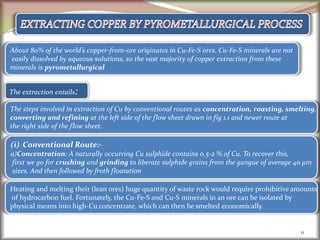
About 80% of the world’s copper-from-ore originates in Cu-Fe-S ores. Cu-Fe-S minerals are not
easily dissolved by aqueous solutions, so the vast majority of copper extraction from these
minerals is pyrometallurgical
The extraction entails:
The steps involved in extraction of Cu by conventional routes as concentration, roasting, smelting,
converting and refining at the left side of the flow sheet drawn in fig 1.1 and newer route at
the right side of the flow sheet.
(i) Conventional Route:-
a)Concentration: A naturally occurring Cu sulphide contains 0.5-2 % of Cu. To recover this,
first we go for crushing and grinding to liberate sulphide grains from the gangue of average 40 µm
sizes. And then followed by froth floatation
Heating and melting their (lean ores) huge quantity of waste rock would require prohibitive amounts
of hydrocarbon fuel. Fortunately, the Cu-Fe-S and Cu-S minerals in an ore can be isolated by
physical means into high-Cu concentrate, which can then be smelted economically.
12
13
Froth flotation
Froth flotation is a process for selectively separating hydrophobic materials
from hydrophilic.
This is used in mineral processing, paper recycling and waste-water treatment
industries.
Historically this was first used in the mining industry, where it was one of
the great enabling technologies of the 20th century. It has been
described as "the single most important operation used for the recovery and
upgrading of sulfide ores". The development of froth flotation has improved
the recovery of valuable minerals, such as copper- and lead-bearing minerals.
Along with mechanized mining, it has allowed the economic recovery of
valuable metals from much lower grade ore than previously.
14
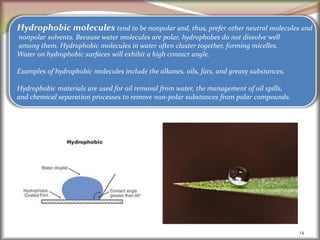
Hydrophobic molecules tend to be nonpolar and, thus, prefer other neutral molecules and
nonpolar solvents. Because water molecules are polar, hydrophobes do not dissolve well
among them. Hydrophobic molecules in water often cluster together, forming micelles.
Water on hydrophobic surfaces will exhibit a high contact angle.
Examples of hydrophobic molecules include the alkanes, oils, fats, and greasy substances.
Hydrophobic materials are used for oil removal from water, the management of oil spills,
and chemical separation processes to remove non-polar substances from polar compounds.
15
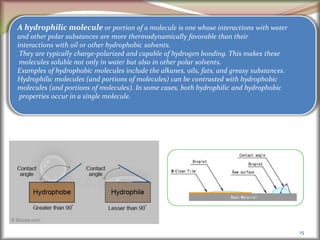
A hydrophilic molecule or portion of a molecule is one whose interactions with water
and other polar substances are more thermodynamically favorable than their
interactions with oil or other hydrophobic solvents.
They are typically charge-polarized and capable of hydrogen bonding. This makes these
molecules soluble not only in water but also in other polar solvents.
Examples of hydrophobic molecules include the alkanes, oils, fats, and greasy substances.
Hydrophilic molecules (and portions of molecules) can be contrasted with hydrophobic
molecules (and portions of molecules). In some cases, both hydrophilic and hydrophobic
properties occur in a single molecule.
16
17
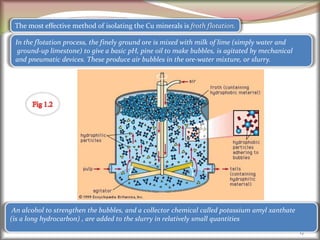
The most effective method of isolating the Cu minerals is froth flotation.
An alcohol to strengthen the bubbles, and a collector chemical called potassium amyl xanthate
(is a long hydrocarbon) , are added to the slurry in relatively small quantities
In the flotation process, the finely ground ore is mixed with milk of lime (simply water and
ground-up limestone) to give a basic pH, pine oil to make bubbles, is agitated by mechanical
and pneumatic devices. These produce air bubbles in the ore-water mixture, or slurry.
18
One end of the chain (the ionic dithiocarbonate) is polar and sticks to sulfide minerals while the
other end is nonpolar, containing the hydrocarbon chain is hydrophobic. It hates being in the
water and is attracted to the nonpolar hydrocarbon pine oil molecules.
Raising the pH causes the polar end to ionize more and to preferentially stick to chalcopyrite
(CuFeS2) and leave the pyrite(FeS2) alone.
Air is blown into the tanks and agitated like a giant blender, producing a foamy froth as the
bubbles rise to the surface, they carry the copper minerals with them, leaving gangue minerals
in the cell to be discarded as tailings.
Collection of the froth from the surface of the flotation cell yields a copper concentrate.
To increase the recovery of copper and reduce losses, the tailings are frequently reground and
passed through a second flotation, the concentrate from which is combined with the
initial production.
The flotation concentrate is then dewatered and filtered to produce a filter cake(20-30% cu)
that is sent to a copper smelter.
19
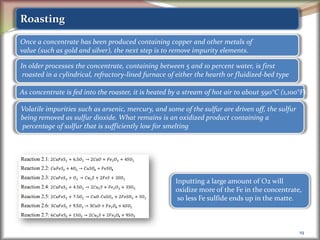
Roasting
Once a concentrate has been produced containing copper and other metals of
value (such as gold and silver), the next step is to remove impurity elements.
In older processes the concentrate, containing between 5 and 10 percent water, is first
roasted in a cylindrical, refractory-lined furnace of either the hearth or fluidized-bed type
As concentrate is fed into the roaster, it is heated by a stream of hot air to about 590°C (1,100°F)
Volatile impurities such as arsenic, mercury, and some of the sulfur are driven off, the sulfur
being removed as sulfur dioxide. What remains is an oxidized product containing a
percentage of sulfur that is sufficiently low for smelting
Inputting a large amount of O2 will
oxidize more of the Fe in the concentrate,
so less Fe sulfide ends up in the matte.
20
1
2
)
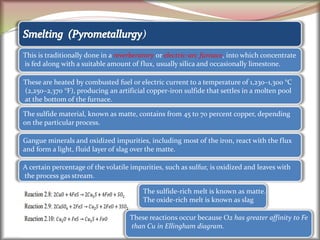
This is traditionally done in a reverberatory or electric-arc furnace, into which concentrate
is fed along with a suitable amount of flux, usually silica and occasionally limestone.
These are heated by combusted fuel or electric current to a temperature of 1,230–1,300 °C
(2,250–2,370 °F), producing an artificial copper-iron sulfide that settles in a molten pool
at the bottom of the furnace.
The sulfide material, known as matte, contains from 45 to 70 percent copper, depending
on the particular process.
Gangue minerals and oxidized impurities, including most of the iron, react with the flux
and form a light, fluid layer of slag over the matte.
A certain percentage of the volatile impurities, such as sulfur, is oxidized and leaves with
the process gas stream.
The sulfide-rich melt is known as matte.
The oxide-rich melt is known as slag
These reactions occur because O2 has greater affinity to Fe
than Cu in Ellingham diagram.
3
)
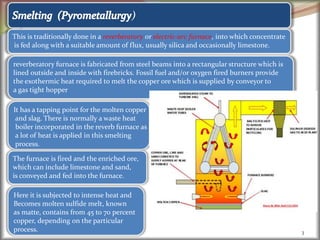
This is traditionally done in a reverberatory or electric-arc furnace, into which concentrate
is fed along with a suitable amount of flux, usually silica and occasionally limestone.
reverberatory furnace is fabricated from steel beams into a rectangular structure which is
lined outside and inside with firebricks. Fossil fuel and/or oxygen fired burners provide
the exothermic heat required to melt the copper ore which is supplied by conveyor to
a gas tight hopper
It has a tapping point for the molten copper
and slag. There is normally a waste heat
boiler incorporated in the reverb furnace as
a lot of heat is applied in this smelting
process.
The furnace is fired and the enriched ore,
which can include limestone and sand,
is conveyed and fed into the furnace.
Here it is subjected to intense heat and
Becomes molten sulfide melt, known
as matte, contains from 45 to 70 percent
copper, depending on the particular
process.
4
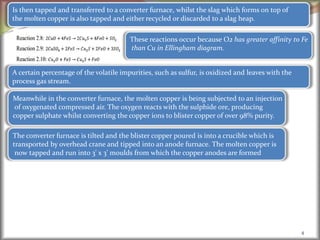
Is then tapped and transferred to a converter furnace, whilst the slag which forms on top of
the molten copper is also tapped and either recycled or discarded to a slag heap.
A certain percentage of the volatile impurities, such as sulfur, is oxidized and leaves with the
process gas stream.
Meanwhile in the converter furnace, the molten copper is being subjected to an injection
of oxygenated compressed air. The oxygen reacts with the sulphide ore, producing
copper sulphate whilst converting the copper ions to blister copper of over 98% purity.
The converter furnace is tilted and the blister copper poured is into a crucible which is
transported by overhead crane and tipped into an anode furnace. The molten copper is
now tapped and run into 3' x 3' moulds from which the copper anodes are formed
These reactions occur because O2 has greater affinity to Fe
than Cu in Ellingham diagram.
5
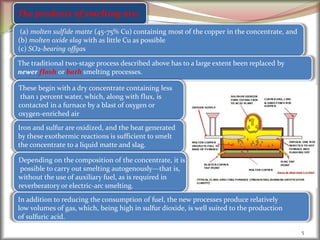
The products of smelting are;
(a) molten sulfide matte (45-75% Cu) containing most of the copper in the concentrate, and
(b) molten oxide slag with as little Cu as possible
(c) SO2-bearing offgas
The traditional two-stage process described above has to a large extent been replaced by
newer flash or bath smelting processes.
These begin with a dry concentrate containing less
than 1 percent water, which, along with flux, is
contacted in a furnace by a blast of oxygen or
oxygen-enriched air
Iron and sulfur are oxidized, and the heat generated
by these exothermic reactions is sufficient to smelt
the concentrate to a liquid matte and slag.
Depending on the composition of the concentrate, it is
possible to carry out smelting autogenously—that is,
without the use of auxiliary fuel, as is required in
reverberatory or electric-arc smelting.
In addition to reducing the consumption of fuel, the new processes produce relatively
low volumes of gas, which, being high in sulfur dioxide, is well suited to the production
of sulfuric acid.
6
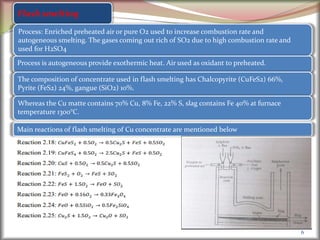
Flash smelting
Process: Enriched preheated air or pure O2 used to increase combustion rate and
autogeneous smelting. The gases coming out rich of SO2 due to high combustion rate and
used for H2SO4
Process is autogeneous provide exothermic heat. Air used as oxidant to preheated.
The composition of concentrate used in flash smelting has Chalcopyrite (CuFeS2) 66%,
Pyrite (FeS2) 24%, gangue (SiO2) 10%.
Whereas the Cu matte contains 70% Cu, 8% Fe, 22% S, slag contains Fe 40% at furnace
temperature 1300°C.
Main reactions of flash smelting of Cu concentrate are mentioned below
7
After the slag, which contains a large percentage of the impurity elements, is removed from the
matte, the remaining iron and sulfur are removed in the conversion process.
The converter is a cylindrical steel shell, normally about four metres in diameter and lined with,
refractory brick. After being charged with matte, flux, and copper scrap (to control temperature)
the converter is rotated in order to immerse tuyeres in the molten bath.
Air or oxygen-enriched air is then blown through the tuyeres into the fluid.
Iron and sulfur are converted to oxides and are removed in either the gas stream or the
slag (the latter being recycled for the recovery of remaining values), leaving a “blister” copper
containing between 98.5 and 99.5 percent copper and up to 0.8 percent oxygen.
The converter is rotated for skimming the slag and pouring the blister copper.`
The conversion of liquid matte in a rotating converter is a batch operation, but newer
continuous processes utilize stationary furnaces similar to those used in smelting.
Continuous systems have the advantage of reducing the gaseous and particulate emissions
normally produced during conversion.
8
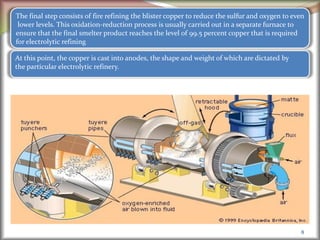
The final step consists of fire refining the blister copper to reduce the sulfur and oxygen to even
lower levels. This oxidation-reduction process is usually carried out in a separate furnace to
ensure that the final smelter product reaches the level of 99.5 percent copper that is required
for electrolytic refining
At this point, the copper is cast into anodes, the shape and weight of which are dictated by
the particular electrolytic refinery.
9
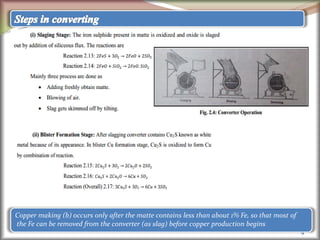
Copper making (b) occurs only after the matte contains less than about 1% Fe, so that most of
the Fe can be removed from the converter (as slag) before copper production begins
10
Continuous Smelting:
It encompass smelting and converting in a single vessel i.e. Cu concentrate charged at
one end and Cu metal withdrawn continuously at the other end.
Mainly three are three processes, given below
(a) WORCRA. (b) Noranda. (c) Mitsubishi.
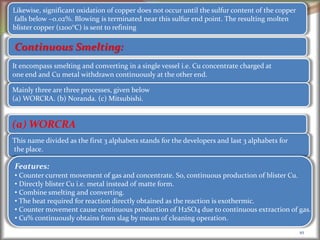
This name divided as the first 3 alphabets stands for the developers and last 3 alphabets for
the place.
(a) WORCRA
Features:
• Counter current movement of gas and concentrate. So, continuous production of blister Cu.
• Directly blister Cu i.e. metal instead of matte form.
• Combine smelting and converting.
• The heat required for reaction directly obtained as the reaction is exothermic.
• Counter movement cause continuous production of H2SO4 due to continuous extraction of gas.
• Cu% continuously obtains from slag by means of cleaning operation.
Likewise, significant oxidation of copper does not occur until the sulfur content of the copper
falls below ~0.02%. Blowing is terminated near this sulfur end point. The resulting molten
blister copper (1200°C) is sent to refining
11
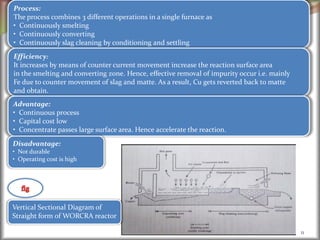
Process:
The process combines 3 different operations in a single furnace as
• Continuously smelting
• Continuously converting
• Continuously slag cleaning by conditioning and settling
Efficiency:
It increases by means of counter current movement increase the reaction surface area
in the smelting and converting zone. Hence, effective removal of impurity occur i.e. mainly
Fe due to counter movement of slag and matte. As a result, Cu gets reverted back to matte
and obtain.
Advantage:
• Continuous process
• Capital cost low
• Concentrate passes large surface area. Hence accelerate the reaction.
Disadvantage:
• Not durable
• Operating cost is high
Vertical Sectional Diagram of
Straight form of WORCRA reactor
12
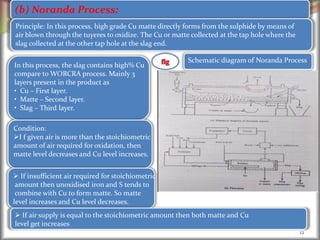
(b) Noranda Process:
Principle: In this process, high grade Cu matte directly forms from the sulphide by means of
air blown through the tuyeres to oxidize. The Cu or matte collected at the tap hole where the
slag collected at the other tap hole at the slag end.
In this process, the slag contains high% Cu
compare to WORCRA process. Mainly 3
layers present in the product as
• Cu – First layer.
• Matte – Second layer.
• Slag – Third layer.
Condition:
➢I f given air is more than the stoichiometric
amount of air required for oxidation, then
matte level decreases and Cu level increases.
➢ If insufficient air required for stoichiometric
amount then unoxidised iron and S tends to
combine with Cu to form matte. So matte
level increases and Cu level decreases.
➢ If air supply is equal to the stoichiometric amount then both matte and Cu
level get increases
Schematic diagram of Noranda Process
13
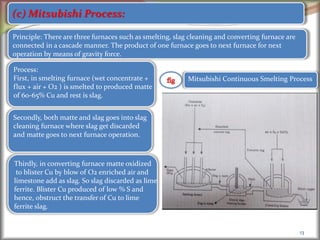
(c) Mitsubishi Process:
Principle: There are three furnaces such as smelting, slag cleaning and converting furnace are
connected in a cascade manner. The product of one furnace goes to next furnace for next
operation by means of gravity force.
Process:
First, in smelting furnace (wet concentrate +
flux + air + O2 ) is smelted to produced matte
of 60-65% Cu and rest is slag.
Secondly, both matte and slag goes into slag
cleaning furnace where slag get discarded
and matte goes to next furnace operation.
Thirdly, in converting furnace matte oxidized
to blister Cu by blow of O2 enriched air and
limestone add as slag. So slag discarded as lime
ferrite. Blister Cu produced of low % S and
hence, obstruct the transfer of Cu to lime
ferrite slag.
Mitsubishi Continuous Smelting Process
14
Fire Refining and Electro refining of Blister Copper
The copper from the above processing is electrochemically refined to high-purity cathode
Copper . This final copper contains less than 20 ppm undesirable impurities. It is suitable for
electrical and almost all other uses
Electro refining requires strong, flat thin anodes to interleave with cathodes in a refining cell.
These anodes are produced by removing S and O from molten blister copper, and casting the
resulting fire-refined copper in open, anode shape molds (occasionally in a continuous strip caster)
The purpose of refining to get Cu extraction is twofold as
• First, to obtain metal in pure form.
• Second, to recover precious metals containing in blister Cu produced.
Fire Refining
Virtually all the molten copper produced by smelting/converting is subsequently electrorefined.
It must, therefore, be suitable for casting into thin, strong, smooth anodes for interleaving with
cathodes in electrorefining cells . This requires that the copper be fire refined to remove most of
its sulfur and oxygen.
15
The molten blister copper from Peircee-Smith converting contains~0.02% S and ~0.3% O. The
copper from single-step smelting and continuous converting contains up to 1% S and 0.2-0.4% O
At these levels, the dissolved sulfur and oxygen would combine during solidification to form
bubbles (blisters)of SO2 in newly cast anodes, making them weak and bumpy.
In stoichiometric terms, 0.01% dissolved sulfur and 0.01% dissolved oxygen would combine to
produce about 2 cm³ of SO2 (1083°C) per cm³ of copper.
The refining is done in reverberatory furnace of 400 ton of capacity contains blister Cu get
oxidized to recover Cu removing the impurities such as S, Fe, Se, Zn by converting its
corresponding oxides and then skimmed off. But, some Cu also in the form of oxides.
To prevent Cu loss poling with green branches used to reduce Cu₂O using hydrocarbon or some
other reducing gases. In this case, the purity of Cu obtained 99.97%. Fire refining is also done in
rotary type refining furnace, where blister Cu directly treated by blowing air, The final product
of fire refining is molten copper,w0.003% S, 0.16% O, 1200°C, ready for casting as anodes.
16
Electrolytic Refining
Almost all copper is treated by an electrolytic process during its production from ore. It is
either electrorefined from impure copper anodes or electrowon from leach/solvent
extraction solutions.
The purpose is to further refined the fire-refined Cu by electrolysis. The electrolysis done in
a electrolytic refining tank made of concrete or wood of 3-5 m deep and utilization minimum
space with maximum cathode and anode area. The electrolyte is CuSO4, H2SO4, some glue
and alcohol at temperature 50-60°C.
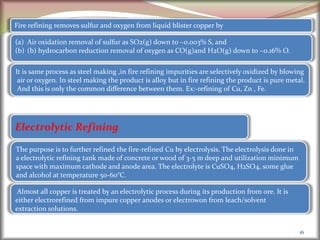
Fire refining removes sulfur and oxygen from liquid blister copper by
(a) Air oxidation removal of sulfur as SO2(g) down to ~0.003% S, and
(b) (b) hydrocarbon reduction removal of oxygen as CO(g)and H2O(g) down to ~0.16% O.
It is same process as steel making ,in fire refining impurities are selectively oxidized by blowing
air or oxygen. In steel making the product is alloy but in fire refining the product is pure metal.
And this is only the common difference between them. Ex:-refining of Cu, Zn , Fe.
17
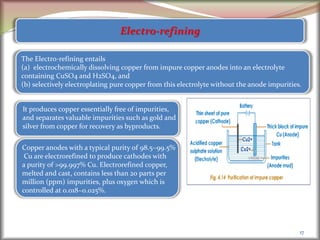
Electro-refining
The Electro-refining entails
(a) electrochemically dissolving copper from impure copper anodes into an electrolyte
containing CuSO4 and H2SO4, and
(b) selectively electroplating pure copper from this electrolyte without the anode impurities.
It produces copper essentially free of impurities,
and separates valuable impurities such as gold and
silver from copper for recovery as byproducts.
Copper anodes with a typical purity of 98.5~99.5%
Cu are electrorefined to produce cathodes with
a purity of >99.997% Cu. Electrorefined copper,
melted and cast, contains less than 20 parts per
million (ppm) impurities, plus oxygen which is
controlled at 0.018~0.025%.
18
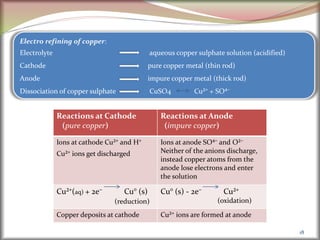
Electro refining of copper:
Electrolyte aqueous copper sulphate solution (acidified)
Cathode pure copper metal (thin rod)
Anode impure copper metal (thick rod)
Dissociation of copper sulphate CuSO4 Cu²⁺ + SO⁴⁻
Reactions at Cathode
(pure copper)
Reactions at Anode
(impure copper)
Ions at cathode Cu²⁺ and H⁺
Cu²⁺ ions get discharged
Ions at anode SO⁴⁻ and O²⁻
Neither of the anions discharge,
instead copper atoms from the
anode lose electrons and enter
the solution
Cu²⁺(aq) + 2e⁻ Cu° (s)
(reduction)
Cu° (s) - 2e⁻ Cu²⁺
(oxidation)
Copper deposits at cathode Cu²⁺ ions are formed at anode
1
2
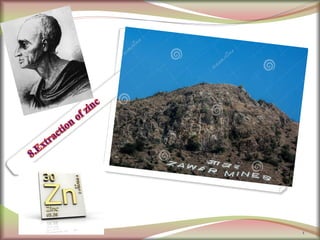
Zinc was discovered by Andreas Marggraf at 1746 in Germany
Centuries before zinc was recognized as a distinct element, zinc ores were used
for making brass (a mixture of copper and zinc).
A brass dating from between 1400-1000 BC has been found in Palestine.
An alloy containing 87% zinc was found in prehistoric ruins in Transylvania.
The smelting of zinc ores with copper was apparently discovered in Cyprus and
was used later by the Romans.
Metallic zinc was produced in the 13th century in India by reducing calamine
(zinc carbonate, ZnCO3) with organic substances such as wool.
The metal was rediscovered later in Europe. William Champion set up a zinc
industry in Bristol (England) in the 1740s.
3
80% of Zinc mines are underground ,8% are of the open pit type and
remaining is combination of both.
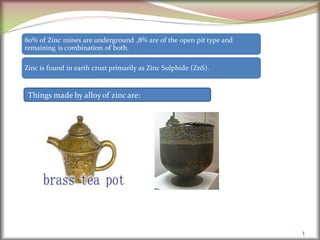
Zinc is found in earth crust primarily as Zinc Sulphide (ZnS).
Things made by alloyof zinc are:
4
S.no
1. Symbol Zn
2. Atomic number 30
3. Abundancein the Earth crust 24
4. Electron configuration [Ar] 3d10
4s2
5. Crystalstructure HCP
6. Density 7.14 g/cc
7. Brinnel Hardness 412 MPa
8. Melting point 419.53
9. Electrical resistivity 6.0 × 10⁻⁸ Ω m
10. Thermal conductivity 116 W.m-1.k-1
11. Color White Silver Color
12. Price 175/- per kg
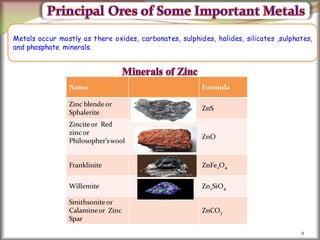
5
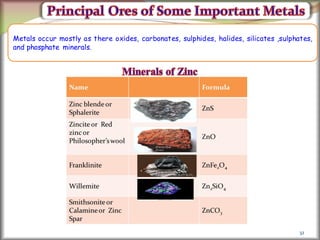
Name Chemical Formula
Sphalerite ZnS
Zincite ZnO
Franklinite
[ZnO(Fe, Mn)2O3]
Willemite Zn2SiO4
Smith Sonite ZnCO3
Location of ore in India : Zawar(Rajasthan),Sikkim,
Udhampur(jammu&kashmir)
Areas of extraction : ZawarMines (Rajasthan)
HZL(Hindustan Zinc Ltd)
COMINOCO-BINANI at Kerala
6
Ways of Extraction
 Potassium K
 Sodium Na
 Calcium Ca
 Magnesium Mg
 Aluminium Al
 Zinc Zn
 Iron Fe
 Tin Sn
 Lead Pb
 Copper Cu
 Mercury Hg
 Silver Ag
 Gold Au
 Platinum Pt
Extracted by
electrolysis of
molten chlorides
Extraction by
reduction of oxides
using carbon
Extraction by
electrolysis of
molten Al2O3
dissolved in
cryolite
Roasting ore by
heating alone
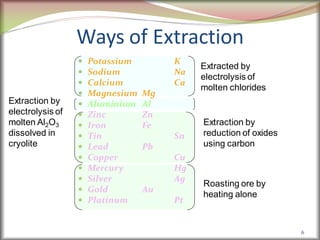
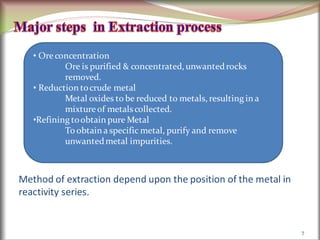
Method of extraction depend upon the position of the metal in
reactivity series.
7
• Ore concentration
Ore is purified & concentrated, unwantedrocks
removed.
• Reduction tocrude metal
Metal oxides to be reduced to metals, resulting in a
mixture of metals collected.
•Refining toobtain pure Metal
To obtain a specific metal, purify and remove
unwantedmetal impurities.
8
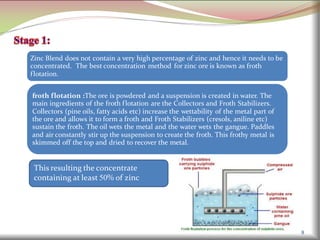
Zinc Blend does not contain a very high percentage of zinc and hence it needs to be
concentrated. The best concentration method for zinc ore is known as froth
flotation.
froth flotation :The ore is powdered and a suspension is created in water. The
main ingredients of the froth flotation are the Collectors and Froth Stabilizers.
Collectors (pine oils, fatty acids etc) increase the wettability of the metal part of
the ore and allows it to form a froth and Froth Stabilizers (cresols, aniline etc)
sustain the froth. The oil wets the metal and the water wets the gangue. Paddles
and air constantly stir up the suspension to create the froth. This frothy metal is
skimmed off the top and dried to recover the metal.
This resulting the concentrate
containing at least 50% of zinc
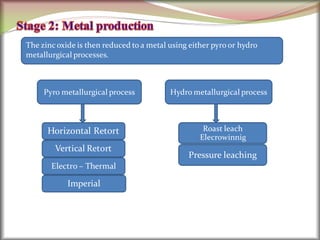
Pyro metallurgical process Hydro metallurgical process
Horizontal Retort
Vertical Retort
Electro – Thermal
Imperial
Roast leach
Elecrowinnig
Pressure leaching
The zinc oxide is then reduced to a metal using either pyro or hydro
metallurgical processes.
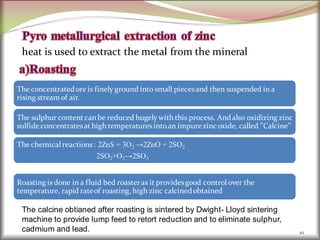
heat is used to extract the metal from the mineral
10
The concentratedore is finely ground into small piecesand then suspended in a
rising streamof air.
The sulphur content can be reduced hugely with this process. Andalso oxidizing zinc
sulfide concentratesat high temperatures intoan impurezincoxide, called ”Calcine”
The chemical reactions : 2ZnS + 3O2 →2ZnO + 2SO2
2SO2+O2→2SO3
Roasting is done in a fluid bed roasteras it providesgood control over the
temperature, rapid rateof roasting, high zinc calcinedobtained
The calcine obtianed after roasting is sintered by Dwight- Lloyd sintering
machine to provide lump feed to retort reduction and to eliminate sulphur,
cadmium and lead.
11
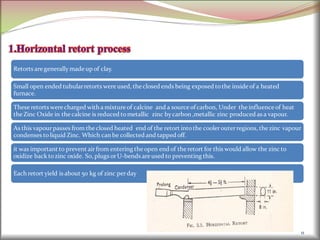
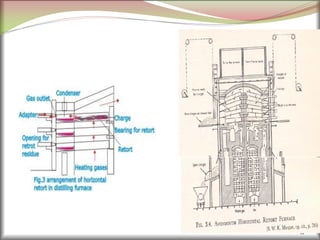
Retorts are generallymade up of clay.
Small open ended tubularretorts were used, theclosed ends being exposed tothe inside of a heated
furnace.
These retorts were charged with a mixture of calcine and a source of carbon, Under theinfluence of heat
theZinc Oxide in the calcine is reduced tometallic zinc bycarbon ,metallic zinc produced as a vapour.
As this vapourpasses from the closed heated end of the retort intothe coolerouterregions, the zinc vapour
condenses toliquid Zinc. Which can be collected and tapped off.
it was important to prevent airfrom entering theopen end of theretort for this would allow the zinc to
oxidize backtozinc oxide. So, plugs orU-bends are used to preventing this.
Each retort yield is about 50 kg of zinc perday
12
13
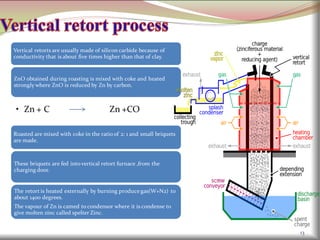
Vertical retorts are usually made of silicon carbide because of
conductivity that is about five times higher than that of clay.
ZnO obtained during roasting is mixed with coke and heated
strongly where ZnO is reduced by Zn by carbon.
• Zn + C Zn +CO
Roasted are mixed with coke in the ratio of 2: 1 and small briquets
are made.
These briquets are fed into vertical retort furnace ,from the
charging door.
The retort is heated externally by burning produce gas(W+N2) to
about 1400 degrees.
The vapour of Zn is camed to condensor where it is condense to
give molten zinc called spelter Zinc.
14
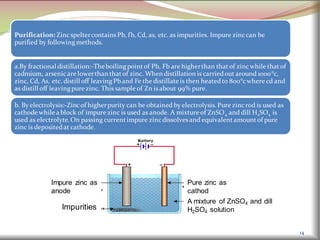
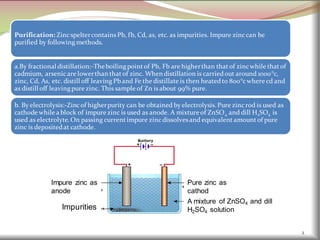
Purification: Zincspeltercontains Pb, fb, Cd, as, etc. as impurities. Impure zinccan be
purified by followingmethods.
a.By fractional distillation:-Theboilingpointof Pb, Fb are higherthan thatof zincwhile thatof
cadmium, arsenicare lowerthan thatof zinc. When distillation is carriedout around 1000°c,
zinc, Cd, As, etc. distill off leaving Pband Fe the distillate is then heatedto 800°cwhere cd and
as distill off leavingpure zinc. This sample of Zn isabout 99% pure.
b. By electrolysis:-Zincof higherpurity can be obtained by electrolysis.Pure zincrod is used as
cathode while a block of impure zinc is used as anode. A mixture of ZnSO4 and dill H2SO4 is
used as electrolyte.On passing currentimpure zincdissolvesand equivalentamountof pure
zinc is depositedat cathode.
Impure zinc as
anode
Impurities
Pure zinc as
cathod
A mixture of ZnSO4 and dill
H2SO4 solution
1
2
Purification: Zincspeltercontains Pb, fb, Cd, as, etc. as impurities. Impure zinccan be
purified by followingmethods.
a.By fractional distillation:-Theboilingpointof Pb, Fb are higherthan thatof zincwhile thatof
cadmium, arsenicare lowerthan thatof zinc. When distillation is carriedout around 1000°c,
zinc, Cd, As, etc. distill off leaving Pband Fe the distillate is then heatedto 800°cwhere cd and
as distill off leavingpure zinc. This sample of Zn isabout 99% pure.
b. By electrolysis:-Zincof higherpurity can be obtained by electrolysis.Pure zincrod is used as
cathode while a block of impure zinc is used as anode. A mixture of ZnSO4 and dill H2SO4 is
used as electrolyte.On passing currentimpure zincdissolvesand equivalentamountof pure
zinc is depositedat cathode.
Impure zinc as
anode
Impurities
Pure zinc as
cathod
A mixture of ZnSO4 and dill
H2SO4 solution
3
It occurs in a vertical retort 15 m high, internal dia. of 24 m about 100 tons Zn per day.
It uses electrodes of graphite are introduced through the silicon carbide walls at two places-near the
bottom and at a zone 9m from the bottom.
The charge in this zone forms the resistance and electrical energy supplied provides the heat necessary
for reduction of the charge instead of fossil fuel employed in horizontal and vertical retorts.
The gas liberated due to reduction of charge has 40-45% Zn ,45% CO, 5-8%N2 and minute CO2.
This gas is bubbled into a U tube arrangement maintained under vacuum to enable the suction of retort
gases through molten zinc.
The zinc condensation needs to be carried out quickly in order to avoid the formation of blue oxide of
zinc( ZnO+Zn).
The residues of the foregoing retort processes contains 3-4% Zn, all the input iron, gangue, copper and
precious metals.
The zinc recovery is over 95% .
4
Thezinc product obtained fromtheretorts is known as spelterand contains otherelements in
addition to zinc.
On melting it forms three distinct layers, namely,
• Bottom layer is molten lead contains some Zn of 1.5%.
• Top layer is Zn contains some lead of 0.8%.
• Intermediate layer of Zn and Fe (15-20)% called hard metal.
The intermediate layer is recycled tothe retorts and lead layeris smelted in order torecoverlead.
The zinc layer is further refined by fractional distillation becausethe wide differences in boiling points
of Zn(907degrees), Cd(780degrees) and Pb(1620degrees) facilitates the seperation of one metal from
another.
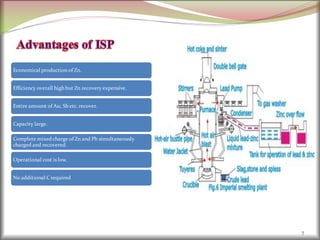
5
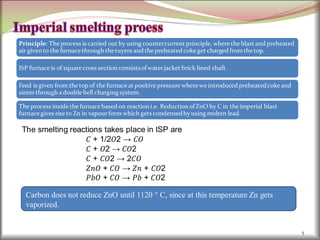
Principle: The process is carried out by using countercurrent principle, where the blast and preheated
air given to the furnace through thetuyereand the preheated coke get charged fromthe top.
ISP furnace is of square cross section consistsof waterjacket brick lined shaft.
Feed is given from the top of the furnace at positive pressure where we introduced preheatedcoke and
sinterthrough a double bell charging system.
The process inside the furnace based on reaction i.e. Reduction of ZnO by C in the imperial blast
furnace gives rise to Zn in vapourform which gets condensedby using molten lead.
The smelting reactions takes place in ISP are
𝐶 + 1/2𝑂2 → 𝐶𝑂
𝐶 + 𝑂2 → 𝐶𝑂2
𝐶 + 𝐶𝑂2 → 2𝐶𝑂
𝑍𝑛𝑂 + 𝐶𝑂 → 𝑍𝑛 + 𝐶𝑂2
𝑃𝑏𝑂 + 𝐶𝑂 → 𝑃𝑏 + 𝐶𝑂2
Carbon does not reduce ZnO until 1120 ° C, since at this temperature Zn gets
vaporized.
6
The zinc oxide is reduced and forms zinc vapour, which is extracted at the top of the furnace along with the
combustion gases.
The vapour is passed to a condenser in which the cooling medium is molten lead, in which the zinc dissolves. The
zinc-in-lead solution is then passed into a separator in which on cooling, a layer of liquid zinc forms a top of the lead
(this separation is due to the fact that the solubility of zinc in lead diminishes at the lower temperature).
The lead is returned to the condenser, and the zinc is further processed by refining.
The lower part of the first column is heated.
Impure zinc is fed continuously into the top of the column and is vaporized as it flows down through the heated
trays.
After further purification by refluxing in the upper part of the column, the zinc vapor (still containing cadmium but
free of other impurities) is passed to a condenser, whence it is fed to the top of the second column, in which all the
cadmium is driven off.
Zinc of 99.995% purity is condensed and drawn from the bottom.
7
Economical production of Zn.
Efficiency overall high but Zn recovery expensive.
Entire amount of Au, Sb etc. recover.
Capacity large.
Complete mixed charge of Zn and Pb simultaneously
charged and recovered.
Operational cost is low.
No additional C required
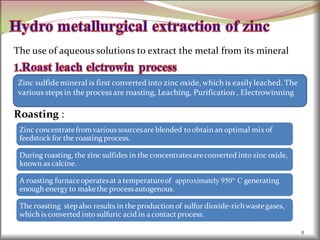
The use of aqueous solutions to extract the metal from its mineral
Roasting :
8
Zinc sulfidemineral is first converted into zinc oxide, which is easilyleached. The
various steps in the process are roasting, Leaching, Purification , Electrowinning
Zinc concentratefromvarious sourcesare blended to obtain an optimal mix of
feedstock for the roasting process.
During roasting, the zinc sulfides in the concentratesareconverted into zinc oxide,
known as calcine.
A roasting furnaceoperatesat a temperatureof approximately 950° C generating
enough energy to makethe processautogenous.
The roasting stepalso results in the production of sulfur dioxide-richwastegases,
which is converted into sulfuric acid in a contact process.
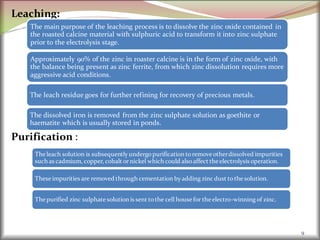
Leaching:
Purification :
9
The main purpose of the leaching process is to dissolve the zinc oxide contained in
the roasted calcine material with sulphuric acid to transform it into zinc sulphate
prior to the electrolysis stage.
Approximately 90% of the zinc in roaster calcine is in the form of zinc oxide, with
the balance being present as zinc ferrite, from which zinc dissolution requires more
aggressive acid conditions.
The leach residue goes for further refining for recovery of precious metals.
The dissolved iron is removed from the zinc sulphate solution as goethite or
haematite which is usually stored in ponds.
The leach solution is subsequentlyundergopurification toremove otherdissolved impurities
such as cadmium, copper, cobalt ornickel which could alsoaffect theelectrolysis operation.
These impurities are removed through cementation byadding zinc dust tothesolution.
The purified zinc sulphate solution is sent tothe cell house for theelectro-winning of zinc.
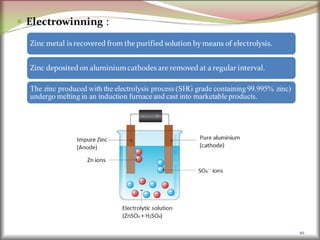
 Electrowinning :
10
Zinc metal is recovered from the purified solution by means of electrolysis.
Zinc deposited on aluminiumcathodes are removed at a regular interval.
The zinc produced with the electrolysis process (SHG grade containing 99.995% zinc)
undergo melting in an induction furnace and cast into marketable products.
11
zinc sulphide or bulk zinc concentrates are oxidized under oxygen overpressures of 1200 kpa abs.
At a temperature of 150°C in sulphuric acid medium to produce zinc sulphate solution directly and
the sulphide content is precipitated as elemental sulphur
• ZnS + H2SO4 + 0.5 02 = ZnSO4 + H2O + S°
The various factors influencingthe kineticsof above reaction arethe particle size,
mineralogy,surface active additives,acidities,reaction time, temperature andoxygen over-
pressureswhere by maximising metal extraction andfixation of lead and iron constituents
into disposable jarosite andother types of residues.
The zincsulphate solution thus produced is amenable to further processing for final zinc
extraction through conventional leach-electrowinning process.
12
• Zn extensively used as a protective coating for steel (Galvanization).
Restrict atmosphere corrosion by impervious basic ZnCO3 layer. Zn is more electropositive.
• Fabrication of Cu-Zn alloys i. e. brasses.
• Spraying – Zn used as for spraying in comparison to other metal on that metal which has low melting point.
• Rolled Zn: Usual method of cold working. Zn is rolled to sheet, plate, and strip. Where, sheet plates are rolled from
98.5% Zn.
• Pigment: Zn in the form of its oxides used in manufactured of paints.
• Alloys: Mainly Cu-Zn alloy produceof 30-37% Zn which is much less plastic when cold and worked about
5000C which mainly used as die casting alloy.
As an anti corrosiveagent.
Extraction of Ni by Pyro-metallurgical
Process
-- Dr. P. Justin, M.Sc, M.Tech, Ph.D
Non-Ferrous Metals
In metallurgy, a non-ferrous metal is any metal, including alloys, that
does not contain iron in appreciable amounts. They are generally suffer
from hot-shortness, possess lower strength at lower temperatures.
Properties:-
 Low density
 Higher thermal & electrical conductivities, magnetic properties
 Attractive colours
 Softness & facility of cold working
 Good formability
 Corrosion resistance
 Fusibility & ease of casting and fabrication.
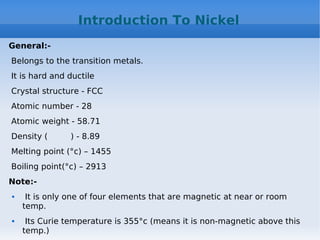
Introduction To Nickel
General:-
Belongs to the transition metals.
It is hard and ductile
Crystal structure - FCC
Atomic number - 28
Atomic weight - 58.71
Density ( ) - 8.89
Melting point (°c) – 1455
Boiling point(°c) – 2913
Note:-
 It is only one of four elements that are magnetic at near or room
temp.
 Its Curie temperature is 355°c (means it is non-magnetic above this
temp.)
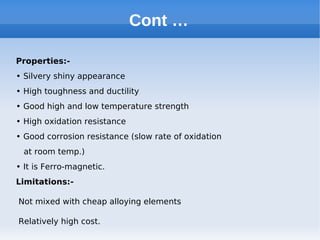
Cont …
Properties:-
• Silvery shiny appearance
• High toughness and ductility
• Good high and low temperature strength
• High oxidation resistance
• Good corrosion resistance (slow rate of oxidation
at room temp.)
• It is Ferro-magnetic.
Limitations:-
Not mixed with cheap alloying elements
Relatively high cost.
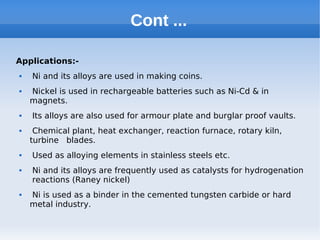
Cont ...
Applications:-
 Ni and its alloys are used in making coins.
 Nickel is used in rechargeable batteries such as Ni-Cd & in
magnets.
 Its alloys are also used for armour plate and burglar proof vaults.
 Chemical plant, heat exchanger, reaction furnace, rotary kiln,
turbine blades.
 Used as alloying elements in stainless steels etc.
 Ni and its alloys are frequently used as catalysts for hydrogenation
reactions (Raney nickel)
 Ni is used as a binder in the cemented tungsten carbide or hard
metal industry.
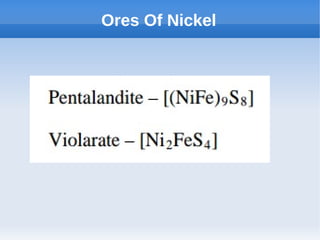
Ores Of Nickel
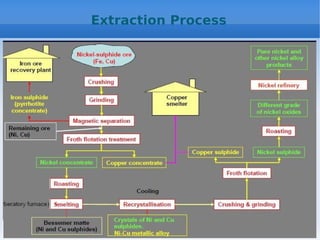
Extraction Process
Extraction of Ni from Sulphide Ore
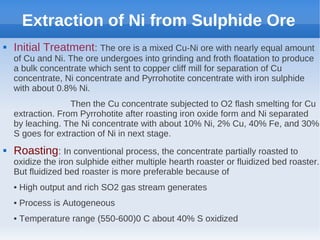
 Initial Treatment: The ore is a mixed Cu-Ni ore with nearly equal amount
of Cu and Ni. The ore undergoes into grinding and froth floatation to produce
a bulk concentrate which sent to copper cliff mill for separation of Cu
concentrate, Ni concentrate and Pyrrohotite concentrate with iron sulphide
with about 0.8% Ni.
Then the Cu concentrate subjected to O2 flash smelting for Cu
extraction. From Pyrrohotite after roasting iron oxide form and Ni separated
by leaching. The Ni concentrate with about 10% Ni, 2% Cu, 40% Fe, and 30%
S goes for extraction of Ni in next stage.
 Roasting: In conventional process, the concentrate partially roasted to
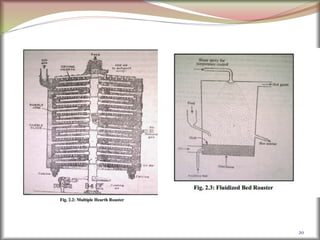
oxidize the iron sulphide either multiple hearth roaster or fluidized bed roaster.
But fluidized bed roaster is more preferable because of
• High output and rich SO2 gas stream generates
• Process is Autogeneous
• Temperature range (550-600)0 C about 40% S oxidized
Cont ...
 Smelting: The roasted calcine contains desired amount of siliceous flux is
smelted in a reverberatory furnace to produce a matte containing Cu, Ni as
20%, 7% respectively where the slag discarded contains gangue and oxidized
iron. There is also converter slag of both Ni and Cu converters are returned to
the reverberatory furnace.
 Converting: Furnace matte is converted to Ni enriched matte with 50% Ni,
25% Cu, 0.7% Fe, and 21.5% S at 1500 C in Pierce-Smith converter. The
slag discarded contains 2% Ni, 1.5% Cu, 40% Fe, and 25% SiO 2 return to
reverberatory furnace for recovery of Ni and Cu.
 Slow Cooling: Converter matte subjected to slow cooling process from
melting point to 4000' C for 3 days to form three layers precipitate out as
• First layer, Cu2S precipitate and grows
• Second layer, metallic Cu-Ni alloy at 7000 C
• Third layer, solid Ni3S2 phase precipitate at 5750 C
Cont ...
 Magnetic Separation and Floating: Diphenyl guanidiene used as
collector as well as frother rather than Xanthate. In floatation, Ni-Cu alloy
contains 95% precious metals is undergo for magnetic separation for
recovery of it. Cu 2 S produced by floatation contains 70% Cu, 5% Ni, 20%
S. Ni sulphide recovered as a low Cu-Ni sulphide with 74% Ni, 0.8% Fe,
0.8% Cu, and 22% S. High Cu-Ni sulphide with 72% Ni, (3-4) % Cu, 0.8%
Fe, and 21% S at a temperature(1100-1250)0 C roasting produce granular
nickel oxide.
 Final Treatment:
• Low Cu-Ni oxide is marketed directly as Nickel oxide or reduced to metal.
• High Cu-Ni oxide sends for refining by carbonyl process and other half by
electrolytic refining.
 Why slow cooling required after converting process?
Answer: Slow cooling required obtaining necessary grain growth, which then
go for subsequent processing of sulphides to recover it in the froth floatation.
Refining Process
 1. Carbonyl Process for Refining Ni:
(i) Mond’s Process: In 1889, this refining process of Ni recovered by
Carl Langer and Ludwig Mond. In this process, at temperature (40-90)0 C
metallic Ni combine with CO to give gaseous nickel carbonyl [Ni(CO)4 ]. At
higher temperature (150-300)' C Ni(CO)4decomposes to give Ni and CO
gas.
Other forms of Carbonyls are volatile carbonyl [Fe(CO) 5 ],
Co carbonyl in tetracarbonyl [Co 2 (CO) 8 ] tricarbonyl [Co 4 (CO) 12 ] form.
Cu and other major elements are not form carbonyls.
 (ii) INCO Process:
INCO Atmospheric Carbonylation Process:
The oxide first reduces to active Ni in the presence of H 2 at about
4000 C. Then active Ni undergoes for carbonylation at 500 C to form Ni(CO)4
then at 2300 C goes for decomposed to Ni either in pellets about 1 cm dia or
powder form about 3.5 μm size.
INCO Pressure Carbonylation Process:
The carbonylation reaction has 4 to 1 volume change permits at about
1800 C and 70 atm pressure carbonyls of Ni, Fe, and Co formed. From which
Ni(CO)4 recovered by fractiona distillation and converted to metallic Ni in
pellet decomposer or a powder decomposer.
Electrolytic Refining of Ni
 The Ni oxide reduce by coke in fuel fired furnace or electric furnace,
and then cast into Ni metal anode. These anodes are electrolytically
refined in a bath contains 60 gm/lit Ni+2, 95 gm/lit SO42-, 35 gm/lit
Na+, 55 gm/lit Cl-, 16 gm/lit H3BO3. This electrolysis carried out at 600
C. Cu remove by cementation with active Ni powder, Fe and other
impurities remove by aeration of electrolyte, Co remove by Cobaltic
Hydroxide for further Chlorine oxidation. Electrolyzed Ni analyzes about
99.93% Ni.
 But in INCO process, electro refining Ni sulphide to metallic Ni to
produce anodecontains 76% Ni, 0.5% Co, 2.6% Cu, and 20% S. The
process is same as the above one, only difference is that the anode
enclosed in a bag to collect anode slime contains 95% S and is
processed to recover elemental Sulpher and precious metals. The
electronickel contains 99.95% Ni.
1
2
S.no
1. Symbol Al
2. Atomic number 13
3. Abundancein the Earth crust 8.1%(firstabundantmetal)
4. Electron configuration [Ne]3s23p1
5. Crystalstructure FCC
6. Density 2.70 g/cc
7. Hardness 160-550MPa BHN
8. Melting point 660.32⁰C
9. Electrical conductivity 3.50*10⁷(S/mat20⁰C)
10. Thermal conductivity 237 W.m-1
.k-1
11. Color Silvery grey Color
12. Price 115/- per kg
History of Aluminum
 Origin of name: from theLatin word “alumen” meaning “alum”. Alum
is a chemical compound known as hydratedpotassiumaluminum
sulfate(potassiumalum)with the formula KAl(SO4)2.12H2O. The
ancient Greek Romansused alum in medicineand in dyeing process.
 The namewas given to it by scientist Sir Humph Davy, an English
chemist who in 1808,discovered that alumium produced by electrolytic
reduction from alumina(aluminaoxide),butdid not manage to prove
thetheory in practice.
 Aluminum was first isolatedby Hans ChristanOersted in 1825 who
reacted aluminumchloride(AlCl3)withPotassiumamalgam.
3
 1808-1873 :- Aluminum is considered to be more precious similarto
Goldand Silver.Because of thecomplexitiesof refining aluminumfrom
ore.
 1886:- Charles Martin Hall and Paul Heroult developed theextraction
process of Aluminum(Hall-HeroultProcess)
 1888 :-Joseph Bayer developed process to extract Aluminafrom Bauxite.
(Bayer’s Process)
Bayer process caused togetherwith Hall-Heroultprocess
drop theprice for Alumium by about 80% in 1890 w.r.t price for 1854.
4
Location of ore in india :- Orissa,Jharkhand-Bihar,
Gujarat,Maharashtra
MadhyaPradesh-Chattisgarrh,
Tamil Nadu
5
Name of the ore Chemical formula
Bauxite
Al₂O₃ .xH2O
Corundum Al2O3
Kryolite Na3AlF6
Location of Aluminum plants
6
Nameof plant Location of plant Production
HINDALCO(Hindustan
Aluminum Corporation
limited)
Renukoot in
UTTERPRADESH
2,51,000t/a
BALCO(BharatAluminum
Company Ltd.)
Korba in CHATTISGARH 86,000 t/a
INDAL(Indian Aluminum
Company Ltd.)
Hirakund in ORISSA 44,000 t/a
NALCO(NationalAluminum
Company Ltd.)
Angulin ORISSA 2,30,000t/a
MALCO(Madras Aluminum
Company Ltd.)
Metturin TAMIL NADU 25,000 t/a
Complexities in refining of Aluminum
 Any metal can beextracted mainlyby using three technologies-
 Pyro Metallurgy:- With theuse of high temperaturetoextract and
purify metals.
 Hydro Metallurgy:-Useof Aqueous chemistryfor the recovery of metals
from ores.
 Electro Metallurgy:- Use of electricity,as for producing heat in refinig
or depositingmetalsby electrolysis.
By using Pyro Metallurgywe can’t extract theAluminum
economically, because of highermelting pointof Alumina (2072⁰c) and
Thermodynamically, carbothermicreduction of Aluminum occurs
around 2100⁰c.At thistemperaturemore that 30% of aluminagets
vaporizedand theremaining form carbide s.Consequentlytherecovery
is extremelypoor.
7
To extract metal by using Electrolysis a substance must be in
its molten stateorin aqueoussolution .
As discussed before toget theAlumina in molten state
very difficult , so next optionis to get theaqueoussolution.
But when theAlumina in itsaqueous state inorderto
decompose theAlumina to Aluminumwe need toapply 1.63V(from
e.m.f series.).
But beforethealuminadecompositionwaterstart to
vaporize intoHydrogen and Oxygen gasesat 1.23V.
Finallyeven thoughweextract thealuminum but it isvery
less in contentwith highercost.
8
Extraction of Aluminum
9
Theextractionof Aluminum involves three steps:-
1.Purificationof Bauxite (Bayer’s process) toobtain pure Alumina.
2.Electrolysisof pure Alumina in molten state(Hallsprocess).
3.Refining of Aluminum (Hoopes process).
Bayer’s process
 It is theprocess of refining Aluminafrom Bauxite by the selective
extractionof pure Aluminum oxide.
 ThisBauxitecontaining30-50%of hydratedAluminum oxide.
Al2O₃. nH₂O Al2O₃ + nH₂O
(Bauxite) (Alumina) (water)
n=1 Dias pore ( A₂lO₃. H₂O)
n=3 Gibbsite (A₂lO₃. 3H₂O)
Thereare mainly 4 steps in theBayer’s process. Those are
Digestion, Clarification, Precipitationand Calcination.
10
11
1. Digestion:-In thisstep thebauxiteslurry is pumped from the
holding tanksto theautoclaves (digestervessels) whereit is mixed with
hot concentratedcausticsoda liquor. Thedigestion temperatureand
pressuredepend on themineralogical compositionof the bauxite.
12
Prior to the Bayerprocess bauxite is crushed and ground in mills to fine particles
A hot solution of the recycled sodium hydroxide(caustic soda, NaOH) is then
added to the ground ore forming a bauxiteslurry, which is stored in holding
tanks and then pumped to the further processing stage.
Refined aluminumoxide (Al2O3) is obtained from the the bauxiteslurry by the
Bayer processcomprising four steps: -
Gibbsite bauxite may be digested at 135-150ºC under atmospheric pressure.
AlO (OH)*H2O + 2NaOH = 2NaAlO2 + 4H2O
Diaspore bauxite may be digested at a temperature above 482ºF (250ºC) under a
pressure of about 35 atm
AlO(OH) + 2NaOH = 2NaAlO2 + 2H2O
2.Clarification:- Except aluminaand silicaall otherbauxitecomponents
(calcium oxide, iron oxide, titaniumoxide) do notdissolvein the
caustic soda liquor.
• Silicadissolved in the liquoris then precipitatedfrom it by slow
heating.
• Theun dissolvedsolid impurities form red mud, which settlesdown at
the bottomof themud thickeners (settlers, clarificationtanks).
• After thesettlingoperationhas been completed thered mud is
separated from theclear liquorsolutionof sodium
tetrahydroxoaluminate(NaAlO2*2H2O), NaAl(OH)4).
3.Precipitation:-Crystalsof aluminum hydroxide(Al(OH)3)arerecovered
in thisstep.
• Theclear liquor is pumped from thesettlersto the precipitators
(thickening tanks) throughheat exchangers, which transferthe heat
from thesolutiontothecold spent (processed) liquor.
• Precipitationof aluminum hydroxideis promotedby seeding the
liquorwith purealuminacrystals acting as nuclei for theprecipitation
process. 13
14
 Thecrystalsof aluminum hydroxide/aluminatrihydrate(Al2O3*3H2O)
grow and aggregate.
 Thecoarser particles are separated from the fineparticles and
transferred tocalcination.
 The finerparticles are filteredfrom theslurry and then used as seeding
(nuclei) crystals. 90% of aluminum hydrateis recovered from the
liquor.
4. Calcination
 Thealuminum hydratecrystals are washed, dried and then heatedto a
temperature1850-2300ºF (1010-1260ºC)in a rotarykiln or fluidized bed
calciners todrive off the molecules of hydratedwater:
Al2O3*3H2O = Al2O3 + 3H2O
or
2Al(OH)3 = 2Al2O3 + 3H2O
15
Hall-Heroult Process
 As discussed previouslyit is not possibleto extract thealuminum by
using Pyro Metallurgy and doing electrolysiswhen theAlumina in its
aqueous media.
 In 1888 Charles Martin Hall and Paul Heroult developed theextraction
process of Aluminum known as Hall-Heroultprocess.
 In thisprocess aluminum is produced extracting it from thealuminum
oxide(Al2o3),calledalsoalumina,throughan electrolysisprocess driven
by electrical current.
16
 In order todo Electrolysis in molten state:- TheAluminum oxide
dissolved in electrolyteconsistingof mainly cryolite(Na3AlF₆)and
Aluminum fluoride(AlF3)and Calcium fluoride.
 Due to thepresence of Cryoliteit start todecrease the melting pointof
Alumina.
 The molten mixtureis placed in theelectrolytic cell.
 Carbon anodesare immersed intotheelectrolyte(usuallyreferedas the
“bath”).
 In thiscell carbon acts as Anode. And the holecontainerof the
electrolyticbath acts as cathode
 .Batteryis connected between theAnodeand cathode. Thecell
operatesat a low voltageof about 5-6 volts,butat hugecurrents of
1,00,000ampsor more.
 The heating effect of theselargecurrents keep thecell at a temperature
of about 1000c
17
 Due to theapplicationof thisvoltagetheAluminastart todecompose
intoAluminum and oxygen at catode and Anoderespectively.
 Ionizationof Alumina:
2Al2O3 → 6O-2 + 4Al+3
 The following aretheAnodic and Cathodicreactionsthatoccur in this
cell.
 At cathode:-Aluminumis released at cathode. Aluminum ions are
reduced by gaining 3 electrons
 4Al+3 + 12e- → 4Al
 At Anode:- Oxygen is prodced initiallyat anode.
 6O-2 → 3O2 + 12e-
 However at the the temperatureof the cell,thecarbon anodes burn in
thisoxygen to givecarbon dioxideand carbon monoxide.
 C + O2 → CO2
18
19
Hoope’s Process
 Aluminium is refined byan electrolyticmethod.
 The electrolysisis carried out in a carbon lined iron tank, which
is filledwiththreemoltenlayers of differentspecificgravityone
over theother.
 The top layer consists of puremoltenAluminiumand acts as
cathode.
 The middle layer consists of fused mixtureof fluoridesof
Sodium, Aluminiumand Barium (Na3 AlF6 + Ba F2) and acts as
the electrolyte.
 The bottomlayer consists of moltenimpurealuminium
containing the impurities.This layer acts as anode.
 When electriccurrentis passed, Al+3 ions fromthe middle layer
go to the top layer and aredeposited aspure Aluminium.
20
 At thesame timean equivalentamount of Al from the bottom
layer passes intothe middle layer.
 The impuritiesremainin the bottomlayer as they do not dissolve
in the electrolyte.
 The purealuminiumcontaining 99.99%Al is removed fromtime
totime from the top layer whereasimpurealuminium is added
intobottomlayer.
 Electro-Chemical Changes:
Na3AlF6 → 3NaF + AlF3
AlF3 → Al+3 + 3F-
At the cathode:
Al+3 + 3e- → Al
At the anode:
Al → Al+3 + 3e-
Overall reaction:
Al+3 + Al → Al + Al+3
21
22
1
2
Physical properties
Property Value
Symbol Pb
Atomic number 82
Standard Atomic weight 207.2
Electronic configuration [Xe]
Crystal structure FCC
Density at 20⁰C 11.34g/cm
Melting point 327°C
Boiling point 1755°C
Coefficient of thermal
expansion
29.1 μm/m•°C
Thermal conductivity 34.9 W/mK
Elastic modulus 16.8 GPa
Poisson ratio 0.42
3
 Growth in transportation field, principally in conventional internal combustion
engine automobiles, has been the main factor in sustaining moderest growth in lead
consumption of around 2.4% in 1998
History
 The use of lead goes back as far as 5000 B.C from ancient Egyptians and also
included weight standards, coinage, sheathing, lining , trinkets, anchoring of iron
rods and making of seals.
 Romans used lead extensively for water piping. Latin name “Plumbum” for lead
came from the word for water spout, and from it has come the name Plumber
 In the twentieth century the appearance of automobile , chemical and machine
industries created large new uses for lead in gasoline antiknock additives , bearings
and plumbing alloys, accumulator batteries and chemical equipment. Modern use
include glass making, sound attentuation and radiation shielding
Introduction
4
Name of the ore Chemical composition % of the metal
Galena or lead sulphide PbS 86
Cerrusite or white lead ore PbCO 3 77.5
Anglesite PbSO 4 68.3
Pyromorphite Pb 5(PO 4) 3Cl 76
Wulfenite or yellow lead
ore
PbMoO 4 56
Important ores
5
Gravita India Ltd is the major producer of lead in India
 NSAIL produces lead and its various alloys
HZL – Major producer of lead in Bihar( Tundoo)
85% lead deposits occur in Rajasthan in India. The important lead deposits in india
include Rampura-Agucha, Rajpura-Dariba, Sindeshwar, and Zawar.
Major industries
Uses of lead
Manufacture of batteries, cable, pigment, flexible sheet and pipe. Basic Pb carbonate
such as 2PbCO 3.Pb(OH) 2 used in Pb pigment from on basis of grade point. Also,
litharge (PbO) used in reverberatory furnace for oxidation for pigmented varnish and
glass production.
6
Applications of lead
 Pb–Acid Batteries. The dominant use of Pb is manufacture of Pb–acid batteries,
which produce electricity at about 2 V per cell by cycling between PbO2 and PbSO4:
PbO2 + H2SO4 + 2H+ + 2e− → PbSO4 + 2H2O positive electrode
Pb + SO 4²− → PbSO4 + 2e− negative electrode
 Pb Cable Sheathing, Sheet, and Pipe. Pb’s easy fabricability and good corrosion
resistance make it an excellent sheathing material to protect buried and overhead cables
from corrosion.
 Ammunition. The easy formability, low cost, and high density of Pb make it the
preferred metal for most ammunition
 Other Metallurgical Pb Uses. Pb (0.5 to 7 wt%) is sometimes added to steel, brass,
and bronze to improve machinability. Pb is insoluble in these metals and forms small
particles of pure Pb that serve as chip breakers and as an in-situ lubricant during cutting
operations
7
8
Production of lead
 The most common feed for lead production is sulphidic lead concentrate which
contains an average of 50-60% lead. Lead ores contain many other impurities which
are to be beneficated and they mainly include crushing, dense medium separation,
grinding, froth flotation and drying of concentrate. Lead flotation is primary stage in
lead-zinc and lead-zinc copper ores.
Smelting
 The main process for production of primary lead from suphide concentrate is the
sinter oxidation-blast furnace reduction route. In this process the lead ore is sintered in
presence of oxygen to make it free from sulphur. The resultant product is reduced to
metal lead bullion with minor impurities in blast furnace with reducing agent which
can be further refined.
9
10
11
The Pb-S-O system
 Lead in sinter occurs mainly as lead monoxide or lead silicate. Oxidation starts with
the formation of stable reaction product at the oxygen and sulphur dioxide partial
pressures and temperatures commonly used in sintering. Lead sulphate then reacts with
lead sulphide, decomposing to increasingly basic sulphates and ultimately to lead
monoxide
 The temperature of the sinter charge
must be high enough to attain the area
of PbO predominance i.e.,>950C
12
Sinter roasting techniques
 Modern sintering technique combines roasting with agglomeration of charge in the
sintering step. A continuous sintering machine with a sintering bell was devised in
1905- 1908 by DWIGHT AND LLYOD.
Sintering machines
Updraft sintering Downdraft sintering
 Updraft sintering is preferred because of higher capacity, elimination of precipitate
wind box, Production of high grade SO 2 gas
13
Roast reaction process
 Lead sulphide reacts with lead oxide or lead sulphate to form metallic lead and sulphur
dioxide in the roast reaction.
 Examples of 1. Excess sulphur type Boliden electric arc furnace
2. Excess oxygen type Scotch (Newnham) hearth process
 This processes are categorised as excess sulphur or excess oxygen, depending on
whether the reaction series exhausts the oxide and sulphate or sulphide species, rsp. In
this %S reduces from 16-18% to 1-2%
 Roasting is a process of heating of concentrated ore in excess of air. It is a metallurgical
process involving gas-solid reactions at elevated temperatures with the goal of
purifying metal components.
14
Blast furnace reduction of sinter product
 The second part of roast reduction process is carried out in blast furnace. Where the
lead content of sinter (mainly lead oxide)is reduced to metallic lead, other metals
such as copper, antimony, arsenic and noble metals are also produced. Other
constituents are carried out as silica slag.
 The charge to blast furnace comprises Sinter, which incorporates the roasted
concentrate and fluxes. Other oxygen-containing lead materials such as oxides and
silicates Metallurgical lump coke as the reducing and heating fuel.
Process description
 The lead blast furnace is a counter current reactor in which a charge (sinter and coke)
moves through a vertical shaft in countercurrent to the ascending gas flow. The
descending charge successfully passes through the preheating zone, the reduction
zone, the melting zone, and finally the combustion zone. The liquid reaction
products collects in the furnace crucible, which is located below the tuyere.
15
16
Principle
 In the combustion zone, atmospheric oxygen blown in through the tuyeres reacts with
coke to form carbon dioxide with extensive release of heat which further form carbon
monoxide by ascending through coke rich layer. In the melting and reduction zone, heat
is transferred from the gas and liquid slag is formed from fluxes and sinter gangue.
Before fusion heterogeneous gas solid reactions and heat transfer reactions takes place.
 For optimal heat and mass transport in reaction zone, gas velocity should be high and
the resistance to gas flow low
Behavior of sinter components
 The exothermic reaction of lead oxide by carbon, CO and H begins at low temp. more
intense temp. are required for other oxygen containing lead species(aluminates, silicates
and ferrites)
 PbO also helps in reducing PbS left unroasted in the sinter machine and hence combine
with silica( SiO 2) in the charge to form 2FeO.SiO 2. Hence the lower melting point of
slag and increase the fluidity of metal layer.
PbSiO 3+Fe →FeSiO₃+Pb
PbO+Fe→FeO+Pb
17
 The noble metals are largely dissolved in lead product (bullien), with small amounts
distributed to sulfide matte and slag. The copper content of sinter is captured in the
form of matte in sulphide form. However if sulphur content in matte is low than copper
in the form of oxide or sulphide is incorporated into slag to avoid copper going back
into slag.
Bullien contains:
Cu- 2%, As-0.25%, Sb-0.5%, S-0.1%, Fe-0.2%, Ag-0.45%, Au- 0.4%,Bi- 0.57%, Pb-96%
• Bullien is recovered and refined to get 99% from 96% lead.
• Base bullien has 4% other precious metals.
2 methods to refine lead
Bullien is treated with in various stages
 Electrolytic Refining
MAGNESIUM EXTRACTION
HISTORY OF MAGNESIUM:
 Joseph Black recognized magnesium as an element in 1755.
 It was isolated by sir Humphry Davy in 1808 almost 200 years later
after its discovery via electrolysis of anhydrous magnesium chloride
with mercury cathode.
 Bussy extracted the metal in 1828 by reducing fused magnesium chloride
with metallic potassium vapour.
 In 1833,FARADAY electrolyzed anhydrous liquid magnesium chloride to
form liquid magnesium and chlorine gas.
 The first commercial production of magnesium by electrolysis of molten
carnallite began in 1886 in Hemelingen(GERMANY) by Robert Bunsen.
In 1940 L.M PIDGEON, an Canadian scientist gave an metallothermic reduction process
where calcined dolomite is reduced with Ferrosilicon.
The name magnesium came from magnesia, a district of Thessaly,Greece.
EVALAUTION OF EPSAM SALT:
In 1618 a farmer by the name of Henry Wicker at Epsom in England attempted to give his
cows water from a well. They refused to drink because bitter taste of the water. However
the farmer noticed that the water seemed to heal scratches and rashes. The fame of
Epsom salts spread. Eventually it was recognized to be magnesium sulphate, MgSO4.
PROPERITIES:
S.NO PARAMETER VALUE/CONFIGURATION
1. Symbol Mg
2. Atomic number 12
3. Abundance in the Earth crust 8
4. Electron configuration 1s2 2s2 2p6 3s2
5. Crystal structure HCP
6. Density 1.74 g/cc
7. Brinnel Hardness 44 MPa
8. Melting point 650°C
9. Electrical resistivity 43.9 nΩ·m (at 20 °C)
10. Thermal conductivity at 25°C 156 W/(m·K)
11. Color Silvery white
12. Price 3100/-per kg
Minerals of Mg:
NAME Chemical Formula
DOLOMITE CaCO3 MgCO3
MAGNESITE MgCO3
BRUCITE [Mg(OH)2]
CARNALLITE (MgCl2.KCl.XH2O)
EPSAM SALT (MgSO4.7H2O)
Location of ore in India: Tamil Nadu,Uttarakhnad,Karnataka etc.
Area of extraction: 1) Metallic Corporation India(MIC)
Kolkatta,India.
2)Shreeji Global
Indoor,India.
3)Vyoma Excel
Bengaluru,India.
Complexities in refining of Magnesium:
Pyro Metallurgy :- With the use of high temperature to extract and
purify metals.
Hydro Metallurgy:-Use of Aqueous chemistry for the recovery of metals
from ores.
Electro Metallurgy:- Use of electricity ,as for producing heat in refining
or depositing metals by electrolysis.
By using Hydro Metallurgy Mg can’t be extracted because electrolysis
of MgCl2 in aqueous solution liberates hydrogen not magnesium at
the cathode.
Carbothermic reduction of magnesium oxide is not used industrially.
The main problems are high reaction temperature(1800-2000 degree
centigrade) and rapid cooling of reaction gases to suppress
magnesium oxide formation.
Production of Mg:
Mg is produced commercially by two ways
1)electrolysis of MgCl2 melt
2)Metallothermic reduction of MgO with silicon
 All extraction process followed by refining and casting.
EXTRACTION OF Mg BY ELECTROLYSIS: This process consist two steps
1)preparation MgCl2 cell feed
2)electrolysis
PREPARATION OF MgCl2 CELL FEED:
MgCl2 cell feed contains dehydrated MgCl2,dehydrated carnallite
3-8% alkali chlorides and minor impurities of C,SiO4,MgO,B etc.
The use of dehydrated MgCl2 allows coproduction of highly
concentrated chlorine gas and electrolysis at high current efficiencies.
To dehydrate the MgCl2 ,there are two ways:
a)Chlorination of magnesia or magnesite in the presence of carbon
b)Dehydration of aqueous MgCl2 solution
Chlorination of MgO or MgCO3 can be done in two ways:
1)IG Farben process
2)MagCan process
IG Farben process: Caustic magnesium oxide extracted from seawater is
mixed with charcoal and MgCl2 brine on a rotating disk to form pellets
with a diameter of 5-10 mm.
Hydrated Mgo act as binder. After slight drying pellets containing 50%
Mgo,15-20% MgCl2,15-20% H20,10% carbon and a balance of alkali
chlorides conveyed to the chlorinators.
The lower third of the brick lined cylindrical shaft furnace is filled
with carbon blocks that act as resistors and are heated by carbon
electrodes. Chlorine produced during subsequent electrolysis of
MgCl2 is introduced in the resistor filled zone. The charge resting on
the resistor bed reacts with chlorine at 1000-1200 degree centigrade.
The main reactions are:
Molten MgCl2 is tapped and transported to the electrolytic cell in
sealed container.
MgCl2 solution added to the charge compensates for chlorine loss.
The anhydrous MgCl2 product typically contains <0.1%MgO,0.1% C,
0.1% SiO2, 20 ppm B,
and 90% MgCl2.
MagCan process:
Magnesite is crshed and screened. Chlorine and carbon monoxide
from gas generator.It is the feed into the lower section as in
chlorinator, reacts with preheated magnesite resting on a bed of
carbon resistor.
The magnesite is present in lump form. During the reaction chlorine
and CO must penetrates the lumps while MgCl2 simulataneously
drains from the surface.
Molten MgCl2 is tapped from reactors at 800 degree centigrade.
During operation, silica rich slag gradually build up at the bottom of
the magnesite bed which eventually be cleaned out.
DEHYDRATION OF AQUEOUS MgCl2 SOLUTION:
These can be done in three ways 1)Norsk Hydro process
2)National Lead Process
3)Dow Chemical Process
1)Norsk Hydro process:
Brines containing 32-34% of MgCl2 may be derived as byproduct
from potassium industry or produced by dissolving Mg bearing
mineral in HCl .
Brine is treated with sodium sulphide and calcium chloride and
barium chloride to remove heavy metals and sulphides by
precipitation and filtration.
Purified 34% MgCl2 solution is preheated by process waste heat and
concentrated to 45-50% MgCl2 by steam heat exchangers before prilling.
Prilling is done.
Dehydration is done in fluidized bed employing hot air at 150-180 degree
centigrade.
MgCl2 prills contain <0.1% MgO are transported to the electrolytic cell.
2)National Lead Process: Naturally occurring dilute brines are concentrated by
solar evoparation.
3)Dow Chemical Process: Naturally occurring dilute brines are concentrated by
conventional dehydration process.
In the dow process magnesium hydroxide is precipitated from seawater by
slurring with calcined dolomite and then converting it to MgCl2 by reacting it
with HCl acid. This product is dried and introduced directly into the cell.
ELECTROLYSIS:
MgCl2 is electrolyzed in a molten mixture with alkali chloride at 700-800 degree
centigrade.
The main reaction being
MgCl2(l)=Mg(l)+Cl2(g)
The electrolyte is contained in brick lined vessel or a steel shell. The Mg raises to
the surface because it is lighter than the electrolyte.
Electrolytic cells are essentially brick lined vessel equipped with multiple steel
cathode and graphite anodes. These are mounted vertically through cell hood
and partially submerged in a molten salt electrolyte composed of alkaline
chlorides.
Chlorine and other gases are generated at the graphite anodes and molten
magnesium metal floats to the top of the salt bath where it is collected.
Industrial electrolytic cell differs in electrode configuration and flow
pattern of the electrolyte and collection system for reaction products.
1)Dow Cell
2)IG Farben Cell
3)ALCAN Cell
4)VAMI Cell
5)ISHIZUKA Cell.
METALLOTHERMIC PROCESS
There are several thermic process for the production of Mg. All of
them use calcined dolomite as ore and Ferrosilicon as the reductant
in a vaccum furnace.
1)PIDGEON PROCESS
2)BOLZANO PROCESS
3)MAGNETHERM PROCESS
All these processes differ in supplying heat.
2CaO+2MgO+Si=2Mg+Ca2SiO4
This reaction is endothermic in nature so heat must be applied to
initiate and sustain it.
To lower the reaction temperature industrial process operated under
vacuum.
PIDGEON PROCESS: Ground and calcined dolomite is mixed with finely
ground ferrosilicon, briquetted and charged into cylindrical Ni-Cr steel
retorts, heated externally to a reaction temperature of 1200 degree
centigrade and evacuated to 13.3 Pa. Mg vapour condenses at the
cooled end of the retorts.
REFINING: Non-metallic impurities in the form of particulate oxides,
nitrides, carbides and chloride inclusions impair corrosion resistance as
well as surface properties. Most alkali chlorides and MgCl2 fluxes wet
and coat the surface of the impurity particles. The higher density of
chloride causes the impurity to sink to the bottom of metal as sludge.
Now use of thickening agents such as MgO and Calcium Flouride
reduce the fluidity of the sludge to prevent it from contaminating the
metal after settling
Extraction of Uranium
Dr.P.Justin ,M.Sc,M.Tech,Ph.D
History :
 Discovered by Martin Klaproth.
 Discovered in 1789.
 Discovered in Germany.
History:
 The discovery of the element is credited to the German chemist Martin
Heinrich Klaproth 1789.
 Klaproth was able to precipitate a yellow compound by dissolving pitchblende
in nitric acid and neutralizing the solution with sodium hydroxide.
 Klaproth assumed the yellow substance was the oxide of a yet-undiscovered
element and heated with charcoal to obtain a black powder , which he
thought was the newly discovered metal itself .
 He named the newly discovered element after the planet Uranus.
 In 1841, Eugene-Melchior peligot who isolated the first sample of uranium
metal by heating uranium tetrachloride with potassium.
 Henri Becquerel discovered radioactivity by using uranium in 1896.Becquerel
made the discovery in Paris by leaving a sample of a uranium salt, K2UO2(SO4)2
(potassium uranyl sulfate), on top of an unexposed photographic plate in a
drawer and noting that the plate had become "fogged".He determined that a
form of invisible light or rays emitted by uranium had exposed the plate
S.no
1. Symbol U
2. Atomic number 92
3 Abundance in the Earth crust 51
4. Electron configuration [Rn] 5f3 6d1 7s2
5. Crystal structure Orthorhombic
6. Density 19.1 g/cm3
7. Thermal conductivity 27.5 W/(m·K)
9. Hardness 2350–3850 Mpa BHN
10. Melting point 1132.2 °C
11. color Silvery gray
12. Price 2,461.15 per kg
Ores of Uranium
Ores Formula
1.Pitchblende UO2
2.Carnatite K2(UO2)2(VO4)2·3H2O
3.Autunite Ca(UO2)2(PO4) 2· 10-12H2O
4.Torbernite Cu(UO2)2(PO4)2·12 H2O
5.Uranitite U3O8
Location of uranium mines in India
Name of the plant Location of the plant
1.Tumalapalle uranium mine Tummalapalle, Kadapa (dt),
Andhrapradesh.
Jaduguda Jarkhand
Location of Uranium in India:
Extraction of Uranium
The basic steps followed in the Uranium Extractions:
1.Crushing and Grinding.
2.Leaching.
3.Solvent extraction or ion exchange.
4.Yellow cake precipitation
5.Production of uranium from yellow cake
1.Crushing and Griniding: The run of mine ore which in some
instances may be 25cm or more in diameter is crushed and then
ground.Most uranium mills use wet grinding and the resulting slurry is
sent for leaching.
1.Pure physical methods such as froth flotation and Electronic sorting methods
can only leads to a limited extent of benification.Because they are directly
dependent on the degree of liberation of minerals in the ore body.
2.So,for a high recovery of metallic values, it becomes necessary to subject
the ore to the chemical treatments such as leaching.
Dilute acid leaching :
 Complex ores are satisfactorily leached by dilute acids.
 The minerals of uranium like UO2 and U3O8 can easily leached by dilute
H2SO4 provided a suitable oxidant,which can oxidise uranium to hexa
valent state from tetra valent state.(Uranium readily goes into solution in
hexa valent state).
2U3O8+6H2SO4 =6UO2SO4+6H2O
However,as the result of other reactions the leach liquor may also
contain UO2(SO4)2^2-and UO2(SO4)3^4- ions.
 Uranium ores may be leached, without the need of any oxidant by dilute
HNO3.But HNO3 is costlier, it also requires better corrosion resistant
equipement.Besides this the leach liquor may not be suitable for subsequent
treatment.
Alkali leaching:
 Ores containing only uranium like UO2,U3O8 can also be leached by carbonate
solution.The reaction is,
 2 U3O8 + O2 +18 Na2CO3 + 6H20 = 6 Na4UO2(CO3)3 +12 NaOH
(It is interesting to note that uranium is reprecipitated as U3O8,if the solution
is made highly alkaline).
 Alkali leaching Vs Acid leaching: It should be noted that alkalies are weaker
leaching agents than acids.Alkali leaching may,therefore require very fine
grinding and also high temperature.On the other hand,acids especially
concentrated acids can attack coarser particles, even lumpy ore.
 Acid leaching usually leads to a high recovery of uranium than alkali leaching.
 However acids can’t be used in cases where the ores contain calcium or
magnesium carbonates or other compounds which consumes excessive amount
of acids.
 Because of corrosion problems,the equipment and procedures required for
acid leaching are more expensive.On the other hand,alkali leaching minimizes
corrosion and also low reagent recovery.
 Ion exchange method :
 This method is useful in recovery of uranium from sulphuric acids solutions.
 In this,uranyl sulphate and ions formed in sulphate solutions can be
selectively removed by adsorption on resins.


where,R is an organic radical and X denotes anions such as cl.
 For alkali leach liquor, the reaction is
 The raw material obtained as a result of the foregoing methods for uranium
recovery from a leach liquor is in the form of yellow powder containing
80-85% UO2.
Purification :
o Purification is carried out by dissolving the powder in HNO3.The resulting
Uranyl nitrate being extracted with Ether. Washing with water gives uranium
in the aqueous phase from which it is precipitate by ammonia as (NH4)2
U2O7.
o This is dried and reduced to UO2 by heating to 650 degree centigrade with
H2.
Production of Uranium metal from pure compound:
UO2 + 2Ca = 2CaO + U (G=-41 kcal/mol)
The dioxide may be coverted to UF4 by heating in a stream of HF gas
UF4 + 2 Ca = 2CaF2 + U (G=-137 kcal/mol)
NFEM- TITANIUM
INTRODUCTION
INTRODUCTION
Titanium is known as a transition metal on the periodic table of elements and is denoted by
the symbol Ti. It is a lightweight, silver-gray material with an atomic number of 22 and an
atomic weight of 47.90. It has a density of 4.54g/cm³ , which is somewhere between the
densities of aluminum and stainless steel. It has a melting point of roughly 1,667°C and
a boiling point of 3,287°C. Rutile and ilmenite, the two primary minerals which contain
titanium, make up 24% of the earth’s crust, thus making titanium the ninth most abundant
element on the planet. However, it occurs in nature only in chemical combinations,
the most common of which are oxygen and iron. As a metal, titanium is well known for
corrosion resistance and for its high strength-to-weight ratio. Approximately 95% of
titanium is consumed in the form of titanium dioxide (TiO2), a white pigment in paints,
paper and plastics. Titanium alloys are widely used in the aerospace, chemical, auto,
medical industries.
Titanium is known as a transition metal on the periodic table of elements and is denoted by
the symbol Ti. It is a lightweight, silver-gray material with an atomic number of 22 and an
atomic weight of 47.90. It has a density of 4.54g/cm³ , which is somewhere between the
densities of aluminum and stainless steel. It has a melting point of roughly 1,667°C and
a boiling point of 3,287°C. Rutile and ilmenite, the two primary minerals which contain
titanium, make up 24% of the earth’s crust, thus making titanium the ninth most abundant
element on the planet. However, it occurs in nature only in chemical combinations,
the most common of which are oxygen and iron. As a metal, titanium is well known for
corrosion resistance and for its high strength-to-weight ratio. Approximately 95% of
titanium is consumed in the form of titanium dioxide (TiO2), a white pigment in paints,
paper and plastics. Titanium alloys are widely used in the aerospace, chemical, auto,
medical industries.
DISCOVERY AND DEVELOPMENTELEMENT
The first suspicion of a new, unknown element present in a dark,
magnetic iron-sand (ilmenite) in Cornwall (UK) was expressed
in 1791 by Gregor, a clergyman and amateur mineralogist.
He analyzed some black magnetic sand (menachanite) from
Cornwall and found a residue he couldn't identify and thought it
might be a new metal.
The first suspicion of a new, unknown element present in a dark,
magnetic iron-sand (ilmenite) in Cornwall (UK) was expressed
in 1791 by Gregor, a clergyman and amateur mineralogist.
He analyzed some black magnetic sand (menachanite) from
Cornwall and found a residue he couldn't identify and thought it
might be a new metal.
Martin Heinrich Klaproth, 1743—1817
In 1795, Klaproth, a German chemist, analyzed rutile from Hungary
and verified an oxide of an unknown element, the same as the one
reported by Gregor. He named it Titanium after the Titans Greek
mythology, the powerful sons of the Earth in Greek mythology
and “the incarnation of natural strength.” However, the element
was not successfully isolated until 1910.
In 1795, Klaproth, a German chemist, analyzed rutile from Hungary
and verified an oxide of an unknown element, the same as the one
reported by Gregor. He named it Titanium after the Titans Greek
mythology, the powerful sons of the Earth in Greek mythology
and “the incarnation of natural strength.” However, the element
was not successfully isolated until 1910.
Reverend William Gregor, 1762—1817
Matthew A. Hunter
In 1910 Hunter, an American professor, was the first to make pure
elemental titanium. Titanium remained a laboratory curiosity until
metallurgist William Kroll invented the Kroll Process in 1946,
a technique that enabled titanium production in large quantities.
Still, by 1947 only two tonnes of titanium had been produced in
the US.
In 1910 Hunter, an American professor, was the first to make pure
elemental titanium. Titanium remained a laboratory curiosity until
metallurgist William Kroll invented the Kroll Process in 1946,
a technique that enabled titanium production in large quantities.
Still, by 1947 only two tonnes of titanium had been produced in
the US.
Industrial Development
Reverend William Gregor, 1762—1817
The Titanium Industry was born in 1948 after the US. Government funded the start-up
to produce the "strategic" metal for aircraft, missiles and spacecraft. Never before had a
structural metal received such scientific, financial and political attention. By 1953, annual
production of titanium reached two million pounds. Since then, titanium production has
grown by about 8% per year, and from the early 1960s as prices dropped, its use shifted
significantly from military applications to commercial uses. Still, as of 2006, 72% of
titanium metal in the US is utilized for aerospace construction. This high demand by a
single industry is the primary reason for the recent surge in titanium prices. The United
States imports 99% of its titanium from Russia, Kazakhstan and Japan. Today, titanium is
utilized in modern applications including aircraft, sports equipment, pigment, corrosion
resistant industrial pumps, high performance automobile components, turbine blades,
golf clubs, bicycles, eyeglass frames, watches and, of course, jewelry.
Reverend William Gregor, 1762—1817
The Titanium Industry was born in 1948 after the US. Government funded the start-up
to produce the "strategic" metal for aircraft, missiles and spacecraft. Never before had a
structural metal received such scientific, financial and political attention. By 1953, annual
production of titanium reached two million pounds. Since then, titanium production has
grown by about 8% per year, and from the early 1960s as prices dropped, its use shifted
significantly from military applications to commercial uses. Still, as of 2006, 72% of
titanium metal in the US is utilized for aerospace construction. This high demand by a
single industry is the primary reason for the recent surge in titanium prices. The United
States imports 99% of its titanium from Russia, Kazakhstan and Japan. Today, titanium is
utilized in modern applications including aircraft, sports equipment, pigment, corrosion
resistant industrial pumps, high performance automobile components, turbine blades,
golf clubs, bicycles, eyeglass frames, watches and, of course, jewelry.
World Titanium resources, reserves and production
Occurrence in nature
Titanium is present in the Earth’s crust at a level of about 0.6% and is therefore the ninth
most abundant element in the Earth's Crust, and fourth most abundant structural metal
after aluminum, iron and magnesium. Titanium is always bonded to other elements in
nature. It is present in most igneous rocks and in sediments derived from them
(as well as in living things and natural bodies of water). Of the 801 types of igneous rocks
analyzed by the United States Geological Survey (USGS), 784 contained titanium. Its
proportion in soils is approximately 0.5 to 1.5%. It is widely distributed and occurs primarily
in the minerals anatase, brookite, ilmenite, perovskite, rutile and titanite (sphene).
The most important mineral sources are ilmenite (FeTiO3) and rutile (TiO2).
Titanium is present in the Earth’s crust at a level of about 0.6% and is therefore the ninth
most abundant element in the Earth's Crust, and fourth most abundant structural metal
after aluminum, iron and magnesium. Titanium is always bonded to other elements in
nature. It is present in most igneous rocks and in sediments derived from them
(as well as in living things and natural bodies of water). Of the 801 types of igneous rocks
analyzed by the United States Geological Survey (USGS), 784 contained titanium. Its
proportion in soils is approximately 0.5 to 1.5%. It is widely distributed and occurs primarily
in the minerals anatase, brookite, ilmenite, perovskite, rutile and titanite (sphene).
The most important mineral sources are ilmenite (FeTiO3) and rutile (TiO2).
Major ilmenite deposit regions: eastern coast and western coast of Australia; Richards
Bay in South Africa; eastern coast of America; Kerala in India; eastern coast and southern
coast of Brazil.
Major rutile deposit regions: eastern coast and western coast of Australia; southwest
coast of Serra Leone; Richards Bay in South Africa, Canada, China and India
Major ilmenite deposit regions: eastern coast and western coast of Australia; Richards
Bay in South Africa; eastern coast of America; Kerala in India; eastern coast and southern
coast of Brazil.
Major rutile deposit regions: eastern coast and western coast of Australia; southwest
coast of Serra Leone; Richards Bay in South Africa, Canada, China and India
Rutile and ilmenite are extracted from sands that may contain only a few percent by weight
of these minerals. After the valuable minerals are separated, the remaining sands are returned
to the deposit and the land recultivated.
Rutile and ilmenite are extracted from sands that may contain only a few percent by weight
of these minerals. After the valuable minerals are separated, the remaining sands are returned
to the deposit and the land recultivated.
Rutile, anatase,and brookite are metamorphic states of titanium dioxide
Major Minerals and Ore
TiO2 FeTiO3
Company Location
Indian Rare Earths Ltd Manavalakurichi,Distt. Kanyakumari,Tamil Nadu.
Kerala Minerals & Metals Ltd
Chavara,Disst. Kollam, Kerala.
Orissa Sands Complex,Distt. Ganjam,Odisha
Chavara,Disst. Kollam, Kerala.
V.V. Mineral Distt. Thoothukudi,Tamil Nadu
Beach Minerals Co. Pvt. Ltd Kuttam,Distt. Tirunelveli, Tamil Nadu
S.no Property Data
Symbol Ti
Atomic number 22
Standard atomic weight 47.867
Abundance in the Earth crust as
an element
9
Electron configuration [Ar] 3d²4s²
Crystal structure HCP
Density at 20°C 4.506 g/cm3
Thermal conductivity 21.9 W/(m·K)
Electrical resistivity 420 nΩ·m (at 20 °C)
Hardness 716–2770 MPa BHN
Melting point 1668°C,(3034°F)
Boiling point (3287 °C)
color Silvery-white
metallic
Price ---- per kg
Titanium reaction with O2, N2, H2 and Air
Corrosion Behavior
Raw material
Titanium is present in the Earth’s crust at a level of about 0.6% and is therefore
the fourth most abundant structural metal after aluminum, iron and magnesium.
Titanium is always bonded to other elements in nature. It is present in most
igneous rocks and in sediments derived from them (as well as in living things
and natural bodies of water). Of the 801 types of igneous rocks analyzed by the
United States Geological Survey (USGS), 784 contained titanium. Its proportion
in soils is approximately 0.5 to 1.5%. It is widely distributed and occurs primarily
in the minerals anatase, brookite, ilmenite, perovskite, rutile and titanite
(sphene). The most important mineral sources are ilmenite (FeTiO3) and rutile
(TiO2)
Extraction
Titanium dioxide
Titanium dioxide pigment (chemical symbol: TiO2) is an inorganic white pigment founded in
a variety of end-uses, including paints (50%+ of global production), plastics (30%), and
papers (5%). TiO2 possesses unique opacity and brightness characteristics with no cost-effective
known replacement. Right now, TiO2 is the world’s most widely used white pigment accounting
for more than 80 percent of global consumption.
Titanium dioxide pigment (chemical symbol: TiO2) is an inorganic white pigment founded in
a variety of end-uses, including paints (50%+ of global production), plastics (30%), and
papers (5%). TiO2 possesses unique opacity and brightness characteristics with no cost-effective
known replacement. Right now, TiO2 is the world’s most widely used white pigment accounting
for more than 80 percent of global consumption.
Why is it used in cosmetics and personal care products
is used to impart a whiteness to color cosmetics and personal care products that are applied to
the skin (including the eye area), nails and lips, which it also helps to increase the opacity, and
reduce the transparency of a product formula. Titanium Dioxide also absorbs, reflects or scatters
light (including ultraviolet radiation in light), which can help protect products from
deterioration.
is used to impart a whiteness to color cosmetics and personal care products that are applied to
the skin (including the eye area), nails and lips, which it also helps to increase the opacity, and
reduce the transparency of a product formula. Titanium Dioxide also absorbs, reflects or scatters
light (including ultraviolet radiation in light), which can help protect products from
deterioration.
TiO2 pigment is extracted from the raw feedstock with either sulfuric acid or chlorine. The
chlorine process is the more advanced technology and is generally regarded as having a lower
cost structure than the sulfate process. While the chlorine process has a higher raw ore cost due
to using purer feedstock, the sulfate process has higher labor, waste and environmental liability
costs. The chloride process is generally preferred for the major end uses in paint and plastics,
and about two thirds of global capacity utilizes chloride.
TiO2 pigment is extracted from the raw feedstock with either sulfuric acid or chlorine. The
chlorine process is the more advanced technology and is generally regarded as having a lower
cost structure than the sulfate process. While the chlorine process has a higher raw ore cost due
to using purer feedstock, the sulfate process has higher labor, waste and environmental liability
costs. The chloride process is generally preferred for the major end uses in paint and plastics,
and about two thirds of global capacity utilizes chloride.
How is titanium dioxide pigment manufactured
Titanium dioxide uses
Titanium dioxide (TiO2) is the most widely used white pigment, for example in paints. It has high
brightness and a very high refractive index. The light passes through the crystal slowly and its path
is substantially altered compared to air. If you have many small particles orientated in different
directions, a high refractive index will lead to the scattering of light as not much light passes
through. In lenses, high refractive index means high clarity and high polarising power.
Titanium dioxide has a higher refractive index than diamond and there are only a few other
substances that have a higher refractive index. Cinnabar (mercury sulphide) is an example.
Historically, cinnabar was used as a red pigment
Uses for white pigment
Four million tons of pigmentary TiO2 are consumed annually. Apart from producing
a white colour in liquids, paste or as coating on solids, TiO2 is also an effective
opacifier, making substances more opaque. Here are some examples of the
extensive range of applications:

Paints

Plastics

Papers

Inks

Medicines

Most toothpastes

Skimmed milk; adding TiO2 to skimmed milk makes it appear brighter, more
opaque and more palatable.

TiO2 in sunscreens

Almost every sunscreen contains titanium dioxide. It is a physical blocker for UVA (ultraviolet light
with wavelength of 315–400 nm) and UVB (ultraviolet light with wavelength of 280–315 nm)
radiation. It is chemically stable and will not become decolourised under UV light.
TiO2 particles have to be coated with silica or alumina. This is because TiO2 particles that come
into contact with water produce hydroxyl radicals which are potentially carcinogenic. The silica or
alumina coating prevents the titanium dioxide particles from coming into contact with the skin and
with water making titanium dioxide very safe to use.
Addition to cement and tiles
Titanium dioxide can be added to the surface of cements, tiles and paints to give the material
sterilising, deodorising and anti-fouling properties. This is because the photocatalytic properties of
TiO2 mean that, in the presence of water, hydroxyl free radicals are formed which can convert
organic molecules to CO2 and water and destroy microorganisms
Self-cleaning glass
The cleaning process works in two phases:

Photocatalytic breaking down of dirt.

Washing off breakdown products when it rains.
Grätzel Cells
The Kroll Process
Most titanium is manufactured from ores containing titanium dioxide using a lengthy
four-stage process:
Most titanium is manufactured from ores containing titanium dioxide using a lengthy
four-stage process:
a) chlorination of the ore to titanium(IV) chloride
b) purification of titanium(IV) chloride
c) reduction of titanium(IV) chloride to titanium sponge
d) processing of titanium sponge
a) chlorination of the ore to titanium(IV) chloride
b) purification of titanium(IV) chloride
c) reduction of titanium(IV) chloride to titanium sponge
d) processing of titanium sponge
a) Chlorination of the ore to titanium (IV) chloride:
Titanium dioxide is thermally stable and very resistant to chemical attack. It cannot
be reduced using carbon, carbon monoxide or hydrogen, and reduction by more
electropositive metals is incomplete. If the oxide is converted into titanium (IV)
chloride, however, a route to titanium becomes viable, as the chloride is more readily
reduced.
a) Chlorination of the ore to titanium (IV) chloride:
Titanium dioxide is thermally stable and very resistant to chemical attack. It cannot
be reduced using carbon, carbon monoxide or hydrogen, and reduction by more
electropositive metals is incomplete. If the oxide is converted into titanium (IV)
chloride, however, a route to titanium becomes viable, as the chloride is more readily
reduced.
 The dry ore is fed into a chlorinator together with coke forming a fluid bed. Once the
bed has been preheated, the heat of reaction with chlorine is sufficient to maintain the
temperature at 1300 K:
 The dry ore is fed into a chlorinator together with coke forming a fluid bed. Once the
bed has been preheated, the heat of reaction with chlorine is sufficient to maintain the
temperature at 1300 K:
Reduction of Titanium tetra chloride with Magnesium
(b) Purification of titanium (IV) chloride
 The crude titanium(IV) chloride is purified by distillation, after chemical treatment with
hydrogen sulfide or mineral oil to remove vanadium oxychloride, VOCl3, which boils at the
same temperature as titanium(IV) chloride. The final product is pure (>99.9%)
titanium(IV) chloride which can be used either to make titanium or oxidized to give
titanium dioxide for pigments.
(b) Purification of titanium (IV) chloride
 The crude titanium(IV) chloride is purified by distillation, after chemical treatment with
hydrogen sulfide or mineral oil to remove vanadium oxychloride, VOCl3, which boils at the
same temperature as titanium(IV) chloride. The final product is pure (>99.9%)
titanium(IV) chloride which can be used either to make titanium or oxidized to give
titanium dioxide for pigments.
(c) Reduction of titanium (IV) chloride to titanium sponge
 Titanium (IV) chloride is a volatile liquid. It is heated to produce a vapour which is passed into
a stainless steel reactor containing molten magnesium (in excess), preheated to about 800 K
in an atmosphere of argon. Exothermic reactions giving titanium (lll) and titanium (ll) chlorides
cause a rapid temperature rise to about 1100 K. These chlorides undergo reduction slowly, so
the temperature is raised to 1300 K to complete the reduction process. Even so, it is a
lengthy process:
(c) Reduction of titanium (IV) chloride to titanium sponge
 Titanium (IV) chloride is a volatile liquid. It is heated to produce a vapour which is passed into
a stainless steel reactor containing molten magnesium (in excess), preheated to about 800 K
in an atmosphere of argon. Exothermic reactions giving titanium (lll) and titanium (ll) chlorides
cause a rapid temperature rise to about 1100 K. These chlorides undergo reduction slowly, so
the temperature is raised to 1300 K to complete the reduction process. Even so, it is a
lengthy process:
The highest purity achieved in the Kroll process so
far is reported to be 99.999 percent
 The magnesium chloride is electrolysed to generate magnesium for the reduction stage and
the chlorine is recycled for the ore chlorination stage.
 The titanium is purified by high temperature vacuum distillation. The metal is in the form of
a porous granule which is called sponge. This may be processed on site, or sold on to other
companies for conversion to titanium products.
 The magnesium chloride is electrolysed to generate magnesium for the reduction stage and
the chlorine is recycled for the ore chlorination stage.
 The titanium is purified by high temperature vacuum distillation. The metal is in the form of
a porous granule which is called sponge. This may be processed on site, or sold on to other
companies for conversion to titanium products.
(d) Processing of titanium sponge
As titanium sponge reacts readily with nitrogen and oxygen at high temperatures, the sponge
must be processed in a vacuum or an inert atmosphere such as argon. At this stage scrap
titanium may be included, and other metals may be added if a titanium alloy is required.
A common method is to compress the materials together to create a large block which then
becomes an electrode in an electric arc melting crucible. An arc forms between the crucible
and the electrode, causing the electrode to melt into the crucible where it is cooled and forms
a large ingot. This may be repeated to produce a "second melt" ingot of higher quality.
(d) Processing of titanium sponge
As titanium sponge reacts readily with nitrogen and oxygen at high temperatures, the sponge
must be processed in a vacuum or an inert atmosphere such as argon. At this stage scrap
titanium may be included, and other metals may be added if a titanium alloy is required.
A common method is to compress the materials together to create a large block which then
becomes an electrode in an electric arc melting crucible. An arc forms between the crucible
and the electrode, causing the electrode to melt into the crucible where it is cooled and forms
a large ingot. This may be repeated to produce a "second melt" ingot of higher quality.
 After 36-50 hours the reactor is removed from the furnace and allowed to cool for at
least four days.
 The unreacted magnesium and the chloride/titanium mixture is recovered, crushed and
leached with dilute hydrochloric acid to remove magnesium chloride. In an alternative method,
used in Japan, magnesium chloride, together with unreacted magnesium, is removed from
the titanium by high temperature vacuum distillation.
 After 36-50 hours the reactor is removed from the furnace and allowed to cool for at
least four days.
 The unreacted magnesium and the chloride/titanium mixture is recovered, crushed and
leached with dilute hydrochloric acid to remove magnesium chloride. In an alternative method,
used in Japan, magnesium chloride, together with unreacted magnesium, is removed from
the titanium by high temperature vacuum distillation.
Summary of the conversion of titanium ore into
useful products
Summary of the conversion of titanium ore into
useful products
ITP Armstrong Process
Titanium and its alloys can be produced from titanium(IV) chloride using sodium
instead of magnesium. Although the chemistry is not new, a continuous rather than
batch process has now been developed, significantly reducing costs.
Titanium and its alloys can be produced from titanium(IV) chloride using sodium
instead of magnesium. Although the chemistry is not new, a continuous rather than
batch process has now been developed, significantly reducing costs.
Titanium (IV) chloride vapour is introduced into a stream of molten sodium, and the chloride
is reduced to the metal. Titanium and sodium chloride are formed as solids, and are extracted
from the sodium stream by filtering. After removing residual sodium, the titanium metal can
be separated from the salt by simple washing. The sodium chloride is dried, heated until
molten and electrolysed, generating sodium for re-use and chlorine for the initial
chlorination stage.
Titanium (IV) chloride vapour is introduced into a stream of molten sodium, and the chloride
is reduced to the metal. Titanium and sodium chloride are formed as solids, and are extracted
from the sodium stream by filtering. After removing residual sodium, the titanium metal can
be separated from the salt by simple washing. The sodium chloride is dried, heated until
molten and electrolysed, generating sodium for re-use and chlorine for the initial
chlorination stage.
If the titanium (IV) chloride feed is mixed thoroughly with the correct proportions of other
metal chlorides before being fed into the liquid sodium stream, the result is a very high
quality titanium alloy powder, one of the major advantages of this process. For example,
Ti-6Al-4V is produced by including aluminium chloride and vanadium (IV) chloride in the
correct proportions in the feed.
If the titanium (IV) chloride feed is mixed thoroughly with the correct proportions of other
metal chlorides before being fed into the liquid sodium stream, the result is a very high
quality titanium alloy powder, one of the major advantages of this process. For example,
Ti-6Al-4V is produced by including aluminium chloride and vanadium (IV) chloride in the
correct proportions in the feed.
FFC Cambridge Process
Research in Cambridge (UK) has led to the development of an electrolytic method for
reducing titanium dioxide directly to titanium.
Research in Cambridge (UK) has led to the development of an electrolytic method for
reducing titanium dioxide directly to titanium.
The electrolytic reduction of titanium (IV) oxide
Titanium dioxide (usually rutile) is powdered and then made up into pellets to act as the
cathode. They are placed in a bath of molten calcium chloride and connected to a metal
rod which acts as the conductor. The cell is completed with a carbon anode. On applying
a voltage, titanium oxide is reduced to titanium and the oxide ions are attracted to the
carbon anode, which is oxidised to carbon monoxide and carbon dioxide
Titanium dioxide (usually rutile) is powdered and then made up into pellets to act as the
cathode. They are placed in a bath of molten calcium chloride and connected to a metal
rod which acts as the conductor. The cell is completed with a carbon anode. On applying
a voltage, titanium oxide is reduced to titanium and the oxide ions are attracted to the
carbon anode, which is oxidised to carbon monoxide and carbon dioxide
If a much higher voltage is applied the mechanism is different. Calcium is deposited at
the cathode and reacts with the titanium dioxide to form titanium and calcium ions are
regenerated.
If a much higher voltage is applied the mechanism is different. Calcium is deposited at
the cathode and reacts with the titanium dioxide to form titanium and calcium ions are
regenerated.
The process is much simpler than existing methods, operating at lower temperatures
(saving energy costs), and has a lower environmental impact. It has the potential to reduce
the production costs significantly, making it possible for the advantages of titanium metal to
be applied to a wider range of end-products.
The process is much simpler than existing methods, operating at lower temperatures
(saving energy costs), and has a lower environmental impact. It has the potential to reduce
the production costs significantly, making it possible for the advantages of titanium metal to
be applied to a wider range of end-products.
The process is also being considered for the production of other
metals, for example, tantalum.
Extraction of Uranium
Dr.P.Justin ,M.Sc,M.Tech,Ph.D
History :
 Discovered by Martin Klaproth.
 Discovered in 1789.
 Discovered in Germany.
History:
 The discovery of the element is credited to the German chemist Martin
Heinrich Klaproth 1789.
 Klaproth was able to precipitate a yellow compound by dissolving pitchblende
in nitric acid and neutralizing the solution with sodium hydroxide.
 Klaproth assumed the yellow substance was the oxide of a yet-undiscovered
element and heated with charcoal to obtain a black powder , which he
thought was the newly discovered metal itself .
 He named the newly discovered element after the planet Uranus.
 In 1841, Eugene-Melchior peligot who isolated the first sample of uranium
metal by heating uranium tetrachloride with potassium.
 Henri Becquerel discovered radioactivity by using uranium in 1896.Becquerel
made the discovery in Paris by leaving a sample of a uranium salt, K2UO2(SO4)2
(potassium uranyl sulfate), on top of an unexposed photographic plate in a
drawer and noting that the plate had become "fogged".He determined that a
form of invisible light or rays emitted by uranium had exposed the plate
S.no
1. Symbol U
2. Atomic number 92
3 Abundance in the Earth crust 51
4. Electron configuration [Rn] 5f3 6d1 7s2
5. Crystal structure Orthorhombic
6. Density 19.1 g/cm3
7. Thermal conductivity 27.5 W/(m·K)
9. Hardness 2350–3850 Mpa BHN
10. Melting point 1132.2 °C
11. color Silvery gray
12. Price 2,461.15 per kg
Ores of Uranium
Ores Formula
1.Pitchblende UO2
2.Carnatite K2(UO2)2(VO4)2·3H2O
3.Autunite Ca(UO2)2(PO4) 2· 10-12H2O
4.Torbernite Cu(UO2)2(PO4)2·12 H2O
5.Uranitite U3O8
Location of uranium mines in India
Name of the plant Location of the plant
1.Tumalapalle uranium mine Tummalapalle, Kadapa (dt),
Andhrapradesh.
Jaduguda Jarkhand
Location of Uranium in India:
Extraction of Uranium
The basic steps followed in the Uranium Extractions:
1.Crushing and Grinding.
2.Leaching.
3.Solvent extraction or ion exchange.
4.Yellow cake precipitation
5.Production of uranium from yellow cake
1.Crushing and Griniding: The run of mine ore which in some
instances may be 25cm or more in diameter is crushed and then
ground.Most uranium mills use wet grinding and the resulting slurry is
sent for leaching.
1.Pure physical methods such as froth flotation and Electronic sorting methods
can only leads to a limited extent of benification.Because they are directly
dependent on the degree of liberation of minerals in the ore body.
2.So,for a high recovery of metallic values, it becomes necessary to subject
the ore to the chemical treatments such as leaching.
Dilute acid leaching :
 Complex ores are satisfactorily leached by dilute acids.
 The minerals of uranium like UO2 and U3O8 can easily leached by dilute
H2SO4 provided a suitable oxidant,which can oxidise uranium to hexa
valent state from tetra valent state.(Uranium readily goes into solution in
hexa valent state).
2U3O8+6H2SO4 =6UO2SO4+6H2O
However,as the result of other reactions the leach liquor may also
contain UO2(SO4)2^2-and UO2(SO4)3^4- ions.
 Uranium ores may be leached, without the need of any oxidant by dilute
HNO3.But HNO3 is costlier, it also requires better corrosion resistant
equipement.Besides this the leach liquor may not be suitable for subsequent
treatment.
Alkali leaching:
 Ores containing only uranium like UO2,U3O8 can also be leached by carbonate
solution.The reaction is,
 2 U3O8 + O2 +18 Na2CO3 + 6H20 = 6 Na4UO2(CO3)3 +12 NaOH
(It is interesting to note that uranium is reprecipitated as U3O8,if the solution
is made highly alkaline).
 Alkali leaching Vs Acid leaching: It should be noted that alkalies are weaker
leaching agents than acids.Alkali leaching may,therefore require very fine
grinding and also high temperature.On the other hand,acids especially
concentrated acids can attack coarser particles, even lumpy ore.
 Acid leaching usually leads to a high recovery of uranium than alkali leaching.
 However acids can’t be used in cases where the ores contain calcium or
magnesium carbonates or other compounds which consumes excessive amount
of acids.
 Because of corrosion problems,the equipment and procedures required for
acid leaching are more expensive.On the other hand,alkali leaching minimizes
corrosion and also low reagent recovery.
 Ion exchange method :
 This method is useful in recovery of uranium from sulphuric acids solutions.
 In this,uranyl sulphate and ions formed in sulphate solutions can be
selectively removed by adsorption on resins.


where,R is an organic radical and X denotes anions such as cl.
 For alkali leach liquor, the reaction is
 The raw material obtained as a result of the foregoing methods for uranium
recovery from a leach liquor is in the form of yellow powder containing
80-85% UO2.
Purification :
o Purification is carried out by dissolving the powder in HNO3.The resulting
Uranyl nitrate being extracted with Ether. Washing with water gives uranium
in the aqueous phase from which it is precipitate by ammonia as (NH4)2
U2O7.
o This is dried and reduced to UO2 by heating to 650 degree centigrade with
H2.
Production of Uranium metal from pure compound:
UO2 + 2Ca = 2CaO + U (G=-41 kcal/mol)
The dioxide may be coverted to UF4 by heating in a stream of HF gas
UF4 + 2 Ca = 2CaF2 + U (G=-137 kcal/mol)

Non Ferrous Extractive Metallurgy.pdf

  • 1.
  • 2.
    2 The periodic tableof elements comprises of 118 elements. All these elements are broadly categorized as metals, non-metals and metalloids. However, over 75% of the elements are metals as the left and middle portions of the periodic table are completely occupied by metals.
  • 3.
  • 4.
  • 5.
  • 6.
  • 7.
    7 Native State: The historyof the study of metals dates back to 6000 BC, a period when gold, silver and copper were the only metals known.  Elements which have low chemical reactivity or noble metals having least electropositive character are not attacked by O2, CO2 and moisture of the air. These elements, therefore, occur in the free state or in the native state, e.g., Au, Ag, Pt, S, O, N, noble gases, etc. Combined State:  Highly reactive elements such as F, CI, Na, K, etc., occur in nature combined form as their compounds such as oxides, sulphides, halides, silicates and oxy salts (carbonate, sulphate and nitrate).  Hydrogen is the only non-metal which exists in oxidized form only (H+). Metals occur in two forms in nature (i) in native state (ii) in combined state, depending upon their chemical reactivity's Generally metals are considered as elements possessing 1 to 3 electrons in their valence shells and non metals as the elements possessing 4 to 7 electrons in their valence shells.
  • 8.
    8 Minerals: The naturally occurringchemical substances in the earth’s crust in which metals occur either in native state or in combined state, which are obtained by mining are known as minerals.  Metals may or may not be extracted profitably from them. Generally every metal possesses more than one mineral. Ores:  Minerals, which act as source of sufficient quantity of metal and can be extracted profitably or economically are known as ores. Thus, all ores are minerals but all minerals are not ores.  For e.g. aluminum occurs in earth’s crust in the form of minerals like bauxite and clay. Out of these two, aluminum can be conveniently and economically extracted from bauxite, while it has not been possible to extract aluminum from clay by some easy and cheap method. Therefore the ore of aluminum is only bauxite not clay.
  • 9.
    9 Metals occur mostlyas there oxides, carbonates, sulphides, halides, silicates ,sulphates, and phosphate minerals.
  • 10.
    10 Metals occur mostlyas there oxides, carbonates, sulphides, halides, silicates, sulphates, and phosphates minerals. Aluminum (Fe) 8.2 % Nature of Ore Ore or Mineral Chemical Formula Oxide Bauxite Diaspore Corundum Al2O3.2H2O Al2O3.H2O Al2O3 Silicate Mica Kaolinite (Clay) Feldspar K2O.3Al2O3.6SiO2.2H2O KAl3Si3O10(OH)2 Al2O3·2SiO2·2H2O KAlSi3O8 Halides Cryolite Na3AlF6 Sulphide Iron Pyrite FeS2
  • 11.
    11 Iron (Fe) 5.6% Nature of Ore Ore or Mineral Chemical Formula Oxide Magnetite Hematite Limonite Chromite IImenite Fe3O4 Fe2O3 Fe2O3.3 H2O FeO. Cr2O3 FeO. TiO2 Carbonate Siderite FeCO3 Sulphide Iron Pyrite Iron Pyrite (Chalcopyrite) FeS2 CuFeS2
  • 12.
  • 13.
  • 14.
    14 Metals occur mostlyas there oxides, carbonates, sulphides, halides, silicates ,sulphates, and phosphate minerals. Many gem stones are impure forms of alumina (Al2O3) and the impurities are chromium in ruby and cobalt in sapphire. Among metals, aluminum is the most abundant it is the third most abundant element in earth’s crust.
  • 15.
  • 16.
  • 17.
  • 18.
  • 19.
  • 20.
  • 21.
  • 22.
  • 23.
    23 Type of mineral Mineral CompositionMetal Oxide Cuprite Haematite Magnetite Zincite Bauxite Cassiterite(or) tin stone 𝐶𝑢2O 𝐹𝑒2𝑂3 𝐹𝑒3𝑂4 ZnO 𝐴𝑙2𝑂3. 2𝐻2𝑂 𝑆𝑛𝑂2 Cu Fe Fe Zn Al Sn Carbonate Calamine Siderite Magnesite Dolomite malachite 𝑍𝑛𝑐𝑜3 𝐹𝑒𝑐𝑜3 𝑀𝑔𝐶𝑜3 𝐶𝑎𝐶𝑂3.𝑀𝑔𝐶𝑂3 𝐶𝑢𝐶𝑂3. 𝐶𝑢(𝑂𝐻)2 Zn Fe Mg Mg/Ca Cu Sulphide Iron pyrites Copper pyrites Copper glance Zinc blende(or) Sphalerite Argentite(or) siver glance 𝐹𝑒𝑆2 𝐶𝑢2𝑆.𝐹𝑒2𝑆3 𝐶𝑢2𝑆 ZnS 𝐴𝑔2 𝑆 Fe Cu Cu Zn Ag
  • 24.
    24 Halide Cryolite Common salt(or)rock salt Carnalite Horn silver 𝑁𝑎3𝐴𝑙𝐹6 𝑁𝑎𝐶𝑙 𝐾𝐶𝑙. 𝑀𝑔𝐶𝑙2.6𝐻2𝑂 𝐴𝑔𝐶𝑙 Al Na Mg Ag Sulphate Gypsum Barytes 𝐶𝑎𝑆𝑂4. 2𝐻2𝑂 𝐵𝑎𝑆𝑂4 Ca Ba Phosphates Monazite phosphorite Phosphates of lanthanides and thorium 𝐶𝑎3(𝑃𝑂4)2 Th Ca Silicate Kaolinite(a form of clay) Asbestos 𝐴𝑙2(𝑂𝐻)4𝑆𝑖2𝑂5 3𝑀𝑔𝑆𝑖𝑂3. 𝐶𝑎𝑆𝑖𝑂3 Al Mg/Ca
  • 25.
  • 26.
    26 In moist aircopper corrodes to produce a green layer on the surface. What is that layer? Copper, in the presence of moisture, oxygen and carbon dioxide of atmosphere, is converted into a basic carbonate, called malachite of composition,CuCo3.Cu(OH)2.This basic carbonate is deposited as green layer on its surface. Metal sulphides occur mainly in rocks, but metal halides occur in lakes and sea. Why? Metal sulphides have high lattice energy and hence low solubility, which can remain in rocks. [Sodium and potassium sulphides are soluble in water so these do not occur in rocks.] But metal halides have low lattice energy and are generally soluble in water and so have dissolved out of the rocks and into the lakes/seas over time.
  • 27.
    27 1. How dometalsoccur in nature? Give some examples for anytwo typesof minerals. 2. What is an ore ? On whatbasis a mineral is chosen as an ore? Give examples. 3. Writethe composition importantof an oxide and halide minerals. 4. Write the compositionimportantof an carbonateand sulphide minerals. 5. Writethe compositionimportantof an phospatesand silicate minerals. 6. Writetwo mineralsof sulphatewith the composition.
  • 28.
  • 29.
    2 Rarely, an orecontains only a desired substance. It is usually contaminated with earthly or undesired materials known as gangue or matrix. The extraction and isolation of metals from ores involvethe followingmajor steps: 1. Crushing and grinding of the ore 2. Concentration of the ore 3. Conversion of concentrated ore to oxide or desired compound 4. Extraction of crude metal from oxide or desired compound 5. Purification or refining of the metal The entire scientific and technological process used for isolation of the metal from its ores is known as extractive metallurgy.
  • 30.
    3 The process ofprogressively reducing the particle size of the ore by blasting, crushing and grinding until the possible particles of mineral can be separated easily is called comminution (unlocked" or "liberated). The reduction ratio of a crushing stage can be defined as the ratio of maximum particle size entering to maximum particle size leaving the crusher, Blasting is the first stage in comminution Blasting:
  • 31.
    4 The big lumpsof ore are crushed into smaller pieces with the help of jaw or roll crushers and the process is called crushing Crushing:
  • 32.
  • 33.
    6 The process ofgrinding the crushed ore into fine powder with the help of the stamp mills is called pulverization. Grinding:
  • 34.
  • 35.
    8 The ores areusually associated with earthy impurities like sand, clays, limestone, rocky impurities, etc., which are called gangue or matrix. The process of removal of the unwanted materials (e.g., sand, clays, etc.) from the pulverized ore is known as concentration, dressing or benefaction of ore. It involves several steps and selection of these steps depends upon the differences in physical properties of the compound of the metal present and that of the gangue. Some of theimportant procedures are described below. The concentration of ore by this method is based on the differences in gravities (specific gravities) of the ore and the gangue particles.
  • 36.
    9 In this process,an upward stream of running water is used to wash the powdered ore. The lighter gangue particles are washed away and the heavier ores are left behind. It is commonly used for oxide ores such as haematite, tin stone and native ores of Au, Ag.
  • 37.
  • 38.
    11 The concentration ofore by this method is based on differences in magnetic properties ore and gangue (i.e., either the ore or the gangue is attracted by a magnet and the other is not).
  • 39.
    12  In thismethod the powdered ore is placed over a leather (rubber) belt which moves over two rollers (pulleys) one of which is a strong magnetic.  As the mass passes over the magnetic roller, the magnetic particles are attracted by it and fall very nearer to it while non magnetic particles fall away from the magnetic roller as shown in figure.  For example, cassiterite (SnO2, (tin stone, an ore of tin) which is non-magnetic, is separated from impurities of ferrous tungstate or wolframite (FeWO4) , which is magnetic.  Rutile TiO2 (magnetic) and chlorapatite 3Ca(PO4)2.CaCl2 (non magnetic) are also separated by this method.  Similarly chromite (FeCr2O4), an ore of chromium, magnetite (Fe3O4) an ore of iron ( silica is non magnetic) and pyrolusite (MnO2) an ore of manganese, all being magnetic are separated from non-magnetic gangue by this process.
  • 40.
    13 The concentration ofore by this method is based on the principle that when an electrostatic field is applied, the particles which are good conductors of electricity becomes electrically charged and are consequently repelled by electrode of same charge and are thrown away.
  • 41.
    14  This methodis used for the concentration of PbS and ZnS ores occurring together in nature.  The powdered ore is fed up on a roller in a thin layer and subjected to the influence of an electrostatic field.  Lead sulphide being a good conductor, gets charged immediately and is thrown away from the roller.  ZnS being a poor conductor of electricity, falls vertically from the roller.
  • 42.
    15  Flotation isa process of separation and concentration based on differences in the physicochemical properties of interfaces.  Flotation can take place either at a liquid– gas, a liquid–liquid, a liquid–solid or a oil- water (oil flotation) or a solid–gas interface.  In froth flotation, the flotation takes place on a gas–liquid interface. The concentration of ore by this method is based on the preferential wetting of ore particles by oil and that of gangue by water. Due to agitation, the ore particles become light and rise to the top in the form of froth (a mass of small bubbles in liquid caused by agitation) while the gangue particles become heavy and settle down.
  • 43.
  • 44.
    17  Froth floatationprocess is used for the concentration of sulphide ores like galena, zinc blende, cinnabar, copper pyrites, iron pyrites etc. The sulphide ores are having lower density than impurities.  Sometimes, it is possible to separate two sulphide ores by adjusting proportion of oil to water or by using ‘depressants’.  A depressants is a chemical substance (NaCN or KCN), which prevent certain type of particles from forming froth during froth floatation process.  In froth floatation process, depressants (NaCN) helps to separate two sulphide ores (zinc blende) by selective prevention of froth formation by one ore (ZnS) and allowing the other (PbS) to come into froth.  A depressants is a chemical substance (NaCN), which prevent certain type of particles from forming froth during froth floatation process.  A depressants is a chemical substance (NaCN), which prevent certain type of particles from forming froth during froth floatation process.
  • 45.
    18  Froth floatationprocess is used for the concentration of sulphide ores like galena, zinc blende, cinnabar, copper pyrites, iron pyrites etc. The sulphide ores are having lower density than impurities.  Sometimes, it is possible to separate two sulphide ores by adjusting proportion of oil to water or by using ‘depressants’.  A depressants is a chemical substance (NaCN or KCN), which prevent certain type of particles from forming froth during froth floatation process.  In froth floatation process, depressants (NaCN) helps to separate two sulphide ores (lead sulphide or zinc blende) by selective prevention of froth formation by one ore (ZnS) and allowing the other (PbS) to come into froth. 4NaCN + ZnS → Na2Zn(CN)4 (water soluble) + Na2S
  • 46.
    19  Froth floatationprocess is used for the concentration of sulphide ores like galena, zinc blende, cinnabar, copper pyrites, iron pyrites etc. The sulphide ores are having lower density than impurities.  Sometimes, it is possible to separate two sulphide ores by adjusting proportion of oil to water or by using ‘depressants’.  A depressants is a chemical substance (NaCN or KCN), which prevent certain type of particles from forming froth during froth floatation process.  In froth floatation process, depressants (NaCN) helps to separate two sulphide ores (zinc blende) by selective prevention of froth formation by one ore (ZnS) and allowing the other (PbS) to come into froth.  A depressants is a chemical substance (NaCN), which prevent certain type of particles from forming froth during froth floatation process.  A depressants is a chemical substance (NaCN), which prevent certain type of particles from forming froth during froth floatation process.
  • 47.
    20 In froth floatationprocess,depressants helps to separate two sulphide ores by selective prevention of froth formation by one ore and allowing the other to come into froth. For example, in order to separate two sulphide ores (ZnS and Pbs), NaCN is used as a depressant. It selectively allows PbS form froth, but prevents ZnS
  • 48.
  • 49.
    22  It isestimated that over two billion tons of various ores and coal are treated annually by flotation processes worldwide.  Today, deinking by flotation annually contributes 130 million tons of recovered paper to the worldwide paper production.
  • 50.
    23 This method isused for the separation of lead sulphide (good conductor) which is charged immediately in an electrostatic field and is thrown away from the roller from zinc sulphide (poor conductor) which is not charged and hence, drops vertically from the roller.
  • 51.
  • 52.
  • 53.
    26  Cu+, Cu2+,Ag+ being soft acids, which can easily combine with soft bases S- 2. that is why sulphides of Cu and Ag are more stable.  Sometimes, it is possible to separate two sulphide ores by adjusting proportion of oil to water or by using ‘depressants’.  A depressants is a chemical substance (NaCN or KCN), which prevent certain type of particles from forming froth during froth floatation process.  In froth floatation process, depressants (NaCN) helps to separate two sulphide ores (zinc blende) by selective prevention of froth formation by one ore (ZnS) and allowing the other (PbS) to come into froth.  A depressants is a chemical substance (NaCN), which prevent certain type of particles from forming froth during froth floatation process.  A depressants is a chemical substance (NaCN), which prevent certain type of particles from forming froth during froth floatation process.
  • 54.
  • 55.
  • 56.
  • 57.
    30 Native State: The historyof the study of metals dates back to 6000 BC, a period when gold, silver and copper were the only metals known.  Elements which have low chemical reactivity or noble metals having least electropositive character are not attacked by O2, CO2 and moisture of the air. These elements, therefore, occur in the free state or in the native state, e.g., Au, Ag, Pt, S, O, N, noble gases, etc. Combined State:  Highly reactive elements such as F, CI, Na, K, etc., occur in nature combined form as their compounds such as oxides, carbonates sulphides, halides, etc.  Hydrogen is the only non-metal which exists in oxidized form only (H+). Metals occur in two forms in nature (i) in native state (ii) in combined state, depending upon their chemical reactivity's Generally metals are considered as elements possessing 1 to 3 electrons in their valence shells and non metals as the elements possessing 4 to 7 electrons in their valence shells.
  • 58.
    31 Minerals: The naturally occurringchemical substances in the earth’s crust in which metals occur either in native state or in combined state, which are obtained by mining are known as minerals.  Metals may or may not be extracted profitably from them. Generally every metal possesses more than one mineral. Ores:  Minerals, which act as source of sufficient quantity of metal and can be extracted profitably or economically are known as ores. Thus, all ores are minerals but all minerals are not ores.  For e.g. aluminum occurs in earth’s crust in the form of minerals like bauxite and clay. Out of these two, aluminum can be conveniently and economically extracted from bauxite, while it has not been possible to extract aluminum from clay by some easy and cheap method. Therefore the ore of aluminum is only bauxite not clay.
  • 59.
    32 Metals occur mostlyas there oxides, carbonates, sulphides, halides, silicates ,sulphates, and phosphate minerals.
  • 60.
  • 61.
  • 62.
    35 Metals occur mostlyas there oxides, carbonates, sulphides, halides, silicates ,sulphates, and phosphate minerals. Many gem stones are impure forms of alumina (Al2O3) and the impurities are chromium in ruby and cobalt in sapphire.
  • 63.
  • 64.
  • 65.
    38 Type of mineral Mineral CompositionMetal Oxide Cuprite Haematite Magnetite Zincite Bauxite Cassiterite(or) tin stone 𝐶𝑢2O 𝐹𝑒2𝑂3 𝐹𝑒3𝑂4 ZnO 𝐴𝑙2𝑂3. 2𝐻2𝑂 𝑆𝑛𝑂2 Cu Fe Fe Zn Al Sn Carbonate Calamine Siderite Magnesite Dolomite malachite 𝑍𝑛𝑐𝑜3 𝐹𝑒𝑐𝑜3 𝑀𝑔𝐶𝑜3 𝐶𝑎𝐶𝑂3.𝑀𝑔𝐶𝑂3 𝐶𝑢𝐶𝑂3. 𝐶𝑢(𝑂𝐻)2 Zn Fe Mg Mg/Ca Cu Sulphide Iron pyrites Copper pyrites Copper glance Zinc blende(or) Sphalerite Argentite(or) siver glance 𝐹𝑒𝑆2 𝐶𝑢2𝑆.𝐹𝑒2𝑆3 𝐶𝑢2𝑆 ZnS 𝐴𝑔2 𝑆 Fe Cu Cu Zn Ag
  • 66.
    39 Halide Cryolite Common salt(or)rock salt Carnalite Horn silver 𝑁𝑎3𝐴𝑙𝐹6 𝑁𝑎𝐶𝑙 𝐾𝐶𝑙. 𝑀𝑔𝐶𝑙2.6𝐻2𝑂 𝐴𝑔𝐶𝑙 Al Na Mg Ag Sulphate Gypsum Barytes 𝐶𝑎𝑆𝑂4. 2𝐻2𝑂 𝐵𝑎𝑆𝑂4 Ca Ba Phosphates Monazite phosphorite Phosphates of lanthanides and thorium 𝐶𝑎3(𝑃𝑂4)2 Th Ca Silicate Kaolinite(a form of clay) Asbestos 𝐴𝑙2(𝑂𝐻)4𝑆𝑖2𝑂5 3𝑀𝑔𝑆𝑖𝑂3. 𝐶𝑎𝑆𝑖𝑂3 Al Mg/Ca
  • 67.
  • 68.
    41 In moist aircopper corrodes to produce a green layer on the surface. What is that layer? Copper, in the presence of moisture, oxygen and carbon dioxide of atmosphere, is converted into a basic carbonate, called malachite of composition,CuCo3.Cu(OH)2.This basic carbonate is deposited as green layer on its surface. Metal sulphides occur mainly in rocks, but metal halides occur in lakes and sea. Why? Metal sulphides have high lattice energy and hence low solubility, which can remain in rocks. [Sodium and potassium sulphides are soluble in water so these do not occur in rocks.] But metal halides have low lattice energy and are generally soluble in water and so have dissolved out of the rocks and into the lakes/seas over time.
  • 69.
    42 1. How dometalsoccur in nature? Give some examples for anytwo typesof minerals. 2. What is an ore ? On whatbasis a mineral is chosen as an ore? Give examples. 3. Writethe composition importantof an oxide and halide minerals. 4. Write the compositionimportantof an carbonateand sulphide minerals. 5. Writethe compositionimportantof an phospatesand silicate minerals. 6. Writetwo mineralsof sulphatewith the composition.
  • 70.
  • 71.
    2  Flotation isa process of separation and concentration based on differences in the physicochemical properties of interfaces.  Flotation can take place either at a liquid– gas, a liquid–liquid, a liquid–solid or a oil- water (oil flotation) or a solid–gas interface.  In froth flotation, the flotation takes place on a gas–liquid interface. The concentration of ore by this method is based on the preferential wetting of ore particles by oil and that of gangue by water. Due to agitation, the ore particles become light and rise to the top in the form of froth (a mass of small bubbles in liquid caused by agitation) while the gangue particles become heavy and settle down.
  • 72.
  • 73.
    4  In thisprocess, a suspension of the powdered ore is made with water in a large tank called the fort floatation cell as shown in figure. To it, collectors and froth stabilizers are added. The mineral particles become wet by oils while the gangue particles by water.  Collectors (e. g., pine oils, fatty acides, xanthates, etc.) enhance the non- wettability of the mineral particles and froth stabilizers (e. g., cresols, aniline) stabilize the froth (a mass of small bubbles in liquid caused by agitation).  A rotating paddle agitates the mixture and draws air in it. As a result, froth is formed which carries the mineral particles. The froth is light and is skimmed off. It is then dried for recovery of the ore particles. Froth: A mass of small bubbles in liquid caused by agitation.
  • 74.
  • 75.
    6  In thisprocess, a suspension of the powdered ore is made with water in a large tank called the fort floatation cell as shown in figure. To it, collectors and froth stabilizers are added.  Collectors (e. g., pine oils, fatty acids, xanthates, etc.) enhance non- wettability of the mineral particles and froth stabilisers (e. g., cresols, aniline) stabilise the froth.. .  This provides the thermodynamic requirement for the particles to bind to the surface of a bubble (i.e.to make the ore water repellant ). They function as surfactants to selectively isolate and aid adsorption between the particles of interest and bubbles rising through the slurry.  In froth floatation process, depressants (NaCN) helps to separate two sulphide ores (zinc blende) by selective prevention of froth formation by one ore ( sphalerite, ZnS) and allowing the other (PbS) to come into froth.  A depressants is a chemical substance (NaCN), which prevent certain type of particles from forming froth during froth floatation process.  Froth flotation is a process for selectively separating hydrophobic materials from hydrophilic. Particles that can be easily wetted by water are called hydrophilic, while particles that are not easily wetted by water are called hydrophobic. Hydrophobic particles have a tendency to form a separate phase in aqueous media.
  • 76.
    7  In thisprocess, a suspension of the powdered ore is made with water in a large tank called the fort floatation cell as shown in figure. To it, collectors and froth stabilizers are added.  A collectors are organic compounds, which increases the hydrophobic nature of ore like pine oil or olive oil, frothing agent like sodium ethyl xanthate (C3H5NaOS2) and froth stabilizers like cresol or aniline are added. .  This provides the thermodynamic requirement for the particles to bind to the surface of a bubble. They function as surfactants to selectively isolate and aid adsorption between the particles of interest and bubbles rising through the slurry.  In froth floatation process, depressants (NaCN) helps to separate two sulphide ores (zinc blende) by selective prevention of froth formation by one ore ( sphalerite, ZnS) and allowing the other (PbS) to come into froth.  A depressants is a chemical substance (NaCN), which prevent certain type of particles from forming froth during froth floatation process.  Froth flotation is a process for selectively separating hydrophobic materials from hydrophilic. Particles that can be easily wetted by water are called hydrophilic, while particles that are not easily wetted by water are called hydrophobic. Hydrophobic particles have a tendency to form a separate phase in aqueous media.
  • 77.
    8  Froth floatationprocess is used for the concentration of sulphide ores like galena, zinc blende, cinnabar, copper pyrites, iron pyrites etc. The sulphide ores are having lower density than impurities.  Sometimes, it is possible to separate two sulphide ores by adjusting proportion of oil to water or by using ‘depressants’.  A depressants is a chemical substance (NaCN or KCN), which prevent certain type of particles from forming froth during froth floatation process.  In froth floatation process, depressants (NaCN) helps to separate mixture two sulphide ores (galena or zinc blende) by selective prevention of froth formation by one ore (sphalerite, ZnS) and allowing the other (galena, PbS) to come into froth. 4NaCN + ZnS → Na2Zn(CN)4 (water soluble) + Na2S
  • 78.
  • 79.
    10  It isestimated that over two billion tons of various ores and coal are treated annually by flotation processes worldwide.  Today, deinking by flotation annually contributes 130 million tons of recovered paper to the worldwide paper production.
  • 80.
  • 81.
  • 82.
    2 Copper was discoveredand first used during the Neolithic period, or New Stone Age. Though the exact time of this discovery will probably never be known, it is believed to have been about 8000 BCE. Copper is found in the free metallic state in nature; this native copper is the material that humans employed as a substitute for stone. From it they fashioned crude hammers and knives and, later, other utensils. The malleability of the material made it relatively simple to shape implements by beating the metal. Pounding hardened the copper so that more durable edges resulted; the bright reddish colour of the metal and its durability made it highly prized The search for copper during this early period led to the discovery and working of deposits of native copper. Sometime after 6000 BCE the discovery was made that the metal could be melted in the campfire and cast into the desired shape. Then followed the discovery of the relation of metallic copper to copper-bearing rock and the possibility of reducing ores to the metal by the use of fire and charcoal. This was the dawn of the metallic age and the birth of metallurgy. Copper finial showing a stag and two steers, from Alaca Hüyük,c. 2400–2200 Courtesy of the Archaeological Museum, Ankara; photograph, Josephine Powell, Rome
  • 83.
    3 The early developmentof copper probably was most advanced in Egypt. As early as 5000 BCE, copper weapons and implements were left in graves for the use of the dead. Definite records have been found of the working of copper mines on the Sinai Peninsula about 3800 BCE, and the discovery of crucibles at these mines indicates that the art of extracting the metal included some refining. Copper was hammered into thin sheets, and the sheets were formed into pipes and other objects. During this period bronze first appeared. The oldest known piece of this material is a bronze rod found in the pyramid at Maydūm (Medum), near Memphis in Egypt, the date of origin being generally accepted as about 3700 BCE. Bronze, an alloy of copper and tin, is both harder and tougher than either; it was widely employed to fashion weapons and objects of art. The period of its extensive and characteristic use has been designated the Bronze Age. From Egypt the use of bronze rapidly spread over the Mediterranean area: to Crete in 3000 BCE, to Sicily in 2500 BCE, to France and other parts of Europe in 2000 BCE, and to Britain and the Scandinavian area in 1800 BCE. About 3000 BCE copper was produced extensively on the island of Cyprus. The copper deposits there were highly prized by the successive masters of the island—Egyptians, Assyrians, Phoenicians, Greeks, Persians, and Romans. Cyprus was almost the sole source of copper to the Romans, who called it aes cyprium (“ore of Cyprus”), which was shortened to cyprium and later corrupted to cuprum, from which comes the English name copper. The first two letters of the Latin name constitute the chemical symbol Cu.
  • 84.
    4 When copper andbronze were first used in Asia is not known. The epics of the Shujing mention the use of copper in China as early as 2500 BCE, but nothing is known of the state of the art at that time or of the use of the metal prior to that time. Bronze vessels of great beauty made during the Shang dynasty, 1766–1122 BCE, have been found, indicating an advanced art. The source of the metals, however, is unknown. Bronze jia, Shang dynasty (18th–12th century BCE); … The Nelson-Atkins Museum of Art, Kansas City, Missouri (Nelson Fund) The Copper Age in the Americas probably dawned between 100 and 200 CE. Native copper was mined and used extensively and, though some bronze appeared in South America, its use developed slowly until after the arrival of Columbus and other European explorers. Both North and South America passed more or less directly from the Copper Age into the Iron Age. copper sculpture of crow, Hopewell culture, c.300 BCE - 500 CE
  • 85.
    5 In India, thefirst record of copper occurrence was made by W. Jones in 1829 and that was in Singbhum, Jharkhand stat But the existence was definitely established by J.C. Haughton in 1854 when he came across some old workings. This led to the first mining of copper in 1857 by Singbhum Copper Company The Egyptians used the ankh symbol to denote copper in their system of hieroglyphs. It also represented eternal life. Copper is one of the oldest metals known to civilization. Its uses and contributions continue to grow. Copper is a vital and positive contributor to humankind and has improved our quality of life for centuries. Copper is the only metal other than gold that has natural color. Other metals are either gray or white Over 400 copper alloys are in use today. Brass is an alloy of copper and zinc. Bronze is an alloy of copper and tin, aluminum, silicon, and beryllium Copper is vital to the health of humans, animals and plants and an essential part of the human diet. Copper-rich foods include dried beans, almonds, broccoli, chocolate, garlic, soybeans, peas, whole wheat products, and seafood. Copper maximizes the performance of the products that contain it, helping save energy, CO2, money and lives.
  • 86.
    6 As man learnedto fashion weapons from iron and steel, copper began to assume another role. Being a durable metal and possessed of great beauty, it was used extensively for household utensils and water pipes and for marine uses and other purposes that required resistance to corrosion. The unusual ability of this metal to conduct electric current accounts for its greatest use today. Property Details Symbol Cu Atomic number 29 Standard Atomic weight 63.546 Electronic Configuration [Ar] 3d¹⁰4s¹ Crystal structure FCC Density 8.96 g/cc Melting point 1084.32°C (1357.77K) Boiling point 2562°C (2835K) Heat of fusion 13.26 KJ/mol Thermal conductivity 401 W/m K Electrical conductivity 5.96×10¹⁰ S/m at 20°C Poisson ration 0.34
  • 87.
    7 Ore; a metalbearing mineral or rock, or a native metal, that can be mined at profit Mineral; an in-organic compound which contains metals & non metals(elements) and having definite chemical composition and physical structure
  • 88.
  • 89.
    9 2) Oxidized minerals 1)Copper-iron-sulfide and Copper sulfide minerals 3) A third major source of copper is scrap copper and copper alloys. Copper is most commonly present in the earth's crust as Minerals such as chalcopyrite (CuFeS2) and chalcocite (Cu2S) Pure copper metal is produced from these ores by concentration, smelting and refining (i.e.Pyrometallurgy) Minerals such as carbonates, oxides, hydroxy-silicates, sulfates, but to a lesser extent. Copper metal is usually produced from these minerals by leaching, solvent extraction and electro winning (i.e. Hydrometallurgy) Typical copper ores contain from 0.5% Cu (open pit mines, Fig. 1.1) to 1 or 2% Cu (underground mines) Although commercial deposits of copper ores occur in almost every continent, 70 percent of the world’s known reserves are found in seven countries: Chile, the United States, Russia, Congo (Kinshasa), Peru, Zambia, and Mexico. The greatest known reserve of copper ore in one body is the deposit at El Teniente mine in Chile.
  • 90.
    10 The extraction ofcopper from ore is normally carried out in three major steps. The first step, mineral processing, is to liberate the copper minerals and remove waste constituents such as alumina, limestone, pyrite, and silica—so that the copper minerals and other nonferrous minerals of value are concentrated into a product containing between 20 and 30 percent copper. The second step, involving either smelting or leaching, removes a large proportion of impurity elements—in particular iron and, in the case of sulfide ores, sulfur. final step, refining, removes the last traces of the impurity elements and produces a copper product of 99.99 percent purity.
  • 91.
    11 About 80% ofthe world’s copper-from-ore originates in Cu-Fe-S ores. Cu-Fe-S minerals are not easily dissolved by aqueous solutions, so the vast majority of copper extraction from these minerals is pyrometallurgical The extraction entails: The steps involved in extraction of Cu by conventional routes as concentration, roasting, smelting, converting and refining at the left side of the flow sheet drawn in fig 1.1 and newer route at the right side of the flow sheet. (i) Conventional Route:- a)Concentration: A naturally occurring Cu sulphide contains 0.5-2 % of Cu. To recover this, first we go for crushing and grinding to liberate sulphide grains from the gangue of average 40 µm sizes. And then followed by froth floatation Heating and melting their (lean ores) huge quantity of waste rock would require prohibitive amounts of hydrocarbon fuel. Fortunately, the Cu-Fe-S and Cu-S minerals in an ore can be isolated by physical means into high-Cu concentrate, which can then be smelted economically.
  • 92.
  • 93.
    13 Froth flotation Froth flotationis a process for selectively separating hydrophobic materials from hydrophilic. This is used in mineral processing, paper recycling and waste-water treatment industries. Historically this was first used in the mining industry, where it was one of the great enabling technologies of the 20th century. It has been described as "the single most important operation used for the recovery and upgrading of sulfide ores". The development of froth flotation has improved the recovery of valuable minerals, such as copper- and lead-bearing minerals. Along with mechanized mining, it has allowed the economic recovery of valuable metals from much lower grade ore than previously.
  • 94.
    14 Hydrophobic molecules tendto be nonpolar and, thus, prefer other neutral molecules and nonpolar solvents. Because water molecules are polar, hydrophobes do not dissolve well among them. Hydrophobic molecules in water often cluster together, forming micelles. Water on hydrophobic surfaces will exhibit a high contact angle. Examples of hydrophobic molecules include the alkanes, oils, fats, and greasy substances. Hydrophobic materials are used for oil removal from water, the management of oil spills, and chemical separation processes to remove non-polar substances from polar compounds.
  • 95.
    15 A hydrophilic moleculeor portion of a molecule is one whose interactions with water and other polar substances are more thermodynamically favorable than their interactions with oil or other hydrophobic solvents. They are typically charge-polarized and capable of hydrogen bonding. This makes these molecules soluble not only in water but also in other polar solvents. Examples of hydrophobic molecules include the alkanes, oils, fats, and greasy substances. Hydrophilic molecules (and portions of molecules) can be contrasted with hydrophobic molecules (and portions of molecules). In some cases, both hydrophilic and hydrophobic properties occur in a single molecule.
  • 96.
  • 97.
    17 The most effectivemethod of isolating the Cu minerals is froth flotation. An alcohol to strengthen the bubbles, and a collector chemical called potassium amyl xanthate (is a long hydrocarbon) , are added to the slurry in relatively small quantities In the flotation process, the finely ground ore is mixed with milk of lime (simply water and ground-up limestone) to give a basic pH, pine oil to make bubbles, is agitated by mechanical and pneumatic devices. These produce air bubbles in the ore-water mixture, or slurry.
  • 98.
    18 One end ofthe chain (the ionic dithiocarbonate) is polar and sticks to sulfide minerals while the other end is nonpolar, containing the hydrocarbon chain is hydrophobic. It hates being in the water and is attracted to the nonpolar hydrocarbon pine oil molecules. Raising the pH causes the polar end to ionize more and to preferentially stick to chalcopyrite (CuFeS2) and leave the pyrite(FeS2) alone. Air is blown into the tanks and agitated like a giant blender, producing a foamy froth as the bubbles rise to the surface, they carry the copper minerals with them, leaving gangue minerals in the cell to be discarded as tailings. Collection of the froth from the surface of the flotation cell yields a copper concentrate. To increase the recovery of copper and reduce losses, the tailings are frequently reground and passed through a second flotation, the concentrate from which is combined with the initial production. The flotation concentrate is then dewatered and filtered to produce a filter cake(20-30% cu) that is sent to a copper smelter.
  • 99.
    19 Roasting Once a concentratehas been produced containing copper and other metals of value (such as gold and silver), the next step is to remove impurity elements. In older processes the concentrate, containing between 5 and 10 percent water, is first roasted in a cylindrical, refractory-lined furnace of either the hearth or fluidized-bed type As concentrate is fed into the roaster, it is heated by a stream of hot air to about 590°C (1,100°F) Volatile impurities such as arsenic, mercury, and some of the sulfur are driven off, the sulfur being removed as sulfur dioxide. What remains is an oxidized product containing a percentage of sulfur that is sufficiently low for smelting Inputting a large amount of O2 will oxidize more of the Fe in the concentrate, so less Fe sulfide ends up in the matte.
  • 100.
  • 101.
  • 102.
    2 ) This is traditionallydone in a reverberatory or electric-arc furnace, into which concentrate is fed along with a suitable amount of flux, usually silica and occasionally limestone. These are heated by combusted fuel or electric current to a temperature of 1,230–1,300 °C (2,250–2,370 °F), producing an artificial copper-iron sulfide that settles in a molten pool at the bottom of the furnace. The sulfide material, known as matte, contains from 45 to 70 percent copper, depending on the particular process. Gangue minerals and oxidized impurities, including most of the iron, react with the flux and form a light, fluid layer of slag over the matte. A certain percentage of the volatile impurities, such as sulfur, is oxidized and leaves with the process gas stream. The sulfide-rich melt is known as matte. The oxide-rich melt is known as slag These reactions occur because O2 has greater affinity to Fe than Cu in Ellingham diagram.
  • 103.
    3 ) This is traditionallydone in a reverberatory or electric-arc furnace, into which concentrate is fed along with a suitable amount of flux, usually silica and occasionally limestone. reverberatory furnace is fabricated from steel beams into a rectangular structure which is lined outside and inside with firebricks. Fossil fuel and/or oxygen fired burners provide the exothermic heat required to melt the copper ore which is supplied by conveyor to a gas tight hopper It has a tapping point for the molten copper and slag. There is normally a waste heat boiler incorporated in the reverb furnace as a lot of heat is applied in this smelting process. The furnace is fired and the enriched ore, which can include limestone and sand, is conveyed and fed into the furnace. Here it is subjected to intense heat and Becomes molten sulfide melt, known as matte, contains from 45 to 70 percent copper, depending on the particular process.
  • 104.
    4 Is then tappedand transferred to a converter furnace, whilst the slag which forms on top of the molten copper is also tapped and either recycled or discarded to a slag heap. A certain percentage of the volatile impurities, such as sulfur, is oxidized and leaves with the process gas stream. Meanwhile in the converter furnace, the molten copper is being subjected to an injection of oxygenated compressed air. The oxygen reacts with the sulphide ore, producing copper sulphate whilst converting the copper ions to blister copper of over 98% purity. The converter furnace is tilted and the blister copper poured is into a crucible which is transported by overhead crane and tipped into an anode furnace. The molten copper is now tapped and run into 3' x 3' moulds from which the copper anodes are formed These reactions occur because O2 has greater affinity to Fe than Cu in Ellingham diagram.
  • 105.
    5 The products ofsmelting are; (a) molten sulfide matte (45-75% Cu) containing most of the copper in the concentrate, and (b) molten oxide slag with as little Cu as possible (c) SO2-bearing offgas The traditional two-stage process described above has to a large extent been replaced by newer flash or bath smelting processes. These begin with a dry concentrate containing less than 1 percent water, which, along with flux, is contacted in a furnace by a blast of oxygen or oxygen-enriched air Iron and sulfur are oxidized, and the heat generated by these exothermic reactions is sufficient to smelt the concentrate to a liquid matte and slag. Depending on the composition of the concentrate, it is possible to carry out smelting autogenously—that is, without the use of auxiliary fuel, as is required in reverberatory or electric-arc smelting. In addition to reducing the consumption of fuel, the new processes produce relatively low volumes of gas, which, being high in sulfur dioxide, is well suited to the production of sulfuric acid.
  • 106.
    6 Flash smelting Process: Enrichedpreheated air or pure O2 used to increase combustion rate and autogeneous smelting. The gases coming out rich of SO2 due to high combustion rate and used for H2SO4 Process is autogeneous provide exothermic heat. Air used as oxidant to preheated. The composition of concentrate used in flash smelting has Chalcopyrite (CuFeS2) 66%, Pyrite (FeS2) 24%, gangue (SiO2) 10%. Whereas the Cu matte contains 70% Cu, 8% Fe, 22% S, slag contains Fe 40% at furnace temperature 1300°C. Main reactions of flash smelting of Cu concentrate are mentioned below
  • 107.
    7 After the slag,which contains a large percentage of the impurity elements, is removed from the matte, the remaining iron and sulfur are removed in the conversion process. The converter is a cylindrical steel shell, normally about four metres in diameter and lined with, refractory brick. After being charged with matte, flux, and copper scrap (to control temperature) the converter is rotated in order to immerse tuyeres in the molten bath. Air or oxygen-enriched air is then blown through the tuyeres into the fluid. Iron and sulfur are converted to oxides and are removed in either the gas stream or the slag (the latter being recycled for the recovery of remaining values), leaving a “blister” copper containing between 98.5 and 99.5 percent copper and up to 0.8 percent oxygen. The converter is rotated for skimming the slag and pouring the blister copper.` The conversion of liquid matte in a rotating converter is a batch operation, but newer continuous processes utilize stationary furnaces similar to those used in smelting. Continuous systems have the advantage of reducing the gaseous and particulate emissions normally produced during conversion.
  • 108.
    8 The final stepconsists of fire refining the blister copper to reduce the sulfur and oxygen to even lower levels. This oxidation-reduction process is usually carried out in a separate furnace to ensure that the final smelter product reaches the level of 99.5 percent copper that is required for electrolytic refining At this point, the copper is cast into anodes, the shape and weight of which are dictated by the particular electrolytic refinery.
  • 109.
    9 Copper making (b)occurs only after the matte contains less than about 1% Fe, so that most of the Fe can be removed from the converter (as slag) before copper production begins
  • 110.
    10 Continuous Smelting: It encompasssmelting and converting in a single vessel i.e. Cu concentrate charged at one end and Cu metal withdrawn continuously at the other end. Mainly three are three processes, given below (a) WORCRA. (b) Noranda. (c) Mitsubishi. This name divided as the first 3 alphabets stands for the developers and last 3 alphabets for the place. (a) WORCRA Features: • Counter current movement of gas and concentrate. So, continuous production of blister Cu. • Directly blister Cu i.e. metal instead of matte form. • Combine smelting and converting. • The heat required for reaction directly obtained as the reaction is exothermic. • Counter movement cause continuous production of H2SO4 due to continuous extraction of gas. • Cu% continuously obtains from slag by means of cleaning operation. Likewise, significant oxidation of copper does not occur until the sulfur content of the copper falls below ~0.02%. Blowing is terminated near this sulfur end point. The resulting molten blister copper (1200°C) is sent to refining
  • 111.
    11 Process: The process combines3 different operations in a single furnace as • Continuously smelting • Continuously converting • Continuously slag cleaning by conditioning and settling Efficiency: It increases by means of counter current movement increase the reaction surface area in the smelting and converting zone. Hence, effective removal of impurity occur i.e. mainly Fe due to counter movement of slag and matte. As a result, Cu gets reverted back to matte and obtain. Advantage: • Continuous process • Capital cost low • Concentrate passes large surface area. Hence accelerate the reaction. Disadvantage: • Not durable • Operating cost is high Vertical Sectional Diagram of Straight form of WORCRA reactor
  • 112.
    12 (b) Noranda Process: Principle:In this process, high grade Cu matte directly forms from the sulphide by means of air blown through the tuyeres to oxidize. The Cu or matte collected at the tap hole where the slag collected at the other tap hole at the slag end. In this process, the slag contains high% Cu compare to WORCRA process. Mainly 3 layers present in the product as • Cu – First layer. • Matte – Second layer. • Slag – Third layer. Condition: ➢I f given air is more than the stoichiometric amount of air required for oxidation, then matte level decreases and Cu level increases. ➢ If insufficient air required for stoichiometric amount then unoxidised iron and S tends to combine with Cu to form matte. So matte level increases and Cu level decreases. ➢ If air supply is equal to the stoichiometric amount then both matte and Cu level get increases Schematic diagram of Noranda Process
  • 113.
    13 (c) Mitsubishi Process: Principle:There are three furnaces such as smelting, slag cleaning and converting furnace are connected in a cascade manner. The product of one furnace goes to next furnace for next operation by means of gravity force. Process: First, in smelting furnace (wet concentrate + flux + air + O2 ) is smelted to produced matte of 60-65% Cu and rest is slag. Secondly, both matte and slag goes into slag cleaning furnace where slag get discarded and matte goes to next furnace operation. Thirdly, in converting furnace matte oxidized to blister Cu by blow of O2 enriched air and limestone add as slag. So slag discarded as lime ferrite. Blister Cu produced of low % S and hence, obstruct the transfer of Cu to lime ferrite slag. Mitsubishi Continuous Smelting Process
  • 114.
    14 Fire Refining andElectro refining of Blister Copper The copper from the above processing is electrochemically refined to high-purity cathode Copper . This final copper contains less than 20 ppm undesirable impurities. It is suitable for electrical and almost all other uses Electro refining requires strong, flat thin anodes to interleave with cathodes in a refining cell. These anodes are produced by removing S and O from molten blister copper, and casting the resulting fire-refined copper in open, anode shape molds (occasionally in a continuous strip caster) The purpose of refining to get Cu extraction is twofold as • First, to obtain metal in pure form. • Second, to recover precious metals containing in blister Cu produced. Fire Refining Virtually all the molten copper produced by smelting/converting is subsequently electrorefined. It must, therefore, be suitable for casting into thin, strong, smooth anodes for interleaving with cathodes in electrorefining cells . This requires that the copper be fire refined to remove most of its sulfur and oxygen.
  • 115.
    15 The molten blistercopper from Peircee-Smith converting contains~0.02% S and ~0.3% O. The copper from single-step smelting and continuous converting contains up to 1% S and 0.2-0.4% O At these levels, the dissolved sulfur and oxygen would combine during solidification to form bubbles (blisters)of SO2 in newly cast anodes, making them weak and bumpy. In stoichiometric terms, 0.01% dissolved sulfur and 0.01% dissolved oxygen would combine to produce about 2 cm³ of SO2 (1083°C) per cm³ of copper. The refining is done in reverberatory furnace of 400 ton of capacity contains blister Cu get oxidized to recover Cu removing the impurities such as S, Fe, Se, Zn by converting its corresponding oxides and then skimmed off. But, some Cu also in the form of oxides. To prevent Cu loss poling with green branches used to reduce Cu₂O using hydrocarbon or some other reducing gases. In this case, the purity of Cu obtained 99.97%. Fire refining is also done in rotary type refining furnace, where blister Cu directly treated by blowing air, The final product of fire refining is molten copper,w0.003% S, 0.16% O, 1200°C, ready for casting as anodes.
  • 116.
    16 Electrolytic Refining Almost allcopper is treated by an electrolytic process during its production from ore. It is either electrorefined from impure copper anodes or electrowon from leach/solvent extraction solutions. The purpose is to further refined the fire-refined Cu by electrolysis. The electrolysis done in a electrolytic refining tank made of concrete or wood of 3-5 m deep and utilization minimum space with maximum cathode and anode area. The electrolyte is CuSO4, H2SO4, some glue and alcohol at temperature 50-60°C. Fire refining removes sulfur and oxygen from liquid blister copper by (a) Air oxidation removal of sulfur as SO2(g) down to ~0.003% S, and (b) (b) hydrocarbon reduction removal of oxygen as CO(g)and H2O(g) down to ~0.16% O. It is same process as steel making ,in fire refining impurities are selectively oxidized by blowing air or oxygen. In steel making the product is alloy but in fire refining the product is pure metal. And this is only the common difference between them. Ex:-refining of Cu, Zn , Fe.
  • 117.
    17 Electro-refining The Electro-refining entails (a)electrochemically dissolving copper from impure copper anodes into an electrolyte containing CuSO4 and H2SO4, and (b) selectively electroplating pure copper from this electrolyte without the anode impurities. It produces copper essentially free of impurities, and separates valuable impurities such as gold and silver from copper for recovery as byproducts. Copper anodes with a typical purity of 98.5~99.5% Cu are electrorefined to produce cathodes with a purity of >99.997% Cu. Electrorefined copper, melted and cast, contains less than 20 parts per million (ppm) impurities, plus oxygen which is controlled at 0.018~0.025%.
  • 118.
    18 Electro refining ofcopper: Electrolyte aqueous copper sulphate solution (acidified) Cathode pure copper metal (thin rod) Anode impure copper metal (thick rod) Dissociation of copper sulphate CuSO4 Cu²⁺ + SO⁴⁻ Reactions at Cathode (pure copper) Reactions at Anode (impure copper) Ions at cathode Cu²⁺ and H⁺ Cu²⁺ ions get discharged Ions at anode SO⁴⁻ and O²⁻ Neither of the anions discharge, instead copper atoms from the anode lose electrons and enter the solution Cu²⁺(aq) + 2e⁻ Cu° (s) (reduction) Cu° (s) - 2e⁻ Cu²⁺ (oxidation) Copper deposits at cathode Cu²⁺ ions are formed at anode
  • 119.
  • 120.
    2 Zinc was discoveredby Andreas Marggraf at 1746 in Germany Centuries before zinc was recognized as a distinct element, zinc ores were used for making brass (a mixture of copper and zinc). A brass dating from between 1400-1000 BC has been found in Palestine. An alloy containing 87% zinc was found in prehistoric ruins in Transylvania. The smelting of zinc ores with copper was apparently discovered in Cyprus and was used later by the Romans. Metallic zinc was produced in the 13th century in India by reducing calamine (zinc carbonate, ZnCO3) with organic substances such as wool. The metal was rediscovered later in Europe. William Champion set up a zinc industry in Bristol (England) in the 1740s.
  • 121.
    3 80% of Zincmines are underground ,8% are of the open pit type and remaining is combination of both. Zinc is found in earth crust primarily as Zinc Sulphide (ZnS). Things made by alloyof zinc are:
  • 122.
    4 S.no 1. Symbol Zn 2.Atomic number 30 3. Abundancein the Earth crust 24 4. Electron configuration [Ar] 3d10 4s2 5. Crystalstructure HCP 6. Density 7.14 g/cc 7. Brinnel Hardness 412 MPa 8. Melting point 419.53 9. Electrical resistivity 6.0 × 10⁻⁸ Ω m 10. Thermal conductivity 116 W.m-1.k-1 11. Color White Silver Color 12. Price 175/- per kg
  • 123.
    5 Name Chemical Formula SphaleriteZnS Zincite ZnO Franklinite [ZnO(Fe, Mn)2O3] Willemite Zn2SiO4 Smith Sonite ZnCO3 Location of ore in India : Zawar(Rajasthan),Sikkim, Udhampur(jammu&kashmir) Areas of extraction : ZawarMines (Rajasthan) HZL(Hindustan Zinc Ltd) COMINOCO-BINANI at Kerala
  • 124.
    6 Ways of Extraction Potassium K  Sodium Na  Calcium Ca  Magnesium Mg  Aluminium Al  Zinc Zn  Iron Fe  Tin Sn  Lead Pb  Copper Cu  Mercury Hg  Silver Ag  Gold Au  Platinum Pt Extracted by electrolysis of molten chlorides Extraction by reduction of oxides using carbon Extraction by electrolysis of molten Al2O3 dissolved in cryolite Roasting ore by heating alone
  • 125.
    Method of extractiondepend upon the position of the metal in reactivity series. 7 • Ore concentration Ore is purified & concentrated, unwantedrocks removed. • Reduction tocrude metal Metal oxides to be reduced to metals, resulting in a mixture of metals collected. •Refining toobtain pure Metal To obtain a specific metal, purify and remove unwantedmetal impurities.
  • 126.
    8 Zinc Blend doesnot contain a very high percentage of zinc and hence it needs to be concentrated. The best concentration method for zinc ore is known as froth flotation. froth flotation :The ore is powdered and a suspension is created in water. The main ingredients of the froth flotation are the Collectors and Froth Stabilizers. Collectors (pine oils, fatty acids etc) increase the wettability of the metal part of the ore and allows it to form a froth and Froth Stabilizers (cresols, aniline etc) sustain the froth. The oil wets the metal and the water wets the gangue. Paddles and air constantly stir up the suspension to create the froth. This frothy metal is skimmed off the top and dried to recover the metal. This resulting the concentrate containing at least 50% of zinc
  • 127.
    Pyro metallurgical processHydro metallurgical process Horizontal Retort Vertical Retort Electro – Thermal Imperial Roast leach Elecrowinnig Pressure leaching The zinc oxide is then reduced to a metal using either pyro or hydro metallurgical processes.
  • 128.
    heat is usedto extract the metal from the mineral 10 The concentratedore is finely ground into small piecesand then suspended in a rising streamof air. The sulphur content can be reduced hugely with this process. Andalso oxidizing zinc sulfide concentratesat high temperatures intoan impurezincoxide, called ”Calcine” The chemical reactions : 2ZnS + 3O2 →2ZnO + 2SO2 2SO2+O2→2SO3 Roasting is done in a fluid bed roasteras it providesgood control over the temperature, rapid rateof roasting, high zinc calcinedobtained The calcine obtianed after roasting is sintered by Dwight- Lloyd sintering machine to provide lump feed to retort reduction and to eliminate sulphur, cadmium and lead.
  • 129.
    11 Retorts are generallymadeup of clay. Small open ended tubularretorts were used, theclosed ends being exposed tothe inside of a heated furnace. These retorts were charged with a mixture of calcine and a source of carbon, Under theinfluence of heat theZinc Oxide in the calcine is reduced tometallic zinc bycarbon ,metallic zinc produced as a vapour. As this vapourpasses from the closed heated end of the retort intothe coolerouterregions, the zinc vapour condenses toliquid Zinc. Which can be collected and tapped off. it was important to prevent airfrom entering theopen end of theretort for this would allow the zinc to oxidize backtozinc oxide. So, plugs orU-bends are used to preventing this. Each retort yield is about 50 kg of zinc perday
  • 130.
  • 131.
    13 Vertical retorts areusually made of silicon carbide because of conductivity that is about five times higher than that of clay. ZnO obtained during roasting is mixed with coke and heated strongly where ZnO is reduced by Zn by carbon. • Zn + C Zn +CO Roasted are mixed with coke in the ratio of 2: 1 and small briquets are made. These briquets are fed into vertical retort furnace ,from the charging door. The retort is heated externally by burning produce gas(W+N2) to about 1400 degrees. The vapour of Zn is camed to condensor where it is condense to give molten zinc called spelter Zinc.
  • 132.
    14 Purification: Zincspeltercontains Pb,fb, Cd, as, etc. as impurities. Impure zinccan be purified by followingmethods. a.By fractional distillation:-Theboilingpointof Pb, Fb are higherthan thatof zincwhile thatof cadmium, arsenicare lowerthan thatof zinc. When distillation is carriedout around 1000°c, zinc, Cd, As, etc. distill off leaving Pband Fe the distillate is then heatedto 800°cwhere cd and as distill off leavingpure zinc. This sample of Zn isabout 99% pure. b. By electrolysis:-Zincof higherpurity can be obtained by electrolysis.Pure zincrod is used as cathode while a block of impure zinc is used as anode. A mixture of ZnSO4 and dill H2SO4 is used as electrolyte.On passing currentimpure zincdissolvesand equivalentamountof pure zinc is depositedat cathode. Impure zinc as anode Impurities Pure zinc as cathod A mixture of ZnSO4 and dill H2SO4 solution
  • 133.
  • 134.
    2 Purification: Zincspeltercontains Pb,fb, Cd, as, etc. as impurities. Impure zinccan be purified by followingmethods. a.By fractional distillation:-Theboilingpointof Pb, Fb are higherthan thatof zincwhile thatof cadmium, arsenicare lowerthan thatof zinc. When distillation is carriedout around 1000°c, zinc, Cd, As, etc. distill off leaving Pband Fe the distillate is then heatedto 800°cwhere cd and as distill off leavingpure zinc. This sample of Zn isabout 99% pure. b. By electrolysis:-Zincof higherpurity can be obtained by electrolysis.Pure zincrod is used as cathode while a block of impure zinc is used as anode. A mixture of ZnSO4 and dill H2SO4 is used as electrolyte.On passing currentimpure zincdissolvesand equivalentamountof pure zinc is depositedat cathode. Impure zinc as anode Impurities Pure zinc as cathod A mixture of ZnSO4 and dill H2SO4 solution
  • 135.
    3 It occurs ina vertical retort 15 m high, internal dia. of 24 m about 100 tons Zn per day. It uses electrodes of graphite are introduced through the silicon carbide walls at two places-near the bottom and at a zone 9m from the bottom. The charge in this zone forms the resistance and electrical energy supplied provides the heat necessary for reduction of the charge instead of fossil fuel employed in horizontal and vertical retorts. The gas liberated due to reduction of charge has 40-45% Zn ,45% CO, 5-8%N2 and minute CO2. This gas is bubbled into a U tube arrangement maintained under vacuum to enable the suction of retort gases through molten zinc. The zinc condensation needs to be carried out quickly in order to avoid the formation of blue oxide of zinc( ZnO+Zn). The residues of the foregoing retort processes contains 3-4% Zn, all the input iron, gangue, copper and precious metals. The zinc recovery is over 95% .
  • 136.
    4 Thezinc product obtainedfromtheretorts is known as spelterand contains otherelements in addition to zinc. On melting it forms three distinct layers, namely, • Bottom layer is molten lead contains some Zn of 1.5%. • Top layer is Zn contains some lead of 0.8%. • Intermediate layer of Zn and Fe (15-20)% called hard metal. The intermediate layer is recycled tothe retorts and lead layeris smelted in order torecoverlead. The zinc layer is further refined by fractional distillation becausethe wide differences in boiling points of Zn(907degrees), Cd(780degrees) and Pb(1620degrees) facilitates the seperation of one metal from another.
  • 137.
    5 Principle: The processis carried out by using countercurrent principle, where the blast and preheated air given to the furnace through thetuyereand the preheated coke get charged fromthe top. ISP furnace is of square cross section consistsof waterjacket brick lined shaft. Feed is given from the top of the furnace at positive pressure where we introduced preheatedcoke and sinterthrough a double bell charging system. The process inside the furnace based on reaction i.e. Reduction of ZnO by C in the imperial blast furnace gives rise to Zn in vapourform which gets condensedby using molten lead. The smelting reactions takes place in ISP are 𝐶 + 1/2𝑂2 → 𝐶𝑂 𝐶 + 𝑂2 → 𝐶𝑂2 𝐶 + 𝐶𝑂2 → 2𝐶𝑂 𝑍𝑛𝑂 + 𝐶𝑂 → 𝑍𝑛 + 𝐶𝑂2 𝑃𝑏𝑂 + 𝐶𝑂 → 𝑃𝑏 + 𝐶𝑂2 Carbon does not reduce ZnO until 1120 ° C, since at this temperature Zn gets vaporized.
  • 138.
    6 The zinc oxideis reduced and forms zinc vapour, which is extracted at the top of the furnace along with the combustion gases. The vapour is passed to a condenser in which the cooling medium is molten lead, in which the zinc dissolves. The zinc-in-lead solution is then passed into a separator in which on cooling, a layer of liquid zinc forms a top of the lead (this separation is due to the fact that the solubility of zinc in lead diminishes at the lower temperature). The lead is returned to the condenser, and the zinc is further processed by refining. The lower part of the first column is heated. Impure zinc is fed continuously into the top of the column and is vaporized as it flows down through the heated trays. After further purification by refluxing in the upper part of the column, the zinc vapor (still containing cadmium but free of other impurities) is passed to a condenser, whence it is fed to the top of the second column, in which all the cadmium is driven off. Zinc of 99.995% purity is condensed and drawn from the bottom.
  • 139.
    7 Economical production ofZn. Efficiency overall high but Zn recovery expensive. Entire amount of Au, Sb etc. recover. Capacity large. Complete mixed charge of Zn and Pb simultaneously charged and recovered. Operational cost is low. No additional C required
  • 140.
    The use ofaqueous solutions to extract the metal from its mineral Roasting : 8 Zinc sulfidemineral is first converted into zinc oxide, which is easilyleached. The various steps in the process are roasting, Leaching, Purification , Electrowinning Zinc concentratefromvarious sourcesare blended to obtain an optimal mix of feedstock for the roasting process. During roasting, the zinc sulfides in the concentratesareconverted into zinc oxide, known as calcine. A roasting furnaceoperatesat a temperatureof approximately 950° C generating enough energy to makethe processautogenous. The roasting stepalso results in the production of sulfur dioxide-richwastegases, which is converted into sulfuric acid in a contact process.
  • 141.
    Leaching: Purification : 9 The mainpurpose of the leaching process is to dissolve the zinc oxide contained in the roasted calcine material with sulphuric acid to transform it into zinc sulphate prior to the electrolysis stage. Approximately 90% of the zinc in roaster calcine is in the form of zinc oxide, with the balance being present as zinc ferrite, from which zinc dissolution requires more aggressive acid conditions. The leach residue goes for further refining for recovery of precious metals. The dissolved iron is removed from the zinc sulphate solution as goethite or haematite which is usually stored in ponds. The leach solution is subsequentlyundergopurification toremove otherdissolved impurities such as cadmium, copper, cobalt ornickel which could alsoaffect theelectrolysis operation. These impurities are removed through cementation byadding zinc dust tothesolution. The purified zinc sulphate solution is sent tothe cell house for theelectro-winning of zinc.
  • 142.
     Electrowinning : 10 Zincmetal is recovered from the purified solution by means of electrolysis. Zinc deposited on aluminiumcathodes are removed at a regular interval. The zinc produced with the electrolysis process (SHG grade containing 99.995% zinc) undergo melting in an induction furnace and cast into marketable products.
  • 143.
    11 zinc sulphide orbulk zinc concentrates are oxidized under oxygen overpressures of 1200 kpa abs. At a temperature of 150°C in sulphuric acid medium to produce zinc sulphate solution directly and the sulphide content is precipitated as elemental sulphur • ZnS + H2SO4 + 0.5 02 = ZnSO4 + H2O + S° The various factors influencingthe kineticsof above reaction arethe particle size, mineralogy,surface active additives,acidities,reaction time, temperature andoxygen over- pressureswhere by maximising metal extraction andfixation of lead and iron constituents into disposable jarosite andother types of residues. The zincsulphate solution thus produced is amenable to further processing for final zinc extraction through conventional leach-electrowinning process.
  • 144.
    12 • Zn extensivelyused as a protective coating for steel (Galvanization). Restrict atmosphere corrosion by impervious basic ZnCO3 layer. Zn is more electropositive. • Fabrication of Cu-Zn alloys i. e. brasses. • Spraying – Zn used as for spraying in comparison to other metal on that metal which has low melting point. • Rolled Zn: Usual method of cold working. Zn is rolled to sheet, plate, and strip. Where, sheet plates are rolled from 98.5% Zn. • Pigment: Zn in the form of its oxides used in manufactured of paints. • Alloys: Mainly Cu-Zn alloy produceof 30-37% Zn which is much less plastic when cold and worked about 5000C which mainly used as die casting alloy. As an anti corrosiveagent.
  • 145.
    Extraction of Niby Pyro-metallurgical Process -- Dr. P. Justin, M.Sc, M.Tech, Ph.D
  • 146.
    Non-Ferrous Metals In metallurgy,a non-ferrous metal is any metal, including alloys, that does not contain iron in appreciable amounts. They are generally suffer from hot-shortness, possess lower strength at lower temperatures. Properties:-  Low density  Higher thermal & electrical conductivities, magnetic properties  Attractive colours  Softness & facility of cold working  Good formability  Corrosion resistance  Fusibility & ease of casting and fabrication.
  • 147.
    Introduction To Nickel General:- Belongsto the transition metals. It is hard and ductile Crystal structure - FCC Atomic number - 28 Atomic weight - 58.71 Density ( ) - 8.89 Melting point (°c) – 1455 Boiling point(°c) – 2913 Note:-  It is only one of four elements that are magnetic at near or room temp.  Its Curie temperature is 355°c (means it is non-magnetic above this temp.)
  • 148.
    Cont … Properties:- • Silveryshiny appearance • High toughness and ductility • Good high and low temperature strength • High oxidation resistance • Good corrosion resistance (slow rate of oxidation at room temp.) • It is Ferro-magnetic. Limitations:- Not mixed with cheap alloying elements Relatively high cost.
  • 149.
    Cont ... Applications:-  Niand its alloys are used in making coins.  Nickel is used in rechargeable batteries such as Ni-Cd & in magnets.  Its alloys are also used for armour plate and burglar proof vaults.  Chemical plant, heat exchanger, reaction furnace, rotary kiln, turbine blades.  Used as alloying elements in stainless steels etc.  Ni and its alloys are frequently used as catalysts for hydrogenation reactions (Raney nickel)  Ni is used as a binder in the cemented tungsten carbide or hard metal industry.
  • 150.
  • 151.
  • 152.
    Extraction of Nifrom Sulphide Ore  Initial Treatment: The ore is a mixed Cu-Ni ore with nearly equal amount of Cu and Ni. The ore undergoes into grinding and froth floatation to produce a bulk concentrate which sent to copper cliff mill for separation of Cu concentrate, Ni concentrate and Pyrrohotite concentrate with iron sulphide with about 0.8% Ni. Then the Cu concentrate subjected to O2 flash smelting for Cu extraction. From Pyrrohotite after roasting iron oxide form and Ni separated by leaching. The Ni concentrate with about 10% Ni, 2% Cu, 40% Fe, and 30% S goes for extraction of Ni in next stage.  Roasting: In conventional process, the concentrate partially roasted to oxidize the iron sulphide either multiple hearth roaster or fluidized bed roaster. But fluidized bed roaster is more preferable because of • High output and rich SO2 gas stream generates • Process is Autogeneous • Temperature range (550-600)0 C about 40% S oxidized
  • 153.
    Cont ...  Smelting:The roasted calcine contains desired amount of siliceous flux is smelted in a reverberatory furnace to produce a matte containing Cu, Ni as 20%, 7% respectively where the slag discarded contains gangue and oxidized iron. There is also converter slag of both Ni and Cu converters are returned to the reverberatory furnace.  Converting: Furnace matte is converted to Ni enriched matte with 50% Ni, 25% Cu, 0.7% Fe, and 21.5% S at 1500 C in Pierce-Smith converter. The slag discarded contains 2% Ni, 1.5% Cu, 40% Fe, and 25% SiO 2 return to reverberatory furnace for recovery of Ni and Cu.  Slow Cooling: Converter matte subjected to slow cooling process from melting point to 4000' C for 3 days to form three layers precipitate out as • First layer, Cu2S precipitate and grows • Second layer, metallic Cu-Ni alloy at 7000 C • Third layer, solid Ni3S2 phase precipitate at 5750 C
  • 154.
    Cont ...  MagneticSeparation and Floating: Diphenyl guanidiene used as collector as well as frother rather than Xanthate. In floatation, Ni-Cu alloy contains 95% precious metals is undergo for magnetic separation for recovery of it. Cu 2 S produced by floatation contains 70% Cu, 5% Ni, 20% S. Ni sulphide recovered as a low Cu-Ni sulphide with 74% Ni, 0.8% Fe, 0.8% Cu, and 22% S. High Cu-Ni sulphide with 72% Ni, (3-4) % Cu, 0.8% Fe, and 21% S at a temperature(1100-1250)0 C roasting produce granular nickel oxide.  Final Treatment: • Low Cu-Ni oxide is marketed directly as Nickel oxide or reduced to metal. • High Cu-Ni oxide sends for refining by carbonyl process and other half by electrolytic refining.  Why slow cooling required after converting process? Answer: Slow cooling required obtaining necessary grain growth, which then go for subsequent processing of sulphides to recover it in the froth floatation.
  • 155.
    Refining Process  1.Carbonyl Process for Refining Ni: (i) Mond’s Process: In 1889, this refining process of Ni recovered by Carl Langer and Ludwig Mond. In this process, at temperature (40-90)0 C metallic Ni combine with CO to give gaseous nickel carbonyl [Ni(CO)4 ]. At higher temperature (150-300)' C Ni(CO)4decomposes to give Ni and CO gas. Other forms of Carbonyls are volatile carbonyl [Fe(CO) 5 ], Co carbonyl in tetracarbonyl [Co 2 (CO) 8 ] tricarbonyl [Co 4 (CO) 12 ] form. Cu and other major elements are not form carbonyls.
  • 156.
     (ii) INCOProcess: INCO Atmospheric Carbonylation Process: The oxide first reduces to active Ni in the presence of H 2 at about 4000 C. Then active Ni undergoes for carbonylation at 500 C to form Ni(CO)4 then at 2300 C goes for decomposed to Ni either in pellets about 1 cm dia or powder form about 3.5 μm size. INCO Pressure Carbonylation Process: The carbonylation reaction has 4 to 1 volume change permits at about 1800 C and 70 atm pressure carbonyls of Ni, Fe, and Co formed. From which Ni(CO)4 recovered by fractiona distillation and converted to metallic Ni in pellet decomposer or a powder decomposer.
  • 157.
    Electrolytic Refining ofNi  The Ni oxide reduce by coke in fuel fired furnace or electric furnace, and then cast into Ni metal anode. These anodes are electrolytically refined in a bath contains 60 gm/lit Ni+2, 95 gm/lit SO42-, 35 gm/lit Na+, 55 gm/lit Cl-, 16 gm/lit H3BO3. This electrolysis carried out at 600 C. Cu remove by cementation with active Ni powder, Fe and other impurities remove by aeration of electrolyte, Co remove by Cobaltic Hydroxide for further Chlorine oxidation. Electrolyzed Ni analyzes about 99.93% Ni.
  • 158.
     But inINCO process, electro refining Ni sulphide to metallic Ni to produce anodecontains 76% Ni, 0.5% Co, 2.6% Cu, and 20% S. The process is same as the above one, only difference is that the anode enclosed in a bag to collect anode slime contains 95% S and is processed to recover elemental Sulpher and precious metals. The electronickel contains 99.95% Ni.
  • 159.
  • 160.
    2 S.no 1. Symbol Al 2.Atomic number 13 3. Abundancein the Earth crust 8.1%(firstabundantmetal) 4. Electron configuration [Ne]3s23p1 5. Crystalstructure FCC 6. Density 2.70 g/cc 7. Hardness 160-550MPa BHN 8. Melting point 660.32⁰C 9. Electrical conductivity 3.50*10⁷(S/mat20⁰C) 10. Thermal conductivity 237 W.m-1 .k-1 11. Color Silvery grey Color 12. Price 115/- per kg
  • 161.
    History of Aluminum Origin of name: from theLatin word “alumen” meaning “alum”. Alum is a chemical compound known as hydratedpotassiumaluminum sulfate(potassiumalum)with the formula KAl(SO4)2.12H2O. The ancient Greek Romansused alum in medicineand in dyeing process.  The namewas given to it by scientist Sir Humph Davy, an English chemist who in 1808,discovered that alumium produced by electrolytic reduction from alumina(aluminaoxide),butdid not manage to prove thetheory in practice.  Aluminum was first isolatedby Hans ChristanOersted in 1825 who reacted aluminumchloride(AlCl3)withPotassiumamalgam. 3
  • 162.
     1808-1873 :-Aluminum is considered to be more precious similarto Goldand Silver.Because of thecomplexitiesof refining aluminumfrom ore.  1886:- Charles Martin Hall and Paul Heroult developed theextraction process of Aluminum(Hall-HeroultProcess)  1888 :-Joseph Bayer developed process to extract Aluminafrom Bauxite. (Bayer’s Process) Bayer process caused togetherwith Hall-Heroultprocess drop theprice for Alumium by about 80% in 1890 w.r.t price for 1854. 4
  • 163.
    Location of orein india :- Orissa,Jharkhand-Bihar, Gujarat,Maharashtra MadhyaPradesh-Chattisgarrh, Tamil Nadu 5 Name of the ore Chemical formula Bauxite Al₂O₃ .xH2O Corundum Al2O3 Kryolite Na3AlF6
  • 164.
    Location of Aluminumplants 6 Nameof plant Location of plant Production HINDALCO(Hindustan Aluminum Corporation limited) Renukoot in UTTERPRADESH 2,51,000t/a BALCO(BharatAluminum Company Ltd.) Korba in CHATTISGARH 86,000 t/a INDAL(Indian Aluminum Company Ltd.) Hirakund in ORISSA 44,000 t/a NALCO(NationalAluminum Company Ltd.) Angulin ORISSA 2,30,000t/a MALCO(Madras Aluminum Company Ltd.) Metturin TAMIL NADU 25,000 t/a
  • 165.
    Complexities in refiningof Aluminum  Any metal can beextracted mainlyby using three technologies-  Pyro Metallurgy:- With theuse of high temperaturetoextract and purify metals.  Hydro Metallurgy:-Useof Aqueous chemistryfor the recovery of metals from ores.  Electro Metallurgy:- Use of electricity,as for producing heat in refinig or depositingmetalsby electrolysis. By using Pyro Metallurgywe can’t extract theAluminum economically, because of highermelting pointof Alumina (2072⁰c) and Thermodynamically, carbothermicreduction of Aluminum occurs around 2100⁰c.At thistemperaturemore that 30% of aluminagets vaporizedand theremaining form carbide s.Consequentlytherecovery is extremelypoor. 7
  • 166.
    To extract metalby using Electrolysis a substance must be in its molten stateorin aqueoussolution . As discussed before toget theAlumina in molten state very difficult , so next optionis to get theaqueoussolution. But when theAlumina in itsaqueous state inorderto decompose theAlumina to Aluminumwe need toapply 1.63V(from e.m.f series.). But beforethealuminadecompositionwaterstart to vaporize intoHydrogen and Oxygen gasesat 1.23V. Finallyeven thoughweextract thealuminum but it isvery less in contentwith highercost. 8
  • 167.
    Extraction of Aluminum 9 TheextractionofAluminum involves three steps:- 1.Purificationof Bauxite (Bayer’s process) toobtain pure Alumina. 2.Electrolysisof pure Alumina in molten state(Hallsprocess). 3.Refining of Aluminum (Hoopes process).
  • 168.
    Bayer’s process  Itis theprocess of refining Aluminafrom Bauxite by the selective extractionof pure Aluminum oxide.  ThisBauxitecontaining30-50%of hydratedAluminum oxide. Al2O₃. nH₂O Al2O₃ + nH₂O (Bauxite) (Alumina) (water) n=1 Dias pore ( A₂lO₃. H₂O) n=3 Gibbsite (A₂lO₃. 3H₂O) Thereare mainly 4 steps in theBayer’s process. Those are Digestion, Clarification, Precipitationand Calcination. 10
  • 169.
  • 170.
    1. Digestion:-In thisstepthebauxiteslurry is pumped from the holding tanksto theautoclaves (digestervessels) whereit is mixed with hot concentratedcausticsoda liquor. Thedigestion temperatureand pressuredepend on themineralogical compositionof the bauxite. 12 Prior to the Bayerprocess bauxite is crushed and ground in mills to fine particles A hot solution of the recycled sodium hydroxide(caustic soda, NaOH) is then added to the ground ore forming a bauxiteslurry, which is stored in holding tanks and then pumped to the further processing stage. Refined aluminumoxide (Al2O3) is obtained from the the bauxiteslurry by the Bayer processcomprising four steps: - Gibbsite bauxite may be digested at 135-150ºC under atmospheric pressure. AlO (OH)*H2O + 2NaOH = 2NaAlO2 + 4H2O Diaspore bauxite may be digested at a temperature above 482ºF (250ºC) under a pressure of about 35 atm AlO(OH) + 2NaOH = 2NaAlO2 + 2H2O
  • 171.
    2.Clarification:- Except aluminaandsilicaall otherbauxitecomponents (calcium oxide, iron oxide, titaniumoxide) do notdissolvein the caustic soda liquor. • Silicadissolved in the liquoris then precipitatedfrom it by slow heating. • Theun dissolvedsolid impurities form red mud, which settlesdown at the bottomof themud thickeners (settlers, clarificationtanks). • After thesettlingoperationhas been completed thered mud is separated from theclear liquorsolutionof sodium tetrahydroxoaluminate(NaAlO2*2H2O), NaAl(OH)4). 3.Precipitation:-Crystalsof aluminum hydroxide(Al(OH)3)arerecovered in thisstep. • Theclear liquor is pumped from thesettlersto the precipitators (thickening tanks) throughheat exchangers, which transferthe heat from thesolutiontothecold spent (processed) liquor. • Precipitationof aluminum hydroxideis promotedby seeding the liquorwith purealuminacrystals acting as nuclei for theprecipitation process. 13
  • 172.
    14  Thecrystalsof aluminumhydroxide/aluminatrihydrate(Al2O3*3H2O) grow and aggregate.  Thecoarser particles are separated from the fineparticles and transferred tocalcination.  The finerparticles are filteredfrom theslurry and then used as seeding (nuclei) crystals. 90% of aluminum hydrateis recovered from the liquor. 4. Calcination  Thealuminum hydratecrystals are washed, dried and then heatedto a temperature1850-2300ºF (1010-1260ºC)in a rotarykiln or fluidized bed calciners todrive off the molecules of hydratedwater: Al2O3*3H2O = Al2O3 + 3H2O or 2Al(OH)3 = 2Al2O3 + 3H2O
  • 173.
  • 174.
    Hall-Heroult Process  Asdiscussed previouslyit is not possibleto extract thealuminum by using Pyro Metallurgy and doing electrolysiswhen theAlumina in its aqueous media.  In 1888 Charles Martin Hall and Paul Heroult developed theextraction process of Aluminum known as Hall-Heroultprocess.  In thisprocess aluminum is produced extracting it from thealuminum oxide(Al2o3),calledalsoalumina,throughan electrolysisprocess driven by electrical current. 16
  • 175.
     In ordertodo Electrolysis in molten state:- TheAluminum oxide dissolved in electrolyteconsistingof mainly cryolite(Na3AlF₆)and Aluminum fluoride(AlF3)and Calcium fluoride.  Due to thepresence of Cryoliteit start todecrease the melting pointof Alumina.  The molten mixtureis placed in theelectrolytic cell.  Carbon anodesare immersed intotheelectrolyte(usuallyreferedas the “bath”).  In thiscell carbon acts as Anode. And the holecontainerof the electrolyticbath acts as cathode  .Batteryis connected between theAnodeand cathode. Thecell operatesat a low voltageof about 5-6 volts,butat hugecurrents of 1,00,000ampsor more.  The heating effect of theselargecurrents keep thecell at a temperature of about 1000c 17
  • 176.
     Due totheapplicationof thisvoltagetheAluminastart todecompose intoAluminum and oxygen at catode and Anoderespectively.  Ionizationof Alumina: 2Al2O3 → 6O-2 + 4Al+3  The following aretheAnodic and Cathodicreactionsthatoccur in this cell.  At cathode:-Aluminumis released at cathode. Aluminum ions are reduced by gaining 3 electrons  4Al+3 + 12e- → 4Al  At Anode:- Oxygen is prodced initiallyat anode.  6O-2 → 3O2 + 12e-  However at the the temperatureof the cell,thecarbon anodes burn in thisoxygen to givecarbon dioxideand carbon monoxide.  C + O2 → CO2 18
  • 177.
  • 178.
    Hoope’s Process  Aluminiumis refined byan electrolyticmethod.  The electrolysisis carried out in a carbon lined iron tank, which is filledwiththreemoltenlayers of differentspecificgravityone over theother.  The top layer consists of puremoltenAluminiumand acts as cathode.  The middle layer consists of fused mixtureof fluoridesof Sodium, Aluminiumand Barium (Na3 AlF6 + Ba F2) and acts as the electrolyte.  The bottomlayer consists of moltenimpurealuminium containing the impurities.This layer acts as anode.  When electriccurrentis passed, Al+3 ions fromthe middle layer go to the top layer and aredeposited aspure Aluminium. 20
  • 179.
     At thesametimean equivalentamount of Al from the bottom layer passes intothe middle layer.  The impuritiesremainin the bottomlayer as they do not dissolve in the electrolyte.  The purealuminiumcontaining 99.99%Al is removed fromtime totime from the top layer whereasimpurealuminium is added intobottomlayer.  Electro-Chemical Changes: Na3AlF6 → 3NaF + AlF3 AlF3 → Al+3 + 3F- At the cathode: Al+3 + 3e- → Al At the anode: Al → Al+3 + 3e- Overall reaction: Al+3 + Al → Al + Al+3 21
  • 180.
  • 181.
  • 182.
    2 Physical properties Property Value SymbolPb Atomic number 82 Standard Atomic weight 207.2 Electronic configuration [Xe] Crystal structure FCC Density at 20⁰C 11.34g/cm Melting point 327°C Boiling point 1755°C Coefficient of thermal expansion 29.1 μm/m•°C Thermal conductivity 34.9 W/mK Elastic modulus 16.8 GPa Poisson ratio 0.42
  • 183.
    3  Growth intransportation field, principally in conventional internal combustion engine automobiles, has been the main factor in sustaining moderest growth in lead consumption of around 2.4% in 1998 History  The use of lead goes back as far as 5000 B.C from ancient Egyptians and also included weight standards, coinage, sheathing, lining , trinkets, anchoring of iron rods and making of seals.  Romans used lead extensively for water piping. Latin name “Plumbum” for lead came from the word for water spout, and from it has come the name Plumber  In the twentieth century the appearance of automobile , chemical and machine industries created large new uses for lead in gasoline antiknock additives , bearings and plumbing alloys, accumulator batteries and chemical equipment. Modern use include glass making, sound attentuation and radiation shielding Introduction
  • 184.
    4 Name of theore Chemical composition % of the metal Galena or lead sulphide PbS 86 Cerrusite or white lead ore PbCO 3 77.5 Anglesite PbSO 4 68.3 Pyromorphite Pb 5(PO 4) 3Cl 76 Wulfenite or yellow lead ore PbMoO 4 56 Important ores
  • 185.
    5 Gravita India Ltdis the major producer of lead in India  NSAIL produces lead and its various alloys HZL – Major producer of lead in Bihar( Tundoo) 85% lead deposits occur in Rajasthan in India. The important lead deposits in india include Rampura-Agucha, Rajpura-Dariba, Sindeshwar, and Zawar. Major industries Uses of lead Manufacture of batteries, cable, pigment, flexible sheet and pipe. Basic Pb carbonate such as 2PbCO 3.Pb(OH) 2 used in Pb pigment from on basis of grade point. Also, litharge (PbO) used in reverberatory furnace for oxidation for pigmented varnish and glass production.
  • 186.
    6 Applications of lead Pb–Acid Batteries. The dominant use of Pb is manufacture of Pb–acid batteries, which produce electricity at about 2 V per cell by cycling between PbO2 and PbSO4: PbO2 + H2SO4 + 2H+ + 2e− → PbSO4 + 2H2O positive electrode Pb + SO 4²− → PbSO4 + 2e− negative electrode  Pb Cable Sheathing, Sheet, and Pipe. Pb’s easy fabricability and good corrosion resistance make it an excellent sheathing material to protect buried and overhead cables from corrosion.  Ammunition. The easy formability, low cost, and high density of Pb make it the preferred metal for most ammunition  Other Metallurgical Pb Uses. Pb (0.5 to 7 wt%) is sometimes added to steel, brass, and bronze to improve machinability. Pb is insoluble in these metals and forms small particles of pure Pb that serve as chip breakers and as an in-situ lubricant during cutting operations
  • 187.
  • 188.
    8 Production of lead The most common feed for lead production is sulphidic lead concentrate which contains an average of 50-60% lead. Lead ores contain many other impurities which are to be beneficated and they mainly include crushing, dense medium separation, grinding, froth flotation and drying of concentrate. Lead flotation is primary stage in lead-zinc and lead-zinc copper ores. Smelting  The main process for production of primary lead from suphide concentrate is the sinter oxidation-blast furnace reduction route. In this process the lead ore is sintered in presence of oxygen to make it free from sulphur. The resultant product is reduced to metal lead bullion with minor impurities in blast furnace with reducing agent which can be further refined.
  • 189.
  • 190.
  • 191.
    11 The Pb-S-O system Lead in sinter occurs mainly as lead monoxide or lead silicate. Oxidation starts with the formation of stable reaction product at the oxygen and sulphur dioxide partial pressures and temperatures commonly used in sintering. Lead sulphate then reacts with lead sulphide, decomposing to increasingly basic sulphates and ultimately to lead monoxide  The temperature of the sinter charge must be high enough to attain the area of PbO predominance i.e.,>950C
  • 192.
    12 Sinter roasting techniques Modern sintering technique combines roasting with agglomeration of charge in the sintering step. A continuous sintering machine with a sintering bell was devised in 1905- 1908 by DWIGHT AND LLYOD. Sintering machines Updraft sintering Downdraft sintering  Updraft sintering is preferred because of higher capacity, elimination of precipitate wind box, Production of high grade SO 2 gas
  • 193.
    13 Roast reaction process Lead sulphide reacts with lead oxide or lead sulphate to form metallic lead and sulphur dioxide in the roast reaction.  Examples of 1. Excess sulphur type Boliden electric arc furnace 2. Excess oxygen type Scotch (Newnham) hearth process  This processes are categorised as excess sulphur or excess oxygen, depending on whether the reaction series exhausts the oxide and sulphate or sulphide species, rsp. In this %S reduces from 16-18% to 1-2%  Roasting is a process of heating of concentrated ore in excess of air. It is a metallurgical process involving gas-solid reactions at elevated temperatures with the goal of purifying metal components.
  • 194.
    14 Blast furnace reductionof sinter product  The second part of roast reduction process is carried out in blast furnace. Where the lead content of sinter (mainly lead oxide)is reduced to metallic lead, other metals such as copper, antimony, arsenic and noble metals are also produced. Other constituents are carried out as silica slag.  The charge to blast furnace comprises Sinter, which incorporates the roasted concentrate and fluxes. Other oxygen-containing lead materials such as oxides and silicates Metallurgical lump coke as the reducing and heating fuel. Process description  The lead blast furnace is a counter current reactor in which a charge (sinter and coke) moves through a vertical shaft in countercurrent to the ascending gas flow. The descending charge successfully passes through the preheating zone, the reduction zone, the melting zone, and finally the combustion zone. The liquid reaction products collects in the furnace crucible, which is located below the tuyere.
  • 195.
  • 196.
    16 Principle  In thecombustion zone, atmospheric oxygen blown in through the tuyeres reacts with coke to form carbon dioxide with extensive release of heat which further form carbon monoxide by ascending through coke rich layer. In the melting and reduction zone, heat is transferred from the gas and liquid slag is formed from fluxes and sinter gangue. Before fusion heterogeneous gas solid reactions and heat transfer reactions takes place.  For optimal heat and mass transport in reaction zone, gas velocity should be high and the resistance to gas flow low Behavior of sinter components  The exothermic reaction of lead oxide by carbon, CO and H begins at low temp. more intense temp. are required for other oxygen containing lead species(aluminates, silicates and ferrites)  PbO also helps in reducing PbS left unroasted in the sinter machine and hence combine with silica( SiO 2) in the charge to form 2FeO.SiO 2. Hence the lower melting point of slag and increase the fluidity of metal layer. PbSiO 3+Fe →FeSiO₃+Pb PbO+Fe→FeO+Pb
  • 197.
    17  The noblemetals are largely dissolved in lead product (bullien), with small amounts distributed to sulfide matte and slag. The copper content of sinter is captured in the form of matte in sulphide form. However if sulphur content in matte is low than copper in the form of oxide or sulphide is incorporated into slag to avoid copper going back into slag. Bullien contains: Cu- 2%, As-0.25%, Sb-0.5%, S-0.1%, Fe-0.2%, Ag-0.45%, Au- 0.4%,Bi- 0.57%, Pb-96% • Bullien is recovered and refined to get 99% from 96% lead. • Base bullien has 4% other precious metals. 2 methods to refine lead Bullien is treated with in various stages  Electrolytic Refining
  • 198.
    MAGNESIUM EXTRACTION HISTORY OFMAGNESIUM:  Joseph Black recognized magnesium as an element in 1755.  It was isolated by sir Humphry Davy in 1808 almost 200 years later after its discovery via electrolysis of anhydrous magnesium chloride with mercury cathode.  Bussy extracted the metal in 1828 by reducing fused magnesium chloride with metallic potassium vapour.  In 1833,FARADAY electrolyzed anhydrous liquid magnesium chloride to form liquid magnesium and chlorine gas.  The first commercial production of magnesium by electrolysis of molten carnallite began in 1886 in Hemelingen(GERMANY) by Robert Bunsen.
  • 199.
    In 1940 L.MPIDGEON, an Canadian scientist gave an metallothermic reduction process where calcined dolomite is reduced with Ferrosilicon. The name magnesium came from magnesia, a district of Thessaly,Greece. EVALAUTION OF EPSAM SALT: In 1618 a farmer by the name of Henry Wicker at Epsom in England attempted to give his cows water from a well. They refused to drink because bitter taste of the water. However the farmer noticed that the water seemed to heal scratches and rashes. The fame of Epsom salts spread. Eventually it was recognized to be magnesium sulphate, MgSO4.
  • 200.
    PROPERITIES: S.NO PARAMETER VALUE/CONFIGURATION 1.Symbol Mg 2. Atomic number 12 3. Abundance in the Earth crust 8 4. Electron configuration 1s2 2s2 2p6 3s2 5. Crystal structure HCP 6. Density 1.74 g/cc 7. Brinnel Hardness 44 MPa 8. Melting point 650°C 9. Electrical resistivity 43.9 nΩ·m (at 20 °C) 10. Thermal conductivity at 25°C 156 W/(m·K) 11. Color Silvery white 12. Price 3100/-per kg
  • 201.
    Minerals of Mg: NAMEChemical Formula DOLOMITE CaCO3 MgCO3 MAGNESITE MgCO3 BRUCITE [Mg(OH)2] CARNALLITE (MgCl2.KCl.XH2O) EPSAM SALT (MgSO4.7H2O)
  • 202.
    Location of orein India: Tamil Nadu,Uttarakhnad,Karnataka etc. Area of extraction: 1) Metallic Corporation India(MIC) Kolkatta,India. 2)Shreeji Global Indoor,India. 3)Vyoma Excel Bengaluru,India.
  • 203.
    Complexities in refiningof Magnesium: Pyro Metallurgy :- With the use of high temperature to extract and purify metals. Hydro Metallurgy:-Use of Aqueous chemistry for the recovery of metals from ores. Electro Metallurgy:- Use of electricity ,as for producing heat in refining or depositing metals by electrolysis. By using Hydro Metallurgy Mg can’t be extracted because electrolysis of MgCl2 in aqueous solution liberates hydrogen not magnesium at the cathode. Carbothermic reduction of magnesium oxide is not used industrially. The main problems are high reaction temperature(1800-2000 degree centigrade) and rapid cooling of reaction gases to suppress magnesium oxide formation.
  • 204.
    Production of Mg: Mgis produced commercially by two ways 1)electrolysis of MgCl2 melt 2)Metallothermic reduction of MgO with silicon  All extraction process followed by refining and casting. EXTRACTION OF Mg BY ELECTROLYSIS: This process consist two steps 1)preparation MgCl2 cell feed 2)electrolysis
  • 205.
    PREPARATION OF MgCl2CELL FEED: MgCl2 cell feed contains dehydrated MgCl2,dehydrated carnallite 3-8% alkali chlorides and minor impurities of C,SiO4,MgO,B etc. The use of dehydrated MgCl2 allows coproduction of highly concentrated chlorine gas and electrolysis at high current efficiencies. To dehydrate the MgCl2 ,there are two ways: a)Chlorination of magnesia or magnesite in the presence of carbon b)Dehydration of aqueous MgCl2 solution Chlorination of MgO or MgCO3 can be done in two ways: 1)IG Farben process 2)MagCan process
  • 206.
    IG Farben process:Caustic magnesium oxide extracted from seawater is mixed with charcoal and MgCl2 brine on a rotating disk to form pellets with a diameter of 5-10 mm. Hydrated Mgo act as binder. After slight drying pellets containing 50% Mgo,15-20% MgCl2,15-20% H20,10% carbon and a balance of alkali chlorides conveyed to the chlorinators. The lower third of the brick lined cylindrical shaft furnace is filled with carbon blocks that act as resistors and are heated by carbon electrodes. Chlorine produced during subsequent electrolysis of MgCl2 is introduced in the resistor filled zone. The charge resting on the resistor bed reacts with chlorine at 1000-1200 degree centigrade. The main reactions are:
  • 207.
    Molten MgCl2 istapped and transported to the electrolytic cell in sealed container. MgCl2 solution added to the charge compensates for chlorine loss. The anhydrous MgCl2 product typically contains <0.1%MgO,0.1% C, 0.1% SiO2, 20 ppm B, and 90% MgCl2.
  • 208.
    MagCan process: Magnesite iscrshed and screened. Chlorine and carbon monoxide from gas generator.It is the feed into the lower section as in chlorinator, reacts with preheated magnesite resting on a bed of carbon resistor. The magnesite is present in lump form. During the reaction chlorine and CO must penetrates the lumps while MgCl2 simulataneously drains from the surface. Molten MgCl2 is tapped from reactors at 800 degree centigrade. During operation, silica rich slag gradually build up at the bottom of the magnesite bed which eventually be cleaned out.
  • 209.
    DEHYDRATION OF AQUEOUSMgCl2 SOLUTION: These can be done in three ways 1)Norsk Hydro process 2)National Lead Process 3)Dow Chemical Process 1)Norsk Hydro process: Brines containing 32-34% of MgCl2 may be derived as byproduct from potassium industry or produced by dissolving Mg bearing mineral in HCl . Brine is treated with sodium sulphide and calcium chloride and barium chloride to remove heavy metals and sulphides by precipitation and filtration.
  • 210.
    Purified 34% MgCl2solution is preheated by process waste heat and concentrated to 45-50% MgCl2 by steam heat exchangers before prilling. Prilling is done. Dehydration is done in fluidized bed employing hot air at 150-180 degree centigrade. MgCl2 prills contain <0.1% MgO are transported to the electrolytic cell. 2)National Lead Process: Naturally occurring dilute brines are concentrated by solar evoparation. 3)Dow Chemical Process: Naturally occurring dilute brines are concentrated by conventional dehydration process. In the dow process magnesium hydroxide is precipitated from seawater by slurring with calcined dolomite and then converting it to MgCl2 by reacting it with HCl acid. This product is dried and introduced directly into the cell.
  • 212.
    ELECTROLYSIS: MgCl2 is electrolyzedin a molten mixture with alkali chloride at 700-800 degree centigrade. The main reaction being MgCl2(l)=Mg(l)+Cl2(g) The electrolyte is contained in brick lined vessel or a steel shell. The Mg raises to the surface because it is lighter than the electrolyte. Electrolytic cells are essentially brick lined vessel equipped with multiple steel cathode and graphite anodes. These are mounted vertically through cell hood and partially submerged in a molten salt electrolyte composed of alkaline chlorides. Chlorine and other gases are generated at the graphite anodes and molten magnesium metal floats to the top of the salt bath where it is collected.
  • 213.
    Industrial electrolytic celldiffers in electrode configuration and flow pattern of the electrolyte and collection system for reaction products. 1)Dow Cell 2)IG Farben Cell 3)ALCAN Cell 4)VAMI Cell 5)ISHIZUKA Cell.
  • 214.
    METALLOTHERMIC PROCESS There areseveral thermic process for the production of Mg. All of them use calcined dolomite as ore and Ferrosilicon as the reductant in a vaccum furnace. 1)PIDGEON PROCESS 2)BOLZANO PROCESS 3)MAGNETHERM PROCESS All these processes differ in supplying heat. 2CaO+2MgO+Si=2Mg+Ca2SiO4 This reaction is endothermic in nature so heat must be applied to initiate and sustain it. To lower the reaction temperature industrial process operated under vacuum.
  • 215.
    PIDGEON PROCESS: Groundand calcined dolomite is mixed with finely ground ferrosilicon, briquetted and charged into cylindrical Ni-Cr steel retorts, heated externally to a reaction temperature of 1200 degree centigrade and evacuated to 13.3 Pa. Mg vapour condenses at the cooled end of the retorts.
  • 216.
    REFINING: Non-metallic impuritiesin the form of particulate oxides, nitrides, carbides and chloride inclusions impair corrosion resistance as well as surface properties. Most alkali chlorides and MgCl2 fluxes wet and coat the surface of the impurity particles. The higher density of chloride causes the impurity to sink to the bottom of metal as sludge. Now use of thickening agents such as MgO and Calcium Flouride reduce the fluidity of the sludge to prevent it from contaminating the metal after settling
  • 217.
  • 218.
    History :  Discoveredby Martin Klaproth.  Discovered in 1789.  Discovered in Germany.
  • 219.
    History:  The discoveryof the element is credited to the German chemist Martin Heinrich Klaproth 1789.  Klaproth was able to precipitate a yellow compound by dissolving pitchblende in nitric acid and neutralizing the solution with sodium hydroxide.  Klaproth assumed the yellow substance was the oxide of a yet-undiscovered element and heated with charcoal to obtain a black powder , which he thought was the newly discovered metal itself .  He named the newly discovered element after the planet Uranus.  In 1841, Eugene-Melchior peligot who isolated the first sample of uranium metal by heating uranium tetrachloride with potassium.  Henri Becquerel discovered radioactivity by using uranium in 1896.Becquerel made the discovery in Paris by leaving a sample of a uranium salt, K2UO2(SO4)2 (potassium uranyl sulfate), on top of an unexposed photographic plate in a drawer and noting that the plate had become "fogged".He determined that a form of invisible light or rays emitted by uranium had exposed the plate
  • 220.
    S.no 1. Symbol U 2.Atomic number 92 3 Abundance in the Earth crust 51 4. Electron configuration [Rn] 5f3 6d1 7s2 5. Crystal structure Orthorhombic 6. Density 19.1 g/cm3 7. Thermal conductivity 27.5 W/(m·K) 9. Hardness 2350–3850 Mpa BHN 10. Melting point 1132.2 °C 11. color Silvery gray 12. Price 2,461.15 per kg
  • 221.
    Ores of Uranium OresFormula 1.Pitchblende UO2 2.Carnatite K2(UO2)2(VO4)2·3H2O 3.Autunite Ca(UO2)2(PO4) 2· 10-12H2O 4.Torbernite Cu(UO2)2(PO4)2·12 H2O 5.Uranitite U3O8
  • 223.
    Location of uraniummines in India Name of the plant Location of the plant 1.Tumalapalle uranium mine Tummalapalle, Kadapa (dt), Andhrapradesh. Jaduguda Jarkhand
  • 224.
  • 225.
    Extraction of Uranium Thebasic steps followed in the Uranium Extractions: 1.Crushing and Grinding. 2.Leaching. 3.Solvent extraction or ion exchange. 4.Yellow cake precipitation 5.Production of uranium from yellow cake 1.Crushing and Griniding: The run of mine ore which in some instances may be 25cm or more in diameter is crushed and then ground.Most uranium mills use wet grinding and the resulting slurry is sent for leaching.
  • 226.
    1.Pure physical methodssuch as froth flotation and Electronic sorting methods can only leads to a limited extent of benification.Because they are directly dependent on the degree of liberation of minerals in the ore body. 2.So,for a high recovery of metallic values, it becomes necessary to subject the ore to the chemical treatments such as leaching. Dilute acid leaching :  Complex ores are satisfactorily leached by dilute acids.  The minerals of uranium like UO2 and U3O8 can easily leached by dilute H2SO4 provided a suitable oxidant,which can oxidise uranium to hexa valent state from tetra valent state.(Uranium readily goes into solution in hexa valent state). 2U3O8+6H2SO4 =6UO2SO4+6H2O However,as the result of other reactions the leach liquor may also contain UO2(SO4)2^2-and UO2(SO4)3^4- ions.
  • 227.
     Uranium oresmay be leached, without the need of any oxidant by dilute HNO3.But HNO3 is costlier, it also requires better corrosion resistant equipement.Besides this the leach liquor may not be suitable for subsequent treatment. Alkali leaching:  Ores containing only uranium like UO2,U3O8 can also be leached by carbonate solution.The reaction is,  2 U3O8 + O2 +18 Na2CO3 + 6H20 = 6 Na4UO2(CO3)3 +12 NaOH (It is interesting to note that uranium is reprecipitated as U3O8,if the solution is made highly alkaline).  Alkali leaching Vs Acid leaching: It should be noted that alkalies are weaker leaching agents than acids.Alkali leaching may,therefore require very fine grinding and also high temperature.On the other hand,acids especially concentrated acids can attack coarser particles, even lumpy ore.  Acid leaching usually leads to a high recovery of uranium than alkali leaching.
  • 228.
     However acidscan’t be used in cases where the ores contain calcium or magnesium carbonates or other compounds which consumes excessive amount of acids.  Because of corrosion problems,the equipment and procedures required for acid leaching are more expensive.On the other hand,alkali leaching minimizes corrosion and also low reagent recovery.  Ion exchange method :  This method is useful in recovery of uranium from sulphuric acids solutions.  In this,uranyl sulphate and ions formed in sulphate solutions can be selectively removed by adsorption on resins.   where,R is an organic radical and X denotes anions such as cl.  For alkali leach liquor, the reaction is
  • 229.
     The rawmaterial obtained as a result of the foregoing methods for uranium recovery from a leach liquor is in the form of yellow powder containing 80-85% UO2. Purification : o Purification is carried out by dissolving the powder in HNO3.The resulting Uranyl nitrate being extracted with Ether. Washing with water gives uranium in the aqueous phase from which it is precipitate by ammonia as (NH4)2 U2O7. o This is dried and reduced to UO2 by heating to 650 degree centigrade with H2. Production of Uranium metal from pure compound: UO2 + 2Ca = 2CaO + U (G=-41 kcal/mol) The dioxide may be coverted to UF4 by heating in a stream of HF gas UF4 + 2 Ca = 2CaF2 + U (G=-137 kcal/mol)
  • 230.
  • 231.
    INTRODUCTION INTRODUCTION Titanium is knownas a transition metal on the periodic table of elements and is denoted by the symbol Ti. It is a lightweight, silver-gray material with an atomic number of 22 and an atomic weight of 47.90. It has a density of 4.54g/cm³ , which is somewhere between the densities of aluminum and stainless steel. It has a melting point of roughly 1,667°C and a boiling point of 3,287°C. Rutile and ilmenite, the two primary minerals which contain titanium, make up 24% of the earth’s crust, thus making titanium the ninth most abundant element on the planet. However, it occurs in nature only in chemical combinations, the most common of which are oxygen and iron. As a metal, titanium is well known for corrosion resistance and for its high strength-to-weight ratio. Approximately 95% of titanium is consumed in the form of titanium dioxide (TiO2), a white pigment in paints, paper and plastics. Titanium alloys are widely used in the aerospace, chemical, auto, medical industries. Titanium is known as a transition metal on the periodic table of elements and is denoted by the symbol Ti. It is a lightweight, silver-gray material with an atomic number of 22 and an atomic weight of 47.90. It has a density of 4.54g/cm³ , which is somewhere between the densities of aluminum and stainless steel. It has a melting point of roughly 1,667°C and a boiling point of 3,287°C. Rutile and ilmenite, the two primary minerals which contain titanium, make up 24% of the earth’s crust, thus making titanium the ninth most abundant element on the planet. However, it occurs in nature only in chemical combinations, the most common of which are oxygen and iron. As a metal, titanium is well known for corrosion resistance and for its high strength-to-weight ratio. Approximately 95% of titanium is consumed in the form of titanium dioxide (TiO2), a white pigment in paints, paper and plastics. Titanium alloys are widely used in the aerospace, chemical, auto, medical industries.
  • 232.
    DISCOVERY AND DEVELOPMENTELEMENT DISCOVERYAND DEVELOPMENTELEMENT The first suspicion of a new, unknown element present in a dark, magnetic iron-sand (ilmenite) in Cornwall (UK) was expressed in 1791 by Gregor, a clergyman and amateur mineralogist. He analyzed some black magnetic sand (menachanite) from Cornwall and found a residue he couldn't identify and thought it might be a new metal. The first suspicion of a new, unknown element present in a dark, magnetic iron-sand (ilmenite) in Cornwall (UK) was expressed in 1791 by Gregor, a clergyman and amateur mineralogist. He analyzed some black magnetic sand (menachanite) from Cornwall and found a residue he couldn't identify and thought it might be a new metal. Martin Heinrich Klaproth, 1743—1817 In 1795, Klaproth, a German chemist, analyzed rutile from Hungary and verified an oxide of an unknown element, the same as the one reported by Gregor. He named it Titanium after the Titans Greek mythology, the powerful sons of the Earth in Greek mythology and “the incarnation of natural strength.” However, the element was not successfully isolated until 1910. In 1795, Klaproth, a German chemist, analyzed rutile from Hungary and verified an oxide of an unknown element, the same as the one reported by Gregor. He named it Titanium after the Titans Greek mythology, the powerful sons of the Earth in Greek mythology and “the incarnation of natural strength.” However, the element was not successfully isolated until 1910. Reverend William Gregor, 1762—1817
  • 233.
    Matthew A. Hunter In1910 Hunter, an American professor, was the first to make pure elemental titanium. Titanium remained a laboratory curiosity until metallurgist William Kroll invented the Kroll Process in 1946, a technique that enabled titanium production in large quantities. Still, by 1947 only two tonnes of titanium had been produced in the US. In 1910 Hunter, an American professor, was the first to make pure elemental titanium. Titanium remained a laboratory curiosity until metallurgist William Kroll invented the Kroll Process in 1946, a technique that enabled titanium production in large quantities. Still, by 1947 only two tonnes of titanium had been produced in the US. Industrial Development Reverend William Gregor, 1762—1817 The Titanium Industry was born in 1948 after the US. Government funded the start-up to produce the "strategic" metal for aircraft, missiles and spacecraft. Never before had a structural metal received such scientific, financial and political attention. By 1953, annual production of titanium reached two million pounds. Since then, titanium production has grown by about 8% per year, and from the early 1960s as prices dropped, its use shifted significantly from military applications to commercial uses. Still, as of 2006, 72% of titanium metal in the US is utilized for aerospace construction. This high demand by a single industry is the primary reason for the recent surge in titanium prices. The United States imports 99% of its titanium from Russia, Kazakhstan and Japan. Today, titanium is utilized in modern applications including aircraft, sports equipment, pigment, corrosion resistant industrial pumps, high performance automobile components, turbine blades, golf clubs, bicycles, eyeglass frames, watches and, of course, jewelry. Reverend William Gregor, 1762—1817 The Titanium Industry was born in 1948 after the US. Government funded the start-up to produce the "strategic" metal for aircraft, missiles and spacecraft. Never before had a structural metal received such scientific, financial and political attention. By 1953, annual production of titanium reached two million pounds. Since then, titanium production has grown by about 8% per year, and from the early 1960s as prices dropped, its use shifted significantly from military applications to commercial uses. Still, as of 2006, 72% of titanium metal in the US is utilized for aerospace construction. This high demand by a single industry is the primary reason for the recent surge in titanium prices. The United States imports 99% of its titanium from Russia, Kazakhstan and Japan. Today, titanium is utilized in modern applications including aircraft, sports equipment, pigment, corrosion resistant industrial pumps, high performance automobile components, turbine blades, golf clubs, bicycles, eyeglass frames, watches and, of course, jewelry.
  • 234.
    World Titanium resources,reserves and production Occurrence in nature Titanium is present in the Earth’s crust at a level of about 0.6% and is therefore the ninth most abundant element in the Earth's Crust, and fourth most abundant structural metal after aluminum, iron and magnesium. Titanium is always bonded to other elements in nature. It is present in most igneous rocks and in sediments derived from them (as well as in living things and natural bodies of water). Of the 801 types of igneous rocks analyzed by the United States Geological Survey (USGS), 784 contained titanium. Its proportion in soils is approximately 0.5 to 1.5%. It is widely distributed and occurs primarily in the minerals anatase, brookite, ilmenite, perovskite, rutile and titanite (sphene). The most important mineral sources are ilmenite (FeTiO3) and rutile (TiO2). Titanium is present in the Earth’s crust at a level of about 0.6% and is therefore the ninth most abundant element in the Earth's Crust, and fourth most abundant structural metal after aluminum, iron and magnesium. Titanium is always bonded to other elements in nature. It is present in most igneous rocks and in sediments derived from them (as well as in living things and natural bodies of water). Of the 801 types of igneous rocks analyzed by the United States Geological Survey (USGS), 784 contained titanium. Its proportion in soils is approximately 0.5 to 1.5%. It is widely distributed and occurs primarily in the minerals anatase, brookite, ilmenite, perovskite, rutile and titanite (sphene). The most important mineral sources are ilmenite (FeTiO3) and rutile (TiO2). Major ilmenite deposit regions: eastern coast and western coast of Australia; Richards Bay in South Africa; eastern coast of America; Kerala in India; eastern coast and southern coast of Brazil. Major rutile deposit regions: eastern coast and western coast of Australia; southwest coast of Serra Leone; Richards Bay in South Africa, Canada, China and India Major ilmenite deposit regions: eastern coast and western coast of Australia; Richards Bay in South Africa; eastern coast of America; Kerala in India; eastern coast and southern coast of Brazil. Major rutile deposit regions: eastern coast and western coast of Australia; southwest coast of Serra Leone; Richards Bay in South Africa, Canada, China and India Rutile and ilmenite are extracted from sands that may contain only a few percent by weight of these minerals. After the valuable minerals are separated, the remaining sands are returned to the deposit and the land recultivated. Rutile and ilmenite are extracted from sands that may contain only a few percent by weight of these minerals. After the valuable minerals are separated, the remaining sands are returned to the deposit and the land recultivated. Rutile, anatase,and brookite are metamorphic states of titanium dioxide
  • 235.
    Major Minerals andOre TiO2 FeTiO3
  • 236.
    Company Location Indian RareEarths Ltd Manavalakurichi,Distt. Kanyakumari,Tamil Nadu. Kerala Minerals & Metals Ltd Chavara,Disst. Kollam, Kerala. Orissa Sands Complex,Distt. Ganjam,Odisha Chavara,Disst. Kollam, Kerala. V.V. Mineral Distt. Thoothukudi,Tamil Nadu Beach Minerals Co. Pvt. Ltd Kuttam,Distt. Tirunelveli, Tamil Nadu
  • 237.
    S.no Property Data SymbolTi Atomic number 22 Standard atomic weight 47.867 Abundance in the Earth crust as an element 9 Electron configuration [Ar] 3d²4s² Crystal structure HCP Density at 20°C 4.506 g/cm3 Thermal conductivity 21.9 W/(m·K) Electrical resistivity 420 nΩ·m (at 20 °C) Hardness 716–2770 MPa BHN Melting point 1668°C,(3034°F) Boiling point (3287 °C) color Silvery-white metallic Price ---- per kg
  • 238.
    Titanium reaction withO2, N2, H2 and Air
  • 239.
  • 240.
    Raw material Titanium ispresent in the Earth’s crust at a level of about 0.6% and is therefore the fourth most abundant structural metal after aluminum, iron and magnesium. Titanium is always bonded to other elements in nature. It is present in most igneous rocks and in sediments derived from them (as well as in living things and natural bodies of water). Of the 801 types of igneous rocks analyzed by the United States Geological Survey (USGS), 784 contained titanium. Its proportion in soils is approximately 0.5 to 1.5%. It is widely distributed and occurs primarily in the minerals anatase, brookite, ilmenite, perovskite, rutile and titanite (sphene). The most important mineral sources are ilmenite (FeTiO3) and rutile (TiO2) Extraction
  • 241.
    Titanium dioxide Titanium dioxidepigment (chemical symbol: TiO2) is an inorganic white pigment founded in a variety of end-uses, including paints (50%+ of global production), plastics (30%), and papers (5%). TiO2 possesses unique opacity and brightness characteristics with no cost-effective known replacement. Right now, TiO2 is the world’s most widely used white pigment accounting for more than 80 percent of global consumption. Titanium dioxide pigment (chemical symbol: TiO2) is an inorganic white pigment founded in a variety of end-uses, including paints (50%+ of global production), plastics (30%), and papers (5%). TiO2 possesses unique opacity and brightness characteristics with no cost-effective known replacement. Right now, TiO2 is the world’s most widely used white pigment accounting for more than 80 percent of global consumption. Why is it used in cosmetics and personal care products is used to impart a whiteness to color cosmetics and personal care products that are applied to the skin (including the eye area), nails and lips, which it also helps to increase the opacity, and reduce the transparency of a product formula. Titanium Dioxide also absorbs, reflects or scatters light (including ultraviolet radiation in light), which can help protect products from deterioration. is used to impart a whiteness to color cosmetics and personal care products that are applied to the skin (including the eye area), nails and lips, which it also helps to increase the opacity, and reduce the transparency of a product formula. Titanium Dioxide also absorbs, reflects or scatters light (including ultraviolet radiation in light), which can help protect products from deterioration. TiO2 pigment is extracted from the raw feedstock with either sulfuric acid or chlorine. The chlorine process is the more advanced technology and is generally regarded as having a lower cost structure than the sulfate process. While the chlorine process has a higher raw ore cost due to using purer feedstock, the sulfate process has higher labor, waste and environmental liability costs. The chloride process is generally preferred for the major end uses in paint and plastics, and about two thirds of global capacity utilizes chloride. TiO2 pigment is extracted from the raw feedstock with either sulfuric acid or chlorine. The chlorine process is the more advanced technology and is generally regarded as having a lower cost structure than the sulfate process. While the chlorine process has a higher raw ore cost due to using purer feedstock, the sulfate process has higher labor, waste and environmental liability costs. The chloride process is generally preferred for the major end uses in paint and plastics, and about two thirds of global capacity utilizes chloride. How is titanium dioxide pigment manufactured
  • 242.
    Titanium dioxide uses Titaniumdioxide (TiO2) is the most widely used white pigment, for example in paints. It has high brightness and a very high refractive index. The light passes through the crystal slowly and its path is substantially altered compared to air. If you have many small particles orientated in different directions, a high refractive index will lead to the scattering of light as not much light passes through. In lenses, high refractive index means high clarity and high polarising power. Titanium dioxide has a higher refractive index than diamond and there are only a few other substances that have a higher refractive index. Cinnabar (mercury sulphide) is an example. Historically, cinnabar was used as a red pigment
  • 244.
    Uses for whitepigment Four million tons of pigmentary TiO2 are consumed annually. Apart from producing a white colour in liquids, paste or as coating on solids, TiO2 is also an effective opacifier, making substances more opaque. Here are some examples of the extensive range of applications:  Paints  Plastics  Papers  Inks  Medicines  Most toothpastes  Skimmed milk; adding TiO2 to skimmed milk makes it appear brighter, more opaque and more palatable.  TiO2 in sunscreens  Almost every sunscreen contains titanium dioxide. It is a physical blocker for UVA (ultraviolet light with wavelength of 315–400 nm) and UVB (ultraviolet light with wavelength of 280–315 nm) radiation. It is chemically stable and will not become decolourised under UV light. TiO2 particles have to be coated with silica or alumina. This is because TiO2 particles that come into contact with water produce hydroxyl radicals which are potentially carcinogenic. The silica or alumina coating prevents the titanium dioxide particles from coming into contact with the skin and with water making titanium dioxide very safe to use.
  • 245.
    Addition to cementand tiles Titanium dioxide can be added to the surface of cements, tiles and paints to give the material sterilising, deodorising and anti-fouling properties. This is because the photocatalytic properties of TiO2 mean that, in the presence of water, hydroxyl free radicals are formed which can convert organic molecules to CO2 and water and destroy microorganisms Self-cleaning glass The cleaning process works in two phases:  Photocatalytic breaking down of dirt.  Washing off breakdown products when it rains. Grätzel Cells
  • 246.
    The Kroll Process Mosttitanium is manufactured from ores containing titanium dioxide using a lengthy four-stage process: Most titanium is manufactured from ores containing titanium dioxide using a lengthy four-stage process: a) chlorination of the ore to titanium(IV) chloride b) purification of titanium(IV) chloride c) reduction of titanium(IV) chloride to titanium sponge d) processing of titanium sponge a) chlorination of the ore to titanium(IV) chloride b) purification of titanium(IV) chloride c) reduction of titanium(IV) chloride to titanium sponge d) processing of titanium sponge a) Chlorination of the ore to titanium (IV) chloride: Titanium dioxide is thermally stable and very resistant to chemical attack. It cannot be reduced using carbon, carbon monoxide or hydrogen, and reduction by more electropositive metals is incomplete. If the oxide is converted into titanium (IV) chloride, however, a route to titanium becomes viable, as the chloride is more readily reduced. a) Chlorination of the ore to titanium (IV) chloride: Titanium dioxide is thermally stable and very resistant to chemical attack. It cannot be reduced using carbon, carbon monoxide or hydrogen, and reduction by more electropositive metals is incomplete. If the oxide is converted into titanium (IV) chloride, however, a route to titanium becomes viable, as the chloride is more readily reduced.  The dry ore is fed into a chlorinator together with coke forming a fluid bed. Once the bed has been preheated, the heat of reaction with chlorine is sufficient to maintain the temperature at 1300 K:  The dry ore is fed into a chlorinator together with coke forming a fluid bed. Once the bed has been preheated, the heat of reaction with chlorine is sufficient to maintain the temperature at 1300 K: Reduction of Titanium tetra chloride with Magnesium
  • 247.
    (b) Purification oftitanium (IV) chloride  The crude titanium(IV) chloride is purified by distillation, after chemical treatment with hydrogen sulfide or mineral oil to remove vanadium oxychloride, VOCl3, which boils at the same temperature as titanium(IV) chloride. The final product is pure (>99.9%) titanium(IV) chloride which can be used either to make titanium or oxidized to give titanium dioxide for pigments. (b) Purification of titanium (IV) chloride  The crude titanium(IV) chloride is purified by distillation, after chemical treatment with hydrogen sulfide or mineral oil to remove vanadium oxychloride, VOCl3, which boils at the same temperature as titanium(IV) chloride. The final product is pure (>99.9%) titanium(IV) chloride which can be used either to make titanium or oxidized to give titanium dioxide for pigments. (c) Reduction of titanium (IV) chloride to titanium sponge  Titanium (IV) chloride is a volatile liquid. It is heated to produce a vapour which is passed into a stainless steel reactor containing molten magnesium (in excess), preheated to about 800 K in an atmosphere of argon. Exothermic reactions giving titanium (lll) and titanium (ll) chlorides cause a rapid temperature rise to about 1100 K. These chlorides undergo reduction slowly, so the temperature is raised to 1300 K to complete the reduction process. Even so, it is a lengthy process: (c) Reduction of titanium (IV) chloride to titanium sponge  Titanium (IV) chloride is a volatile liquid. It is heated to produce a vapour which is passed into a stainless steel reactor containing molten magnesium (in excess), preheated to about 800 K in an atmosphere of argon. Exothermic reactions giving titanium (lll) and titanium (ll) chlorides cause a rapid temperature rise to about 1100 K. These chlorides undergo reduction slowly, so the temperature is raised to 1300 K to complete the reduction process. Even so, it is a lengthy process: The highest purity achieved in the Kroll process so far is reported to be 99.999 percent
  • 248.
     The magnesiumchloride is electrolysed to generate magnesium for the reduction stage and the chlorine is recycled for the ore chlorination stage.  The titanium is purified by high temperature vacuum distillation. The metal is in the form of a porous granule which is called sponge. This may be processed on site, or sold on to other companies for conversion to titanium products.  The magnesium chloride is electrolysed to generate magnesium for the reduction stage and the chlorine is recycled for the ore chlorination stage.  The titanium is purified by high temperature vacuum distillation. The metal is in the form of a porous granule which is called sponge. This may be processed on site, or sold on to other companies for conversion to titanium products. (d) Processing of titanium sponge As titanium sponge reacts readily with nitrogen and oxygen at high temperatures, the sponge must be processed in a vacuum or an inert atmosphere such as argon. At this stage scrap titanium may be included, and other metals may be added if a titanium alloy is required. A common method is to compress the materials together to create a large block which then becomes an electrode in an electric arc melting crucible. An arc forms between the crucible and the electrode, causing the electrode to melt into the crucible where it is cooled and forms a large ingot. This may be repeated to produce a "second melt" ingot of higher quality. (d) Processing of titanium sponge As titanium sponge reacts readily with nitrogen and oxygen at high temperatures, the sponge must be processed in a vacuum or an inert atmosphere such as argon. At this stage scrap titanium may be included, and other metals may be added if a titanium alloy is required. A common method is to compress the materials together to create a large block which then becomes an electrode in an electric arc melting crucible. An arc forms between the crucible and the electrode, causing the electrode to melt into the crucible where it is cooled and forms a large ingot. This may be repeated to produce a "second melt" ingot of higher quality.  After 36-50 hours the reactor is removed from the furnace and allowed to cool for at least four days.  The unreacted magnesium and the chloride/titanium mixture is recovered, crushed and leached with dilute hydrochloric acid to remove magnesium chloride. In an alternative method, used in Japan, magnesium chloride, together with unreacted magnesium, is removed from the titanium by high temperature vacuum distillation.  After 36-50 hours the reactor is removed from the furnace and allowed to cool for at least four days.  The unreacted magnesium and the chloride/titanium mixture is recovered, crushed and leached with dilute hydrochloric acid to remove magnesium chloride. In an alternative method, used in Japan, magnesium chloride, together with unreacted magnesium, is removed from the titanium by high temperature vacuum distillation.
  • 249.
    Summary of theconversion of titanium ore into useful products Summary of the conversion of titanium ore into useful products
  • 250.
    ITP Armstrong Process ITPArmstrong Process Titanium and its alloys can be produced from titanium(IV) chloride using sodium instead of magnesium. Although the chemistry is not new, a continuous rather than batch process has now been developed, significantly reducing costs. Titanium and its alloys can be produced from titanium(IV) chloride using sodium instead of magnesium. Although the chemistry is not new, a continuous rather than batch process has now been developed, significantly reducing costs.
  • 251.
    Titanium (IV) chloridevapour is introduced into a stream of molten sodium, and the chloride is reduced to the metal. Titanium and sodium chloride are formed as solids, and are extracted from the sodium stream by filtering. After removing residual sodium, the titanium metal can be separated from the salt by simple washing. The sodium chloride is dried, heated until molten and electrolysed, generating sodium for re-use and chlorine for the initial chlorination stage. Titanium (IV) chloride vapour is introduced into a stream of molten sodium, and the chloride is reduced to the metal. Titanium and sodium chloride are formed as solids, and are extracted from the sodium stream by filtering. After removing residual sodium, the titanium metal can be separated from the salt by simple washing. The sodium chloride is dried, heated until molten and electrolysed, generating sodium for re-use and chlorine for the initial chlorination stage. If the titanium (IV) chloride feed is mixed thoroughly with the correct proportions of other metal chlorides before being fed into the liquid sodium stream, the result is a very high quality titanium alloy powder, one of the major advantages of this process. For example, Ti-6Al-4V is produced by including aluminium chloride and vanadium (IV) chloride in the correct proportions in the feed. If the titanium (IV) chloride feed is mixed thoroughly with the correct proportions of other metal chlorides before being fed into the liquid sodium stream, the result is a very high quality titanium alloy powder, one of the major advantages of this process. For example, Ti-6Al-4V is produced by including aluminium chloride and vanadium (IV) chloride in the correct proportions in the feed.
  • 252.
    FFC Cambridge Process Researchin Cambridge (UK) has led to the development of an electrolytic method for reducing titanium dioxide directly to titanium. Research in Cambridge (UK) has led to the development of an electrolytic method for reducing titanium dioxide directly to titanium. The electrolytic reduction of titanium (IV) oxide The electrolytic reduction of titanium (IV) oxide
  • 253.
    Titanium dioxide (usuallyrutile) is powdered and then made up into pellets to act as the cathode. They are placed in a bath of molten calcium chloride and connected to a metal rod which acts as the conductor. The cell is completed with a carbon anode. On applying a voltage, titanium oxide is reduced to titanium and the oxide ions are attracted to the carbon anode, which is oxidised to carbon monoxide and carbon dioxide Titanium dioxide (usually rutile) is powdered and then made up into pellets to act as the cathode. They are placed in a bath of molten calcium chloride and connected to a metal rod which acts as the conductor. The cell is completed with a carbon anode. On applying a voltage, titanium oxide is reduced to titanium and the oxide ions are attracted to the carbon anode, which is oxidised to carbon monoxide and carbon dioxide If a much higher voltage is applied the mechanism is different. Calcium is deposited at the cathode and reacts with the titanium dioxide to form titanium and calcium ions are regenerated. If a much higher voltage is applied the mechanism is different. Calcium is deposited at the cathode and reacts with the titanium dioxide to form titanium and calcium ions are regenerated. The process is much simpler than existing methods, operating at lower temperatures (saving energy costs), and has a lower environmental impact. It has the potential to reduce the production costs significantly, making it possible for the advantages of titanium metal to be applied to a wider range of end-products. The process is much simpler than existing methods, operating at lower temperatures (saving energy costs), and has a lower environmental impact. It has the potential to reduce the production costs significantly, making it possible for the advantages of titanium metal to be applied to a wider range of end-products. The process is also being considered for the production of other metals, for example, tantalum.
  • 254.
  • 255.
    History :  Discoveredby Martin Klaproth.  Discovered in 1789.  Discovered in Germany.
  • 256.
    History:  The discoveryof the element is credited to the German chemist Martin Heinrich Klaproth 1789.  Klaproth was able to precipitate a yellow compound by dissolving pitchblende in nitric acid and neutralizing the solution with sodium hydroxide.  Klaproth assumed the yellow substance was the oxide of a yet-undiscovered element and heated with charcoal to obtain a black powder , which he thought was the newly discovered metal itself .  He named the newly discovered element after the planet Uranus.  In 1841, Eugene-Melchior peligot who isolated the first sample of uranium metal by heating uranium tetrachloride with potassium.  Henri Becquerel discovered radioactivity by using uranium in 1896.Becquerel made the discovery in Paris by leaving a sample of a uranium salt, K2UO2(SO4)2 (potassium uranyl sulfate), on top of an unexposed photographic plate in a drawer and noting that the plate had become "fogged".He determined that a form of invisible light or rays emitted by uranium had exposed the plate
  • 257.
    S.no 1. Symbol U 2.Atomic number 92 3 Abundance in the Earth crust 51 4. Electron configuration [Rn] 5f3 6d1 7s2 5. Crystal structure Orthorhombic 6. Density 19.1 g/cm3 7. Thermal conductivity 27.5 W/(m·K) 9. Hardness 2350–3850 Mpa BHN 10. Melting point 1132.2 °C 11. color Silvery gray 12. Price 2,461.15 per kg
  • 258.
    Ores of Uranium OresFormula 1.Pitchblende UO2 2.Carnatite K2(UO2)2(VO4)2·3H2O 3.Autunite Ca(UO2)2(PO4) 2· 10-12H2O 4.Torbernite Cu(UO2)2(PO4)2·12 H2O 5.Uranitite U3O8
  • 260.
    Location of uraniummines in India Name of the plant Location of the plant 1.Tumalapalle uranium mine Tummalapalle, Kadapa (dt), Andhrapradesh. Jaduguda Jarkhand
  • 261.
  • 262.
    Extraction of Uranium Thebasic steps followed in the Uranium Extractions: 1.Crushing and Grinding. 2.Leaching. 3.Solvent extraction or ion exchange. 4.Yellow cake precipitation 5.Production of uranium from yellow cake 1.Crushing and Griniding: The run of mine ore which in some instances may be 25cm or more in diameter is crushed and then ground.Most uranium mills use wet grinding and the resulting slurry is sent for leaching.
  • 263.
    1.Pure physical methodssuch as froth flotation and Electronic sorting methods can only leads to a limited extent of benification.Because they are directly dependent on the degree of liberation of minerals in the ore body. 2.So,for a high recovery of metallic values, it becomes necessary to subject the ore to the chemical treatments such as leaching. Dilute acid leaching :  Complex ores are satisfactorily leached by dilute acids.  The minerals of uranium like UO2 and U3O8 can easily leached by dilute H2SO4 provided a suitable oxidant,which can oxidise uranium to hexa valent state from tetra valent state.(Uranium readily goes into solution in hexa valent state). 2U3O8+6H2SO4 =6UO2SO4+6H2O However,as the result of other reactions the leach liquor may also contain UO2(SO4)2^2-and UO2(SO4)3^4- ions.
  • 264.
     Uranium oresmay be leached, without the need of any oxidant by dilute HNO3.But HNO3 is costlier, it also requires better corrosion resistant equipement.Besides this the leach liquor may not be suitable for subsequent treatment. Alkali leaching:  Ores containing only uranium like UO2,U3O8 can also be leached by carbonate solution.The reaction is,  2 U3O8 + O2 +18 Na2CO3 + 6H20 = 6 Na4UO2(CO3)3 +12 NaOH (It is interesting to note that uranium is reprecipitated as U3O8,if the solution is made highly alkaline).  Alkali leaching Vs Acid leaching: It should be noted that alkalies are weaker leaching agents than acids.Alkali leaching may,therefore require very fine grinding and also high temperature.On the other hand,acids especially concentrated acids can attack coarser particles, even lumpy ore.  Acid leaching usually leads to a high recovery of uranium than alkali leaching.
  • 265.
     However acidscan’t be used in cases where the ores contain calcium or magnesium carbonates or other compounds which consumes excessive amount of acids.  Because of corrosion problems,the equipment and procedures required for acid leaching are more expensive.On the other hand,alkali leaching minimizes corrosion and also low reagent recovery.  Ion exchange method :  This method is useful in recovery of uranium from sulphuric acids solutions.  In this,uranyl sulphate and ions formed in sulphate solutions can be selectively removed by adsorption on resins.   where,R is an organic radical and X denotes anions such as cl.  For alkali leach liquor, the reaction is
  • 266.
     The rawmaterial obtained as a result of the foregoing methods for uranium recovery from a leach liquor is in the form of yellow powder containing 80-85% UO2. Purification : o Purification is carried out by dissolving the powder in HNO3.The resulting Uranyl nitrate being extracted with Ether. Washing with water gives uranium in the aqueous phase from which it is precipitate by ammonia as (NH4)2 U2O7. o This is dried and reduced to UO2 by heating to 650 degree centigrade with H2. Production of Uranium metal from pure compound: UO2 + 2Ca = 2CaO + U (G=-41 kcal/mol) The dioxide may be coverted to UF4 by heating in a stream of HF gas UF4 + 2 Ca = 2CaF2 + U (G=-137 kcal/mol)