REFRACTORIES
-DHRUV DATTANI
(14BCL024)
DEFINATION
 The materials whose usage is applied at
temperature of >6000
C are considered as
refractories
 According to ASTM(American Society For
Testing And Materials) C71 the definition of
refractories is:
 Non-metallic materials having those
chemical and physical properties that made
them applicable for structures, or as
components of systems, that are exposed to
environments above 10000
F(800K,5000
C)
GENERAL PROPERTIES
 These type of materials are stable at high
temperatures and also they retain their strength
at same
 As their operating environment are different,
they need to be thermal resistant ,they must be
chemically inert
 Also they must be having a specific range of
thermal conductivity and coefficient of thermal
expansion depending upon their working
conditions
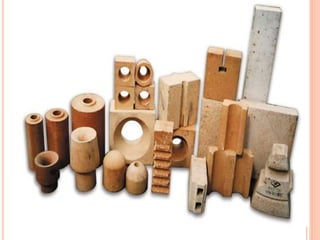
 Generally the materials used in manufacturing
of refractories are oxides of alumina, silica,
magnesia etc.
GENERAL PROPERTIES(CONT…..)
 Oxides of calcium(lime) are also one of the
general refractories found. Fire clays are
also used in the manufacturing of
refractories
 The highest referring melting pt. refractory is
hafnium carbide with a melting point of
39000
C(approx.)
CHARACTERISTICS OF GOOD
REFRACTORY
 Resistance against heat
 Resistance against corrosion
 Should have high fusing temperature
 Ability to withstand high load
 Should be chemically inert
 Should not undergo deformation
 Uniform expansion and contraction
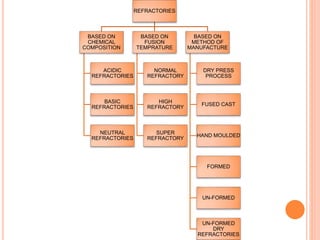
CLASSIFICATION OF REFRACTORIES
 The refractories are mainly classified on the basis
of chemical composition, fusion temperature,
method of manufacture
 The classification is as follows:
REFRACTORIES
BASED ON
CHEMICAL
COMPOSITION
ACIDIC
REFRACTORIES
BASIC
REFRACTORIES
NEUTRAL
REFRACTORIES
BASED ON
FUSION
TEMPRATURE
NORMAL
REFRACTORY
HIGH
REFRACTORY
SUPER
REFRACTORY
BASED ON
METHOD OF
MANUFACTURE
DRY PRESS
PROCESS
FUSED CAST
HAND MOULDED
FORMED
UN-FORMED
UN-FORMED
DRY
REFRACTORIES
BASED ON CHEMICAL COMPOSITION
 ACIDIC REFRACTORIES: The main element in
this type of refractory is silica which reacts with
bases such as alkalies, lime, basic oxides etc
 Also alumina(Al2O3) is the main component
along with silica
 Mostly these are used in places where the
atmosphere is acidic and these type of
refractories are stable to acid attacks but the
converse is not true
 The major use of these type of refractories is
done in steel and iron industries
BASED ON CHEMICAL
COMPOSITION(CONT…..)
 BASIC REFRACTORIES: The key material
used in this type of refractory is
magnesia(MgO) or dolomite(MgCO3
+CaCO3) or chrome-magnesia(Cr2O3+MgO)
 This type of refractory is used in work place
which has basic atmosphere(involving basic
chemicals)
 These are stable to basic attacks but they
are affected by acidic attacks
BASED ON CHEMICAL
COMPOSITION(CONT…..)
 NEUTRAL REFRACTORIES: These
refractories are used in areas where slag
and atmosphere is not fixed i.e. sometimes
acidic and sometimes basic
 Examples of these kind of materials are
alumina(Al2O3),chrome(Cr2O3) and carbon
 To avoid reaction between acidic bricks and
basic bricks we use the neutral bricks. The
neutral bricks are made up of graphite and
chromites
BASED ON FUSION TEMPERATURE
 Based on Fusion temperature refractories
are classified in following:
 NORMAL REFRACTORY: Fusion
temperature=1580-17800
C(ex: fire clay)
 HIGH REFRACTORY: Fusion
temperature=1780-20000
C(ex: chromite)
 SUPER REFRACTORY: Fusion
temperature>20000
C(ex: zirconia)
REFRACTORY ANCHORAGE
 Anchorage systems are must for all
refractories. Anchorage systems such as
wire formed anchors, ceramic tiles etc.
support the refractory lining
 The commonly used anchorage systems
have a rectangular or circular cross-section
 The rectangular cross section can bear
higher weight and it is used for high
thickness refractory whereas the circular
cross section can bear low weight and is
used for low thickness refractory
REFFRACTORY ANCHORAGE(CONT…)
 Refractories used for roofs demand the ability
to support the weight of refractory even at the
elevated temperatures and operating conditions
 The amount of anchors used in the refractory is
dependent on the working conditions of the
refractory
 The preference of anchors shape, materials,
size and numbers has significant impact on the
quality and life of refractory
RERRACTORY HEAT-UP
 Now after making of a new refractory lined
furnace or equipment the next step is to initiate
its working by heating it up in a controlled
manner
 It is done in order to stop spalling(the method in
which the flakes of a material are broken from a
large body by projectile impact, corrosion,
cavitations etc.) or shortening of the materials
predicted lifetime
 The technology which is used of heating up the
refractory must contain following features:
REFRACTORY HEAT-UP(CONT…)
 1.Thermal homogeneity within all the
equipment
 2.Thermal stability of the heat source
 3.Safety of operation
 4.Reproducibility(ability to reproduce)
COMPOSITION AND APPLICATION
THANKYOU

Refractories-A Short Description

  • 1.
  • 2.
    DEFINATION  The materialswhose usage is applied at temperature of >6000 C are considered as refractories  According to ASTM(American Society For Testing And Materials) C71 the definition of refractories is:  Non-metallic materials having those chemical and physical properties that made them applicable for structures, or as components of systems, that are exposed to environments above 10000 F(800K,5000 C)
  • 3.
    GENERAL PROPERTIES  Thesetype of materials are stable at high temperatures and also they retain their strength at same  As their operating environment are different, they need to be thermal resistant ,they must be chemically inert  Also they must be having a specific range of thermal conductivity and coefficient of thermal expansion depending upon their working conditions  Generally the materials used in manufacturing of refractories are oxides of alumina, silica, magnesia etc.
  • 4.
    GENERAL PROPERTIES(CONT…..)  Oxidesof calcium(lime) are also one of the general refractories found. Fire clays are also used in the manufacturing of refractories  The highest referring melting pt. refractory is hafnium carbide with a melting point of 39000 C(approx.)
  • 6.
    CHARACTERISTICS OF GOOD REFRACTORY Resistance against heat  Resistance against corrosion  Should have high fusing temperature  Ability to withstand high load  Should be chemically inert  Should not undergo deformation  Uniform expansion and contraction
  • 7.
    CLASSIFICATION OF REFRACTORIES The refractories are mainly classified on the basis of chemical composition, fusion temperature, method of manufacture  The classification is as follows:
  • 8.
  • 9.
    BASED ON CHEMICALCOMPOSITION  ACIDIC REFRACTORIES: The main element in this type of refractory is silica which reacts with bases such as alkalies, lime, basic oxides etc  Also alumina(Al2O3) is the main component along with silica  Mostly these are used in places where the atmosphere is acidic and these type of refractories are stable to acid attacks but the converse is not true  The major use of these type of refractories is done in steel and iron industries
  • 10.
    BASED ON CHEMICAL COMPOSITION(CONT…..) BASIC REFRACTORIES: The key material used in this type of refractory is magnesia(MgO) or dolomite(MgCO3 +CaCO3) or chrome-magnesia(Cr2O3+MgO)  This type of refractory is used in work place which has basic atmosphere(involving basic chemicals)  These are stable to basic attacks but they are affected by acidic attacks
  • 11.
    BASED ON CHEMICAL COMPOSITION(CONT…..) NEUTRAL REFRACTORIES: These refractories are used in areas where slag and atmosphere is not fixed i.e. sometimes acidic and sometimes basic  Examples of these kind of materials are alumina(Al2O3),chrome(Cr2O3) and carbon  To avoid reaction between acidic bricks and basic bricks we use the neutral bricks. The neutral bricks are made up of graphite and chromites
  • 12.
    BASED ON FUSIONTEMPERATURE  Based on Fusion temperature refractories are classified in following:  NORMAL REFRACTORY: Fusion temperature=1580-17800 C(ex: fire clay)  HIGH REFRACTORY: Fusion temperature=1780-20000 C(ex: chromite)  SUPER REFRACTORY: Fusion temperature>20000 C(ex: zirconia)
  • 13.
    REFRACTORY ANCHORAGE  Anchoragesystems are must for all refractories. Anchorage systems such as wire formed anchors, ceramic tiles etc. support the refractory lining  The commonly used anchorage systems have a rectangular or circular cross-section  The rectangular cross section can bear higher weight and it is used for high thickness refractory whereas the circular cross section can bear low weight and is used for low thickness refractory
  • 14.
    REFFRACTORY ANCHORAGE(CONT…)  Refractoriesused for roofs demand the ability to support the weight of refractory even at the elevated temperatures and operating conditions  The amount of anchors used in the refractory is dependent on the working conditions of the refractory  The preference of anchors shape, materials, size and numbers has significant impact on the quality and life of refractory
  • 16.
    RERRACTORY HEAT-UP  Nowafter making of a new refractory lined furnace or equipment the next step is to initiate its working by heating it up in a controlled manner  It is done in order to stop spalling(the method in which the flakes of a material are broken from a large body by projectile impact, corrosion, cavitations etc.) or shortening of the materials predicted lifetime  The technology which is used of heating up the refractory must contain following features:
  • 17.
    REFRACTORY HEAT-UP(CONT…)  1.Thermalhomogeneity within all the equipment  2.Thermal stability of the heat source  3.Safety of operation  4.Reproducibility(ability to reproduce)
  • 18.
  • 19.