GRAPHENE AND ITS
FUTURE
APPLICATIONS
BY: ARPIT AGARWAL
ELECTRICAL & ELECTRONICS (3RD YEAR)
1109721026
UNDER GUIDANCE OF:
Mr MANISH SRIVASTAVA
GRAPHENE: Structural Properties
* Hexagonal structural element of some carbon allotropes
including graphite, charcoal, carbon nanotubes and fullerenes
* Graphite (layered material) formed by stacks 41 of graphene sheets
separated by 0.3 nm and held together by weak vander Waals forces.
* Each atom forming 3 bonds with each of its nearest neighbors,
known as the sigma bonds.
* Fourth valence electron is in the 2pz state
oriented perpendicular to the sheet of graphite
forms a conducting sigma bond.
* Two dimensional sp2 hybridized forms of carbon
* Zero band gap semiconductor with 2 linearly
dispersing bands that touch at the corners of the first Brillouin zone.
a) Fullerene b) Nanotube
c) Graphite
Honey comb structure of
Graphene
GRAPHENE: Discovery
For decades but until recently there were no experiments on grapheme,
Due to the difficulty in separating and isolating single layers of graphene for study.
In 2004, Andre Geim and Kostya Novolselov came up with an ingenious method
after years of effort to isolate monolayer graphene flakes.
Andre and Kostya were awarded the 2010 Nobel prize in physics for this work.
At University of Manchester in
England, they simply stuck a flake
of graphite debris
onto plastic adhesive tape, folded
the sticky side of the tape over the
flake
and then pulled the tape apart,
cleaving the flake in two. As the
experimenters
repeated the process, the resulting
fragments grew thinner
Andre Geim
Kostya Novoselov
GRAPHENE: Synthesis
Two basic techniques used are :
1) To cleave multi layer graphite into single layers. (EXFOLIATION)
2) By depositing one layer of Carbon onto another material (EPITAXY)
a) DRAWING METHOD
The basic ‘recipe’ for making graphene using “scotch tape” technique
requires using 300nm of SiO2-coated silicon wafer as a substrate
and cleaning it with a mix of hydrochloric acid and hydrogen peroxide
To remove any residue that is adhering to the wafer.
Following this one patiently peels graphite by sandwiching it
between scotch tape repeatedly till the tape is translucent.
b) GRAPHITE OXIDE REDUCTION
Graphite can be oxidized to produced GO and then exfoliated
to create stable aqueous dispersions of individual sheets.
After deposition, GO may be reduced to graphene either
chemically or by means of thermal annealing
EXFOLIATION
Graphene layer formed using Scotch tape
Graphite oxide
exfoliated in water
as individual
platelets of
Graphene oxide
EPITAXY
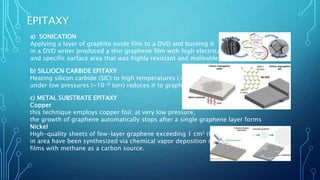
a) SONICATION
Applying a layer of graphite oxide film to a DVD and burning it
in a DVD writer produced a thin graphene film with high electrical conductivity
and specific surface area that was highly resistant and malleable
c) METAL SUBSTRATE EPITAXY
Copper
this technique employs copper foil; at very low pressure,
the growth of graphene automatically stops after a single graphene layer forms
Nickel
High-quality sheets of few-layer graphene exceeding 1 cm2 (0.2 sq in)
in area have been synthesized via chemical vapor deposition on thin nickel
films with methane as a carbon source.
b) SILLIOCN CARBIDE EPITAXY
Heating silicon carbide (SiC) to high temperatures (>1100 °C)
under low pressures (~10−6 torr) reduces it to graphene.
GRAPHENE: Characteristics
ELECTRONIC PROPERTIES
* High Electron Mobility at room temperature,
with reported values in excess of 15,000 cm2/Vs.
* Intrinsic graphene is a semi-metal or zero-gap semiconductor
* Low resistivity and better current capacity & temperature conductivity
* Graphene is estimated to operate at terahertzfrequencies
i.e. trillions of operations per second.
OPTICAL PROPERTIES
* An unexpectedly high opacity for an atomic monolayer,
it absorbs πα= 2.3% of white light, where α is the fine-structure constant.
* Graphene can be saturated readily under
strong excitation over the visible to near-infrared region,
due to the universal optical absorption
MECHANICAL PROPERITIES
* Strongest materials ever tested
* Breaking strength 200 times greater than steel, a bulk strength of130GPa.
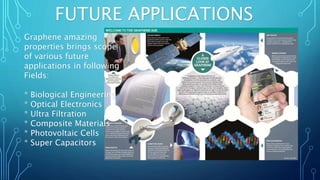
FUTURE APPLICATIONS
Graphene amazing
properties brings scope
of various future
applications in following
Fields:
* Biological Engineering
* Optical Electronics
* Ultra Filtration
* Composite Materials
* Photovoltaic Cells
* Super Capacitors
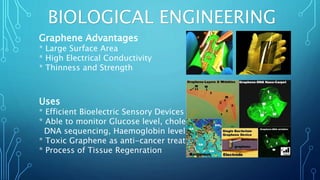
BIOLOGICAL ENGINEERING
Graphene Advantages
* Large Surface Area
* High Electrical Conductivity
* Thinness and Strength
Uses
* Efficient Bioelectric Sensory Devices
* Able to monitor Glucose level, cholesterol
DNA sequencing, Haemoglobin level etc
* Toxic Graphene as anti-cancer treatment
* Process of Tissue Regenration
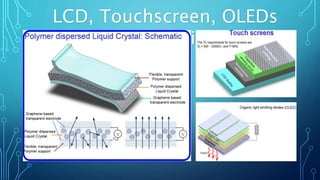
OPTICAL ELECTRONICS
Graphene Advantages
* Optically transmit more than 90% of light
* Conductivity more than 1x 10⁶ Ω1m1
* Completely Transparent material
* High Tensile strength and Flexible
* Able to replace Indium Tin Oxide (ITO)
due to less cost and better properties
Uses
* Touchscreens
* Liquid Crystal Display (LCD)
* Organic Light Emitting Diodes (OLEDs)
LCD, Touchscreen, OLEDs
Schematics
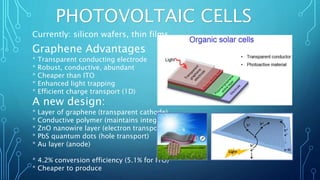
PHOTOVOLTAIC CELLS
Currently: silicon wafers, thin films
Graphene Advantages
* Transparent conducting electrode
* Robust, conductive, abundant
* Cheaper than ITO
* Enhanced light trapping
* Efficient charge transport (1D)
A new design:
* Layer of graphene (transparent cathode)
* Conductive polymer (maintains integrity)
* ZnO nanowire layer (electron transport)
* PbS quantum dots (hole transport)
* Au layer (anode)
* 4.2% conversion efficiency (5.1% for ITO)
* Cheaper to produce
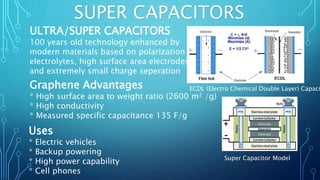
SUPER CAPACITORS
Graphene Advantages
* High surface area to weight ratio (2600 m2 /g)
* High conductivity
* Measured specific capacitance 135 F/g
Uses
* Electric vehicles
* Backup powering
* High power capability
* Cell phones
ULTRA/SUPER CAPACITORS
100 years old technology enhanced by
modern materials based on polarization of
electrolytes, high surface area electrodes
and extremely small charge seperation
ECDL (Electro Chemical Double Layer) Capaci
Super Capacitor Model
REFERENCES
* A.K. Geim and K.S. Novoselov- The Rise of Graphene, 2007. Nature Mater
* C. N. R. Rao, K. S. Subrahmanyam, H. S. S. Ramakrishna Matte and A. Gov
Chemistry and Physics of Materials Unit, International Centre for Materia
New Chemistry Unit and CSIR Centre of Excellence in Chemistry
* Andrea C. Ferrari Department of Engineering, Cambridge University, Cam
http://cape.eng.cam.ac.uk/
* Rodney S. Rodney S. Ruoff Ruoff ,The University of Texas at Austin
http://bucky--central.me.utexas.edu/
* www.en.wikipedia.org

Graphene and its future applications

  • 1.
    GRAPHENE AND ITS FUTURE APPLICATIONS BY:ARPIT AGARWAL ELECTRICAL & ELECTRONICS (3RD YEAR) 1109721026 UNDER GUIDANCE OF: Mr MANISH SRIVASTAVA
  • 2.
    GRAPHENE: Structural Properties *Hexagonal structural element of some carbon allotropes including graphite, charcoal, carbon nanotubes and fullerenes * Graphite (layered material) formed by stacks 41 of graphene sheets separated by 0.3 nm and held together by weak vander Waals forces. * Each atom forming 3 bonds with each of its nearest neighbors, known as the sigma bonds. * Fourth valence electron is in the 2pz state oriented perpendicular to the sheet of graphite forms a conducting sigma bond. * Two dimensional sp2 hybridized forms of carbon * Zero band gap semiconductor with 2 linearly dispersing bands that touch at the corners of the first Brillouin zone. a) Fullerene b) Nanotube c) Graphite Honey comb structure of Graphene
  • 3.
    GRAPHENE: Discovery For decadesbut until recently there were no experiments on grapheme, Due to the difficulty in separating and isolating single layers of graphene for study. In 2004, Andre Geim and Kostya Novolselov came up with an ingenious method after years of effort to isolate monolayer graphene flakes. Andre and Kostya were awarded the 2010 Nobel prize in physics for this work. At University of Manchester in England, they simply stuck a flake of graphite debris onto plastic adhesive tape, folded the sticky side of the tape over the flake and then pulled the tape apart, cleaving the flake in two. As the experimenters repeated the process, the resulting fragments grew thinner Andre Geim Kostya Novoselov
  • 4.
    GRAPHENE: Synthesis Two basictechniques used are : 1) To cleave multi layer graphite into single layers. (EXFOLIATION) 2) By depositing one layer of Carbon onto another material (EPITAXY) a) DRAWING METHOD The basic ‘recipe’ for making graphene using “scotch tape” technique requires using 300nm of SiO2-coated silicon wafer as a substrate and cleaning it with a mix of hydrochloric acid and hydrogen peroxide To remove any residue that is adhering to the wafer. Following this one patiently peels graphite by sandwiching it between scotch tape repeatedly till the tape is translucent. b) GRAPHITE OXIDE REDUCTION Graphite can be oxidized to produced GO and then exfoliated to create stable aqueous dispersions of individual sheets. After deposition, GO may be reduced to graphene either chemically or by means of thermal annealing EXFOLIATION Graphene layer formed using Scotch tape Graphite oxide exfoliated in water as individual platelets of Graphene oxide
  • 5.
    EPITAXY a) SONICATION Applying alayer of graphite oxide film to a DVD and burning it in a DVD writer produced a thin graphene film with high electrical conductivity and specific surface area that was highly resistant and malleable c) METAL SUBSTRATE EPITAXY Copper this technique employs copper foil; at very low pressure, the growth of graphene automatically stops after a single graphene layer forms Nickel High-quality sheets of few-layer graphene exceeding 1 cm2 (0.2 sq in) in area have been synthesized via chemical vapor deposition on thin nickel films with methane as a carbon source. b) SILLIOCN CARBIDE EPITAXY Heating silicon carbide (SiC) to high temperatures (>1100 °C) under low pressures (~10−6 torr) reduces it to graphene.
  • 6.
    GRAPHENE: Characteristics ELECTRONIC PROPERTIES *High Electron Mobility at room temperature, with reported values in excess of 15,000 cm2/Vs. * Intrinsic graphene is a semi-metal or zero-gap semiconductor * Low resistivity and better current capacity & temperature conductivity * Graphene is estimated to operate at terahertzfrequencies i.e. trillions of operations per second. OPTICAL PROPERTIES * An unexpectedly high opacity for an atomic monolayer, it absorbs πα= 2.3% of white light, where α is the fine-structure constant. * Graphene can be saturated readily under strong excitation over the visible to near-infrared region, due to the universal optical absorption MECHANICAL PROPERITIES * Strongest materials ever tested * Breaking strength 200 times greater than steel, a bulk strength of130GPa.
  • 7.
    FUTURE APPLICATIONS Graphene amazing propertiesbrings scope of various future applications in following Fields: * Biological Engineering * Optical Electronics * Ultra Filtration * Composite Materials * Photovoltaic Cells * Super Capacitors
  • 8.
    BIOLOGICAL ENGINEERING Graphene Advantages *Large Surface Area * High Electrical Conductivity * Thinness and Strength Uses * Efficient Bioelectric Sensory Devices * Able to monitor Glucose level, cholesterol DNA sequencing, Haemoglobin level etc * Toxic Graphene as anti-cancer treatment * Process of Tissue Regenration
  • 9.
    OPTICAL ELECTRONICS Graphene Advantages *Optically transmit more than 90% of light * Conductivity more than 1x 10⁶ Ω1m1 * Completely Transparent material * High Tensile strength and Flexible * Able to replace Indium Tin Oxide (ITO) due to less cost and better properties Uses * Touchscreens * Liquid Crystal Display (LCD) * Organic Light Emitting Diodes (OLEDs)
  • 10.
  • 11.
    PHOTOVOLTAIC CELLS Currently: siliconwafers, thin films Graphene Advantages * Transparent conducting electrode * Robust, conductive, abundant * Cheaper than ITO * Enhanced light trapping * Efficient charge transport (1D) A new design: * Layer of graphene (transparent cathode) * Conductive polymer (maintains integrity) * ZnO nanowire layer (electron transport) * PbS quantum dots (hole transport) * Au layer (anode) * 4.2% conversion efficiency (5.1% for ITO) * Cheaper to produce
  • 12.
    SUPER CAPACITORS Graphene Advantages *High surface area to weight ratio (2600 m2 /g) * High conductivity * Measured specific capacitance 135 F/g Uses * Electric vehicles * Backup powering * High power capability * Cell phones ULTRA/SUPER CAPACITORS 100 years old technology enhanced by modern materials based on polarization of electrolytes, high surface area electrodes and extremely small charge seperation ECDL (Electro Chemical Double Layer) Capaci Super Capacitor Model
  • 13.
    REFERENCES * A.K. Geimand K.S. Novoselov- The Rise of Graphene, 2007. Nature Mater * C. N. R. Rao, K. S. Subrahmanyam, H. S. S. Ramakrishna Matte and A. Gov Chemistry and Physics of Materials Unit, International Centre for Materia New Chemistry Unit and CSIR Centre of Excellence in Chemistry * Andrea C. Ferrari Department of Engineering, Cambridge University, Cam http://cape.eng.cam.ac.uk/ * Rodney S. Rodney S. Ruoff Ruoff ,The University of Texas at Austin http://bucky--central.me.utexas.edu/ * www.en.wikipedia.org