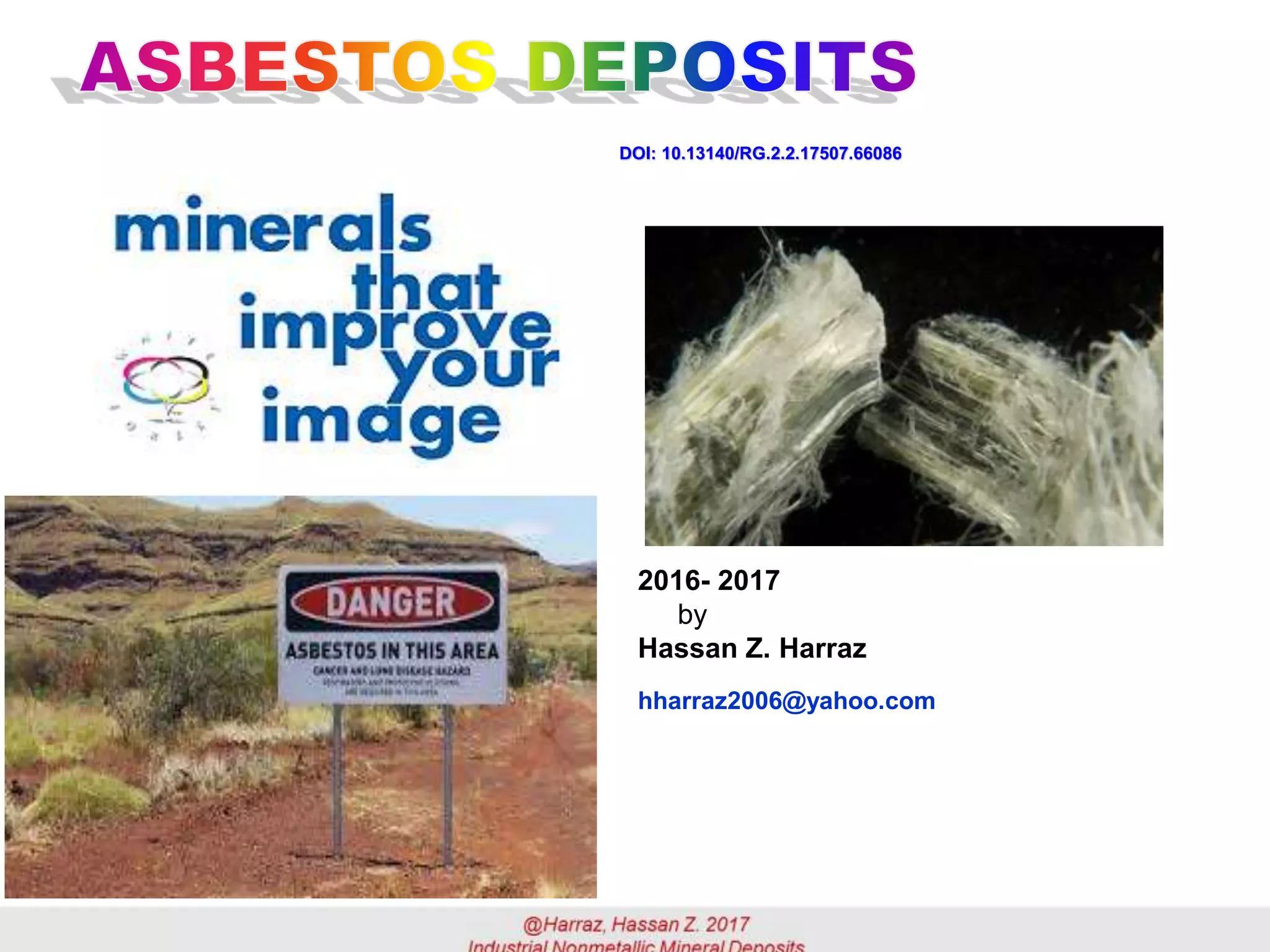
2016- 2017
by
Hassan Z. Harraz
hharraz2006@yahoo.com
DOI: 10.13140/RG.2.2.17507.66086
Objectives:
❖ Define what is asbestos
❖ Describe where asbestos is found
❖ Type of Asbestos Deposits
❖ Typical Asbestos Types in Structures
A) Serpentine Asbestos (or Chrysotile Asbestos)
B) Amphibole Asbestos :
❖ Resources Type of Asbestos
❖ OSHA’s Asbestos Standard
❖ Most Common Types of Asbestos
❖ Asbestos Fibrous Minerals
➢Properties of Asbestos Fibres
➢Types Of Asbestos Deposits
❖ Asbestos Grades
❖ THE MANUFACTURING PROCESS OF ASBESTOS
➢ Mining of Asbestos
➢ Separating of Asbestos
➢ Quality Control
❖ USES OF ASBESTOS
❖ APPLICATION OF ASBESTOS
➢ Properties Of Asbestos Cement Products
❖ Applications Of Asbestos Fibres
❖ World Asbestos Production
❖ World Asbestos Production by Type
❖ Global Asbestos Consumption
❖ Health Concerns
➢Asbestos Diseases
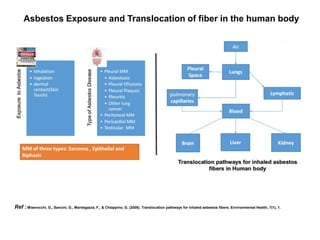
➢Asbestos Exposure and Translocation of fiber in the human body
➢Asbestos Fiber Facts
➢Cancer Hazard and Role of Fiber Glass
➢Asbestos – People At Risk?
➢How to Avoid Asbestos Exposure
❖ The Future
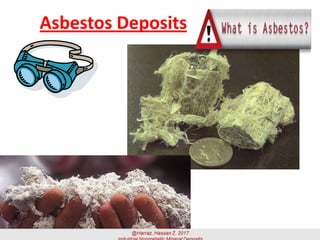
Asbestos Deposits
Asbestos History
 Many people believed asbestos a "miracle" product of the
20th century…. That couldn't be further from the truth.
 1st Century AD Pliny the Elder notes that slaves working in
asbestos mines die young of lung disease.
 The Greeks recognized that not everything about asbestos
was good.
➢ Greek and Roman scientists recognized asbestos caused
"sickness of the lungs" in the slaves that wove asbestos
into cloth or mined the mineral.
➢ Egyptian mummy’s were wrapped in asbestos containing
fabric
Asbestos – what is it?
The word "asbestos" comes from the Greek meaning
"inextinguishable."
Asbestos is a commercial term: Any fibrous mineral utilized
in an industrial process with a 3:1 length to width.
“A commercial term applied to a group of highly fibrous
silicate minerals that readily separate into long, thin, strong
fibers of sufficient flexibility to be woven.”
A collective mineralogic term that describes a variety of
certain silicates belonging to the serpentine and amphibole
mineral groups, which have crystallized in the asbestiform
habit causing them to be easily separated into long, thin,
flexible, strong fibers when crushed or processed.
5
Naturally occurring mineral, mined all over the world
Long silky fibers
Its heat resistance, tensile strength and insulating
properties:
✓ Resistant to abrasion
✓ Resistant to breakdown by acid and alkali
✓ Stable at high temperatures
✓ A highly heat- resistant fibrous silicate mineral
that can be woven into fabrics, and is used in
brake linings and in fire-resistance and insulating
materials.
✓ Very high tensile strength
Asbestos – what is it?
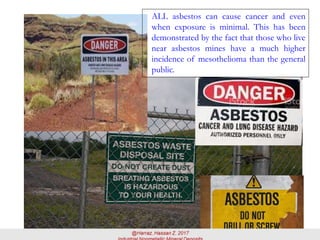
ALL asbestos can cause cancer and even
when exposure is minimal. This has been
demonstrated by the fact that those who live
near asbestos mines have a much higher
incidence of mesothelioma than the general
public.
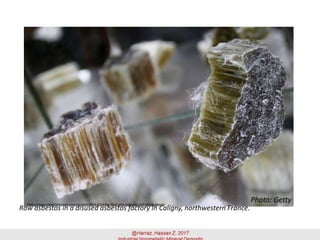
Raw asbestos in a disused asbestos factory in Caligny, northwestern France.
Photo: Gettyhttps://www.newstatesman.com/sci-tech/2014/03/killer-dust-why-asbestos-still-killing-people
Type of Asbestos Deposits
9
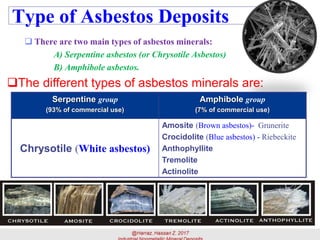
 There are two main types of asbestos minerals:
A) Serpentine asbestos (or Chrysotile Asbestos)
B) Amphibole asbestos.
Serpentine group
(93% of commercial use)
Amphibole group
(7% of commercial use)
Chrysotile (White asbestos)
Amosite (Brown asbestos)- Grunerite
Crocidolite (Blue asbestos) - Riebeckite
Anthophyllite
Tremolite
Actinolite
The different types of asbestos minerals are:
Typical Asbestos Types in Structures
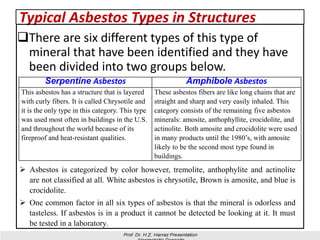
There are six different types of this type of
mineral that have been identified and they have
been divided into two groups below.
Serpentine Asbestos Amphibole Asbestos
This asbestos has a structure that is layered
with curly fibers. It is called Chrysotile and
it is the only type in this category. This type
was used most often in buildings in the U.S.
and throughout the world because of its
fireproof and heat-resistant qualities.
These asbestos fibers are like long chains that are
straight and sharp and very easily inhaled. This
category consists of the remaining five asbestos
minerals: amosite, anthophyllite, crocidolite, and
actinolite. Both amosite and crocidolite were used
in many products until the 1980’s, with amosite
likely to be the second most type found in
buildings.
➢ Asbestos is categorized by color however, tremolite, anthophylite and actinolite
are not classified at all. White asbestos is chrysotile, Brown is amosite, and blue is
crocidolite.
➢ One common factor in all six types of asbestos is that the mineral is odorless and
tasteless. If asbestos is in a product it cannot be detected be looking at it. It must
be tested in a laboratory.
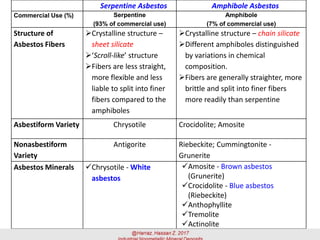
Serpentine Asbestos Amphibole Asbestos
Commercial Use (%) Serpentine
(93% of commercial use)
Amphibole
(7% of commercial use)
Structure of
Asbestos Fibers
➢Crystalline structure –
sheet silicate
➢‘Scroll-like’ structure
➢Fibers are less straight,
more flexible and less
liable to split into finer
fibers compared to the
amphiboles
➢Crystalline structure – chain silicate
➢Different amphiboles distinguished
by variations in chemical
composition.
➢Fibers are generally straighter, more
brittle and split into finer fibers
more readily than serpentine
Asbestiform Variety Chrysotile Crocidolite; Amosite
Nonasbestiform
Variety
Antigorite Riebeckite; Cummingtonite -
Grunerite
Asbestos Minerals ✓Chrysotile - White
asbestos
✓Amosite - Brown asbestos
(Grunerite)
✓Crocidolite - Blue asbestos
(Riebeckite)
✓Anthophyllite
✓Tremolite
✓Actinolite
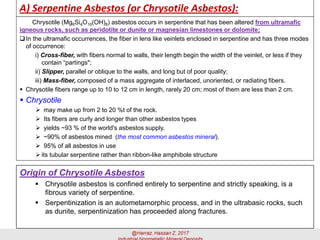
A) Serpentine Asbestos (or Chrysotile Asbestos):
Chrysotile (Mg6Si4O10(OH)8) asbestos occurs in serpentine that has been altered from ultramafic
igneous rocks, such as peridotite or dunite or magnesian limestones or dolomite;
In the ultramafic occurrences, the fiber in lens like veinlets enclosed in serpentine and has three modes
of occurrence:
i) Cross-fiber, with fibers normal to walls, their length begin the width of the veinlet, or less if they
contain “partings";
ii) Slipper, parallel or oblique to the walls, and long but of poor quality;
iii) Mass-fiber, composed of a mass aggregate of interlaced, unoriented, or radiating fibers.
▪ Chrysotile fibers range up to 10 to 12 cm in length, rarely 20 cm; most of them are less than 2 cm.
▪ Chrysotile
➢ may make up from 2 to 20 %t of the rock.
➢ Its fibers are curly and longer than other asbestos types
➢ yields ~93 % of the world's asbestos supply.
➢ ~90% of asbestos mined (the most common asbestos mineral).
➢ 95% of all asbestos in use
➢ its tubular serpentine rather than ribbon-like amphibole structure
Origin of Chrysotile Asbestos
▪ Chrysotile asbestos is confined entirely to serpentine and strictly speaking, is a
fibrous variety of serpentine.
▪ Serpentinization is an autometamorphic process, and in the ultrabasic rocks, such
as dunite, serpentinization has proceeded along fractures.
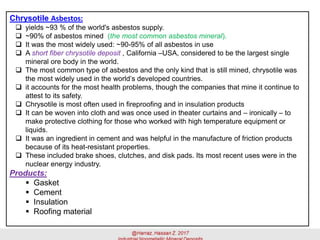
Chrysotile Asbestos:
 yields ~93 % of the world's asbestos supply.
 ~90% of asbestos mined (the most common asbestos mineral).
 It was the most widely used: ~90-95% of all asbestos in use
 A short fiber chrysotile deposit , California –USA, considered to be the largest single
mineral ore body in the world.
 The most common type of asbestos and the only kind that is still mined, chrysotile was
the most widely used in the world’s developed countries.
 it accounts for the most health problems, though the companies that mine it continue to
attest to its safety.
 Chrysotile is most often used in fireproofing and in insulation products
 It can be woven into cloth and was once used in theater curtains and – ironically – to
make protective clothing for those who worked with high temperature equipment or
liquids.
 It was an ingredient in cement and was helpful in the manufacture of friction products
because of its heat-resistant properties.
 These included brake shoes, clutches, and disk pads. Its most recent uses were in the
nuclear energy industry.
Products:
▪ Gasket
▪ Cement
▪ Insulation
▪ Roofing material
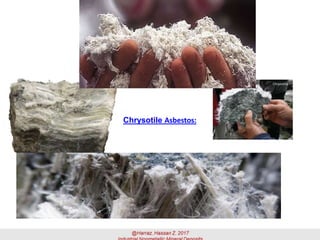
Chrysotile Asbestos:
B) Amphibole Asbestos :
▪ The amphiboles comprise the minerals:
amosite, crocidolite, termolite, actinolite and
anthophyllite.
▪ The amphibole varieties, of which crocidolite
and amosite are the most important.
▪ The crocidolite deposits are said to be the most
extensive asbestos deposits in the world.
Anthophyllite [Mg2Mg5]Si8O22(OH)2
Crocidolite = Riebeckite Na2[(Fe, Mg)3Fe3+
2] Si8O22(OH)2
Amosite = Grunerite [Fe2Fe2+
5]Si8O22(OH)2
Actinolite Ca2(Mg4.5-2.5Fe2+
0.5-2.5)Si8O22(OH)2
Tremolite Ca2Mg5Si8O22(OH)2
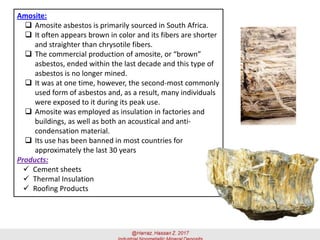
Amosite:
 Amosite asbestos is primarily sourced in South Africa.
 It often appears brown in color and its fibers are shorter
and straighter than chrysotile fibers.
 The commercial production of amosite, or “brown”
asbestos, ended within the last decade and this type of
asbestos is no longer mined.
 It was at one time, however, the second-most commonly
used form of asbestos and, as a result, many individuals
were exposed to it during its peak use.
 Amosite was employed as insulation in factories and
buildings, as well as both an acoustical and anti-
condensation material.
 Its use has been banned in most countries for
approximately the last 30 years
Products:
✓ Cement sheets
✓ Thermal Insulation
✓ Roofing Products
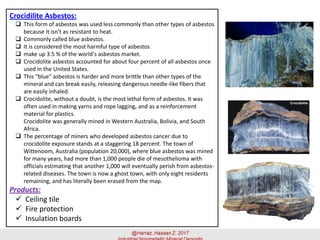
Crocidilite Asbestos:
 This form of asbestos was used less commonly than other types of asbestos
because it isn't as resistant to heat.
 Commonly called blue asbestos.
 It is considered the most harmful type of asbestos
 make up 3.5 % of the world's asbestos market.
 Crocidolite asbestos accounted for about four percent of all asbestos once
used in the United States.
 This “blue” asbestos is harder and more brittle than other types of the
mineral and can break easily, releasing dangerous needle-like fibers that
are easily inhaled.
 Crocidolite, without a doubt, is the most lethal form of asbestos. It was
often used in making yarns and rope lagging, and as a reinforcement
material for plastics.
Crocidolite was generally mined in Western Australia, Bolivia, and South
Africa.
 The percentage of miners who developed asbestos cancer due to
crocidolite exposure stands at a staggering 18 percent. The town of
Wittenoom, Australia (population 20,000), where blue asbestos was mined
for many years, had more than 1,000 people die of mesothelioma with
officials estimating that another 1,000 will eventually perish from asbestos-
related diseases. The town is now a ghost town, with only eight residents
remaining, and has literally been erased from the map.
Products:
✓ Ceiling tile
✓ Fire protection
✓ Insulation boards
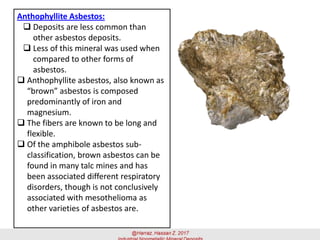
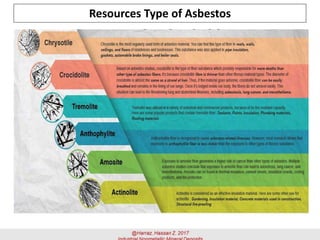
Anthophyllite Asbestos:
 Deposits are less common than
other asbestos deposits.
 Less of this mineral was used when
compared to other forms of
asbestos.
 Anthophyllite asbestos, also known as
“brown” asbestos is composed
predominantly of iron and
magnesium.
 The fibers are known to be long and
flexible.
 Of the amphibole asbestos sub-
classification, brown asbestos can be
found in many talc mines and has
been associated different respiratory
disorders, though is not conclusively
associated with mesothelioma as
other varieties of asbestos are.
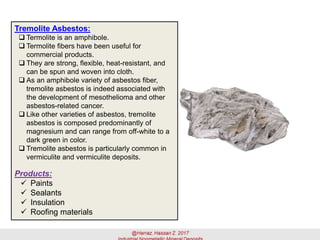
Tremolite Asbestos:
 Termolite is an amphibole.
 Termolite fibers have been useful for
commercial products.
 They are strong, flexible, heat-resistant, and
can be spun and woven into cloth.
 As an amphibole variety of asbestos fiber,
tremolite asbestos is indeed associated with
the development of mesothelioma and other
asbestos-related cancer.
 Like other varieties of asbestos, tremolite
asbestos is composed predominantly of
magnesium and can range from off-white to a
dark green in color.
 Tremolite asbestos is particularly common in
vermiculite and vermiculite deposits.
Products:
✓ Paints
✓ Sealants
✓ Insulation
✓ Roofing materials
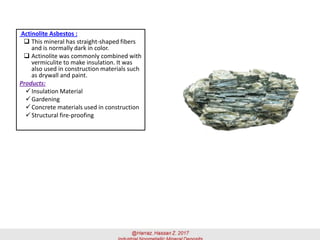
Actinolite Asbestos :
 This mineral has straight-shaped fibers
and is normally dark in color.
 Actinolite was commonly combined with
vermiculite to make insulation. It was
also used in construction materials such
as drywall and paint.
Products:
✓Insulation Material
✓Gardening
✓Concrete materials used in construction
✓Structural fire-proofing
Resources Type of Asbestos
OSHA’s Asbestos Standard
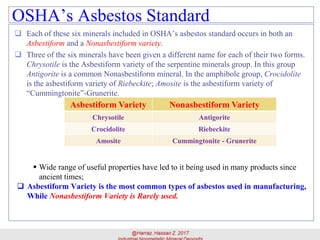
 Each of these six minerals included in OSHA’s asbestos standard occurs in both an
Asbestiform and a Nonasbestiform variety.
 Three of the six minerals have been given a different name for each of their two forms.
Chrysotile is the Asbestiform variety of the serpentine minerals group. In this group
Antigorite is a common Nonasbestiform mineral. In the amphibole group, Crocidolite
is the asbestiform variety of Riebeckite; Amosite is the asbestiform variety of
“Cummingtonite”-Grunerite.
22
▪ Wide range of useful properties have led to it being used in many products since
ancient times;
 Asbestiform Variety is the most common types of asbestos used in manufacturing,
While Nonasbestiform Variety is Rarely used.
Asbestiform Variety Nonasbestiform Variety
Chrysotile Antigorite
Crocidolite Riebeckite
Amosite Cummingtonite - Grunerite
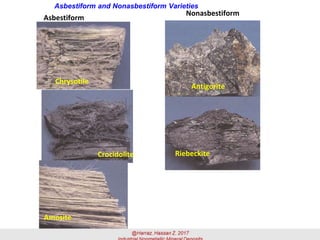
Asbestiform
Nonasbestiform
Chrysotile
Antigorite
Crocidolite Riebeckite
Amosite
Asbestiform and Nonasbestiform Varieties
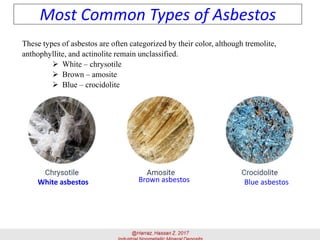
Most Common Types of Asbestos
White asbestos Brown asbestos Blue asbestos
These types of asbestos are often categorized by their color, although tremolite,
anthophyllite, and actinolite remain unclassified.
➢ White – chrysotile
➢ Brown – amosite
➢ Blue – crocidolite
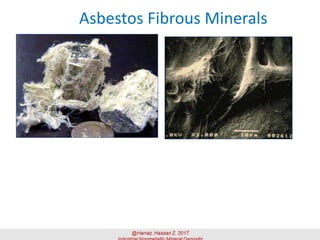
Asbestos Fibrous Minerals
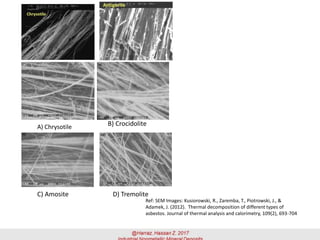
A) Chrysotile
Ref: SEM Images: Kusiorowski, R., Zaremba, T., Piotrowski, J., &
Adamek, J. (2012). Thermal decomposition of different types of
asbestos. Journal of thermal analysis and calorimetry, 109(2), 693-704
B) Crocidolite
D) TremoliteC) Amosite
Properties of Asbestos Fibres
 Industrial applications of asbestos take advantage of a combination of properties:
➢ Occur as bundles of fibres
✓ Easily separated
✓ Can split into thinner fibres
➢ Use of fibre as reinforcing material largely dependent on length of fibre.
➢ High length / diameter (aspect) ratios
✓ Minimum of 20 – can be up to 1000
➢ Combustibility
✓ Asbestos fibres do not burn, although will undergo changes at high temperatures
• Widespread use as fire-proofing
➢ Thermal conductivity
✓ Resistance to heat (i.e., heat-resistant fibers)
✓ All asbestos types have very low thermal conductivities – i.e. they are all very good insulating
materials
• Widespread use in thermal insulation and lagging
➢ Other properties that make asbestos useful include:
✓ Flexibility…Sufficiently flexible to be spun
✓ High tensile strength
✓ lower refractive index
✓ greater surface area and positive surface charge
✓ Low electrical conductivity
✓ Resistance to chemical attack (i.e., greater susceptibility to decomposition by strong acids).
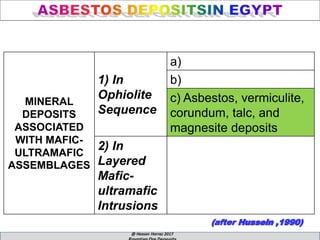
MINERAL
DEPOSITS
ASSOCIATED
WITH MAFIC-
ULTRAMAFIC
ASSEMBLAGES
1) In
Ophiolite
Sequence
a)
b)
c) Asbestos, vermiculite,
corundum, talc, and
magnesite deposits
2) In
Layered
Mafic-
ultramafic
Intrusions
Types Of Asbestos Deposits
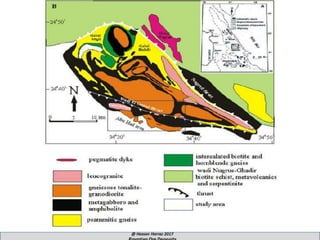
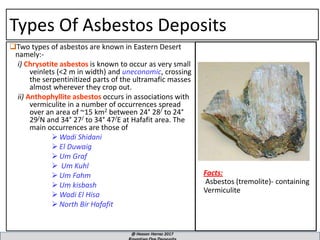
Two types of asbestos are known in Eastern Desert
namely:-
i) Chrysotite asbestos is known to occur as very small
veinlets (<2 m in width) and uneconomic, crossing
the serpentinitized parts of the ultramafic masses
almost wherever they crop out.
ii) Anthophyllite asbestos occurs in associations with
vermiculite in a number of occurrences spread
over an area of ~15 km2 between 24° 28/ to 24°
29/N and 34° 27/ to 34° 47/E at Hafafit area. The
main occurrences are those of
➢ Wadi Shidani
➢ El Duwaig
➢ Um Graf
➢ Um Kuhl
➢ Um Fahm
➢ Um kisbash
➢ Wadi El Hisa
➢ North Bir Hafafit
Facts:
Asbestos (tremolite)- containing
Vermiculite
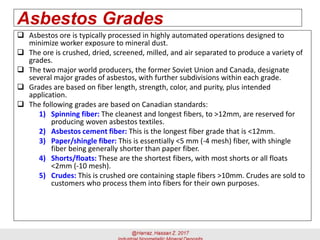
Asbestos Grades
 Asbestos ore is typically processed in highly automated operations designed to
minimize worker exposure to mineral dust.
 The ore is crushed, dried, screened, milled, and air separated to produce a variety of
grades.
 The two major world producers, the former Soviet Union and Canada, designate
several major grades of asbestos, with further subdivisions within each grade.
 Grades are based on fiber length, strength, color, and purity, plus intended
application.
 The following grades are based on Canadian standards:
1) Spinning fiber: The cleanest and longest fibers, to >12mm, are reserved for
producing woven asbestos textiles.
2) Asbestos cement fiber: This is the longest fiber grade that is <12mm.
3) Paper/shingle fiber: This is essentially <5 mm (-4 mesh) fiber, with shingle
fiber being generally shorter than paper fiber.
4) Shorts/floats: These are the shortest fibers, with most shorts or all floats
<2mm (-10 mesh).
5) Crudes: This is crushed ore containing staple fibers >10mm. Crudes are sold to
customers who process them into fibers for their own purposes.
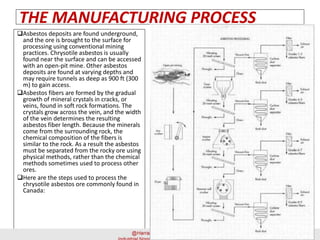
THE MANUFACTURING PROCESS
Asbestos deposits are found underground,
and the ore is brought to the surface for
processing using conventional mining
practices. Chrysotile asbestos is usually
found near the surface and can be accessed
with an open-pit mine. Other asbestos
deposits are found at varying depths and
may require tunnels as deep as 900 ft (300
m) to gain access.
Asbestos fibers are formed by the gradual
growth of mineral crystals in cracks, or
veins, found in soft rock formations. The
crystals grow across the vein, and the width
of the vein determines the resulting
asbestos fiber length. Because the minerals
come from the surrounding rock, the
chemical composition of the fibers is
similar to the rock. As a result the asbestos
must be separated from the rocky ore using
physical methods, rather than the chemical
methods sometimes used to process other
ores.
Here are the steps used to process the
chrysotile asbestos ore commonly found in
Canada:
A) Mining of Asbestos
• Chrysoltile asbestos deposits are usually located using a magnetic sensor
called a magnometer.
• This method relies on the fact that the magnetic mineral magnetite is often
found near asbestos formations.
• Core drillings are used to pinpoint the location of the deposits and to
determine the size and purity of the asbestos.
• Most chrysotile asbestos mining operations are conducted in an open-pit
mine.
• A spiraling series of flat terraces, or benches, are cut into the sloping interior
sides of the pit.
• These are used both as a work platform and as a roadway for hauling the
ore up and out of the pit. The asbestos ore deposits are loosened from the
surrounding rock by careful drilling and blasting with explosives. The
resulting rocky debris is loaded into large rubber-tired haul trucks and
brought out of the mine. Some operations use an excavation technique
called block caving, in which a section of the ore deposit is under-cut until it
crumbles under its own weight and slides down a chute into the waiting haul
trucks.
B) Separating of Asbestos
The ore contains only about 10% asbestos, which must be carefully separated from the rock to avoid fracturing
the very thin fibers. The most common method of separation is called dry milling. In this method, the primary
separation is done in a series of crushing and vacuum aspirating operations in which the asbestos fibers are
literally sucked out of the ore. This is followed by a series of secondary separation operations to remove rock
dust and other small debris.
1)The ore is fed into a jaw crusher, which squeezes the ore to break it up into pieces that are 0.75 in (20.0
mm) in diameter or less. The crushed ore is then dried to remove any moisture that may be present.
2)The ore falls on the surface of a vibrating 30-mesh screen, which has openings that are 0.002 in (0.06 mm)
in diameter. As the screen vibrates, the loosened asbestos fibers rise to the top of the crushed ore and are
vacuumed off. Because the crushed ore is much denser than the fibers, only the very smallest rock particles
get vacuumed off with the asbestos.
3)The very fine silt and rock particles that fall through the vibrating screen are called throughs or tailings and
are discarded. The crushed ore pieces that remain on the screen are called overs and are moved to the
next stage of processing.
4)The crushed ore from the first screen is fed through a second crusher, which reduces the ore pieces to
about 0.25 in (6.0 mm) in diameter or less. The ore then falls on another vibrating 30-mesh screen and
repeats the process described in steps 3 and 4.
5)The process of crushing and vacuum aspiration of the asbestos fibers is repeated twice more. Each time
the pieces of ore get smaller until the last asbestos fibers are captured and the remaining ore is so small
that it falls through the screen and is discarded. This four-step process also separates the asbestos fibers
by length. The longest fibers are broken free from the surrounding rock in the first crusher and are
vacuumed off the first screen. Shorter length fibers are broken free and captured on each successive set of
crushers and screens, until the shortest fibers are captured on the last screen.
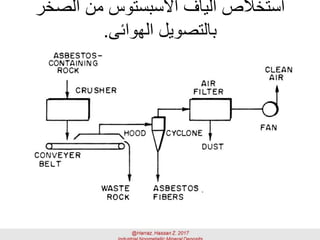
6)The asbestos fibers and other material captured from each screen are carried suspended in a stream of air
and run through four separate cyclone separators. The heavier debris and rock dust particles fall to the
center of the whirling air stream and drop out the bottom of the separators.
7)The air then passes through four separate sets of filters, which capture the different length asbestos fibers
for packaging.
‫الصخر‬ ‫من‬ ‫األسبستوس‬ ‫ألياف‬ ‫استخالص‬
‫الهوائى‬ ‫بالتصويل‬.
Quality Control
 Asbestos fibers are graded according to several factors. One of the most
important factors is their length, since this determines the applications
where they may be used and, therefore, their commercial value.
 The most common grading system for chrysotile asbestos fibers is called
the Quebec Standard dry classification method. This standard defines
nine grades of fibers from Grade 1, which is the longest, to Grade 9,
which is the shortest. At the upper end of the scale, Grades 1 through 3
are called long fibers and range from 0.74 in (19.0 mm) and longer down
to 0.25 in (6.0 mm) in length. Grades 4 through 6 are called medium
fibers, while Grades 7 through 9 are called short fibers. Grade 8 and 9
fibers are under 0.12 in (3.0 mm) long and are classified by their loose
density rather than their length.
 Other factors for establishing the quality of asbestos fibers include tests
to determine the degree of fiber separation or openness, the reinforcing
capacity of the fibers in concrete, and the dust and granule content.
Specific applications may require other quality control standards and
tests.
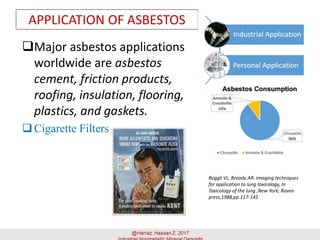
APPLICATION OF ASBESTOS
Roggli VL, Broody AR: Imaging techniques
for application to lung toxicology, In
Toxicology of the lung ,New York; Raven
press,1988,pp.117-145
Major asbestos applications
worldwide are asbestos
cement, friction products,
roofing, insulation, flooring,
plastics, and gaskets.
Cigarette Filters
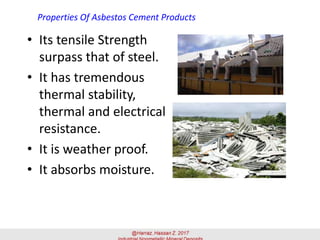
Properties Of Asbestos Cement Products
• Its tensile Strength
surpass that of steel.
• It has tremendous
thermal stability,
thermal and electrical
resistance.
• It is weather proof.
• It absorbs moisture.
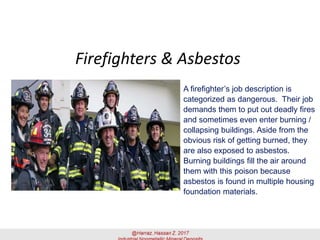
Firefighters & Asbestos
A firefighter’s job description is
categorized as dangerous. Their job
demands them to put out deadly fires
and sometimes even enter burning /
collapsing buildings. Aside from the
obvious risk of getting burned, they
are also exposed to asbestos.
Burning buildings fill the air around
them with this poison because
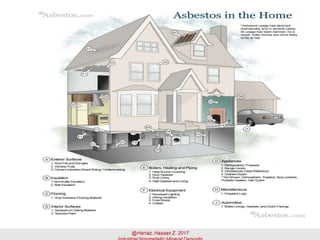
asbestos is found in multiple housing
foundation materials.
USES OF ASBESTOS
 Asbestos cement: In asbestos cement pipe asbestos provides good drainage and high green strength during
manufacture, plus high pipe tensile strength, impact strength, heat resistance, and alkali resistance. In
asbestos cement sheets it provides high flexural strength as well.
 Friction products: Paper and shingle fibers are used in molded clutch plates and disk brake pads, while short
and float fibers are used in brake linings.
➢ Clutch plates are also made from open-weave asbestos cloth impregnated with resin. In all cases,
asbestos is used for its durability, heat and moisture resistance, low thermal conductivity, and high
strength.
 Roofing: Short, float, and shingle fiber are used in asphalt shingles and roofing felts and in asphalt-based roof
coatings to provide dimensional stability and flexibility, to enhance crack resistance and weatherability, and to
control rheology (coatings).
 Insulating products: Textiles for heat-resistant protective clothing are woven from spinning fiber, but most
asbestos insulation products are in the form of paper, paperboard, millboard, and mat from paper-grade fiber.
➢ Asbestos provides flexibility, dimensional stability, tear resistance, heat resistance, chemical resistance,
moisture resistance, low thermal conductivity, and high electrical resistivity. Products include pipe wrap,
thermal insulation in appliances, and electrical and heat insulation in electronics.
 Flooring: Short fiber is used in vinyl tile to provide flexibility, resilience, durability, fire resistance, and
dimensional stability. Short fiber is also coated with rubber latex and formed into paper used as backing for
vinyl sheet flooring.
 Plastics: Abrasion-free asbestos is used to thicken and reinforce thermosets, providing heat, tear, and
electrical resistance, low heat deformation, high strength, and stiffness. Short and float fibers are used as
fillers; mat, felt, paper and cloth are impregnated with resin to form laminates.
 Gaskets: Abrasion-free asbestos cement- and paper-grade fibers are used in rubber-based gaskets and
packing to provide resilience, plus resistance to heat, tear, and chemical attack. Densified latex-asbestos
paper is also used to make gaskets.
 Other uses: Short and float fibers are used in textured paints, drywall joint cements, caulking compounds,
automotive undercoatings, and asphalt paving mixes for high traffic areas.
Uses of Asbestos Asbestos can be strung into thin, strong fibers that are flexible, heat resistant, and chemically
inert, thus making asbestos minerals suitable for use in fireproof fabrics, yarn, cloth, paper,
paint filler, gaskets, roofing composition, reinforcing agent in rubber and plastics, brake linings,
tiles, electrical and heat insulation, cement, and chemical filters.
 The crystal structure and chemical composition of this mineral make its fibers very
strong and resistant to heat and chemicals. Thus, asbestos is an excellent source for
building materials, including ceiling and floor tiles, insulation for walls and pipes,
decorative coatings, and roofing materials.
 Widespread uses of asbestos include:
➢ Thermal and acoustic insulation
➢ Spray coating (as fire protection)
➢ Fireproofing
➢ Artificial fireplaces and materials
➢ Asbestos reinforced building board
➢ Re-enforcing concrete, tiles
➢ Asbestos reinforced cement products
➢ Plastic products (e.g. vinyl floor tiles)
➢ Textiles
➢ Brake linings
➢ Pot holders and ironing board pads
➢ Patching and spackling compounds
➢ Wall and ceiling panels
➢ Pipe and duct insulation
➢ Building insulation
➢ Friction materials (brake pads …etc)
➢ Gaskets and packing materials
➢ Roofing felts, Roofing materials. … etc
‫؟‬ ‫األسبستوس‬ ‫يستخدم‬ ‫فيما‬
‫الص‬ ‫في‬ ‫أخرى‬ ‫مواد‬ ‫مع‬ ‫دمجه‬ َّ‫م‬‫ت‬ ‫السابقة‬ ‫األسبستوس‬ ‫ألياف‬ ‫لخواص‬‫ناعات‬
‫اآلتية‬:
(1‫العوازل‬:‫األسبست‬ ‫وأسمنت‬ ‫العازل‬ ‫والطوب‬ ‫المعزولة‬ ‫األنابيب‬ ‫مثل‬‫وس‬
(2‫السفن‬ ‫بناء‬.
(3‫التكرير‬ ‫ومعامل‬ ‫الطاقة‬ ‫وحدات‬
(4‫وعازلة‬ ‫للحرائق‬ ‫مقاومة‬ ‫بناء‬ ‫مواد‬ ‫إلنتاج‬ ‫والتشييد‬ ‫البناء‬ ‫شركات‬‫للصوت‬
‫األسطح‬ ‫ومواد‬ ‫الترميم‬ ‫ومواد‬ ‫وللحرارة‬.
(5‫مثل‬ ‫النسيج‬ ‫صناعات‬:‫والبطاطين‬ ‫القفازات‬ ‫صناعة‬
(6‫السيارات‬ ‫وتروس‬ ‫فرامل‬ ‫في‬.
(7‫الكهربائية‬ ‫األسالك‬.
(8‫الشعر‬ ‫مجففات‬
(9‫الخبزالمنزلية‬ ‫أفران‬(toasters)
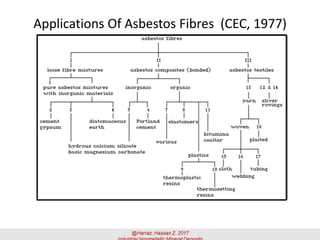
Applications Of Asbestos Fibres (CEC, 1977)
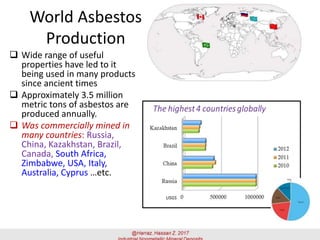
World Asbestos
Production
 Wide range of useful
properties have led to it
being used in many products
since ancient times
 Approximately 3.5 million
metric tons of asbestos are
produced annually.
 Was commercially mined in
many countries: Russia,
China, Kazakhstan, Brazil,
Canada, South Africa,
Zimbabwe, USA, Italy,
Australia, Cyprus …etc.
USGS
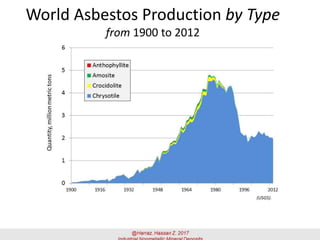
World Asbestos Production by Type
from 1900 to 2012
(USGS).
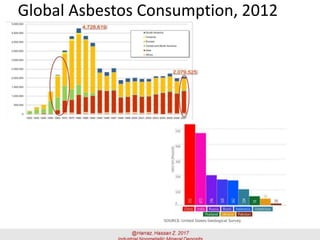
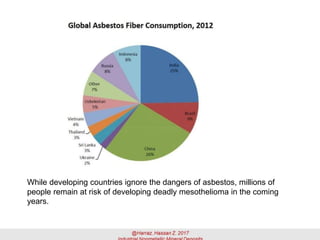
Global Asbestos Consumption, 2012
While developing countries ignore the dangers of asbestos, millions of
people remain at risk of developing deadly mesothelioma in the coming
years.
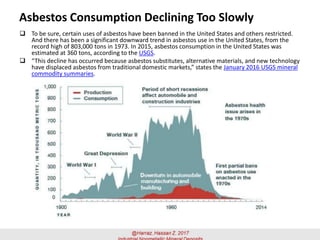
Asbestos Consumption Declining Too Slowly
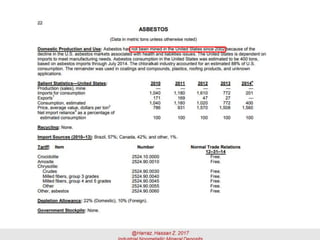
 To be sure, certain uses of asbestos have been banned in the United States and others restricted.
And there has been a significant downward trend in asbestos use in the United States, from the
record high of 803,000 tons in 1973. In 2015, asbestos consumption in the United States was
estimated at 360 tons, according to the USGS.
 “This decline has occurred because asbestos substitutes, alternative materials, and new technology
have displaced asbestos from traditional domestic markets,” states the January 2016 USGS mineral
commodity summaries.
Health Effects
Because it is so hard to destroy asbestos fibers, the
body cannot break them down or remove them once
they are lodged in lung or body tissues. They remain
in place where they can cause disease.
There are three primary diseases associated with
asbestos exposure:
❖Asbestosis
❖Lung Cancer
❖Mesothelioma
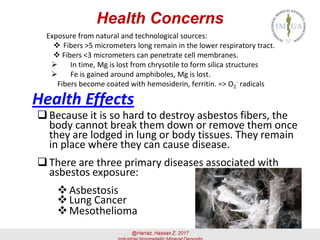
Exposure from natural and technological sources:
❖ Fibers >5 micrometers long remain in the lower respiratory tract.
❖ Fibers <3 micrometers can penetrate cell membranes.
➢ In time, Mg is lost from chrysotile to form silica structures
➢ Fe is gained around amphiboles, Mg is lost.
Fibers become coated with hemosiderin, ferritin. => O2
- radicals
Health Concerns
Asbestos Diseases
1) Asbestosis: Fibrosis of the lung tissue associated with heavy and prolonged
exposure to all types of asbestos. It leads to breathing problems and heart failure.
Pleural plaques: localized fibrous scars lining the space surrounding the lungs.
2) Mesothelioma: rare, malignant tumors of the pleural, pericardial, or peritoneal
linings.
It has a strong association with crocidolite asbestos. Heavy exposure to
chrysotile does not increase the risk.
It becomes significant 20 years after the 1st exposure and continues to climb in
rate even after 45 years. It is usually fatal [50% of 280 such deaths per year in
US & Canada are linked to asbestos].
The problem is international.
3) Bronchoginic carcinoma: LUNG CANCER
Increased death rate appears after 10 to 14 years from 1st exposure. Incidence
peaks after 35 years. Strongly correlated with smoking. Non-smokers probably
are not at risk. Associated with all types of asbestos.
Asbestos Exposure and Translocation of fiber in the human body
Ref : Miserocchi, G., Sancini, G., Mantegazza, F., & Chiappino, G. (2008). Translocation pathways for inhaled asbestos fibers. Environmental Health, 7(1), 1.
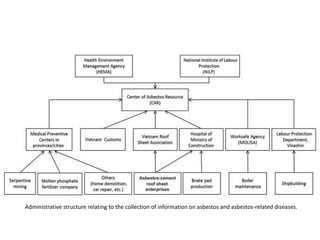
Administrative structure relating to the collection of information on asbestos and asbestos-related diseases.
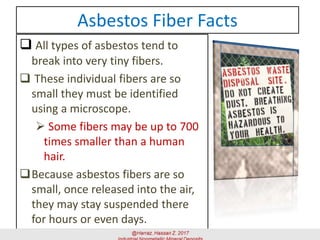
Asbestos Fiber Facts
 All types of asbestos tend to
break into very tiny fibers.
 These individual fibers are so
small they must be identified
using a microscope.
➢ Some fibers may be up to 700
times smaller than a human
hair.
Because asbestos fibers are so
small, once released into the air,
they may stay suspended there
for hours or even days.
Cancer Hazard and Role of Fiber Glass
 The use of asbestos and asbestos-containing products has decreased
dramatically but they continue to pose a health risk to workers and others
because they are still found in numerous commercial and residential settings.
 There have been more cases of Mesothelioma and cancer found in people
working with Crocidolite than any other type of asbestos. However, all forms
of asbestos, except Chrysotile, are of the same mineralogical family called
Amphiboles. Even though there appear to be fewer incidences of disease in
workers who deal only with Chrysotile, all asbestos forms are believed to
carry similar risks.
 Asbestos-containing material (ACM) is dangerous if the asbestos fibers
can be released. Once they are floating freely in the air, asbestos fibers can
be inhaled and cause disease.
 Some ACM can easily be crumbled by hand pressure. This soft or loosely-
bound material is called “friable” asbestos. Friable ACM is the greatest
health concern because it can easily release fibers. In places where it is
beginning to deteriorate, the likelihood of fiber release is even greater.
Examples of friable asbestos-containing materials are sprayed-on asbestos
ceiling insulation, fireproofing on structural beams and troweled-on acoustical
insulation.
 Hard ACM, in which asbestos fibers are firmly bound or encased, such as
vinyl floor tile, does not generally create exposure problems. However, if it is
sanded, ground, cut or disturbed in some way, even non-friable ACM can
release fibers and present a hazard. Therefore, any material that contains
asbestos has the potential to release fibers and become hazardous.
Asbestos – People At Risk?
 Evidence of harmful effects from asbestos exposure became
apparent during the 20th century
 Workers initially found to be at risk
▪ Asbestos miners
▪ Asbestos insulation installers (laggers)
▪ Asbestos textile workers
▪ (Groups with very high exposure levels)
 Occurrence of asbestosis documented first, followed later by
increased risk of lung cancer and then mesothelioma
 As use of asbestos insulating board increased – builders and
construction trades exposed to high levels of asbestos
How to Avoid Asbestos Exposure
• In order to avoid being exposed to asbestos, you must be
aware of the locations it is likely to be found. If you do not
know whether something is asbestos or not, assume that it
is until it is verified otherwise. Remember that you cannot
tell if floor or ceiling tiles contain asbestos just by looking
at them.
• If you do not know that a building material is
asbestos free…….DOT DISTURB IT.
Never
Drill Break
Hammer Damage
Cut Move
Saw Disturb
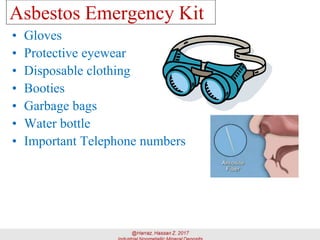
Asbestos Emergency Kit
• Gloves
• Protective eyewear
• Disposable clothing
• Booties
• Garbage bags
• Water bottle
• Important Telephone numbers
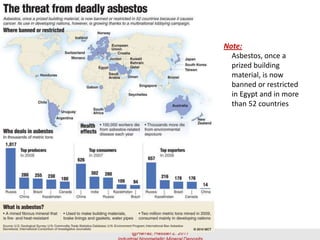
Note:
Asbestos, once a
prized building
material, is now
banned or restricted
in Egypt and in more
than 52 countries
The Future
• Asbestos is still an important component in
many products and processes, although its
usage is expected to remain low in the United
States. The stricter exposure regulations and
improved manufacturing and handling
procedures now in place are expected to
eliminate health problems associated with
asbestos.
References
Brady, George S., Henry R. Clauser, and John A. Vaccari. Materials Handbook, 14th Edition. McGraw-Hill, 1997.
Hornbostel, Caleb.Construction Materials, 2nd Edition. John Wiley and Sons, Inc., 1991.
OSHA Asbestos Web Page. Retrieved from:
• http://www.osha.gov/SLTC/asbestos/index.html
Environmental Health and Safety online:
• http://www.ehso.com/Asbestos/asbestreg.php
Environmental Protection Agency. Libby Site Background. Retrieved from:
• http://www.epa.gov/region8/superfund/libby/background.html
U-W Madison. General Safety, Asbestos. Retrieved from:
• http://www2.fpm.wisc.edu/safety/gsp/Asbestos.htm
Mesothelioma Cancer Alliance. Retrieved from:
• http://www.mesothelioma.com/
http://www.mesothelioma.com/asbestos-cancer/asbestos-types/#ixzz3E4hmEzab
Hessel PA et al. Asbestos, asbestosis, and lung cancer: a critical assessment of the epidemiological evidence. Thorax 2005.
• http://www.atsdr.cdc.gov/DT/fibrous-glass.html
• http://www.osha.gov/SLTC/etools/silica/silicosis/silicosis.html
• Camus M et al. Nonoccupational Exposure to Chrysotile Asbestos and the Risk of Lung Cancer N Engl J Med 1998
• Beckett WS. Current Concepts: Occupational Respiratory Diseases. N Engl J Med 2000
• Steele JPC. Prognostic Factors for Mesothelioma. Hematol Oncol Clin N Am. 2005
• West SD, Lee YCG. Management of Malignant Pleural Mesothelioma. Clin Chest Med 2006
• Krug LM. An overview of the chemotherapy for mesothelioma. Hematol Oncol Clin N Am 2005
• Calvert et al. Occupational silica exposure and risk of various diseases: an analysis using death certificates from 27 states of the United States.
Occup Environ Med. 2003; 60(2):122-9.
• Occupational, Industrial, and Environmental Toxicology. M Greenberg (ed.). Mosby, Inc 2003
• Yarborough. Chrysotile as a cause of mesothelioma: An assessment based on epidemiology. Crit Rev Toxicol. 36: 165-187. 2006
• http://www.asbestos-institute.ca.
• http://www.epa.gov/ttnuatwl/hlthef/asbestos.html.

Asbestos deposits

  • 1.
    2016- 2017 by Hassan Z.Harraz hharraz2006@yahoo.com DOI: 10.13140/RG.2.2.17507.66086
  • 2.
    Objectives: ❖ Define whatis asbestos ❖ Describe where asbestos is found ❖ Type of Asbestos Deposits ❖ Typical Asbestos Types in Structures A) Serpentine Asbestos (or Chrysotile Asbestos) B) Amphibole Asbestos : ❖ Resources Type of Asbestos ❖ OSHA’s Asbestos Standard ❖ Most Common Types of Asbestos ❖ Asbestos Fibrous Minerals ➢Properties of Asbestos Fibres ➢Types Of Asbestos Deposits ❖ Asbestos Grades ❖ THE MANUFACTURING PROCESS OF ASBESTOS ➢ Mining of Asbestos ➢ Separating of Asbestos ➢ Quality Control ❖ USES OF ASBESTOS ❖ APPLICATION OF ASBESTOS ➢ Properties Of Asbestos Cement Products ❖ Applications Of Asbestos Fibres ❖ World Asbestos Production ❖ World Asbestos Production by Type ❖ Global Asbestos Consumption ❖ Health Concerns ➢Asbestos Diseases ➢Asbestos Exposure and Translocation of fiber in the human body ➢Asbestos Fiber Facts ➢Cancer Hazard and Role of Fiber Glass ➢Asbestos – People At Risk? ➢How to Avoid Asbestos Exposure ❖ The Future
  • 3.
  • 4.
    Asbestos History  Manypeople believed asbestos a "miracle" product of the 20th century…. That couldn't be further from the truth.  1st Century AD Pliny the Elder notes that slaves working in asbestos mines die young of lung disease.  The Greeks recognized that not everything about asbestos was good. ➢ Greek and Roman scientists recognized asbestos caused "sickness of the lungs" in the slaves that wove asbestos into cloth or mined the mineral. ➢ Egyptian mummy’s were wrapped in asbestos containing fabric
  • 5.
    Asbestos – whatis it? The word "asbestos" comes from the Greek meaning "inextinguishable." Asbestos is a commercial term: Any fibrous mineral utilized in an industrial process with a 3:1 length to width. “A commercial term applied to a group of highly fibrous silicate minerals that readily separate into long, thin, strong fibers of sufficient flexibility to be woven.” A collective mineralogic term that describes a variety of certain silicates belonging to the serpentine and amphibole mineral groups, which have crystallized in the asbestiform habit causing them to be easily separated into long, thin, flexible, strong fibers when crushed or processed. 5
  • 6.
    Naturally occurring mineral,mined all over the world Long silky fibers Its heat resistance, tensile strength and insulating properties: ✓ Resistant to abrasion ✓ Resistant to breakdown by acid and alkali ✓ Stable at high temperatures ✓ A highly heat- resistant fibrous silicate mineral that can be woven into fabrics, and is used in brake linings and in fire-resistance and insulating materials. ✓ Very high tensile strength Asbestos – what is it?
  • 7.
    ALL asbestos cancause cancer and even when exposure is minimal. This has been demonstrated by the fact that those who live near asbestos mines have a much higher incidence of mesothelioma than the general public.
  • 8.
    Raw asbestos ina disused asbestos factory in Caligny, northwestern France. Photo: Gettyhttps://www.newstatesman.com/sci-tech/2014/03/killer-dust-why-asbestos-still-killing-people
  • 9.
    Type of AsbestosDeposits 9  There are two main types of asbestos minerals: A) Serpentine asbestos (or Chrysotile Asbestos) B) Amphibole asbestos. Serpentine group (93% of commercial use) Amphibole group (7% of commercial use) Chrysotile (White asbestos) Amosite (Brown asbestos)- Grunerite Crocidolite (Blue asbestos) - Riebeckite Anthophyllite Tremolite Actinolite The different types of asbestos minerals are:
  • 10.
    Typical Asbestos Typesin Structures There are six different types of this type of mineral that have been identified and they have been divided into two groups below. Serpentine Asbestos Amphibole Asbestos This asbestos has a structure that is layered with curly fibers. It is called Chrysotile and it is the only type in this category. This type was used most often in buildings in the U.S. and throughout the world because of its fireproof and heat-resistant qualities. These asbestos fibers are like long chains that are straight and sharp and very easily inhaled. This category consists of the remaining five asbestos minerals: amosite, anthophyllite, crocidolite, and actinolite. Both amosite and crocidolite were used in many products until the 1980’s, with amosite likely to be the second most type found in buildings. ➢ Asbestos is categorized by color however, tremolite, anthophylite and actinolite are not classified at all. White asbestos is chrysotile, Brown is amosite, and blue is crocidolite. ➢ One common factor in all six types of asbestos is that the mineral is odorless and tasteless. If asbestos is in a product it cannot be detected be looking at it. It must be tested in a laboratory.
  • 11.
    Serpentine Asbestos AmphiboleAsbestos Commercial Use (%) Serpentine (93% of commercial use) Amphibole (7% of commercial use) Structure of Asbestos Fibers ➢Crystalline structure – sheet silicate ➢‘Scroll-like’ structure ➢Fibers are less straight, more flexible and less liable to split into finer fibers compared to the amphiboles ➢Crystalline structure – chain silicate ➢Different amphiboles distinguished by variations in chemical composition. ➢Fibers are generally straighter, more brittle and split into finer fibers more readily than serpentine Asbestiform Variety Chrysotile Crocidolite; Amosite Nonasbestiform Variety Antigorite Riebeckite; Cummingtonite - Grunerite Asbestos Minerals ✓Chrysotile - White asbestos ✓Amosite - Brown asbestos (Grunerite) ✓Crocidolite - Blue asbestos (Riebeckite) ✓Anthophyllite ✓Tremolite ✓Actinolite
  • 12.
    A) Serpentine Asbestos(or Chrysotile Asbestos): Chrysotile (Mg6Si4O10(OH)8) asbestos occurs in serpentine that has been altered from ultramafic igneous rocks, such as peridotite or dunite or magnesian limestones or dolomite; In the ultramafic occurrences, the fiber in lens like veinlets enclosed in serpentine and has three modes of occurrence: i) Cross-fiber, with fibers normal to walls, their length begin the width of the veinlet, or less if they contain “partings"; ii) Slipper, parallel or oblique to the walls, and long but of poor quality; iii) Mass-fiber, composed of a mass aggregate of interlaced, unoriented, or radiating fibers. ▪ Chrysotile fibers range up to 10 to 12 cm in length, rarely 20 cm; most of them are less than 2 cm. ▪ Chrysotile ➢ may make up from 2 to 20 %t of the rock. ➢ Its fibers are curly and longer than other asbestos types ➢ yields ~93 % of the world's asbestos supply. ➢ ~90% of asbestos mined (the most common asbestos mineral). ➢ 95% of all asbestos in use ➢ its tubular serpentine rather than ribbon-like amphibole structure Origin of Chrysotile Asbestos ▪ Chrysotile asbestos is confined entirely to serpentine and strictly speaking, is a fibrous variety of serpentine. ▪ Serpentinization is an autometamorphic process, and in the ultrabasic rocks, such as dunite, serpentinization has proceeded along fractures.
  • 13.
    Chrysotile Asbestos:  yields~93 % of the world's asbestos supply.  ~90% of asbestos mined (the most common asbestos mineral).  It was the most widely used: ~90-95% of all asbestos in use  A short fiber chrysotile deposit , California –USA, considered to be the largest single mineral ore body in the world.  The most common type of asbestos and the only kind that is still mined, chrysotile was the most widely used in the world’s developed countries.  it accounts for the most health problems, though the companies that mine it continue to attest to its safety.  Chrysotile is most often used in fireproofing and in insulation products  It can be woven into cloth and was once used in theater curtains and – ironically – to make protective clothing for those who worked with high temperature equipment or liquids.  It was an ingredient in cement and was helpful in the manufacture of friction products because of its heat-resistant properties.  These included brake shoes, clutches, and disk pads. Its most recent uses were in the nuclear energy industry. Products: ▪ Gasket ▪ Cement ▪ Insulation ▪ Roofing material
  • 14.
  • 15.
    B) Amphibole Asbestos: ▪ The amphiboles comprise the minerals: amosite, crocidolite, termolite, actinolite and anthophyllite. ▪ The amphibole varieties, of which crocidolite and amosite are the most important. ▪ The crocidolite deposits are said to be the most extensive asbestos deposits in the world. Anthophyllite [Mg2Mg5]Si8O22(OH)2 Crocidolite = Riebeckite Na2[(Fe, Mg)3Fe3+ 2] Si8O22(OH)2 Amosite = Grunerite [Fe2Fe2+ 5]Si8O22(OH)2 Actinolite Ca2(Mg4.5-2.5Fe2+ 0.5-2.5)Si8O22(OH)2 Tremolite Ca2Mg5Si8O22(OH)2
  • 16.
    Amosite:  Amosite asbestosis primarily sourced in South Africa.  It often appears brown in color and its fibers are shorter and straighter than chrysotile fibers.  The commercial production of amosite, or “brown” asbestos, ended within the last decade and this type of asbestos is no longer mined.  It was at one time, however, the second-most commonly used form of asbestos and, as a result, many individuals were exposed to it during its peak use.  Amosite was employed as insulation in factories and buildings, as well as both an acoustical and anti- condensation material.  Its use has been banned in most countries for approximately the last 30 years Products: ✓ Cement sheets ✓ Thermal Insulation ✓ Roofing Products
  • 17.
    Crocidilite Asbestos:  Thisform of asbestos was used less commonly than other types of asbestos because it isn't as resistant to heat.  Commonly called blue asbestos.  It is considered the most harmful type of asbestos  make up 3.5 % of the world's asbestos market.  Crocidolite asbestos accounted for about four percent of all asbestos once used in the United States.  This “blue” asbestos is harder and more brittle than other types of the mineral and can break easily, releasing dangerous needle-like fibers that are easily inhaled.  Crocidolite, without a doubt, is the most lethal form of asbestos. It was often used in making yarns and rope lagging, and as a reinforcement material for plastics. Crocidolite was generally mined in Western Australia, Bolivia, and South Africa.  The percentage of miners who developed asbestos cancer due to crocidolite exposure stands at a staggering 18 percent. The town of Wittenoom, Australia (population 20,000), where blue asbestos was mined for many years, had more than 1,000 people die of mesothelioma with officials estimating that another 1,000 will eventually perish from asbestos- related diseases. The town is now a ghost town, with only eight residents remaining, and has literally been erased from the map. Products: ✓ Ceiling tile ✓ Fire protection ✓ Insulation boards
  • 18.
    Anthophyllite Asbestos:  Depositsare less common than other asbestos deposits.  Less of this mineral was used when compared to other forms of asbestos.  Anthophyllite asbestos, also known as “brown” asbestos is composed predominantly of iron and magnesium.  The fibers are known to be long and flexible.  Of the amphibole asbestos sub- classification, brown asbestos can be found in many talc mines and has been associated different respiratory disorders, though is not conclusively associated with mesothelioma as other varieties of asbestos are.
  • 19.
    Tremolite Asbestos:  Termoliteis an amphibole.  Termolite fibers have been useful for commercial products.  They are strong, flexible, heat-resistant, and can be spun and woven into cloth.  As an amphibole variety of asbestos fiber, tremolite asbestos is indeed associated with the development of mesothelioma and other asbestos-related cancer.  Like other varieties of asbestos, tremolite asbestos is composed predominantly of magnesium and can range from off-white to a dark green in color.  Tremolite asbestos is particularly common in vermiculite and vermiculite deposits. Products: ✓ Paints ✓ Sealants ✓ Insulation ✓ Roofing materials
  • 20.
    Actinolite Asbestos : This mineral has straight-shaped fibers and is normally dark in color.  Actinolite was commonly combined with vermiculite to make insulation. It was also used in construction materials such as drywall and paint. Products: ✓Insulation Material ✓Gardening ✓Concrete materials used in construction ✓Structural fire-proofing
  • 21.
  • 22.
    OSHA’s Asbestos Standard Each of these six minerals included in OSHA’s asbestos standard occurs in both an Asbestiform and a Nonasbestiform variety.  Three of the six minerals have been given a different name for each of their two forms. Chrysotile is the Asbestiform variety of the serpentine minerals group. In this group Antigorite is a common Nonasbestiform mineral. In the amphibole group, Crocidolite is the asbestiform variety of Riebeckite; Amosite is the asbestiform variety of “Cummingtonite”-Grunerite. 22 ▪ Wide range of useful properties have led to it being used in many products since ancient times;  Asbestiform Variety is the most common types of asbestos used in manufacturing, While Nonasbestiform Variety is Rarely used. Asbestiform Variety Nonasbestiform Variety Chrysotile Antigorite Crocidolite Riebeckite Amosite Cummingtonite - Grunerite
  • 23.
  • 24.
    Most Common Typesof Asbestos White asbestos Brown asbestos Blue asbestos These types of asbestos are often categorized by their color, although tremolite, anthophyllite, and actinolite remain unclassified. ➢ White – chrysotile ➢ Brown – amosite ➢ Blue – crocidolite
  • 25.
  • 26.
    A) Chrysotile Ref: SEMImages: Kusiorowski, R., Zaremba, T., Piotrowski, J., & Adamek, J. (2012). Thermal decomposition of different types of asbestos. Journal of thermal analysis and calorimetry, 109(2), 693-704 B) Crocidolite D) TremoliteC) Amosite
  • 27.
    Properties of AsbestosFibres  Industrial applications of asbestos take advantage of a combination of properties: ➢ Occur as bundles of fibres ✓ Easily separated ✓ Can split into thinner fibres ➢ Use of fibre as reinforcing material largely dependent on length of fibre. ➢ High length / diameter (aspect) ratios ✓ Minimum of 20 – can be up to 1000 ➢ Combustibility ✓ Asbestos fibres do not burn, although will undergo changes at high temperatures • Widespread use as fire-proofing ➢ Thermal conductivity ✓ Resistance to heat (i.e., heat-resistant fibers) ✓ All asbestos types have very low thermal conductivities – i.e. they are all very good insulating materials • Widespread use in thermal insulation and lagging ➢ Other properties that make asbestos useful include: ✓ Flexibility…Sufficiently flexible to be spun ✓ High tensile strength ✓ lower refractive index ✓ greater surface area and positive surface charge ✓ Low electrical conductivity ✓ Resistance to chemical attack (i.e., greater susceptibility to decomposition by strong acids).
  • 28.
    MINERAL DEPOSITS ASSOCIATED WITH MAFIC- ULTRAMAFIC ASSEMBLAGES 1) In Ophiolite Sequence a) b) c)Asbestos, vermiculite, corundum, talc, and magnesite deposits 2) In Layered Mafic- ultramafic Intrusions
  • 30.
    Types Of AsbestosDeposits Two types of asbestos are known in Eastern Desert namely:- i) Chrysotite asbestos is known to occur as very small veinlets (<2 m in width) and uneconomic, crossing the serpentinitized parts of the ultramafic masses almost wherever they crop out. ii) Anthophyllite asbestos occurs in associations with vermiculite in a number of occurrences spread over an area of ~15 km2 between 24° 28/ to 24° 29/N and 34° 27/ to 34° 47/E at Hafafit area. The main occurrences are those of ➢ Wadi Shidani ➢ El Duwaig ➢ Um Graf ➢ Um Kuhl ➢ Um Fahm ➢ Um kisbash ➢ Wadi El Hisa ➢ North Bir Hafafit Facts: Asbestos (tremolite)- containing Vermiculite
  • 31.
    Asbestos Grades  Asbestosore is typically processed in highly automated operations designed to minimize worker exposure to mineral dust.  The ore is crushed, dried, screened, milled, and air separated to produce a variety of grades.  The two major world producers, the former Soviet Union and Canada, designate several major grades of asbestos, with further subdivisions within each grade.  Grades are based on fiber length, strength, color, and purity, plus intended application.  The following grades are based on Canadian standards: 1) Spinning fiber: The cleanest and longest fibers, to >12mm, are reserved for producing woven asbestos textiles. 2) Asbestos cement fiber: This is the longest fiber grade that is <12mm. 3) Paper/shingle fiber: This is essentially <5 mm (-4 mesh) fiber, with shingle fiber being generally shorter than paper fiber. 4) Shorts/floats: These are the shortest fibers, with most shorts or all floats <2mm (-10 mesh). 5) Crudes: This is crushed ore containing staple fibers >10mm. Crudes are sold to customers who process them into fibers for their own purposes.
  • 32.
    THE MANUFACTURING PROCESS Asbestosdeposits are found underground, and the ore is brought to the surface for processing using conventional mining practices. Chrysotile asbestos is usually found near the surface and can be accessed with an open-pit mine. Other asbestos deposits are found at varying depths and may require tunnels as deep as 900 ft (300 m) to gain access. Asbestos fibers are formed by the gradual growth of mineral crystals in cracks, or veins, found in soft rock formations. The crystals grow across the vein, and the width of the vein determines the resulting asbestos fiber length. Because the minerals come from the surrounding rock, the chemical composition of the fibers is similar to the rock. As a result the asbestos must be separated from the rocky ore using physical methods, rather than the chemical methods sometimes used to process other ores. Here are the steps used to process the chrysotile asbestos ore commonly found in Canada:
  • 33.
    A) Mining ofAsbestos • Chrysoltile asbestos deposits are usually located using a magnetic sensor called a magnometer. • This method relies on the fact that the magnetic mineral magnetite is often found near asbestos formations. • Core drillings are used to pinpoint the location of the deposits and to determine the size and purity of the asbestos. • Most chrysotile asbestos mining operations are conducted in an open-pit mine. • A spiraling series of flat terraces, or benches, are cut into the sloping interior sides of the pit. • These are used both as a work platform and as a roadway for hauling the ore up and out of the pit. The asbestos ore deposits are loosened from the surrounding rock by careful drilling and blasting with explosives. The resulting rocky debris is loaded into large rubber-tired haul trucks and brought out of the mine. Some operations use an excavation technique called block caving, in which a section of the ore deposit is under-cut until it crumbles under its own weight and slides down a chute into the waiting haul trucks.
  • 34.
    B) Separating ofAsbestos The ore contains only about 10% asbestos, which must be carefully separated from the rock to avoid fracturing the very thin fibers. The most common method of separation is called dry milling. In this method, the primary separation is done in a series of crushing and vacuum aspirating operations in which the asbestos fibers are literally sucked out of the ore. This is followed by a series of secondary separation operations to remove rock dust and other small debris. 1)The ore is fed into a jaw crusher, which squeezes the ore to break it up into pieces that are 0.75 in (20.0 mm) in diameter or less. The crushed ore is then dried to remove any moisture that may be present. 2)The ore falls on the surface of a vibrating 30-mesh screen, which has openings that are 0.002 in (0.06 mm) in diameter. As the screen vibrates, the loosened asbestos fibers rise to the top of the crushed ore and are vacuumed off. Because the crushed ore is much denser than the fibers, only the very smallest rock particles get vacuumed off with the asbestos. 3)The very fine silt and rock particles that fall through the vibrating screen are called throughs or tailings and are discarded. The crushed ore pieces that remain on the screen are called overs and are moved to the next stage of processing. 4)The crushed ore from the first screen is fed through a second crusher, which reduces the ore pieces to about 0.25 in (6.0 mm) in diameter or less. The ore then falls on another vibrating 30-mesh screen and repeats the process described in steps 3 and 4. 5)The process of crushing and vacuum aspiration of the asbestos fibers is repeated twice more. Each time the pieces of ore get smaller until the last asbestos fibers are captured and the remaining ore is so small that it falls through the screen and is discarded. This four-step process also separates the asbestos fibers by length. The longest fibers are broken free from the surrounding rock in the first crusher and are vacuumed off the first screen. Shorter length fibers are broken free and captured on each successive set of crushers and screens, until the shortest fibers are captured on the last screen. 6)The asbestos fibers and other material captured from each screen are carried suspended in a stream of air and run through four separate cyclone separators. The heavier debris and rock dust particles fall to the center of the whirling air stream and drop out the bottom of the separators. 7)The air then passes through four separate sets of filters, which capture the different length asbestos fibers for packaging.
  • 35.
    ‫الصخر‬ ‫من‬ ‫األسبستوس‬‫ألياف‬ ‫استخالص‬ ‫الهوائى‬ ‫بالتصويل‬.
  • 36.
    Quality Control  Asbestosfibers are graded according to several factors. One of the most important factors is their length, since this determines the applications where they may be used and, therefore, their commercial value.  The most common grading system for chrysotile asbestos fibers is called the Quebec Standard dry classification method. This standard defines nine grades of fibers from Grade 1, which is the longest, to Grade 9, which is the shortest. At the upper end of the scale, Grades 1 through 3 are called long fibers and range from 0.74 in (19.0 mm) and longer down to 0.25 in (6.0 mm) in length. Grades 4 through 6 are called medium fibers, while Grades 7 through 9 are called short fibers. Grade 8 and 9 fibers are under 0.12 in (3.0 mm) long and are classified by their loose density rather than their length.  Other factors for establishing the quality of asbestos fibers include tests to determine the degree of fiber separation or openness, the reinforcing capacity of the fibers in concrete, and the dust and granule content. Specific applications may require other quality control standards and tests.
  • 37.
    APPLICATION OF ASBESTOS RoggliVL, Broody AR: Imaging techniques for application to lung toxicology, In Toxicology of the lung ,New York; Raven press,1988,pp.117-145 Major asbestos applications worldwide are asbestos cement, friction products, roofing, insulation, flooring, plastics, and gaskets. Cigarette Filters
  • 39.
    Properties Of AsbestosCement Products • Its tensile Strength surpass that of steel. • It has tremendous thermal stability, thermal and electrical resistance. • It is weather proof. • It absorbs moisture.
  • 40.
    Firefighters & Asbestos Afirefighter’s job description is categorized as dangerous. Their job demands them to put out deadly fires and sometimes even enter burning / collapsing buildings. Aside from the obvious risk of getting burned, they are also exposed to asbestos. Burning buildings fill the air around them with this poison because asbestos is found in multiple housing foundation materials.
  • 41.
    USES OF ASBESTOS Asbestos cement: In asbestos cement pipe asbestos provides good drainage and high green strength during manufacture, plus high pipe tensile strength, impact strength, heat resistance, and alkali resistance. In asbestos cement sheets it provides high flexural strength as well.  Friction products: Paper and shingle fibers are used in molded clutch plates and disk brake pads, while short and float fibers are used in brake linings. ➢ Clutch plates are also made from open-weave asbestos cloth impregnated with resin. In all cases, asbestos is used for its durability, heat and moisture resistance, low thermal conductivity, and high strength.  Roofing: Short, float, and shingle fiber are used in asphalt shingles and roofing felts and in asphalt-based roof coatings to provide dimensional stability and flexibility, to enhance crack resistance and weatherability, and to control rheology (coatings).  Insulating products: Textiles for heat-resistant protective clothing are woven from spinning fiber, but most asbestos insulation products are in the form of paper, paperboard, millboard, and mat from paper-grade fiber. ➢ Asbestos provides flexibility, dimensional stability, tear resistance, heat resistance, chemical resistance, moisture resistance, low thermal conductivity, and high electrical resistivity. Products include pipe wrap, thermal insulation in appliances, and electrical and heat insulation in electronics.  Flooring: Short fiber is used in vinyl tile to provide flexibility, resilience, durability, fire resistance, and dimensional stability. Short fiber is also coated with rubber latex and formed into paper used as backing for vinyl sheet flooring.  Plastics: Abrasion-free asbestos is used to thicken and reinforce thermosets, providing heat, tear, and electrical resistance, low heat deformation, high strength, and stiffness. Short and float fibers are used as fillers; mat, felt, paper and cloth are impregnated with resin to form laminates.  Gaskets: Abrasion-free asbestos cement- and paper-grade fibers are used in rubber-based gaskets and packing to provide resilience, plus resistance to heat, tear, and chemical attack. Densified latex-asbestos paper is also used to make gaskets.  Other uses: Short and float fibers are used in textured paints, drywall joint cements, caulking compounds, automotive undercoatings, and asphalt paving mixes for high traffic areas.
  • 42.
    Uses of AsbestosAsbestos can be strung into thin, strong fibers that are flexible, heat resistant, and chemically inert, thus making asbestos minerals suitable for use in fireproof fabrics, yarn, cloth, paper, paint filler, gaskets, roofing composition, reinforcing agent in rubber and plastics, brake linings, tiles, electrical and heat insulation, cement, and chemical filters.  The crystal structure and chemical composition of this mineral make its fibers very strong and resistant to heat and chemicals. Thus, asbestos is an excellent source for building materials, including ceiling and floor tiles, insulation for walls and pipes, decorative coatings, and roofing materials.  Widespread uses of asbestos include: ➢ Thermal and acoustic insulation ➢ Spray coating (as fire protection) ➢ Fireproofing ➢ Artificial fireplaces and materials ➢ Asbestos reinforced building board ➢ Re-enforcing concrete, tiles ➢ Asbestos reinforced cement products ➢ Plastic products (e.g. vinyl floor tiles) ➢ Textiles ➢ Brake linings ➢ Pot holders and ironing board pads ➢ Patching and spackling compounds ➢ Wall and ceiling panels ➢ Pipe and duct insulation ➢ Building insulation ➢ Friction materials (brake pads …etc) ➢ Gaskets and packing materials ➢ Roofing felts, Roofing materials. … etc
  • 43.
    ‫؟‬ ‫األسبستوس‬ ‫يستخدم‬‫فيما‬ ‫الص‬ ‫في‬ ‫أخرى‬ ‫مواد‬ ‫مع‬ ‫دمجه‬ َّ‫م‬‫ت‬ ‫السابقة‬ ‫األسبستوس‬ ‫ألياف‬ ‫لخواص‬‫ناعات‬ ‫اآلتية‬: (1‫العوازل‬:‫األسبست‬ ‫وأسمنت‬ ‫العازل‬ ‫والطوب‬ ‫المعزولة‬ ‫األنابيب‬ ‫مثل‬‫وس‬ (2‫السفن‬ ‫بناء‬. (3‫التكرير‬ ‫ومعامل‬ ‫الطاقة‬ ‫وحدات‬ (4‫وعازلة‬ ‫للحرائق‬ ‫مقاومة‬ ‫بناء‬ ‫مواد‬ ‫إلنتاج‬ ‫والتشييد‬ ‫البناء‬ ‫شركات‬‫للصوت‬ ‫األسطح‬ ‫ومواد‬ ‫الترميم‬ ‫ومواد‬ ‫وللحرارة‬. (5‫مثل‬ ‫النسيج‬ ‫صناعات‬:‫والبطاطين‬ ‫القفازات‬ ‫صناعة‬ (6‫السيارات‬ ‫وتروس‬ ‫فرامل‬ ‫في‬. (7‫الكهربائية‬ ‫األسالك‬. (8‫الشعر‬ ‫مجففات‬ (9‫الخبزالمنزلية‬ ‫أفران‬(toasters)
  • 44.
    Applications Of AsbestosFibres (CEC, 1977)
  • 45.
    World Asbestos Production  Widerange of useful properties have led to it being used in many products since ancient times  Approximately 3.5 million metric tons of asbestos are produced annually.  Was commercially mined in many countries: Russia, China, Kazakhstan, Brazil, Canada, South Africa, Zimbabwe, USA, Italy, Australia, Cyprus …etc. USGS
  • 46.
    World Asbestos Productionby Type from 1900 to 2012 (USGS).
  • 47.
  • 48.
    While developing countriesignore the dangers of asbestos, millions of people remain at risk of developing deadly mesothelioma in the coming years.
  • 50.
    Asbestos Consumption DecliningToo Slowly  To be sure, certain uses of asbestos have been banned in the United States and others restricted. And there has been a significant downward trend in asbestos use in the United States, from the record high of 803,000 tons in 1973. In 2015, asbestos consumption in the United States was estimated at 360 tons, according to the USGS.  “This decline has occurred because asbestos substitutes, alternative materials, and new technology have displaced asbestos from traditional domestic markets,” states the January 2016 USGS mineral commodity summaries.
  • 51.
    Health Effects Because itis so hard to destroy asbestos fibers, the body cannot break them down or remove them once they are lodged in lung or body tissues. They remain in place where they can cause disease. There are three primary diseases associated with asbestos exposure: ❖Asbestosis ❖Lung Cancer ❖Mesothelioma Exposure from natural and technological sources: ❖ Fibers >5 micrometers long remain in the lower respiratory tract. ❖ Fibers <3 micrometers can penetrate cell membranes. ➢ In time, Mg is lost from chrysotile to form silica structures ➢ Fe is gained around amphiboles, Mg is lost. Fibers become coated with hemosiderin, ferritin. => O2 - radicals Health Concerns
  • 52.
    Asbestos Diseases 1) Asbestosis:Fibrosis of the lung tissue associated with heavy and prolonged exposure to all types of asbestos. It leads to breathing problems and heart failure. Pleural plaques: localized fibrous scars lining the space surrounding the lungs. 2) Mesothelioma: rare, malignant tumors of the pleural, pericardial, or peritoneal linings. It has a strong association with crocidolite asbestos. Heavy exposure to chrysotile does not increase the risk. It becomes significant 20 years after the 1st exposure and continues to climb in rate even after 45 years. It is usually fatal [50% of 280 such deaths per year in US & Canada are linked to asbestos]. The problem is international. 3) Bronchoginic carcinoma: LUNG CANCER Increased death rate appears after 10 to 14 years from 1st exposure. Incidence peaks after 35 years. Strongly correlated with smoking. Non-smokers probably are not at risk. Associated with all types of asbestos.
  • 53.
    Asbestos Exposure andTranslocation of fiber in the human body Ref : Miserocchi, G., Sancini, G., Mantegazza, F., & Chiappino, G. (2008). Translocation pathways for inhaled asbestos fibers. Environmental Health, 7(1), 1.
  • 54.
    Administrative structure relatingto the collection of information on asbestos and asbestos-related diseases.
  • 55.
    Asbestos Fiber Facts All types of asbestos tend to break into very tiny fibers.  These individual fibers are so small they must be identified using a microscope. ➢ Some fibers may be up to 700 times smaller than a human hair. Because asbestos fibers are so small, once released into the air, they may stay suspended there for hours or even days.
  • 56.
    Cancer Hazard andRole of Fiber Glass  The use of asbestos and asbestos-containing products has decreased dramatically but they continue to pose a health risk to workers and others because they are still found in numerous commercial and residential settings.  There have been more cases of Mesothelioma and cancer found in people working with Crocidolite than any other type of asbestos. However, all forms of asbestos, except Chrysotile, are of the same mineralogical family called Amphiboles. Even though there appear to be fewer incidences of disease in workers who deal only with Chrysotile, all asbestos forms are believed to carry similar risks.  Asbestos-containing material (ACM) is dangerous if the asbestos fibers can be released. Once they are floating freely in the air, asbestos fibers can be inhaled and cause disease.  Some ACM can easily be crumbled by hand pressure. This soft or loosely- bound material is called “friable” asbestos. Friable ACM is the greatest health concern because it can easily release fibers. In places where it is beginning to deteriorate, the likelihood of fiber release is even greater. Examples of friable asbestos-containing materials are sprayed-on asbestos ceiling insulation, fireproofing on structural beams and troweled-on acoustical insulation.  Hard ACM, in which asbestos fibers are firmly bound or encased, such as vinyl floor tile, does not generally create exposure problems. However, if it is sanded, ground, cut or disturbed in some way, even non-friable ACM can release fibers and present a hazard. Therefore, any material that contains asbestos has the potential to release fibers and become hazardous.
  • 57.
    Asbestos – PeopleAt Risk?  Evidence of harmful effects from asbestos exposure became apparent during the 20th century  Workers initially found to be at risk ▪ Asbestos miners ▪ Asbestos insulation installers (laggers) ▪ Asbestos textile workers ▪ (Groups with very high exposure levels)  Occurrence of asbestosis documented first, followed later by increased risk of lung cancer and then mesothelioma  As use of asbestos insulating board increased – builders and construction trades exposed to high levels of asbestos
  • 58.
    How to AvoidAsbestos Exposure • In order to avoid being exposed to asbestos, you must be aware of the locations it is likely to be found. If you do not know whether something is asbestos or not, assume that it is until it is verified otherwise. Remember that you cannot tell if floor or ceiling tiles contain asbestos just by looking at them. • If you do not know that a building material is asbestos free…….DOT DISTURB IT. Never Drill Break Hammer Damage Cut Move Saw Disturb
  • 59.
    Asbestos Emergency Kit •Gloves • Protective eyewear • Disposable clothing • Booties • Garbage bags • Water bottle • Important Telephone numbers
  • 60.
    Note: Asbestos, once a prizedbuilding material, is now banned or restricted in Egypt and in more than 52 countries
  • 61.
    The Future • Asbestosis still an important component in many products and processes, although its usage is expected to remain low in the United States. The stricter exposure regulations and improved manufacturing and handling procedures now in place are expected to eliminate health problems associated with asbestos.
  • 62.
    References Brady, George S.,Henry R. Clauser, and John A. Vaccari. Materials Handbook, 14th Edition. McGraw-Hill, 1997. Hornbostel, Caleb.Construction Materials, 2nd Edition. John Wiley and Sons, Inc., 1991. OSHA Asbestos Web Page. Retrieved from: • http://www.osha.gov/SLTC/asbestos/index.html Environmental Health and Safety online: • http://www.ehso.com/Asbestos/asbestreg.php Environmental Protection Agency. Libby Site Background. Retrieved from: • http://www.epa.gov/region8/superfund/libby/background.html U-W Madison. General Safety, Asbestos. Retrieved from: • http://www2.fpm.wisc.edu/safety/gsp/Asbestos.htm Mesothelioma Cancer Alliance. Retrieved from: • http://www.mesothelioma.com/ http://www.mesothelioma.com/asbestos-cancer/asbestos-types/#ixzz3E4hmEzab Hessel PA et al. Asbestos, asbestosis, and lung cancer: a critical assessment of the epidemiological evidence. Thorax 2005. • http://www.atsdr.cdc.gov/DT/fibrous-glass.html • http://www.osha.gov/SLTC/etools/silica/silicosis/silicosis.html • Camus M et al. Nonoccupational Exposure to Chrysotile Asbestos and the Risk of Lung Cancer N Engl J Med 1998 • Beckett WS. Current Concepts: Occupational Respiratory Diseases. N Engl J Med 2000 • Steele JPC. Prognostic Factors for Mesothelioma. Hematol Oncol Clin N Am. 2005 • West SD, Lee YCG. Management of Malignant Pleural Mesothelioma. Clin Chest Med 2006 • Krug LM. An overview of the chemotherapy for mesothelioma. Hematol Oncol Clin N Am 2005 • Calvert et al. Occupational silica exposure and risk of various diseases: an analysis using death certificates from 27 states of the United States. Occup Environ Med. 2003; 60(2):122-9. • Occupational, Industrial, and Environmental Toxicology. M Greenberg (ed.). Mosby, Inc 2003 • Yarborough. Chrysotile as a cause of mesothelioma: An assessment based on epidemiology. Crit Rev Toxicol. 36: 165-187. 2006 • http://www.asbestos-institute.ca. • http://www.epa.gov/ttnuatwl/hlthef/asbestos.html.