Presentation on
Pitting Corrosion
Prepared by-
RAHUL DEO SONAR
Jr. Metallurgist
1
Metallurgy Dept.- Dammam Lab-KSA
INDEX
Definition of Pitting Corrosion
Mechanism
Common Environments of Pitting Corrosion
Prevention
2
Definition
It is a form of entirely localized corrosion.
Leads to formation of cavities or holes in
the material.
Considered to be the most dangerous and
insidious type of corrosion.
Rate of corrosion is higher than uniform
corrosion because of large cathode/anode
ratio.
Difficult to detect and measure.
Its is autocatalytic in nature.
Occurs usually in the direction of gravity.
Fig.1: Pitting corrosion on a Stainless
Steel surface
3
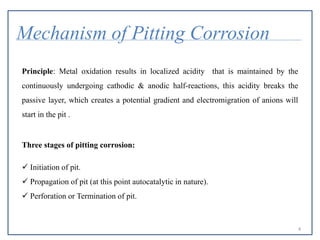
Mechanism of Pitting Corrosion
Principle: Metal oxidation results in localized acidity that is maintained by the
continuously undergoing cathodic & anodic half-reactions, this acidity breaks the
passive layer, which creates a potential gradient and electromigration of anions will
start in the pit .
Three stages of pitting corrosion:
 Initiation of pit.
 Propagation of pit (at this point autocatalytic in nature).
 Perforation or Termination of pit.
4
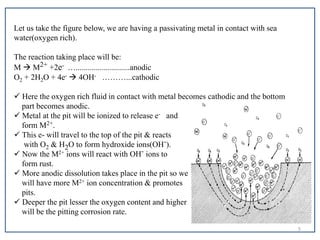
Let us take the figure below, we are having a passivating metal in contact with sea
water(oxygen rich).
The reaction taking place will be:
M  M2+ +2e- …...........................anodic
O2 + 2H2O + 4e-  4OH- ………...cathodic
 Here the oxygen rich fluid in contact with metal becomes cathodic and the bottom
part becomes anodic.
 Metal at the pit will be ionized to release e- and
form M2+.
 This e- will travel to the top of the pit & reacts
with O2 & H2O to form hydroxide ions(OH-).
 Now the M2+ ions will react with OH- ions to
form rust.
 More anodic dissolution takes place in the pit so we
will have more M2+ ion concentration & promotes
pits.
 Deeper the pit lesser the oxygen content and higher
will be the pitting corrosion rate.
5
Common environments of pitting corrosion
 Occurs in alloys that are protected by passivating film like stainless steel, Al alloys.
 Materials having poor surface finish may undergo this corrosion.
 Presence of dirt on surface.
 Stagnant water conditions favour pitting(low velocity).
Cholride environment.
Oxidizing metal ions with chlorides are aggressive pitters.
Prevention
 Proper material selection(e.g. SS316 with Mo) will have higher resistance to pitting.
 Controlling oxygen level.
 Cathodic & Anodic protection.
 Good surface finish required.
 Agitation of stagnant fluids.
Controlling the pH, chloride concentration and temperature.
6
7

Pitting Corrosion_Rahul

  • 1.
    Presentation on Pitting Corrosion Preparedby- RAHUL DEO SONAR Jr. Metallurgist 1 Metallurgy Dept.- Dammam Lab-KSA
  • 2.
    INDEX Definition of PittingCorrosion Mechanism Common Environments of Pitting Corrosion Prevention 2
  • 3.
    Definition It is aform of entirely localized corrosion. Leads to formation of cavities or holes in the material. Considered to be the most dangerous and insidious type of corrosion. Rate of corrosion is higher than uniform corrosion because of large cathode/anode ratio. Difficult to detect and measure. Its is autocatalytic in nature. Occurs usually in the direction of gravity. Fig.1: Pitting corrosion on a Stainless Steel surface 3
  • 4.
    Mechanism of PittingCorrosion Principle: Metal oxidation results in localized acidity that is maintained by the continuously undergoing cathodic & anodic half-reactions, this acidity breaks the passive layer, which creates a potential gradient and electromigration of anions will start in the pit . Three stages of pitting corrosion:  Initiation of pit.  Propagation of pit (at this point autocatalytic in nature).  Perforation or Termination of pit. 4
  • 5.
    Let us takethe figure below, we are having a passivating metal in contact with sea water(oxygen rich). The reaction taking place will be: M  M2+ +2e- …...........................anodic O2 + 2H2O + 4e-  4OH- ………...cathodic  Here the oxygen rich fluid in contact with metal becomes cathodic and the bottom part becomes anodic.  Metal at the pit will be ionized to release e- and form M2+.  This e- will travel to the top of the pit & reacts with O2 & H2O to form hydroxide ions(OH-).  Now the M2+ ions will react with OH- ions to form rust.  More anodic dissolution takes place in the pit so we will have more M2+ ion concentration & promotes pits.  Deeper the pit lesser the oxygen content and higher will be the pitting corrosion rate. 5
  • 6.
    Common environments ofpitting corrosion  Occurs in alloys that are protected by passivating film like stainless steel, Al alloys.  Materials having poor surface finish may undergo this corrosion.  Presence of dirt on surface.  Stagnant water conditions favour pitting(low velocity). Cholride environment. Oxidizing metal ions with chlorides are aggressive pitters. Prevention  Proper material selection(e.g. SS316 with Mo) will have higher resistance to pitting.  Controlling oxygen level.  Cathodic & Anodic protection.  Good surface finish required.  Agitation of stagnant fluids. Controlling the pH, chloride concentration and temperature. 6
  • 7.