GRAPHENE AN
INTRODUCTION TO THE
FUNDAMENTALS
PRESENTED BY :
SAIYED MOH. MARUF (D19ME112)
MENTOR : MR. RUGNESH PATEL
ME-349 SUMMER INTERNSHIP -1
15 APRIL 2020 TO 31 MAY 2020
What is Graphene ?
Graphene is a flat monolayer of carbon atoms tightly packed into a
two- dimensional (2D)honeycomb structure ,which works on
diffraction of electrons.
It is a single layer of Graphite (pure crystalline carbon)
Graphite was discovered in 1564 at Sea Thwaite (Borrowdale),
Northumberland
‘Graphene’ was first isolated in the lab by Professor Andre Gem with
former student Konstantin Novoselov at the University of
Manchester, England in 2004
2010 Nobel Prize for “groundbreaking experiments regarding the
two-dimensional material graphene” (Both were later Knighted,
twice)
 Carbon-the basis of all known life on the earth-has surprised the
scientific community once again with its exotic properties.
Introduction
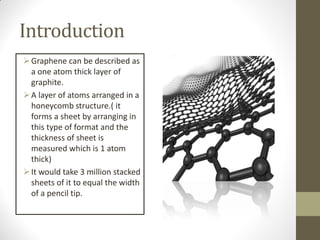
Graphene can be described as
a one atom thick layer of
graphite.
A layer of atoms arranged in a
honeycomb structure.( it
forms a sheet by arranging in
this type of format and the
thickness of sheet is
measured which is 1 atom
thick)
It would take 3 million stacked
sheets of it to equal the width
of a pencil tip.
Introduction
 Despite being the lightest known material It’s also the
strongest
 Harder than diamond and to get a idea here is a
comparison with steel
 And 200x stronger than steel
 It conducts electricity and heat better than any other
material it is steel not being found how much but it more
(more than silver but how much more not being conclude)
accurate so we don’t know the perfect measure of electric
conductivity
 It is so dense as it is in honey comb structure so it can only
pass the water through it not anything else , hence it can be
use for water purification in near by future
 Graphene has proven to be an anti-corrosion coating for
metal that is transparent, thinner, and longer lasting than
anything that currently exists.
History
One of the very first patents pertaining to
the production of Graphene was filed in
October, 2002 entitled, “Nano- scaled
Graphene Plates”.
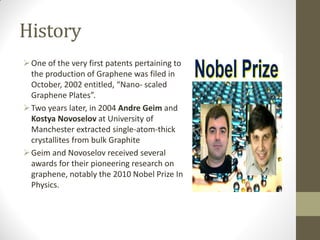
Two years later, in 2004 Andre Geim and
Kostya Novoselov at University of
Manchester extracted single-atom-thick
crystallites from bulk Graphite
Geim and Novoselov received several
awards for their pioneering research on
graphene, notably the 2010 Nobel Prize In
Physics.
Structure
 Graphene is a 2-dimensional network of carbon atoms.
 By stacking of these layers on top of each other, the
well known 3-dimensional graphite crystal is formed.
 It is a basic building block for graphitic materials of all
other dimensionalities.
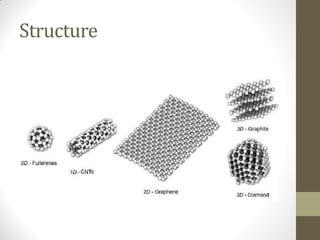
 It can be wrapped up into 0D fullerenes, rolled into 1D
nanotubes or stacked into 3D graphite.
 Sheets of graphene are bonded by loose bond in
graphite. These bonds are broken and sheets are
isolated to form graphene. These isolated hexagonal
sheets are graphene.
Structure
Mechanical Properties
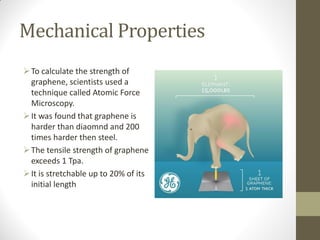
To calculate the strength of
graphene, scientists used a
technique called Atomic Force
Microscopy.
It was found that graphene is
harder than diaomnd and 200
times harder then steel.
The tensile strength of graphene
exceeds 1 Tpa.
It is stretchable up to 20% of its
initial length
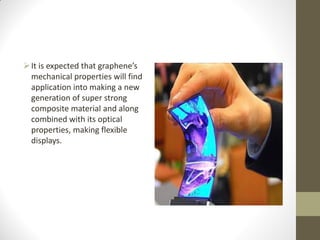
It is expected that graphene’s
mechanical properties will find
application into making a new
generation of super strong
composite material and along
combined with its optical
properties, making flexible
displays.
Chemical Properties
Graphene is chemically the most reactive form of carbon.
Only form of carbon (and generally all solid materials) in which each
single atom is in exposure for chemical reaction from two sides (due to
the 2D structure).
Carbon atoms at the edge of graphene sheets have special chemical
reactivity.
graphene burns at very low temperature (e.g., 350 °C).
Graphene has the highest ratio of edgy carbons (in comparison with
similar materials such as carbon nanotubes).
Graphene is commonly modified with oxygen- and nitrogen- containing
functional groups
Electronic Properties
 It is a zero-overlap semimetal (with both holes and
electrons as charge carriers) with very high electrical
conductivity.
 Electrons are able to flow through graphene more easily
than through even copper.
 The electrons travel through the graphene sheet as if they
carry no mass, as fast as just one hundredth that of the
speed of light.
 High charge carrier mobility, for which values of 10,000
cm²/Ns, in some cases even 200,000 cm²/Ns were
reported.
 Best Known conductor till now.
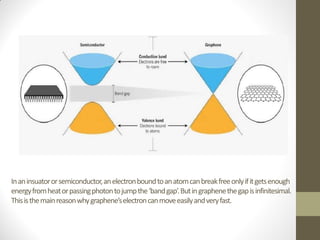
Inaninsuatororsemiconductor,anelectronboundtoanatomcanbreakfreeonlyifitgetsenough
energyfromheatorpassingphotontojumpthe‘bandgap’.Butingraphenethegapisinfinitesimal.
Thisisthemainreasonwhygraphene’selectroncanmoveeasilyandveryfast.
Thermal Properties
 Graphene is a perfect thermal conductor
 Its thermal conductivity is much higher than all the other carbon
structures as carbon nanotubes, graphite and diamond (> 5000
W/m/K) at room temperature
 Graphite, the 3 D version of graphene, shows a thermal conductivity
about 5 times smaller (1000 W/m/K)
 The ballistic thermal conductance of graphene is isotropic, i.e. same
in all directions
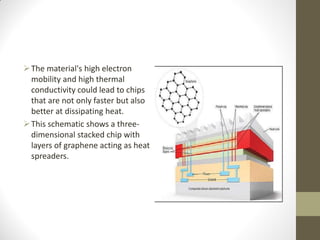
The material's high electron
mobility and high thermal
conductivity could lead to chips
that are not only faster but also
better at dissipating heat.
This schematic shows a three-
dimensional stacked chip with
layers of graphene acting as heat
spreaders.
Some Other Properties
 Thinnest imaginable and strongest material ever measured
 Stiffest known material (stiffer than diamond)
 Most stretchable crystal (up to 20% elastically)
 Record thermal conductivity (outperforming diamond)
 Highest current density at room T (million times of those in
copper)
 Highest intrinsic mobility (100 times more than in Si)
 Conducts electricity in the limit of no electrons
 Good for flexible, wearable devices
 It is transparent: One atom-thick layer sheet absorbs ~2.3%
visible light (πα).
What makes Graphene Different from
other ?
 Unique structure.
 All in one Properties
 Low cost
 Abundant element
 Chemically inert
 Thermal stability
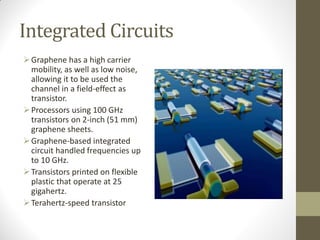
Integrated Circuits
Graphene has a high carrier
mobility, as well as low noise,
allowing it to be used the
channel in a field-effect as
transistor.
Processors using 100 GHz
transistors on 2-inch (51 mm)
graphene sheets.
Graphene-based integrated
circuit handled frequencies up
to 10 GHz.
Transistors printed on flexible
plastic that operate at 25
gigahertz.
Terahertz-speed transistor
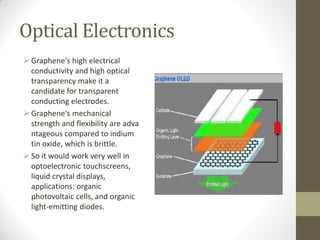
Optical Electronics
 Graphene's high electrical
conductivity and high optical
transparency make it a
candidate for transparent
conducting electrodes.
 Graphene's mechanical
strength and flexibility are adva
ntageous compared to indium
tin oxide, which is brittle.
 So it would work very well in
optoelectronic touchscreens,
liquid crystal displays,
applications: organic
photovoltaic cells, and organic
light-emitting diodes.
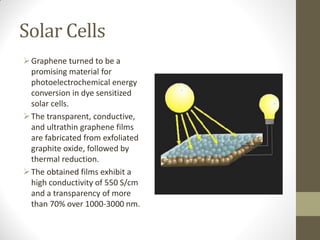
Solar Cells
Graphene turned to be a
promising material for
photoelectrochemical energy
conversion in dye sensitized
solar cells.
The transparent, conductive,
and ultrathin graphene films
are fabricated from exfoliated
graphite oxide, followed by
thermal reduction.
The obtained films exhibit a
high conductivity of 550 S/cm
and a transparency of more
than 70% over 1000-3000 nm.
Electronics Engineering
Will definitely replace silicon
and germanium as device
material.
Conducting material on PCBS.
Single molecule sensors -
Touchscreens
Graphene transistor. Graphene
integrated circuits. Graphene
chips.
Applications
While as of 2014, graphene is not used in commercial applications,
many have been proposed and/or are under active development, in
areas including electronics, biological engineering, filtration,
lightweight/strong composite materials, photovoltaics and energy
storage.
Graphene makes experiments possible that give new twists to the
phenomena in quantum physics.
Applications in electrical engineering.
Mechanical engineering.
Most important in electronics engineering as component material.
As a superconducting material. Micro electronics.
Transparent conducting electrode.
Solar cells
Graphene bio devices.
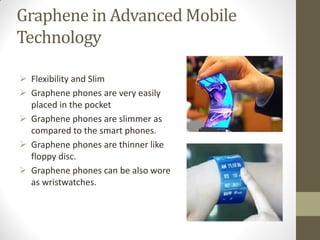
Graphene in Advanced Mobile
Technology
 Flexibility and Slim
 Graphene phones are very easily
placed in the pocket
 Graphene phones are slimmer as
compared to the smart phones.
 Graphene phones are thinner like
floppy disc.
 Graphene phones can be also wore
as wristwatches.
 Graphene phones as cannot be broken down as it is
a metal.
 Both the graphene (carbon) and the silicon flex with
the battery's charge cycles, but don't break.
 Thus the graphene phones are charged quickly and
can remain charge for a longer time
 Large memory capacity
 Ultra-low power consumption
 Compatible with state-of-the-art technology
 Strong immunity to short channel effects
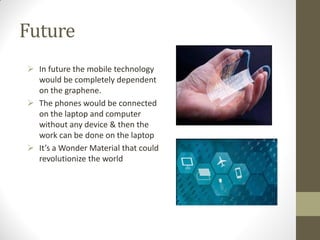
Future
 In future the mobile technology
would be completely dependent
on the graphene.
 The phones would be connected
on the laptop and computer
without any device & then the
work can be done on the laptop
 It’s a Wonder Material that could
revolutionize the world
References
 Graphene an introduction to the fundamentals and industrial
application by Madhuri Sharon, Maheshwar Sharon, Ashutosh
Tiwari
 https://en.m.wikipedia.org/wiki/Graphene
 Applications of Graphene and Graphene-Oxide Based
Nanomaterials by Sekhar Chandra Ray
 Functionalization of Graphene by Vasilios Georgakilas
 Graphene Nanomaterials Fabrication, Properties and
Applications by Satyendra Mishra and Dharmesh Hansora
 Graphene Technology by Soroush Nazarpour and Stephen R.
Waite
 https://www.researchgate.net/publication/300223835_Literatu
re_Review_and_Research_Background
 https://graphene-flagship.eu/material/Pages/The-history-of-
graphene.aspx
 https://www.ncbi.nlm.nih.gov/pmc/articles/PMC6304494/

Ppt

  • 1.
    GRAPHENE AN INTRODUCTION TOTHE FUNDAMENTALS PRESENTED BY : SAIYED MOH. MARUF (D19ME112) MENTOR : MR. RUGNESH PATEL ME-349 SUMMER INTERNSHIP -1 15 APRIL 2020 TO 31 MAY 2020
  • 2.
    What is Graphene? Graphene is a flat monolayer of carbon atoms tightly packed into a two- dimensional (2D)honeycomb structure ,which works on diffraction of electrons. It is a single layer of Graphite (pure crystalline carbon) Graphite was discovered in 1564 at Sea Thwaite (Borrowdale), Northumberland ‘Graphene’ was first isolated in the lab by Professor Andre Gem with former student Konstantin Novoselov at the University of Manchester, England in 2004 2010 Nobel Prize for “groundbreaking experiments regarding the two-dimensional material graphene” (Both were later Knighted, twice)  Carbon-the basis of all known life on the earth-has surprised the scientific community once again with its exotic properties.
  • 3.
    Introduction Graphene can bedescribed as a one atom thick layer of graphite. A layer of atoms arranged in a honeycomb structure.( it forms a sheet by arranging in this type of format and the thickness of sheet is measured which is 1 atom thick) It would take 3 million stacked sheets of it to equal the width of a pencil tip.
  • 4.
    Introduction  Despite beingthe lightest known material It’s also the strongest  Harder than diamond and to get a idea here is a comparison with steel  And 200x stronger than steel  It conducts electricity and heat better than any other material it is steel not being found how much but it more (more than silver but how much more not being conclude) accurate so we don’t know the perfect measure of electric conductivity  It is so dense as it is in honey comb structure so it can only pass the water through it not anything else , hence it can be use for water purification in near by future  Graphene has proven to be an anti-corrosion coating for metal that is transparent, thinner, and longer lasting than anything that currently exists.
  • 5.
    History One of thevery first patents pertaining to the production of Graphene was filed in October, 2002 entitled, “Nano- scaled Graphene Plates”. Two years later, in 2004 Andre Geim and Kostya Novoselov at University of Manchester extracted single-atom-thick crystallites from bulk Graphite Geim and Novoselov received several awards for their pioneering research on graphene, notably the 2010 Nobel Prize In Physics.
  • 6.
    Structure  Graphene isa 2-dimensional network of carbon atoms.  By stacking of these layers on top of each other, the well known 3-dimensional graphite crystal is formed.  It is a basic building block for graphitic materials of all other dimensionalities.  It can be wrapped up into 0D fullerenes, rolled into 1D nanotubes or stacked into 3D graphite.  Sheets of graphene are bonded by loose bond in graphite. These bonds are broken and sheets are isolated to form graphene. These isolated hexagonal sheets are graphene.
  • 7.
  • 8.
    Mechanical Properties To calculatethe strength of graphene, scientists used a technique called Atomic Force Microscopy. It was found that graphene is harder than diaomnd and 200 times harder then steel. The tensile strength of graphene exceeds 1 Tpa. It is stretchable up to 20% of its initial length
  • 9.
    It is expectedthat graphene’s mechanical properties will find application into making a new generation of super strong composite material and along combined with its optical properties, making flexible displays.
  • 10.
    Chemical Properties Graphene ischemically the most reactive form of carbon. Only form of carbon (and generally all solid materials) in which each single atom is in exposure for chemical reaction from two sides (due to the 2D structure). Carbon atoms at the edge of graphene sheets have special chemical reactivity. graphene burns at very low temperature (e.g., 350 °C). Graphene has the highest ratio of edgy carbons (in comparison with similar materials such as carbon nanotubes). Graphene is commonly modified with oxygen- and nitrogen- containing functional groups
  • 11.
    Electronic Properties  Itis a zero-overlap semimetal (with both holes and electrons as charge carriers) with very high electrical conductivity.  Electrons are able to flow through graphene more easily than through even copper.  The electrons travel through the graphene sheet as if they carry no mass, as fast as just one hundredth that of the speed of light.  High charge carrier mobility, for which values of 10,000 cm²/Ns, in some cases even 200,000 cm²/Ns were reported.  Best Known conductor till now.
  • 12.
  • 13.
    Thermal Properties  Grapheneis a perfect thermal conductor  Its thermal conductivity is much higher than all the other carbon structures as carbon nanotubes, graphite and diamond (> 5000 W/m/K) at room temperature  Graphite, the 3 D version of graphene, shows a thermal conductivity about 5 times smaller (1000 W/m/K)  The ballistic thermal conductance of graphene is isotropic, i.e. same in all directions
  • 14.
    The material's highelectron mobility and high thermal conductivity could lead to chips that are not only faster but also better at dissipating heat. This schematic shows a three- dimensional stacked chip with layers of graphene acting as heat spreaders.
  • 15.
    Some Other Properties Thinnest imaginable and strongest material ever measured  Stiffest known material (stiffer than diamond)  Most stretchable crystal (up to 20% elastically)  Record thermal conductivity (outperforming diamond)  Highest current density at room T (million times of those in copper)  Highest intrinsic mobility (100 times more than in Si)  Conducts electricity in the limit of no electrons  Good for flexible, wearable devices  It is transparent: One atom-thick layer sheet absorbs ~2.3% visible light (πα).
  • 16.
    What makes GrapheneDifferent from other ?  Unique structure.  All in one Properties  Low cost  Abundant element  Chemically inert  Thermal stability
  • 17.
    Integrated Circuits Graphene hasa high carrier mobility, as well as low noise, allowing it to be used the channel in a field-effect as transistor. Processors using 100 GHz transistors on 2-inch (51 mm) graphene sheets. Graphene-based integrated circuit handled frequencies up to 10 GHz. Transistors printed on flexible plastic that operate at 25 gigahertz. Terahertz-speed transistor
  • 18.
    Optical Electronics  Graphene'shigh electrical conductivity and high optical transparency make it a candidate for transparent conducting electrodes.  Graphene's mechanical strength and flexibility are adva ntageous compared to indium tin oxide, which is brittle.  So it would work very well in optoelectronic touchscreens, liquid crystal displays, applications: organic photovoltaic cells, and organic light-emitting diodes.
  • 19.
    Solar Cells Graphene turnedto be a promising material for photoelectrochemical energy conversion in dye sensitized solar cells. The transparent, conductive, and ultrathin graphene films are fabricated from exfoliated graphite oxide, followed by thermal reduction. The obtained films exhibit a high conductivity of 550 S/cm and a transparency of more than 70% over 1000-3000 nm.
  • 20.
    Electronics Engineering Will definitelyreplace silicon and germanium as device material. Conducting material on PCBS. Single molecule sensors - Touchscreens Graphene transistor. Graphene integrated circuits. Graphene chips.
  • 21.
    Applications While as of2014, graphene is not used in commercial applications, many have been proposed and/or are under active development, in areas including electronics, biological engineering, filtration, lightweight/strong composite materials, photovoltaics and energy storage. Graphene makes experiments possible that give new twists to the phenomena in quantum physics. Applications in electrical engineering. Mechanical engineering. Most important in electronics engineering as component material. As a superconducting material. Micro electronics. Transparent conducting electrode. Solar cells Graphene bio devices.
  • 22.
    Graphene in AdvancedMobile Technology  Flexibility and Slim  Graphene phones are very easily placed in the pocket  Graphene phones are slimmer as compared to the smart phones.  Graphene phones are thinner like floppy disc.  Graphene phones can be also wore as wristwatches.
  • 23.
     Graphene phonesas cannot be broken down as it is a metal.  Both the graphene (carbon) and the silicon flex with the battery's charge cycles, but don't break.  Thus the graphene phones are charged quickly and can remain charge for a longer time  Large memory capacity  Ultra-low power consumption  Compatible with state-of-the-art technology  Strong immunity to short channel effects
  • 24.
    Future  In futurethe mobile technology would be completely dependent on the graphene.  The phones would be connected on the laptop and computer without any device & then the work can be done on the laptop  It’s a Wonder Material that could revolutionize the world
  • 25.
    References  Graphene anintroduction to the fundamentals and industrial application by Madhuri Sharon, Maheshwar Sharon, Ashutosh Tiwari  https://en.m.wikipedia.org/wiki/Graphene  Applications of Graphene and Graphene-Oxide Based Nanomaterials by Sekhar Chandra Ray  Functionalization of Graphene by Vasilios Georgakilas  Graphene Nanomaterials Fabrication, Properties and Applications by Satyendra Mishra and Dharmesh Hansora  Graphene Technology by Soroush Nazarpour and Stephen R. Waite  https://www.researchgate.net/publication/300223835_Literatu re_Review_and_Research_Background  https://graphene-flagship.eu/material/Pages/The-history-of- graphene.aspx  https://www.ncbi.nlm.nih.gov/pmc/articles/PMC6304494/