Topic Out line
Graphite
 Graphite Classifications
 Natural Graphite
 Amorphous
 Flake
 High Crystalline
 Synthetic Graphite
 Applications
Marble
chlorite
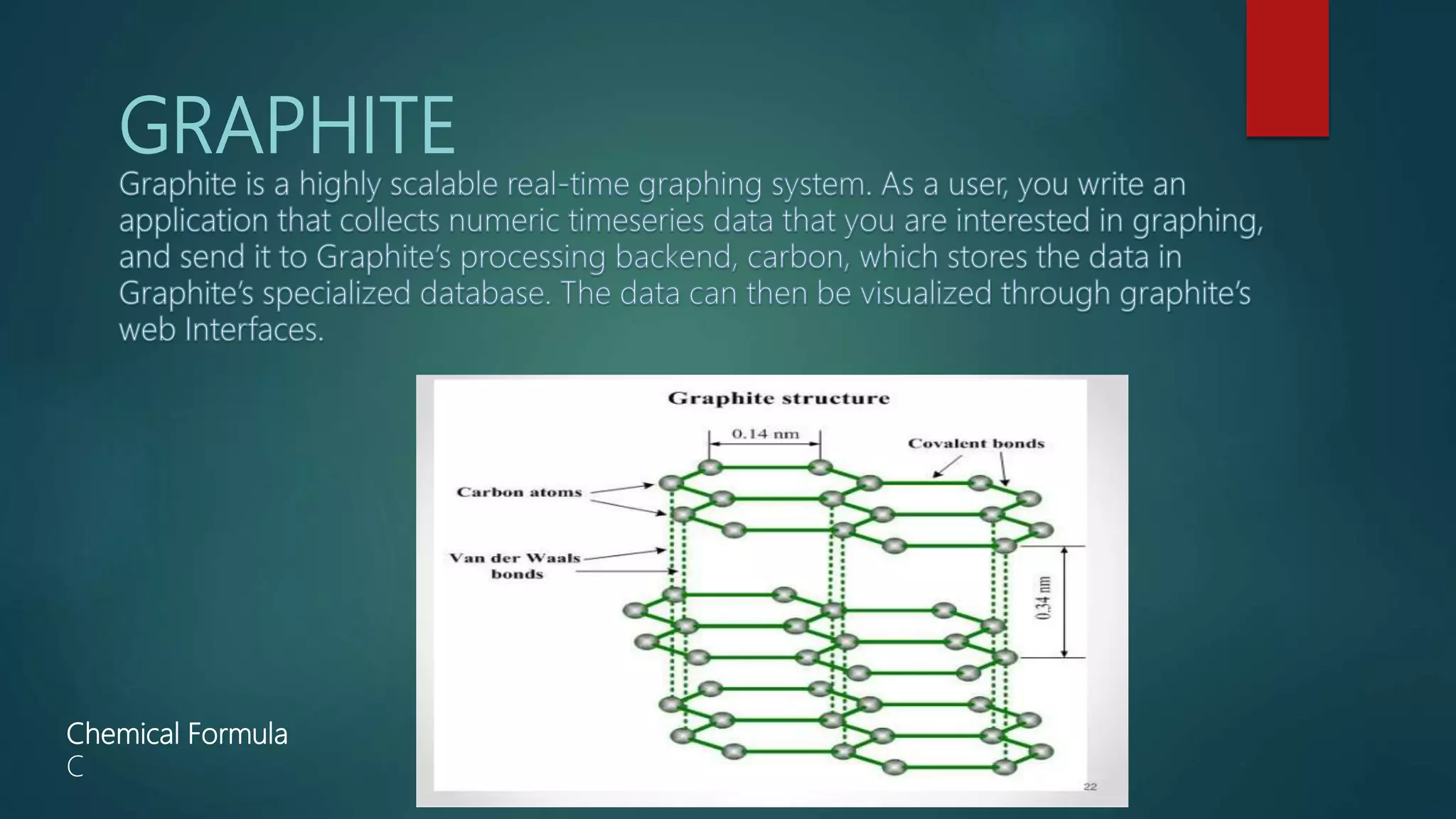
GRAPHITE
Chemical Formula
C
 Graphite Classifications
 There are two main classifications of graphite,
 natural
 synthetic.
 Natural Graphite
 Natural Graphite is a mineral consisting of graphitic carbon.
 It varies considerably in crystallinity.
 Most commercial (natural) graphite are mined and often contain other minerals.
Subsequent to mining the graphite often requires a considerable amount of mineral
processing such as froth flotation to concentrate the graphite.
 Natural graphite is an excellent conductor of heat and electricity.
 It is stable over a wide range of temperatures. Graphite is a highly refractory material
with a high melting point (3650°C.)
 Natural graphite is subdivided into three types of material:
 Amorphous
 Flake
 High Crystalline
 Amorphous Graphite
 Amorphous graphite is the least graphitic of the natural graphites.
 However, the term "amorphous" is a misnomer since the material is still crystalline.
 Amorphous graphite is found as minute particles in beds of mesomorphic rocks such as
slate or shale deposits. The graphite content ranges from 25% to 85% dependent on the
geological conditions.
 Amorphous graphite is extracted using conventional mining techniques and occurs
in Mexico, North Korea, South Korea and Austria.
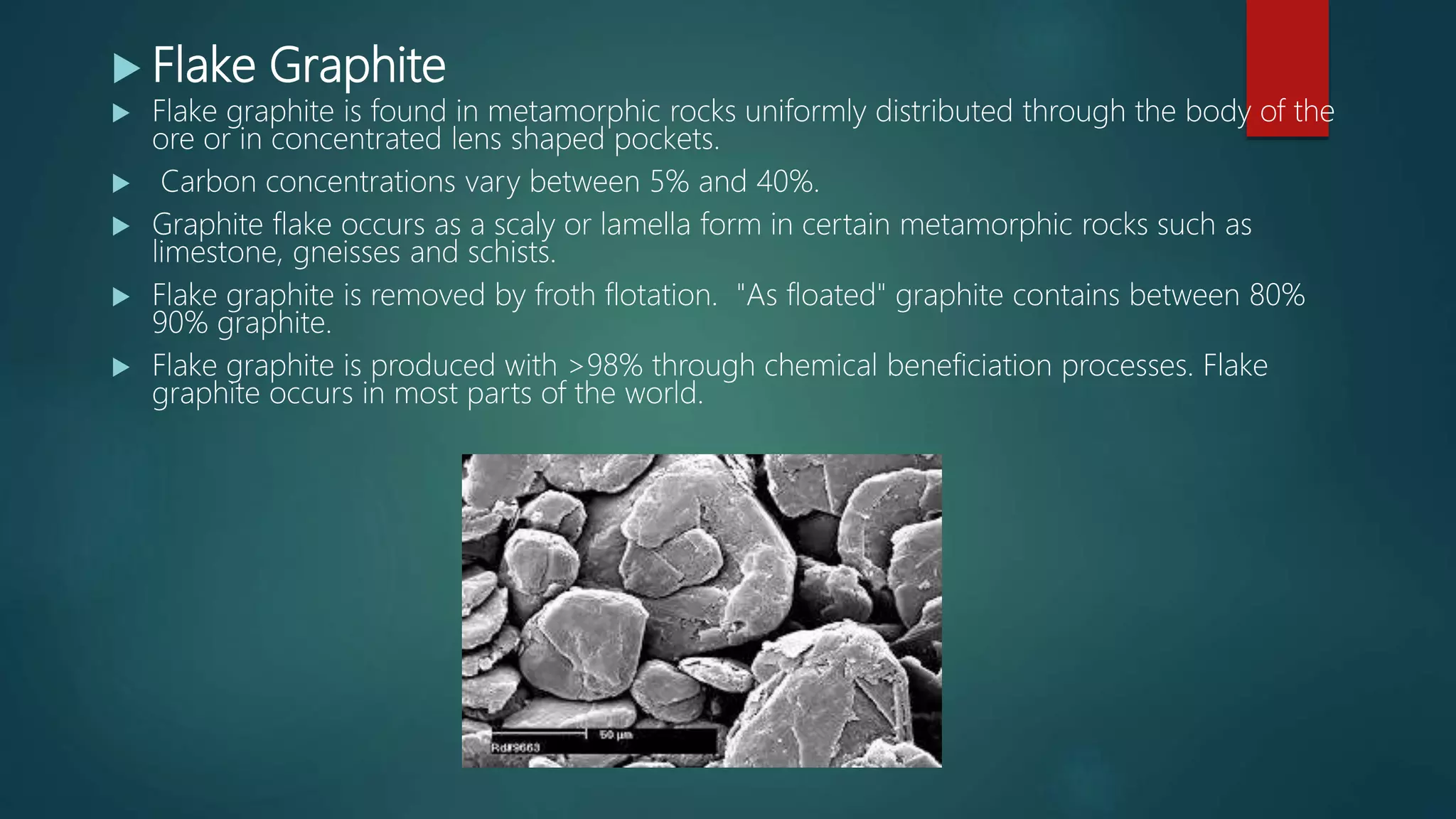
 Flake Graphite
 Flake graphite is found in metamorphic rocks uniformly distributed through the body of the
ore or in concentrated lens shaped pockets.
 Carbon concentrations vary between 5% and 40%.
 Graphite flake occurs as a scaly or lamella form in certain metamorphic rocks such as
limestone, gneisses and schists.
 Flake graphite is removed by froth flotation. "As floated" graphite contains between 80%
90% graphite.
 Flake graphite is produced with >98% through chemical beneficiation processes. Flake
graphite occurs in most parts of the world.
 Crystalline Graphite
 Crystalline vein graphite is believed to originate from crude oil deposits that
through time, temperature and pressure have converted to graphite.
 Vein graphite fissures are typically between 1cm and 1 m thick, and are
typically > 90% pure.
 Although this form of graphite is found all over the world, it is only
commercially mined in Sri Lanka by conventional shaft or surface mining
techniques.
 Synthetic Graphite
 Synthetic graphite can be produced from coke and pitch. It tends to be of higher purity
though not as crystalline as natural graphite.
 There are essentially two types of synthetic graphite.
 Synthetic Graphite consists mainly of graphitic carbon that has been obtained by
graphitization, heat treatment of non-graphitic carbon, or by chemical vapor
from hydrocarbons at temperatures above 2100K.
Property Commercial graphite
Bulk Density (g/cm3) 1.3-1.95
Porosity (%) 0.7-53
Modulus of Elasticity (GPa) 8-15
Compressive strength (MPa) 20-200
Flexural strength (MPa) 6.9-100
Coefficient of Thermal Expansion (x10-6 °C) 1.2-8.2
Thermal conductivity (W/m.K) 25-470
Specific heat capacity (J/kg.K) 710-830
Electrical resistivity (Ω.m) 5x10⁻⁶-30x10-6
Applications
 Chemical Industry
 There are many high temperature uses for graphite in the chemical industry such as in
the production of phosphorus and calcium carbide in arc furnaces.
 Graphite is used as anodes in some aqueous electrolytic processes such as in the
production of halogens (chlorine and fluorine.)
 Nuclear Industry
 High purity electrographite is used in large amounts for the production of
moderator rods and reflector components in nuclear reactors.
 Their suitability arises from their low absorption of neutrons, high thermal
conductivity and their high strength at temperature.
 Electrical Applications
 The main application for graphite as an electrical material is in the manufacture of
carbon brushes in electric motors.
 In this application the performance and lifetime of the component is very dependent
grade and structure.
 Mechanical Applications
 Graphite is used widely as an engineering material over a variety of
 Applications include piston rings, thrust bearings, journal bearings and vanes.
 Carbon based seals are used in the shafts and fuel pumps of many aircraft jet
engines.
Other Applications
 Amorphous graphite has applications in:
 Metallurgy
 Pencil production
 Refractories
 Coatings
 Lubricants
 Paint production
 Crystalline graphite is used in:
 Batteries
Marble
 NTRODUCTIONI
 The word Marble comes from Greek word Mamaros which means shining stone Marble is a
non-foliated, Granular Metamorphic Rock that is formed by the Metamorphism of
Limestone and Dolostone. Marble is calcium Carbonate (caCO3).
 The term marble is also applied to serpentine rocks that can be polished to high shine.
 The Marble is a carbonate rock which means it has (CO3) in chemistry.
 FORMATION OF MARBLE:
 Metamorphic Rock of Crystalline Aggregate of Calcite and/or Dolomite. CALC – Silicate
Rock with Calcium – Magnesium Silicate Mineral”(Calciphyre).
 Any Calcareous and / or Dolomite Rock Capable of Taking Polish & Suitable for
Decorative & Structural Purposes.
 Crystalline Calcite and / or Dolomite Rock – Marble Geologically
 Partially Crystallized Dense Compact Limestones – Marble
 Commercially Travertine (Calcium Carbonate Precipitates) – Onyx marble Verde Antique
– Serpentine Marble
 CHEMICAL COMPOSITION OF MARBLE
 Calcite & Dolomite Carbonate of calcium (Hardness 3-sp.grav.2.72)
 Carbonate of calcium & Magnesium (Hardness 3.5/4-Sp.Grave.2.9)
 Marble Formula (CaCO3), 1- Calcium, 1-Carbon, 3Oxygen
Uses
 Industrial use:
 Blocks of cut Marble: Colorless or light-colored marbles are a very
pure source of calcium carbonate,
 which is used in a wide variety of industries.
 Finely ground marble or calcium carbonate powder is a
component in paper, and in consumer products such as
toothpaste, plastics the ground calcium carbonate worldwide is
made from marble.
 Ground calcium carbonate is used as a coating pigment for paper
because of its high brightness and as a paper filler because it
strengthens the sheet and imparts high brightness.
 Consumer products:
 consumer products such as a food additive, in toothpaste, and as an inert filler in pills.
 It is used in plastics because it imparts stiffness, impact strength, dimensional stability,
and thermal conductivity. I
 t is used in paints because it is a good filler and extender, has high brightness, and is
weather resistant.
 which has many applications including being a primary component of many forms of
cement
Production Sculpture:
 White marble has been prized for its use in sculptures since classical times.
 This preference has to do with its softness, relative isotropy and homogeneity,
and a relative resistance to shattering. Also, the low index of refraction of
calcite allows light to penetrate several millimeters into the stone before
scattered out, resulting in the characteristic waxy look which gives "life" to
marble sculptures of the human body
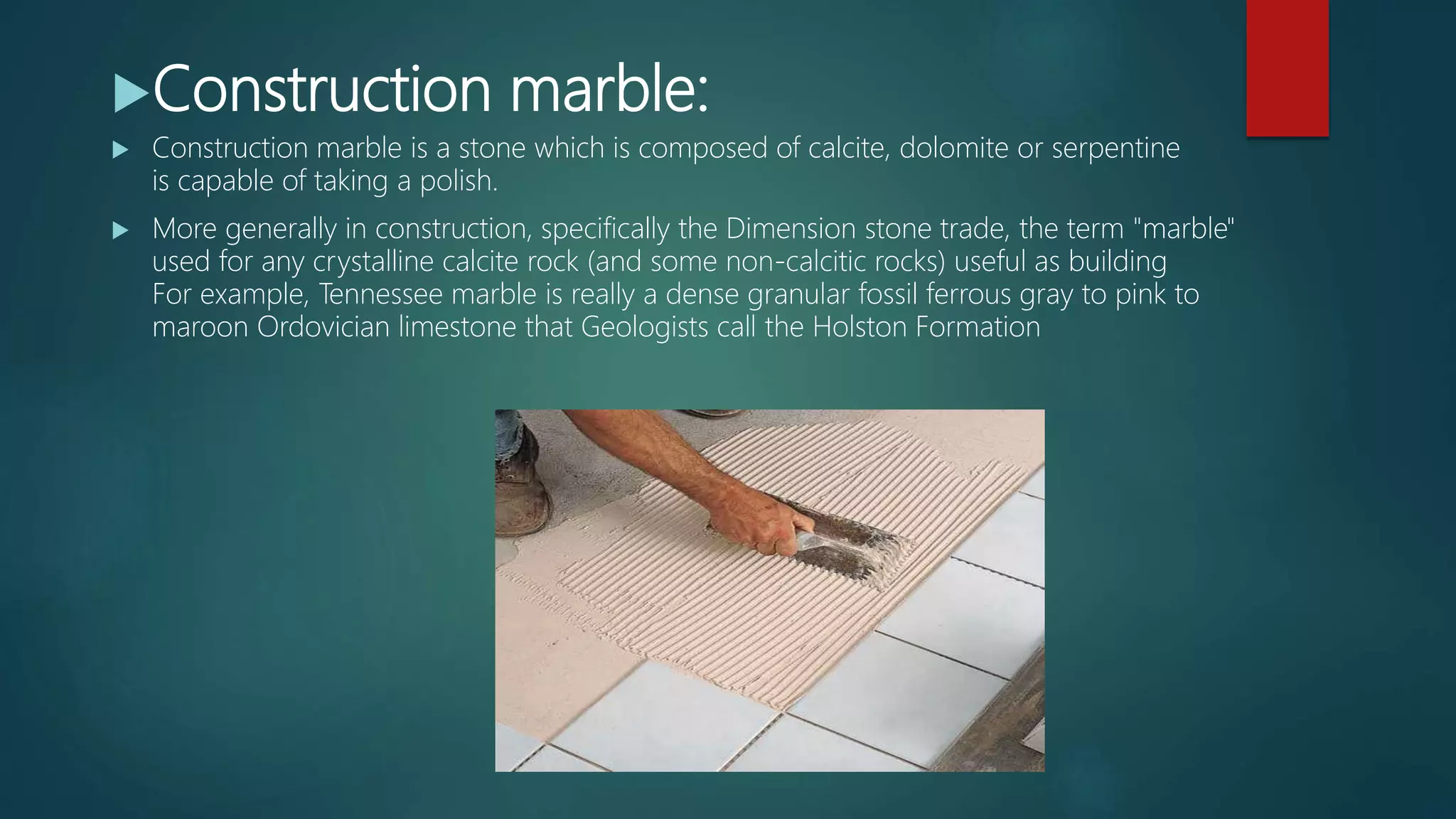
Construction marble:
 Construction marble is a stone which is composed of calcite, dolomite or serpentine
is capable of taking a polish.
 More generally in construction, specifically the Dimension stone trade, the term "marble"
used for any crystalline calcite rock (and some non-calcitic rocks) useful as building
For example, Tennessee marble is really a dense granular fossil ferrous gray to pink to
maroon Ordovician limestone that Geologists call the Holston Formation
Characteristics Of Marbles
 Marble is a stone with a firm crystalline structure and slight porosity.
 Due to its structure, marble can be polished to improve its shine and is
thus a common and attractive stone for building applications.
 The restricted marble porosity, mainly when refined, makes it less
susceptible to water damage. However, calcium carbonate, the main
ingredient of marble, is exceedingly susceptible to acidic agents: it rapidly
dissolves in some acids.
 The actual influence of acidic contact will vary with the kind of the acid:
chlorides, sulfates, and other chemical compounds respond in different
ways with marble. Byproducts are created that possess a wide range of
solubility and influence on the durability of marble.
 Therefore, it is essential to ascertain the exact kind of pollutants that cause
marble deterioration.
Graphite
Graphite
Graphite
Graphite
Graphite
Graphite
Graphite
Graphite
Graphite
Graphite
Graphite
Graphite
Graphite
Graphite
Graphite
Graphite

Graphite

  • 1.
    Topic Out line Graphite Graphite Classifications  Natural Graphite  Amorphous  Flake  High Crystalline  Synthetic Graphite  Applications Marble chlorite
  • 2.
  • 3.
     Graphite Classifications There are two main classifications of graphite,  natural  synthetic.
  • 4.
     Natural Graphite Natural Graphite is a mineral consisting of graphitic carbon.  It varies considerably in crystallinity.  Most commercial (natural) graphite are mined and often contain other minerals. Subsequent to mining the graphite often requires a considerable amount of mineral processing such as froth flotation to concentrate the graphite.  Natural graphite is an excellent conductor of heat and electricity.  It is stable over a wide range of temperatures. Graphite is a highly refractory material with a high melting point (3650°C.)
  • 5.
     Natural graphiteis subdivided into three types of material:  Amorphous  Flake  High Crystalline
  • 6.
     Amorphous Graphite Amorphous graphite is the least graphitic of the natural graphites.  However, the term "amorphous" is a misnomer since the material is still crystalline.  Amorphous graphite is found as minute particles in beds of mesomorphic rocks such as slate or shale deposits. The graphite content ranges from 25% to 85% dependent on the geological conditions.  Amorphous graphite is extracted using conventional mining techniques and occurs in Mexico, North Korea, South Korea and Austria.
  • 7.
     Flake Graphite Flake graphite is found in metamorphic rocks uniformly distributed through the body of the ore or in concentrated lens shaped pockets.  Carbon concentrations vary between 5% and 40%.  Graphite flake occurs as a scaly or lamella form in certain metamorphic rocks such as limestone, gneisses and schists.  Flake graphite is removed by froth flotation. "As floated" graphite contains between 80% 90% graphite.  Flake graphite is produced with >98% through chemical beneficiation processes. Flake graphite occurs in most parts of the world.
  • 8.
     Crystalline Graphite Crystalline vein graphite is believed to originate from crude oil deposits that through time, temperature and pressure have converted to graphite.  Vein graphite fissures are typically between 1cm and 1 m thick, and are typically > 90% pure.  Although this form of graphite is found all over the world, it is only commercially mined in Sri Lanka by conventional shaft or surface mining techniques.
  • 9.
     Synthetic Graphite Synthetic graphite can be produced from coke and pitch. It tends to be of higher purity though not as crystalline as natural graphite.  There are essentially two types of synthetic graphite.  Synthetic Graphite consists mainly of graphitic carbon that has been obtained by graphitization, heat treatment of non-graphitic carbon, or by chemical vapor from hydrocarbons at temperatures above 2100K.
  • 10.
    Property Commercial graphite BulkDensity (g/cm3) 1.3-1.95 Porosity (%) 0.7-53 Modulus of Elasticity (GPa) 8-15 Compressive strength (MPa) 20-200 Flexural strength (MPa) 6.9-100 Coefficient of Thermal Expansion (x10-6 °C) 1.2-8.2 Thermal conductivity (W/m.K) 25-470 Specific heat capacity (J/kg.K) 710-830 Electrical resistivity (Ω.m) 5x10⁻⁶-30x10-6
  • 12.
    Applications  Chemical Industry There are many high temperature uses for graphite in the chemical industry such as in the production of phosphorus and calcium carbide in arc furnaces.  Graphite is used as anodes in some aqueous electrolytic processes such as in the production of halogens (chlorine and fluorine.)  Nuclear Industry  High purity electrographite is used in large amounts for the production of moderator rods and reflector components in nuclear reactors.  Their suitability arises from their low absorption of neutrons, high thermal conductivity and their high strength at temperature.
  • 13.
     Electrical Applications The main application for graphite as an electrical material is in the manufacture of carbon brushes in electric motors.  In this application the performance and lifetime of the component is very dependent grade and structure.  Mechanical Applications  Graphite is used widely as an engineering material over a variety of  Applications include piston rings, thrust bearings, journal bearings and vanes.  Carbon based seals are used in the shafts and fuel pumps of many aircraft jet engines.
  • 14.
    Other Applications  Amorphousgraphite has applications in:  Metallurgy  Pencil production  Refractories  Coatings  Lubricants  Paint production  Crystalline graphite is used in:  Batteries
  • 16.
    Marble  NTRODUCTIONI  Theword Marble comes from Greek word Mamaros which means shining stone Marble is a non-foliated, Granular Metamorphic Rock that is formed by the Metamorphism of Limestone and Dolostone. Marble is calcium Carbonate (caCO3).  The term marble is also applied to serpentine rocks that can be polished to high shine.  The Marble is a carbonate rock which means it has (CO3) in chemistry.
  • 17.
     FORMATION OFMARBLE:  Metamorphic Rock of Crystalline Aggregate of Calcite and/or Dolomite. CALC – Silicate Rock with Calcium – Magnesium Silicate Mineral”(Calciphyre).  Any Calcareous and / or Dolomite Rock Capable of Taking Polish & Suitable for Decorative & Structural Purposes.  Crystalline Calcite and / or Dolomite Rock – Marble Geologically  Partially Crystallized Dense Compact Limestones – Marble  Commercially Travertine (Calcium Carbonate Precipitates) – Onyx marble Verde Antique – Serpentine Marble
  • 18.
     CHEMICAL COMPOSITIONOF MARBLE  Calcite & Dolomite Carbonate of calcium (Hardness 3-sp.grav.2.72)  Carbonate of calcium & Magnesium (Hardness 3.5/4-Sp.Grave.2.9)  Marble Formula (CaCO3), 1- Calcium, 1-Carbon, 3Oxygen
  • 19.
    Uses  Industrial use: Blocks of cut Marble: Colorless or light-colored marbles are a very pure source of calcium carbonate,  which is used in a wide variety of industries.  Finely ground marble or calcium carbonate powder is a component in paper, and in consumer products such as toothpaste, plastics the ground calcium carbonate worldwide is made from marble.  Ground calcium carbonate is used as a coating pigment for paper because of its high brightness and as a paper filler because it strengthens the sheet and imparts high brightness.
  • 20.
     Consumer products: consumer products such as a food additive, in toothpaste, and as an inert filler in pills.  It is used in plastics because it imparts stiffness, impact strength, dimensional stability, and thermal conductivity. I  t is used in paints because it is a good filler and extender, has high brightness, and is weather resistant.  which has many applications including being a primary component of many forms of cement
  • 21.
    Production Sculpture:  Whitemarble has been prized for its use in sculptures since classical times.  This preference has to do with its softness, relative isotropy and homogeneity, and a relative resistance to shattering. Also, the low index of refraction of calcite allows light to penetrate several millimeters into the stone before scattered out, resulting in the characteristic waxy look which gives "life" to marble sculptures of the human body
  • 22.
    Construction marble:  Constructionmarble is a stone which is composed of calcite, dolomite or serpentine is capable of taking a polish.  More generally in construction, specifically the Dimension stone trade, the term "marble" used for any crystalline calcite rock (and some non-calcitic rocks) useful as building For example, Tennessee marble is really a dense granular fossil ferrous gray to pink to maroon Ordovician limestone that Geologists call the Holston Formation
  • 23.
    Characteristics Of Marbles Marble is a stone with a firm crystalline structure and slight porosity.  Due to its structure, marble can be polished to improve its shine and is thus a common and attractive stone for building applications.  The restricted marble porosity, mainly when refined, makes it less susceptible to water damage. However, calcium carbonate, the main ingredient of marble, is exceedingly susceptible to acidic agents: it rapidly dissolves in some acids.  The actual influence of acidic contact will vary with the kind of the acid: chlorides, sulfates, and other chemical compounds respond in different ways with marble. Byproducts are created that possess a wide range of solubility and influence on the durability of marble.  Therefore, it is essential to ascertain the exact kind of pollutants that cause marble deterioration.