Graphing Quadratic Functions
Today:
Notebooks
Warm-Up
Review: Vertex and Axis of Symmetry:
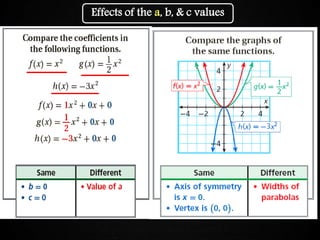
The effects of a, b, & c on the parabola
Graphing Various Quadratic Functions
Class Work: 4.1 (Front and back)
Graphing Quadratic Functions
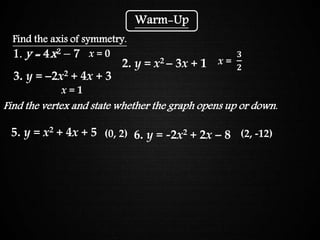
x = 0
x = 1
(0, 2)
1. y = 4x2 – 7
2. y = x2 – 3x + 1
Find the axis of symmetry.
3. y = –2x2 + 4x + 3
(2, -12)5. y = x2 + 4x + 5 6. y = -2x2 + 2x – 8
Find the vertex and state whether the graph opens up or down.
x =
𝟑
𝟐
Warm-Up
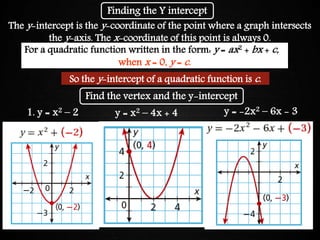
Graphing Quadratic FunctionsFinding the Y intercept
Find the vertex and the y-intercept
1. y = x2 – 2 y = x2 – 4x + 4 y = -2x2 – 6x - 3
The y-intercept is the y-coordinate of the point where a graph intersects
the y-axis. The x-coordinate of this point is always 0.
For a quadratic function written in the form: y = ax2 + bx + c,
when x = 0, y = c.
So the y-intercept of a quadratic function is c.
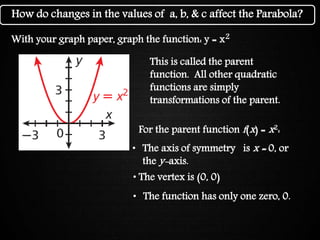
Graphing Quadratic FunctionsHow do changes in the values of a, b, & c affect the Parabola?
With your graph paper, graph the function: y = x2
This is called the parent
function. All other quadratic
functions are simply
transformations of the parent.
For the parent function f(x) = x2:
• The axis of symmetry is x = 0, or
the y-axis.
• The vertex is (0, 0)
• The function has only one zero, 0.
Graphing Quadratic FunctionsEffects of the a, b, & c values
Graphing Quadratic Functions
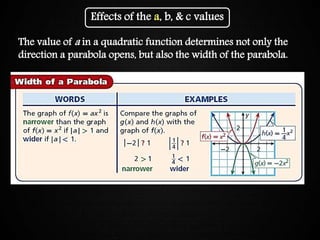
The value of a in a quadratic function determines not only the
direction a parabola opens, but also the width of the parabola.
Effects of the a, b, & c values
Graphing Quadratic FunctionsEffects of the a, b, & c values
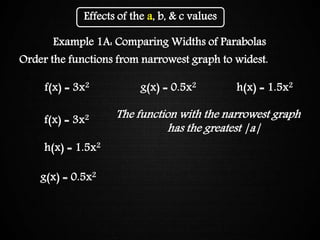
Example 1A: Comparing Widths of Parabolas
Order the functions from narrowest graph to widest.
f(x) = 3x2 g(x) = 0.5x2 h(x) = 1.5x2
f(x) = 3x2
h(x) = 1.5x2
g(x) = 0.5x2
The function with the narrowest graph
has the greatest |a|
Graphing Quadratic FunctionsEffects of the a, b, & c values
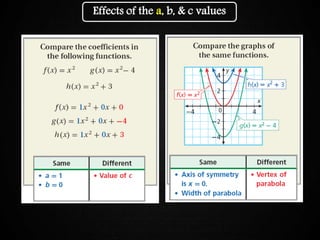
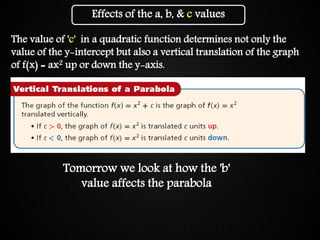
The value of 'c' in a quadratic function determines not only the
value of the y-intercept but also a vertical translation of the graph
of f(x) = ax2 up or down the y-axis.
Tomorrow we look at how the 'b'
value affects the parabola
Graphing Quadratic FunctionsComparing Graphs of Quadratic Functions
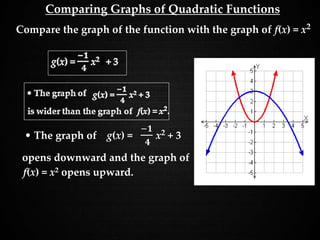
Compare the graph of the function with the graph of f(x) = x2
opens downward and the graph of
f(x) = x2 opens upward.
g(x) =
−𝟏
𝟒
x2 + 3• The graph of
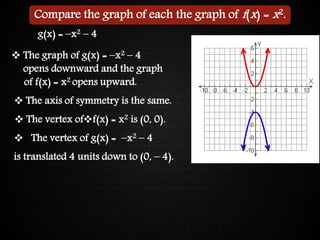
Graphing Quadratic FunctionsCompare the graph of each the graph of f(x) = x2.
g(x) = –x2 – 4
 The graph of g(x) = –x2 – 4
opens downward and the graph
of f(x) = x2 opens upward.
 The vertex of g(x) = –x2 – 4
f(x) = x2 is (0, 0).
is translated 4 units down to (0, – 4).
 The vertex of
 The axis of symmetry is the same.
Graphing Quadratic Functions
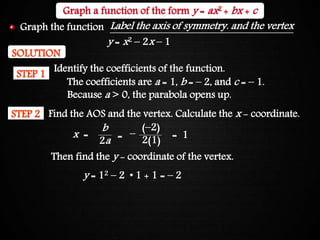
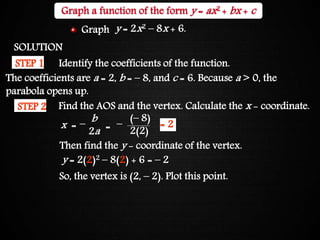
SOLUTION
Identify the coefficients of the function.
STEP 1
STEP 2 Find the AOS and the vertex. Calculate the x - coordinate.
Then find the y - coordinate of the vertex.
(–2)
2(1)= = 1x =
b
2a
–
y = 12 – 2 • 1 + 1 = – 2
The coefficients are a = 1, b = – 2, and c = – 1.
Because a > 0, the parabola opens up.
Graph a function of the form y = ax2 + bx + c
y = x2 – 2x – 1
Label the axis of symmetry. and the vertexGraph the function
Graphing Quadratic FunctionsGraph a function of the form y = ax2 + bx + c
SOLUTION
Identify the coefficients of the function.STEP 1
STEP 2 Find the AOS and the vertex. Calculate the x - coordinate.
x =
b
2a =
(– 8)
2(2)
– –
Then find the y - coordinate of the vertex.
y = 2(2)2 – 8(2) + 6 = – 2
So, the vertex is (2, – 2). Plot this point.
The coefficients are a = 2, b = – 8, and c = 6. Because a > 0, the
parabola opens up.
= 2
y = 2x2 – 8x + 6.Graph
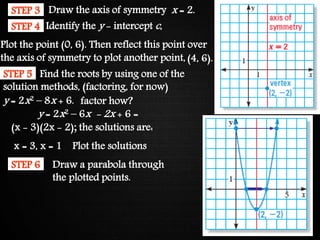
Graphing Quadratic FunctionsSTEP 3 Draw the axis of symmetry
STEP 4 Identify the y - intercept c,
STEP 5 Find the roots by using one of the
solution methods, (factoring, for now)
(x - 3)(2x - 2); the solutions are:
Plot the point (0, 6). Then reflect this point over
the axis of symmetry to plot another point, (4, 6).
Plot the solutionsx = 3, x = 1
STEP 6 Draw a parabola through
the plotted points.
y = 2x2 – 8x + 6. factor how?
y = 2x2 – 6x - 2x + 6 =
x = 2.
Graphing Quadratic Functions
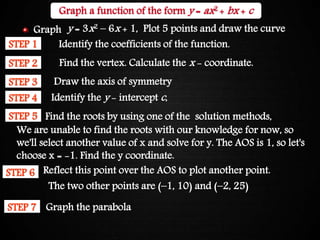
STEP 1 Identify the coefficients of the function.
STEP 2 Find the vertex. Calculate the x - coordinate.
STEP 3 Draw the axis of symmetry
STEP 4 Identify the y - intercept c,
STEP 5 Find the roots by using one of the solution methods,
We are unable to find the roots with our knowledge for now, so
we'll select another value of x and solve for y. The AOS is 1, so let's
choose x = -1. Find the y coordinate.
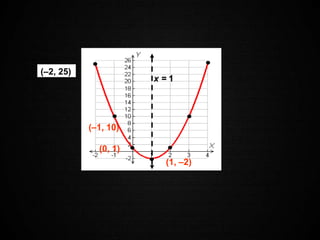
The two other points are (–1, 10) and (–2, 25)
STEP 6 Reflect this point over the AOS to plot another point.
STEP 7 Graph the parabola
Graph a function of the form y = ax2 + bx + c
y = 3x2 – 6x + 1, Plot 5 points and draw the curveGraph
Graphing Quadratic Functions
x = 1
(–1, 10)
(0, 1)
(1, –2)
(–2, 25)
Graphing Quadratic FunctionsGraph a function of the form y = ax2 + bx + c
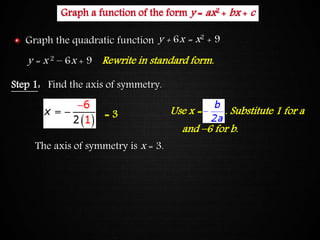
Step 1: Find the axis of symmetry.
Use x = . Substitute 1 for a
and –6 for b.
The axis of symmetry is x = 3.
= 3
y = x 2 – 6x + 9 Rewrite in standard form.
y + 6x = x2 + 9Graph the quadratic function
Graphing Quadratic Functions
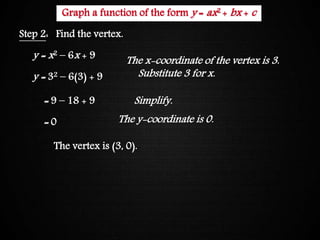
Step 2: Find the vertex.
Simplify.= 9 – 18 + 9
= 0
The vertex is (3, 0).
The x-coordinate of the vertex is 3.
Substitute 3 for x.
The y-coordinate is 0.
y = x2 – 6x + 9
y = 32 – 6(3) + 9
Graph a function of the form y = ax2 + bx + c
Graphing Quadratic Functions
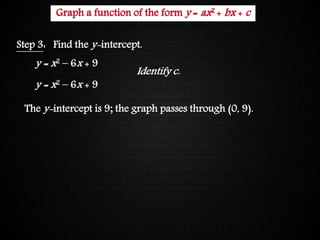
Step 3: Find the y-intercept.
y = x2 – 6x + 9
y = x2 – 6x + 9
The y-intercept is 9; the graph passes through (0, 9).
Identify c.
Graph a function of the form y = ax2 + bx + c
Graphing Quadratic Functions
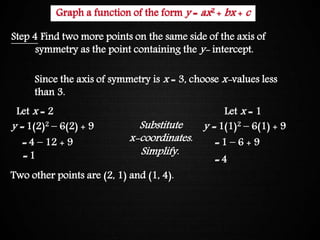
Step 4 Find two more points on the same side of the axis of
symmetry as the point containing the y- intercept.
Since the axis of symmetry is x = 3, choose x-values less
than 3.
Let x = 2
y = 1(2)2 – 6(2) + 9
= 4 – 12 + 9
= 1
Let x = 1
y = 1(1)2 – 6(1) + 9
= 1 – 6 + 9
= 4
Substitute
x-coordinates.
Simplify.
Two other points are (2, 1) and (1, 4).
Graph a function of the form y = ax2 + bx + c
Graphing Quadratic Functions
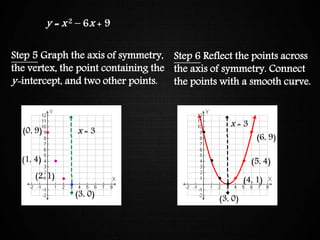
Step 5 Graph the axis of symmetry,
the vertex, the point containing the
y-intercept, and two other points.
Step 6 Reflect the points across
the axis of symmetry. Connect
the points with a smooth curve.
y = x 2 – 6x + 9
x = 3
(3, 0)
(0, 9)
(2, 1)
(1, 4)
(6, 9)
(5, 4)
(4, 1)
x = 3
(3, 0)
Graphing Quadratic Functions
Class Work 4.1
Front & Back
Show all work for credit
Graphing Quadratic Functions

April 10, 2015

  • 1.
    Graphing Quadratic Functions Today: Notebooks Warm-Up Review:Vertex and Axis of Symmetry: The effects of a, b, & c on the parabola Graphing Various Quadratic Functions Class Work: 4.1 (Front and back)
  • 2.
    Graphing Quadratic Functions x= 0 x = 1 (0, 2) 1. y = 4x2 – 7 2. y = x2 – 3x + 1 Find the axis of symmetry. 3. y = –2x2 + 4x + 3 (2, -12)5. y = x2 + 4x + 5 6. y = -2x2 + 2x – 8 Find the vertex and state whether the graph opens up or down. x = 𝟑 𝟐 Warm-Up
  • 3.
    Graphing Quadratic FunctionsFindingthe Y intercept Find the vertex and the y-intercept 1. y = x2 – 2 y = x2 – 4x + 4 y = -2x2 – 6x - 3 The y-intercept is the y-coordinate of the point where a graph intersects the y-axis. The x-coordinate of this point is always 0. For a quadratic function written in the form: y = ax2 + bx + c, when x = 0, y = c. So the y-intercept of a quadratic function is c.
  • 4.
    Graphing Quadratic FunctionsHowdo changes in the values of a, b, & c affect the Parabola? With your graph paper, graph the function: y = x2 This is called the parent function. All other quadratic functions are simply transformations of the parent. For the parent function f(x) = x2: • The axis of symmetry is x = 0, or the y-axis. • The vertex is (0, 0) • The function has only one zero, 0.
  • 5.
    Graphing Quadratic FunctionsEffectsof the a, b, & c values
  • 6.
    Graphing Quadratic Functions Thevalue of a in a quadratic function determines not only the direction a parabola opens, but also the width of the parabola. Effects of the a, b, & c values
  • 7.
    Graphing Quadratic FunctionsEffectsof the a, b, & c values Example 1A: Comparing Widths of Parabolas Order the functions from narrowest graph to widest. f(x) = 3x2 g(x) = 0.5x2 h(x) = 1.5x2 f(x) = 3x2 h(x) = 1.5x2 g(x) = 0.5x2 The function with the narrowest graph has the greatest |a|
  • 8.
    Graphing Quadratic FunctionsEffectsof the a, b, & c values
  • 9.
    Graphing Quadratic FunctionsEffectsof the a, b, & c values The value of 'c' in a quadratic function determines not only the value of the y-intercept but also a vertical translation of the graph of f(x) = ax2 up or down the y-axis. Tomorrow we look at how the 'b' value affects the parabola
  • 10.
    Graphing Quadratic FunctionsComparingGraphs of Quadratic Functions Compare the graph of the function with the graph of f(x) = x2 opens downward and the graph of f(x) = x2 opens upward. g(x) = −𝟏 𝟒 x2 + 3• The graph of
  • 11.
    Graphing Quadratic FunctionsComparethe graph of each the graph of f(x) = x2. g(x) = –x2 – 4  The graph of g(x) = –x2 – 4 opens downward and the graph of f(x) = x2 opens upward.  The vertex of g(x) = –x2 – 4 f(x) = x2 is (0, 0). is translated 4 units down to (0, – 4).  The vertex of  The axis of symmetry is the same.
  • 12.
    Graphing Quadratic Functions SOLUTION Identifythe coefficients of the function. STEP 1 STEP 2 Find the AOS and the vertex. Calculate the x - coordinate. Then find the y - coordinate of the vertex. (–2) 2(1)= = 1x = b 2a – y = 12 – 2 • 1 + 1 = – 2 The coefficients are a = 1, b = – 2, and c = – 1. Because a > 0, the parabola opens up. Graph a function of the form y = ax2 + bx + c y = x2 – 2x – 1 Label the axis of symmetry. and the vertexGraph the function
  • 13.
    Graphing Quadratic FunctionsGrapha function of the form y = ax2 + bx + c SOLUTION Identify the coefficients of the function.STEP 1 STEP 2 Find the AOS and the vertex. Calculate the x - coordinate. x = b 2a = (– 8) 2(2) – – Then find the y - coordinate of the vertex. y = 2(2)2 – 8(2) + 6 = – 2 So, the vertex is (2, – 2). Plot this point. The coefficients are a = 2, b = – 8, and c = 6. Because a > 0, the parabola opens up. = 2 y = 2x2 – 8x + 6.Graph
  • 14.
    Graphing Quadratic FunctionsSTEP3 Draw the axis of symmetry STEP 4 Identify the y - intercept c, STEP 5 Find the roots by using one of the solution methods, (factoring, for now) (x - 3)(2x - 2); the solutions are: Plot the point (0, 6). Then reflect this point over the axis of symmetry to plot another point, (4, 6). Plot the solutionsx = 3, x = 1 STEP 6 Draw a parabola through the plotted points. y = 2x2 – 8x + 6. factor how? y = 2x2 – 6x - 2x + 6 = x = 2.
  • 15.
    Graphing Quadratic Functions STEP1 Identify the coefficients of the function. STEP 2 Find the vertex. Calculate the x - coordinate. STEP 3 Draw the axis of symmetry STEP 4 Identify the y - intercept c, STEP 5 Find the roots by using one of the solution methods, We are unable to find the roots with our knowledge for now, so we'll select another value of x and solve for y. The AOS is 1, so let's choose x = -1. Find the y coordinate. The two other points are (–1, 10) and (–2, 25) STEP 6 Reflect this point over the AOS to plot another point. STEP 7 Graph the parabola Graph a function of the form y = ax2 + bx + c y = 3x2 – 6x + 1, Plot 5 points and draw the curveGraph
  • 16.
    Graphing Quadratic Functions x= 1 (–1, 10) (0, 1) (1, –2) (–2, 25)
  • 17.
    Graphing Quadratic FunctionsGrapha function of the form y = ax2 + bx + c Step 1: Find the axis of symmetry. Use x = . Substitute 1 for a and –6 for b. The axis of symmetry is x = 3. = 3 y = x 2 – 6x + 9 Rewrite in standard form. y + 6x = x2 + 9Graph the quadratic function
  • 18.
    Graphing Quadratic Functions Step2: Find the vertex. Simplify.= 9 – 18 + 9 = 0 The vertex is (3, 0). The x-coordinate of the vertex is 3. Substitute 3 for x. The y-coordinate is 0. y = x2 – 6x + 9 y = 32 – 6(3) + 9 Graph a function of the form y = ax2 + bx + c
  • 19.
    Graphing Quadratic Functions Step3: Find the y-intercept. y = x2 – 6x + 9 y = x2 – 6x + 9 The y-intercept is 9; the graph passes through (0, 9). Identify c. Graph a function of the form y = ax2 + bx + c
  • 20.
    Graphing Quadratic Functions Step4 Find two more points on the same side of the axis of symmetry as the point containing the y- intercept. Since the axis of symmetry is x = 3, choose x-values less than 3. Let x = 2 y = 1(2)2 – 6(2) + 9 = 4 – 12 + 9 = 1 Let x = 1 y = 1(1)2 – 6(1) + 9 = 1 – 6 + 9 = 4 Substitute x-coordinates. Simplify. Two other points are (2, 1) and (1, 4). Graph a function of the form y = ax2 + bx + c
  • 21.
    Graphing Quadratic Functions Step5 Graph the axis of symmetry, the vertex, the point containing the y-intercept, and two other points. Step 6 Reflect the points across the axis of symmetry. Connect the points with a smooth curve. y = x 2 – 6x + 9 x = 3 (3, 0) (0, 9) (2, 1) (1, 4) (6, 9) (5, 4) (4, 1) x = 3 (3, 0)
  • 22.
    Graphing Quadratic Functions ClassWork 4.1 Front & Back Show all work for credit
  • 23.
  • 24.