(SDLC)
Amna Razzaq 06
Aqsa Ijaz 30
Rubab Fatimi 02
Rehab Khan 35
Anjuman Chaudhry 45
“The systems development life cycle (SDLC), also
referred to as the application development life-cycle,
is a term used in systems engineering, information
system and software engineering to describe a process
for planning, creating, testing, and deploying an
information system.”
 The systems development life-cycle concept applies to
a range of hardware and software configurations, as a
system can be composed of hardware only, software
only, or a combination of both.
An SDLC has three primary business objectives:
 Ensure the delivery of high quality systems;
 Provide strong management controls;
 Maximize productivity.
 The systems development life cycle, according to
Elliott & Strachan & Radford (2004), "originated in the
1960s, to develop large scale functional business
systems in an age of large scale business
conglomerates. Information systems activities revolved
around heavy data processing and number
crunching routines".
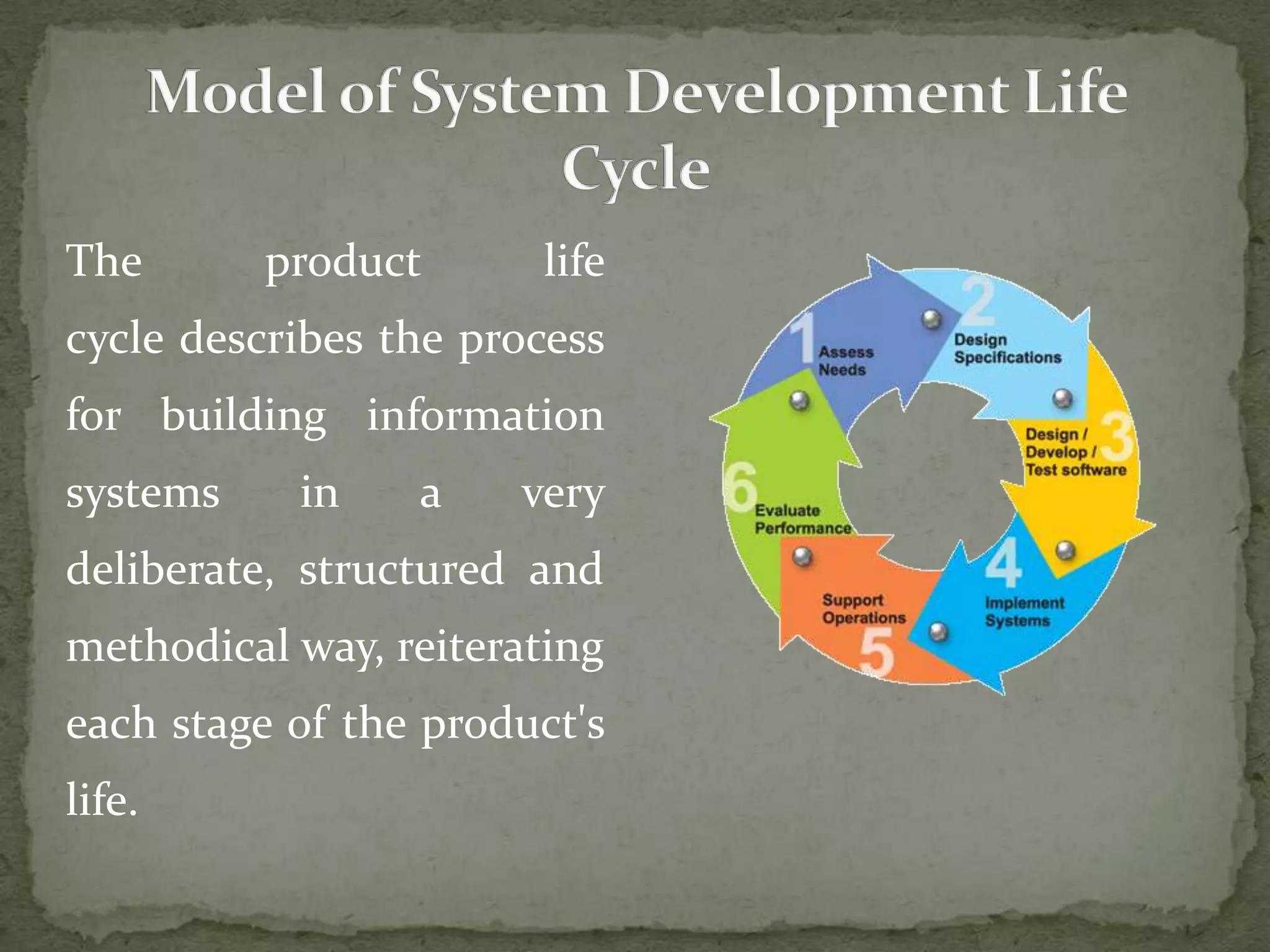
The product life
cycle describes the process
for building information
systems in a very
deliberate, structured and
methodical way, reiterating
each stage of the product's
life.
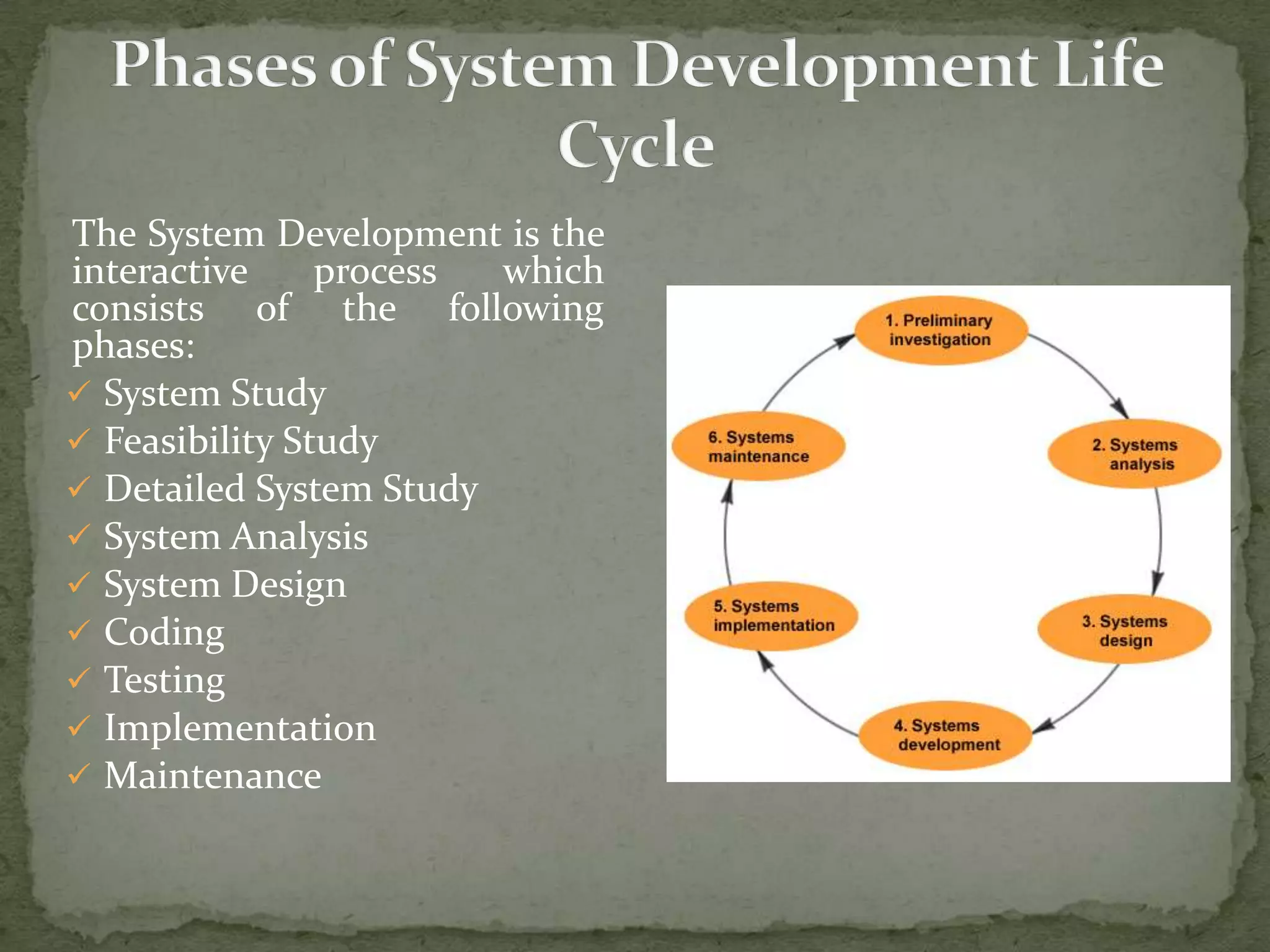
The System Development is the
interactive process which
consists of the following
phases:
 System Study
 Feasibility Study
 Detailed System Study
 System Analysis
 System Design
 Coding
 Testing
 Implementation
 Maintenance
 Preliminary system study is the first stage of system
development life cycle. This is a brief investigation of the
system under consideration and gives a clear picture of what
actually the physical system is?
 In practice, the initial system study involves the preparation
of a System proposal which lists the Problem Definition,
Objectives of the Study, Terms of reference for Study,
Constraints, Expected benefits of the new system, etc.
 In case the system proposal is acceptable to the
management, the next phase is to examine the feasibility of
the system.
 The feasibility study is basically the test of the proposed
system in the light of its workability, meeting user’s
requirements, effective use of resources and of course, the
cost effectiveness.
 These are categorized as:
 Technical
 Operational
 Economic
 Schedule
 Social feasibility
 The detailed investigation of the system is carried out in
accordance with the objectives of the proposed system.
This involves detailed study of various operations
performed by a system and their relationships within and
outside the system.
 During this process, data are collected on the available
files, decision points and transactions handled by the
present system. Interviews, on-site observation and
questionnaire are the tools used for detailed system study.
 Systems analysis is a process of collecting factual data,
understand the processes involved, identifying problems
and recommending feasible suggestions for improving the
system functioning.
 This involves studying the business processes, gathering
operational data, understand the information flow, finding
out bottlenecks and evolving solutions for overcoming the
weaknesses of the system so as to achieve the
organizational goals.
 The most crucial phase in the development of a system.
 In the design phase the SDLC process continues to move
from the what questions of the analysis phase to the how .
 The logical design produced during the analysis is turned
into a physical design.
 Physical design: a detailed description of what is needed
to solve original problem.
 Data structure, control process, equipment source,
workload and limitation of the system, Interface,
documentation, training, procedures of using the system,
taking backups and staffing requirement are decided at
this stage.
 There are several tools and techniques used for describing
the system design of the system. These tools and
techniques are:
 Flowchart
 Data flow diagram (DFD)
 Data dictionary
 Structured English
 Decision table
 Decision tree
 The system design needs to be implemented to make it
a workable system. his demands the coding of design
into computer language, i.e., programming language.
This is also called the programming phase in which
the programmer converts the program specifications
into computer instructions, which we refer to as
programs.
 It is an important stage where the defined procedures
are transformed into control specifications by the help
of a computer language.
 Programming tools like compilers, interpreters and
language like c, c++, and java etc., are used for coding.
After codifying the whole programs of the system, a test plan
should be developed and run on a given set of test data. The
output of the test run should match the expected results.
Using the test data following test run are carried out:
 Program test
 System test
 Program test : When the programs have been coded and
compiled and brought to working conditions, they must be
individually tested with the prepared test data.
 System Test : After carrying out the program test for each
of the programs of the system and errors removed, then
system test is done.
After having the user acceptance of the new system
developed, the implementation phase begins.
Implementation is the stage of a project during
which theory is turned into practice. The major steps
involved in this phase are:
 Acquisition and Installation of Hardware and
Software
 Conversion
 User Training
 Documentation
 Maintenance is necessary to eliminate errors in the system
during its working life and to tune the system to any
variations in its working environments. It must meet the
scope of any future enhancement, future functionality and
any other added functional features to cope up with the
latest future needs. It has been seen that there are always
some errors found in the systems that must be noted and
corrected. It also means the review of the system from time
to time.
 The review of the system is done for:
 Knowing the full capabilities of the system
 Knowing the required changes or the additional requirements
 Studying the performance.
 Waterfall Model
 Spiral Model
 Rapid Application Development (RAD) Model
 V-shap Model
 Incremental Model
 Agile Model
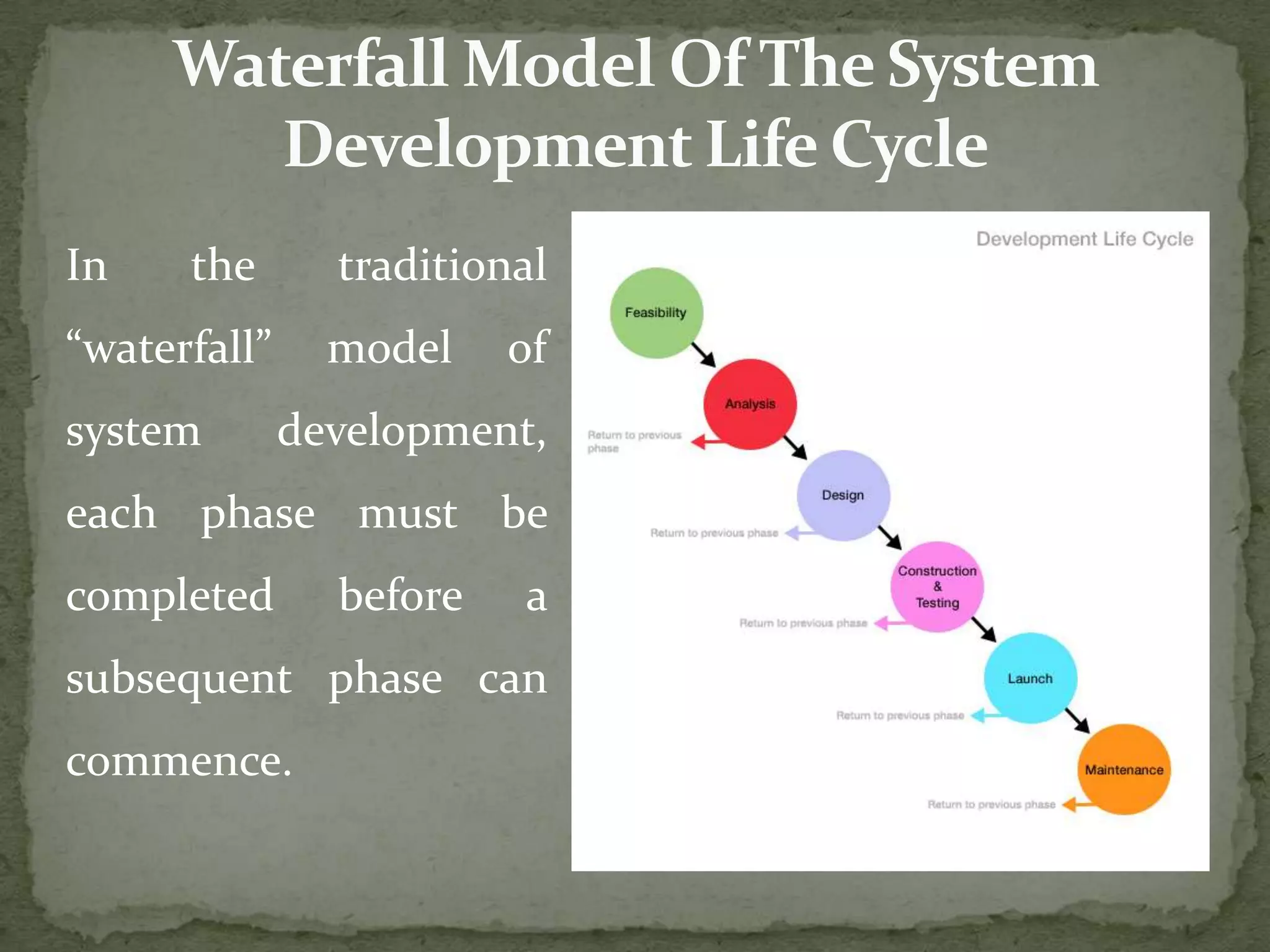
In the traditional
“waterfall” model of
system development,
each phase must be
completed before a
subsequent phase can
commence.
 Control.
 Monitor large projects.
 Detailed steps.
 Evaluate costs and completion targets.
 Documentation.
 Well defined user input.
 Ease of maintenance.
 Development and design standards.
 Tolerates changes in MIS staffing.
Increased development time.
Increased development cost.
Systems must be defined up front.
Rigidity.
Hard to estimate costs, project overruns.
User input is sometimes limited.
 http://en.wikipedia.org/wiki/Systems_development_li
fe_cycle
 http://www.merttol.com/articles/web/web-site-
development-life-cycle.html
 http://oer.nios.ac.in/wiki/index.php/Phases_of_Syste
m_Development_Life_Cycle

Gr 6 sdlc models

  • 1.
  • 2.
    Amna Razzaq 06 AqsaIjaz 30 Rubab Fatimi 02 Rehab Khan 35 Anjuman Chaudhry 45
  • 3.
    “The systems developmentlife cycle (SDLC), also referred to as the application development life-cycle, is a term used in systems engineering, information system and software engineering to describe a process for planning, creating, testing, and deploying an information system.”  The systems development life-cycle concept applies to a range of hardware and software configurations, as a system can be composed of hardware only, software only, or a combination of both.
  • 4.
    An SDLC hasthree primary business objectives:  Ensure the delivery of high quality systems;  Provide strong management controls;  Maximize productivity.
  • 5.
     The systemsdevelopment life cycle, according to Elliott & Strachan & Radford (2004), "originated in the 1960s, to develop large scale functional business systems in an age of large scale business conglomerates. Information systems activities revolved around heavy data processing and number crunching routines".
  • 6.
    The product life cycledescribes the process for building information systems in a very deliberate, structured and methodical way, reiterating each stage of the product's life.
  • 7.
    The System Developmentis the interactive process which consists of the following phases:  System Study  Feasibility Study  Detailed System Study  System Analysis  System Design  Coding  Testing  Implementation  Maintenance
  • 8.
     Preliminary systemstudy is the first stage of system development life cycle. This is a brief investigation of the system under consideration and gives a clear picture of what actually the physical system is?  In practice, the initial system study involves the preparation of a System proposal which lists the Problem Definition, Objectives of the Study, Terms of reference for Study, Constraints, Expected benefits of the new system, etc.
  • 9.
     In casethe system proposal is acceptable to the management, the next phase is to examine the feasibility of the system.  The feasibility study is basically the test of the proposed system in the light of its workability, meeting user’s requirements, effective use of resources and of course, the cost effectiveness.  These are categorized as:  Technical  Operational  Economic  Schedule  Social feasibility
  • 10.
     The detailedinvestigation of the system is carried out in accordance with the objectives of the proposed system. This involves detailed study of various operations performed by a system and their relationships within and outside the system.  During this process, data are collected on the available files, decision points and transactions handled by the present system. Interviews, on-site observation and questionnaire are the tools used for detailed system study.
  • 11.
     Systems analysisis a process of collecting factual data, understand the processes involved, identifying problems and recommending feasible suggestions for improving the system functioning.  This involves studying the business processes, gathering operational data, understand the information flow, finding out bottlenecks and evolving solutions for overcoming the weaknesses of the system so as to achieve the organizational goals.
  • 12.
     The mostcrucial phase in the development of a system.  In the design phase the SDLC process continues to move from the what questions of the analysis phase to the how .  The logical design produced during the analysis is turned into a physical design.  Physical design: a detailed description of what is needed to solve original problem.
  • 13.
     Data structure,control process, equipment source, workload and limitation of the system, Interface, documentation, training, procedures of using the system, taking backups and staffing requirement are decided at this stage.  There are several tools and techniques used for describing the system design of the system. These tools and techniques are:  Flowchart  Data flow diagram (DFD)  Data dictionary  Structured English  Decision table  Decision tree
  • 14.
     The systemdesign needs to be implemented to make it a workable system. his demands the coding of design into computer language, i.e., programming language. This is also called the programming phase in which the programmer converts the program specifications into computer instructions, which we refer to as programs.  It is an important stage where the defined procedures are transformed into control specifications by the help of a computer language.  Programming tools like compilers, interpreters and language like c, c++, and java etc., are used for coding.
  • 15.
    After codifying thewhole programs of the system, a test plan should be developed and run on a given set of test data. The output of the test run should match the expected results. Using the test data following test run are carried out:  Program test  System test  Program test : When the programs have been coded and compiled and brought to working conditions, they must be individually tested with the prepared test data.  System Test : After carrying out the program test for each of the programs of the system and errors removed, then system test is done.
  • 16.
    After having theuser acceptance of the new system developed, the implementation phase begins. Implementation is the stage of a project during which theory is turned into practice. The major steps involved in this phase are:  Acquisition and Installation of Hardware and Software  Conversion  User Training  Documentation
  • 17.
     Maintenance isnecessary to eliminate errors in the system during its working life and to tune the system to any variations in its working environments. It must meet the scope of any future enhancement, future functionality and any other added functional features to cope up with the latest future needs. It has been seen that there are always some errors found in the systems that must be noted and corrected. It also means the review of the system from time to time.  The review of the system is done for:  Knowing the full capabilities of the system  Knowing the required changes or the additional requirements  Studying the performance.
  • 18.
     Waterfall Model Spiral Model  Rapid Application Development (RAD) Model  V-shap Model  Incremental Model  Agile Model
  • 19.
    In the traditional “waterfall”model of system development, each phase must be completed before a subsequent phase can commence.
  • 20.
     Control.  Monitorlarge projects.  Detailed steps.  Evaluate costs and completion targets.  Documentation.  Well defined user input.  Ease of maintenance.  Development and design standards.  Tolerates changes in MIS staffing.
  • 21.
    Increased development time. Increaseddevelopment cost. Systems must be defined up front. Rigidity. Hard to estimate costs, project overruns. User input is sometimes limited.
  • 22.