SYSTEM
ANALYSIS
AND
DESIGN
SECP1013-08
TECHNOLOGY & INFORMATION
SYSTEM
SYSTEM
ANALYSTS
&
DESIGNER
 AZ MUKHLIS ISKANDAR BIN AZLI
 MUHAMMAD ISKANDAR ZULQARNAIN BIN MOHD ISHAK
 NUR NABILAH BINTIYUSMAN
LEARNING OUTCOMES
 Describe the six phases of the systems life cycle.
 Identify information needs and formulate possible solutions.
 Analyze existing information systems and evaluate the feasibility of
alternative systems.
 Identify, acquire, and test new system software and hardware.
 Switch from an existing information system to a new one with minimal risk.
 Perform system audits and periodic evaluations.
 Describe prototyping and rapid applications development.
SYSTEM ANALYSIS AND DESIGN
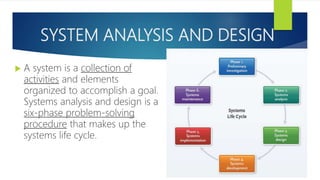
 A system is a collection of
activities and elements
organized to accomplish a goal.
Systems analysis and design is a
six-phase problem-solving
procedure that makes up the
systems life cycle.
PHASE 1 : PRELIMINARY INVESTIGATION
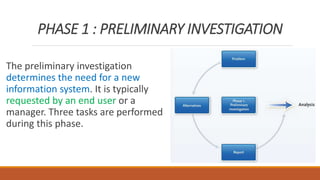
The preliminary investigation
determines the need for a new
information system. It is typically
requested by an end user or a
manager. Three tasks are performed
during this phase.
PHASE 1 : PRELIMINARY INVESTIGATION
Defining the Problem
The current information system is examined to determine who needs what information,
when the information is needed, and why it is needed.
Suggesting Alternative Systems
Some possible alternative systems are suggested. Based on interviews and observations
made in defining the problem, alternative information systems are identified.
Preparing a Short Report
To document and communicate the findings of Phase 1, preliminary investigation, a
short report is prepared and presented to management.
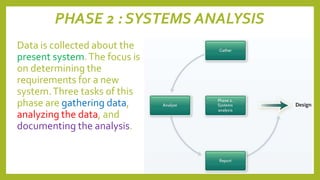
PHASE 2 : SYSTEMS ANALYSIS
Data is collected about the
present system.The focus is
on determining the
requirements for a new
system.Three tasks of this
phase are gathering data,
analyzing the data, and
documenting the analysis.
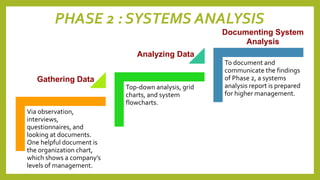
PHASE 2 : SYSTEMS ANALYSIS
Via observation,
interviews,
questionnaires, and
looking at documents.
One helpful document is
the organization chart,
which shows a company’s
levels of management.
Top-down analysis, grid
charts, and system
flowcharts.
To document and
communicate the findings
of Phase 2, a systems
analysis report is prepared
for higher management.
Gathering Data
Analyzing Data
Documenting System
Analysis
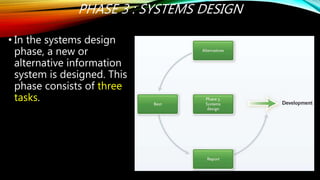
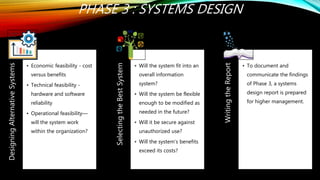
PHASE 3 : SYSTEMS DESIGN
• In the systems design
phase, a new or
alternative information
system is designed. This
phase consists of three
tasks.
PHASE 3 : SYSTEMS DESIGNDesigningAlternativeSystems
• Economic feasibility - cost
versus benefits
• Technical feasibility -
hardware and software
reliability
• Operational feasibility—
will the system work
within the organization?
SelectingtheBestSystem
• Will the system fit into an
overall information
system?
• Will the system be flexible
enough to be modified as
needed in the future?
• Will it be secure against
unauthorized use?
• Will the system’s benefits
exceed its costs?
WritingtheReport
• To document and
communicate the findings
of Phase 3, a systems
design report is prepared
for higher management.
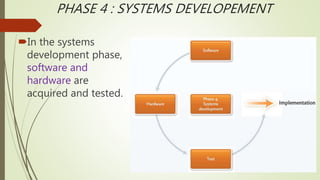
PHASE 4 : SYSTEMS DEVELOPEMENT
In the systems
development phase,
software and
hardware are
acquired and tested.
Acquiring Software
 Purchasing off-the-shelf packaged software and designing custom
programs.
Acquiring Hardware
 Consideration for future company growth, existing networks,
communication capabilities, and training.
Testing the New System
 Using sample data, the new system is tested. This step can take
several months for a complex system.
PHASE 4 : SYSTEMS DEVELOPEMENT
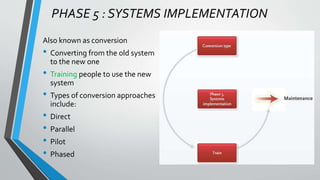
PHASE 5 : SYSTEMS IMPLEMENTATION
Also known as conversion
• Converting from the old system
to the new one
• Training people to use the new
system
• Types of conversion approaches
include:
• Direct
• Parallel
• Pilot
• Phased
PHASE 6 : SYSTEMS MAINTENANCE
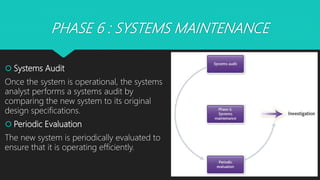
 Systems Audit
Once the system is operational, the systems
analyst performs a systems audit by
comparing the new system to its original
design specifications.
 Periodic Evaluation
The new system is periodically evaluated to
ensure that it is operating efficiently.
Prototyping and Rapid Applications
Development
• Prototyping
Build a model or prototype that can be modified before
the actual system is installed. Typically, the development
time for prototyping is shorter; however, it can be more
difficult to manage the project and to control costs.
• Rapid Applications Development
Powerful development software, small specialized teams,
and highly trained personnel. Typically, the development
costs more. However, the time is much less and the quality
is often better.

Systems Analysis & Design

  • 1.
  • 2.
    SYSTEM ANALYSTS & DESIGNER  AZ MUKHLISISKANDAR BIN AZLI  MUHAMMAD ISKANDAR ZULQARNAIN BIN MOHD ISHAK  NUR NABILAH BINTIYUSMAN
  • 3.
    LEARNING OUTCOMES  Describethe six phases of the systems life cycle.  Identify information needs and formulate possible solutions.  Analyze existing information systems and evaluate the feasibility of alternative systems.  Identify, acquire, and test new system software and hardware.  Switch from an existing information system to a new one with minimal risk.  Perform system audits and periodic evaluations.  Describe prototyping and rapid applications development.
  • 4.
    SYSTEM ANALYSIS ANDDESIGN  A system is a collection of activities and elements organized to accomplish a goal. Systems analysis and design is a six-phase problem-solving procedure that makes up the systems life cycle.
  • 5.
    PHASE 1 :PRELIMINARY INVESTIGATION The preliminary investigation determines the need for a new information system. It is typically requested by an end user or a manager. Three tasks are performed during this phase.
  • 6.
    PHASE 1 :PRELIMINARY INVESTIGATION Defining the Problem The current information system is examined to determine who needs what information, when the information is needed, and why it is needed. Suggesting Alternative Systems Some possible alternative systems are suggested. Based on interviews and observations made in defining the problem, alternative information systems are identified. Preparing a Short Report To document and communicate the findings of Phase 1, preliminary investigation, a short report is prepared and presented to management.
  • 7.
    PHASE 2 :SYSTEMS ANALYSIS Data is collected about the present system.The focus is on determining the requirements for a new system.Three tasks of this phase are gathering data, analyzing the data, and documenting the analysis.
  • 8.
    PHASE 2 :SYSTEMS ANALYSIS Via observation, interviews, questionnaires, and looking at documents. One helpful document is the organization chart, which shows a company’s levels of management. Top-down analysis, grid charts, and system flowcharts. To document and communicate the findings of Phase 2, a systems analysis report is prepared for higher management. Gathering Data Analyzing Data Documenting System Analysis
  • 9.
    PHASE 3 :SYSTEMS DESIGN • In the systems design phase, a new or alternative information system is designed. This phase consists of three tasks.
  • 10.
    PHASE 3 :SYSTEMS DESIGNDesigningAlternativeSystems • Economic feasibility - cost versus benefits • Technical feasibility - hardware and software reliability • Operational feasibility— will the system work within the organization? SelectingtheBestSystem • Will the system fit into an overall information system? • Will the system be flexible enough to be modified as needed in the future? • Will it be secure against unauthorized use? • Will the system’s benefits exceed its costs? WritingtheReport • To document and communicate the findings of Phase 3, a systems design report is prepared for higher management.
  • 11.
    PHASE 4 :SYSTEMS DEVELOPEMENT In the systems development phase, software and hardware are acquired and tested.
  • 12.
    Acquiring Software  Purchasingoff-the-shelf packaged software and designing custom programs. Acquiring Hardware  Consideration for future company growth, existing networks, communication capabilities, and training. Testing the New System  Using sample data, the new system is tested. This step can take several months for a complex system. PHASE 4 : SYSTEMS DEVELOPEMENT
  • 13.
    PHASE 5 :SYSTEMS IMPLEMENTATION Also known as conversion • Converting from the old system to the new one • Training people to use the new system • Types of conversion approaches include: • Direct • Parallel • Pilot • Phased
  • 14.
    PHASE 6 :SYSTEMS MAINTENANCE  Systems Audit Once the system is operational, the systems analyst performs a systems audit by comparing the new system to its original design specifications.  Periodic Evaluation The new system is periodically evaluated to ensure that it is operating efficiently.
  • 15.
    Prototyping and RapidApplications Development • Prototyping Build a model or prototype that can be modified before the actual system is installed. Typically, the development time for prototyping is shorter; however, it can be more difficult to manage the project and to control costs. • Rapid Applications Development Powerful development software, small specialized teams, and highly trained personnel. Typically, the development costs more. However, the time is much less and the quality is often better.

Editor's Notes

  • #5 More and more end users are developing their own information systems. This is because in many organizations there is a three-year backlog of work for systems analysts. For instance, suppose you recognize that there is a need for certain information within your organization. Obtaining this information will require the introduction of new hardware and software. You go to seek expert help from systems analysts in studying these information needs. At that point you discover that the systems analysts are so overworked it will take them three years to get to your request! You can see, then, why many managers are learning to do these activities themselves. In any case, learning the six steps described in this chapter will raise your computer efficiency and effectiveness. It also will give you skills to solve a wide range of problems. These skills can make you more valuable to an organization.
  • #14 Training is important, however, often overlooked. Some people may train early as the equipment is being delivered so that they can adjust more easily. Sometimes a professional trainer is used; other times the systems analyst acts as the trainer. Direct approach—abandoning the old system and starting up the new system; can be very risky and not recommended. Parallel approach—running the old and new side by side until the new system proves its worth; very low risk; however, very expensive; not generally recommended. Pilot approach—converting only one part of the organization to the new system until the new system proves its worth; less expensive but riskier than parallel conversion; recommended for situations with many people performing similar operations. Phased approach—gradually implementing the new system to the entire organization; less risky but more expensive than parallel conversion; recommended for situations with many people performing different operations.