Presented to,
BS-IT-4th-Eve
Presented by,
aUbaid-ur-Rehman :- 3014
18-04-2015 1
Contents
 Definition
 Diagram
 Phases
 Contrast
 Implementation Guideline
 Reference
2
Definition
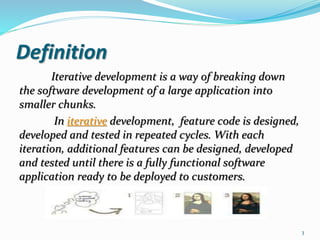
Iterative development is a way of breaking down
the software development of a large application into
smaller chunks.
In iterative development, feature code is designed,
developed and tested in repeated cycles. With each
iteration, additional features can be designed, developed
and tested until there is a fully functional software
application ready to be deployed to customers.
3
4
As like all others models , it also follow the ADCOT
Principle of software developing.
A : Analysis
D : Designing
CO : Coding
T : Testing
and we are well aware of these steps.
5
Phases
Incremental development slices the system
functionality into increments (portions). In each
increment, a slice of functionality is delivered through
cross-discipline work, from the requirements to
the deployment. The Unified Process groups
increments/iterations into phases: inception, elaboration,
construction, and transition.
6
Inception identifies project scope, requirements (functional and non-functional)
and risks at a high level but in enough detail that work can be estimated.
Elaboration delivers a working architecture that mitigates the top risks and fulfills
the non-functional requirements.
Construction incrementally fills-in the architecture with production-ready code
produced from analysis, design, implementation, and testing of the functional
requirements.
Transition delivers the system into the production operating environment.
Each of the phases may be divided into 1 or more iterations, which are usually
time-boxed rather than feature-boxed. Architects and analysts work one iteration
ahead of developers and testers to keep their work-product backlog full.
7
Contrast with Waterfall development
Waterfall development completes the project-wide
work-products of each discipline in one step before
moving on to the next discipline in the next step. Business
value is delivered all at once, and only at the very end of
the project. Backtracking is possible in an iterative
approach.
8
Implementation guidelines
 Any difficulty in design, coding and testing a modification should signal the need
for redesign or re-coding.
 Modifications should fit easily into isolated and easy-to-find modules. If they do
not, some redesign is possibly needed.
 Modifications to tables should be especially easy to make. If any table
modification is not quickly and easily done, redesign is indicated.
 Modifications should become easier to make as the iterations progress. If they are
not, there is a basic problem such as a design flaw or a proliferation of patches.
 Patches should normally be allowed to exist for only one or two iterations.
Patches may be necessary to avoid redesigning during an implementation phase.
 The existing implementation should be analyzed frequently to determine how
well it measures up to project goals.
 Program analysis facilities should be used whenever available to aid in the
analysis of partial implementations.
 User reaction should be solicited and analyzed for indications of deficiencies in
the current implementation.
9
Reference
 http://en.wikipedia.org/wiki/Iterative_and_incre
mental_development#Phases
 http://en.wikipedia.org/wiki/File:Iterative_develo
pment_model.svg
 Dr. Alistair Cockburn (May 2008). "Using Both
Incremental and Iterative Development". STSC
CrossTalk (USAF Software Technology Support
Center) 21 (5): 27–30. ISSN 2160-1593. Retrieved 2011-
07-20.
 Ubaid-ur-Rehman
10

Itertaive Process Development

  • 1.
  • 2.
    Contents  Definition  Diagram Phases  Contrast  Implementation Guideline  Reference 2
  • 3.
    Definition Iterative development isa way of breaking down the software development of a large application into smaller chunks. In iterative development, feature code is designed, developed and tested in repeated cycles. With each iteration, additional features can be designed, developed and tested until there is a fully functional software application ready to be deployed to customers. 3
  • 4.
  • 5.
    As like allothers models , it also follow the ADCOT Principle of software developing. A : Analysis D : Designing CO : Coding T : Testing and we are well aware of these steps. 5
  • 6.
    Phases Incremental development slicesthe system functionality into increments (portions). In each increment, a slice of functionality is delivered through cross-discipline work, from the requirements to the deployment. The Unified Process groups increments/iterations into phases: inception, elaboration, construction, and transition. 6
  • 7.
    Inception identifies projectscope, requirements (functional and non-functional) and risks at a high level but in enough detail that work can be estimated. Elaboration delivers a working architecture that mitigates the top risks and fulfills the non-functional requirements. Construction incrementally fills-in the architecture with production-ready code produced from analysis, design, implementation, and testing of the functional requirements. Transition delivers the system into the production operating environment. Each of the phases may be divided into 1 or more iterations, which are usually time-boxed rather than feature-boxed. Architects and analysts work one iteration ahead of developers and testers to keep their work-product backlog full. 7
  • 8.
    Contrast with Waterfalldevelopment Waterfall development completes the project-wide work-products of each discipline in one step before moving on to the next discipline in the next step. Business value is delivered all at once, and only at the very end of the project. Backtracking is possible in an iterative approach. 8
  • 9.
    Implementation guidelines  Anydifficulty in design, coding and testing a modification should signal the need for redesign or re-coding.  Modifications should fit easily into isolated and easy-to-find modules. If they do not, some redesign is possibly needed.  Modifications to tables should be especially easy to make. If any table modification is not quickly and easily done, redesign is indicated.  Modifications should become easier to make as the iterations progress. If they are not, there is a basic problem such as a design flaw or a proliferation of patches.  Patches should normally be allowed to exist for only one or two iterations. Patches may be necessary to avoid redesigning during an implementation phase.  The existing implementation should be analyzed frequently to determine how well it measures up to project goals.  Program analysis facilities should be used whenever available to aid in the analysis of partial implementations.  User reaction should be solicited and analyzed for indications of deficiencies in the current implementation. 9
  • 10.
    Reference  http://en.wikipedia.org/wiki/Iterative_and_incre mental_development#Phases  http://en.wikipedia.org/wiki/File:Iterative_develo pment_model.svg Dr. Alistair Cockburn (May 2008). "Using Both Incremental and Iterative Development". STSC CrossTalk (USAF Software Technology Support Center) 21 (5): 27–30. ISSN 2160-1593. Retrieved 2011- 07-20.  Ubaid-ur-Rehman 10