System Analysis and Design
B.FTech
Semester-IV
NIFT New Delhi
System Approach
Systems are created to solve problems.
One can think of the systems approach as
an organized way of dealing with a
problem.
OBJECTIVES
• understand a system
• understand the different phases of system
developments life cycle
• know the components of system analysis
• know the components of system designing
SYSTEM LIFE CYCLE
• System life cycle is an organizational
process of developing and maintaining
systems.
• It helps in establishing a system project
plan, because it gives overall list of
processes and sub-processes required
developing a system.
SDLC
• System development life cycle means
combination of various activities.
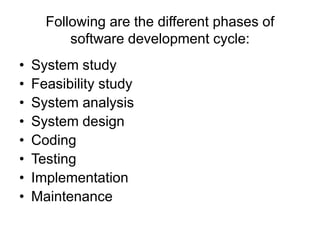
Following are the different phases of
software development cycle:
• System study
• Feasibility study
• System analysis
• System design
• Coding
• Testing
• Implementation
• Maintenance
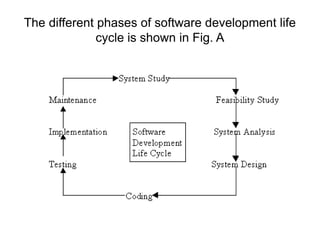
The different phases of software development life
cycle is shown in Fig. A
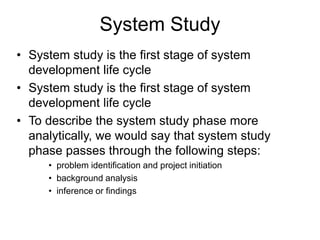
System Study
• System study is the first stage of system
development life cycle
• System study is the first stage of system
development life cycle
• To describe the system study phase more
analytically, we would say that system study
phase passes through the following steps:
• problem identification and project initiation
• background analysis
• inference or findings
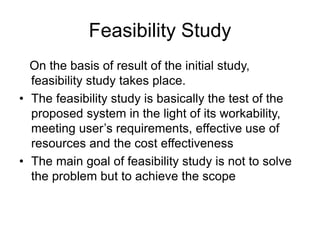
Feasibility Study
On the basis of result of the initial study,
feasibility study takes place.
• The feasibility study is basically the test of the
proposed system in the light of its workability,
meeting user’s requirements, effective use of
resources and the cost effectiveness
• The main goal of feasibility study is not to solve
the problem but to achieve the scope
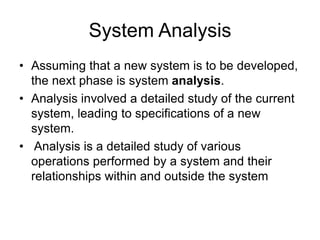
System Analysis
• Assuming that a new system is to be developed,
the next phase is system analysis.
• Analysis involved a detailed study of the current
system, leading to specifications of a new
system.
• Analysis is a detailed study of various
operations performed by a system and their
relationships within and outside the system
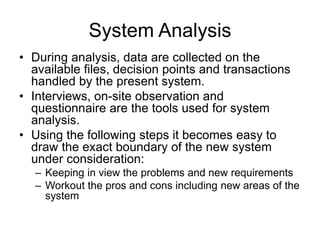
System Analysis
• During analysis, data are collected on the
available files, decision points and transactions
handled by the present system.
• Interviews, on-site observation and
questionnaire are the tools used for system
analysis.
• Using the following steps it becomes easy to
draw the exact boundary of the new system
under consideration:
– Keeping in view the problems and new requirements
– Workout the pros and cons including new areas of the
system
System Analysis
• All procedures, requirements must be analysed and
documented in the form of detailed data flow diagrams
(DFDs), data dictionary, logical data structures and
miniature specifications.
• System Analysis also includes sub-dividing of complex
process involving the entire system, identification of data
store and manual processes.
• The main points to be discussed in system analysis are:
• Specification of what the new system is to accomplish based
on the user requirements.
• Functional hierarchy showing the functions to be performed by
the new system and their relationship with each other.
• Function network which are similar to function hierarchy but
they highlight the those functions which are common to more
than one procedure.
• List of attributes of the entities - these are the data items which
need to be held about each entity (record)
System Design
• Based on the user requirements and the detailed
analysis of a new system, the new system must
be designed.
• This is the phase of system designing. It is a
most crucial phase in the development of a
system.
• Normally, the design proceeds in two stages :
• preliminary or general design
• Structure or detailed design
There are several tools and techniques used for
designing. These tools and techniques are:
• Flowchart
• Data flow diagram (DFDs)
• Data dictionary
• Structured English
• Decision table
• Decision tree
Coding
• After designing the new system, the whole system is
required to be converted into computer understanding
language.
• Coding the new system into computer programming
language does this.
• It is an important stage where the defined procedure are
transformed into control specifications by the help of a
computer language.
• This is also called the programming phase in which the
programmer converts the program specifications into
computer instructions, which we refer as programs.
• The programs coordinate the data movements and
control the entire process in a system.
Testing
• Before actually implementing the new system
into operations, a test run of the system is done
removing all the bugs, if any.
• It is an important phase of a successful system.
After codifying the whole programs of the
system, a test plan should be developed and run
on a given set of test data.
• The output of the test run should match the
expected results.
• Using the test data following test run are carried
out:
– Unit test
– System test
Testing
• Unit test: When the programs have been coded and
compiled and brought to working conditions, they must
be individually tested with the prepared test data. Any
undesirable happening must be noted and debugged
(error corrections).
• System Test: After carrying out the unit test for each of
the programs of the system and when errors are
removed, then system test is done.
– At this stage the test is done on actual data. The complete
system is executed on the actual data.
– At each stage of the execution, the results or output of the
system is analysed.
– During the result analysis, it may be found that the outputs are
not matching the expected out of the system.
– In such case, the errors in the particular programs are identified
and are fixed and further tested for the expected output.
Implementation
• After having the user acceptance of the new system
developed, the implementation phase begins.
• Implementation is the stage of a project during which
theory is turned into practice.
• During this phase, all the programs of the system are
loaded onto the user's computer.
• After loading the system, training of the users starts.
Main topics of such type of training are:
• How to execute the package
• How to enter the data
• How to process the data (processing details)
• How to take out the reports
• After the users are trained about the computerized
system, manual working has to shift from manual to
computerized working. The following two strategies
are followed for running the system:
• Parallel run: In such run for a certain defined period, both the
systems i.e. computerized and manual are executed in parallel. This
strategy is helpful because of the following:
• Manual results can be compared with the results of the
computerized system.
• Failure of the computerized system at the early stage, does
not affect the working of the organization, because the
manual system continues to work, as it used to do.
– Pilot run: In this type of run, the new system is installed
in parts. Some part of the new system is installed first
and executed successfully for considerable time period.
When the results are found satisfactory then only other
parts are implemented. This strategy builds the
confidence and the errors are traced easily.
Maintenance
• Maintenance is necessary to eliminate errors in the
system during its working life and to tune the system to
any variations in its working environment.
• It has been seen that there are always some errors
found in the system that must be noted and corrected.
• It also means the review of the system from time to
time. The review of the system is done for:
– knowing the full capabilities of the system
– knowing the required changes or the additional requirements
– studying the performance
• If a major change to a system is needed, a new project
may have to be set up to carry out the change. The new
project will then proceed through all the above life cycle
phases.

Sad1

  • 1.
    System Analysis andDesign B.FTech Semester-IV NIFT New Delhi
  • 2.
    System Approach Systems arecreated to solve problems. One can think of the systems approach as an organized way of dealing with a problem.
  • 3.
    OBJECTIVES • understand asystem • understand the different phases of system developments life cycle • know the components of system analysis • know the components of system designing
  • 4.
    SYSTEM LIFE CYCLE •System life cycle is an organizational process of developing and maintaining systems. • It helps in establishing a system project plan, because it gives overall list of processes and sub-processes required developing a system.
  • 5.
    SDLC • System developmentlife cycle means combination of various activities.
  • 6.
    Following are thedifferent phases of software development cycle: • System study • Feasibility study • System analysis • System design • Coding • Testing • Implementation • Maintenance
  • 7.
    The different phasesof software development life cycle is shown in Fig. A
  • 8.
    System Study • Systemstudy is the first stage of system development life cycle • System study is the first stage of system development life cycle • To describe the system study phase more analytically, we would say that system study phase passes through the following steps: • problem identification and project initiation • background analysis • inference or findings
  • 9.
    Feasibility Study On thebasis of result of the initial study, feasibility study takes place. • The feasibility study is basically the test of the proposed system in the light of its workability, meeting user’s requirements, effective use of resources and the cost effectiveness • The main goal of feasibility study is not to solve the problem but to achieve the scope
  • 10.
    System Analysis • Assumingthat a new system is to be developed, the next phase is system analysis. • Analysis involved a detailed study of the current system, leading to specifications of a new system. • Analysis is a detailed study of various operations performed by a system and their relationships within and outside the system
  • 11.
    System Analysis • Duringanalysis, data are collected on the available files, decision points and transactions handled by the present system. • Interviews, on-site observation and questionnaire are the tools used for system analysis. • Using the following steps it becomes easy to draw the exact boundary of the new system under consideration: – Keeping in view the problems and new requirements – Workout the pros and cons including new areas of the system
  • 12.
    System Analysis • Allprocedures, requirements must be analysed and documented in the form of detailed data flow diagrams (DFDs), data dictionary, logical data structures and miniature specifications. • System Analysis also includes sub-dividing of complex process involving the entire system, identification of data store and manual processes. • The main points to be discussed in system analysis are: • Specification of what the new system is to accomplish based on the user requirements. • Functional hierarchy showing the functions to be performed by the new system and their relationship with each other. • Function network which are similar to function hierarchy but they highlight the those functions which are common to more than one procedure. • List of attributes of the entities - these are the data items which need to be held about each entity (record)
  • 13.
    System Design • Basedon the user requirements and the detailed analysis of a new system, the new system must be designed. • This is the phase of system designing. It is a most crucial phase in the development of a system. • Normally, the design proceeds in two stages : • preliminary or general design • Structure or detailed design
  • 14.
    There are severaltools and techniques used for designing. These tools and techniques are: • Flowchart • Data flow diagram (DFDs) • Data dictionary • Structured English • Decision table • Decision tree
  • 15.
    Coding • After designingthe new system, the whole system is required to be converted into computer understanding language. • Coding the new system into computer programming language does this. • It is an important stage where the defined procedure are transformed into control specifications by the help of a computer language. • This is also called the programming phase in which the programmer converts the program specifications into computer instructions, which we refer as programs. • The programs coordinate the data movements and control the entire process in a system.
  • 16.
    Testing • Before actuallyimplementing the new system into operations, a test run of the system is done removing all the bugs, if any. • It is an important phase of a successful system. After codifying the whole programs of the system, a test plan should be developed and run on a given set of test data. • The output of the test run should match the expected results. • Using the test data following test run are carried out: – Unit test – System test
  • 17.
    Testing • Unit test:When the programs have been coded and compiled and brought to working conditions, they must be individually tested with the prepared test data. Any undesirable happening must be noted and debugged (error corrections). • System Test: After carrying out the unit test for each of the programs of the system and when errors are removed, then system test is done. – At this stage the test is done on actual data. The complete system is executed on the actual data. – At each stage of the execution, the results or output of the system is analysed. – During the result analysis, it may be found that the outputs are not matching the expected out of the system. – In such case, the errors in the particular programs are identified and are fixed and further tested for the expected output.
  • 18.
    Implementation • After havingthe user acceptance of the new system developed, the implementation phase begins. • Implementation is the stage of a project during which theory is turned into practice. • During this phase, all the programs of the system are loaded onto the user's computer. • After loading the system, training of the users starts. Main topics of such type of training are: • How to execute the package • How to enter the data • How to process the data (processing details) • How to take out the reports
  • 19.
    • After theusers are trained about the computerized system, manual working has to shift from manual to computerized working. The following two strategies are followed for running the system: • Parallel run: In such run for a certain defined period, both the systems i.e. computerized and manual are executed in parallel. This strategy is helpful because of the following: • Manual results can be compared with the results of the computerized system. • Failure of the computerized system at the early stage, does not affect the working of the organization, because the manual system continues to work, as it used to do. – Pilot run: In this type of run, the new system is installed in parts. Some part of the new system is installed first and executed successfully for considerable time period. When the results are found satisfactory then only other parts are implemented. This strategy builds the confidence and the errors are traced easily.
  • 20.
    Maintenance • Maintenance isnecessary to eliminate errors in the system during its working life and to tune the system to any variations in its working environment. • It has been seen that there are always some errors found in the system that must be noted and corrected. • It also means the review of the system from time to time. The review of the system is done for: – knowing the full capabilities of the system – knowing the required changes or the additional requirements – studying the performance • If a major change to a system is needed, a new project may have to be set up to carry out the change. The new project will then proceed through all the above life cycle phases.