MANAGEMENT INFORMATION SYSTEM 
REPORT ON SOFTWARE DEVELOPMENT LIFE CYCLE 
Submitted By:- 
Neetu Marwah (MBABI013001)
MANAGEMENT INFORMATION SYSTEM 
MIS is computerized system continuously gather relevant 
data, both from external and internal sources. 
This data is then processed, integrated, and stored in 
centralized database where it is constantly updated and 
made available to all users who have the authority to access 
it. 
SYSTEM DEVELOPMENT LIFE CYCLE (SDLC) 
In software engineering, a software development 
methodology (also known as a system development 
methodology, software development life cycle, software 
development process, software process) is a division of 
software development work into distinct phases or activities 
with the intent of better planning and management. 
It is often considered a subset of the systems development 
life cycle. The methodology may include the pre-definition 
of specific deliverables and artifacts that are created and 
completed by a project team to develop or maintain an 
application. 
SDLC, Software Development Life Cycle is a process used 
by software industry to design, develop and test high quality 
software's. 
The SDLC aims to produce high quality software that meets 
or exceeds customer expectations, reaches completion within 
times and cost estimates.
SDLC is a process used by IT analysis in order to develop or 
redesign high quality software system which meets both the 
customer and real world requirement taking into 
consideration all associated aspects of 
 Software testing 
 Analysis 
 Post process maintenance 
 SDLC is the acronym of Software Development Life 
Cycle. It is also called as Software development process. 
 The software development life cycle (SDLC) Is a 
framework defining tasks performed at each step in the 
software development process. 
 ISO/IEC 12207 is an international standard for software 
life-cycle processes. 
 It aims to be the standard that defines all the tasks 
required for developing and maintaining software.
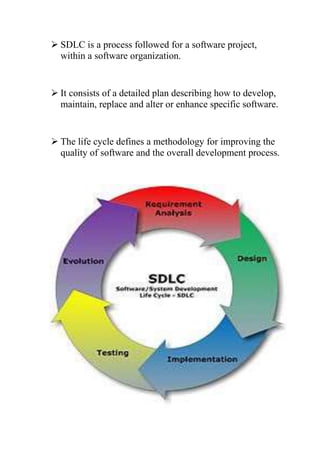
 SDLC is a process followed for a software project, 
within a software organization. 
 It consists of a detailed plan describing how to develop, 
maintain, replace and alter or enhance specific software. 
 The life cycle defines a methodology for improving the 
quality of software and the overall development process.
SYSTEM DEVELOPMENT LIFE CYCLE (SDLC) 
STAGES:- 
1) Problem initiation / Preliminary investigation 
2) Requirements /feasibility study 
3) Analysis 
4) Design 
5) Development 
6) Testing 
7) Implementation 
8) Maintenance & support
1) Problem Initiation 
 In this phase of the system development life cycle, the 
analyst is concerns with identifying Problem, 
opportunities and objectives. 
 The aim is to investigate through an identified need or 
opportunity and to present a proposal to management 
may accept. 
 The output of this phase is feasibility report containing a 
problem definition and summary of objectives. 
 Rough estimate of the cost involved for the system 
development is also provided at this stage, because the 
process of developing a major information system can 
be costly. 
2) Requirements / Feasibility study 
 Feasibility study is conducted to investigate the 
preliminary specification and development plan for the 
system. 
 Include analysis of project requirement in terms of input 
data and desired output , processing required to 
transform input into output. 
 The feasibility analysis also includes the technical 
feasibility of project in terms of available software tools, 
hardware, and skilled software professionals.
The feasibility of a proposed system are: 
Organizational feasibility –objective of organization’s 
strategic plan. 
Economical feasibility- cost 
Technical feasibility -whether reliable hardware and 
software, capable of solving the problem 
Operational feasibility - ability of management, employees, 
customers, suppliers, to operate, use of system. 
3) Analysis: 
In this phase, the system analyst analyses the system needs. 
Special tools and techniques help the analyst in determination 
of requirements. 
At this phase detailed study of objective is done and analyze 
no. of solution available for solving the problem/achieve the 
objective 
There are two major activities performed as part of this phase: 
Existing system is studied to solve the problem i.e. 
1) Find out no of possible solutions, the strengths 
,weaknesses and compared this with the current system must 
be defined to serve as evaluation of other alternatives. 
2) Other alternatives are identified and evaluated.
4) Design 
In this phase the requirement specifications from first phase 
are studied in this phase and system design is prepared. 
System Design helps in specifying hardware and system 
requirements and also helps in defining overall system 
architecture or layout. 
Different architectures are use – 
Technical architecture - defines the hardware, software, and 
telecommunications equipment required to run the system. 
Modeling - the activity of drawing a graphical 
representation of a design 
Graphical user interface (GUI) - the interface to an 
information system. 
GUI screen design - the ability to model the information 
system screens for an entire system. 
Document should be prepared in design phase are: 
 SRDD-system requirement design document 
 FSD- functional specification document 
 PS- programmed specification 
 GAD- gap analysis document 
5) Development 
 Take all of detailed design documents from the design 
phase and transform them into an actual system.
 The analyst works with programmers to develop any 
original software that needed. 
 Some of the structured techniques for designing and 
documenting software include structure charts and 
pseudo code. 
6) Testing 
 We need to discuss what is being tested, when testing 
must occur, the steps in testing, the properties to test for 
and the definition of the overall testing effort. 
 Verifies that the system works and meets all of the 
business requirements defined in the analysis phase. 
 With inputs from system design, the system is first 
developed in small programs called units, which are 
integrated in the next phase. 
 Each unit is developed and tested for its functionality 
which is referred to as Unit Testing. 
 It is relatively less expensive to detect problems before 
 The system is being used by the users. 
 Test conditions - the detailed steps the system must 
perform along with the expected results of each step. 
7) Implementation 
In this phase acquisition of hardware and software site 
preparations users training and installation of the system
 User documentation - How to use the system. 
 Online training - runs over the Internet or off a CD-ROM. 
 Workshop training - is held in a classroom 
 System Installation: There are five topics which 
describe the process of converting from the existing 
system to the new one: 
 Data Conversion- is the process of translating the data 
from the existing data formats and data definitions to 
those required by the new system. 
 Training- Training is the process of teaching all users of 
the system how to use the functions 
 Hardware/Software Installation- Hardware/software 
installation is the process of installing the vendor 
supplied computer configuration and supplemental 
applications required to support the system being 
developed. 
8) Maintenance & support 
 Monitor and support the new system to ensure it 
continues to meet the business goals.
 System maintenance involves the monitoring, evaluating 
and modifying of system to make desirable or necessary 
improvement. 
Strengths of SDLC 
Methodologies incorporating this approach have been 
well tried and tested. 
Divides development into distinct phases: 
a) Makes tasks more manageable 
b) Offers opportunity for more control over development 
process 
Provides standards for documentation 
Much better than trial and error 
Weaknesses of SDLC 
Fails to see the “big picture” of strategic management 
Too inflexible to cope with changing requirements 
Emphasis on “hard” thinking (which is often reflected in 
documentation that is too technical) 
Unable to capture true needs of users 
SDLC Summary 
1. Determine the requirements of the desired software 
(Requirements Study Phase). 
2. Produce a design that meets the requirements (Design 
Phase).
3. Build (code) the designed software (Development 
Phase). 
4. Verify that the software meets the requirements (Testing 
Phase). 
5. Maintain the software throughout its lifetime 
(Maintenance Phase). 
The term software development life cycle model is a way of 
describing the planning, designing, coding, and testing of a 
software system, as well as the method in which these steps 
are implemented. A variety of life cycle models exist, but they 
all include the same constituent parts. All life cycle models 
take a project through several primary phases: a requirements-gathering 
phase, a design phase, a construction or 
implementation phase, and a testing phase.

Report on SOFTWARE DEVELOPMENT LIFE CYCLE SDLC

  • 1.
    MANAGEMENT INFORMATION SYSTEM REPORT ON SOFTWARE DEVELOPMENT LIFE CYCLE Submitted By:- Neetu Marwah (MBABI013001)
  • 2.
    MANAGEMENT INFORMATION SYSTEM MIS is computerized system continuously gather relevant data, both from external and internal sources. This data is then processed, integrated, and stored in centralized database where it is constantly updated and made available to all users who have the authority to access it. SYSTEM DEVELOPMENT LIFE CYCLE (SDLC) In software engineering, a software development methodology (also known as a system development methodology, software development life cycle, software development process, software process) is a division of software development work into distinct phases or activities with the intent of better planning and management. It is often considered a subset of the systems development life cycle. The methodology may include the pre-definition of specific deliverables and artifacts that are created and completed by a project team to develop or maintain an application. SDLC, Software Development Life Cycle is a process used by software industry to design, develop and test high quality software's. The SDLC aims to produce high quality software that meets or exceeds customer expectations, reaches completion within times and cost estimates.
  • 3.
    SDLC is aprocess used by IT analysis in order to develop or redesign high quality software system which meets both the customer and real world requirement taking into consideration all associated aspects of  Software testing  Analysis  Post process maintenance  SDLC is the acronym of Software Development Life Cycle. It is also called as Software development process.  The software development life cycle (SDLC) Is a framework defining tasks performed at each step in the software development process.  ISO/IEC 12207 is an international standard for software life-cycle processes.  It aims to be the standard that defines all the tasks required for developing and maintaining software.
  • 4.
     SDLC isa process followed for a software project, within a software organization.  It consists of a detailed plan describing how to develop, maintain, replace and alter or enhance specific software.  The life cycle defines a methodology for improving the quality of software and the overall development process.
  • 5.
    SYSTEM DEVELOPMENT LIFECYCLE (SDLC) STAGES:- 1) Problem initiation / Preliminary investigation 2) Requirements /feasibility study 3) Analysis 4) Design 5) Development 6) Testing 7) Implementation 8) Maintenance & support
  • 6.
    1) Problem Initiation  In this phase of the system development life cycle, the analyst is concerns with identifying Problem, opportunities and objectives.  The aim is to investigate through an identified need or opportunity and to present a proposal to management may accept.  The output of this phase is feasibility report containing a problem definition and summary of objectives.  Rough estimate of the cost involved for the system development is also provided at this stage, because the process of developing a major information system can be costly. 2) Requirements / Feasibility study  Feasibility study is conducted to investigate the preliminary specification and development plan for the system.  Include analysis of project requirement in terms of input data and desired output , processing required to transform input into output.  The feasibility analysis also includes the technical feasibility of project in terms of available software tools, hardware, and skilled software professionals.
  • 7.
    The feasibility ofa proposed system are: Organizational feasibility –objective of organization’s strategic plan. Economical feasibility- cost Technical feasibility -whether reliable hardware and software, capable of solving the problem Operational feasibility - ability of management, employees, customers, suppliers, to operate, use of system. 3) Analysis: In this phase, the system analyst analyses the system needs. Special tools and techniques help the analyst in determination of requirements. At this phase detailed study of objective is done and analyze no. of solution available for solving the problem/achieve the objective There are two major activities performed as part of this phase: Existing system is studied to solve the problem i.e. 1) Find out no of possible solutions, the strengths ,weaknesses and compared this with the current system must be defined to serve as evaluation of other alternatives. 2) Other alternatives are identified and evaluated.
  • 8.
    4) Design Inthis phase the requirement specifications from first phase are studied in this phase and system design is prepared. System Design helps in specifying hardware and system requirements and also helps in defining overall system architecture or layout. Different architectures are use – Technical architecture - defines the hardware, software, and telecommunications equipment required to run the system. Modeling - the activity of drawing a graphical representation of a design Graphical user interface (GUI) - the interface to an information system. GUI screen design - the ability to model the information system screens for an entire system. Document should be prepared in design phase are:  SRDD-system requirement design document  FSD- functional specification document  PS- programmed specification  GAD- gap analysis document 5) Development  Take all of detailed design documents from the design phase and transform them into an actual system.
  • 9.
     The analystworks with programmers to develop any original software that needed.  Some of the structured techniques for designing and documenting software include structure charts and pseudo code. 6) Testing  We need to discuss what is being tested, when testing must occur, the steps in testing, the properties to test for and the definition of the overall testing effort.  Verifies that the system works and meets all of the business requirements defined in the analysis phase.  With inputs from system design, the system is first developed in small programs called units, which are integrated in the next phase.  Each unit is developed and tested for its functionality which is referred to as Unit Testing.  It is relatively less expensive to detect problems before  The system is being used by the users.  Test conditions - the detailed steps the system must perform along with the expected results of each step. 7) Implementation In this phase acquisition of hardware and software site preparations users training and installation of the system
  • 10.
     User documentation- How to use the system.  Online training - runs over the Internet or off a CD-ROM.  Workshop training - is held in a classroom  System Installation: There are five topics which describe the process of converting from the existing system to the new one:  Data Conversion- is the process of translating the data from the existing data formats and data definitions to those required by the new system.  Training- Training is the process of teaching all users of the system how to use the functions  Hardware/Software Installation- Hardware/software installation is the process of installing the vendor supplied computer configuration and supplemental applications required to support the system being developed. 8) Maintenance & support  Monitor and support the new system to ensure it continues to meet the business goals.
  • 11.
     System maintenanceinvolves the monitoring, evaluating and modifying of system to make desirable or necessary improvement. Strengths of SDLC Methodologies incorporating this approach have been well tried and tested. Divides development into distinct phases: a) Makes tasks more manageable b) Offers opportunity for more control over development process Provides standards for documentation Much better than trial and error Weaknesses of SDLC Fails to see the “big picture” of strategic management Too inflexible to cope with changing requirements Emphasis on “hard” thinking (which is often reflected in documentation that is too technical) Unable to capture true needs of users SDLC Summary 1. Determine the requirements of the desired software (Requirements Study Phase). 2. Produce a design that meets the requirements (Design Phase).
  • 12.
    3. Build (code)the designed software (Development Phase). 4. Verify that the software meets the requirements (Testing Phase). 5. Maintain the software throughout its lifetime (Maintenance Phase). The term software development life cycle model is a way of describing the planning, designing, coding, and testing of a software system, as well as the method in which these steps are implemented. A variety of life cycle models exist, but they all include the same constituent parts. All life cycle models take a project through several primary phases: a requirements-gathering phase, a design phase, a construction or implementation phase, and a testing phase.