SYSTEM
DEVEVELOPMENT LIFE
CYCLE
n
NGONI DOMA
 QUESTION: WITH AN AID OF A DIAGRAM
EXPLAIN THE SYSTEM DEVELOPMENT LIFE
CYCLE AND THE ROLE OF ACCOUNTANT IN
EACH STAGE (20)MARKS
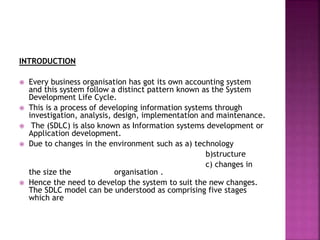
INTRODUCTION
 Every business organisation has got its own accounting system
and this system follow a distinct pattern known as the System
Development Life Cycle.
 This is a process of developing information systems through
investigation, analysis, design, implementation and maintenance.
 The (SDLC) is also known as Information systems development or
Application development.
 Due to changes in the environment such as a) technology
b)structure
c) changes in
the size the organisation .
 Hence the need to develop the system to suit the new changes.
The SDLC model can be understood as comprising five stages
which are
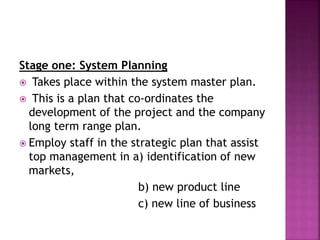
Stage one: System Planning
 Takes place within the system master plan.
 This is a plan that co-ordinates the
development of the project and the company
long term range plan.
 Employ staff in the strategic plan that assist
top management in a) identification of new
markets,
b) new product line
c) new line of business
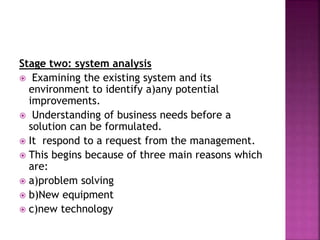
Stage two: system analysis
 Examining the existing system and its
environment to identify a)any potential
improvements.
 Understanding of business needs before a
solution can be formulated.
 It respond to a request from the management.
 This begins because of three main reasons which
are:
 a)problem solving
 b)New equipment
 c)new technology
Stage three: System design
Objective
 to reach consensus between users and systems
professionals on possible alternative designs for
the new system.
 Choose the best option either to:
a) Embark on internal developments.
b) Buying a package from outside.
 In-house Project Development will definitely
meet the organizational needs. However, if the
firm fails to meet its goals or objectives, then
the In-house system will not work
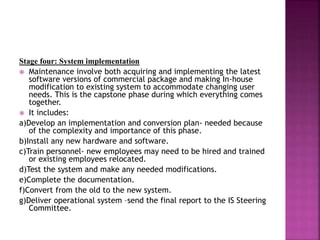
Stage four: System implementation
 Maintenance involve both acquiring and implementing the latest
software versions of commercial package and making In-house
modification to existing system to accommodate changing user
needs. This is the capstone phase during which everything comes
together.
 It includes:
a)Develop an implementation and conversion plan- needed because
of the complexity and importance of this phase.
b)Install any new hardware and software.
c)Train personnel- new employees may need to be hired and trained
or existing employees relocated.
d)Test the system and make any needed modifications.
e)Complete the documentation.
f)Convert from the old to the new system.
g)Deliver operational system –send the final report to the IS Steering
Committee.
Stage five: System operation
 Once the system is set-up and running,
operations and monitoring continue.
 It includes:
 Fine-tune and do post-implementation review
- post implementation review involves analysing
and appraisal of the new system, its purpose is
to determine whether the new system meet the
objectives established during system analysis and
design or not.
 Operate the system
 Periodically review and modify the system
BELOW IS A DIAGRAM EXPLAINING THE STEPS
INVOLVED IN THE SYSTEM DEVELOPMENT
LIFE CYCLE:
ACCOUNTANT’S ROLE IN FOUR STAGES OF
SYSTEM DEVELOPMENT LIFE CYCLE.
 Accountant plays a very important role in the
system development life cycle:
a)They provide a clear picture of their
problems and needs.
b)They act as members of the development
team.
c)They act as auditors, to ensure that the
system is designed with appropriate
computer audit technique.
 Below is the full explanation of the roles of
accountant in the three stages of the development
life cycle.
System Planning
 Accountants are often called on to provide expertise
in evaluating the feasibility of projects during the
planning process.
 As auditors, must examine the systems planning
phase of the SDLC since careful systems planning
helps to prevent unnecessary development costs.
 A careful system planning is a cost-effective activity
in reducing the risk of a)creating unneeded,
unwanted, inefficient and ineffective systems.
 Both internal and external auditors have vested
interests in this outcome.
System Analysis
 System analysis is an intellectual process
that is commingled with fact gathering.
 The accountant’s expertise makes them
important players in the design of a good
well-controlled system:
 Internal control standards
 Audit trail requirements
 External reporting requirements
 Double entry system
System Design
 Making sure that the current system’s weak
points are eliminated while preserving its
strengths.
 Conceptual system (able to adhere to the
double entry rule), and the systems professionals
are responsible for the physical system.
 If important accounting considerations are not
conceptualized at this point, they may be
overlooked and expose the organization to
potential loss.
 The audit ability of a system depends in part on
its design characteristics
System Implementation
 Accountants implement the newly designed
system
 Conducting follow up studies.
 Acquiring resources for the new system
 Training new or existing employees to use it.
 Companies conduct follow up studies on an
ongoing basis in order to determine whether
the new system is successful and, of course,
to identify any new problems with it.
System Operation.
 This is the final stage of the system development
life cycle
The accountant role in this stage is:
 They take part in the post implementation
review by verifying whether the new system is
able to meet the company objectives.
 System operation and report if there are any
areas that require modification.
 Periodic review of the system in terms of
internal control standards and maintenance.
 They are the users of the system.
 REFFERENCES:
 Hall, James A; Accounting information
systems: Australia, South-western Cengage
Learning [2008].
 Hollander, Anita Sawyer [et.al]: Accounting
information technology and business
solutions; Boston: Irwin/McGraw [2000].
 Hurt, Robert’s; Accounting information
systems: Basic concept and current issues;
Boston: McGraw-Hill Irwin, [2008].

THANK
YOU
THANK YOU:
SYSTEM DEVELOPMENT CYCLE
Business Requirement
System Interfaces,
Architecture and
User requirements High priority proposals
Undergo Additional
Study and development
Feedback
U UUu User requests User requests for system
Improvements and support
Selected Systems
Proposals go forward for
Detailed design
User requests for new
System
Business Needs
And Strategy
1. Systems Strategy
 Assessment
 Develop Strategy Plan
2. Project Initiation
 Feasibility Study
 Conceptual Analysis
 Design
 Cost/Benefit Analysis
Legacy
Situation
3. In –house Development
 Construct
 Deliver
4. Commercial Package
 Configure
 Test
 Roll out
5. Management and Support
• User help desk
• Configuration and management
• Risk management and security
New and Revised custom
Enters into production
System Development Life Cycle

System Development Life Cycle

  • 1.
  • 2.
     QUESTION: WITHAN AID OF A DIAGRAM EXPLAIN THE SYSTEM DEVELOPMENT LIFE CYCLE AND THE ROLE OF ACCOUNTANT IN EACH STAGE (20)MARKS
  • 3.
    INTRODUCTION  Every businessorganisation has got its own accounting system and this system follow a distinct pattern known as the System Development Life Cycle.  This is a process of developing information systems through investigation, analysis, design, implementation and maintenance.  The (SDLC) is also known as Information systems development or Application development.  Due to changes in the environment such as a) technology b)structure c) changes in the size the organisation .  Hence the need to develop the system to suit the new changes. The SDLC model can be understood as comprising five stages which are
  • 4.
    Stage one: SystemPlanning  Takes place within the system master plan.  This is a plan that co-ordinates the development of the project and the company long term range plan.  Employ staff in the strategic plan that assist top management in a) identification of new markets, b) new product line c) new line of business
  • 5.
    Stage two: systemanalysis  Examining the existing system and its environment to identify a)any potential improvements.  Understanding of business needs before a solution can be formulated.  It respond to a request from the management.  This begins because of three main reasons which are:  a)problem solving  b)New equipment  c)new technology
  • 6.
    Stage three: Systemdesign Objective  to reach consensus between users and systems professionals on possible alternative designs for the new system.  Choose the best option either to: a) Embark on internal developments. b) Buying a package from outside.  In-house Project Development will definitely meet the organizational needs. However, if the firm fails to meet its goals or objectives, then the In-house system will not work
  • 7.
    Stage four: Systemimplementation  Maintenance involve both acquiring and implementing the latest software versions of commercial package and making In-house modification to existing system to accommodate changing user needs. This is the capstone phase during which everything comes together.  It includes: a)Develop an implementation and conversion plan- needed because of the complexity and importance of this phase. b)Install any new hardware and software. c)Train personnel- new employees may need to be hired and trained or existing employees relocated. d)Test the system and make any needed modifications. e)Complete the documentation. f)Convert from the old to the new system. g)Deliver operational system –send the final report to the IS Steering Committee.
  • 8.
    Stage five: Systemoperation  Once the system is set-up and running, operations and monitoring continue.  It includes:  Fine-tune and do post-implementation review - post implementation review involves analysing and appraisal of the new system, its purpose is to determine whether the new system meet the objectives established during system analysis and design or not.  Operate the system  Periodically review and modify the system
  • 9.
    BELOW IS ADIAGRAM EXPLAINING THE STEPS INVOLVED IN THE SYSTEM DEVELOPMENT LIFE CYCLE:
  • 10.
    ACCOUNTANT’S ROLE INFOUR STAGES OF SYSTEM DEVELOPMENT LIFE CYCLE.  Accountant plays a very important role in the system development life cycle: a)They provide a clear picture of their problems and needs. b)They act as members of the development team. c)They act as auditors, to ensure that the system is designed with appropriate computer audit technique.
  • 11.
     Below isthe full explanation of the roles of accountant in the three stages of the development life cycle. System Planning  Accountants are often called on to provide expertise in evaluating the feasibility of projects during the planning process.  As auditors, must examine the systems planning phase of the SDLC since careful systems planning helps to prevent unnecessary development costs.  A careful system planning is a cost-effective activity in reducing the risk of a)creating unneeded, unwanted, inefficient and ineffective systems.  Both internal and external auditors have vested interests in this outcome.
  • 12.
    System Analysis  Systemanalysis is an intellectual process that is commingled with fact gathering.  The accountant’s expertise makes them important players in the design of a good well-controlled system:  Internal control standards  Audit trail requirements  External reporting requirements  Double entry system
  • 13.
    System Design  Makingsure that the current system’s weak points are eliminated while preserving its strengths.  Conceptual system (able to adhere to the double entry rule), and the systems professionals are responsible for the physical system.  If important accounting considerations are not conceptualized at this point, they may be overlooked and expose the organization to potential loss.  The audit ability of a system depends in part on its design characteristics
  • 14.
    System Implementation  Accountantsimplement the newly designed system  Conducting follow up studies.  Acquiring resources for the new system  Training new or existing employees to use it.  Companies conduct follow up studies on an ongoing basis in order to determine whether the new system is successful and, of course, to identify any new problems with it.
  • 15.
    System Operation.  Thisis the final stage of the system development life cycle The accountant role in this stage is:  They take part in the post implementation review by verifying whether the new system is able to meet the company objectives.  System operation and report if there are any areas that require modification.  Periodic review of the system in terms of internal control standards and maintenance.  They are the users of the system.
  • 16.
     REFFERENCES:  Hall,James A; Accounting information systems: Australia, South-western Cengage Learning [2008].  Hollander, Anita Sawyer [et.al]: Accounting information technology and business solutions; Boston: Irwin/McGraw [2000].  Hurt, Robert’s; Accounting information systems: Basic concept and current issues; Boston: McGraw-Hill Irwin, [2008]. 
  • 17.
  • 18.
    SYSTEM DEVELOPMENT CYCLE BusinessRequirement System Interfaces, Architecture and User requirements High priority proposals Undergo Additional Study and development Feedback U UUu User requests User requests for system Improvements and support Selected Systems Proposals go forward for Detailed design User requests for new System Business Needs And Strategy 1. Systems Strategy  Assessment  Develop Strategy Plan 2. Project Initiation  Feasibility Study  Conceptual Analysis  Design  Cost/Benefit Analysis Legacy Situation
  • 19.
    3. In –houseDevelopment  Construct  Deliver 4. Commercial Package  Configure  Test  Roll out 5. Management and Support • User help desk • Configuration and management • Risk management and security New and Revised custom Enters into production