GENERAL CHARACTERISTICS:
 Artistic style of the High Middle Ages
 12th - 15th centuries.
 Originated in northern France (Paris).
 It developed in urban areas (cities).
The name "Gothic" was given
during the Renaissance (16th
centuries), because people of
those times considered Gothic
art as a barbarian art (like the
Goths!) compared to the
Classical Art (Greek & Roman).
GOTHIC ARCHITECTURE
Notredame Cathedral in Paris (1163 – 1345)
 Main buildings:
 Religious: cathedrals  most
important building & symbol
of a city. It showed the
power & wealth of the city.
Cities competed to have the
highest, biggest & more
beautiful cathedral.
 Secular:
 town halls
 marketplaces
 palaces
Gothic
cathedral
Cathedral of Leon
(1205–1301)
Town Hall of
Brugge (Belgium)
Marketplace (“Lonja”)
of palma de Mallorca
Palazzo Ducale
(Venice)
 Characteristics of Gothic cathedrals:
 Tall buildings built with stone
 Many stained glass windows that added light and colour
to the interior of the cathedral.
 Pointed arches
 Rose windows
 Inside:
• Ribbed vaults
• Latin cross plan, with several naves separated by arcades of
pointed arches, and chapels on the sides
• Three levels: arcades / triforium / clerestory
 Outside:
• Flying buttress
• Two high towers on the sides
• Pinnacles
• Gargoyles
Tall buildings built with stone
Cathedral of Valencia
Cathedral of Notredame (Paris)
Stained glass
windows
(vidrieras)
Cathedral of
Leon
Cathedral of
Chartres (France)
Sainte Chapelle (Paris)
Pointed arch
(arco apuntado
o de ojiva)
Cathedral of Bilbao Cathedral of Amiens (France)
Rose Window
(Rosetón)
Rose window (interior) of
St.Denis Cathedral (Paris)
Rose window (exterior) of
St. Francis of Assisi Cathedral
(Assisi, Italy)
Ribbed Vaults
(bóveda de crucería)
Gothic Romanesque
St.Denis Cathedral (Paris)
Cathedral of Leon
BARREL VAULT VS RIBBED VAULT
(Romanesque) (Gothic)
Latin cross plan
(planta de cruz latina)
several naves separated by arcades
of pointed arches
Side chapels
Side chapels in the
Cathedral of Burgos Cathedral of Valencia
Three levels inside:
Clerestory (claristorio)
Triforium (triforio)
Arcade (aracada)
• 1st level: Arcade. Generally there are 3 naves separated
by arcades of pointed arches.
Arcade of the Cathedral of
Cologne (Germany)
• 2nd level: Triforium. Open galleries. Sometimes it
contains a narrow walkway.
Triforium of the
Cathedral of Burgos
• 3rd level: Clerestory. It
holds large stained glass
windows adding light and
colour to the interior of the
cathedral.
Clerestory
of the
Cathedral
of Leon
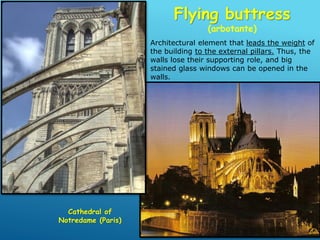
Flying buttress
(arbotante)
Architectural element that leads the weight of
the building to the external pillars. Thus, the
walls lose their supporting role, and big
stained glass windows can be opened in the
walls.
Flying buttress
(arbotante)
Cathedral of
Notredame (Paris)
Architectural element that leads the weight of
the building to the external pillars. Thus, the
walls lose their supporting role, and big
stained glass windows can be opened in the
walls.
Two high towers on the sides
Cathedral of Notredame (Paris) Cathedral of Cologne (Germany)
Pinnacles
(pináculos)
Duomo di Milano (Italy)
Gargoyles
(gárgolas)
ROMANESQUE OR GOTHIC?
GOTHIC
SCULPTURE
&
PAINTING
 GENERAL CHARACTERISTICS:
 Still mostly religious themes.
 Despite they still have a didactic function, figures
become more realistic (not symbolic) and there is an
increased interest in beauty, movement & expression
of feelings.
Virgin Mery is
represented in a more
maternal attitude,
seeking to inspire
tenderness & affection.
 SculptureS:
 More realistic & natural positions than Romanesque sculpture.
Figures no longer adapt their shape to the architectural frame
(“Law of the frame”).
 Mainly in entrance portals.
Gothic
sculptures
 Paintings:
 Not on the walls anymore (that space is now occupied by stained
glass windows); now they are painted on wooden plates.
 Sometimes several paintings were put together to form an
altarpiece.
 Vivid colours, gold leaf, and increased interest in depth & volume
of figures.
Gothic
altarpieces
(“retablos”)
ROMANESQUE OR GOTHIC?

Gothic art