Sandrine Le Bail AP Art History 
Gothic Art 
12th century to 16th 
France and England
Gothic 
• From 12th to 16th century 
• Francigenum Opus 
• Emerged in France from 1137-1144 
• By Abbot Suger 
• Word invented in the 16th century by Vasari– 
“monstrous and barbarous” 
• Spread all around Europe
New Era… 
• Opus Modernum 
• Era of peace and prosperity (merchands organized in 
guilds) 
• Era of knowlegde: 1st Universities (importance of Paris as 
intellectual center) 
• Era of deep spirituality : the religious life shifted from 
monasteries to secular cities 
• Era of extraordinary technological inventions
Europe around 1200
Suger and Saint Denis
Abbot Suger 
(1081-1151) 
• Political and religious 
advisor of the kings of 
France 
• Regent of France when 
Louis VII in crusade 
• 1122 - Abbot of Saint 
Denis Monastery 
• Church in disrepair
Suger’s theory 
• Inspired by Dyonisus (mistaken for S.Denis) 
• Place of great physical beauty (gold, jewels) 
• Mathematics Harmony 
• Mystical effect of light 
• Light = God 
• Stain glasses = theology
Innovation In Architecture 
Goals: Higher and lighter 
Based of Romanesque innovations 
• Rib vault = standard vaulting practice 
• Bays : repeated vertical elements 
• Rose window 
• Pointed arches 
• Flying buttress 
• Pinnacles
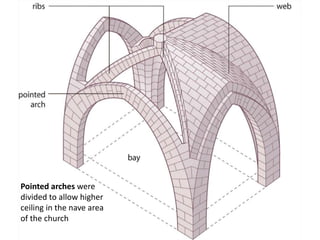
Ribbed vaults
Ribbed vaults: 
• Reinforce the vault 
• Distribute the weight more efficiency 
• Free space for windows 
• The infilling (web) can be of a lighter material
Pointed arches were 
divided to allow higher 
ceiling in the nave area 
of the church
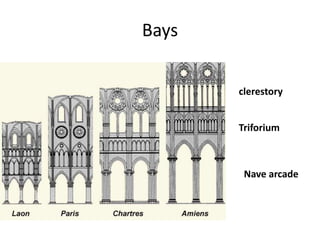
Bays 
clerestory 
Triforium 
Nave arcade
Bays 
Piers: 
The ribs of the 
vaults formed a 
serie of lines 
which continued 
down to the floor 
by colonnettes 
branching off into 
arches and vaults. 
Vertical unity
Flying buttress 
Flying Buttresses 
were invented to 
stabilize the pointed 
arches
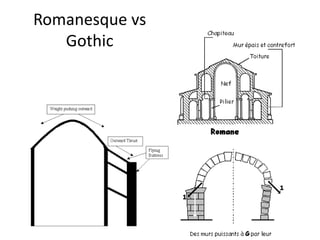
Romanesque vs 
Gothic
Flying buttresses: 
Masonry struts that 
transfer he thrust of the 
nave vaults across the 
roofs of the side aisles 
and ambulatory to a tall 
pier rising above the 
church’s exterior wall.
Pinnacle 
Sharply pointed ornament 
capping the piers or flying 
buttresses 
• Decorative 
• Stabilize forces in a wind 
storm
Chevet
Chevet 
Radiating chapels 
Ambulatory 
Choir
Romanesque vs Gothic
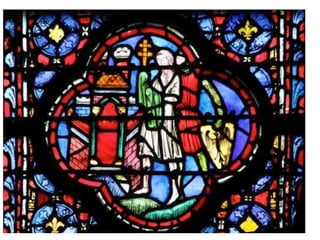
Stained-Glass Window 
Translucent colored glass 
cut to form a window 
design. 
Main colors: Red and 
Blue
Strips of lead
In the figures, the lead is 
arranged to conform to an 
ouline 
The background is divided 
into randon sections. 
Details added in black 
enamel 
Framed by an iron armature 
Cross Bars
Stained glass 
• Depicted biblical and historical stories 
• Brought colored light to the interior of 
churches 
• Created a mystical atmosphere inside the 
churches
Characteristics of Gothic architecture 
• Tall and narrow 
• Religious Symbolism 
• Competition between cities to have the taller 
cathedral 
• In the cities (limited space)
4 periods of French Gothic 
Architecture 
• Early Gothic 
• High Gothic 
• Rayonnant “radiating” 
• Late / Flamboyant “flaming”
Build a cathedral
-Master builders 
traveled all around 
Europe 
- Hundred of laborers 
and artisans 
- Important for the 
pride of the city 
- Important for local 
economy
Early Gothic 
1140-1194 
Saint Denis 
(Notre Dame)
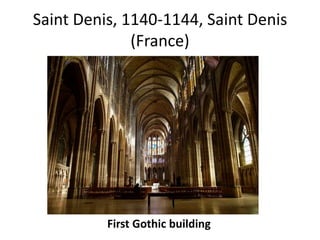
Saint Denis, 1140-1144, Saint Denis 
(France) 
First Gothic building
Rib vaults supported 
by pointed arches
Sense of unity
Lighter space 
Architectural unity
Light filtered by stained glass
Sainte Foix vs Saint Denis
West Façade of 
Saint Denis
Early Gothic characteristics 
• Round columns in the interior 
• Rib vault starts at the ceiling but travel down 
only to the top of the column capitals
The birthplace of Gothic art and architecture 
was Saint-Denis, where Abbot Suger used rib 
vaults with pointed arches to rebuild the 
Carolingian royal church and filled the window 
of the ambulatory with stained glass. On the 
west façade, Suger introduced sculpted figures 
on the portal jambs, a feature that appeared 
shortly later on the Royal Portal of Chartres 
Cathedral.
High Gothic 
1194-1300 
Chartres 
Amiens 
Reims
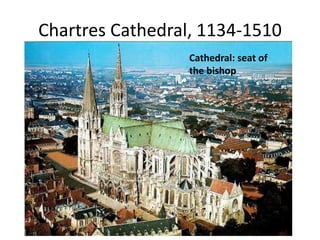
Chartres Cathedral, 1134-1510 
Cathedral: seat of 
the bishop
Importance for local economy 
• Lot of worker 
• Patrons: clergy, noblemen, royal family, 
citizens, guilds, pilgrims… 
• Recognition of the patrons (coat of arms, 
stained windows…) 
• Importance of the master builder
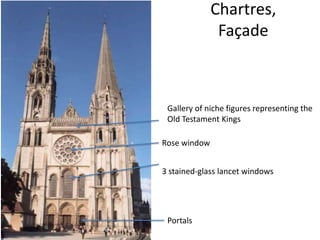
Chartres, Façade 
- 2 towers 
Tripartite (association 
with the Trinity: Father, 
Son and Holy Ghost) 
- cross between 
Romanesque and early 
Gothic 
Begun 1504 Before 1194
Chartres, 
Façade 
Gallery of niche figures representing the 
Old Testament Kings 
Rose window 
3 stained-glass lancet windows 
Portals
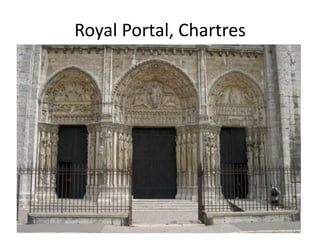
Royal Portal, Chartres, completed in 
1150
Royal Portal, Chartres 
Archivolts 
Tympanum 
Lintel 
Doorjambs 
Door
Tripartite
Royal Portal, Chartres
Southern Portal 
Story of the 
Virgin
Northern Portal 
Ascension of Christ
Central Portal 
Second coming of the Christ
Saint Pierre, Moissac 
Chartes Cathedral 
Apostles
Saint Pierre, Moissac 
Chartes Cathedral 
- Easier to 
read the 
Tympanum 
- More clarity 
- Deeper Relief 
- Minimal 
floral designs
Doorjambs 
Statues 
- Slim 
- Vertical 
-Stylized 
- Frontal 
-Rigidity 
- Feet in diagonal
Royal Portal, Chartres
South Façade, 13th century
South portals
South portal: central tympanum 
Second coming of Christ
More peaceful 
Less fearful 
More volume
West Portal 
South Portal
Chartres
Each vault 
spans one 
bay 
Rib vaults 
from the 
ceiling 
down to 
the floor
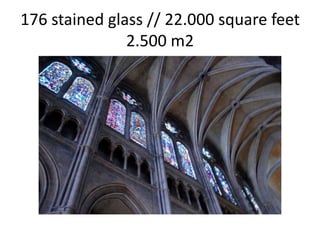
176 stained glass // 22.000 square feet 
2.500 m2
Chartres
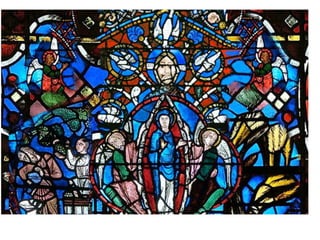
Our Lady of the 
beautiful 
Window 
(12-13th 
century)
North 
Rose 
Window 
and 
lancets 
Given by King Louis VIII 
in honor of Queen 
Blanche de Castille. 
Connection between 
the HolyFamily and the 
royal family
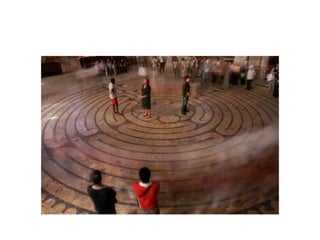
Labyrinth
Amiens 
Cathedral, 
France 
(1241-1290) 
Tallest Gothic French 
Church
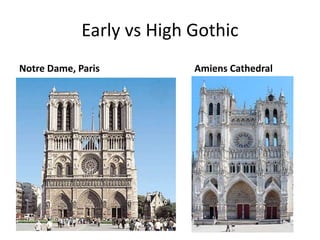
Early vs High Gothic 
Notre Dame, Paris Amiens Cathedral
Very high vaults 
(148 feet/113 m) 
Larger windows 
Narrow nave – 
Enhances 
verticality
Le Beau Dieu, 1225-1230 Vierge Dorée, 1250
Reims 
Cathedral, 
begun 1211 
through 
late 13th 
century
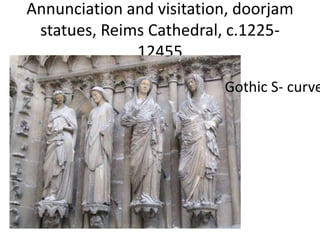
Annunciation and visitation, doorjam 
statues, Reims Cathedral, c.1225- 
12455 
Gothic S- curve
Evolution 
of Gothic 
Sculpture
Virgin of Paris, 
early 14th century 
Notre Dame de Paris 
Balance between greater 
naturalism and propriety. 
S- Curve
Evolution of Gothic Sculpture 
• More realistic 
• More movement 
• More freedom 
• More inspired from classical models 
• New realism 
• Gothic S-curve
Characteristics of High Gothic 
• Articulated columns in the interior: rib vaults 
from the ceiling down to the floor 
• Larger window space 
• Larger choirs and chevets 
• More sculpture on the façade
High Gothic 
After a fire in 1194, Chartres cathedral was 
rebuilt with flying buttresses, four-part nave 
vaults, and a three-story elevation of nave : 
arcade, triforium and clerestory. These features 
set the pattern for High Gothic (1194-1300) 
cathedrals. French architects sought to construct 
naves of soaring heights. The vault of Amiens 
cathedral are 144m high.
High Gothic 
Flying buttresses made possible huge stained-glass 
windows. High gothic windows employed 
delicate stained windows. The colored stained 
converted natural sunlight into divine light, 
dramatically transforming the character of 
church interior.
High Gothic 
The High Gothic jamb statue broke up of the 
architectural straightjacket of their early gothic 
predecessors. At Chartres, Reims, and 
elsewhere, the sculpted figures move freely and 
sometimes converse with their neighbors.
Rayonnant 
(Radiant) 
Sainte Chapelle
Sainte Chapelle, Paris, 1243-1248 
Commissioned by Louis IX 
Rayonnant Style 
Chapel of the royal palace 
Designed by Thomas de 
Cormont 
Built for the crucifixion relics= 
Giant reliquary
Dissolution of wall space: ¾ of the wall space is 
windows
Characteristics of Rayonnant 
• Dissolution of the wall space 
• Great sheet of stained glass
Flamboyant (Flaming) 
Late Gothic 
1350-15th century
Difficults times 
• 1337-1453 – Hundred Years’ War between 
France and England 
• 1248 – The Black Death / The Plague 
A quarter to a third of the world perished.
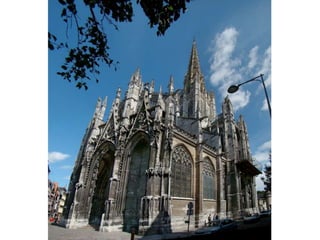
Ogee Arch
Saint Maclou, Rouen, France, 1500- 
1514
Characteristics of Flamboyant 
• Same structure than previous style 
• Highly decorative 
• Mass of pinnacles and tracery 
• Ogee arches are used
Gothic in Europe 
French masons who worked in the Gothic style 
traveled around Europe looking for work. This 
helped disseminate the French Gothic Style.
England
Early Gothic
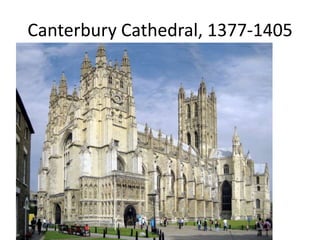
Canterbury Cathedral, 1377-1405
Choir of the cathedral of Canterbury, 
1174 
French Architect: 
William of Sens 
Stones imported from 
Caen (France)
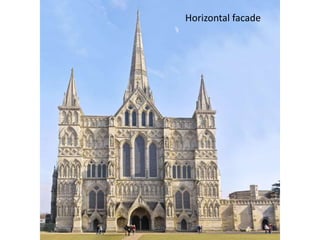
Salisbury Cathedral, begun 1220
• Close = 
precinct of 
lawns and 
trees
Salisbury 
Cathedral 
- Double Transept 
- Square Apse 
- More elongated than 
French churches
Horizontal facade
Less Windows 
Massive walls
Chapter 
House, 
Salisbury 
Cathedral, 
1263-1284
Perpendicular Gothic 
Ca. 1350
Characteristics of the Perpendicular 
Gothic 
• Enormous window spaces 
• Elaborate decorative vertical patterns of stone 
tracery 
• Clusters of vertical shafts rise dramatically 
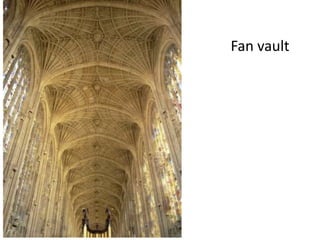
• Fan Vault
King’s College Chapel, Cambridge
Fan vault
Germany
Cologne Cathedral
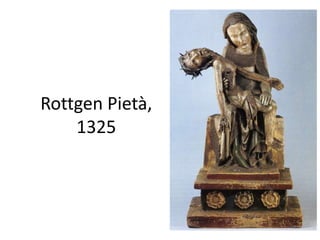
Rottgen Pietà, 
1325
Holy Roman Empire 
German architects eagerly embraced the French 
gothic architectural style at Cologne cathedral 
and elsewhere. German originality manifested 
itself most clearly in the Gothic period in 
sculpture.
Siena Cathedral, Tuscany, Italy 1284- 
1299
Milan Cathedral, Milan, Italy, begun 
1386
Romanesque 
• Dark 
• Fear-inspiring decoration 
• Barrel Vaults 
• Thick walls 
Gothic 
• Lot of light 
• Heavenly decoration 
• Ribbed vaults 
• Flying Buttresses
NL

NL

Editor's Notes

  • #3 Gothic is rude As the Goths destroyed the classical art
  • #7 Importance of the cathedral (burial ground of kings) Symbol of French Monarchy Aimed to increase the prestige of the church and the king
  • #8 He wrote 3 treatises about his activities Great beauty contrasts with the last judgement
  • #10 The weigh of the ribbed vult is concentrated only at the corners of the bay. Structures can be buttressed at intervals freeing up more spaces for windows
  • #12 The pointed arches can be raised to any height regardless of the distance between the support – more flexible
  • #15 In romanesque – thick walls Support the roof Weight bypass the walls and travel down to piers outside Stabilize the building
  • #16 In romanesque – thick walls Support the roof Weight bypass the walls and travel down to piers outside Stabilize the building
  • #18 Notre Dame
  • #22 Ambulatory – more pilgrims to visit the church without disturbing the priests
  • #23 Need more space between the choir and the
  • #26 Cut the piece Fitted into a model Strips of lead
  • #27 Énamel – email From saint chapelle Illustration of sophisticated theological program
  • #31 Stones exactly carved on the carry Cranes and scaffolding
  • #34 Nave / Later Legendary burial ground of Saint Denis !st use of stained glass
  • #35 Moves away from the demarcation of spaces in the Romanesque period: Radiating chapels open up and one continuous space is created Spaces between the chapels flow from one to the other
  • #36 Rib vaults start at the ceiling and go down as far as the capitals on the columns Columns are round ans unarticulated No big piers but slender columns
  • #37 Pointed arches
  • #39 Sense of unity
  • #42 Suger wanted light filtered by stained glass to saturate the inside of the building Pointed arches Seens very light
  • #45 From Suger But decoration lost
  • #49 Cathedral – seat of the bishop (cathedra) Importance of the cult of Virgin Mary (legend of the statue of Mary found in Pagan time) veil of mary Fire in 1194 Importance of local economy Construction lasted from 1134 to 1510
  • #51 Importance of verticality Evolution of style : 2 towers Verticality and heights Not formally symmetric
  • #52 Rose _ symbole of Christ and universality
  • #53 Many tripartite elements Chapls and flying buttresses 5 lancet windows
  • #54 Royal portal because depict kings and queen from the old testament
  • #56 Entering a church = centering the paradise
  • #57 Didactic function – tell a story
  • #58 Story of the virgin Christ nativity, Enthroned Virgin 7 liberal Arts (Grammar/ Rhetoric/ Dialectic/ Arithmetic/Geometry/Astronomy / Music) Importance of learning
  • #60 Second coming of Christ (Book of revelation) Seated Christ with mandorla !2 apostles 24 elders
  • #63 In front of the columns/ not columns Earliest example of Early Gothic sculpture // Byzantine art Projected forwards the columns Concentric composition of the rove King and queen are the precursors of Jesus Christ
  • #64 More human Lines less sharp Earliest example of Early Gothic sculpture // Byzantine art Projected forwards the columns King and queen are the precursors of Jesus Christ
  • #65 Iconography Portals on the side : life of Christ Central _ secondcoming of Christ The New testament is supported by the Old Testament
  • #67 More sense of depth
  • #71 Not stucked on the colonnes More natural Less elongated Less frontal More variety of poses, gestures and costume More sense of depth Folds more deeply carved
  • #73 Earlier example of High Gothic Vault : 120 feet / 37.58 m.) Heigh possible thanks to buttressing system
  • #77 In 1906, the glazier Gaudin restored Mary's head.  While before Mary's gaze was fixed straight ahead, her head is now inclined very slightly towards the viewer's left.
  • #78 IMPORTANT FOR PATRONAGE Center Mary and 12 elements (12 apostles) Painting in light 1st serie : doves and angels 2nd serie: Old testament king (square) 12 qutrefoils – symbol of the king of France Outer semicircles : 12 apostles
  • #79 With the name of the master builder
  • #81 High Gothic style Tallest of the Gothic French churches Head of Satin John deposited by crusaders
  • #82 More extravagant use of sculpture Concentration of light and dark Arcgitectural projection
  • #83 Unified plan – built from scratch after fire
  • #85 Evolution More realistic More movement Beau Dieu : Almost 3 dimentional // Teacher blessing to those who enter through the doorway Kind teacher and not a fearful judge Triumph over evil 3 angels // Dead of Christ More and more independent from the doorjam
  • #86 Vertical façade Liberal use of glass Extra long nave and very high roof
  • #87 More realistic and naturalistic Convesarion / interaction Contrapposto 1st example in monumental Christian Art of an interested in the relationship between drapery and the human form // Classical statuary Almost 3 dimensional In conversation Gothic S-curve
  • #91 The folds are complex but don’t reveal her body. // Praxiteles
  • #98 Fragment of the True Cross, Crown of thorns, lance, sponge and nail
  • #99 The walls disapeared Pure light
  • #107 5 portals Skeletal glabes over portals Complexity of design
  • #116 Mpre complex patterns
  • #125 No fòying butresses Extranal buttresses
  • #131 Emotion