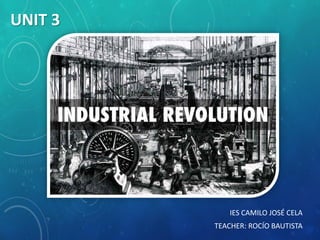
UNIT 3
IES CAMILO JOSÉ CELA
TEACHER: ROCÍO BAUTISTA
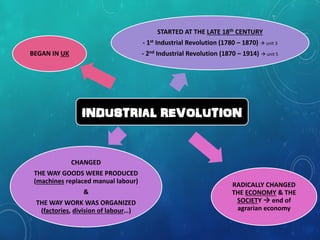
INDUSTRIAL REVOLUTION
STARTED AT THE LATE 18th CENTURY
- 1st Industrial Revolution (1780 – 1870)  unit 3
- 2nd Industrial Revolution (1870 – 1914)  unit 5
CHANGED
THE WAY GOODS WERE PRODUCED
(machines replaced manual labour)
&
THE WAY WORK WAS ORGANIZED
(factories, division of labour…)
RADICALLY CHANGED
THE ECONOMY & THE
SOCIETY  end of
agrarian economy
BEGAN IN UK
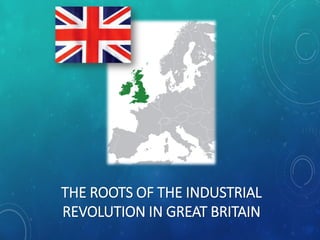
THE ROOTS OF THE INDUSTRIAL
REVOLUTION IN GREAT BRITAIN
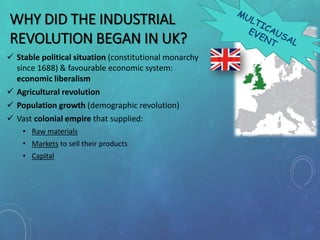
WHY DID THE INDUSTRIAL
REVOLUTION BEGAN IN UK?
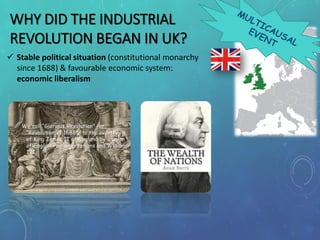
 Stable political situation (constitutional monarchy
since 1688) & favourable economic system:
economic liberalism
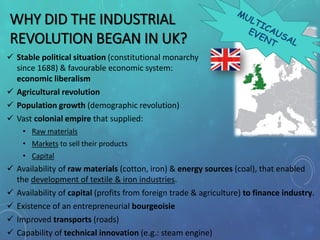
WHY DID THE INDUSTRIAL
REVOLUTION BEGAN IN UK?
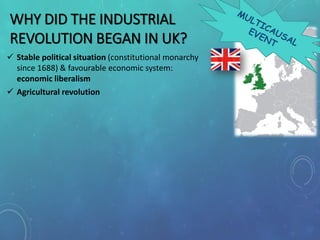
 Stable political situation (constitutional monarchy
since 1688) & favourable economic system:
economic liberalism
 Agricultural revolution
AGRICULTURAL REVOLUTION
(18th Century)
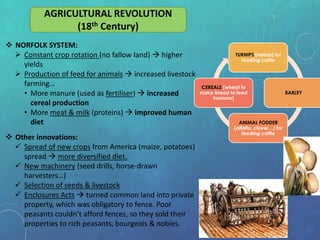
 NORFOLK SYSTEM:
 Constant crop rotation (no fallow land)  higher
yields
 Production of feed for animals  increased livestock
farming…
• More manure (used as fertiliser)  increased
cereal production
• More meat & milk (proteins)  improved human
diet
 Other innovations:
 Spread of new crops from America (maize, potatoes)
spread  more diversified diet.
 New machinery (seed drills, horse-drawn
harvesters…)
 Selection of seeds & livestock
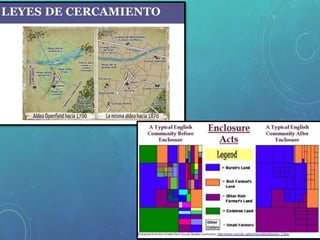
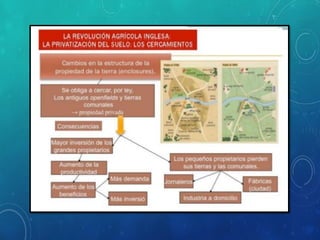
 Enclosures Acts  turned common land into private
property, which was obligatory to fence. Poor
peasants couldn’t afford fences, so they sold their
properties to rich peasants, bourgeois & nobles.
TURNIPS (nabos) for
feeding cattle
BARLEY
ANIMAL FODDER
(alfalfa, clover…) for
feeding cattle
CEREALS (wheat to
make bread to feed
humans)
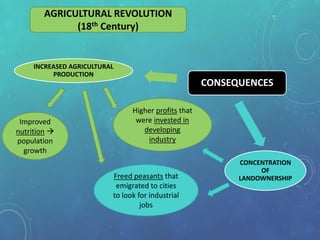
AGRICULTURAL REVOLUTION
(18th Century)
CONSEQUENCES
CONCENTRATION
OF
LANDOWNERSHIP
INCREASED AGRICULTURAL
PRODUCTION
Improved
nutrition 
population
growth
Higher profits that
were invested in
developing
industry
Freed peasants that
emigrated to cities
to look for industrial
jobs
WHY DID THE INDUSTRIAL
REVOLUTION BEGAN IN UK?
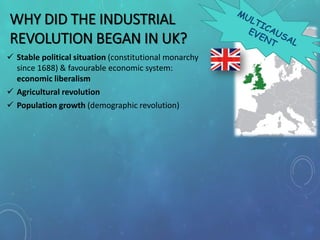
 Stable political situation (constitutional monarchy
since 1688) & favourable economic system:
economic liberalism
 Agricultural revolution
 Population growth (demographic revolution)
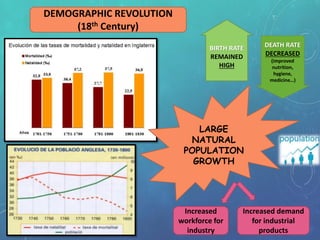
DEMOGRAPHIC REVOLUTION
(18th Century)
BIRTH RATE
REMAINED
HIGH
DEATH RATE
DECREASED
(improved
nutrition,
hygiene,
medicine…)
LARGE
NATURAL
POPULATION
GROWTH
Increased
workforce for
industry
Increased demand
for industrial
products
WHY DID THE INDUSTRIAL
REVOLUTION BEGAN IN UK?
 Stable political situation (constitutional monarchy
since 1688) & favourable economic system:
economic liberalism
 Agricultural revolution
 Population growth (demographic revolution)
 Vast colonial empire that supplied:
• Raw materials
• Markets to sell their products
• Capital
VAST COLONIAL EMPIRE
Raw materials
Markets
Capital (from
foreign trade)
WHY DID THE INDUSTRIAL
REVOLUTION BEGAN IN UK?
 Stable political situation (constitutional monarchy
since 1688) & favourable economic system:
economic liberalism
 Agricultural revolution
 Population growth (demographic revolution)
 Vast colonial empire that supplied:
• Raw materials
• Markets to sell their products
• Capital
 Availability of raw materials (cotton, iron) & energy sources (coal), that enabled
the development of textile & iron industries.
 Availability of capital (profits from foreign trade & agriculture) to finance industry.
 Existence of an entrepreneurial bourgeoisie
 Improved transports (roads)
 Capability of technical innovation (e.g.: steam engine)
ACTIVITY 1
https://play.kahoot.it/#/k/a46316cb-daa9-
46ea-888d-df434303eb7f
GO TO WWW.KAHOOT.IT
PIN: XXXXXX
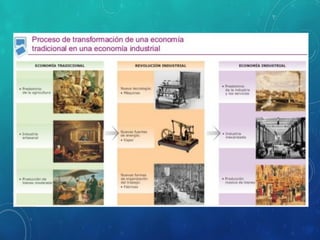
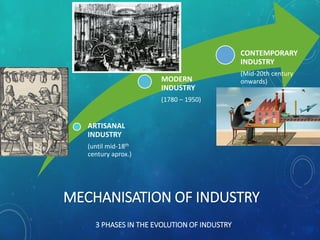
3 PHASES IN THE EVOLUTION OF INDUSTRY
ARTISANAL
INDUSTRY
(until mid-18th
century aprox.)
MODERN
INDUSTRY
(1780 – 1950)
CONTEMPORARY
INDUSTRY
(Mid-20th century
onwards)
MECHANISATION OF INDUSTRY
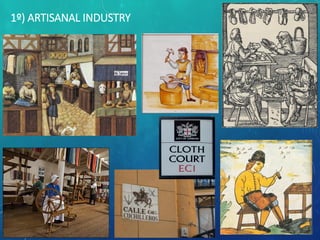
1º) ARTISANAL INDUSTRY
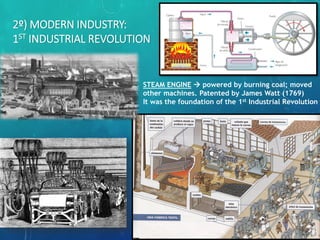
2º) MODERN INDUSTRY:
1ST INDUSTRIAL REVOLUTION
STEAM ENGINE  powered by burning coal; moved
other machines. Patented by James Watt (1769)
It was the foundation of the 1st Industrial Revolution
Factory Production
 Concentrates production in one place
[materials, labour].
 Located near sources of power
[rather than labour or markets].
 Requires a lot of capital investment
[factory, machines, etc.] more
than skilled labour.
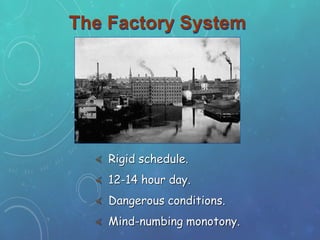
The Factory System
 Rigid schedule.
 12-14 hour day.
 Dangerous conditions.
 Mind-numbing monotony.
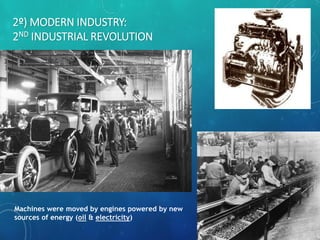
2º) MODERN INDUSTRY:
2ND INDUSTRIAL REVOLUTION
Machines were moved by engines powered by new
sources of energy (oil & electricity)
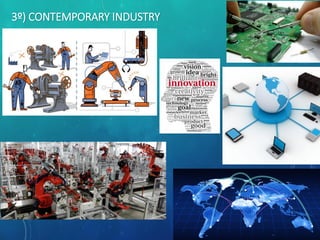
3º) CONTEMPORARY INDUSTRY
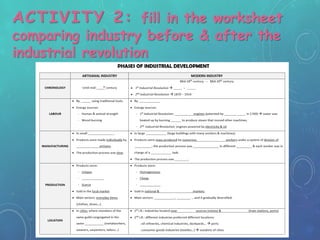
ACTIVITY 2: fill in the worksheet
comparing industry before & after the
industrial revolution
TEXTILE INDUSTRY
POPULATION
GROWTH
INCRESED
DEMAND OF
COTTON FABRICS
NEW MACHINES WERE INVENTED TO
INCREASE PRODUCTION
(1st powered by hand & water, later by
steam engines)
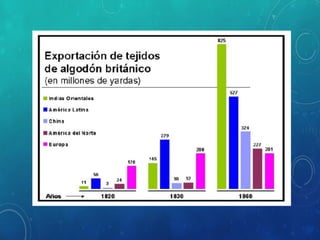
1st sector that became mechanized
Different machines were invented to:
a) Spin cotton (“hilar”)  transform raw cotton into cotton thread.
b) Weave cloth (“tejer”)  lace threads together to form a fabric.
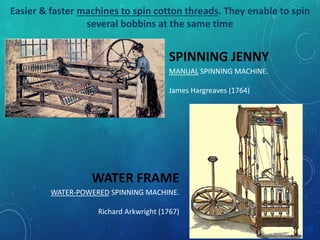
SPINNING JENNY
MANUAL SPINNING MACHINE.
James Hargreaves (1764)
Easier & faster machines to spin cotton threads. They enable to spin
several bobbins at the same time
WATER FRAME
WATER-POWERED SPINNING MACHINE.
Richard Arkwright (1767)
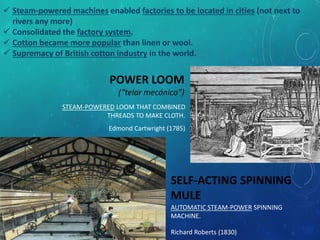
POWER LOOM
(“telar mecánico”)
Edmond Cartwright (1785)
STEAM-POWERED LOOM THAT COMBINED
THREADS TO MAKE CLOTH.
 Steam-powered machines enabled factories to be located in cities (not next to
rivers any more)
 Consolidated the factory system.
 Cotton became more popular than linen or wool.
 Supremacy of British cotton industry in the world.
SELF-ACTING SPINNING
MULE
Richard Roberts (1830)
AUTOMATIC STEAM-POWER SPINNING
MACHINE.
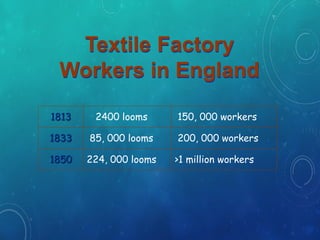
Textile Factory
Workers in England
1813 2400 looms 150, 000 workers
1833 85, 000 looms 200, 000 workers
1850 224, 000 looms >1 million workers
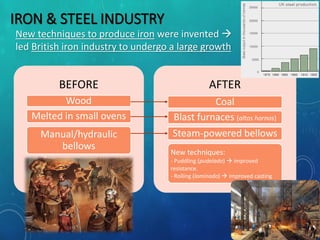
IRON & STEEL INDUSTRY
New techniques to produce iron were invented 
led British iron industry to undergo a large growth
BEFORE
Wood
Melted in small ovens
Manual/hydraulic
bellows
AFTER
Coal
Blast furnaces (altos hornos)
Steam-powered bellows
New techniques:
- Puddling (pudelado)  improved
resistance.
- Rolling (laminado)  improved casting
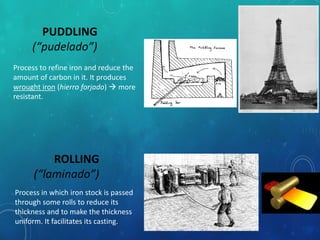
PUDDLING
(“pudelado”)
Process to refine iron and reduce the
amount of carbon in it. It produces
wrought iron (hierro forjado)  more
resistant.
ROLLING
(“laminado”)
Process in which iron stock is passed
through some rolls to reduce its
thickness and to make the thickness
uniform. It facilitates its casting.
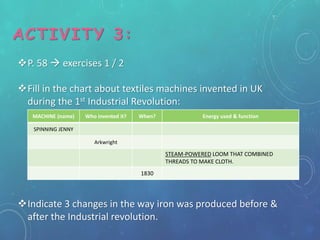
ACTIVITY 3:
P. 58  exercises 1 / 2
Fill in the chart about textiles machines invented in UK
during the 1st Industrial Revolution:
Indicate 3 changes in the way iron was produced before &
after the Industrial revolution.
MACHINE (name) Who invented it? When? Energy used & function
SPINNING JENNY
Arkwright
STEAM-POWERED LOOM THAT COMBINED
THREADS TO MAKE CLOTH.
1830
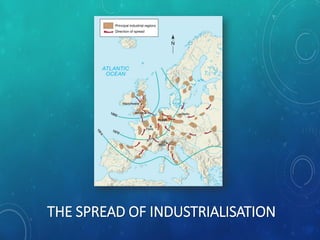
THE SPREAD OF INDUSTRIALISATION
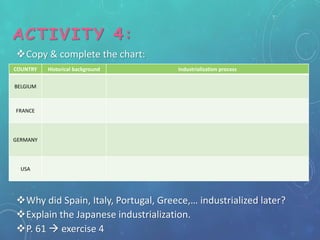
ACTIVITY 4:
Copy & complete the chart:
Why did Spain, Italy, Portugal, Greece,… industrialized later?
Explain the Japanese industrialization.
P. 61  exercise 4
COUNTRY Historical background Industrialization process
BELGIUM
FRANCE
GERMANY
USA
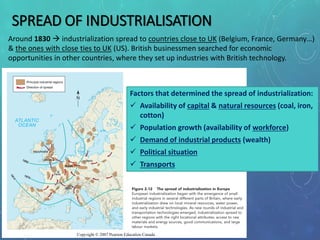
SPREAD OF INDUSTRIALISATION
Factors that determined the spread of industrialization:
 Availability of capital & natural resources (coal, iron,
cotton)
 Population growth (availability of workforce)
 Demand of industrial products (wealth)
 Political situation
 Transports
Around 1830  industrialization spread to countries close to UK (Belgium, France, Germany…)
& the ones with close ties to UK (US). British businessmen searched for economic
opportunities in other countries, where they set up industries with British technology.
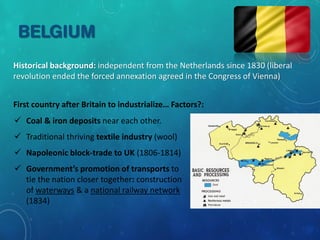
BELGIUM
Historical background: independent from the Netherlands since 1830 (liberal
revolution ended the forced annexation agreed in the Congress of Vienna)
First country after Britain to industrialize… Factors?:
 Coal & iron deposits near each other.
 Traditional thriving textile industry (wool)
 Napoleonic block-trade to UK (1806-1814)
 Government’s promotion of transports to
tie the nation closer together: construction
of waterways & a national railway network
(1834)
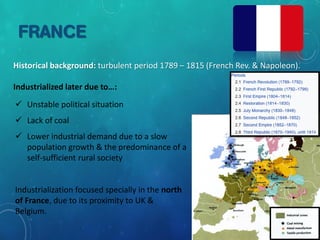
FRANCE
Historical background: turbulent period 1789 – 1815 (French Rev. & Napoleon).
Industrialized later due to…:
 Unstable political situation
 Lack of coal
 Lower industrial demand due to a slow
population growth & the predominance of a
self-sufficient rural society
Industrialization focused specially in the north
of France, due to its proximity to UK &
Belgium.
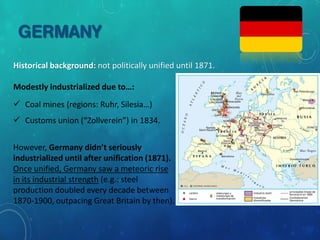
GERMANY
Historical background: not politically unified until 1871.
Modestly industrialized due to…:
 Coal mines (regions: Ruhr, Silesia…)
 Customs union (“Zollverein”) in 1834.
However, Germany didn’t seriously
industrialized until after unification (1871).
Once unified, Germany saw a meteoric rise
in its industrial strength (e.g.: steel
production doubled every decade between
1870-1900, outpacing Great Britain by then).
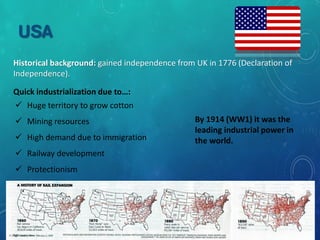
USA
Historical background: gained independence from UK in 1776 (Declaration of
Independence).
Quick industrialization due to…:
 Huge territory to grow cotton
 Mining resources
 High demand due to immigration
 Railway development
 Protectionism
By 1914 it was the leading industrial power
in the world.
By 1914 (WW1) it was the
leading industrial power in
the world.
2ND WAVE OF COUNTRIES TO
INDUSTRIALIZE
 Poor natural resources
 Little demand (rural & impoverished countries)
 Low investment either from the bourgeoisie or the government
 Far away from main trading areas
JAPAN  last of the industrialized countries in the 19th Century.
The process was directly led by the government, who set up the
first companies with the profits obtained from:
 Exporting rice, silk & tea
 Compensation after the war against China (1894-95)
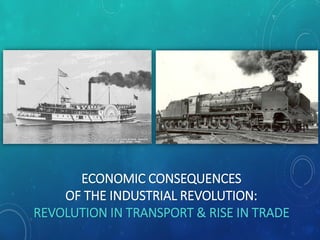
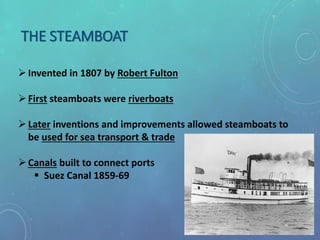
ECONOMIC CONSEQUENCES
OF THE INDUSTRIAL REVOLUTION:
REVOLUTION IN TRANSPORT & RISE IN TRADE
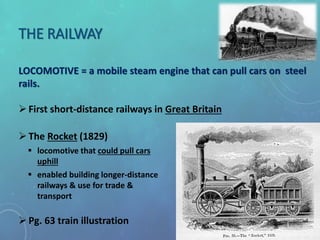
THE STEAMBOAT
Invented in 1807 by Robert Fulton
First steamboats were riverboats
Later inventions and improvements allowed steamboats to
be used for sea transport & trade
Canals built to connect ports
 Suez Canal 1859-69
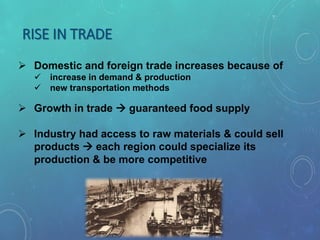
THE RAILWAY
LOCOMOTIVE = a mobile steam engine that can pull cars on steel
rails.
First short-distance railways in Great Britain
The Rocket (1829)
 locomotive that could pull cars
uphill
 enabled building longer-distance
railways & use for trade &
transport
Pg. 63 train illustration
VIDEO
https://www.youtube.com/watch?v=-RKmPxM83cc
RISE IN TRADE
 Domestic and foreign trade increases because of
 increase in demand & production
 new transportation methods
 Growth in trade  guaranteed food supply
 Industry had access to raw materials & could sell
products  each region could specialize its
production & be more competitive
CONSEQUENCES
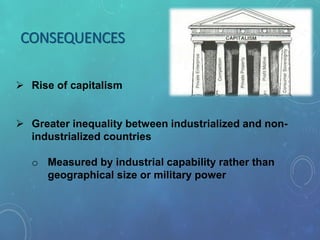
 Rise of capitalism
 Greater inequality between industrialized and non-
industrialized countries
o Measured by industrial capability rather than
geographical size or military power
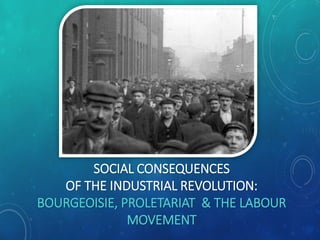
SOCIAL CONSEQUENCES
OF THE INDUSTRIAL REVOLUTION:
BOURGEOISIE, PROLETARIAT & THE LABOUR
MOVEMENT
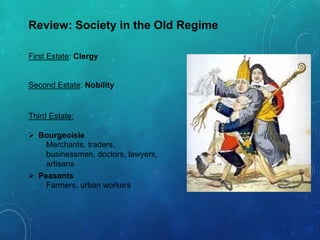
Review: Society in the Old Regime
First Estate: Clergy
Second Estate: Nobility
Third Estate:
 Bourgeoisie
Merchants, traders,
businessmen, doctors, lawyers,
artisans
 Peasants
Farmers, urban workers
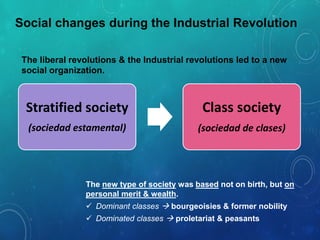
Social changes during the Industrial Revolution
The liberal revolutions & the Industrial revolutions led to a new
social organization.
Stratified society
(sociedad estamental)
Class society
(sociedad de clases)
The new type of society was based not on birth, but on
personal merit & wealth.
 Dominant classes  bourgeoisies & former nobility
 Dominated classes  proletariat & peasants
Social changes during the Industrial Revolution:
RISE OF THE BOURGEOISIE
Upper Bourgeoisie  owned
factories, businesses, mines,
land, banks…
Petite Bourgeoisie  small
business owners & merchants,
government workers, doctors,
and lawyers.
Men worked.
Women ran the home.
Children went to school.
The bourgeoisie gained
political power, became
wealthy through their
economic activities, and
became an elite cultural
group.
They valued hard work,
personal success, family,
education, culture and art.
Social changes during the Industrial Revolution:
BIRTH OF THE PROLETARIAT
Proletariat  urban workers,
miners, peasants.
Men worked.
Women worked.
Children worked.
New machines made for
manufacturing and
agriculture made it difficult
for peasants and artisans to
continue their work.
However, the Industrial
Revolution increased the
demand for work in
factories and mines.
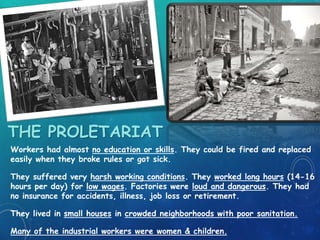
THE PROLETARIAT
Workers had almost no education or skills. They could be fired and replaced
easily when they broke rules or got sick.
They suffered very harsh working conditions. They worked long hours (14-16
hours per day) for low wages. Factories were loud and dangerous. They had
no insurance for accidents, illness, job loss or retirement.
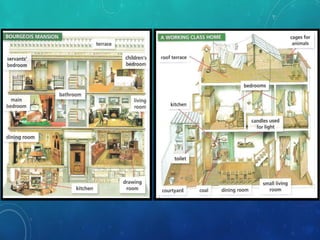
They lived in small houses in crowded neighborhoods with poor sanitation.
Many of the industrial workers were women & children.
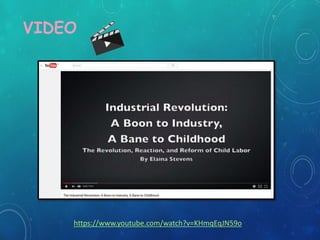
VIDEO
https://www.youtube.com/watch?v=KHmqEqJN59o
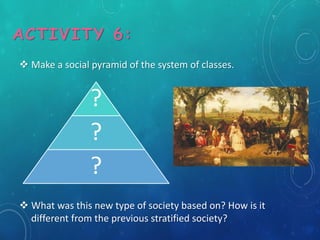
ACTIVITY 6:
 Make a social pyramid of the system of classes.
 What was this new type of society based on? How is it
different from the previous stratified society?
?
?
?
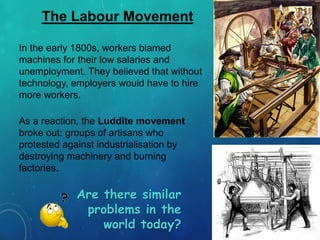
The Labour Movement
In the early 1800s, workers blamed
machines for their low salaries and
unemployment. They believed that without
technology, employers would have to hire
more workers.
As a reaction, the Luddite movement
broke out: groups of artisans who
protested against industrialisation by
destroying machinery and burning
factories.
Are there similar
problems in the
world today?
The Labour Movement
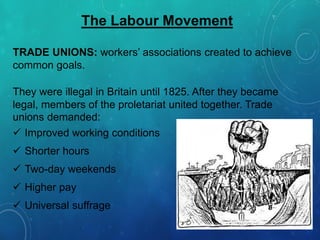
TRADE UNIONS: workers’ associations created to achieve
common goals.
They were illegal in Britain until 1825. After they became
legal, members of the proletariat united together. Trade
unions demanded:
 Improved working conditions
 Shorter hours
 Two-day weekends
 Higher pay
 Universal suffrage
The Labour Movement
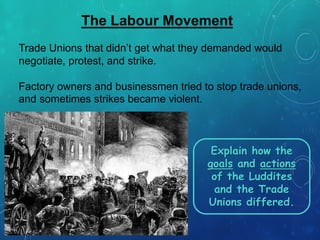
Trade Unions that didn’t get what they demanded would
negotiate, protest, and strike.
Factory owners and businessmen tried to stop trade unions,
and sometimes strikes became violent.
Explain how the
goals and actions
of the Luddites
and the Trade
Unions differed.
New political ideologies:
socialism & anarchism
The conflict between the bourgeoisie and the proletariat led to
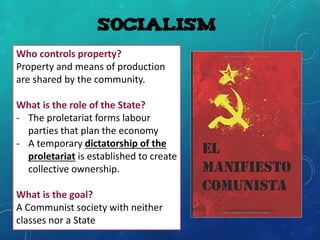
new ideologies. The primary ones were socialism and anarchism.
CLASSSTRUGGLE
Industrial capitalism
Who controls property?
The bourgeoisie controls private
property and the means of
production (machines, tools,
technology).
What is the role of the State?
The government protects people
and their private property.
What is the goal?
The goal is to gain wealth.
Socialism
Who controls property?
Property and means of production
are shared by the community.
What is the role of the State?
- The proletariat forms labour
parties that plan the economy
- A temporary dictatorship of the
proletariat is established to create
collective ownership.
What is the goal?
A Communist society with neither
classes nor a State
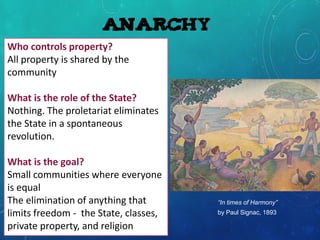
Anarchy
Who controls property?
All property is shared by the
community
What is the role of the State?
Nothing. The proletariat eliminates
the State in a spontaneous
revolution.
What is the goal?
Small communities where everyone
is equal
The elimination of anything that
limits freedom - the State, classes,
private property, and religion
“In times of Harmony”
by Paul Signac, 1893
ACTIVITY 7:
1) Get with a partner.
2) Play Rock-Paper-Scissors. If you lose, give the winner a
piece of candy.
3) Find a new partner and continue playing.
4) You need at least one piece of candy to survive. If you
have no candy, you are “dead” until the next round.
ROUND 1 - Capitalism
Some people start with more candy than
others.
ACTIVITY 7:
1) Get with a partner.
2) Play Rock-Paper-Scissors. If you lose, give the winner a
piece of candy.
3) Find a new partner and continue playing.
4) You need at least one piece of candy to survive. If you
have no candy, you are “dead” until the next round.
ROUND 2 - Anarchy
When you win, you can give or take as
much candy as you want.
ACTIVITY 7:
1) Get with a partner.
2) Play Rock-Paper-Scissors. If you lose, give the winner a
piece of candy.
3) Find a new partner and continue playing.
4) You need at least one piece of candy to survive. If you
have no candy, you are “dead” until the next round.
ROUND 3 - Socialism
Everyone starts with the same amount of
candy.
ACTIVITY 7:
1) Get with a partner.
2) Play Rock-Paper-Scissors. If you lose, give the winner a
piece of candy.
3) Find a new partner and continue playing.
4) You need at least one piece of candy to survive. If you
have no candy, you are “dead” until the next round.
ROUND 4 - Dictatorship
Give your candy to the teacher. They
decide how much everyone gets.
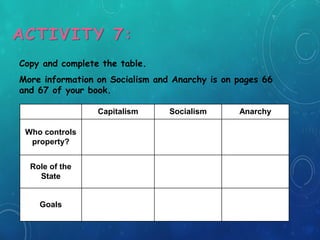
ACTIVITY 7:
Copy and complete the table.
More information on Socialism and Anarchy is on pages 66
and 67 of your book.
Capitalism Socialism Anarchy
Who controls
property?
Role of the
State
Goals

U3. industrial revolution

  • 1.
    UNIT 3 IES CAMILOJOSÉ CELA TEACHER: ROCÍO BAUTISTA
  • 2.
    INDUSTRIAL REVOLUTION STARTED ATTHE LATE 18th CENTURY - 1st Industrial Revolution (1780 – 1870)  unit 3 - 2nd Industrial Revolution (1870 – 1914)  unit 5 CHANGED THE WAY GOODS WERE PRODUCED (machines replaced manual labour) & THE WAY WORK WAS ORGANIZED (factories, division of labour…) RADICALLY CHANGED THE ECONOMY & THE SOCIETY  end of agrarian economy BEGAN IN UK
  • 4.
    THE ROOTS OFTHE INDUSTRIAL REVOLUTION IN GREAT BRITAIN
  • 5.
    WHY DID THEINDUSTRIAL REVOLUTION BEGAN IN UK?  Stable political situation (constitutional monarchy since 1688) & favourable economic system: economic liberalism
  • 6.
    WHY DID THEINDUSTRIAL REVOLUTION BEGAN IN UK?  Stable political situation (constitutional monarchy since 1688) & favourable economic system: economic liberalism  Agricultural revolution
  • 7.
    AGRICULTURAL REVOLUTION (18th Century) NORFOLK SYSTEM:  Constant crop rotation (no fallow land)  higher yields  Production of feed for animals  increased livestock farming… • More manure (used as fertiliser)  increased cereal production • More meat & milk (proteins)  improved human diet  Other innovations:  Spread of new crops from America (maize, potatoes) spread  more diversified diet.  New machinery (seed drills, horse-drawn harvesters…)  Selection of seeds & livestock  Enclosures Acts  turned common land into private property, which was obligatory to fence. Poor peasants couldn’t afford fences, so they sold their properties to rich peasants, bourgeois & nobles. TURNIPS (nabos) for feeding cattle BARLEY ANIMAL FODDER (alfalfa, clover…) for feeding cattle CEREALS (wheat to make bread to feed humans)
  • 10.
    AGRICULTURAL REVOLUTION (18th Century) CONSEQUENCES CONCENTRATION OF LANDOWNERSHIP INCREASEDAGRICULTURAL PRODUCTION Improved nutrition  population growth Higher profits that were invested in developing industry Freed peasants that emigrated to cities to look for industrial jobs
  • 11.
    WHY DID THEINDUSTRIAL REVOLUTION BEGAN IN UK?  Stable political situation (constitutional monarchy since 1688) & favourable economic system: economic liberalism  Agricultural revolution  Population growth (demographic revolution)
  • 12.
    DEMOGRAPHIC REVOLUTION (18th Century) BIRTHRATE REMAINED HIGH DEATH RATE DECREASED (improved nutrition, hygiene, medicine…) LARGE NATURAL POPULATION GROWTH Increased workforce for industry Increased demand for industrial products
  • 13.
    WHY DID THEINDUSTRIAL REVOLUTION BEGAN IN UK?  Stable political situation (constitutional monarchy since 1688) & favourable economic system: economic liberalism  Agricultural revolution  Population growth (demographic revolution)  Vast colonial empire that supplied: • Raw materials • Markets to sell their products • Capital
  • 14.
    VAST COLONIAL EMPIRE Rawmaterials Markets Capital (from foreign trade)
  • 15.
    WHY DID THEINDUSTRIAL REVOLUTION BEGAN IN UK?  Stable political situation (constitutional monarchy since 1688) & favourable economic system: economic liberalism  Agricultural revolution  Population growth (demographic revolution)  Vast colonial empire that supplied: • Raw materials • Markets to sell their products • Capital  Availability of raw materials (cotton, iron) & energy sources (coal), that enabled the development of textile & iron industries.  Availability of capital (profits from foreign trade & agriculture) to finance industry.  Existence of an entrepreneurial bourgeoisie  Improved transports (roads)  Capability of technical innovation (e.g.: steam engine)
  • 16.
  • 17.
    3 PHASES INTHE EVOLUTION OF INDUSTRY ARTISANAL INDUSTRY (until mid-18th century aprox.) MODERN INDUSTRY (1780 – 1950) CONTEMPORARY INDUSTRY (Mid-20th century onwards) MECHANISATION OF INDUSTRY
  • 18.
  • 19.
    2º) MODERN INDUSTRY: 1STINDUSTRIAL REVOLUTION STEAM ENGINE  powered by burning coal; moved other machines. Patented by James Watt (1769) It was the foundation of the 1st Industrial Revolution
  • 20.
    Factory Production  Concentratesproduction in one place [materials, labour].  Located near sources of power [rather than labour or markets].  Requires a lot of capital investment [factory, machines, etc.] more than skilled labour.
  • 21.
    The Factory System Rigid schedule.  12-14 hour day.  Dangerous conditions.  Mind-numbing monotony.
  • 22.
    2º) MODERN INDUSTRY: 2NDINDUSTRIAL REVOLUTION Machines were moved by engines powered by new sources of energy (oil & electricity)
  • 23.
  • 24.
    ACTIVITY 2: fillin the worksheet comparing industry before & after the industrial revolution
  • 25.
    TEXTILE INDUSTRY POPULATION GROWTH INCRESED DEMAND OF COTTONFABRICS NEW MACHINES WERE INVENTED TO INCREASE PRODUCTION (1st powered by hand & water, later by steam engines) 1st sector that became mechanized Different machines were invented to: a) Spin cotton (“hilar”)  transform raw cotton into cotton thread. b) Weave cloth (“tejer”)  lace threads together to form a fabric.
  • 26.
    SPINNING JENNY MANUAL SPINNINGMACHINE. James Hargreaves (1764) Easier & faster machines to spin cotton threads. They enable to spin several bobbins at the same time WATER FRAME WATER-POWERED SPINNING MACHINE. Richard Arkwright (1767)
  • 27.
    POWER LOOM (“telar mecánico”) EdmondCartwright (1785) STEAM-POWERED LOOM THAT COMBINED THREADS TO MAKE CLOTH.  Steam-powered machines enabled factories to be located in cities (not next to rivers any more)  Consolidated the factory system.  Cotton became more popular than linen or wool.  Supremacy of British cotton industry in the world. SELF-ACTING SPINNING MULE Richard Roberts (1830) AUTOMATIC STEAM-POWER SPINNING MACHINE.
  • 28.
    Textile Factory Workers inEngland 1813 2400 looms 150, 000 workers 1833 85, 000 looms 200, 000 workers 1850 224, 000 looms >1 million workers
  • 30.
    IRON & STEELINDUSTRY New techniques to produce iron were invented  led British iron industry to undergo a large growth BEFORE Wood Melted in small ovens Manual/hydraulic bellows AFTER Coal Blast furnaces (altos hornos) Steam-powered bellows New techniques: - Puddling (pudelado)  improved resistance. - Rolling (laminado)  improved casting
  • 32.
    PUDDLING (“pudelado”) Process to refineiron and reduce the amount of carbon in it. It produces wrought iron (hierro forjado)  more resistant. ROLLING (“laminado”) Process in which iron stock is passed through some rolls to reduce its thickness and to make the thickness uniform. It facilitates its casting.
  • 33.
    ACTIVITY 3: P. 58 exercises 1 / 2 Fill in the chart about textiles machines invented in UK during the 1st Industrial Revolution: Indicate 3 changes in the way iron was produced before & after the Industrial revolution. MACHINE (name) Who invented it? When? Energy used & function SPINNING JENNY Arkwright STEAM-POWERED LOOM THAT COMBINED THREADS TO MAKE CLOTH. 1830
  • 34.
    THE SPREAD OFINDUSTRIALISATION
  • 35.
    ACTIVITY 4: Copy &complete the chart: Why did Spain, Italy, Portugal, Greece,… industrialized later? Explain the Japanese industrialization. P. 61  exercise 4 COUNTRY Historical background Industrialization process BELGIUM FRANCE GERMANY USA
  • 36.
    SPREAD OF INDUSTRIALISATION Factorsthat determined the spread of industrialization:  Availability of capital & natural resources (coal, iron, cotton)  Population growth (availability of workforce)  Demand of industrial products (wealth)  Political situation  Transports Around 1830  industrialization spread to countries close to UK (Belgium, France, Germany…) & the ones with close ties to UK (US). British businessmen searched for economic opportunities in other countries, where they set up industries with British technology.
  • 37.
    BELGIUM Historical background: independentfrom the Netherlands since 1830 (liberal revolution ended the forced annexation agreed in the Congress of Vienna) First country after Britain to industrialize… Factors?:  Coal & iron deposits near each other.  Traditional thriving textile industry (wool)  Napoleonic block-trade to UK (1806-1814)  Government’s promotion of transports to tie the nation closer together: construction of waterways & a national railway network (1834)
  • 38.
    FRANCE Historical background: turbulentperiod 1789 – 1815 (French Rev. & Napoleon). Industrialized later due to…:  Unstable political situation  Lack of coal  Lower industrial demand due to a slow population growth & the predominance of a self-sufficient rural society Industrialization focused specially in the north of France, due to its proximity to UK & Belgium.
  • 39.
    GERMANY Historical background: notpolitically unified until 1871. Modestly industrialized due to…:  Coal mines (regions: Ruhr, Silesia…)  Customs union (“Zollverein”) in 1834. However, Germany didn’t seriously industrialized until after unification (1871). Once unified, Germany saw a meteoric rise in its industrial strength (e.g.: steel production doubled every decade between 1870-1900, outpacing Great Britain by then).
  • 40.
    USA Historical background: gainedindependence from UK in 1776 (Declaration of Independence). Quick industrialization due to…:  Huge territory to grow cotton  Mining resources  High demand due to immigration  Railway development  Protectionism By 1914 it was the leading industrial power in the world. By 1914 (WW1) it was the leading industrial power in the world.
  • 41.
    2ND WAVE OFCOUNTRIES TO INDUSTRIALIZE  Poor natural resources  Little demand (rural & impoverished countries)  Low investment either from the bourgeoisie or the government  Far away from main trading areas JAPAN  last of the industrialized countries in the 19th Century. The process was directly led by the government, who set up the first companies with the profits obtained from:  Exporting rice, silk & tea  Compensation after the war against China (1894-95)
  • 42.
    ECONOMIC CONSEQUENCES OF THEINDUSTRIAL REVOLUTION: REVOLUTION IN TRANSPORT & RISE IN TRADE
  • 43.
    THE STEAMBOAT Invented in1807 by Robert Fulton First steamboats were riverboats Later inventions and improvements allowed steamboats to be used for sea transport & trade Canals built to connect ports  Suez Canal 1859-69
  • 44.
    THE RAILWAY LOCOMOTIVE =a mobile steam engine that can pull cars on steel rails. First short-distance railways in Great Britain The Rocket (1829)  locomotive that could pull cars uphill  enabled building longer-distance railways & use for trade & transport Pg. 63 train illustration
  • 45.
  • 46.
    RISE IN TRADE Domestic and foreign trade increases because of  increase in demand & production  new transportation methods  Growth in trade  guaranteed food supply  Industry had access to raw materials & could sell products  each region could specialize its production & be more competitive
  • 47.
    CONSEQUENCES  Rise ofcapitalism  Greater inequality between industrialized and non- industrialized countries o Measured by industrial capability rather than geographical size or military power
  • 48.
    SOCIAL CONSEQUENCES OF THEINDUSTRIAL REVOLUTION: BOURGEOISIE, PROLETARIAT & THE LABOUR MOVEMENT
  • 49.
    Review: Society inthe Old Regime First Estate: Clergy Second Estate: Nobility Third Estate:  Bourgeoisie Merchants, traders, businessmen, doctors, lawyers, artisans  Peasants Farmers, urban workers
  • 50.
    Social changes duringthe Industrial Revolution The liberal revolutions & the Industrial revolutions led to a new social organization. Stratified society (sociedad estamental) Class society (sociedad de clases) The new type of society was based not on birth, but on personal merit & wealth.  Dominant classes  bourgeoisies & former nobility  Dominated classes  proletariat & peasants
  • 51.
    Social changes duringthe Industrial Revolution: RISE OF THE BOURGEOISIE Upper Bourgeoisie  owned factories, businesses, mines, land, banks… Petite Bourgeoisie  small business owners & merchants, government workers, doctors, and lawyers. Men worked. Women ran the home. Children went to school. The bourgeoisie gained political power, became wealthy through their economic activities, and became an elite cultural group. They valued hard work, personal success, family, education, culture and art.
  • 52.
    Social changes duringthe Industrial Revolution: BIRTH OF THE PROLETARIAT Proletariat  urban workers, miners, peasants. Men worked. Women worked. Children worked. New machines made for manufacturing and agriculture made it difficult for peasants and artisans to continue their work. However, the Industrial Revolution increased the demand for work in factories and mines.
  • 54.
    THE PROLETARIAT Workers hadalmost no education or skills. They could be fired and replaced easily when they broke rules or got sick. They suffered very harsh working conditions. They worked long hours (14-16 hours per day) for low wages. Factories were loud and dangerous. They had no insurance for accidents, illness, job loss or retirement. They lived in small houses in crowded neighborhoods with poor sanitation. Many of the industrial workers were women & children.
  • 55.
  • 56.
    ACTIVITY 6:  Makea social pyramid of the system of classes.  What was this new type of society based on? How is it different from the previous stratified society? ? ? ?
  • 57.
    The Labour Movement Inthe early 1800s, workers blamed machines for their low salaries and unemployment. They believed that without technology, employers would have to hire more workers. As a reaction, the Luddite movement broke out: groups of artisans who protested against industrialisation by destroying machinery and burning factories. Are there similar problems in the world today?
  • 58.
    The Labour Movement TRADEUNIONS: workers’ associations created to achieve common goals. They were illegal in Britain until 1825. After they became legal, members of the proletariat united together. Trade unions demanded:  Improved working conditions  Shorter hours  Two-day weekends  Higher pay  Universal suffrage
  • 59.
    The Labour Movement TradeUnions that didn’t get what they demanded would negotiate, protest, and strike. Factory owners and businessmen tried to stop trade unions, and sometimes strikes became violent. Explain how the goals and actions of the Luddites and the Trade Unions differed.
  • 60.
    New political ideologies: socialism& anarchism The conflict between the bourgeoisie and the proletariat led to new ideologies. The primary ones were socialism and anarchism.
  • 61.
  • 62.
    Industrial capitalism Who controlsproperty? The bourgeoisie controls private property and the means of production (machines, tools, technology). What is the role of the State? The government protects people and their private property. What is the goal? The goal is to gain wealth.
  • 63.
    Socialism Who controls property? Propertyand means of production are shared by the community. What is the role of the State? - The proletariat forms labour parties that plan the economy - A temporary dictatorship of the proletariat is established to create collective ownership. What is the goal? A Communist society with neither classes nor a State
  • 64.
    Anarchy Who controls property? Allproperty is shared by the community What is the role of the State? Nothing. The proletariat eliminates the State in a spontaneous revolution. What is the goal? Small communities where everyone is equal The elimination of anything that limits freedom - the State, classes, private property, and religion “In times of Harmony” by Paul Signac, 1893
  • 65.
    ACTIVITY 7: 1) Getwith a partner. 2) Play Rock-Paper-Scissors. If you lose, give the winner a piece of candy. 3) Find a new partner and continue playing. 4) You need at least one piece of candy to survive. If you have no candy, you are “dead” until the next round. ROUND 1 - Capitalism Some people start with more candy than others.
  • 66.
    ACTIVITY 7: 1) Getwith a partner. 2) Play Rock-Paper-Scissors. If you lose, give the winner a piece of candy. 3) Find a new partner and continue playing. 4) You need at least one piece of candy to survive. If you have no candy, you are “dead” until the next round. ROUND 2 - Anarchy When you win, you can give or take as much candy as you want.
  • 67.
    ACTIVITY 7: 1) Getwith a partner. 2) Play Rock-Paper-Scissors. If you lose, give the winner a piece of candy. 3) Find a new partner and continue playing. 4) You need at least one piece of candy to survive. If you have no candy, you are “dead” until the next round. ROUND 3 - Socialism Everyone starts with the same amount of candy.
  • 68.
    ACTIVITY 7: 1) Getwith a partner. 2) Play Rock-Paper-Scissors. If you lose, give the winner a piece of candy. 3) Find a new partner and continue playing. 4) You need at least one piece of candy to survive. If you have no candy, you are “dead” until the next round. ROUND 4 - Dictatorship Give your candy to the teacher. They decide how much everyone gets.
  • 69.
    ACTIVITY 7: Copy andcomplete the table. More information on Socialism and Anarchy is on pages 66 and 67 of your book. Capitalism Socialism Anarchy Who controls property? Role of the State Goals