ROMANESQUE ART
WHAT WAS ROMANESQUE ART LIKE? Romanesque: It’s a new style of art, called so, because it is  reminiscent of Roman art   (But it has got nothing to do with Roman art)
What was the romanesque art used for? Romanesque art aimed ( buscaba ) to spread ( propagar ) religion and bring people closer to God
What were the main buldings? The most representative buildings were  churches ,  cathedrals , and  monasteries . Sculptures and paintings were used to convey (transmit) spirituality.
ROMANESQUE ART
ROMANESQUE From the 11th century, a new style of art spread throughout Western Europe. It is known as  Romanesque  because it is reminiscent of Roman art.  Romanesque art aimed to spread religion and bring people closer to God.
The use of symbols was very important. Everything had a message, from the shape of the buildings to the materials and motifs used.  The artists were mostly  anonymous craftsmen . Once they had finished work in one place they usually moved  to another place.
In Architecture, the most representative buildings were  churches ,  cathedrals  and  monasteries .  Sculpture and painting were used to convey  spirituality .
ROMANESQUE ARCHITECTURE The main Romanesque buildings were made of  stone . At first they had flat,  wooden roofs , but fires were frequent and stone was safer.
Wooden roof
ROMANESQUE ELEMENTS The architects used Roman elements such as  barrel vaults  and  domes.
Barrel vault
Domes
The buildings had  round arches  and big columns and pillars. The walls were very thick. The windows were very small, and there were not many of them. They let little light inside. Consequently, the buildings looked very solid and compact.
Round arches
Round arches
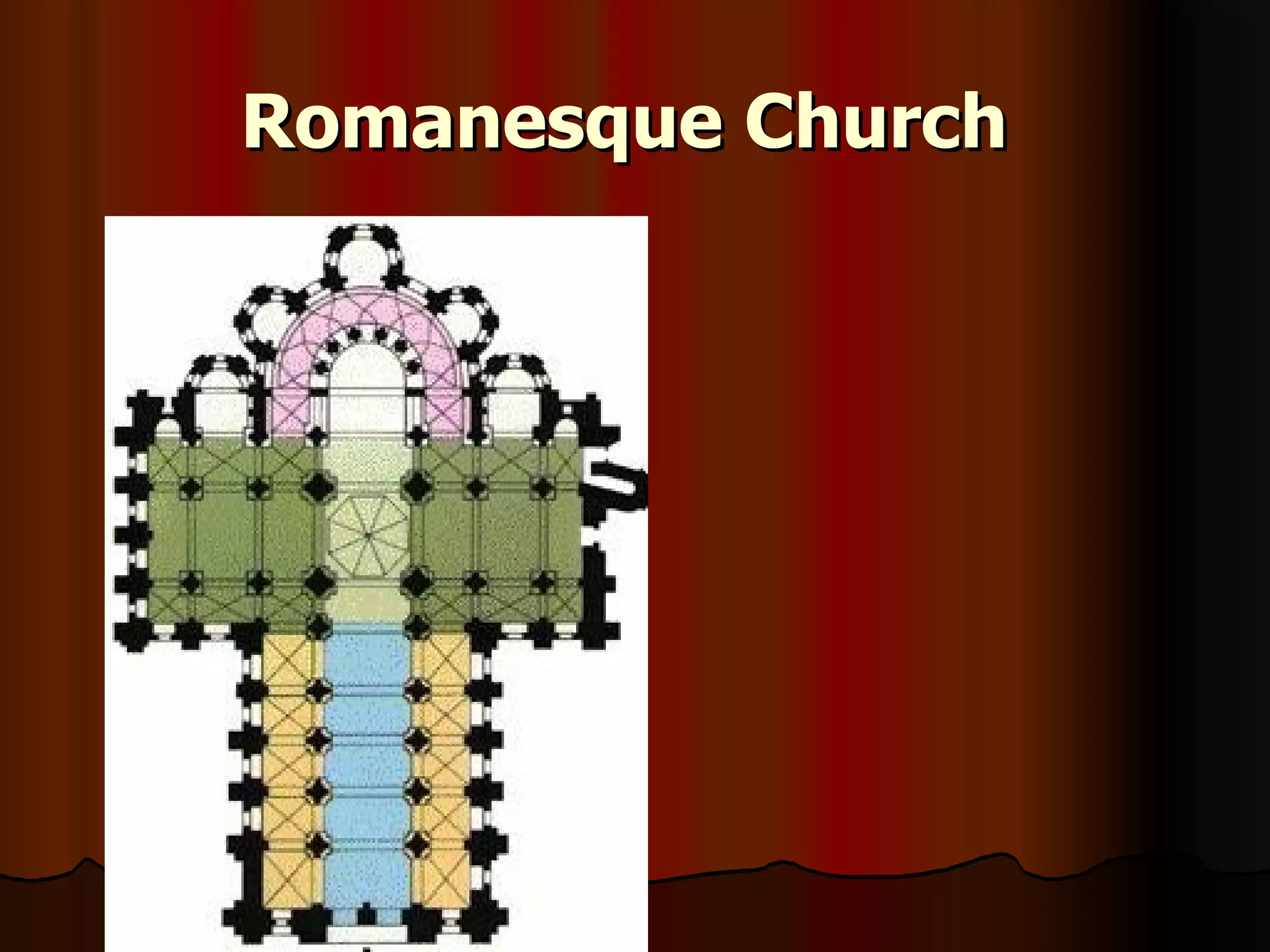
Plans The plan churches were usually  cruciform , to recall the cross on which Jesus died: a Latin cross.  The long arm of the cross was made up of one or more naves finishing in an  apse . The shorter arm is called the transept.
Apse
Cruciform plan
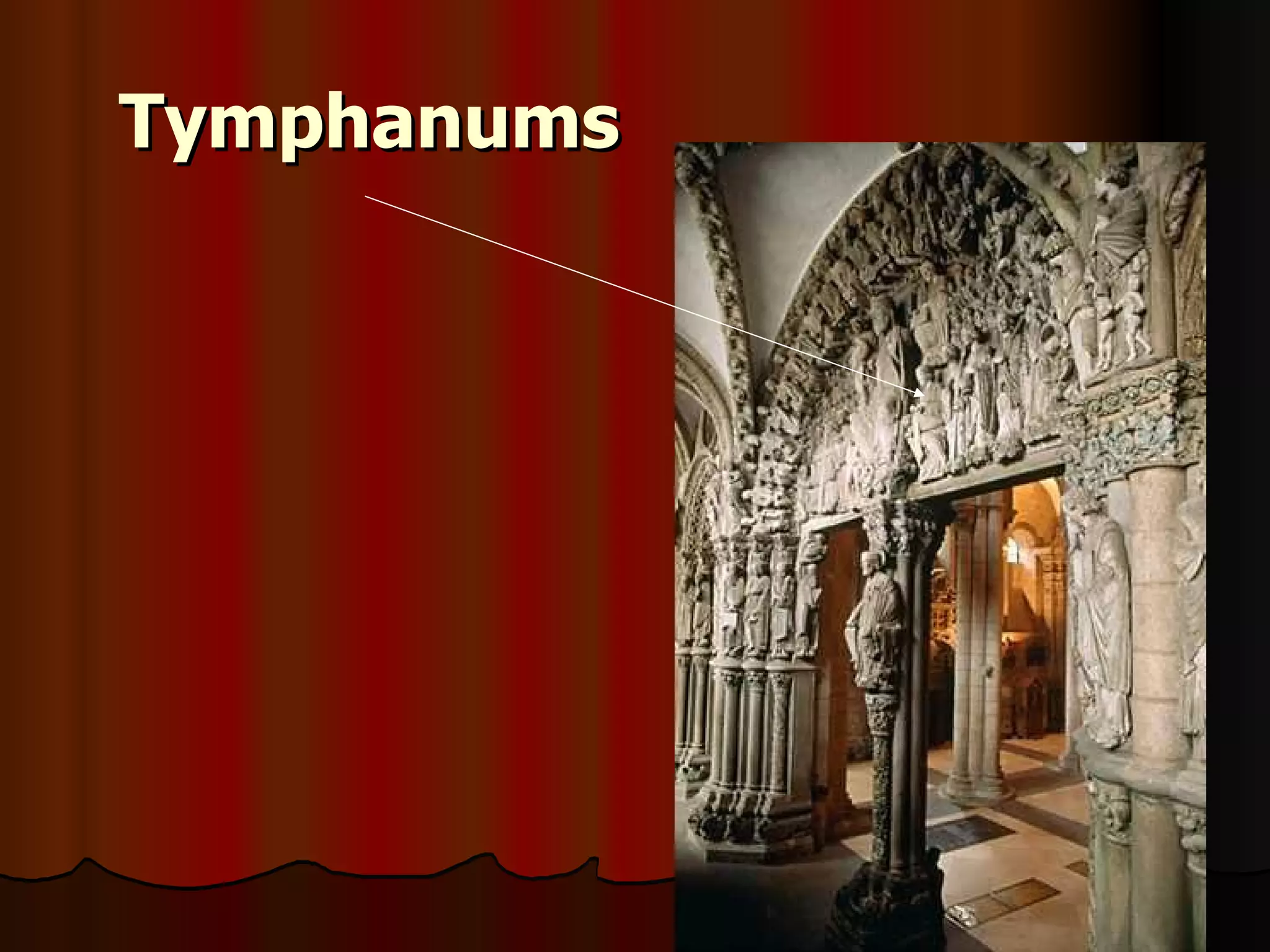
Romanesque sculpture In the Middle Ages, art had an educational and religious function. Most people could not read or write. Images taught them about the Christian religion. The size and shape of Romanesque sculptures were adapted to fit into the space available. Human figures were  unrealistic .
 
Typhanum
Is it schemathic or realistic?
The  sculptures were painted in bright colours . Today most of the colours have disappeared.  The facades of the churches, specially the  tymphanums , were decorated with subjects such as  Christ in Glory  and the  Last Judgement .
Tymphanums
Tymphanums
Christ in Glory (into a Tymphanums)
Sculptures were painted in bright colours
The  capitals  and the  cloisters  were decorated with animals, plants, Biblical stories, and everyday scenes.  There were wooden carvings, ussually on the altars. Two main themes were shown: The Virgin and the Child and Christ on the Cross.
Capitals the upper part of a column
Romanesque Cloister
ROMANESQUE PAINTING The most important paintings were inside churches. Humans figures were  rigid  and  schematic.  Some were painted much bigger than the rest to show their importance. Bright colours were used. The figures were outlined in black, and the eyes and hands were emphasised. There were no background landscapes.
The Virgin with the Child
Christ in Glory It is painted on a wall
Mural painting was common  on walls,  specially in the main aspe near the altar. The favourite themes were  Christ in Glory  and the  Virgin and Child   Panel painting was used on  altars  and small  altarpieces . The lives of saints and martyrs were shown.  Miniatures  were small paintings wich illustrated bibles and manuscripts.
Miniatures
Romanesque art in England In England, Romanesque art came from France with the  Norman  Conquest  in 1066 AD
Round arch Key stone
PILGRIMAGE ROUTES
ROMANESQUE MONASTERY OF CLUNNY
Monastery of Clunny   (It was the most important monastery in Europe during the Middle Ages
Romanesque Church
Cathedral of Pisa (Italy)
St.M Vezelay (France)
 

Romanesque Art

  • 1.
  • 2.
    WHAT WAS ROMANESQUEART LIKE? Romanesque: It’s a new style of art, called so, because it is reminiscent of Roman art (But it has got nothing to do with Roman art)
  • 3.
    What was theromanesque art used for? Romanesque art aimed ( buscaba ) to spread ( propagar ) religion and bring people closer to God
  • 4.
    What were themain buldings? The most representative buildings were churches , cathedrals , and monasteries . Sculptures and paintings were used to convey (transmit) spirituality.
  • 5.
  • 6.
    ROMANESQUE From the11th century, a new style of art spread throughout Western Europe. It is known as Romanesque because it is reminiscent of Roman art. Romanesque art aimed to spread religion and bring people closer to God.
  • 7.
    The use ofsymbols was very important. Everything had a message, from the shape of the buildings to the materials and motifs used. The artists were mostly anonymous craftsmen . Once they had finished work in one place they usually moved to another place.
  • 8.
    In Architecture, themost representative buildings were churches , cathedrals and monasteries . Sculpture and painting were used to convey spirituality .
  • 9.
    ROMANESQUE ARCHITECTURE Themain Romanesque buildings were made of stone . At first they had flat, wooden roofs , but fires were frequent and stone was safer.
  • 10.
  • 11.
    ROMANESQUE ELEMENTS Thearchitects used Roman elements such as barrel vaults and domes.
  • 12.
  • 13.
  • 14.
    The buildings had round arches and big columns and pillars. The walls were very thick. The windows were very small, and there were not many of them. They let little light inside. Consequently, the buildings looked very solid and compact.
  • 15.
  • 16.
  • 17.
    Plans The planchurches were usually cruciform , to recall the cross on which Jesus died: a Latin cross. The long arm of the cross was made up of one or more naves finishing in an apse . The shorter arm is called the transept.
  • 18.
  • 19.
  • 20.
    Romanesque sculpture Inthe Middle Ages, art had an educational and religious function. Most people could not read or write. Images taught them about the Christian religion. The size and shape of Romanesque sculptures were adapted to fit into the space available. Human figures were unrealistic .
  • 21.
  • 22.
  • 23.
    Is it schemathicor realistic?
  • 24.
    The sculptureswere painted in bright colours . Today most of the colours have disappeared. The facades of the churches, specially the tymphanums , were decorated with subjects such as Christ in Glory and the Last Judgement .
  • 25.
  • 26.
  • 27.
    Christ in Glory(into a Tymphanums)
  • 28.
    Sculptures were paintedin bright colours
  • 29.
    The capitals and the cloisters were decorated with animals, plants, Biblical stories, and everyday scenes. There were wooden carvings, ussually on the altars. Two main themes were shown: The Virgin and the Child and Christ on the Cross.
  • 30.
    Capitals the upperpart of a column
  • 31.
  • 32.
    ROMANESQUE PAINTING Themost important paintings were inside churches. Humans figures were rigid and schematic. Some were painted much bigger than the rest to show their importance. Bright colours were used. The figures were outlined in black, and the eyes and hands were emphasised. There were no background landscapes.
  • 33.
    The Virgin withthe Child
  • 34.
    Christ in GloryIt is painted on a wall
  • 35.
    Mural painting wascommon on walls, specially in the main aspe near the altar. The favourite themes were Christ in Glory and the Virgin and Child Panel painting was used on altars and small altarpieces . The lives of saints and martyrs were shown. Miniatures were small paintings wich illustrated bibles and manuscripts.
  • 36.
  • 37.
    Romanesque art inEngland In England, Romanesque art came from France with the Norman Conquest in 1066 AD
  • 38.
  • 39.
  • 40.
  • 41.
    Monastery of Clunny (It was the most important monastery in Europe during the Middle Ages
  • 42.
  • 43.
  • 44.
  • 45.