Gothic Art
What it is?
The Gothic Art is a stile wihch was developed
in Western Europe from Medium ages till
the Renaissance.
Extensive artistic stage that began in the
northern of France and expanded
throughout the West.
According stages and cities the Gothic art
was developed by different way.
Gothic term
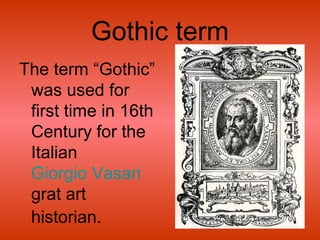
The term “Gothic”
was used for
first time in 16th
Century for the
Italian
Giorgio Vasari
grat art
historian.
The NeoGothic
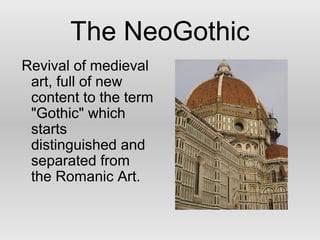
Revival of medieval
art, full of new
content to the term
"Gothic" which
starts
distinguished and
separated from
the Romanic Art.
Historical Context
• The Gothic architecture coincides with
the time, the fullness and the crisis.
• The Gothic coincides with the maximum
development of urban culture where it
appears the bourgeoisie, universities
and the flourishing of religious orders
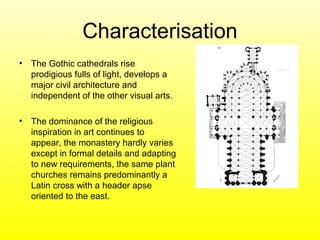
Characterisation
• The Gothic cathedrals rise
prodigious fulls of light, develops a
major civil architecture and
independent of the other visual arts.
• The dominance of the religious
inspiration in art continues to
appear, the monastery hardly varies
except in formal details and adapting
to new requirements, the same plant
churches remains predominantly a
Latin cross with a header apse
oriented to the east.
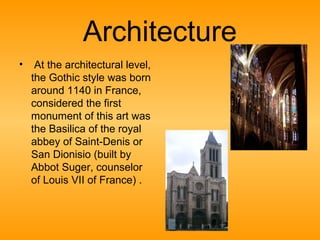
Architecture
• At the architectural level,
the Gothic style was born
around 1140 in France,
considered the first
monument of this art was
the Basilica of the royal
abbey of Saint-Denis or
San Dionisio (built by
Abbot Suger, counselor
of Louis VII of France) .
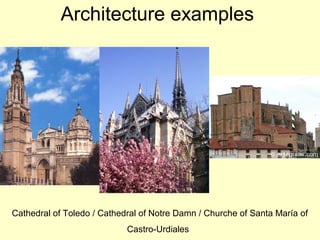
Architecture examples
Cathedral of Toledo / Cathedral of Notre Damn / Churche of Santa María of
Castro-Urdiales
Cistercian art.
• This art has been defined for
a long time fairly superficial,
exclusively for the use of one
of its elements, the pointed
arch, which is usually invoked
ogival, from which derives the
rib vault that allows thrusts to
move the buttresses outside,
that is further away from the
walls through the use of flying
buttresses. That allowed the
construction of buildings
much larger and higher, and
that there is more than the
vain on the walls
The light
• The light is understood as
the sublimation of divinity.
The symbolism
dominates the artists of
the time, the school sees
the light of Chartres the
most noble of natural
phenomena, less material
element, the closest
approximation to the pure
form.
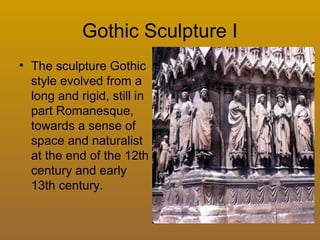
Gothic Sculpture I
• The sculpture Gothic
style evolved from a
long and rigid, still in
part Romanesque,
towards a sense of
space and naturalist
at the end of the 12th
century and early
13th century.
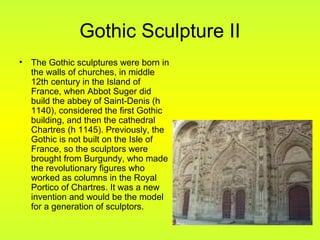
Gothic Sculpture II
• The Gothic sculptures were born in
the walls of churches, in middle
12th century in the Island of
France, when Abbot Suger did
build the abbey of Saint-Denis (h
1140), considered the first Gothic
building, and then the cathedral
Chartres (h 1145). Previously, the
Gothic is not built on the Isle of
France, so the sculptors were
brought from Burgundy, who made
the revolutionary figures who
worked as columns in the Royal
Portico of Chartres. It was a new
invention and would be the model
for a generation of sculptors.
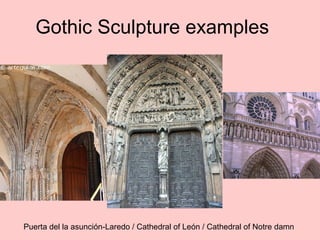
Gothic Sculpture examples
Puerta del la asunción-Laredo / Cathedral of León / Cathedral of Notre damn
Gothic Pint I
1.The Gothic Paint didn´t
appear till around the
year 1200, nearly 50
years after gothic
architecture and
sculpture.
3.The gothic is
corresponding with the
new tends;
philosophical and
religious.
2.While in the
Romanesque paintings
are simplified and
idealised, in the Gothic
is increased realism
and naturalism,
approaching the
imitation of nature,
painting scenery,
although it remains
unusual.
Gothic paint II
• Frescs: Mural
painting, a
continuation of the
previous Roman and
Christian traditions.
Gothic Paint II
• Stained-glass
windows. In northern
Europe, the stained
glass art were
preferred until the
15th century.
Gothic paint II
• Painting on board.
They began in Italy in
the 13th century and
spread for all Europe,
so as to the 15th
century had become
the predominant form,
supplanting even the
windows.
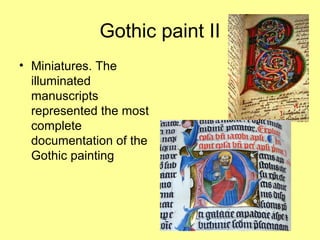
Gothic paint II
• Miniatures. The
illuminated
manuscripts
represented the most
complete
documentation of the
Gothic painting
Gothic paint II
• The oil painting on
canvas was not
popular until the 15th
and 16th centuries
and was the starting
point of Renaissance
art.

Gothic art

  • 1.
  • 2.
    What it is? TheGothic Art is a stile wihch was developed in Western Europe from Medium ages till the Renaissance. Extensive artistic stage that began in the northern of France and expanded throughout the West. According stages and cities the Gothic art was developed by different way.
  • 3.
    Gothic term The term“Gothic” was used for first time in 16th Century for the Italian Giorgio Vasari grat art historian.
  • 4.
    The NeoGothic Revival ofmedieval art, full of new content to the term "Gothic" which starts distinguished and separated from the Romanic Art.
  • 5.
    Historical Context • TheGothic architecture coincides with the time, the fullness and the crisis. • The Gothic coincides with the maximum development of urban culture where it appears the bourgeoisie, universities and the flourishing of religious orders
  • 6.
    Characterisation • The Gothiccathedrals rise prodigious fulls of light, develops a major civil architecture and independent of the other visual arts. • The dominance of the religious inspiration in art continues to appear, the monastery hardly varies except in formal details and adapting to new requirements, the same plant churches remains predominantly a Latin cross with a header apse oriented to the east.
  • 7.
    Architecture • At thearchitectural level, the Gothic style was born around 1140 in France, considered the first monument of this art was the Basilica of the royal abbey of Saint-Denis or San Dionisio (built by Abbot Suger, counselor of Louis VII of France) .
  • 8.
    Architecture examples Cathedral ofToledo / Cathedral of Notre Damn / Churche of Santa María of Castro-Urdiales
  • 9.
    Cistercian art. • Thisart has been defined for a long time fairly superficial, exclusively for the use of one of its elements, the pointed arch, which is usually invoked ogival, from which derives the rib vault that allows thrusts to move the buttresses outside, that is further away from the walls through the use of flying buttresses. That allowed the construction of buildings much larger and higher, and that there is more than the vain on the walls
  • 10.
    The light • Thelight is understood as the sublimation of divinity. The symbolism dominates the artists of the time, the school sees the light of Chartres the most noble of natural phenomena, less material element, the closest approximation to the pure form.
  • 11.
    Gothic Sculpture I •The sculpture Gothic style evolved from a long and rigid, still in part Romanesque, towards a sense of space and naturalist at the end of the 12th century and early 13th century.
  • 12.
    Gothic Sculpture II •The Gothic sculptures were born in the walls of churches, in middle 12th century in the Island of France, when Abbot Suger did build the abbey of Saint-Denis (h 1140), considered the first Gothic building, and then the cathedral Chartres (h 1145). Previously, the Gothic is not built on the Isle of France, so the sculptors were brought from Burgundy, who made the revolutionary figures who worked as columns in the Royal Portico of Chartres. It was a new invention and would be the model for a generation of sculptors.
  • 13.
    Gothic Sculpture examples Puertadel la asunción-Laredo / Cathedral of León / Cathedral of Notre damn
  • 14.
    Gothic Pint I 1.TheGothic Paint didn´t appear till around the year 1200, nearly 50 years after gothic architecture and sculpture. 3.The gothic is corresponding with the new tends; philosophical and religious. 2.While in the Romanesque paintings are simplified and idealised, in the Gothic is increased realism and naturalism, approaching the imitation of nature, painting scenery, although it remains unusual.
  • 15.
    Gothic paint II •Frescs: Mural painting, a continuation of the previous Roman and Christian traditions.
  • 16.
    Gothic Paint II •Stained-glass windows. In northern Europe, the stained glass art were preferred until the 15th century.
  • 17.
    Gothic paint II •Painting on board. They began in Italy in the 13th century and spread for all Europe, so as to the 15th century had become the predominant form, supplanting even the windows.
  • 18.
    Gothic paint II •Miniatures. The illuminated manuscripts represented the most complete documentation of the Gothic painting
  • 19.
    Gothic paint II •The oil painting on canvas was not popular until the 15th and 16th centuries and was the starting point of Renaissance art.