 THANK YOU
RAI SAHAB BHANWAR SINGH E,
COLLEG E
RALA- NASRUULLAGANJ
class-B.sc 5th sem.
subject-physic presentation
 Guided by-Mr. Gyanrao dhote
sir
 Student name-Aarti
yaduvanshi
GEIGER-MULLER COUNTER
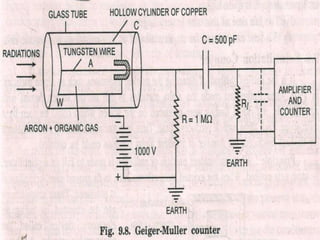
DEFINATION-: Geiger Muller Counter is a
device, which used for the detection &
measurement of all types of radiation : alpha
beta & gayma radiation.
Basically it consist of a pair of
electrodes have a high voltage across them. The
gas used in usually helium or argon.
PRINCIPAL-: The ionisation chamber
when the potential
difference between the electrode is
increased beyond the saturation
current region ab the electrons
produced due to ionisation of the
atoms of the gas enclosed in the
chamber by the incident particle moved
toward the anode with such a velocity
that they ionise the other atoms of the
gas.
As result the ionisation current
begin to increase. As the potential
difference is increased the
ionisation current increase .The
positive sheath developed near
the anode makes the electric field
weak to a value below critical value
required to produce Geiger
discharge .as a result ,the counter
becomes temporarily dead .
QUNCHING:-Due to successive
avalanche amplification , it
becomes difficult to count the fast
coming pulses .hence it becomes
essential that the successive are
the stopped .the method adopted
to stop the successive avalanche
amplification ,is called qunching.
(1)By the connecting an external
resistance
(2)By filling proper gas inside the
chamber
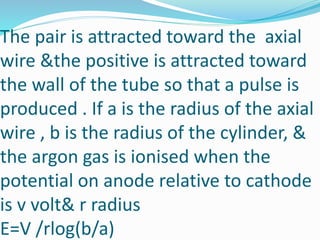
The pair is attracted toward the axial
wire &the positive is attracted toward
the wall of the tube so that a pulse is
produced . If a is the radius of the axial
wire , b is the radius of the cylinder, &
the argon gas is ionised when the
potential on anode relative to cathode
is v volt& r radius
E=V /rlog(b/a)
The pair is attracted toward the axial
wire &the positive is attracted toward
the wall of the tube so that a pulse is
produced . If a is the radius of the axial
wire , b is the radius of the cylinder, &
the argon gas is ionised when the
potential on anode relative to cathode
is v volt& r radius
E=V /rlog(b/a)
THANK YOU

gm counter

  • 1.
  • 2.
    RAI SAHAB BHANWARSINGH E, COLLEG E RALA- NASRUULLAGANJ class-B.sc 5th sem. subject-physic presentation  Guided by-Mr. Gyanrao dhote sir  Student name-Aarti yaduvanshi
  • 3.
  • 5.
    DEFINATION-: Geiger MullerCounter is a device, which used for the detection & measurement of all types of radiation : alpha beta & gayma radiation. Basically it consist of a pair of electrodes have a high voltage across them. The gas used in usually helium or argon. PRINCIPAL-: The ionisation chamber when the potential
  • 6.
    difference between theelectrode is increased beyond the saturation current region ab the electrons produced due to ionisation of the atoms of the gas enclosed in the chamber by the incident particle moved toward the anode with such a velocity that they ionise the other atoms of the gas.
  • 7.
    As result theionisation current begin to increase. As the potential difference is increased the ionisation current increase .The positive sheath developed near the anode makes the electric field weak to a value below critical value required to produce Geiger discharge .as a result ,the counter becomes temporarily dead .
  • 8.
    QUNCHING:-Due to successive avalancheamplification , it becomes difficult to count the fast coming pulses .hence it becomes essential that the successive are the stopped .the method adopted to stop the successive avalanche amplification ,is called qunching.
  • 9.
    (1)By the connectingan external resistance (2)By filling proper gas inside the chamber
  • 12.
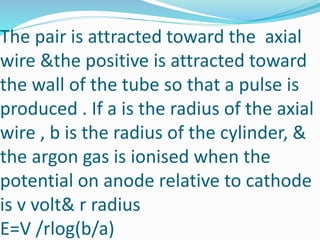
    The pair isattracted toward the axial wire &the positive is attracted toward the wall of the tube so that a pulse is produced . If a is the radius of the axial wire , b is the radius of the cylinder, & the argon gas is ionised when the potential on anode relative to cathode is v volt& r radius E=V /rlog(b/a)
  • 13.
    The pair isattracted toward the axial wire &the positive is attracted toward the wall of the tube so that a pulse is produced . If a is the radius of the axial wire , b is the radius of the cylinder, & the argon gas is ionised when the potential on anode relative to cathode is v volt& r radius E=V /rlog(b/a)
  • 14.