Geiger Muller Counter
Presented to: Respected Dr. Kamran Sb.
Presented by: Tahir Younus
Roll No. BS-PHYS-18-44
Course: BS Physics 5th (E)
Department of Physics
Ghazi University DG Khan
Outline
Introduction
1
History
2
Basic Components
3
Diagram
4
Principle and Working
5
Efficiency
6
Applications
6
 The Geiger Counter is an instrument used for
measuring ionizing radiation. It detects ionization
radiations such as α-particles, β- particles and γ-rays
using the ionization effect produced in a Geiger-Müller
tube.
 It is perhaps one of the world’s best-known radiation
detecting instrument.
Introduction
 In 1908,the first model of G.M. Counter was developed by Hans Geiger and
Ernest Rutherford which was only capable of detecting α-particles.
 In1928, Geiger and Walther Muller developed advanced model of Geiger
Muller Counter consisting of sealed G.M. Tube capable of detecting all
kinds of radiations.
 Interesting fact is that it was developed under- supervision of Hans Geiger
by Walther Muller who, was PhD student of Sir Hans Geiger.
History
Basic Components
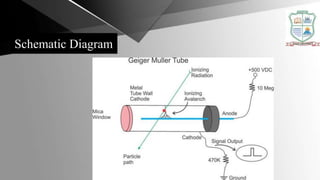
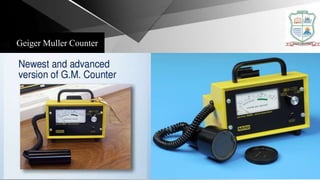
 A Geiger counter consists of a Geiger-Müller tube, the sensing
element which detects the radiation, and the processing
electronics, which displays the result.
 The Geiger-Müller tube is filled with an inert gas such as helium,
neon, or argon at low pressure, to which a high voltage typically
400- 600 V is applied.
Schematic Diagram
Geiger Muller Counter
Principle & Working
All the nuclear radiations such as alpha, beta and gamma radiation
will ionize while passing through a gaseous medium. This ionizing
property of nuclear radiations is used for the detection.
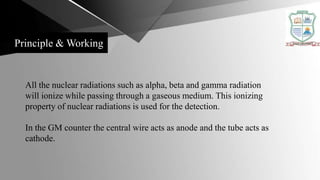
In the GM counter the central wire acts as anode and the tube acts as
cathode.
 When an ionizing radiation such as alpha, beta, gamma radiation enters the
tube it ionizes some of the gas molecules in tube.
 From these ionized atoms an electron comes out of atom, the remaining
atom is positively charged.
 Due to the high voltage in tube, it produces electric field.
 The electrons that come out of atom are attracted to positive electrode and
positively charged atoms are attracted to negative electrode.
 This produces a pulse of current in wires connected to electrodes and the
pulse is counted.
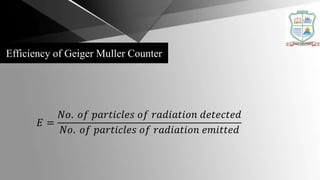
Efficiency of Geiger Muller Counter
𝐸 =
𝑁𝑜. 𝑜𝑓 𝑝𝑎𝑟𝑡𝑖𝑐𝑙𝑒𝑠 𝑜𝑓 𝑟𝑎𝑑𝑖𝑎𝑡𝑖𝑜𝑛 𝑑𝑒𝑡𝑒𝑐𝑡𝑒𝑑
𝑁𝑜. 𝑜𝑓 𝑝𝑎𝑟𝑡𝑖𝑐𝑙𝑒𝑠 𝑜𝑓 𝑟𝑎𝑑𝑖𝑎𝑡𝑖𝑜𝑛 𝑒𝑚𝑖𝑡𝑡𝑒𝑑
Precautions While Operating
 If the continuous discharge is produced, the voltage should
be lowered.
 The applied voltage must be relatively stabilized.
 Introduction of light should be prevented to avoid photo
electric effect.
Applications
 To detect radioactive rocks and minerals in the course of mineral
prospecting.
 To check for radioactive contamination of clothing and shoes in
your workplace.
 To check possible leakage or exposure to X-rays in a medical
facility.
 To check for radiation in areas where depleted uranium
 To check for irradiated gemstones in the jewellery trade.
 To check the levels of iodine 131 in cancer patients undergoing radiation therapy.
 You are in close proximity to a uranium mine and want to test the soil and
environment for dangerous levels of radioactivity.
 To test for radioactive contamination of food.
 To check materials in your anthropology or archaeology field.
Applications
 To check for radioactivity in metal objects in your home or office that could
be made of recycled radioactive materials.
Applications

Geiger muller counter

  • 1.
    Geiger Muller Counter Presentedto: Respected Dr. Kamran Sb. Presented by: Tahir Younus Roll No. BS-PHYS-18-44 Course: BS Physics 5th (E) Department of Physics Ghazi University DG Khan
  • 2.
  • 3.
     The GeigerCounter is an instrument used for measuring ionizing radiation. It detects ionization radiations such as α-particles, β- particles and γ-rays using the ionization effect produced in a Geiger-Müller tube.  It is perhaps one of the world’s best-known radiation detecting instrument. Introduction
  • 4.
     In 1908,thefirst model of G.M. Counter was developed by Hans Geiger and Ernest Rutherford which was only capable of detecting α-particles.  In1928, Geiger and Walther Muller developed advanced model of Geiger Muller Counter consisting of sealed G.M. Tube capable of detecting all kinds of radiations.  Interesting fact is that it was developed under- supervision of Hans Geiger by Walther Muller who, was PhD student of Sir Hans Geiger. History
  • 5.
    Basic Components  AGeiger counter consists of a Geiger-Müller tube, the sensing element which detects the radiation, and the processing electronics, which displays the result.  The Geiger-Müller tube is filled with an inert gas such as helium, neon, or argon at low pressure, to which a high voltage typically 400- 600 V is applied.
  • 6.
  • 7.
  • 8.
    Principle & Working Allthe nuclear radiations such as alpha, beta and gamma radiation will ionize while passing through a gaseous medium. This ionizing property of nuclear radiations is used for the detection. In the GM counter the central wire acts as anode and the tube acts as cathode.
  • 9.
     When anionizing radiation such as alpha, beta, gamma radiation enters the tube it ionizes some of the gas molecules in tube.  From these ionized atoms an electron comes out of atom, the remaining atom is positively charged.  Due to the high voltage in tube, it produces electric field.  The electrons that come out of atom are attracted to positive electrode and positively charged atoms are attracted to negative electrode.  This produces a pulse of current in wires connected to electrodes and the pulse is counted.
  • 10.
    Efficiency of GeigerMuller Counter 𝐸 = 𝑁𝑜. 𝑜𝑓 𝑝𝑎𝑟𝑡𝑖𝑐𝑙𝑒𝑠 𝑜𝑓 𝑟𝑎𝑑𝑖𝑎𝑡𝑖𝑜𝑛 𝑑𝑒𝑡𝑒𝑐𝑡𝑒𝑑 𝑁𝑜. 𝑜𝑓 𝑝𝑎𝑟𝑡𝑖𝑐𝑙𝑒𝑠 𝑜𝑓 𝑟𝑎𝑑𝑖𝑎𝑡𝑖𝑜𝑛 𝑒𝑚𝑖𝑡𝑡𝑒𝑑
  • 11.
    Precautions While Operating If the continuous discharge is produced, the voltage should be lowered.  The applied voltage must be relatively stabilized.  Introduction of light should be prevented to avoid photo electric effect.
  • 12.
    Applications  To detectradioactive rocks and minerals in the course of mineral prospecting.  To check for radioactive contamination of clothing and shoes in your workplace.  To check possible leakage or exposure to X-rays in a medical facility.  To check for radiation in areas where depleted uranium
  • 13.
     To checkfor irradiated gemstones in the jewellery trade.  To check the levels of iodine 131 in cancer patients undergoing radiation therapy.  You are in close proximity to a uranium mine and want to test the soil and environment for dangerous levels of radioactivity.  To test for radioactive contamination of food.  To check materials in your anthropology or archaeology field. Applications
  • 14.
     To checkfor radioactivity in metal objects in your home or office that could be made of recycled radioactive materials. Applications