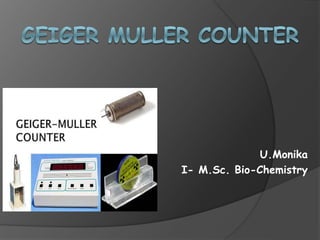

U.Monika
I- M.Sc. Bio-Chemistry
INTRODUCTION
All radiations cause ionizations and excitation.
Both of these types of interactions with matter are utilized in detecting and
measuring radioactivity.
The methods are,
1. GEIGER MULLER COUNTER (gas ionization)
2. SCINTILLATION COUNTING (excitation property)
3. AUTORADIOGRAPHY
DEFINITION
G.M. Counter detects and measures the rate of
ionization of gases induced by the radiation.
G.M. Counter is an excellent detector for ß-particles , but less
sensitive to other radiations.
Widely used in applications such as radiation dosimetry ,
radiological protection, experimental physics and the nuclear industry.
Invented by Hans Geiger and Walther Muller.
PRINCIPLE :
• A G.M. Counter is sensitive to ß-particles, γ-rays and
α-particle.
• As charged particle passes through a gas, its electrostatic field
dislodges orbital electrons from atoms and causes ionization.
• If ionization occurs between a pair of electrodes
enclosed in a chamber , a pulse is produced.
• The magnitude of which is related to the
applied potential and the number of radiation
particles entering the chamber.
INSTRUMENTATION
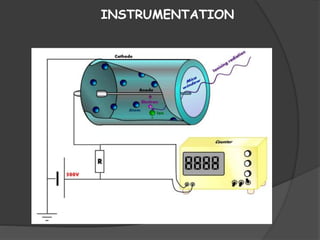
• It consists of a G.M.Tube – a copper cylindrical closed with a
thin mica window at one end.
• The thin mica membrane allows ß- particles to enter and the
other end is closed by an insulated plug.
• In the middle of the cylinder but insulated from it is a
tungsten wire which acts as the anode and the metal wall acts
as a cathode.
• The tube is filled with an inert ionizable gas ( He,
Ar or Xe ) at low pressure.
• A sensitive electronic indicator is included for
recording any current pulse generated in the circuit.
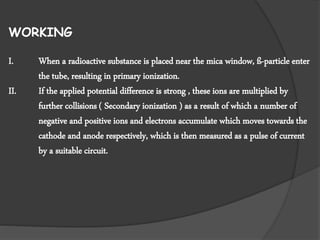
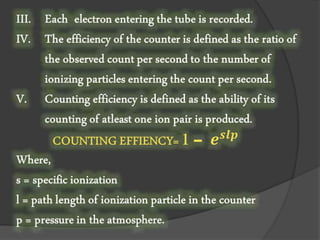
WORKING
I. When a radioactive substance is placed near the mica window, ß-particle enter
the tube, resulting in primary ionization.
II. If the applied potential difference is strong , these ions are multiplied by
further collisions ( Secondary ionization ) as a result of which a number of
negative and positive ions and electrons accumulate which moves towards the
cathode and anode respectively, which is then measured as a pulse of current
by a suitable circuit.
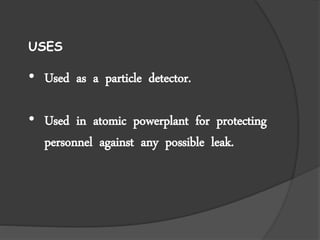
USES
• Used as a particle detector.
• Used in atomic powerplant for protecting
personnel against any possible leak.
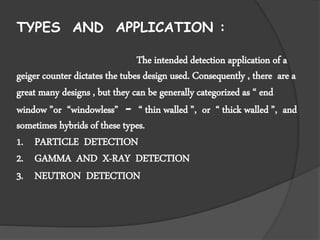
TYPES AND APPLICATION :
The intended detection application of a
geiger counter dictates the tubes design used. Consequently , there are a
great many designs , but they can be generally categorized as “ end
window ”or “windowless” - “ thin walled ”, or “ thick walled ”, and
sometimes hybrids of these types.
1. PARTICLE DETECTION
2. GAMMA AND X-RAY DETECTION
3. NEUTRON DETECTION
PARTICLE DETECTION
The first historical uses of the geiger principle were the
detection of alpha and beta particles and the instrument is still used for this
purpose today.
For alpha and low energy beta particles, the “end-window” type of
GM tube has to be used as these particles have a limited range even in the free air,
and are easily stopped by a solid material . Therefore , the tube requires a window
which is thin enough to allow as many as possible of these particles through to the
fill gas.
Some beta particles can also
be detected by a thick walled “windowless” GM Tube , which
has no end window, but allows high energy beta particles to
pass through the tube walls.
However , for discrimination between alpha and
beta particles or provision of particle energy information ,
scintillation counters or proportional counters are used.
GAMMA AND X-RAY DETECTION
G.M. Counters are widely used to detect gamma
radiation , and for this the windowless tube is used.
However efficiency is generally low due to the poor
interaction of gamma rays compared with alpha and beta particles.
For instance , a chrome steel GM tube is only about 1%
efficient over a wide range of energies.
Low energy photon radiation such as low energy x-rays or
gamma rays interacts better with the fill gas.
Consequently , a typical design for low energy photon
detection for these is a long tube with a thin wall or with an
end window.
The tube has a larger gas volume than a steel walled
tube to give an increased chance of particle interaction.
NEUTRON DETECTION
A variation of the geiger tube
is used to measure neutrons , where the gas used is boron tri-
fluoride or helium – 3 and a plastic moderator is used to slow
the neutrons.
This creates an alpha particle inside the
detector and thus neutrons can be counted.
LIMITATIONS
There are 2 main limitations of GM Counter.
• The output pulse from a GM tube is always of the same
magnitude regardless of the energy of the incident radiation , the
tube cannot differentiate between radiation types.
• The inability to measure high radiation rates due to “dead time”
of the tube.
CONCLUSION
The Geiger Muller Counter is
regarded as one of the world’s best radiation detection
instrument. It is relatively low cost. They are regarded as
the indispensable tool for detecting and measuring
ionization radiation.
Analytical biochemistry

Analytical biochemistry

  • 1.
  • 2.
    INTRODUCTION All radiations causeionizations and excitation. Both of these types of interactions with matter are utilized in detecting and measuring radioactivity. The methods are, 1. GEIGER MULLER COUNTER (gas ionization) 2. SCINTILLATION COUNTING (excitation property) 3. AUTORADIOGRAPHY
  • 3.
    DEFINITION G.M. Counter detectsand measures the rate of ionization of gases induced by the radiation. G.M. Counter is an excellent detector for ß-particles , but less sensitive to other radiations. Widely used in applications such as radiation dosimetry , radiological protection, experimental physics and the nuclear industry. Invented by Hans Geiger and Walther Muller.
  • 4.
    PRINCIPLE : • AG.M. Counter is sensitive to ß-particles, γ-rays and α-particle. • As charged particle passes through a gas, its electrostatic field dislodges orbital electrons from atoms and causes ionization.
  • 5.
    • If ionizationoccurs between a pair of electrodes enclosed in a chamber , a pulse is produced. • The magnitude of which is related to the applied potential and the number of radiation particles entering the chamber.
  • 6.
  • 7.
    • It consistsof a G.M.Tube – a copper cylindrical closed with a thin mica window at one end. • The thin mica membrane allows ß- particles to enter and the other end is closed by an insulated plug. • In the middle of the cylinder but insulated from it is a tungsten wire which acts as the anode and the metal wall acts as a cathode.
  • 8.
    • The tubeis filled with an inert ionizable gas ( He, Ar or Xe ) at low pressure. • A sensitive electronic indicator is included for recording any current pulse generated in the circuit.
  • 9.
    WORKING I. When aradioactive substance is placed near the mica window, ß-particle enter the tube, resulting in primary ionization. II. If the applied potential difference is strong , these ions are multiplied by further collisions ( Secondary ionization ) as a result of which a number of negative and positive ions and electrons accumulate which moves towards the cathode and anode respectively, which is then measured as a pulse of current by a suitable circuit.
  • 11.
    USES • Used asa particle detector. • Used in atomic powerplant for protecting personnel against any possible leak.
  • 12.
    TYPES AND APPLICATION: The intended detection application of a geiger counter dictates the tubes design used. Consequently , there are a great many designs , but they can be generally categorized as “ end window ”or “windowless” - “ thin walled ”, or “ thick walled ”, and sometimes hybrids of these types. 1. PARTICLE DETECTION 2. GAMMA AND X-RAY DETECTION 3. NEUTRON DETECTION
  • 13.
    PARTICLE DETECTION The firsthistorical uses of the geiger principle were the detection of alpha and beta particles and the instrument is still used for this purpose today. For alpha and low energy beta particles, the “end-window” type of GM tube has to be used as these particles have a limited range even in the free air, and are easily stopped by a solid material . Therefore , the tube requires a window which is thin enough to allow as many as possible of these particles through to the fill gas.
  • 14.
    Some beta particlescan also be detected by a thick walled “windowless” GM Tube , which has no end window, but allows high energy beta particles to pass through the tube walls. However , for discrimination between alpha and beta particles or provision of particle energy information , scintillation counters or proportional counters are used.
  • 15.
    GAMMA AND X-RAYDETECTION G.M. Counters are widely used to detect gamma radiation , and for this the windowless tube is used. However efficiency is generally low due to the poor interaction of gamma rays compared with alpha and beta particles. For instance , a chrome steel GM tube is only about 1% efficient over a wide range of energies.
  • 16.
    Low energy photonradiation such as low energy x-rays or gamma rays interacts better with the fill gas. Consequently , a typical design for low energy photon detection for these is a long tube with a thin wall or with an end window. The tube has a larger gas volume than a steel walled tube to give an increased chance of particle interaction.
  • 17.
    NEUTRON DETECTION A variationof the geiger tube is used to measure neutrons , where the gas used is boron tri- fluoride or helium – 3 and a plastic moderator is used to slow the neutrons. This creates an alpha particle inside the detector and thus neutrons can be counted.
  • 18.
    LIMITATIONS There are 2main limitations of GM Counter. • The output pulse from a GM tube is always of the same magnitude regardless of the energy of the incident radiation , the tube cannot differentiate between radiation types. • The inability to measure high radiation rates due to “dead time” of the tube.
  • 19.
    CONCLUSION The Geiger MullerCounter is regarded as one of the world’s best radiation detection instrument. It is relatively low cost. They are regarded as the indispensable tool for detecting and measuring ionization radiation.