GLYCOGEN METABOLISM
DEPARTMENT OF BIOCHEMISTRY
Prepared by:-
Supriya singh
GLYCOGEN- INTRODUCTION
Glycogen is a readily mobilized storage form of
glucose.
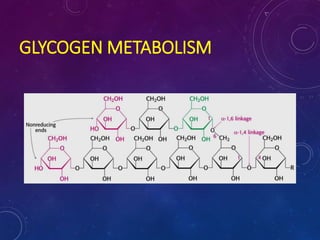
It is a very large, branched polymer of glucose
residues that can be broken down to yield glucose
molecules when energy is needed.
Most of the glucose residues in glycogen are
linked by α-1,4-glycosidic bonds.
Branches created by α-1,6-glycosidic bonds.
GLYCOGEN METABOLISM
GLYCOGEN STORAGE SITES
It is stored mainly in liver and muscle
The liver content of glycogen is greater than that
of muscle,
Since the muscle mass of the body is considerably
greater than that of the liver, about three-quarters
of total body glycogen is in muscle
Reasons for storing glycogen as a fuel
Glycogen serves as a buffer to maintain blood-
glucose levels.
Glucose is virtually the only fuel used by the
brain, except during prolonged starvation.
The glucose from glycogen is readily mobilized
and is therefore a good source of energy for
sudden, strenuous activity.
Unlike fatty acids, the released glucose can
provide energy in the absence of oxygen and can
thus supply energy for anaerobic activity.
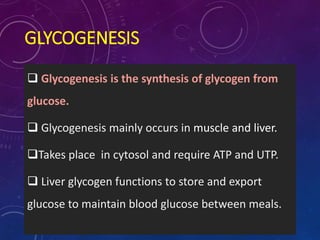
GLYCOGENESIS
 Glycogenesis is the synthesis of glycogen from
glucose.
 Glycogenesis mainly occurs in muscle and liver.
Takes place in cytosol and require ATP and UTP.
 Liver glycogen functions to store and export
glucose to maintain blood glucose between meals.
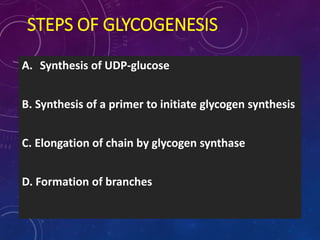
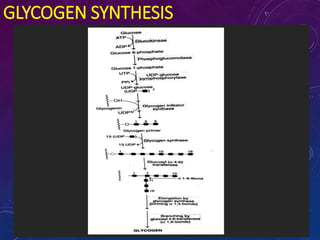
STEPS OF GLYCOGENESIS
A. Synthesis of UDP-glucose
B. Synthesis of a primer to initiate glycogen synthesis
C. Elongation of chain by glycogen synthase
D. Formation of branches
A. Synthesis of UDP-glucose
 Glucose-1-phosphate reacts with uridine tri-
phosphate (UTP) to form uridine diphosphate
glucose (UDPG)
 This reaction is catalysed by UDPG pyro-
phosphorylase
Glucose-1-phosphate + UTP UDP-glucose + PPi
UDP-glucose
pyrophosphorylase
B. Synthesis of a primer to initiate
glycogen synthesis
 Glucose moiety from UDP-glucose is transferred to a
glycogen primer (Glycogenin) molecule.
 Primer is made up of protein-carbohydrate complex.
 It a dimeric protein, having two identical monomers to which
an oligosaccharide chain of 7 glucose units is added.
 UDP is released and glucose is added to the glycogen primer
 Glycogen primer having n glucose units would have n+1
glucose units after the reaction
B. Synthesis of a primer to initiate
glycogen synthesis
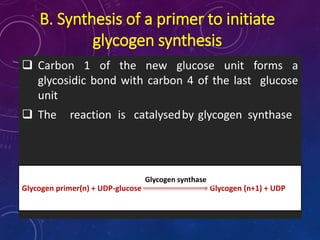
 Carbon 1 of the new glucose unit forms a
glycosidic bond with carbon 4 of the last glucose
unit
 The reaction is catalysedby glycogen synthase
Glycogen primer(n) + UDP-glucose Glycogen (n+1) + UDP
Glycogen synthase
C. Elongation of chain by glycogen
synthase
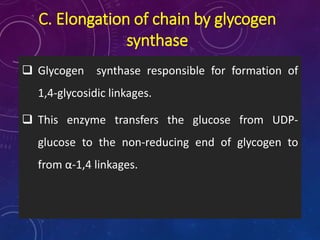
 Glycogen synthase responsible for formation of
1,4-glycosidic linkages.
 This enzyme transfers the glucose from UDP-
glucose to the non-reducing end of glycogen to
from α-1,4 linkages.
D. Formation of branches
Addition of glucose units to the glycogen primer continues until
the chain contains about eleven glucose units
Then, amylo-1,4 1,6-transglucosidase detaches a fragment of
6-7 glucose units from the growing end
The two branches start growing again by addition of glucose
units by α-1,4-glycosidic bonds catalysed by glycogen synthase
When the branches contain about 11 glucose units, branching
enzyme acts again and creates more branches
The process of lengthening and branching continues until a large
and highly branched glycogen molecule is formed
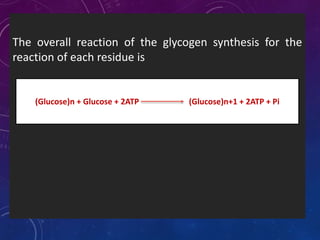
The overall reaction of the glycogen synthesis for the
reaction of each residue is
(Glucose)n + Glucose + 2ATP (Glucose)n+1 + 2ATP + Pi
GLYCOGEN SYNTHESIS
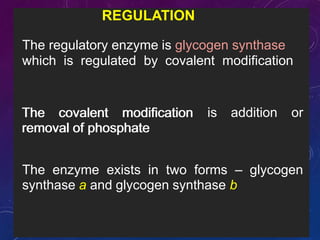
The regulatory enzyme is glycogen synthase
which is regulated by covalent modification
is addition orThe covalent modification
removal of phosphate
The enzyme exists in two forms – glycogen
synthase a and glycogen synthase b
The covalent modification
removal of phosphate
REGULATION
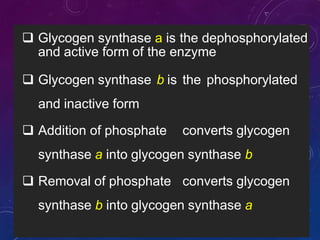
 Glycogen synthase a is the dephosphorylated
and active form of the enzyme
 Glycogen synthase b is the phosphorylated
and inactive form
 Addition of phosphate converts glycogen
synthase a into glycogen synthase b
 Removal of phosphate converts glycogen
synthase b into glycogen synthase a
 Phosphate is added to glycogen synthase a by
protein kinase A
 Phosphate is removed from glycogen synthase b
by protein phosphatase-1
 Protein kinase A and protein phosphatase- 1 are
regulated by cAMP
 Intracellular concentration Of cAMP is regulated by
some hormones
 So, the ultimate regulators of glycogenesis are epinephrine,
glucagon and insulin
 Epinephrine and glucagon increase the concentration of cAMP
 Insulin decreases the concentration of cAMP
 cAMP is the regulatorof protein kinase A
(cAMP-dependent protein kinase)
 Protein kinase A is a tetramer made up of
two regulatory (R) and two catalytic (C)
subunits
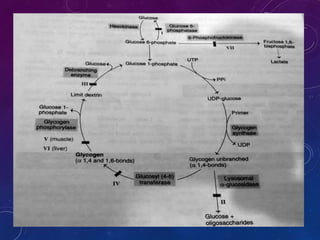
GLYCOGENOLYSIS (DEGRADATION
OF GLYCOGEN)
 Glycogen is degraded by breaking α-1,4- and α-1,6-
glycosidic bonds
Glycogen degradation consists of three steps:
(1) Action of glycogen phosphorylase.
(2) Action of debranching enzyme.
(3) Formation of glucose-6-phosphate and glucose.
1.Action of glycogen phosphorylase
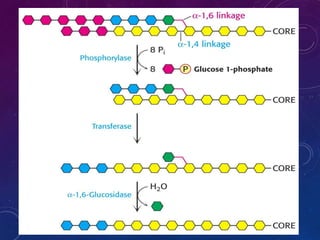
 The α-1,4-glycosidic bonds are cleaved by glycogen
phosphorylase to yield glucose-1-phosphate.
 Called phosphorolysis- continues until four glucose
residues remain on either side of branching pont.
 The glycogen formed known as Limit dextrin which
cannot further degraded.
2.Action of debranching enzyme
 The branches of glycogen cleaved by two enzyme c/d
debranching enzyme, hence it is a bifunctional enzyme.
 Glycosyl 4:4 transferase removes a fragment of three or
four glucose residues.
 Amylo α-1,6-glucosidase breaks the α-1,6 bond at a
branch and releases a free glucose.
3. Formation of glucose-6-phosphate
and glucose.
 Glycogen phosphorylase and debranching enzyme,
glucose 1-phosphate and free glucose are produced.
 Glucose 1-phosphate is converted to glucose 6-
phosphate by the enzyme phosphoglucomutase.
 Glucose6-phosphatase cleaves glucose 6-phosphate to
glucose.
CONVERSION OF GLUCOSE-6-P TO FREE
GLUCOSE
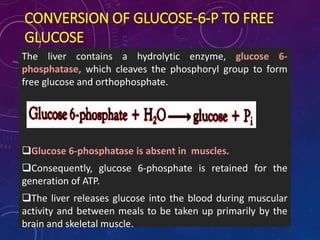
The liver contains a hydrolytic enzyme, glucose 6-
phosphatase, which cleaves the phosphoryl group to form
free glucose and orthophosphate.
Glucose 6-phosphatase is absent in muscles.
Consequently, glucose 6-phosphate is retained for the
generation of ATP.
The liver releases glucose into the blood during muscular
activity and between meals to be taken up primarily by the
brain and skeletal muscle.
REGULATION OF GLYCOGEN METABOLISM
The principal enzymes controlling glycogen
metabolism—glycogen phosphorylase and glycogen
synthase—are regulated by three mechanisms
1. Allosteric regulation
2. Hormonal regulation
3. Influence of calcium
1. ALLOSTERIC REGULATION
Glycogen synthesis increase when substrate
availability and energy (ATP) levels high.
Glycogen breakdown increase when glucose conc.
and energy level low
In well-fed state glucose-6-phosphate availability
high which activates glycogen synthase and inhibits
glycogen phosphorylase.
Also free glucose and ATP inhibits glycogen
phosphorylase.
2. HORMONAL REGULATION
Hormones bring covalent modification, phosphorylation
and dephosphorylation of enzyme proteins, thus control
glycogen synthesis and degradation.
Hormones epinephrine and nor-epinephrine, and
glucagon activate adenylate cyclase and increase
production of cAMP.
Enzyme phosphodiesterase breaks down cAMP.
Hormone insulin increase phosphodiesterase activity in
liver
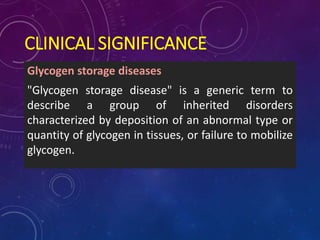
CLINICAL SIGNIFICANCE
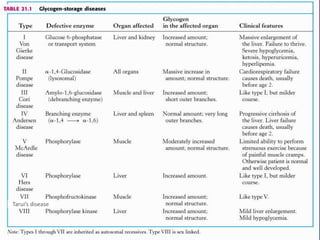
Glycogen storage diseases
"Glycogen storage disease" is a generic term to
describe a group of inherited disorders
characterized by deposition of an abnormal type or
quantity of glycogen in tissues, or failure to mobilize
glycogen.
Tarui’s disease
QUESTIONS
Q1. What is Glycogenesis? Describe briefly the
metabolic pathway involved in glycogenesis.
Q2. Describe the regulation of glycogenesis,
glycogenolysis?
Q3. Short Notes on-
a) Glycogen storage disease
b) Glycogenesis
c) Glycogenolysis

Glycogen metabolism s

  • 1.
    GLYCOGEN METABOLISM DEPARTMENT OFBIOCHEMISTRY Prepared by:- Supriya singh
  • 2.
    GLYCOGEN- INTRODUCTION Glycogen isa readily mobilized storage form of glucose. It is a very large, branched polymer of glucose residues that can be broken down to yield glucose molecules when energy is needed. Most of the glucose residues in glycogen are linked by α-1,4-glycosidic bonds. Branches created by α-1,6-glycosidic bonds.
  • 3.
  • 4.
    GLYCOGEN STORAGE SITES Itis stored mainly in liver and muscle The liver content of glycogen is greater than that of muscle, Since the muscle mass of the body is considerably greater than that of the liver, about three-quarters of total body glycogen is in muscle
  • 5.
    Reasons for storingglycogen as a fuel Glycogen serves as a buffer to maintain blood- glucose levels. Glucose is virtually the only fuel used by the brain, except during prolonged starvation. The glucose from glycogen is readily mobilized and is therefore a good source of energy for sudden, strenuous activity. Unlike fatty acids, the released glucose can provide energy in the absence of oxygen and can thus supply energy for anaerobic activity.
  • 6.
    GLYCOGENESIS  Glycogenesis isthe synthesis of glycogen from glucose.  Glycogenesis mainly occurs in muscle and liver. Takes place in cytosol and require ATP and UTP.  Liver glycogen functions to store and export glucose to maintain blood glucose between meals.
  • 7.
    STEPS OF GLYCOGENESIS A.Synthesis of UDP-glucose B. Synthesis of a primer to initiate glycogen synthesis C. Elongation of chain by glycogen synthase D. Formation of branches
  • 8.
    A. Synthesis ofUDP-glucose  Glucose-1-phosphate reacts with uridine tri- phosphate (UTP) to form uridine diphosphate glucose (UDPG)  This reaction is catalysed by UDPG pyro- phosphorylase Glucose-1-phosphate + UTP UDP-glucose + PPi UDP-glucose pyrophosphorylase
  • 9.
    B. Synthesis ofa primer to initiate glycogen synthesis  Glucose moiety from UDP-glucose is transferred to a glycogen primer (Glycogenin) molecule.  Primer is made up of protein-carbohydrate complex.  It a dimeric protein, having two identical monomers to which an oligosaccharide chain of 7 glucose units is added.  UDP is released and glucose is added to the glycogen primer  Glycogen primer having n glucose units would have n+1 glucose units after the reaction
  • 10.
    B. Synthesis ofa primer to initiate glycogen synthesis  Carbon 1 of the new glucose unit forms a glycosidic bond with carbon 4 of the last glucose unit  The reaction is catalysedby glycogen synthase Glycogen primer(n) + UDP-glucose Glycogen (n+1) + UDP Glycogen synthase
  • 11.
    C. Elongation ofchain by glycogen synthase  Glycogen synthase responsible for formation of 1,4-glycosidic linkages.  This enzyme transfers the glucose from UDP- glucose to the non-reducing end of glycogen to from α-1,4 linkages.
  • 12.
    D. Formation ofbranches Addition of glucose units to the glycogen primer continues until the chain contains about eleven glucose units Then, amylo-1,4 1,6-transglucosidase detaches a fragment of 6-7 glucose units from the growing end The two branches start growing again by addition of glucose units by α-1,4-glycosidic bonds catalysed by glycogen synthase When the branches contain about 11 glucose units, branching enzyme acts again and creates more branches The process of lengthening and branching continues until a large and highly branched glycogen molecule is formed
  • 13.
    The overall reactionof the glycogen synthesis for the reaction of each residue is (Glucose)n + Glucose + 2ATP (Glucose)n+1 + 2ATP + Pi
  • 14.
  • 15.
    The regulatory enzymeis glycogen synthase which is regulated by covalent modification is addition orThe covalent modification removal of phosphate The enzyme exists in two forms – glycogen synthase a and glycogen synthase b The covalent modification removal of phosphate REGULATION
  • 16.
     Glycogen synthasea is the dephosphorylated and active form of the enzyme  Glycogen synthase b is the phosphorylated and inactive form  Addition of phosphate converts glycogen synthase a into glycogen synthase b  Removal of phosphate converts glycogen synthase b into glycogen synthase a
  • 17.
     Phosphate isadded to glycogen synthase a by protein kinase A  Phosphate is removed from glycogen synthase b by protein phosphatase-1  Protein kinase A and protein phosphatase- 1 are regulated by cAMP
  • 18.
     Intracellular concentrationOf cAMP is regulated by some hormones  So, the ultimate regulators of glycogenesis are epinephrine, glucagon and insulin  Epinephrine and glucagon increase the concentration of cAMP  Insulin decreases the concentration of cAMP
  • 19.
     cAMP isthe regulatorof protein kinase A (cAMP-dependent protein kinase)  Protein kinase A is a tetramer made up of two regulatory (R) and two catalytic (C) subunits
  • 20.
    GLYCOGENOLYSIS (DEGRADATION OF GLYCOGEN) Glycogen is degraded by breaking α-1,4- and α-1,6- glycosidic bonds Glycogen degradation consists of three steps: (1) Action of glycogen phosphorylase. (2) Action of debranching enzyme. (3) Formation of glucose-6-phosphate and glucose.
  • 21.
    1.Action of glycogenphosphorylase  The α-1,4-glycosidic bonds are cleaved by glycogen phosphorylase to yield glucose-1-phosphate.  Called phosphorolysis- continues until four glucose residues remain on either side of branching pont.  The glycogen formed known as Limit dextrin which cannot further degraded.
  • 22.
    2.Action of debranchingenzyme  The branches of glycogen cleaved by two enzyme c/d debranching enzyme, hence it is a bifunctional enzyme.  Glycosyl 4:4 transferase removes a fragment of three or four glucose residues.  Amylo α-1,6-glucosidase breaks the α-1,6 bond at a branch and releases a free glucose.
  • 23.
    3. Formation ofglucose-6-phosphate and glucose.  Glycogen phosphorylase and debranching enzyme, glucose 1-phosphate and free glucose are produced.  Glucose 1-phosphate is converted to glucose 6- phosphate by the enzyme phosphoglucomutase.  Glucose6-phosphatase cleaves glucose 6-phosphate to glucose.
  • 25.
    CONVERSION OF GLUCOSE-6-PTO FREE GLUCOSE The liver contains a hydrolytic enzyme, glucose 6- phosphatase, which cleaves the phosphoryl group to form free glucose and orthophosphate. Glucose 6-phosphatase is absent in muscles. Consequently, glucose 6-phosphate is retained for the generation of ATP. The liver releases glucose into the blood during muscular activity and between meals to be taken up primarily by the brain and skeletal muscle.
  • 26.
    REGULATION OF GLYCOGENMETABOLISM The principal enzymes controlling glycogen metabolism—glycogen phosphorylase and glycogen synthase—are regulated by three mechanisms 1. Allosteric regulation 2. Hormonal regulation 3. Influence of calcium
  • 27.
    1. ALLOSTERIC REGULATION Glycogensynthesis increase when substrate availability and energy (ATP) levels high. Glycogen breakdown increase when glucose conc. and energy level low In well-fed state glucose-6-phosphate availability high which activates glycogen synthase and inhibits glycogen phosphorylase. Also free glucose and ATP inhibits glycogen phosphorylase.
  • 28.
    2. HORMONAL REGULATION Hormonesbring covalent modification, phosphorylation and dephosphorylation of enzyme proteins, thus control glycogen synthesis and degradation. Hormones epinephrine and nor-epinephrine, and glucagon activate adenylate cyclase and increase production of cAMP. Enzyme phosphodiesterase breaks down cAMP. Hormone insulin increase phosphodiesterase activity in liver
  • 29.
    CLINICAL SIGNIFICANCE Glycogen storagediseases "Glycogen storage disease" is a generic term to describe a group of inherited disorders characterized by deposition of an abnormal type or quantity of glycogen in tissues, or failure to mobilize glycogen.
  • 30.
  • 32.
    QUESTIONS Q1. What isGlycogenesis? Describe briefly the metabolic pathway involved in glycogenesis. Q2. Describe the regulation of glycogenesis, glycogenolysis? Q3. Short Notes on- a) Glycogen storage disease b) Glycogenesis c) Glycogenolysis