GLYCOGEN METABOLISM
Medical Biochemistry
SoM&D – UDOM
August 2021
Glycogen
• Glycogen is the major storage
carbohydrate in animals
• It is a rapidly mobilizable form of glucose
storage
• Glycogen guarantees a quick supply of
glucose to the body in response to falling
blood glucose levels
Glycogen
• The main stores of glycogen in the body
are found in skeletal muscle and the liver
• Glycogen makes up to 10% of the fresh
weight of a well fed adult liver and 1-2% of
the fresh weight of a resting muscle.
Glycogen
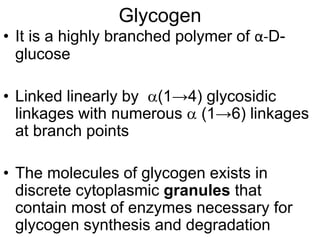
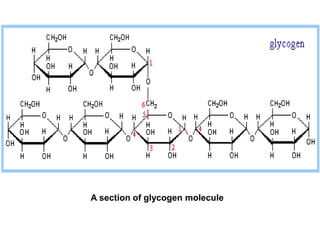
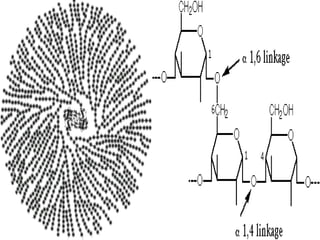
• It is a highly branched polymer of α-D-
glucose
• Linked linearly by (1→4) glycosidic
linkages with numerous  (1→6) linkages
at branch points
• The molecules of glycogen exists in
discrete cytoplasmic granules that
contain most of enzymes necessary for
glycogen synthesis and degradation
Glycogen
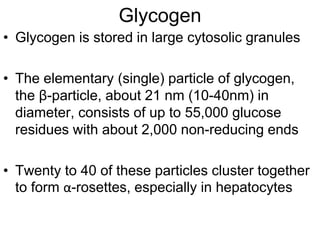
• Glycogen is stored in large cytosolic granules
• The elementary (single) particle of glycogen,
the β-particle, about 21 nm (10-40nm) in
diameter, consists of up to 55,000 glucose
residues with about 2,000 non-reducing ends
• Twenty to 40 of these particles cluster together
to form α-rosettes, especially in hepatocytes
Glycogen
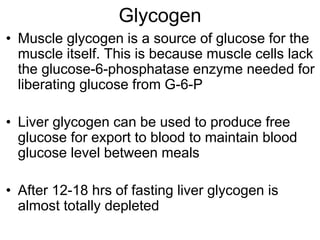
• Muscle glycogen is a source of glucose for the
muscle itself. This is because muscle cells lack
the glucose-6-phosphatase enzyme needed for
liberating glucose from G-6-P
• Liver glycogen can be used to produce free
glucose for export to blood to maintain blood
glucose level between meals
• After 12-18 hrs of fasting liver glycogen is
almost totally depleted
A section of glycogen molecule
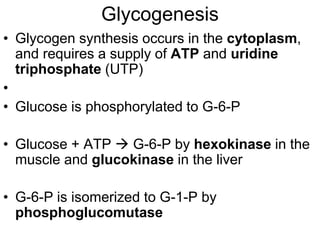
Glycogenesis
• Glycogen synthesis occurs in the cytoplasm,
and requires a supply of ATP and uridine
triphosphate (UTP)
•
• Glucose is phosphorylated to G-6-P
• Glucose + ATP  G-6-P by hexokinase in the
muscle and glucokinase in the liver
• G-6-P is isomerized to G-1-P by
phosphoglucomutase
Glycogenesis cont…
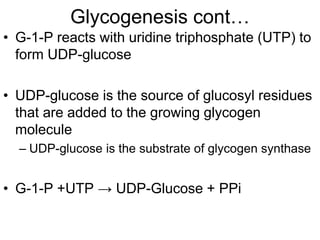
• G-1-P reacts with uridine triphosphate (UTP) to
form UDP-glucose
• UDP-glucose is the source of glucosyl residues
that are added to the growing glycogen
molecule
– UDP-glucose is the substrate of glycogen synthase
• G-1-P +UTP → UDP-Glucose + PPi
Glycogenesis cont…
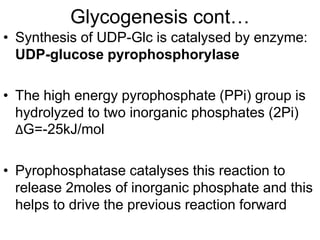
• Synthesis of UDP-Glc is catalysed by enzyme:
UDP-glucose pyrophosphorylase
• The high energy pyrophosphate (PPi) group is
hydrolyzed to two inorganic phosphates (2Pi)
ΔG=-25kJ/mol
• Pyrophosphatase catalyses this reaction to
release 2moles of inorganic phosphate and this
helps to drive the previous reaction forward
Glycogenesis cont…
• Glucose residues are added to glycogen at the
non-reducing ends of the branched glycogen
molecule
• UDP is released as a reaction product
• Glycogen synthase is responsible for
polymerization of glucose residues into the
glycogen polymer
• It catalyzes transfer of the glucose from UDP-
glucose to the hydroxyl at C4 of the terminal
residue (non-reducing end) of a glycogen chain
Glycogenesis cont…
• This forms an (1→4) glycosidic linkage
• The enzyme cannot initiate a glucose chain
synthesis using free glucose as an acceptor of
a molecule of glucose from UDP-glucose
• An  (1→4) glucose chain primer having at
least four glucose residues must be present for
the enzyme to work
• A fragment of glycogen remaining in a cell can
serve as a primer in cells whose glycogen
stores are not completely depleted.
Glycogenesis cont…
• In the absence of glycogen fragment, to act as
a primer
• The primer is usually formed on and by the
protein gycogenin
• Glycogenin acts as a glucose acceptor and
catalyzes the transfer of the first few (7)
glucose residues from UDP-glucose
• Glycogenin stays associated with and is found
in the center of the completed molecule of
glycogen
Glycogenesis cont…
• At this point glycogen synthase takes over,
further extending the glycogen chain
• Glycogen synthase can not catalyze the
branching that is seen in glycogen molecules
because it can not make the (α1→6) bond
found at branch points
• Branching is done by the glycogen-branching
enzyme.
– also called amylo (1→4) to (1→6)
transglycosylase or glycosyl-(4→6)-transferase
Glycogenesis cont…
• The branching enzyme catalyses the transfer of
a terminal fragment of about 6-8 glucose
residues from the non reducing end of a
glycogen branch having atleast 11 residues
• The enzyme will attach it to the OH group of C-
6 at a more interior position on the same
chain it was broken off from or at a different
chain
• This fragment will constitute the initial chain of a
new branch
Glycogenesis cont…
• Then elongation continues at the non reducing
ends of the old and new branches
• Elongation and branching continues throughout
the macromolecule as described above
increasing its size.
Glycogenesis cont…
• The extensive branching makes the molecule
more soluble and increases the number of non
reducing ends
• Thus branching increase the number of sites
accessible to glycogen synthase and glycogen
phosphorylase both of which act only on non
reducing ends
Glycogenolysis
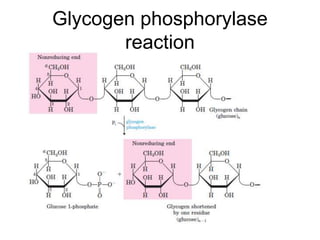
• Glycogen breakdown is catalyzed by glycogen
phosphorylase
• The glycogenolytic pathway cleaves off residues of
glucose, one by one, from the outer branches of
glycogen, i.e the non reducing ends
• The enzymes involved are: glycogen
phoshorylase which catalyzes a phosphorolysis
reaction through which the glucose residues in an
(α1→4) linkage are cleaved as glucose-1-
phosphate.
Glycogen phosphorylase
reaction
Glycogenolysis cont…
• In phosphorolysis reaction some of the energy
released when the glycosidic bond is broken is
conserved in the bond between phosphate and
glucose in the G-1-P molecule that is formed
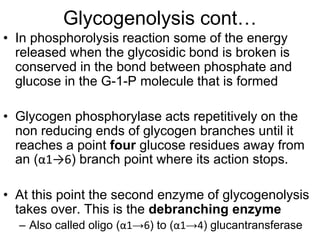
• Glycogen phosphorylase acts repetitively on the
non reducing ends of glycogen branches until it
reaches a point four glucose residues away from
an (α1→6) branch point where its action stops.
• At this point the second enzyme of glycogenolysis
takes over. This is the debranching enzyme
– Also called oligo (α1→6) to (α1→4) glucantransferase
Glycogenolysis cont…
• The debranching enzyme catalyzes two
successive reactions
• A fragment of 3 residues out of the 4 glucose
residues remaining on the branch is hydrolysed
off and reattached at the main chain in an
(α1→4) linkage
Glycogenolysis cont…
• The remaining glucosyl residue at the
branching point in an (α1→6) linkage with the
main chain is hydrolysed and released as free
glucose
• After the debranching enzyme has done this,
glycogen phosphorylase activity can continues
until the next branching point is approached.
Glycogenolysis cont…
• The produced G-1-P is acted upon by a
third enzyme, the phosphoglucomutase
which isomerizes G-1-P to G-6-P
• The G-6-P can enter glycolysis, in case of
glycogenolysis in muscle cells or be used
for other functions in the same tissue
Glycogenolysis cont…
• In the liver cells G-6-P can be converted
to free glucose by glucose-6-phosphatase,
an enzyme found only in the endoplasmic
reticulum of the cells of the liver and
kidney cortex
• This glucose can then be transported into
the blood to maintain blood glucose levels
and supply tissues that preferentially or
exclusively oxidize glucose for energy
Regulation of glycogen metabolism
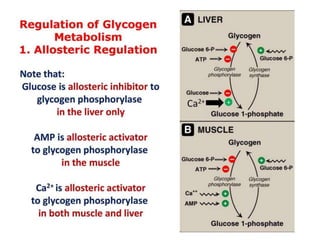
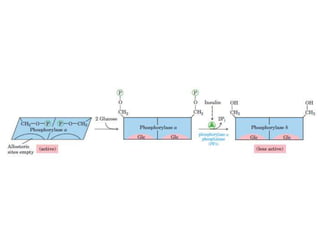
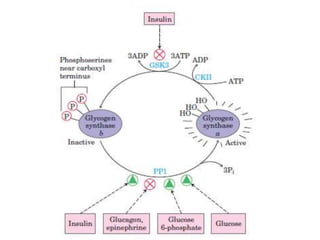
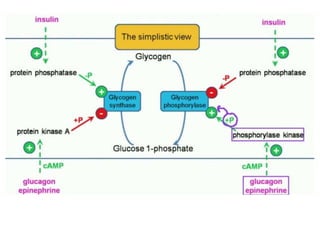
• The synthase and phosphorylase are
reciprocally regulated
• The enzymes are regulated both allosterically
and by covalent modification (hormonal control)
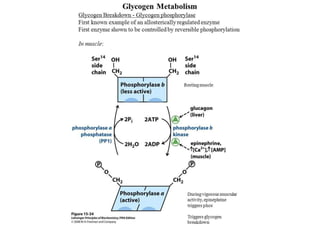
• The synthesis and degradation enzymes can
exist in an active or inactive form
– Phosphorylase b (dephosphorylated)(inactive) and
Phosphorylase a (phosphorylated) (active)
– Glycogen synthase a (active form)
(dephosphorylated) and Glycogen synthase b
(inactive form) (phosphorylated)
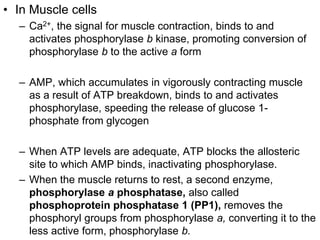
• In Muscle cells
– Ca2+, the signal for muscle contraction, binds to and
activates phosphorylase b kinase, promoting conversion of
phosphorylase b to the active a form
– AMP, which accumulates in vigorously contracting muscle
as a result of ATP breakdown, binds to and activates
phosphorylase, speeding the release of glucose 1-
phosphate from glycogen
– When ATP levels are adequate, ATP blocks the allosteric
site to which AMP binds, inactivating phosphorylase.
– When the muscle returns to rest, a second enzyme,
phosphorylase a phosphatase, also called
phosphoprotein phosphatase 1 (PP1), removes the
phosphoryl groups from phosphorylase a, converting it to the
less active form, phosphorylase b.
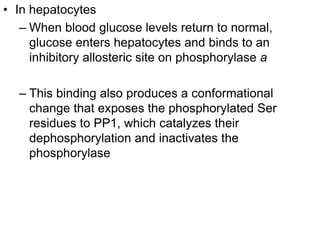
• In hepatocytes
– When blood glucose levels return to normal,
glucose enters hepatocytes and binds to an
inhibitory allosteric site on phosphorylase a
– This binding also produces a conformational
change that exposes the phosphorylated Ser
residues to PP1, which catalyzes their
dephosphorylation and inactivates the
phosphorylase
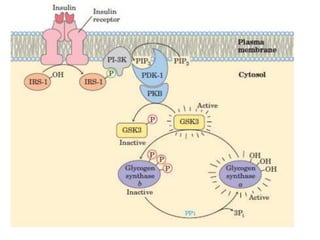
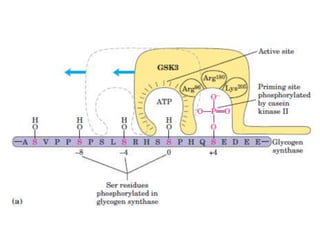
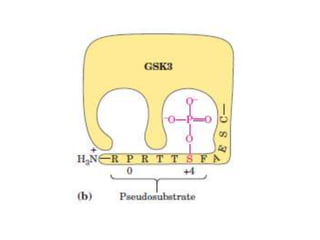
• Glycogen synthase is also under hormonal mediated
regulation by covalent modification
– Glucagon/epinephrine causing its phosphorylation and
inactivation
– Insulin causing its dephosphorylation and activation
• Allosteric regulation
• In hepatocytes
– Glucose 6-phosphate binds to an allosteric site on
glycogen synthase b, making the enzyme a better
substrate for dephosphorylation by PP1 and
causing its activation
Glycogen Metabolism-1.ppt

Glycogen Metabolism-1.ppt

  • 1.
  • 2.
    Glycogen • Glycogen isthe major storage carbohydrate in animals • It is a rapidly mobilizable form of glucose storage • Glycogen guarantees a quick supply of glucose to the body in response to falling blood glucose levels
  • 3.
    Glycogen • The mainstores of glycogen in the body are found in skeletal muscle and the liver • Glycogen makes up to 10% of the fresh weight of a well fed adult liver and 1-2% of the fresh weight of a resting muscle.
  • 4.
    Glycogen • It isa highly branched polymer of α-D- glucose • Linked linearly by (1→4) glycosidic linkages with numerous  (1→6) linkages at branch points • The molecules of glycogen exists in discrete cytoplasmic granules that contain most of enzymes necessary for glycogen synthesis and degradation
  • 5.
    Glycogen • Glycogen isstored in large cytosolic granules • The elementary (single) particle of glycogen, the β-particle, about 21 nm (10-40nm) in diameter, consists of up to 55,000 glucose residues with about 2,000 non-reducing ends • Twenty to 40 of these particles cluster together to form α-rosettes, especially in hepatocytes
  • 6.
    Glycogen • Muscle glycogenis a source of glucose for the muscle itself. This is because muscle cells lack the glucose-6-phosphatase enzyme needed for liberating glucose from G-6-P • Liver glycogen can be used to produce free glucose for export to blood to maintain blood glucose level between meals • After 12-18 hrs of fasting liver glycogen is almost totally depleted
  • 7.
    A section ofglycogen molecule
  • 9.
    Glycogenesis • Glycogen synthesisoccurs in the cytoplasm, and requires a supply of ATP and uridine triphosphate (UTP) • • Glucose is phosphorylated to G-6-P • Glucose + ATP  G-6-P by hexokinase in the muscle and glucokinase in the liver • G-6-P is isomerized to G-1-P by phosphoglucomutase
  • 10.
    Glycogenesis cont… • G-1-Preacts with uridine triphosphate (UTP) to form UDP-glucose • UDP-glucose is the source of glucosyl residues that are added to the growing glycogen molecule – UDP-glucose is the substrate of glycogen synthase • G-1-P +UTP → UDP-Glucose + PPi
  • 11.
    Glycogenesis cont… • Synthesisof UDP-Glc is catalysed by enzyme: UDP-glucose pyrophosphorylase • The high energy pyrophosphate (PPi) group is hydrolyzed to two inorganic phosphates (2Pi) ΔG=-25kJ/mol • Pyrophosphatase catalyses this reaction to release 2moles of inorganic phosphate and this helps to drive the previous reaction forward
  • 12.
    Glycogenesis cont… • Glucoseresidues are added to glycogen at the non-reducing ends of the branched glycogen molecule • UDP is released as a reaction product • Glycogen synthase is responsible for polymerization of glucose residues into the glycogen polymer • It catalyzes transfer of the glucose from UDP- glucose to the hydroxyl at C4 of the terminal residue (non-reducing end) of a glycogen chain
  • 13.
    Glycogenesis cont… • Thisforms an (1→4) glycosidic linkage • The enzyme cannot initiate a glucose chain synthesis using free glucose as an acceptor of a molecule of glucose from UDP-glucose • An  (1→4) glucose chain primer having at least four glucose residues must be present for the enzyme to work • A fragment of glycogen remaining in a cell can serve as a primer in cells whose glycogen stores are not completely depleted.
  • 14.
    Glycogenesis cont… • Inthe absence of glycogen fragment, to act as a primer • The primer is usually formed on and by the protein gycogenin • Glycogenin acts as a glucose acceptor and catalyzes the transfer of the first few (7) glucose residues from UDP-glucose • Glycogenin stays associated with and is found in the center of the completed molecule of glycogen
  • 15.
    Glycogenesis cont… • Atthis point glycogen synthase takes over, further extending the glycogen chain • Glycogen synthase can not catalyze the branching that is seen in glycogen molecules because it can not make the (α1→6) bond found at branch points • Branching is done by the glycogen-branching enzyme. – also called amylo (1→4) to (1→6) transglycosylase or glycosyl-(4→6)-transferase
  • 16.
    Glycogenesis cont… • Thebranching enzyme catalyses the transfer of a terminal fragment of about 6-8 glucose residues from the non reducing end of a glycogen branch having atleast 11 residues • The enzyme will attach it to the OH group of C- 6 at a more interior position on the same chain it was broken off from or at a different chain • This fragment will constitute the initial chain of a new branch
  • 17.
    Glycogenesis cont… • Thenelongation continues at the non reducing ends of the old and new branches • Elongation and branching continues throughout the macromolecule as described above increasing its size.
  • 18.
    Glycogenesis cont… • Theextensive branching makes the molecule more soluble and increases the number of non reducing ends • Thus branching increase the number of sites accessible to glycogen synthase and glycogen phosphorylase both of which act only on non reducing ends
  • 19.
    Glycogenolysis • Glycogen breakdownis catalyzed by glycogen phosphorylase • The glycogenolytic pathway cleaves off residues of glucose, one by one, from the outer branches of glycogen, i.e the non reducing ends • The enzymes involved are: glycogen phoshorylase which catalyzes a phosphorolysis reaction through which the glucose residues in an (α1→4) linkage are cleaved as glucose-1- phosphate.
  • 20.
  • 21.
    Glycogenolysis cont… • Inphosphorolysis reaction some of the energy released when the glycosidic bond is broken is conserved in the bond between phosphate and glucose in the G-1-P molecule that is formed • Glycogen phosphorylase acts repetitively on the non reducing ends of glycogen branches until it reaches a point four glucose residues away from an (α1→6) branch point where its action stops. • At this point the second enzyme of glycogenolysis takes over. This is the debranching enzyme – Also called oligo (α1→6) to (α1→4) glucantransferase
  • 22.
    Glycogenolysis cont… • Thedebranching enzyme catalyzes two successive reactions • A fragment of 3 residues out of the 4 glucose residues remaining on the branch is hydrolysed off and reattached at the main chain in an (α1→4) linkage
  • 23.
    Glycogenolysis cont… • Theremaining glucosyl residue at the branching point in an (α1→6) linkage with the main chain is hydrolysed and released as free glucose • After the debranching enzyme has done this, glycogen phosphorylase activity can continues until the next branching point is approached.
  • 24.
    Glycogenolysis cont… • Theproduced G-1-P is acted upon by a third enzyme, the phosphoglucomutase which isomerizes G-1-P to G-6-P • The G-6-P can enter glycolysis, in case of glycogenolysis in muscle cells or be used for other functions in the same tissue
  • 25.
    Glycogenolysis cont… • Inthe liver cells G-6-P can be converted to free glucose by glucose-6-phosphatase, an enzyme found only in the endoplasmic reticulum of the cells of the liver and kidney cortex • This glucose can then be transported into the blood to maintain blood glucose levels and supply tissues that preferentially or exclusively oxidize glucose for energy
  • 26.
    Regulation of glycogenmetabolism • The synthase and phosphorylase are reciprocally regulated • The enzymes are regulated both allosterically and by covalent modification (hormonal control) • The synthesis and degradation enzymes can exist in an active or inactive form – Phosphorylase b (dephosphorylated)(inactive) and Phosphorylase a (phosphorylated) (active) – Glycogen synthase a (active form) (dephosphorylated) and Glycogen synthase b (inactive form) (phosphorylated)
  • 29.
    • In Musclecells – Ca2+, the signal for muscle contraction, binds to and activates phosphorylase b kinase, promoting conversion of phosphorylase b to the active a form – AMP, which accumulates in vigorously contracting muscle as a result of ATP breakdown, binds to and activates phosphorylase, speeding the release of glucose 1- phosphate from glycogen – When ATP levels are adequate, ATP blocks the allosteric site to which AMP binds, inactivating phosphorylase. – When the muscle returns to rest, a second enzyme, phosphorylase a phosphatase, also called phosphoprotein phosphatase 1 (PP1), removes the phosphoryl groups from phosphorylase a, converting it to the less active form, phosphorylase b.
  • 30.
    • In hepatocytes –When blood glucose levels return to normal, glucose enters hepatocytes and binds to an inhibitory allosteric site on phosphorylase a – This binding also produces a conformational change that exposes the phosphorylated Ser residues to PP1, which catalyzes their dephosphorylation and inactivates the phosphorylase
  • 34.
    • Glycogen synthaseis also under hormonal mediated regulation by covalent modification – Glucagon/epinephrine causing its phosphorylation and inactivation – Insulin causing its dephosphorylation and activation • Allosteric regulation • In hepatocytes – Glucose 6-phosphate binds to an allosteric site on glycogen synthase b, making the enzyme a better substrate for dephosphorylation by PP1 and causing its activation

Editor's Notes

  • #14 It can only elongate already existing chains of glucose.