FORMATION AND DEGRADATIONOF
GLYCOGEN;
GLYCOGENESIS AND GLYCOGENOLYSIS
Glycogen is the storage form of carbohydrates in
the human body. The major sites of storage are
liver and muscle. The major function of liver
glycogen is to provide glucose during fasting,
while in the skeletal muscle it acts as reserve fuel
(energy) for muscle contraction. Glycogen is a
homopolysaccharide with glucose units linked in
α-1,4 linkages (straight line) and α-1,6 linkages
(branching point). Branching makes the molecule
more globular and less space consuming.
3.
GLYCOGENESIS
The synthesisof glycogen occurs in 4 steps,
namely:
a). Activation of glucose
b). Initiation reaction
c). Elongation
d). Branching
4.
GLYCOGENESIS
ACTIVATION:
Glucose is phosphorylatedto Glucose-6-
Phosphate, a reaction which is common to the
first reaction in the pathway of glycolysis from
glocose. Glucose-6-Phosphate is then converted
to Glucose-1-Phosphate in a reaction catalysed
by the enzyme phosphoglucomutase. It appears
that this enzyme is phosphorylated and that the
phospho-group takes part in the reversible
reaction.
5.
HEXOKINASE
Glucose + ATP GLUCOSE-6-P +
ADP
Glucose-6-P is then converted by
phosphoglucomutase into Glucose-1-P
PHOSPHOGLUCOMUTASE
Glucose-6-P Glucose-1-P
Next Glucose-1-P reacts with uridine
triphosphate (UTP) to form the active
nucleotide uridine diphosphate glucose
(UDPGlc)
6.
UDPGlc PYROPHOSPHORYLASE
Glucose-1-P UDP-
Glucose
Uridinediphosphate glucose serves as the
source of glucose to be polymerised into
glycogen. This reaction is catalysed by the
enzyme UDP Glucose Pyrophosphorylase and
proceeds to the right on hydrolysis of
Pyrophosphate by Pyrophosphatase.
UTP PPi
PPi
2Pi
Pyro phosphatase
7.
GLYCOGENESIS
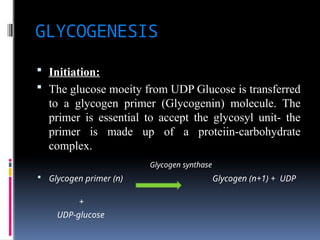
Initiation:
Theglucose moeity from UDP Glucose is transferred
to a glycogen primer (Glycogenin) molecule. The
primer is essential to accept the glycosyl unit- the
primer is made up of a proteiin-carbohydrate
complex.
Glycogen synthase
Glycogen primer (n) Glycogen (n+1) + UDP
+
UDP-glucose
8.
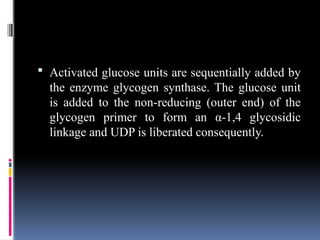
Activated glucoseunits are sequentially added by
the enzyme glycogen synthase. The glucose unit
is added to the non-reducing (outer end) of the
glycogen primer to form an α-1,4 glycosidic
linkage and UDP is liberated consequently.
GLYCOGENESIS
Elongation:
Theaddition of glucose residue to a pre-existing
glycogen chain occurs at the non-reducing, outer
end of the molecule so thet the “branches” of the
glycogen “tree” become elongated as successive
α-1,4 linkages occur.
11.
GLYCOGENESIS
Branching:
Theglycogen synthase can add glucose unit only in
α-1,4 linkage. A branching enzyme (amylo-1,4=>1,6
transglucosidase) is required to create -1,6 linkages.
When the chain is lengthened to 10-12 glucose
residues, the branching enzyme will transfer a block
of 6 to 8 glucose residues from this chain to another
site on the growing molecule. Further glucose units
can be added in α-1,4 linkage to this newly created
branch by glycogen synthase. This results in a highly
branched tree-like structure called Glycogen.
12.
GLYCOGENOLYSIS
The breakdownof glycogen occurs in two steps
as follows:
1). Hydrolysis of α-1,4 glycosidic linkages
2). Removal of branches
13.
GLYCOGENOLYSIS
Hydrolysis ofa-1,4 linkages
Glycogen phosphorylase removes glocose as
glucose-1-P from glycogen (phosphorolysis) with
the aid of inorganic phosphate and pyridoxal
phosphate (PLP) as a prosthetic group. The α-1,4
glycosidic linkages in the glycogen are cleaved. It
removes glucose units one at a time. α-1,4
glycosidic linkages are sequentially hydrolysed
till it reaches a glucose residue, 3-4 glucose units
away from a branch point. It cannot attack the
α-1,6 linkage at branch point.
14.
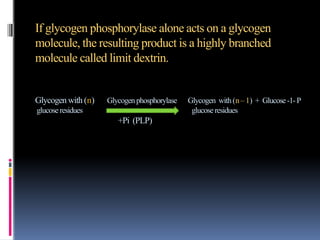
If glycogen phosphorylasealone acts on a glycogen
molecule, the resulting product is a highly branched
molecule called limit dextrin.
Glycogen with (n) Glycogenphosphorylase Glycogen with(n–1) + Glucose-1-P
glucoseresidues glucoseresidues
+Pi (PLP)
15.
Removal ofbranches (Debranching by
bifunctional enzymes)
A block of 3 glucose residues (trisaccharide unit) are
transferred from the branching point to another
branch. This is α-1,4=>α-1,4 glucan transferase. This
makes the branched point to be free. Then α-1,6
glucosidase (debranching enzyme) can hydrolyze the
remaining glucose unit held by α-1,6 linkage at the
branched point. This glucose residue is liberated as
free glucose.
16.
At thispoint the ratio of glucose-1-P to free
glucose is about 8:1.
The activity of glycogen phosphorylase then
continues with the removal of the branch point.
The combined action of glycogen phosphorylase
and debranching enzyme results in complete
breakdown of glycogen.
17.
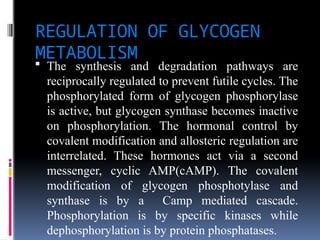
REGULATION OF GLYCOGEN
METABOLISM
The synthesis and degradation pathways are
reciprocally regulated to prevent futile cycles. The
phosphorylated form of glycogen phosphorylase
is active, but glycogen synthase becomes inactive
on phosphorylation. The hormonal control by
covalent modification and allosteric regulation are
interrelated. These hormones act via a second
messenger, cyclic AMP(cAMP). The covalent
modification of glycogen phosphotylase and
synthase is by a Camp mediated cascade.
Phosphorylation is by specific kinases while
dephosphorylation is by protein phosphatases.
18.
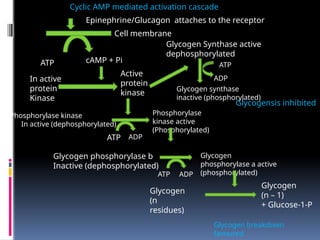
Both liverand muscle phosphorylases are activated
by Camp mediated activation cascade triggered by
the hormonal signal. Both epinerphrine and
glucagon can activate liver glycogen phosphorylase
but glucagon has no effect on the muscle.
When the hormone binds to a specific receptor on
the plasma membrane, adenyl cyclase is activated
which converts ATP to CAMP. Whwn the level of
CAMP increases or rises, it activates protein kinase.
19.
ATP cAMP +Pi
Epinephrine/Glucagon attaches to the receptor
Cell membrane
In active
protein
Kinase
Active
protein
kinase
Phosphorylase kinase
In active (dephosphorylated)
ATP ADP
Phosphorylase
kinase active
(Phosphorylated)
Glycogen phosphorylase b
Inactive (dephosphorylated)
ATP ADP
Glycogen
phosphorylase a active
(phosphorylated)
Glycogen
(n
residues)
Glycogen
(n – 1)
+ Glucose-1-P
Glycogen breakdown
favoured
Glycogen Synthase active
dephosphorylated
ATP
ADP
Glycogen synthase
inactive (phosphorylated)
Glycogensis inhibited
Cyclic AMP mediated activation cascade
20.
Reciprocal regulation ofglycogenolysis and glycogenesis by cyclic AMP
Insulin
Protein phosphatase
P
+
+
-
Protein kinase A
Glycogen
synthase
P
P
P
-
–
+
Glycogen/ Epinephrine
cAMP
+
+
+
Glycogen
phosphoryla
se
Glycogen
Glucose -1- phosphate
Protein
phosphatase
Insulin
–
+
Phosphorylase
kinase
cAMP
Glucagon/Epinephrine