G L O BA L I Z AT I O N
ク

ロ

バ

リ

ゼ

シヨ

一

ン
OVERVIEW

• Examination of the Globalization
debate.

• Defining Globalization.
• Analytical frameworks for making
sense of globalization.

• Broader implications of globalization
(beyond the globalization debate)
GLOBALIZATION?

• What is it?
• What does it imply for the international
system?

• Is it a key feature of the international
system at present?
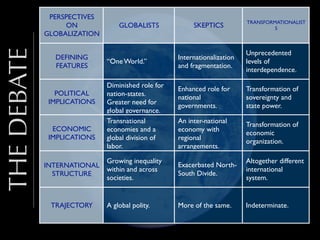
THE DEBATE

PERSPECTIVES
ON
GLOBALIZATION
DEFINING
FEATURES

POLITICAL
IMPLICATIONS

ECONOMIC
IMPLICATIONS

INTERNATIONAL
STRUCTURE

TRAJECTORY

GLOBALISTS

SKEPTICS

TRANSFORMATIONALIST
S

Internationalization
and fragmentation.

Unprecedented
levels of
interdependence.

Enhanced role for
national
governments.

Transformation of
sovereignty and
state power.

An inter-national
economy with
regional
arrangements.

Transformation of
economic
organization.

Growing inequality
within and across
societies.

Exacerbated NorthSouth Divide.

Altogether different
international
system.

A global polity.

More of the same.

Indeterminate.

“One World.”
Diminished role for
nation-states.
Greater need for
global governance.
Transnational
economies and a
global division of
labor.
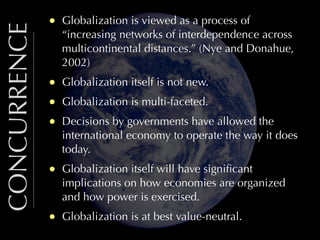
CONCURRENCE

•

Globalization is viewed as a process of
“increasing networks of interdependence across
multicontinental distances.” (Nye and Donahue,
2002)

•
•
•

Globalization itself is not new.

•

Globalization itself will have significant
implications on how economies are organized
and how power is exercised.

•

Globalization is at best value-neutral.

Globalization is multi-faceted.
Decisions by governments have allowed the
international economy to operate the way it does
today.
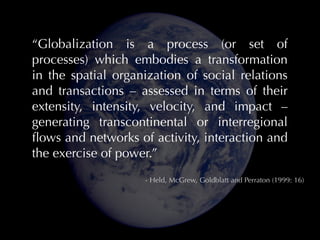
“Globalization is a process (or set of
processes) which embodies a transformation
in the spatial organization of social relations
and transactions – assessed in terms of their
extensity, intensity, velocity, and impact –
generating transcontinental or interregional
flows and networks of activity, interaction and
the exercise of power.”
- Held, McGrew, Goldblatt and Perraton (1999: 16)
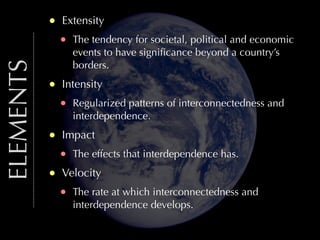
ELEMENTS

•
•
•
•

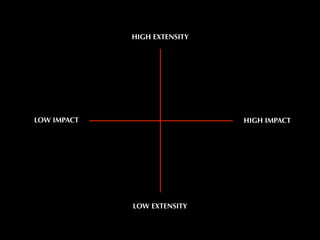
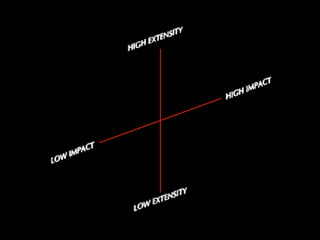
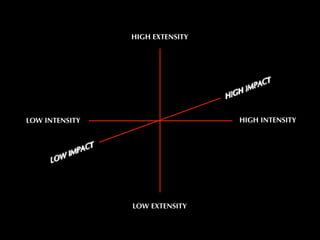
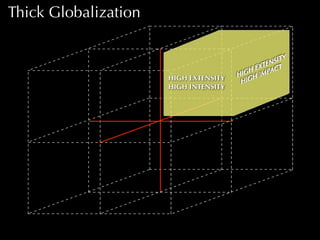
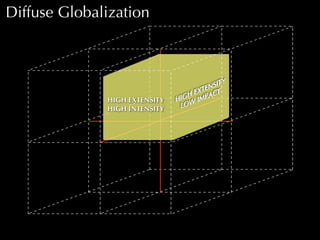
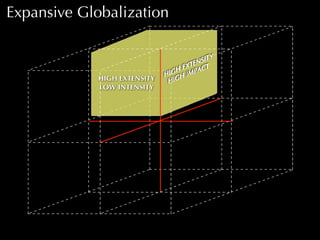
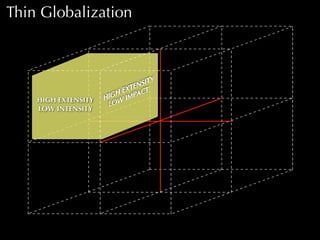
Extensity

•

The tendency for societal, political and economic
events to have significance beyond a country’s
borders.

Intensity

•

Regularized patterns of interconnectedness and
interdependence.

Impact

•

The effects that interdependence has.

Velocity

•

The rate at which interconnectedness and
interdependence develops.
ONE GLOBALIZATION
OR MANY?
Part I: Thinking in Three Dimensions
(The Held-McGrew-Goldblatt-Perraton Framework)
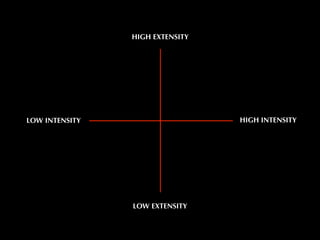
HIGH EXTENSITY

HIGH INTENSITY

LOW INTENSITY

LOW EXTENSITY
HIGH EXTENSITY

LOW IMPACT

HIGH IMPACT

LOW EXTENSITY
HIGH EXTENSITY

HIGH INTENSITY

LOW INTENSITY

LOW EXTENSITY
Thick Globalization

HIGH EXTENSITY
HIGH INTENSITY
Diffuse Globalization

HIGH EXTENSITY
HIGH INTENSITY
Expansive Globalization

HIGH EXTENSITY
LOW INTENSITY
Thin Globalization

HIGH EXTENSITY
LOW INTENSITY
ONE GLOBALIZATION
OR MANY?
Part II: Thinking Across Dimensions
(The Keohane-Nye Framework)
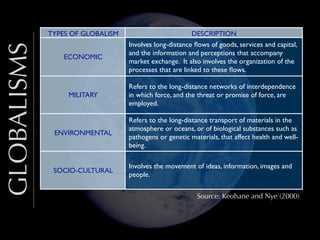
GLOBALISMS

TYPES OF GLOBALISM
ECONOMIC

DESCRIPTION
Involves long-distance flows of goods, services and capital,
and the information and perceptions that accompany
market exchange. It also involves the organization of the
processes that are linked to these flows.

MILITARY

Refers to the long-distance networks of interdependence
in which force, and the threat or promise of force, are
employed.

ENVIRONMENTAL

Refers to the long-distance transport of materials in the
atmosphere or oceans, or of biological substances such as
pathogens or genetic materials, that affect health and wellbeing.

SOCIO-CULTURAL

Involves the movement of ideas, information, images and
people.
Source: Keohane and Nye (2000)
INSIGHTS?

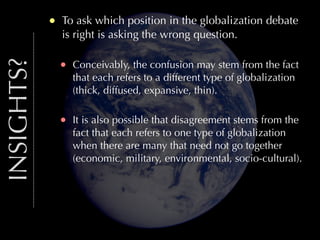
•

To ask which position in the globalization debate
is right is asking the wrong question.

•

Conceivably, the confusion may stem from the fact
that each refers to a different type of globalization
(thick, diffused, expansive, thin).

•

It is also possible that disagreement stems from the
fact that each refers to one type of globalization
when there are many that need not go together
(economic, military, environmental, socio-cultural).
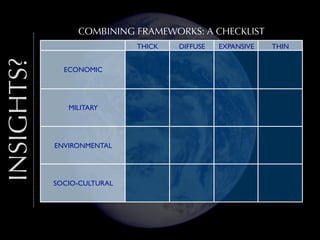
COMBINING FRAMEWORKS: A CHECKLIST

INSIGHTS?

THICK
ECONOMIC

MILITARY

ENVIRONMENTAL

SOCIO-CULTURAL

DIFFUSE

EXPANSIVE

THIN
INSIGHTS?

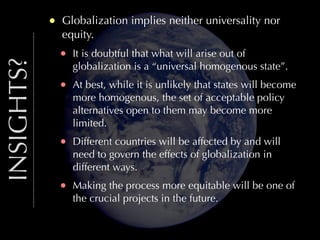
•

Globalization implies neither universality nor
equity.

•

It is doubtful that what will arise out of
globalization is a “universal homogenous state”.

•

At best, while it is unlikely that states will become
more homogenous, the set of acceptable policy
alternatives open to them may become more
limited.

•

Different countries will be affected by and will
need to govern the effects of globalization in
different ways.

•

Making the process more equitable will be one of
the crucial projects in the future.
INSIGHTS?

•
•

“Political globalism” appears unlikely.

•

All politics is local (?).

Globalization itself is fraught with many
contradictions.

•
•

It subsumes the local, national and international.

•

The very factors that allow globalization to operate
also empower those that want to undermine the
global system.

It entails both integration and fragmentation (and in
this it is paradoxical).
に
プ
レ
セ
ン
テ
シ
ヨ
オ
ン
を
し
ま
す.

THE END
お

わ

る

Globalization

  • 1.
    G L OBA L I Z AT I O N ク ロ バ リ ゼ シヨ 一 ン
  • 2.
    OVERVIEW • Examination ofthe Globalization debate. • Defining Globalization. • Analytical frameworks for making sense of globalization. • Broader implications of globalization (beyond the globalization debate)
  • 3.
    GLOBALIZATION? • What isit? • What does it imply for the international system? • Is it a key feature of the international system at present?
  • 4.
    THE DEBATE PERSPECTIVES ON GLOBALIZATION DEFINING FEATURES POLITICAL IMPLICATIONS ECONOMIC IMPLICATIONS INTERNATIONAL STRUCTURE TRAJECTORY GLOBALISTS SKEPTICS TRANSFORMATIONALIST S Internationalization and fragmentation. Unprecedented levelsof interdependence. Enhanced role for national governments. Transformation of sovereignty and state power. An inter-national economy with regional arrangements. Transformation of economic organization. Growing inequality within and across societies. Exacerbated NorthSouth Divide. Altogether different international system. A global polity. More of the same. Indeterminate. “One World.” Diminished role for nation-states. Greater need for global governance. Transnational economies and a global division of labor.
  • 5.
    CONCURRENCE • Globalization is viewedas a process of “increasing networks of interdependence across multicontinental distances.” (Nye and Donahue, 2002) • • • Globalization itself is not new. • Globalization itself will have significant implications on how economies are organized and how power is exercised. • Globalization is at best value-neutral. Globalization is multi-faceted. Decisions by governments have allowed the international economy to operate the way it does today.
  • 6.
    “Globalization is aprocess (or set of processes) which embodies a transformation in the spatial organization of social relations and transactions – assessed in terms of their extensity, intensity, velocity, and impact – generating transcontinental or interregional flows and networks of activity, interaction and the exercise of power.” - Held, McGrew, Goldblatt and Perraton (1999: 16)
  • 7.
    ELEMENTS • • • • Extensity • The tendency forsocietal, political and economic events to have significance beyond a country’s borders. Intensity • Regularized patterns of interconnectedness and interdependence. Impact • The effects that interdependence has. Velocity • The rate at which interconnectedness and interdependence develops.
  • 8.
    ONE GLOBALIZATION OR MANY? PartI: Thinking in Three Dimensions (The Held-McGrew-Goldblatt-Perraton Framework)
  • 9.
    HIGH EXTENSITY HIGH INTENSITY LOWINTENSITY LOW EXTENSITY
  • 10.
    HIGH EXTENSITY LOW IMPACT HIGHIMPACT LOW EXTENSITY
  • 12.
    HIGH EXTENSITY HIGH INTENSITY LOWINTENSITY LOW EXTENSITY
  • 13.
  • 14.
  • 15.
  • 16.
  • 17.
    ONE GLOBALIZATION OR MANY? PartII: Thinking Across Dimensions (The Keohane-Nye Framework)
  • 18.
    GLOBALISMS TYPES OF GLOBALISM ECONOMIC DESCRIPTION Involveslong-distance flows of goods, services and capital, and the information and perceptions that accompany market exchange. It also involves the organization of the processes that are linked to these flows. MILITARY Refers to the long-distance networks of interdependence in which force, and the threat or promise of force, are employed. ENVIRONMENTAL Refers to the long-distance transport of materials in the atmosphere or oceans, or of biological substances such as pathogens or genetic materials, that affect health and wellbeing. SOCIO-CULTURAL Involves the movement of ideas, information, images and people. Source: Keohane and Nye (2000)
  • 19.
    INSIGHTS? • To ask whichposition in the globalization debate is right is asking the wrong question. • Conceivably, the confusion may stem from the fact that each refers to a different type of globalization (thick, diffused, expansive, thin). • It is also possible that disagreement stems from the fact that each refers to one type of globalization when there are many that need not go together (economic, military, environmental, socio-cultural).
  • 20.
    COMBINING FRAMEWORKS: ACHECKLIST INSIGHTS? THICK ECONOMIC MILITARY ENVIRONMENTAL SOCIO-CULTURAL DIFFUSE EXPANSIVE THIN
  • 21.
    INSIGHTS? • Globalization implies neitheruniversality nor equity. • It is doubtful that what will arise out of globalization is a “universal homogenous state”. • At best, while it is unlikely that states will become more homogenous, the set of acceptable policy alternatives open to them may become more limited. • Different countries will be affected by and will need to govern the effects of globalization in different ways. • Making the process more equitable will be one of the crucial projects in the future.
  • 22.
    INSIGHTS? • • “Political globalism” appearsunlikely. • All politics is local (?). Globalization itself is fraught with many contradictions. • • It subsumes the local, national and international. • The very factors that allow globalization to operate also empower those that want to undermine the global system. It entails both integration and fragmentation (and in this it is paradoxical).
  • 23.