On Philippine Elections
and Political Parties
Overview
What are the historical
underpinnings of elections in the
Philippines?
How did the Philippine party
system develop and perform?
What are some of the pressing
issues surrounding the Philippine
electoral and party systems?
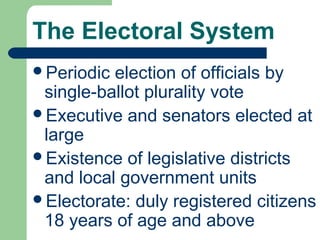
The Electoral System
Periodic election of officials by
single-ballot plurality vote
Executive and senators elected at
large
Existence of legislative districts
and local government units
Electorate: duly registered citizens
18 years of age and above
Pre-Colonial Philippines
No elections for ruling authorities
Government was based more on
intangibles
– Kinship
– Customs/Traditions
– Favors
– Unwritten laws
Colonial Government
In colonizing the Philippines,
Spain effectively formalized and
modernized government rule
To be able to administer the
colony effectively, the colonial
government created pockets of
local authority across the country
American Colonial Rule
American colonial rule set the
foundation for elections in the
Philippines
Government institutions and the
electoral system were patterned
after the American system
Filipinos could run for public office
in a limited capacity
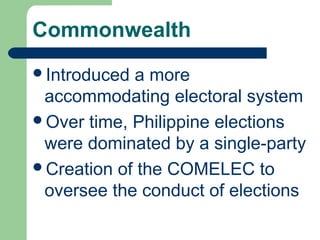
Commonwealth
Introduced a more
accommodating electoral system
Over time, Philippine elections
were dominated by a single-party
Creation of the COMELEC to
oversee the conduct of elections
1973 Constitution
Consolidation of power under
Martial Rule
Less electoral safeguards
– Weakening of the powers of the
COMELEC
– Lack of checks and balances within
the electoral system
The Filipino Party System
American Colonial Rule
– Initial dominance of the Federal Party
Party advocating Philippine statehood
within the United States
– Rise and subsequent preponderance
of the Nacionalista Party
Coalition of different groups advocating
Philippine independence
The Filipino Party System
Post-War Period
– Split of the Liberal Party from the
Nacionalista Party
Encouraged by the Americans to
avoid single-party hegemony
Over time, the distinction between the
two became blurred
Growing importance of personalities
The Filipino Party System
Martial Law
– Clampdown on political institutions
– Rise of the Kilusang Bagong
Lipunan (KBL) as the dominant
political party
– Eventual emergence of regional
political parties
The Filipino Party System
Post-EDSA (1986)
– Development of a multi-party
system
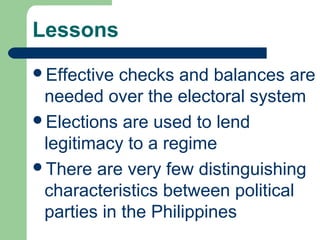
Lessons
Effective checks and balances are
needed over the electoral system
Elections are used to lend
legitimacy to a regime
There are very few distinguishing
characteristics between political
parties in the Philippines
More Lessons
Parties have generally been
ineffective as political institutions
that lend predictability to politics in
the Philippines
Personalities overpower parties
as political entities
Some Contemporary Issues
Party-list
Absentee Voting
Election Fraud
Political Dynasties
Nuisance Candidates
Etc.

On Philippine Elections and Political Parties

  • 1.
    On Philippine Elections andPolitical Parties
  • 2.
    Overview What are thehistorical underpinnings of elections in the Philippines? How did the Philippine party system develop and perform? What are some of the pressing issues surrounding the Philippine electoral and party systems?
  • 3.
    The Electoral System Periodicelection of officials by single-ballot plurality vote Executive and senators elected at large Existence of legislative districts and local government units Electorate: duly registered citizens 18 years of age and above
  • 4.
    Pre-Colonial Philippines No electionsfor ruling authorities Government was based more on intangibles – Kinship – Customs/Traditions – Favors – Unwritten laws
  • 5.
    Colonial Government In colonizingthe Philippines, Spain effectively formalized and modernized government rule To be able to administer the colony effectively, the colonial government created pockets of local authority across the country
  • 6.
    American Colonial Rule Americancolonial rule set the foundation for elections in the Philippines Government institutions and the electoral system were patterned after the American system Filipinos could run for public office in a limited capacity
  • 7.
    Commonwealth Introduced a more accommodatingelectoral system Over time, Philippine elections were dominated by a single-party Creation of the COMELEC to oversee the conduct of elections
  • 8.
    1973 Constitution Consolidation ofpower under Martial Rule Less electoral safeguards – Weakening of the powers of the COMELEC – Lack of checks and balances within the electoral system
  • 9.
    The Filipino PartySystem American Colonial Rule – Initial dominance of the Federal Party Party advocating Philippine statehood within the United States – Rise and subsequent preponderance of the Nacionalista Party Coalition of different groups advocating Philippine independence
  • 10.
    The Filipino PartySystem Post-War Period – Split of the Liberal Party from the Nacionalista Party Encouraged by the Americans to avoid single-party hegemony Over time, the distinction between the two became blurred Growing importance of personalities
  • 11.
    The Filipino PartySystem Martial Law – Clampdown on political institutions – Rise of the Kilusang Bagong Lipunan (KBL) as the dominant political party – Eventual emergence of regional political parties
  • 12.
    The Filipino PartySystem Post-EDSA (1986) – Development of a multi-party system
  • 13.
    Lessons Effective checks andbalances are needed over the electoral system Elections are used to lend legitimacy to a regime There are very few distinguishing characteristics between political parties in the Philippines
  • 14.
    More Lessons Parties havegenerally been ineffective as political institutions that lend predictability to politics in the Philippines Personalities overpower parties as political entities
  • 15.
    Some Contemporary Issues Party-list AbsenteeVoting Election Fraud Political Dynasties Nuisance Candidates Etc.

Editor's Notes

  • #7 Limited capacity Only men could vote Only those of 23 years of age could vote