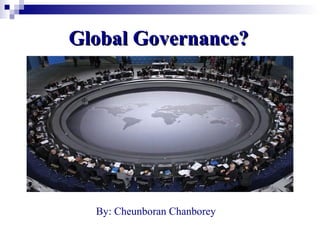
Global Governance?Global Governance?
By: Cheunboran Chanborey
 The world is facing with threats
and challenges that no single
country, no matter how powerful
it is, can deal with.
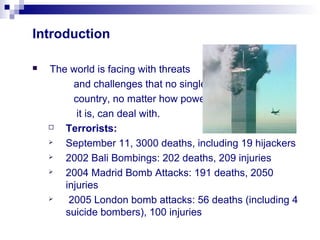
 Terrorists:
 September 11, 3000 deaths, including 19 hijackers
 2002 Bali Bombings: 202 deaths, 209 injuries
 2004 Madrid Bomb Attacks: 191 deaths, 2050
injuries
 2005 London bomb attacks: 56 deaths (including 4
suicide bombers), 100 injuries
Introduction
 Proliferation of WMDs:
 Nuclear Weapons
 Biological Weapons
 Chemical Weapons
 What will happen if WMDs
fall into the hands of terrorists?
 Environmental Degradation:
 Global warming
 Ozone layer
 Living atmosphere
 Natural Disasters:
 2004 Tsunami: 230,000 deaths and missing
 2008 Cyclone Nagis: 138,366 deaths, $10bn
damages
 2010 Haiti earthquake: around 92,000-230,000
deaths
 2011 Earthquake and Tsunami
in Japan: 15,756 death, 5,927
injured, and 4,460 missing
 Famine in the Horn of Africa:
 29,000 children may have already been perished
 UN said it has only $1.3 billion of the 2.4 billion it
needs 2 assist 12m people
 Flooding in Southeast Asia:
 In Cambodia, 250 people died, 18 provinces affected with the
total cost of $521 millions
 Thailand, more than 500 people died with the damage cost of
$ 3.2 billions
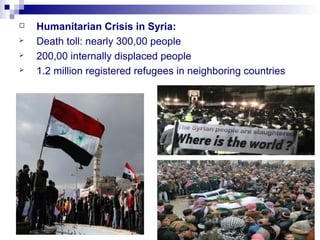
 Humanitarian Crisis in Syria:
 Death toll: nearly 300,00 people
 200,00 internally displaced people
 1.2 million registered refugees in neighboring countries
 Piracy and Transnational Crimes:
 Arms trafficking
 Drug trafficking
 Trafficking in persons
 Sex slavery
 Cyber crimes …
 Pandemics:
 HIV/AIDS
 Malaria, TB
 2009 A(H1N1): 16,931 deaths in more than 100
countries
 EV71: 64 deaths in Cambodia
 There is no world government to coordinate and
facilitate cooperation among all actors to deal with
threats and challenges.
 Therefore, global governance is especially needed.
 What is Global Governance?
“…sum of the many ways individuals and
institutions, public and private, manage their common
affairs…” (Commission on Global Governance)
“… collection of governance-related activities, rules
and mechanisms, formal and informal, existing at a
variety of levels in the world today, also referred to as
the ‘pieces of global governance’…” (Karns and Mingst)
Global Governance
1. International Law
 There are 5 sources of international law: treaties or
conventions, customary practices, the writings of legal
scholars, judicial decisions, and general principles of
law)
 Much of the growth has been in treaty law (1951-1995:
3,666 new multilateral treaties were concluded)
 What is the role of the international law?
Pieces of Global Governance
2. International Norms or Soft Law
 Not a binding legal documents, but rather the
standards of behaviors, such as: some human rights,
labor rights, framework conventions on climate change
and biodiversity.
3. International Organizations (IGOs)
 In 2003/04, there were around 238 IGOs.
 Types: Global (UN, WTO, WHO…), Regional (ASEAN,
EU, AU, SAARC..), General purpose (UN, OAS),
Specialized (WTO, WHO, ILO, Nato..)
 Functions:
 Informational – gather, analyze, disseminate data
 Forum – exchanges of views and decision-making
 Normative – defining standards of behavior
 Rule-creating – drafting treaties
 Rule-supervisory – monitoring compliance
 Operational – actions to achieve goals
4. NGOs
 There are over 6,500 NGOs that have an international
dimension either in terms of membership or commitment
to conduct activities.
 Advocating a particular cause such as human rights,
peace or environmental protection.
 Providing services such as disaster relief, humanitarian
aid…
5. International Regimes
 Encompassing rules, norms and principles as well as the
practices of actors that show both how their expectations
converge and their acceptance of and compliance with
rules.
 E.g. IAEA, Kyoto Protocol
6. Global Conference
 The Summit for Children in1990 in New York
 Rio Earth Summit in 1992
 Fourth World Conference on Women in 1995
 Copenhagen Conference on Climate Change (COP15)
 Cancun Conference on Climate Change (COP16)
 COP17???
7. Ad hoc Arrangements
 G7
 G8
 G20
 G77
8. Private Governance
 Private governance is a growing, but little studies
phenomenon.
 Private firms are attempting to establish enforceable
intellectual property rules for music, software,
harmonization of labor standards, sanitation regulation
…
What Actors in Global Governance?
 States
 IGOs
 NGOs
 Experts
 Global Policy Networks
 MNCs…
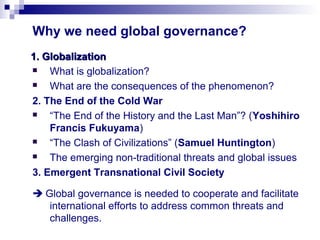
1. Globalization1. Globalization
 What is globalization?
 What are the consequences of the phenomenon?
2. The End of the Cold War
 “The End of the History and the Last Man”? (Yoshihiro
Francis Fukuyama)
 “The Clash of Civilizations” (Samuel Huntington)
 The emerging non-traditional threats and global issues
3. Emergent Transnational Civil Society
 Global governance is needed to cooperate and facilitate
international efforts to address common threats and
challenges.
Why we need global governance?
Reading Materials:
Chapter I, International Organization: The
Politics and Processes of Global Governance

1. global governance

  • 1.
  • 2.
     The worldis facing with threats and challenges that no single country, no matter how powerful it is, can deal with.  Terrorists:  September 11, 3000 deaths, including 19 hijackers  2002 Bali Bombings: 202 deaths, 209 injuries  2004 Madrid Bomb Attacks: 191 deaths, 2050 injuries  2005 London bomb attacks: 56 deaths (including 4 suicide bombers), 100 injuries Introduction
  • 3.
     Proliferation ofWMDs:  Nuclear Weapons  Biological Weapons  Chemical Weapons  What will happen if WMDs fall into the hands of terrorists?  Environmental Degradation:  Global warming  Ozone layer  Living atmosphere
  • 4.
     Natural Disasters: 2004 Tsunami: 230,000 deaths and missing  2008 Cyclone Nagis: 138,366 deaths, $10bn damages  2010 Haiti earthquake: around 92,000-230,000 deaths  2011 Earthquake and Tsunami in Japan: 15,756 death, 5,927 injured, and 4,460 missing
  • 5.
     Famine inthe Horn of Africa:  29,000 children may have already been perished  UN said it has only $1.3 billion of the 2.4 billion it needs 2 assist 12m people
  • 6.
     Flooding inSoutheast Asia:  In Cambodia, 250 people died, 18 provinces affected with the total cost of $521 millions  Thailand, more than 500 people died with the damage cost of $ 3.2 billions
  • 7.
     Humanitarian Crisisin Syria:  Death toll: nearly 300,00 people  200,00 internally displaced people  1.2 million registered refugees in neighboring countries
  • 8.
     Piracy andTransnational Crimes:  Arms trafficking  Drug trafficking  Trafficking in persons  Sex slavery  Cyber crimes …  Pandemics:  HIV/AIDS  Malaria, TB  2009 A(H1N1): 16,931 deaths in more than 100 countries  EV71: 64 deaths in Cambodia
  • 9.
     There isno world government to coordinate and facilitate cooperation among all actors to deal with threats and challenges.  Therefore, global governance is especially needed.  What is Global Governance? “…sum of the many ways individuals and institutions, public and private, manage their common affairs…” (Commission on Global Governance) “… collection of governance-related activities, rules and mechanisms, formal and informal, existing at a variety of levels in the world today, also referred to as the ‘pieces of global governance’…” (Karns and Mingst) Global Governance
  • 10.
    1. International Law There are 5 sources of international law: treaties or conventions, customary practices, the writings of legal scholars, judicial decisions, and general principles of law)  Much of the growth has been in treaty law (1951-1995: 3,666 new multilateral treaties were concluded)  What is the role of the international law? Pieces of Global Governance
  • 11.
    2. International Normsor Soft Law  Not a binding legal documents, but rather the standards of behaviors, such as: some human rights, labor rights, framework conventions on climate change and biodiversity.
  • 12.
    3. International Organizations(IGOs)  In 2003/04, there were around 238 IGOs.  Types: Global (UN, WTO, WHO…), Regional (ASEAN, EU, AU, SAARC..), General purpose (UN, OAS), Specialized (WTO, WHO, ILO, Nato..)  Functions:  Informational – gather, analyze, disseminate data  Forum – exchanges of views and decision-making  Normative – defining standards of behavior  Rule-creating – drafting treaties  Rule-supervisory – monitoring compliance  Operational – actions to achieve goals
  • 13.
    4. NGOs  Thereare over 6,500 NGOs that have an international dimension either in terms of membership or commitment to conduct activities.  Advocating a particular cause such as human rights, peace or environmental protection.  Providing services such as disaster relief, humanitarian aid…
  • 14.
    5. International Regimes Encompassing rules, norms and principles as well as the practices of actors that show both how their expectations converge and their acceptance of and compliance with rules.  E.g. IAEA, Kyoto Protocol
  • 15.
    6. Global Conference The Summit for Children in1990 in New York  Rio Earth Summit in 1992  Fourth World Conference on Women in 1995  Copenhagen Conference on Climate Change (COP15)  Cancun Conference on Climate Change (COP16)  COP17???
  • 16.
    7. Ad hocArrangements  G7  G8  G20  G77
  • 17.
    8. Private Governance Private governance is a growing, but little studies phenomenon.  Private firms are attempting to establish enforceable intellectual property rules for music, software, harmonization of labor standards, sanitation regulation …
  • 18.
    What Actors inGlobal Governance?  States  IGOs  NGOs  Experts  Global Policy Networks  MNCs…
  • 19.
    1. Globalization1. Globalization What is globalization?  What are the consequences of the phenomenon? 2. The End of the Cold War  “The End of the History and the Last Man”? (Yoshihiro Francis Fukuyama)  “The Clash of Civilizations” (Samuel Huntington)  The emerging non-traditional threats and global issues 3. Emergent Transnational Civil Society  Global governance is needed to cooperate and facilitate international efforts to address common threats and challenges. Why we need global governance?
  • 20.
    Reading Materials: Chapter I,International Organization: The Politics and Processes of Global Governance