GLOBALIZATION
Trends, Networks, and Critical Thinking in the 21st Century Culture
Teacher: BABYLYN Z. ATILLAGA-BAYLON
PHOTO ANALYSIS
NATUREOF
GLOBALIZATION
Globalization is rooted from the word
global which means that actions occur
“across political and political
boundaries”, which “creates intensive as
well as spatially extensive
interconnections between a range of
institution and actors” and develops
“transnational process, institutions and
ways of interpreting the world as a
single space
GLOBALIZATION
Emergence of an international network,
belonging to an economic and social
system.
ROLAND
ROBERTSON
 Professor of Sociology at the University
of Aberden, was the first person defined
globalization as the “understanding of
the world and the increased perception of
the world as a whole”
MARTINALBROW
&ELIZABETH
KING
 Sociologists, define globalization as “all
those processes by which the peoples of
the world are incorporated into a single
world society.
GLOBALIZATION
Is the process in which economies of
different countries around the world
become increasingly assimilated over time.
This process of interaction and integration
among the people, companies and
governments happens as technological
advancement accelerate.
“trade of goods and services, the flow of
capital, and the migration of people across
international borders”
GLOBALIZATION
 Technology acts as the main catalyst of
globalization.
 Economic actor like the consumers,
investors, and businesses have been
given important tool to determine and
develop economic opportunities.
 Technology also provided faster and
“more informed analyses of economic
trends around the world, easy transfer of
assets, and collaboration with far-flung
partners”
MIGRATION
 Is a movement to another place, often of
a large group of people.
LABOR
 Is defined as work, especially hard
physical work
ELEMENTSOF
GLOBALIZATON
1.Privatization
2.Deregulation
3.Liberalization
Privatization
refers to the policies of the
government to transfer to
government-owned
corporations and sell them to
the control of the private
sector.
profit-oriented
Deregulation
refers to the streamlining of
government’s control over the
industry for basic commodities
like oil supply, water and
electricity.
Liberalization
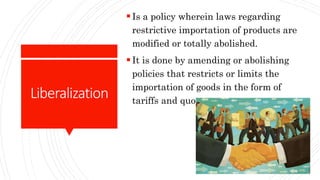
Is a policy wherein laws regarding
restrictive importation of products are
modified or totally abolished.
It is done by amending or abolishing
policies that restricts or limits the
importation of goods in the form of
tariffs and quotes.
TYPESOF
GLOBALIZATION
1.Economic Globalization
2.Social Globalization
3. Political Globalization
4.Financial Globalization
5.Technological Globalization
6.Ecological Globalization
7.Geographical Globalization
Economic
Globalization
Is the increasing economic
integration and interdependence of
national, regional, and local
economies across the world
through an intensification of cross
boarder movement of goods,
services, technologies and capital.
It involves the movement or
economic resources from one
country to another.
Economic
Globalization
 • Trans-national trades are companies that extend
beyond the borders of one country example of these are
Unilever and McDonalds
 • World Trade Organization is the only global
international organization dealing with the rules of
trade between nations. The WTO has 164 members
and 24 observer governments.
 • Foreign Direct Investment is an investment in the
form of a controlling ownership in a business in one
country by an entity based in another country. It is
thus distinguished from a foreign portfolio investment
by a notion of direct control. In 2019, China and South
Korea followed Singapore as the largest investors in
the Philippines.
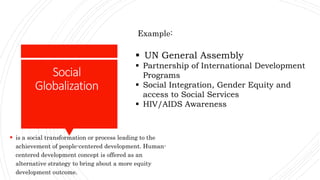
Example:
Social
Globalization
 is a social transformation or process leading to the
achievement of people-centered development. Human-
centered development concept is offered as an
alternative strategy to bring about a more equity
development outcome.
Example:
 UN General Assembly
 Partnership of International Development
Programs
 Social Integration, Gender Equity and
access to Social Services
 HIV/AIDS Awareness
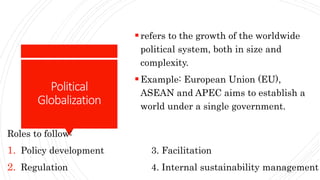
Political
Globalization
refers to the growth of the worldwide
political system, both in size and
complexity.
Example: European Union (EU),
ASEAN and APEC aims to establish a
world under a single government.
Roles to follow:
1. Policy development 3. Facilitation
2. Regulation 4. Internal sustainability management
Financial
Globalization
is a collective concept that refers
to increasing global linkages
created through cross-border
financial flows. Financial
integration refers to an
individual country's linkages to
international capital markets.
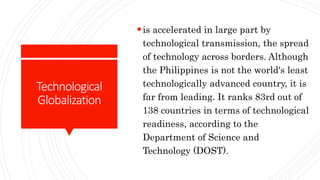
Technological
Globalization
is accelerated in large part by
technological transmission, the spread
of technology across borders. Although
the Philippines is not the world's least
technologically advanced country, it is
far from leading. It ranks 83rd out of
138 countries in terms of technological
readiness, according to the
Department of Science and
Technology (DOST).
Ecological
Globalization
occurs when ecosystems are
constantly exchanging materials
through the movement of air in the
atmosphere, the flow of water in
rivers and the migration of animals
across the landscape. The world is
also becoming highly interconnected
through the movement of people and
the transport of goods locally to
globally (EurekAlert.com).
Geographical
Globalization
is defined as the set of processes
(economic, social, cultural,
technological, and institutional that
contributes to the relationship
between societies and individuals
around the world. It is a progressive
process by which exchanges and flows
between different parts of the world
are intensified.
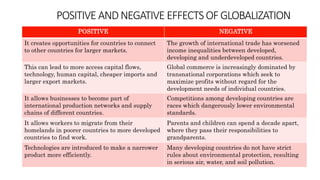
POSITIVE ANDNEGATIVE EFFECTSOFGLOBALIZATION
POSITIVE NEGATIVE
It creates opportunities for countries to connect
to other countries for larger markets.
The growth of international trade has worsened
income inequalities between developed,
developing and underdeveloped countries.
This can lead to more access capital flows,
technology, human capital, cheaper imports and
larger export markets.
Global commerce is increasingly dominated by
transnational corporations which seek to
maximize profits without regard for the
development needs of individual countries.
It allows businesses to become part of
international production networks and supply
chains of different countries.
Competitions among developing countries are
races which dangerously lower environmental
standards.
It allows workers to migrate from their
homelands in poorer countries to more developed
countries to find work.
Parents and children can spend a decade apart,
where they pass their responsibilities to
grandparents.
Technologies are introduced to make a narrower
product more efficiently.
Many developing countries do not have strict
rules about environmental protection, resulting
in serious air, water, and soil pollution.
CriticalThinking
Essay.Answerthe
followingquestions.
1. What are the manifestations of globalization in
society today?
2. Can we consider globalization a necessary evil? Why
did you say so?
3. Do you think globalization is inevitable? Why did you
say so?
4. How would you compare the different types of
globalization?
5. How does globalization affect migration and labor
movement?

GLOBALIZATION.pptx

  • 1.
    GLOBALIZATION Trends, Networks, andCritical Thinking in the 21st Century Culture Teacher: BABYLYN Z. ATILLAGA-BAYLON
  • 2.
  • 3.
    NATUREOF GLOBALIZATION Globalization is rootedfrom the word global which means that actions occur “across political and political boundaries”, which “creates intensive as well as spatially extensive interconnections between a range of institution and actors” and develops “transnational process, institutions and ways of interpreting the world as a single space
  • 4.
    GLOBALIZATION Emergence of aninternational network, belonging to an economic and social system.
  • 5.
    ROLAND ROBERTSON  Professor ofSociology at the University of Aberden, was the first person defined globalization as the “understanding of the world and the increased perception of the world as a whole”
  • 6.
    MARTINALBROW &ELIZABETH KING  Sociologists, defineglobalization as “all those processes by which the peoples of the world are incorporated into a single world society.
  • 7.
    GLOBALIZATION Is the processin which economies of different countries around the world become increasingly assimilated over time. This process of interaction and integration among the people, companies and governments happens as technological advancement accelerate. “trade of goods and services, the flow of capital, and the migration of people across international borders”
  • 8.
    GLOBALIZATION  Technology actsas the main catalyst of globalization.  Economic actor like the consumers, investors, and businesses have been given important tool to determine and develop economic opportunities.  Technology also provided faster and “more informed analyses of economic trends around the world, easy transfer of assets, and collaboration with far-flung partners”
  • 9.
    MIGRATION  Is amovement to another place, often of a large group of people.
  • 10.
    LABOR  Is definedas work, especially hard physical work
  • 11.
  • 12.
    Privatization refers to thepolicies of the government to transfer to government-owned corporations and sell them to the control of the private sector. profit-oriented
  • 13.
    Deregulation refers to thestreamlining of government’s control over the industry for basic commodities like oil supply, water and electricity.
  • 14.
    Liberalization Is a policywherein laws regarding restrictive importation of products are modified or totally abolished. It is done by amending or abolishing policies that restricts or limits the importation of goods in the form of tariffs and quotes.
  • 15.
    TYPESOF GLOBALIZATION 1.Economic Globalization 2.Social Globalization 3.Political Globalization 4.Financial Globalization 5.Technological Globalization 6.Ecological Globalization 7.Geographical Globalization
  • 16.
    Economic Globalization Is the increasingeconomic integration and interdependence of national, regional, and local economies across the world through an intensification of cross boarder movement of goods, services, technologies and capital. It involves the movement or economic resources from one country to another.
  • 17.
    Economic Globalization  • Trans-nationaltrades are companies that extend beyond the borders of one country example of these are Unilever and McDonalds  • World Trade Organization is the only global international organization dealing with the rules of trade between nations. The WTO has 164 members and 24 observer governments.  • Foreign Direct Investment is an investment in the form of a controlling ownership in a business in one country by an entity based in another country. It is thus distinguished from a foreign portfolio investment by a notion of direct control. In 2019, China and South Korea followed Singapore as the largest investors in the Philippines. Example:
  • 18.
    Social Globalization  is asocial transformation or process leading to the achievement of people-centered development. Human- centered development concept is offered as an alternative strategy to bring about a more equity development outcome. Example:  UN General Assembly  Partnership of International Development Programs  Social Integration, Gender Equity and access to Social Services  HIV/AIDS Awareness
  • 19.
    Political Globalization refers to thegrowth of the worldwide political system, both in size and complexity. Example: European Union (EU), ASEAN and APEC aims to establish a world under a single government. Roles to follow: 1. Policy development 3. Facilitation 2. Regulation 4. Internal sustainability management
  • 20.
    Financial Globalization is a collectiveconcept that refers to increasing global linkages created through cross-border financial flows. Financial integration refers to an individual country's linkages to international capital markets.
  • 21.
    Technological Globalization is accelerated inlarge part by technological transmission, the spread of technology across borders. Although the Philippines is not the world's least technologically advanced country, it is far from leading. It ranks 83rd out of 138 countries in terms of technological readiness, according to the Department of Science and Technology (DOST).
  • 22.
    Ecological Globalization occurs when ecosystemsare constantly exchanging materials through the movement of air in the atmosphere, the flow of water in rivers and the migration of animals across the landscape. The world is also becoming highly interconnected through the movement of people and the transport of goods locally to globally (EurekAlert.com).
  • 23.
    Geographical Globalization is defined asthe set of processes (economic, social, cultural, technological, and institutional that contributes to the relationship between societies and individuals around the world. It is a progressive process by which exchanges and flows between different parts of the world are intensified.
  • 24.
    POSITIVE ANDNEGATIVE EFFECTSOFGLOBALIZATION POSITIVENEGATIVE It creates opportunities for countries to connect to other countries for larger markets. The growth of international trade has worsened income inequalities between developed, developing and underdeveloped countries. This can lead to more access capital flows, technology, human capital, cheaper imports and larger export markets. Global commerce is increasingly dominated by transnational corporations which seek to maximize profits without regard for the development needs of individual countries. It allows businesses to become part of international production networks and supply chains of different countries. Competitions among developing countries are races which dangerously lower environmental standards. It allows workers to migrate from their homelands in poorer countries to more developed countries to find work. Parents and children can spend a decade apart, where they pass their responsibilities to grandparents. Technologies are introduced to make a narrower product more efficiently. Many developing countries do not have strict rules about environmental protection, resulting in serious air, water, and soil pollution.
  • 25.
    CriticalThinking Essay.Answerthe followingquestions. 1. What arethe manifestations of globalization in society today? 2. Can we consider globalization a necessary evil? Why did you say so? 3. Do you think globalization is inevitable? Why did you say so? 4. How would you compare the different types of globalization? 5. How does globalization affect migration and labor movement?

Editor's Notes

  • #4 Globalization is the keyword for the rise of global networks. But what is globalization?
  • #5 Modern-day information technology speeds up the “trade of goods and services, the flow of capital, and the migration of people across international borders” - Through globalization, companies have more access to markets while consumers have greater access to different varieties of goods and services. Globalization affects not only political systems and economic development of countries around the world but it also affects the environment, culture and physical well-being of societies in different parts of the world.
  • #8 Modern-day information technology speeds up the “trade of goods and services, the flow of capital, and the migration of people across international borders” - Through globalization, companies have more access to markets while consumers have greater access to different varieties of goods and services. Globalization affects not only political systems and economic development of countries around the world but it also affects the environment, culture and physical well-being of societies in different parts of the world.
  • #13 When privatization happens, government-owned corporation are all maintained by the private sector. When a government-owned company is privatized, it becomes profit-oriented. In the Philippines, most of the government-owned corporations that have been privatized are related to public services like electricity, water, transportation, and telecommunications. When this services became privatized, the cost of electricity, water, telecommunications services and even transportation became expensive because its private owners became profit-driven and no longer service-oriented,
  • #14 To deregulate means that the government does not have any legislative interference over the certain companies for as long as they provided valid reasons for their courses of actions.
  • #15 Meaning when liberalization is implemented, products of develop countries can no penetrate the markets of developing countries and the least developed nations.
  • #20 Examples of trade blocs are the European Union, the WTO and G8. These organizations help to spread ideologies like democracy, protect human rights, intervene to solve misunderstandings and aid in international agreements.
  • #21 The fast spread of cultural globalization became possible through modern technology, particularly, satellite communication, telecommunication networks, information technology and the internet.
  • #22 The fast spread of cultural globalization became possible through modern technology, particularly, satellite communication, telecommunication networks, information technology and the internet.
  • #23 The fast spread of cultural globalization became possible through modern technology, particularly, satellite communication, telecommunication networks, information technology and the internet.
  • #24 The fast spread of cultural globalization became possible through modern technology, particularly, satellite communication, telecommunication networks, information technology and the internet.
  • #25 Some argue that globalization is a positive development as it will give rise to new industries and more jobs in developing countries. Others say globalization is negative in that it will force poorer countries of the world to do whatever the big developed countries tell them to do.