Expenditure and output
Saving, Consumption and Investment in the Economy
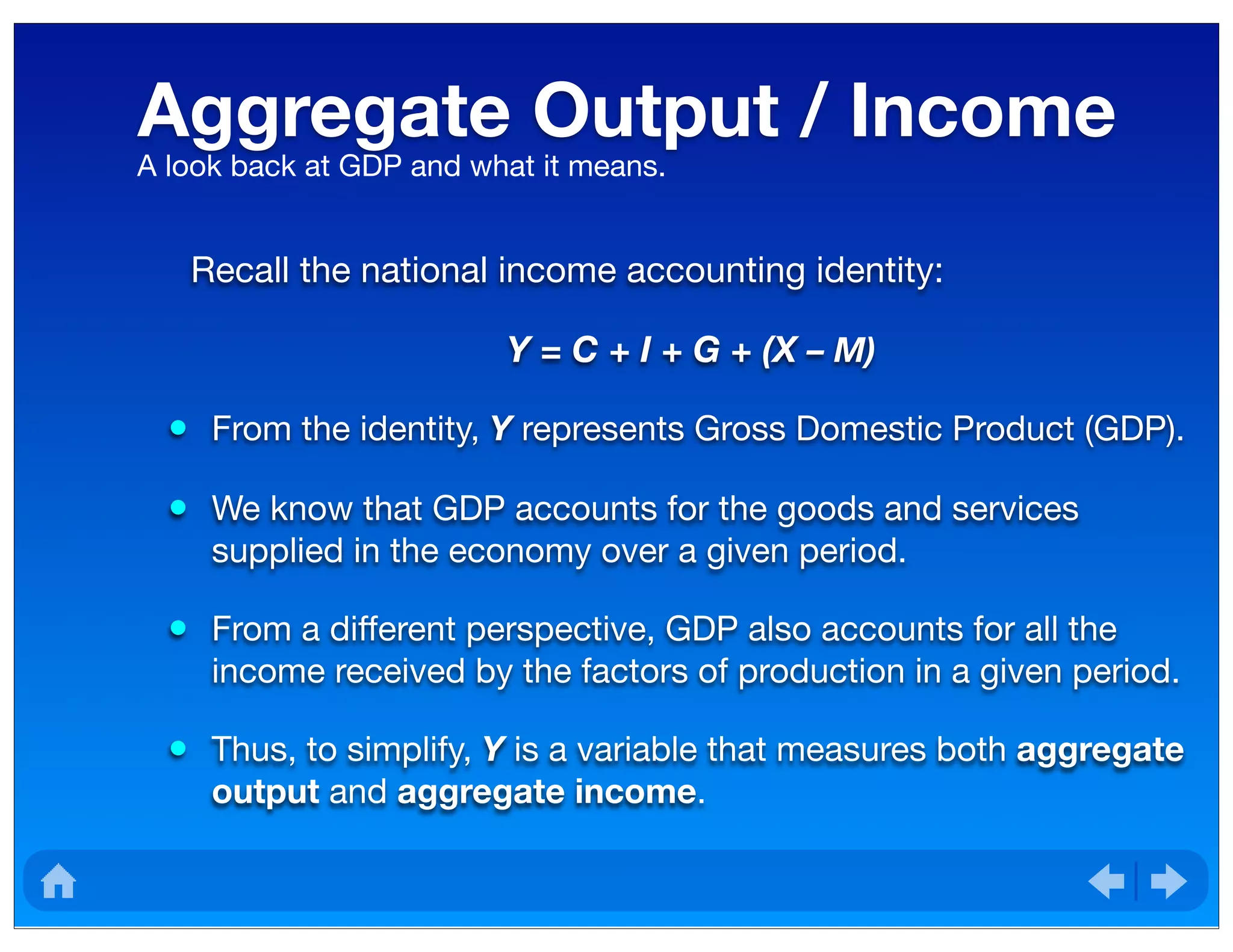
Aggregate Output / Income
Recall the national income accounting identity:
Y = C + I + G + (X – M)
• From the identity, Y represents Gross Domestic Product (GDP).
• We know that GDP accounts for the goods and services
supplied in the economy over a given period.
• From a different perspective, GDP also accounts for all the
income received by the factors of production in a given period.
• Thus, to simplify, Y is a variable that measures both aggregate
output and aggregate income.
A look back at GDP and what it means.
Simplifications
• Recall that all variables are aggregates.
• Since people only care about the “real” value of their
income/output, we can assume that all variables under
consideration are expressed in real terms.
• To proceed with the analysis, we can consider the simplest
case:
• There is no government intervention in the economy
(i.e. G = 0).
• A closed economy model (i.e. [X – M] = 0).
• Thus, our model reduces to:
Y = C + I
Some assumptions to make the analysis easier.
Consumption
Determinants of aggregate consumption:
1. Household Income
2. Household Wealth
3. Households’ Expectations about the Future
4. Interest Rates
Identifying the factors that influence spending behavior.
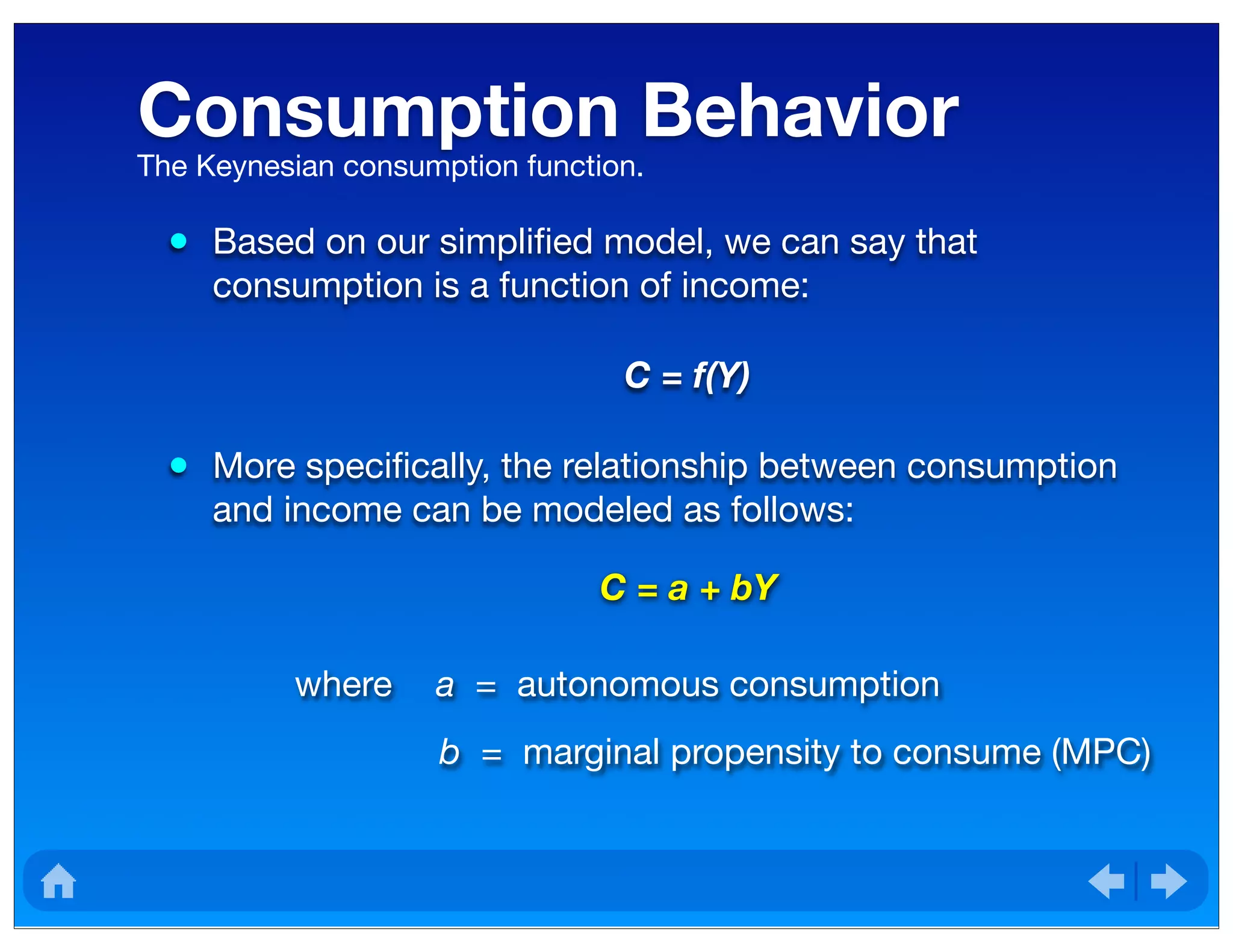
Consumption Behavior
• Based on our simplified model, we can say that
consumption is a function of income:
C = f(Y)
• More specifically, the relationship between consumption
and income can be modeled as follows:
The Keynesian consumption function.
C = a + bY
where a = autonomous consumption
b = marginal propensity to consume (MPC)
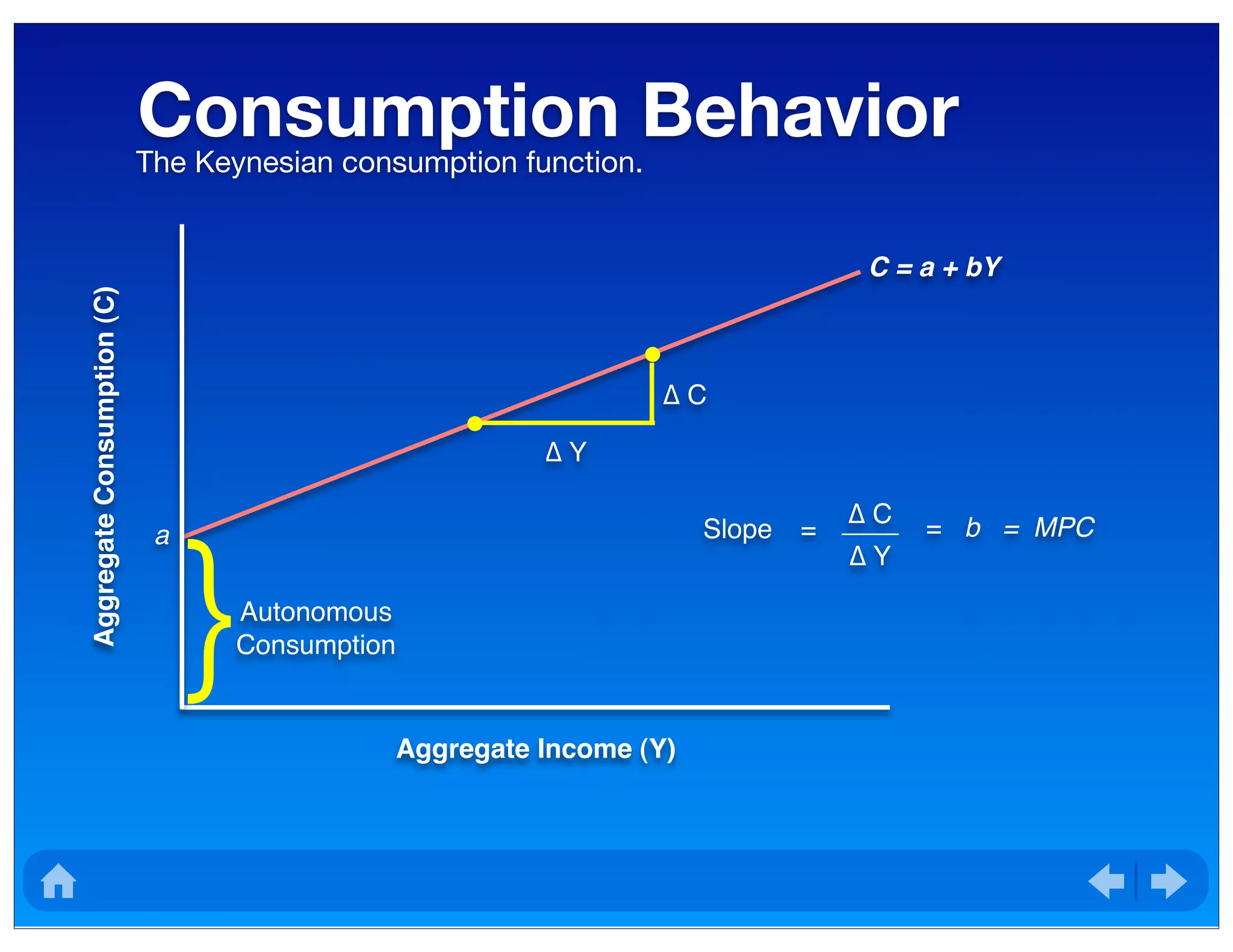
C = a + bY
Consumption BehaviorThe Keynesian consumption function.
AggregateConsumption(C)
Aggregate Income (Y)
a
}Autonomous
Consumption
∆ C
∆ Y
= b = MPC
∆ C
∆ Y
Slope =
Saving ≠ Savings
• Saving refers to the amount from this period’s income that
has not been spent.
• It is a flow variable and may vary from period to period.
• Savings refers to the total amount that households have
saved over their lifetimes.
• It is a stock variable that totals saving from day zero to
the present.
A little note on terminology (and a lot of nitpicking).
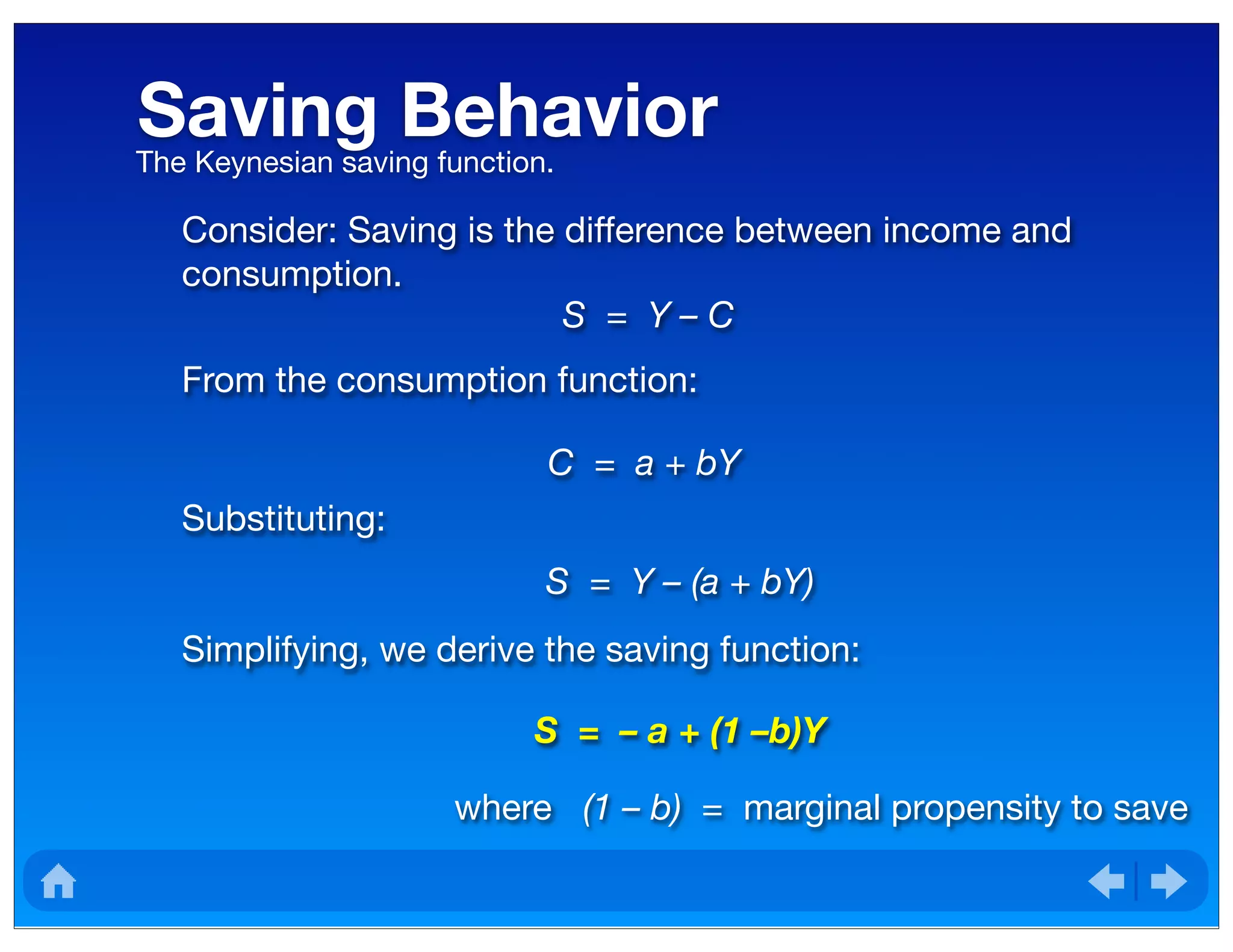
Saving Behavior	The Keynesian saving function.
Consider: Saving is the difference between income and
consumption.
S = Y – C
From the consumption function:
C = a + bY
Substituting:
S = Y – (a + bY)
Simplifying, we derive the saving function:
S = – a + (1 –b)Y
where (1 – b) = marginal propensity to save
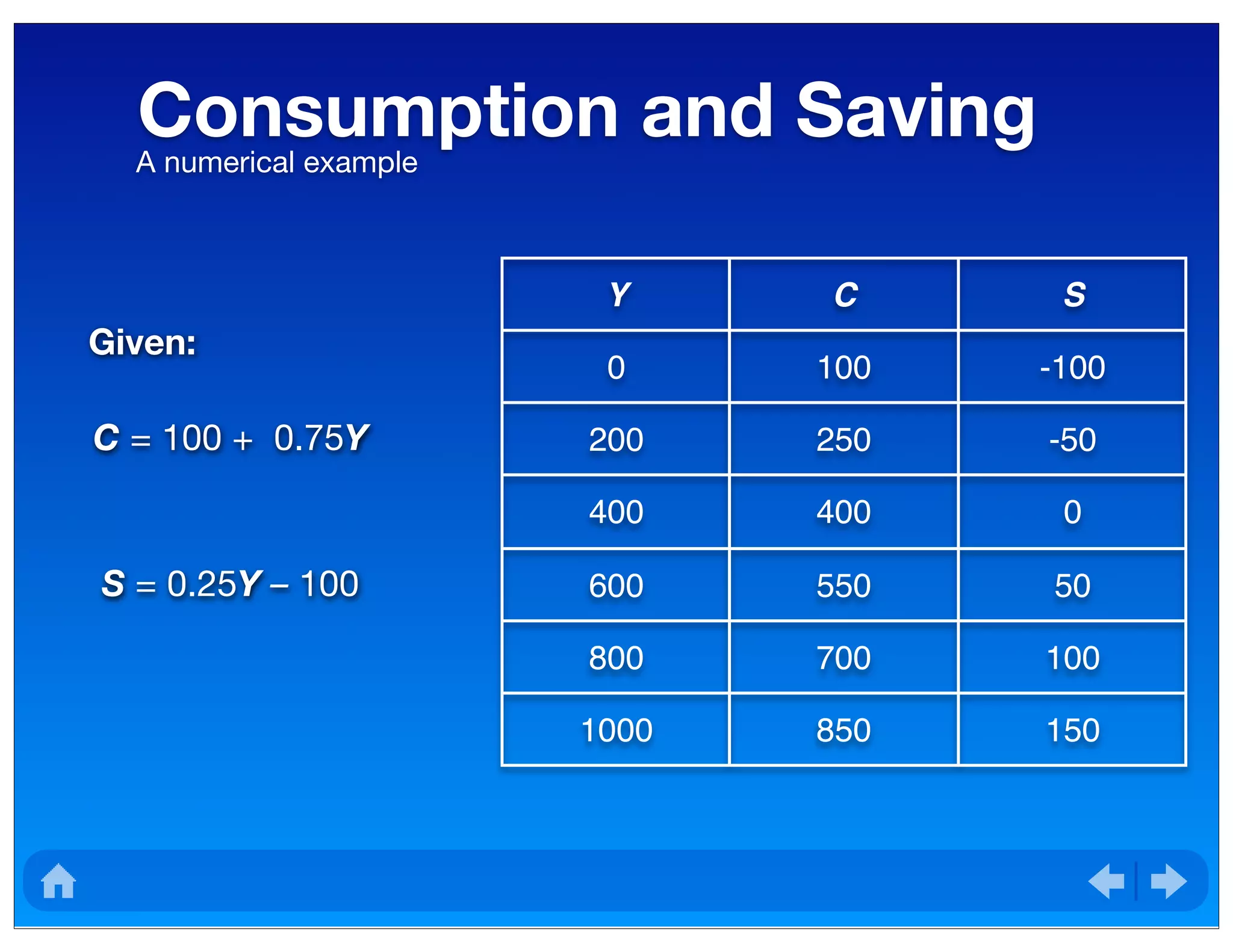
Consumption and SavingA numerical example
Y
0
200
400
600
800
1000
C
100
250
400
550
700
850
S
-100
-50
0
50
100
150
Given:
C = 100 + 0.75Y
S = 0.25Y – 100
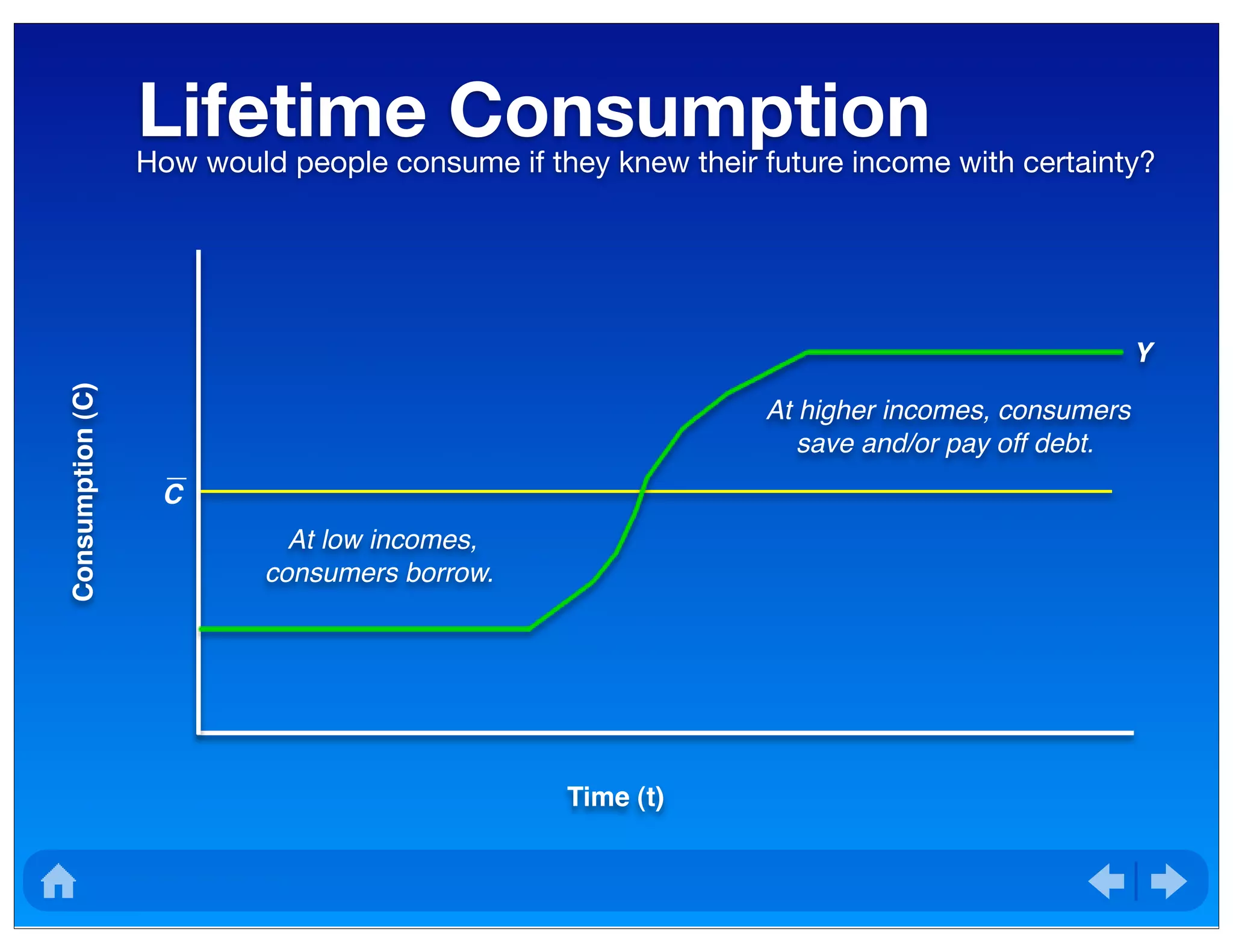
At low incomes,
consumers borrow.
Lifetime ConsumptionHow would people consume if they knew their future income with certainty?
Consumption(C)
Time (t)
C
Y
At higher incomes, consumers
save and/or pay off debt.
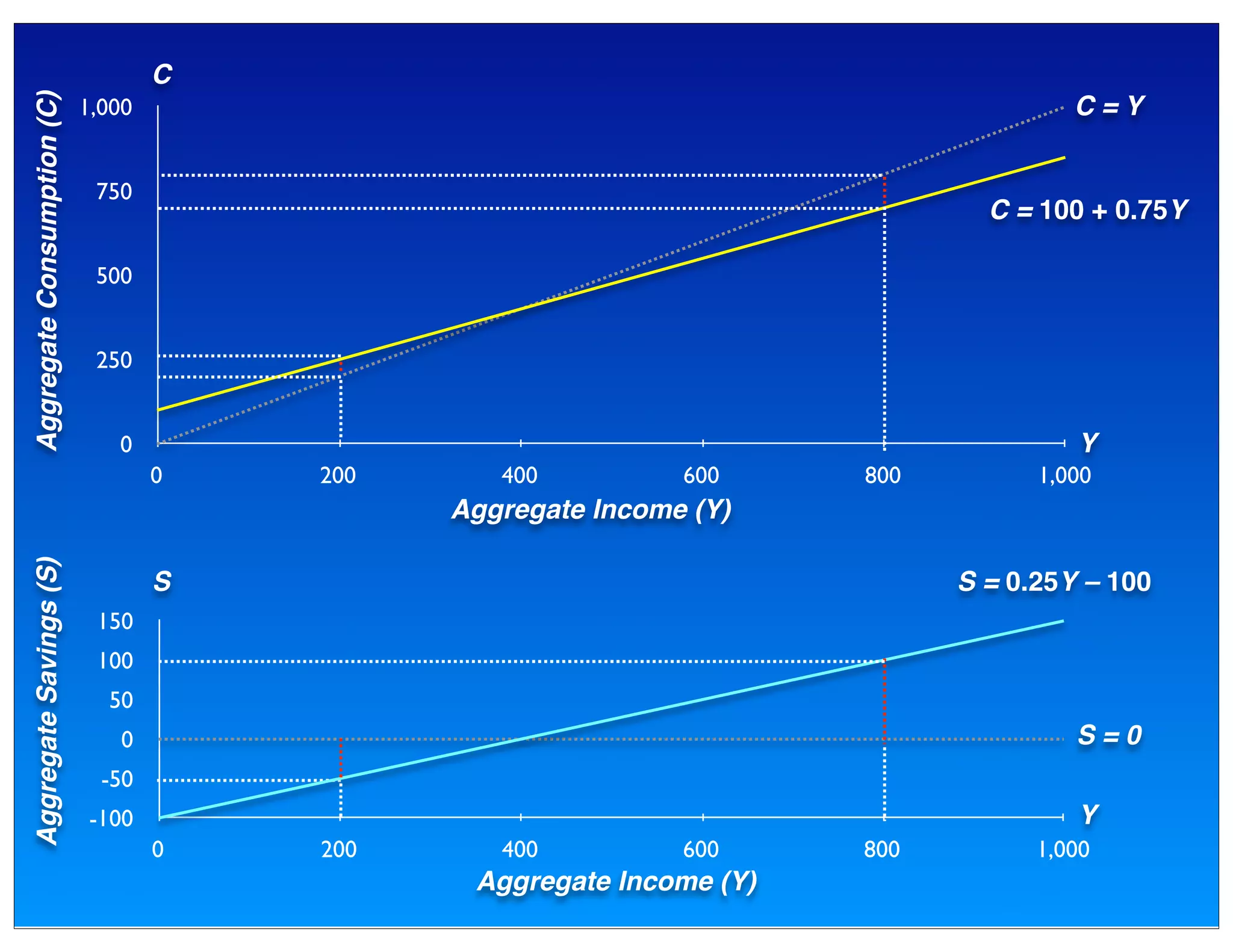
0
250
500
750
1,000
0 200 400 600 800 1,000
-100
-50
0
50
100
150
0 200 400 600 800 1,000
Y
AggregateConsumption(C)
S
Y
C = Y
C
AggregateSavings(S)
Aggregate Income (Y)
C = 100 + 0.75Y
S = 0.25Y – 100
S = 0
Investment
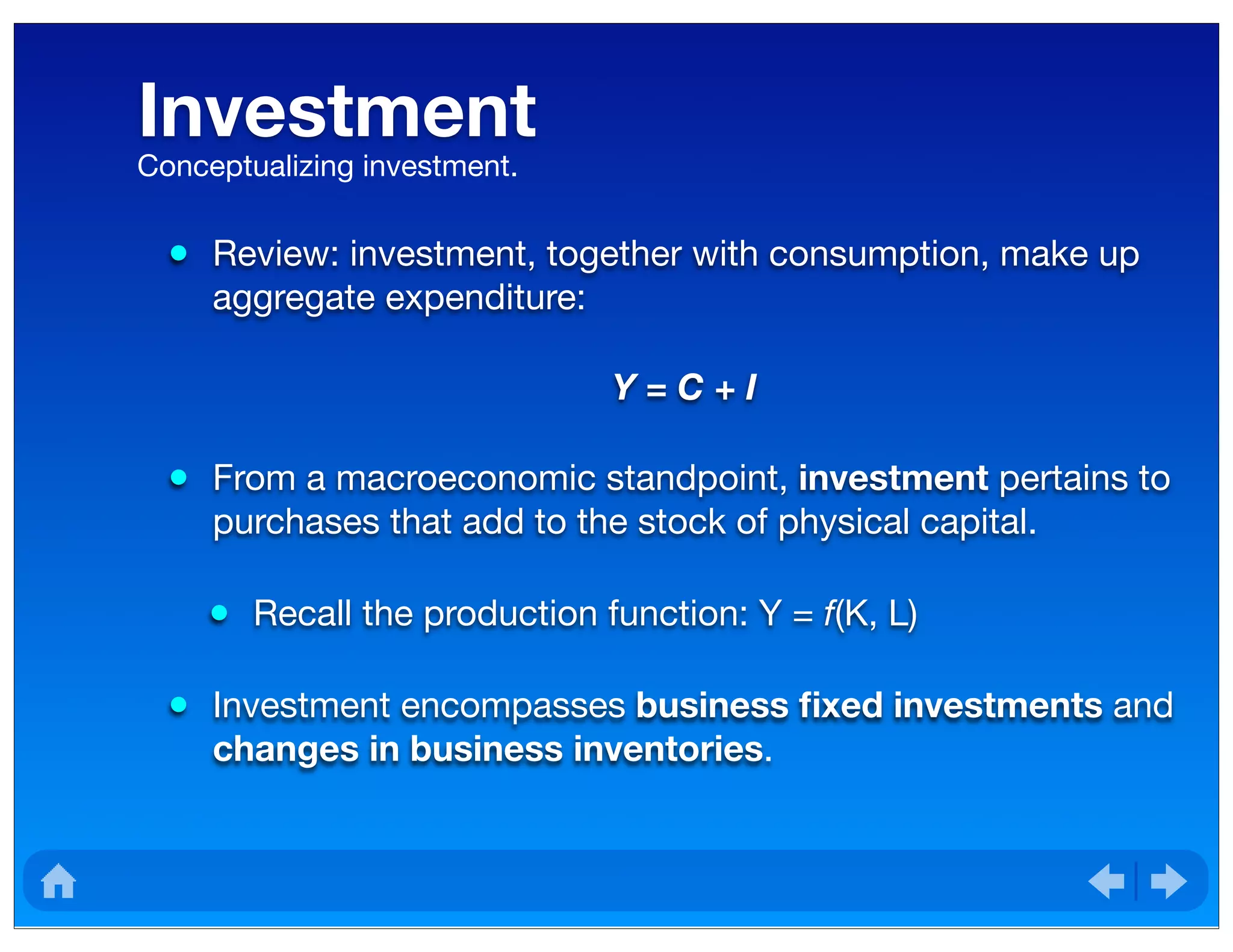
• Review: investment, together with consumption, make up
aggregate expenditure:
Y = C + I
• From a macroeconomic standpoint, investment pertains to
purchases that add to the stock of physical capital.
• Recall the production function: Y = f(K, L)
• Investment encompasses business fixed investments and
changes in business inventories.
Conceptualizing investment.
Interest Rates
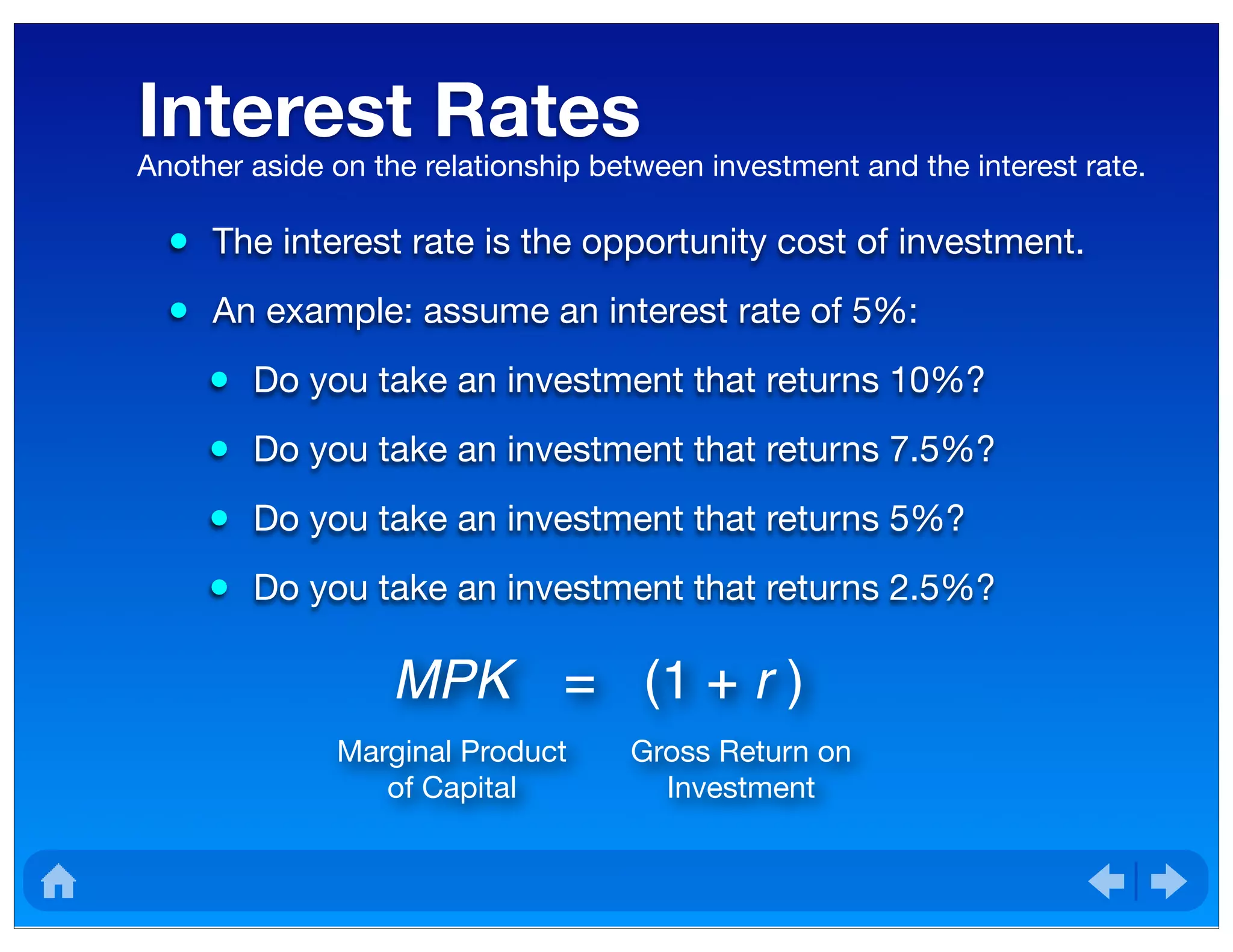
• The interest rate is the opportunity cost of investment.
• An example: assume an interest rate of 5%:
• Do you take an investment that returns 10%?
• Do you take an investment that returns 7.5%?
• Do you take an investment that returns 5%?
• Do you take an investment that returns 2.5%?
Another aside on the relationship between investment and the interest rate.
MPK = (1 + r )
Marginal Product
of Capital
Gross Return on
Investment
More on Investment
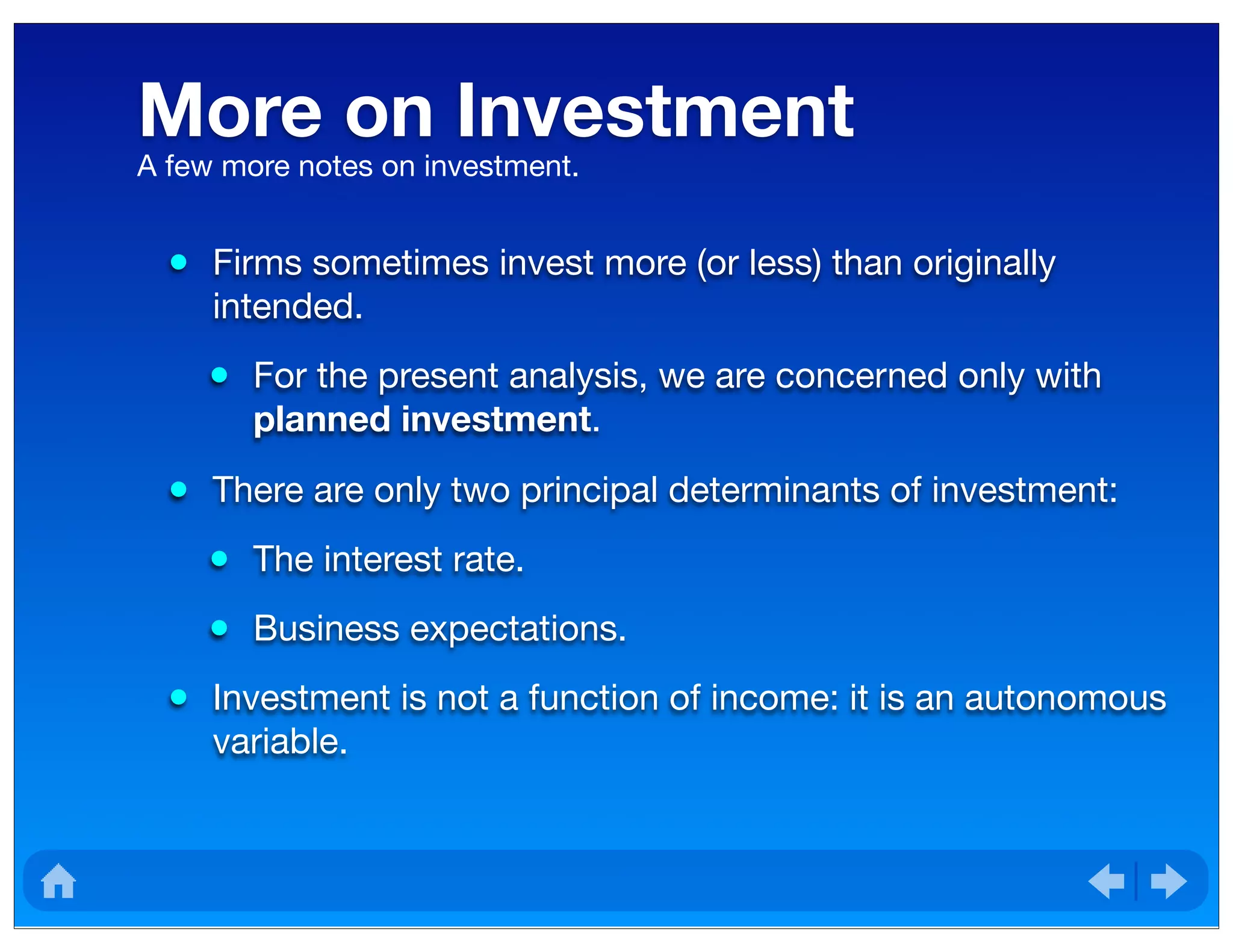
• Firms sometimes invest more (or less) than originally
intended.
• For the present analysis, we are concerned only with
planned investment.
• There are only two principal determinants of investment:
• The interest rate.
• Business expectations.
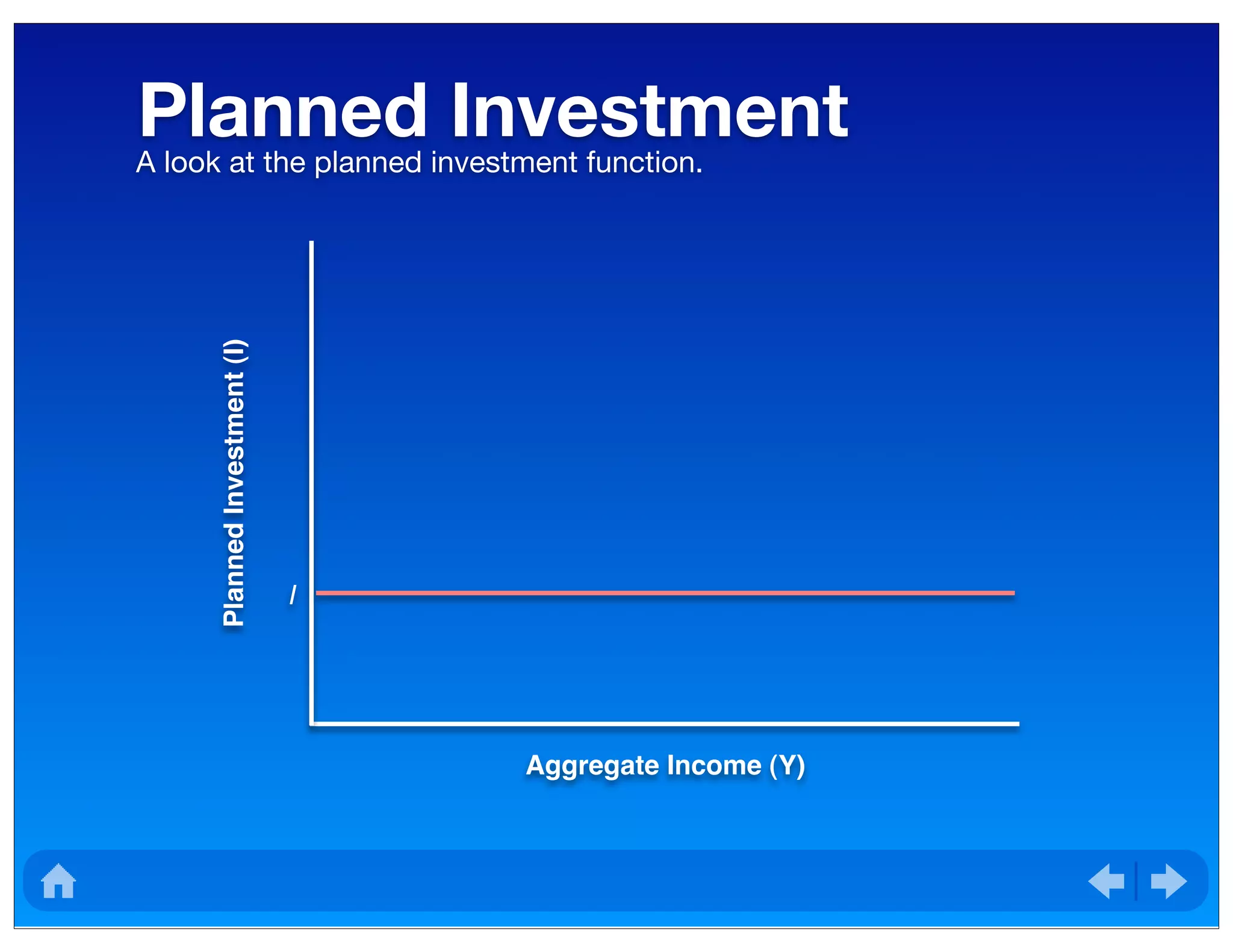
• Investment is not a function of income: it is an autonomous
variable.
A few more notes on investment.
Planned InvestmentA look at the planned investment function.
PlannedInvestment(I)
Aggregate Income (Y)
I
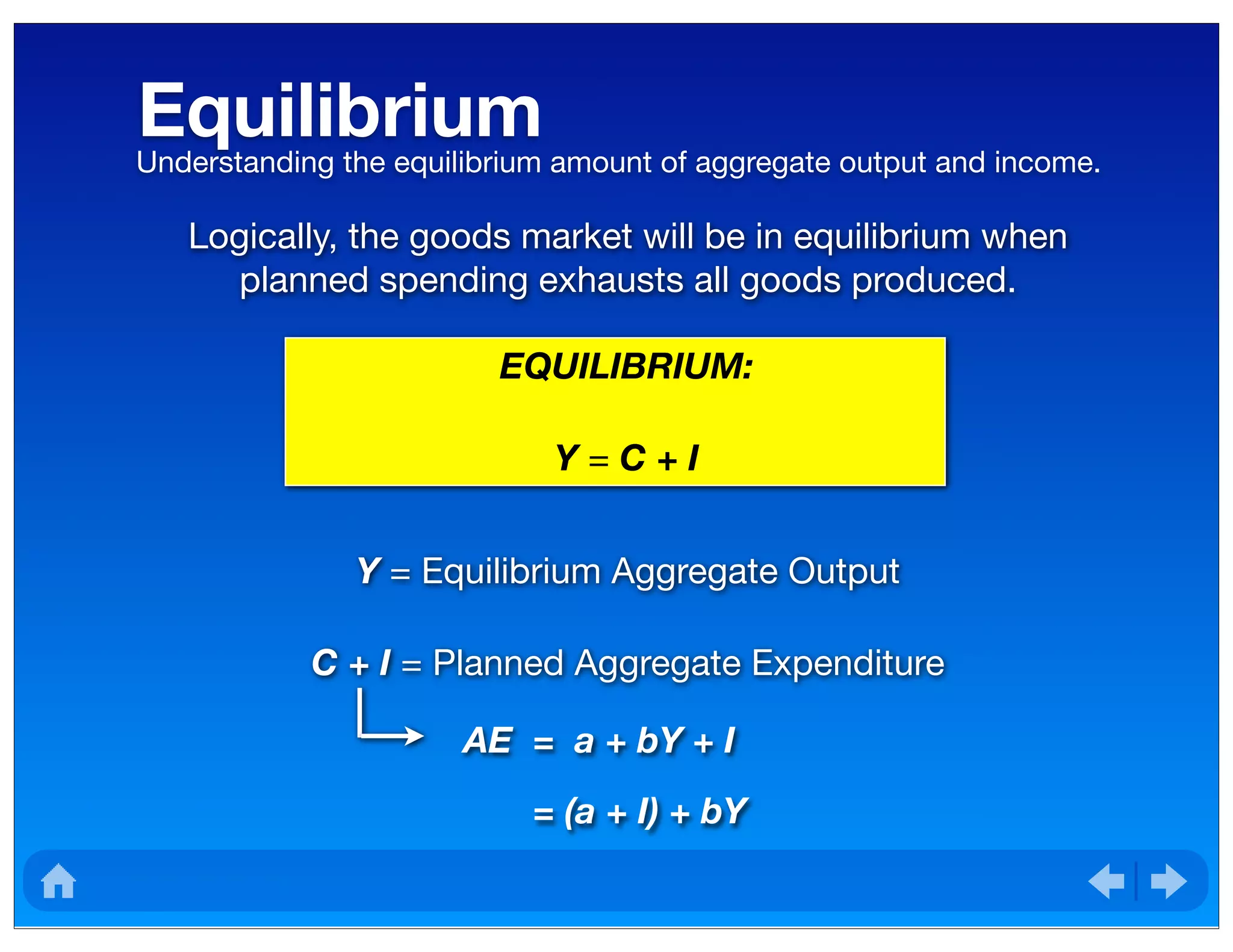
EquilibriumUnderstanding the equilibrium amount of aggregate output and income.
Logically, the goods market will be in equilibrium when
planned spending exhausts all goods produced.
Y = Equilibrium Aggregate Output
C + I = Planned Aggregate Expenditure
EQUILIBRIUM:
Y = C + I
AE = a + bY + I
= (a + I) + bY
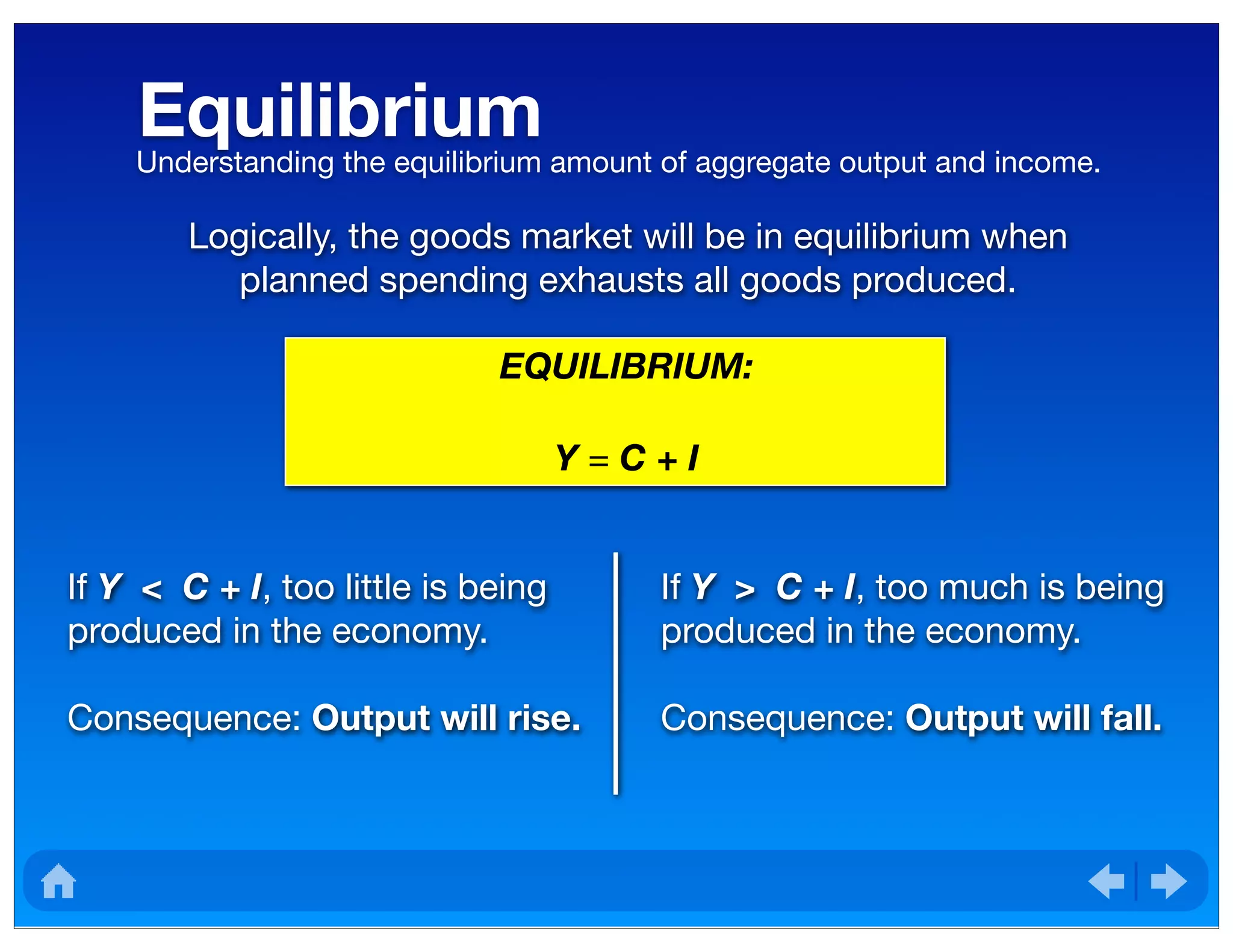
EquilibriumUnderstanding the equilibrium amount of aggregate output and income.
Logically, the goods market will be in equilibrium when
planned spending exhausts all goods produced.
If Y > C + I, too much is being
produced in the economy.
Consequence: Output will fall.
EQUILIBRIUM:
Y = C + I
If Y < C + I, too little is being
produced in the economy.
Consequence: Output will rise.
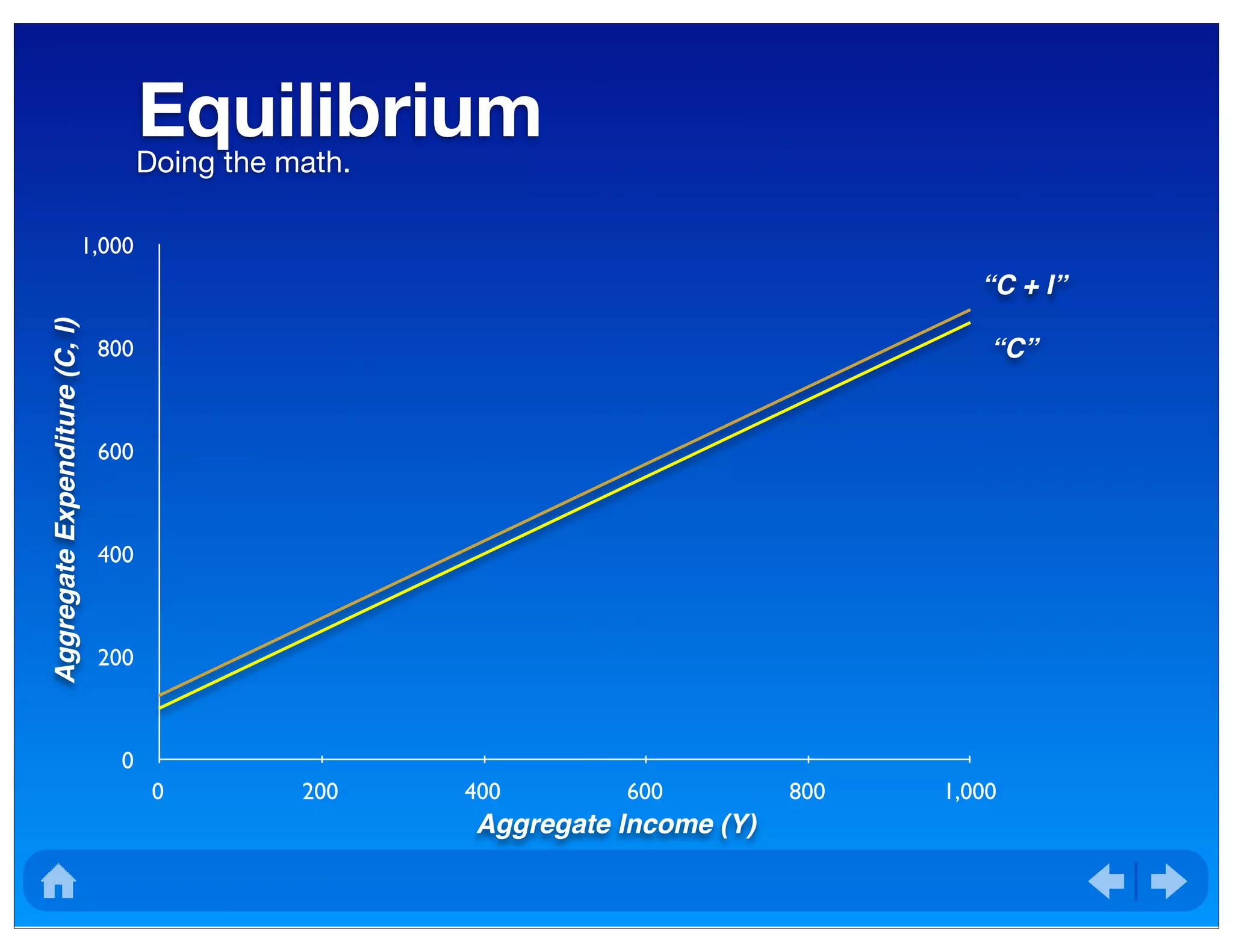
EquilibriumDoing the math.
0
200
400
600
800
1,000
0 200 400 600 800 1,000
“C + I”
Aggregate Income (Y)
AggregateExpenditure(C,I)
“C”
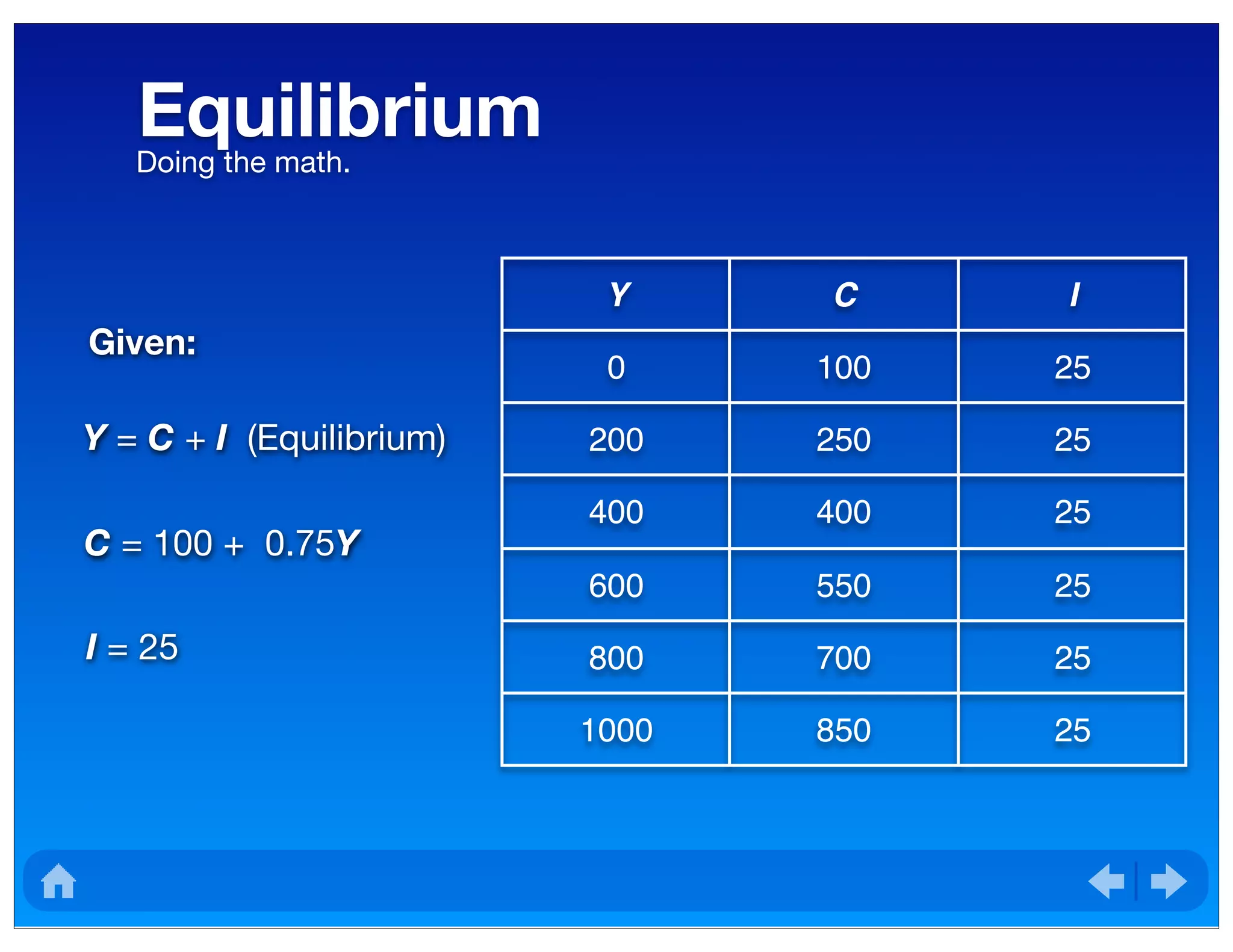
EquilibriumDoing the math.
Y C I
0 100 25
200 250 25
400 400 25
600 550 25
800 700 25
1000 850 25
Given:
Y = C + I (Equilibrium)
C = 100 + 0.75Y
I = 25
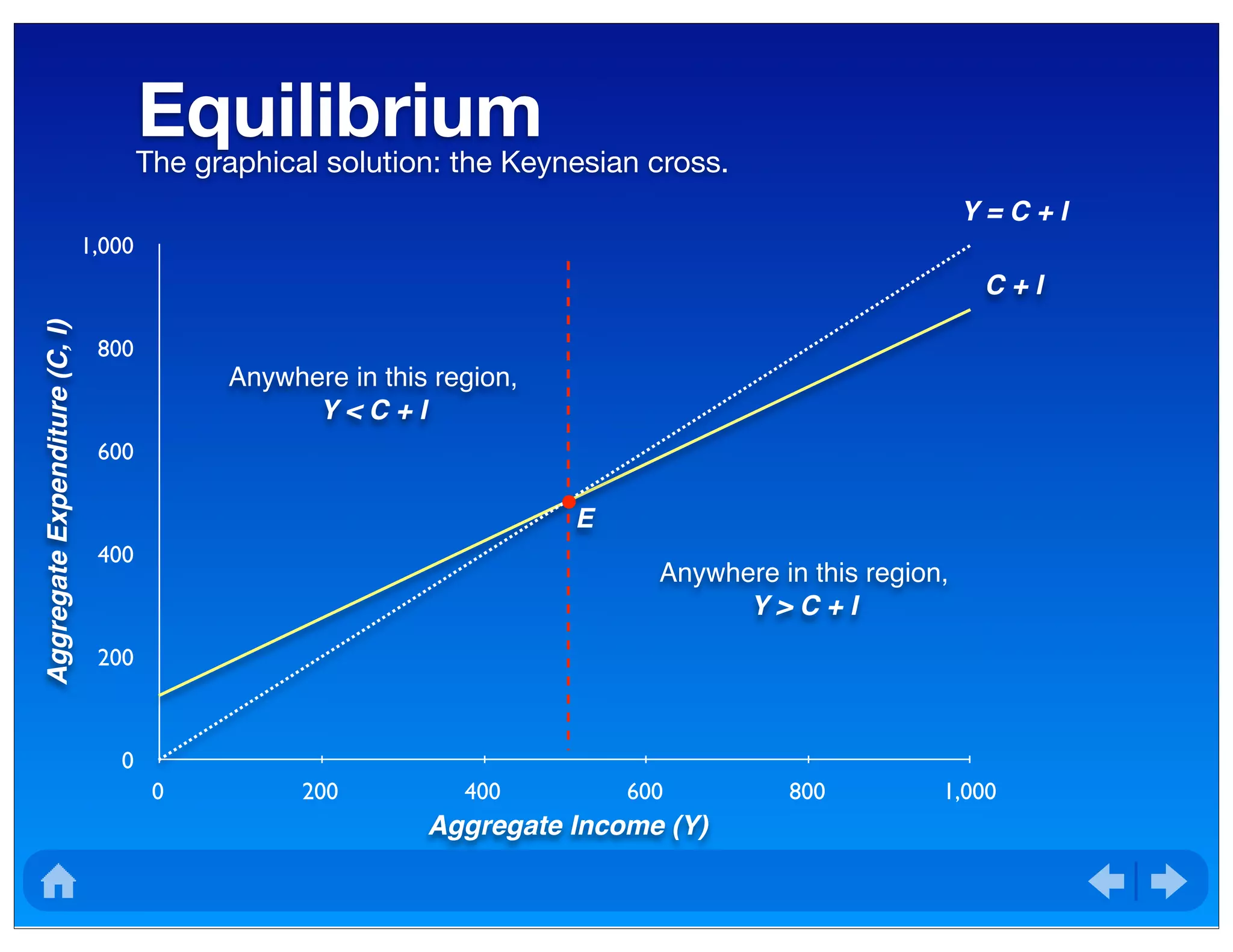
EquilibriumThe graphical solution: the Keynesian cross.
0
200
400
600
800
1,000
0 200 400 600 800 1,000
C + I
Anywhere in this region,
Y < C + I
Anywhere in this region,
Y > C + I
Y = C + I
Aggregate Income (Y)
AggregateExpenditure(C,I)
E
Equilibrium
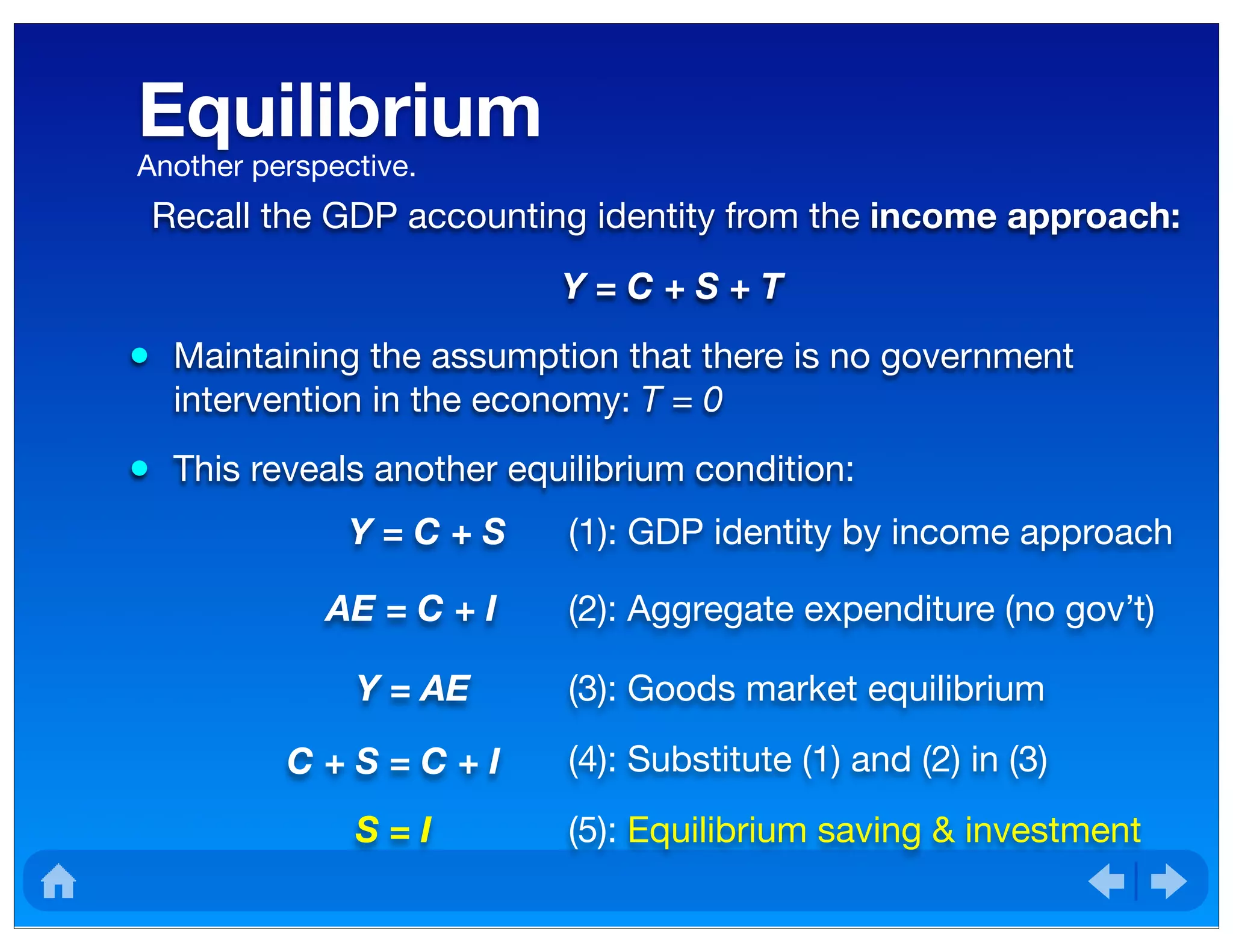
Recall the GDP accounting identity from the income approach:
Y = C + S + T
• Maintaining the assumption that there is no government
intervention in the economy: T = 0
• This reveals another equilibrium condition:
Another perspective.
Y = C + S (1): GDP identity by income approach
AE = C + I (2): Aggregate expenditure (no gov’t)
Y = AE (3): Goods market equilibrium
C + S = C + I (4): Substitute (1) and (2) in (3)
S = I (5): Equilibrium saving & investment
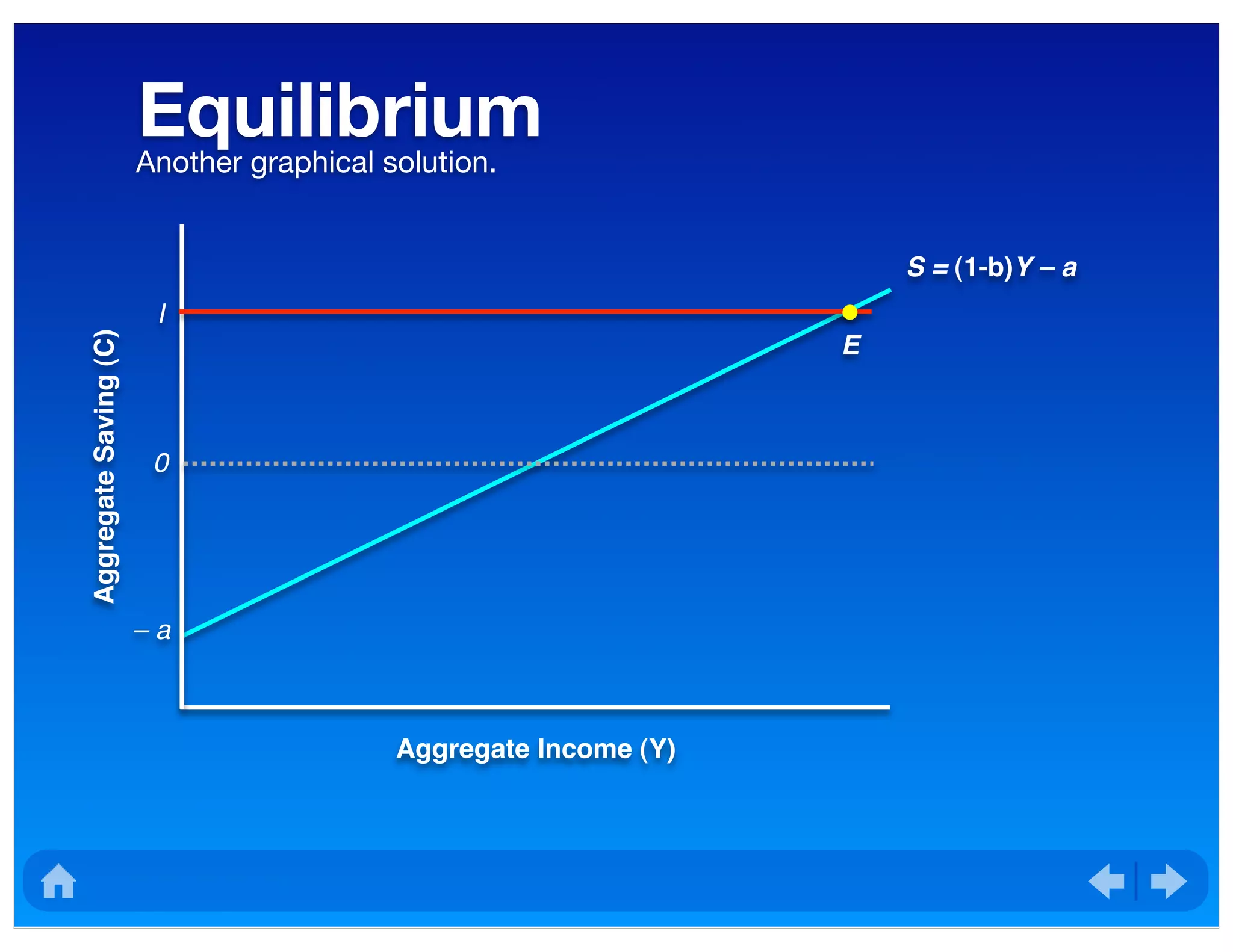
EquilibriumAnother graphical solution.
AggregateSaving(C)
Aggregate Income (Y)
– a
S = (1-b)Y – a
0
I
E
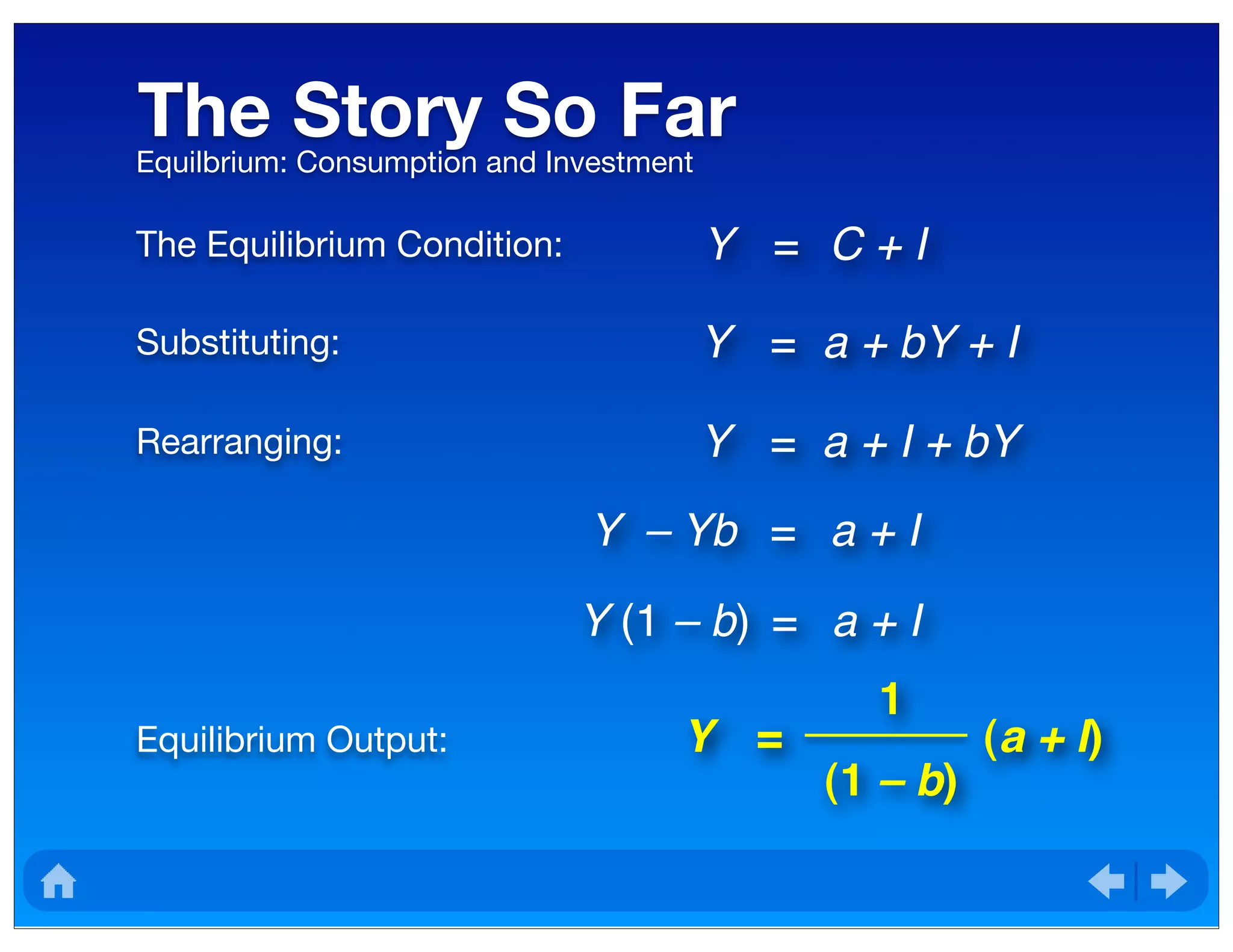
The Story So FarEquilbrium: Consumption and Investment
The Equilibrium Condition: Y = C + I
Rearranging:
Substituting: Y = a + bY + I
Y = a + I + bY
Y = (a + I)
(1 – b)
1
Y – Yb = a + I
Y (1 – b) = a + I
Equilibrium Output:
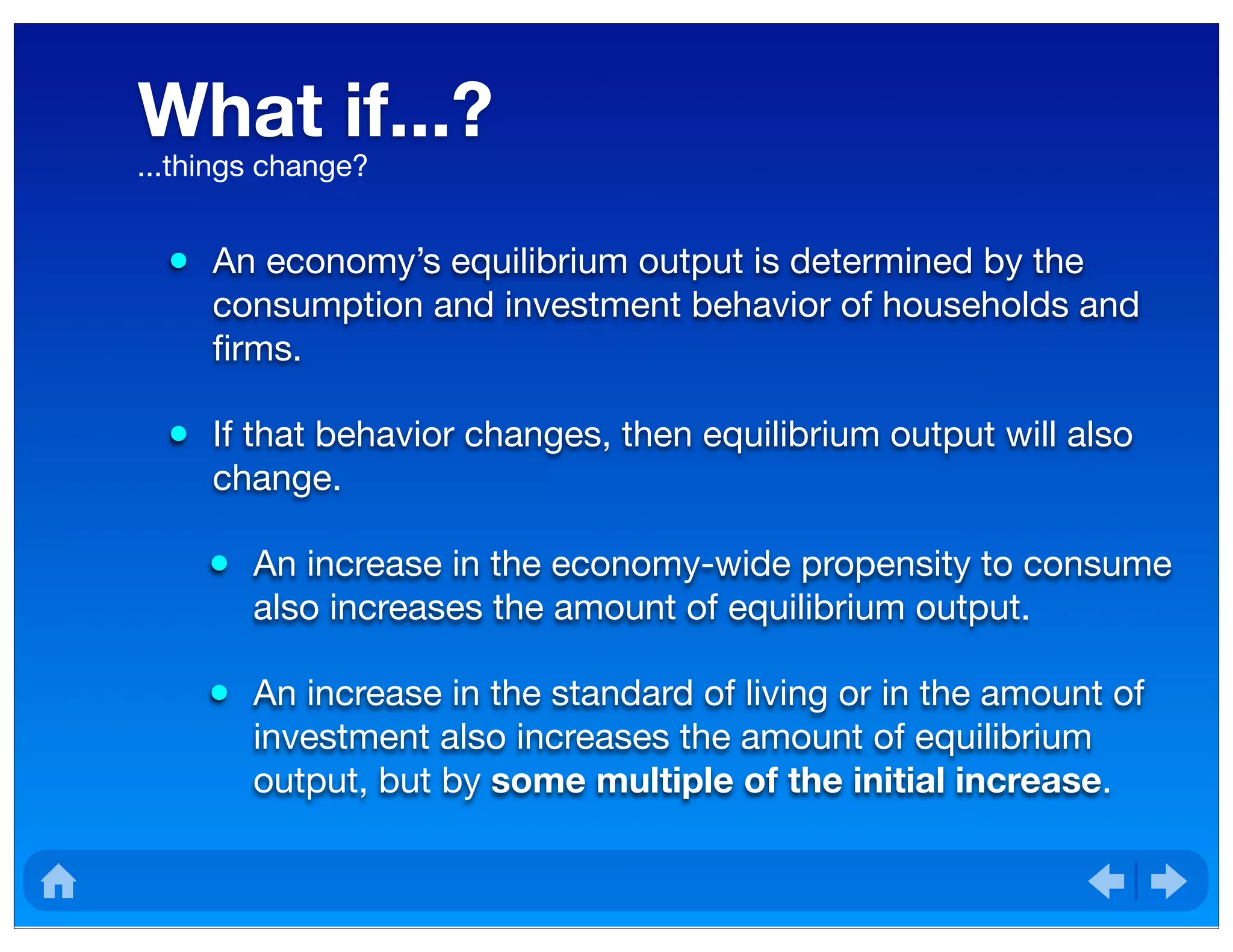
What if...?
• An economy’s equilibrium output is determined by the
consumption and investment behavior of households and
firms.
• If that behavior changes, then equilibrium output will also
change.
• An increase in the economy-wide propensity to consume
also increases the amount of equilibrium output.
• An increase in the standard of living or in the amount of
investment also increases the amount of equilibrium
output, but by some multiple of the initial increase.
...things change?
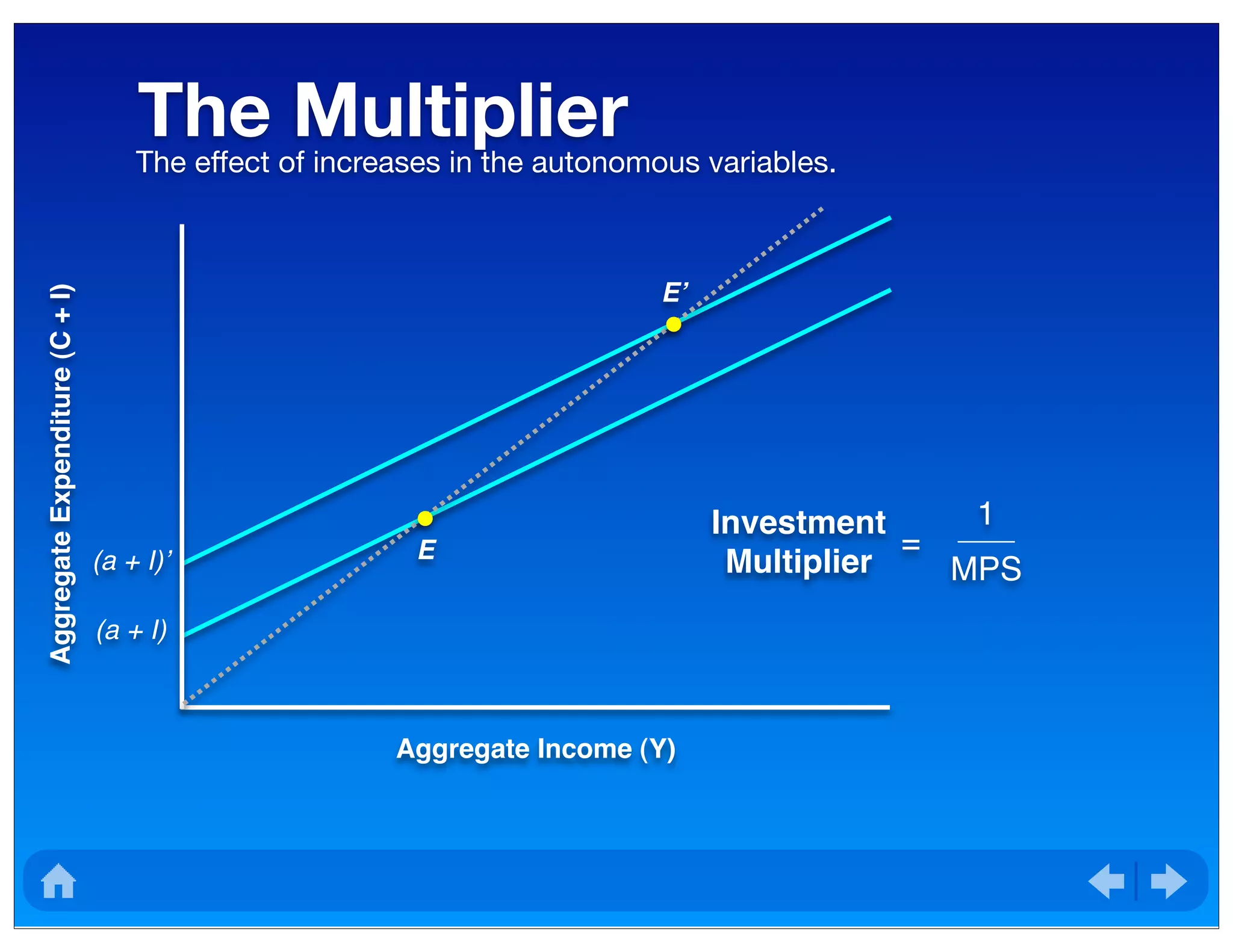
AggregateExpenditure(C+I)
Aggregate Income (Y)
(a + I)
E(a + I)’
E’
The MultiplierThe effect of increases in the autonomous variables.
Investment
Multiplier
=
1
MPS
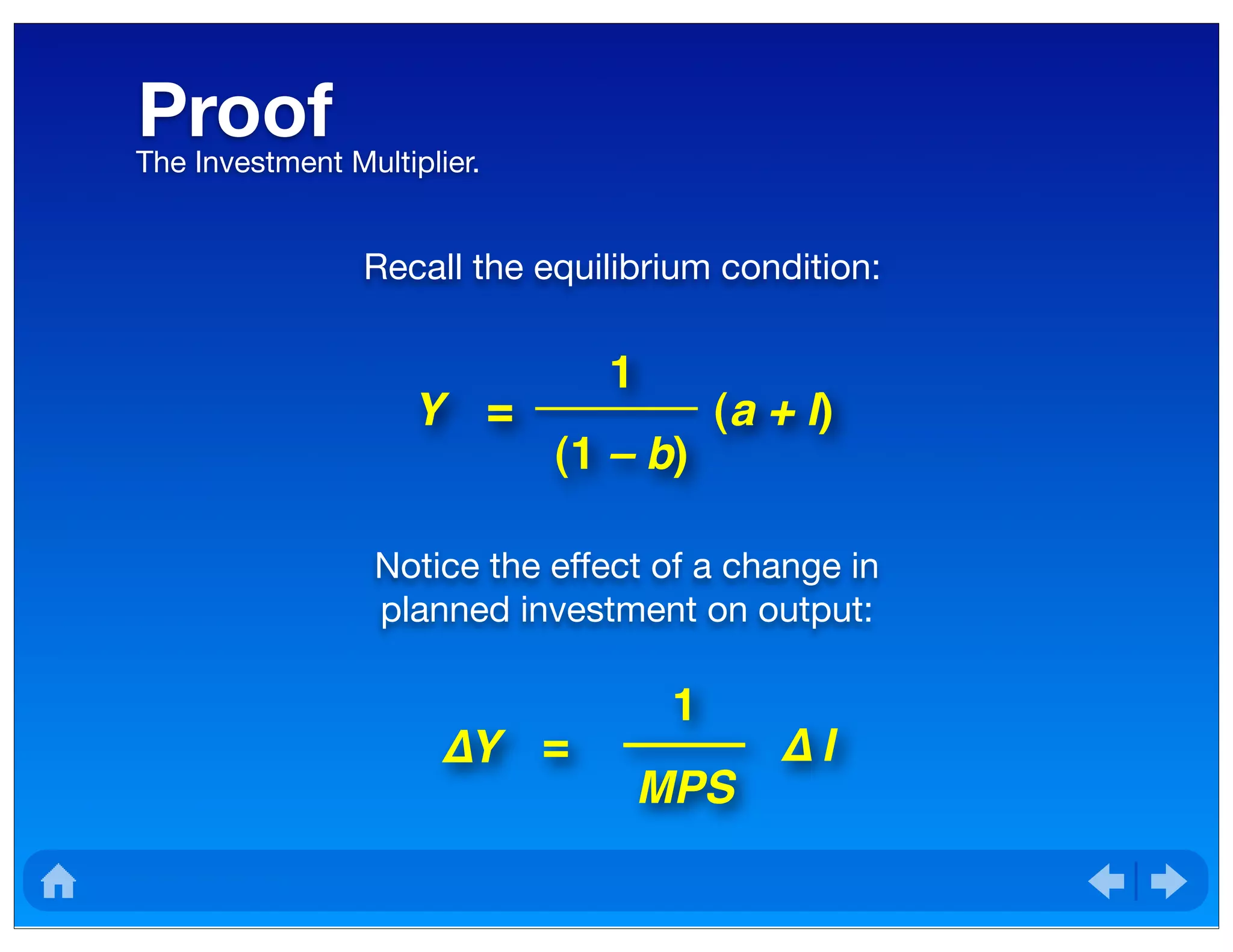
ProofThe Investment Multiplier.
Y = (a + I)
(1 – b)
1
Recall the equilibrium condition:
Notice the effect of a change in
planned investment on output:
∆Y =
1
MPS
∆ I
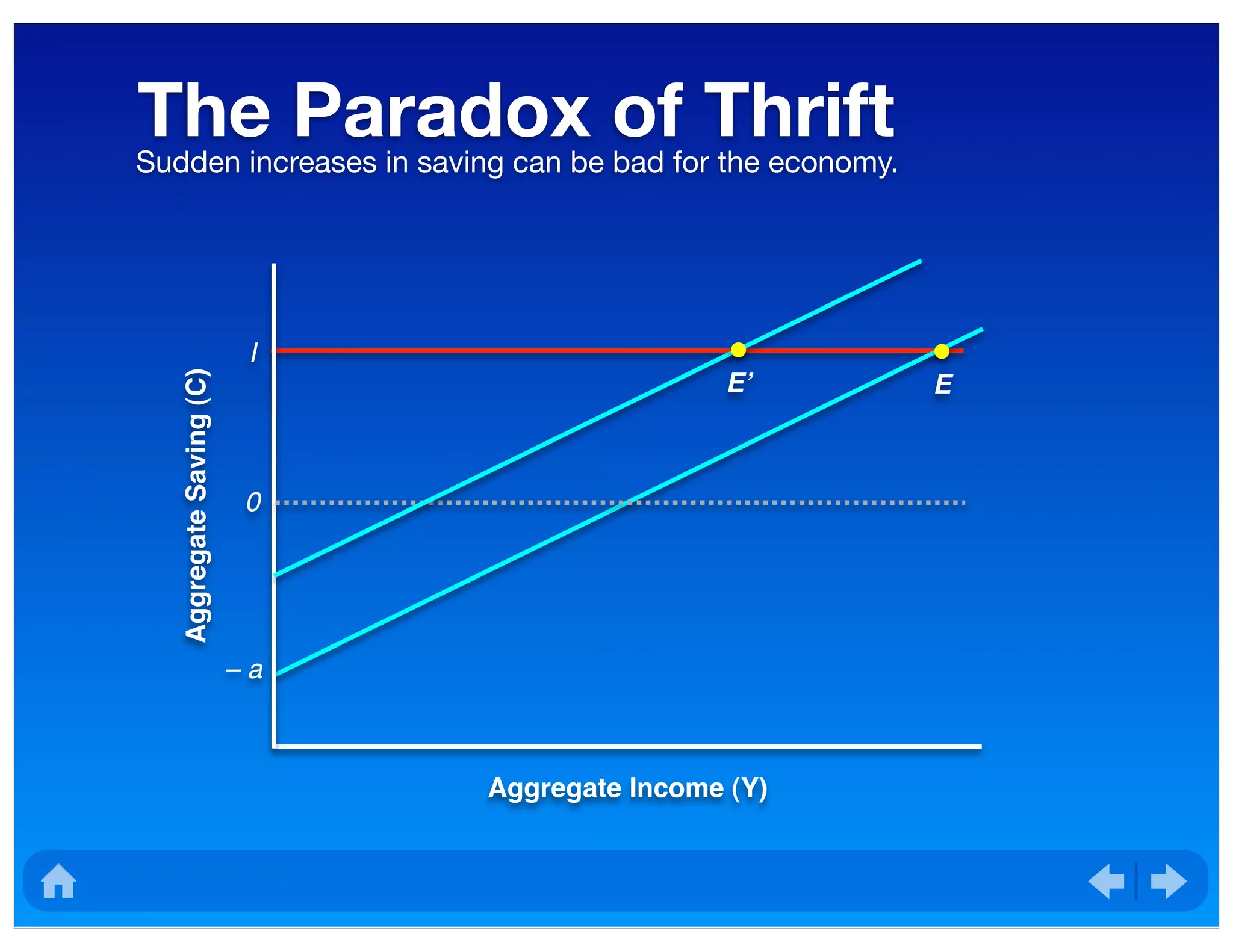
The Paradox of ThriftSudden increases in saving can be bad for the economy.
AggregateSaving(C)
Aggregate Income (Y)
– a
0
I
EE’

Macroeconomic Consumer Theory

  • 1.
    Expenditure and output Saving,Consumption and Investment in the Economy
  • 2.
    Aggregate Output /Income Recall the national income accounting identity: Y = C + I + G + (X – M) • From the identity, Y represents Gross Domestic Product (GDP). • We know that GDP accounts for the goods and services supplied in the economy over a given period. • From a different perspective, GDP also accounts for all the income received by the factors of production in a given period. • Thus, to simplify, Y is a variable that measures both aggregate output and aggregate income. A look back at GDP and what it means.
  • 3.
    Simplifications • Recall thatall variables are aggregates. • Since people only care about the “real” value of their income/output, we can assume that all variables under consideration are expressed in real terms. • To proceed with the analysis, we can consider the simplest case: • There is no government intervention in the economy (i.e. G = 0). • A closed economy model (i.e. [X – M] = 0). • Thus, our model reduces to: Y = C + I Some assumptions to make the analysis easier.
  • 4.
    Consumption Determinants of aggregateconsumption: 1. Household Income 2. Household Wealth 3. Households’ Expectations about the Future 4. Interest Rates Identifying the factors that influence spending behavior.
  • 5.
    Consumption Behavior • Basedon our simplified model, we can say that consumption is a function of income: C = f(Y) • More specifically, the relationship between consumption and income can be modeled as follows: The Keynesian consumption function. C = a + bY where a = autonomous consumption b = marginal propensity to consume (MPC)
  • 6.
    C = a+ bY Consumption BehaviorThe Keynesian consumption function. AggregateConsumption(C) Aggregate Income (Y) a }Autonomous Consumption ∆ C ∆ Y = b = MPC ∆ C ∆ Y Slope =
  • 7.
    Saving ≠ Savings •Saving refers to the amount from this period’s income that has not been spent. • It is a flow variable and may vary from period to period. • Savings refers to the total amount that households have saved over their lifetimes. • It is a stock variable that totals saving from day zero to the present. A little note on terminology (and a lot of nitpicking).
  • 8.
    Saving Behavior The Keynesiansaving function. Consider: Saving is the difference between income and consumption. S = Y – C From the consumption function: C = a + bY Substituting: S = Y – (a + bY) Simplifying, we derive the saving function: S = – a + (1 –b)Y where (1 – b) = marginal propensity to save
  • 9.
    Consumption and SavingAnumerical example Y 0 200 400 600 800 1000 C 100 250 400 550 700 850 S -100 -50 0 50 100 150 Given: C = 100 + 0.75Y S = 0.25Y – 100
  • 10.
    At low incomes, consumersborrow. Lifetime ConsumptionHow would people consume if they knew their future income with certainty? Consumption(C) Time (t) C Y At higher incomes, consumers save and/or pay off debt.
  • 11.
    0 250 500 750 1,000 0 200 400600 800 1,000 -100 -50 0 50 100 150 0 200 400 600 800 1,000 Y AggregateConsumption(C) S Y C = Y C AggregateSavings(S) Aggregate Income (Y) Aggregate Income (Y) C = 100 + 0.75Y S = 0.25Y – 100 S = 0
  • 12.
    Investment • Review: investment,together with consumption, make up aggregate expenditure: Y = C + I • From a macroeconomic standpoint, investment pertains to purchases that add to the stock of physical capital. • Recall the production function: Y = f(K, L) • Investment encompasses business fixed investments and changes in business inventories. Conceptualizing investment.
  • 13.
    Interest Rates • Theinterest rate is the opportunity cost of investment. • An example: assume an interest rate of 5%: • Do you take an investment that returns 10%? • Do you take an investment that returns 7.5%? • Do you take an investment that returns 5%? • Do you take an investment that returns 2.5%? Another aside on the relationship between investment and the interest rate. MPK = (1 + r ) Marginal Product of Capital Gross Return on Investment
  • 14.
    More on Investment •Firms sometimes invest more (or less) than originally intended. • For the present analysis, we are concerned only with planned investment. • There are only two principal determinants of investment: • The interest rate. • Business expectations. • Investment is not a function of income: it is an autonomous variable. A few more notes on investment.
  • 15.
    Planned InvestmentA lookat the planned investment function. PlannedInvestment(I) Aggregate Income (Y) I
  • 16.
    EquilibriumUnderstanding the equilibriumamount of aggregate output and income. Logically, the goods market will be in equilibrium when planned spending exhausts all goods produced. Y = Equilibrium Aggregate Output C + I = Planned Aggregate Expenditure EQUILIBRIUM: Y = C + I AE = a + bY + I = (a + I) + bY
  • 17.
    EquilibriumUnderstanding the equilibriumamount of aggregate output and income. Logically, the goods market will be in equilibrium when planned spending exhausts all goods produced. If Y > C + I, too much is being produced in the economy. Consequence: Output will fall. EQUILIBRIUM: Y = C + I If Y < C + I, too little is being produced in the economy. Consequence: Output will rise.
  • 18.
    EquilibriumDoing the math. 0 200 400 600 800 1,000 0200 400 600 800 1,000 “C + I” Aggregate Income (Y) AggregateExpenditure(C,I) “C”
  • 19.
    EquilibriumDoing the math. YC I 0 100 25 200 250 25 400 400 25 600 550 25 800 700 25 1000 850 25 Given: Y = C + I (Equilibrium) C = 100 + 0.75Y I = 25
  • 20.
    EquilibriumThe graphical solution:the Keynesian cross. 0 200 400 600 800 1,000 0 200 400 600 800 1,000 C + I Anywhere in this region, Y < C + I Anywhere in this region, Y > C + I Y = C + I Aggregate Income (Y) AggregateExpenditure(C,I) E
  • 21.
    Equilibrium Recall the GDPaccounting identity from the income approach: Y = C + S + T • Maintaining the assumption that there is no government intervention in the economy: T = 0 • This reveals another equilibrium condition: Another perspective. Y = C + S (1): GDP identity by income approach AE = C + I (2): Aggregate expenditure (no gov’t) Y = AE (3): Goods market equilibrium C + S = C + I (4): Substitute (1) and (2) in (3) S = I (5): Equilibrium saving & investment
  • 22.
  • 23.
    The Story SoFarEquilbrium: Consumption and Investment The Equilibrium Condition: Y = C + I Rearranging: Substituting: Y = a + bY + I Y = a + I + bY Y = (a + I) (1 – b) 1 Y – Yb = a + I Y (1 – b) = a + I Equilibrium Output:
  • 24.
    What if...? • Aneconomy’s equilibrium output is determined by the consumption and investment behavior of households and firms. • If that behavior changes, then equilibrium output will also change. • An increase in the economy-wide propensity to consume also increases the amount of equilibrium output. • An increase in the standard of living or in the amount of investment also increases the amount of equilibrium output, but by some multiple of the initial increase. ...things change?
  • 25.
    AggregateExpenditure(C+I) Aggregate Income (Y) (a+ I) E(a + I)’ E’ The MultiplierThe effect of increases in the autonomous variables. Investment Multiplier = 1 MPS
  • 26.
    ProofThe Investment Multiplier. Y= (a + I) (1 – b) 1 Recall the equilibrium condition: Notice the effect of a change in planned investment on output: ∆Y = 1 MPS ∆ I
  • 27.
    The Paradox ofThriftSudden increases in saving can be bad for the economy. AggregateSaving(C) Aggregate Income (Y) – a 0 I EE’