AGGREgate supply and demand
Goods and Money Market Equilibrium: Bringing Everything Together
Review
• The goods market is in equilibrium where Y = AE.
• The money market is in equilibrium at that interest rate
where money demanded is equal to money supplied.
• The goods and money market are related because income
affects our demand for money, and the interest rate
determines the amount of investment.
• There is an interest rate and a level of income at which both
the goods and money markets are in equilibrium.
• Fiscal and monetary policies affect the equilibrium amount
of goods and services provided in the economy.
What we know about macroeconomics.
A Note on AD–AS Curves
• Aggregate demand and aggregate supply curves resemble
“traditional” demand and supply curves but are very
different.
• An individual or market supply curve depicts the
quantities that are demanded or supplied for a given
price level ceteris paribus.
• At the economy-wide level, we are unable to fully make
use of the assumption that everything else is constant.
• Recall: the goods market and money market are
intimately related through the demand for money and the
interest rate.
Points to ponder about aggregate demand and aggregate supply curves.
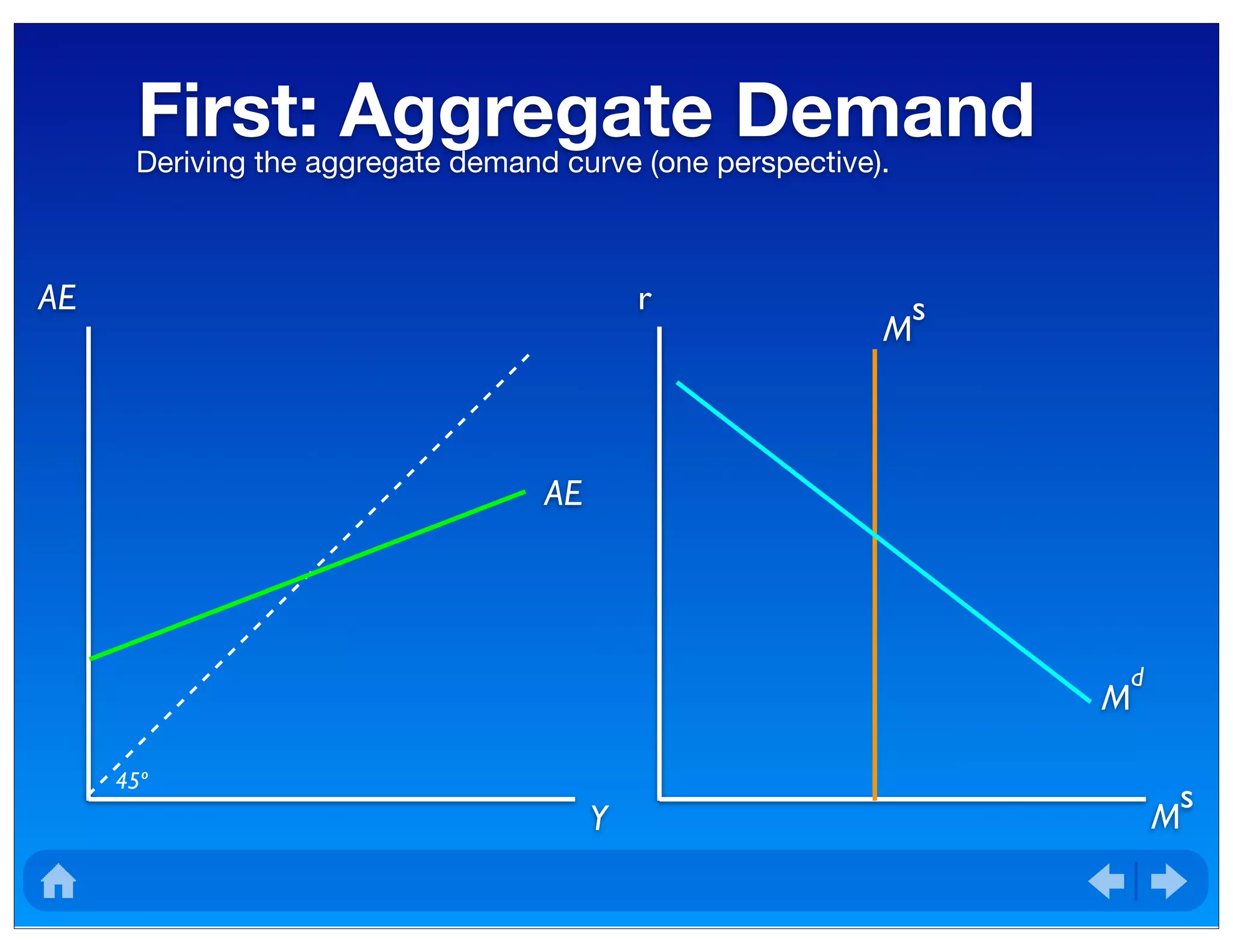
First: Aggregate DemandDeriving the aggregate demand curve (one perspective).
AE
Y
r
M
s
45º
M
s
M
d
AE
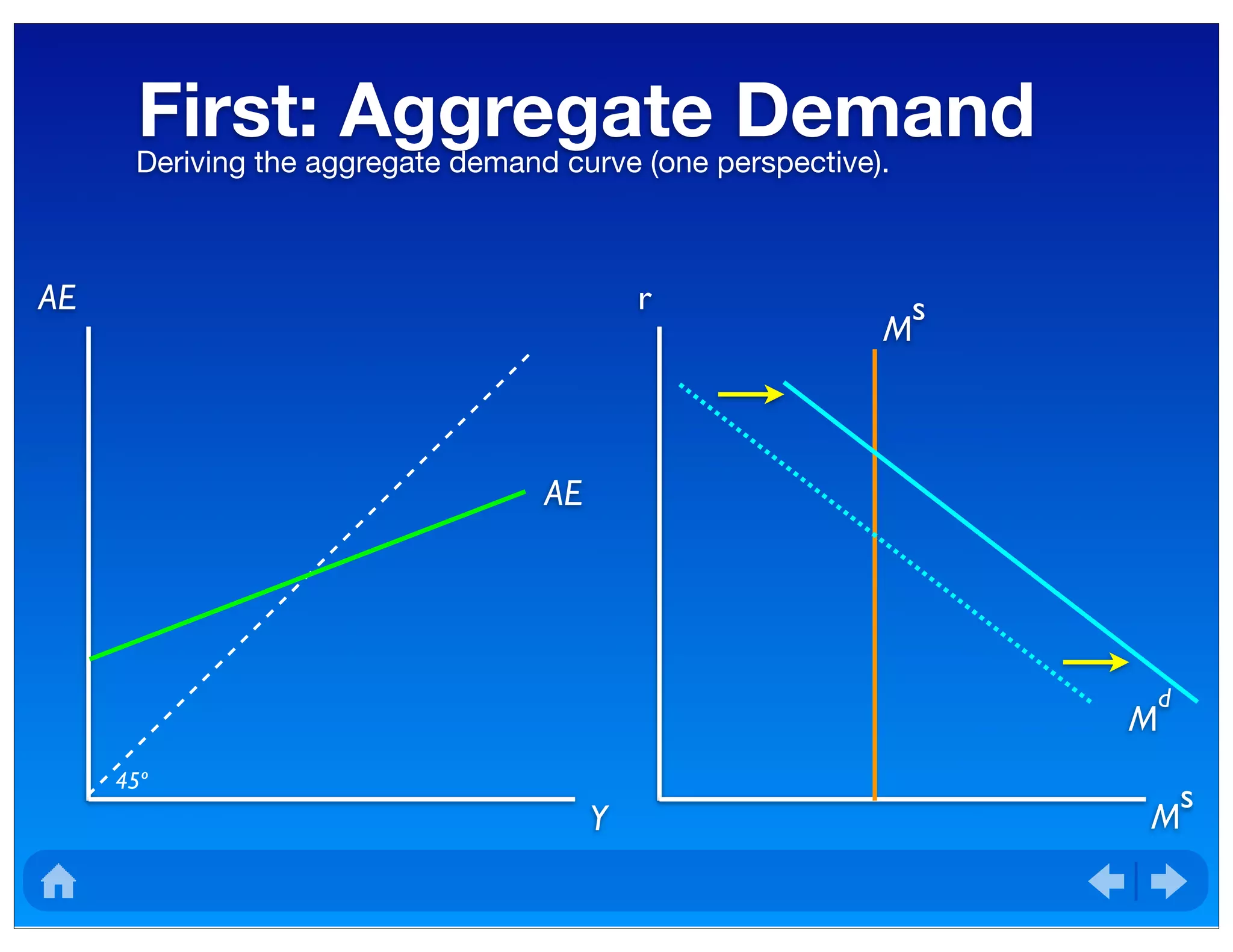
First: Aggregate DemandDeriving the aggregate demand curve (one perspective).
AE
Y
45º
AE
r
M
s
M
d
M
s
First: Aggregate DemandDeriving the aggregate demand curve (one perspective).
AE
Y
45º
AE
r
M
s
M
d
M
s
First: Aggregate DemandDeriving the aggregate demand curve (one perspective).
P
Y
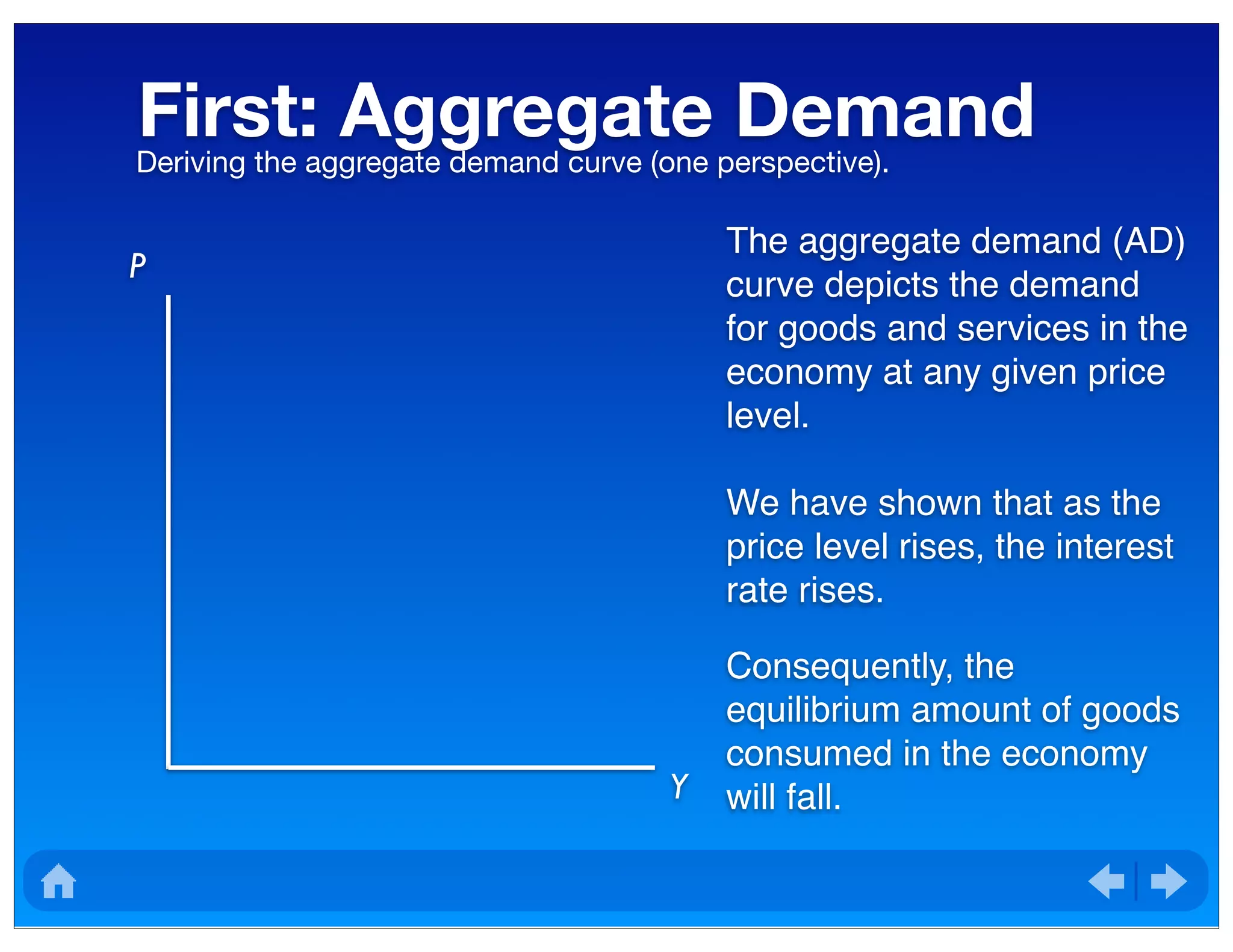
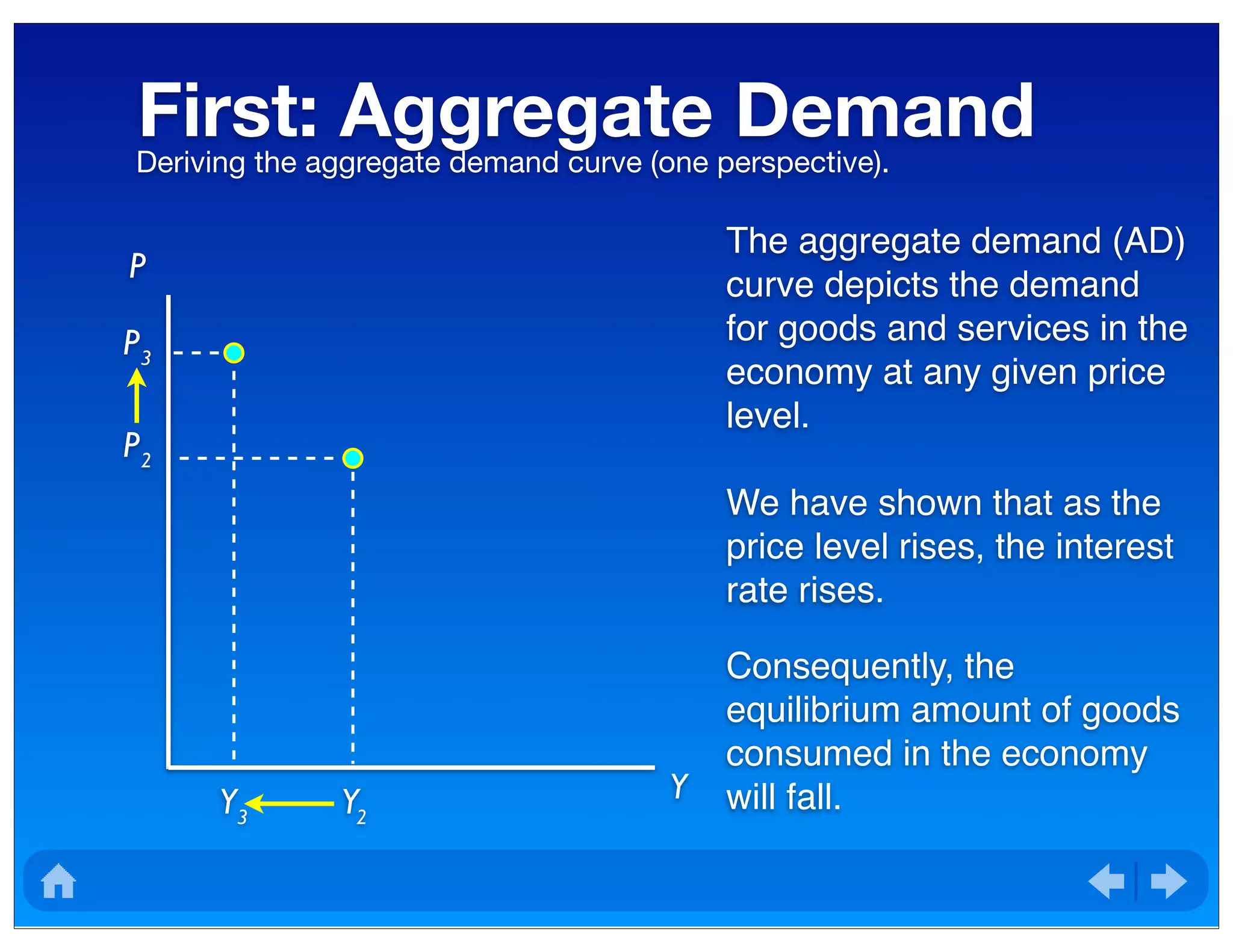
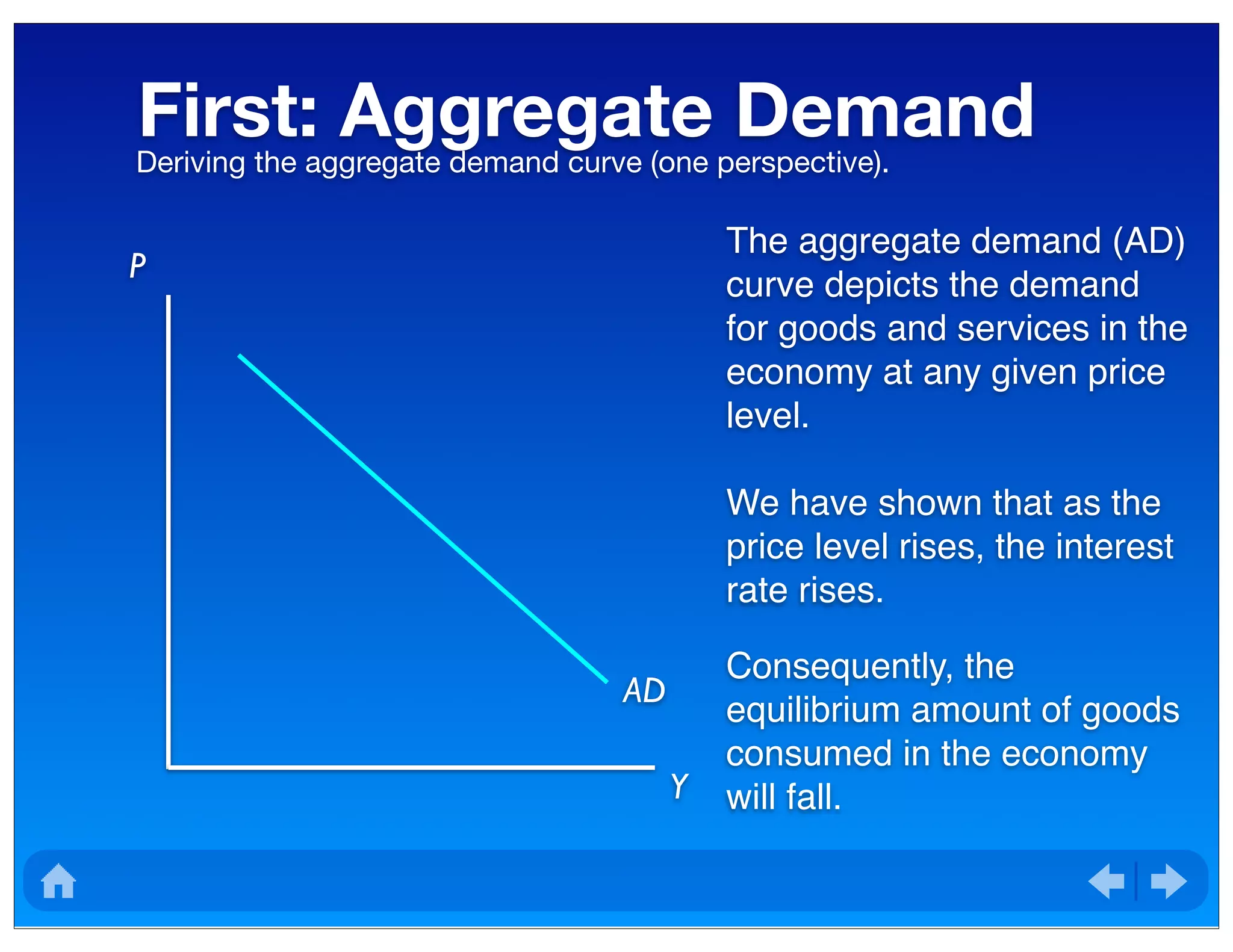
The aggregate demand (AD)
curve depicts the demand
for goods and services in the
economy at any given price
level.
We have shown that as the
price level rises, the interest
rate rises.
Consequently, the
equilibrium amount of goods
consumed in the economy
will fall.
First: Aggregate DemandDeriving the aggregate demand curve (one perspective).
P
Y
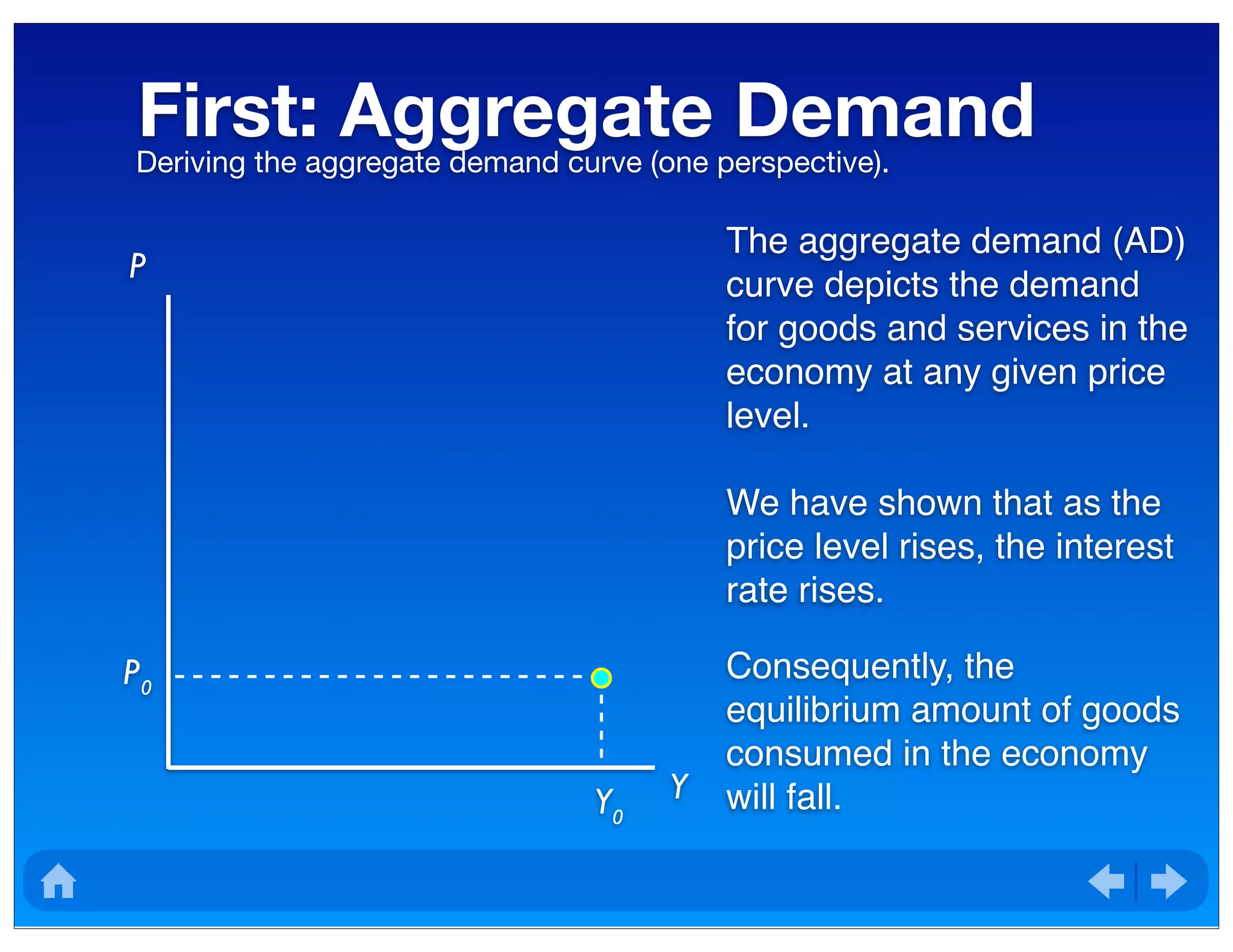
The aggregate demand (AD)
curve depicts the demand
for goods and services in the
economy at any given price
level.
We have shown that as the
price level rises, the interest
rate rises.
Consequently, the
equilibrium amount of goods
consumed in the economy
will fall.Y0
P0
First: Aggregate DemandDeriving the aggregate demand curve (one perspective).
P
Y
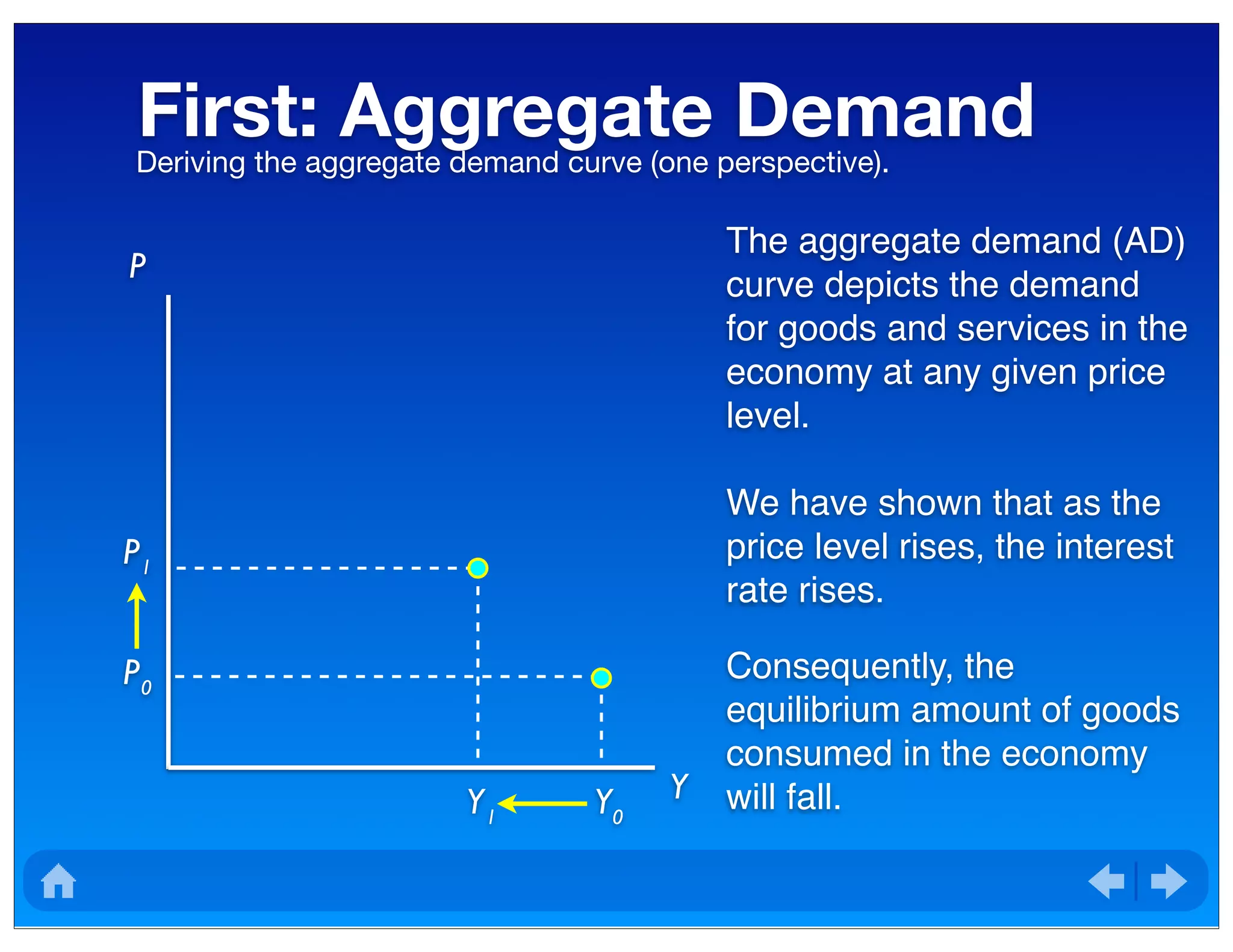
The aggregate demand (AD)
curve depicts the demand
for goods and services in the
economy at any given price
level.
We have shown that as the
price level rises, the interest
rate rises.
Consequently, the
equilibrium amount of goods
consumed in the economy
will fall.
P1
Y1 Y0
P0
First: Aggregate DemandDeriving the aggregate demand curve (one perspective).
P
Y
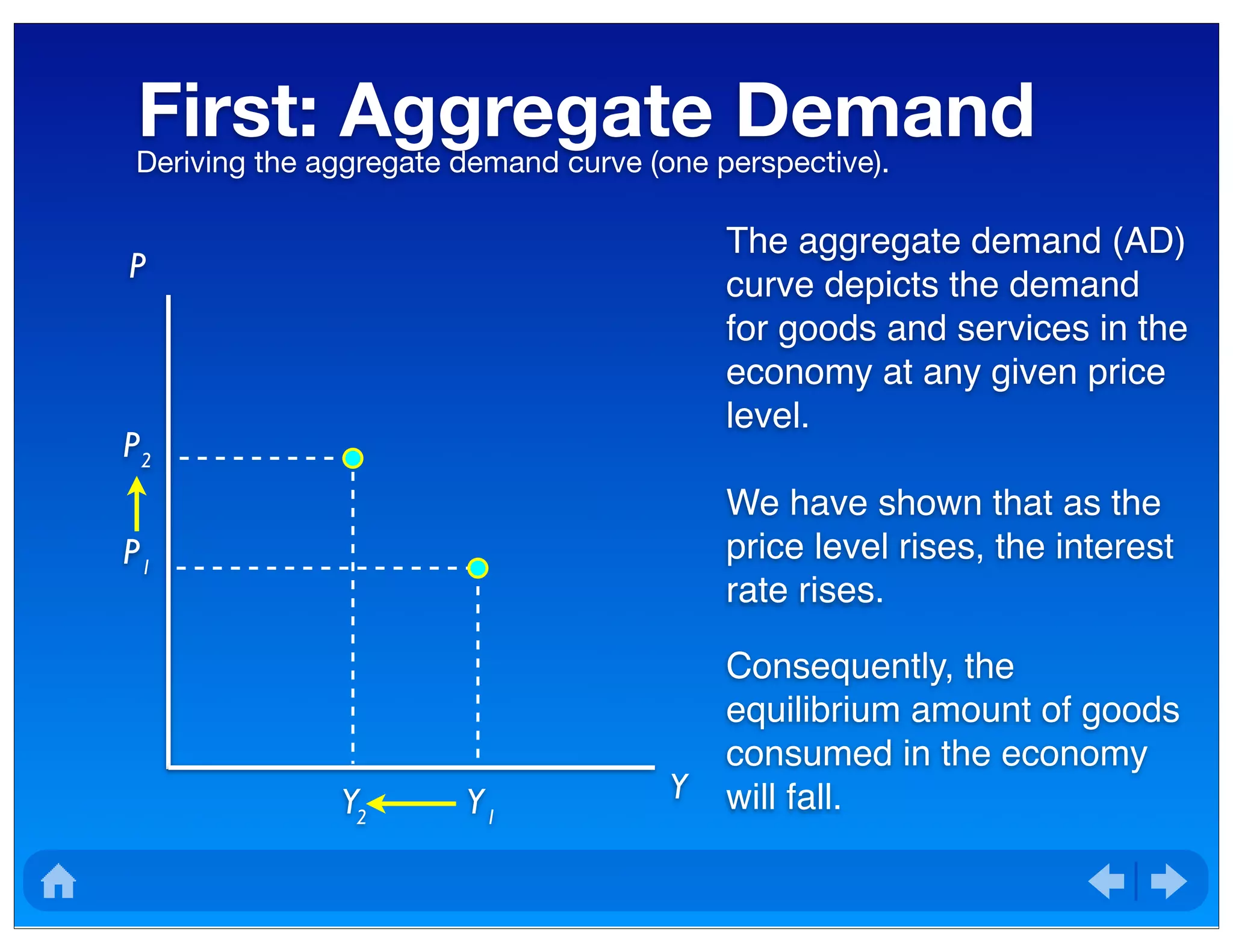
The aggregate demand (AD)
curve depicts the demand
for goods and services in the
economy at any given price
level.
We have shown that as the
price level rises, the interest
rate rises.
Consequently, the
equilibrium amount of goods
consumed in the economy
will fall.
P1
Y1Y2
P2
First: Aggregate DemandDeriving the aggregate demand curve (one perspective).
P
Y
The aggregate demand (AD)
curve depicts the demand
for goods and services in the
economy at any given price
level.
We have shown that as the
price level rises, the interest
rate rises.
Consequently, the
equilibrium amount of goods
consumed in the economy
will fall.Y3
P3
Y2
P2
First: Aggregate DemandDeriving the aggregate demand curve (one perspective).
P
Y
AD
The aggregate demand (AD)
curve depicts the demand
for goods and services in the
economy at any given price
level.
We have shown that as the
price level rises, the interest
rate rises.
Consequently, the
equilibrium amount of goods
consumed in the economy
will fall.
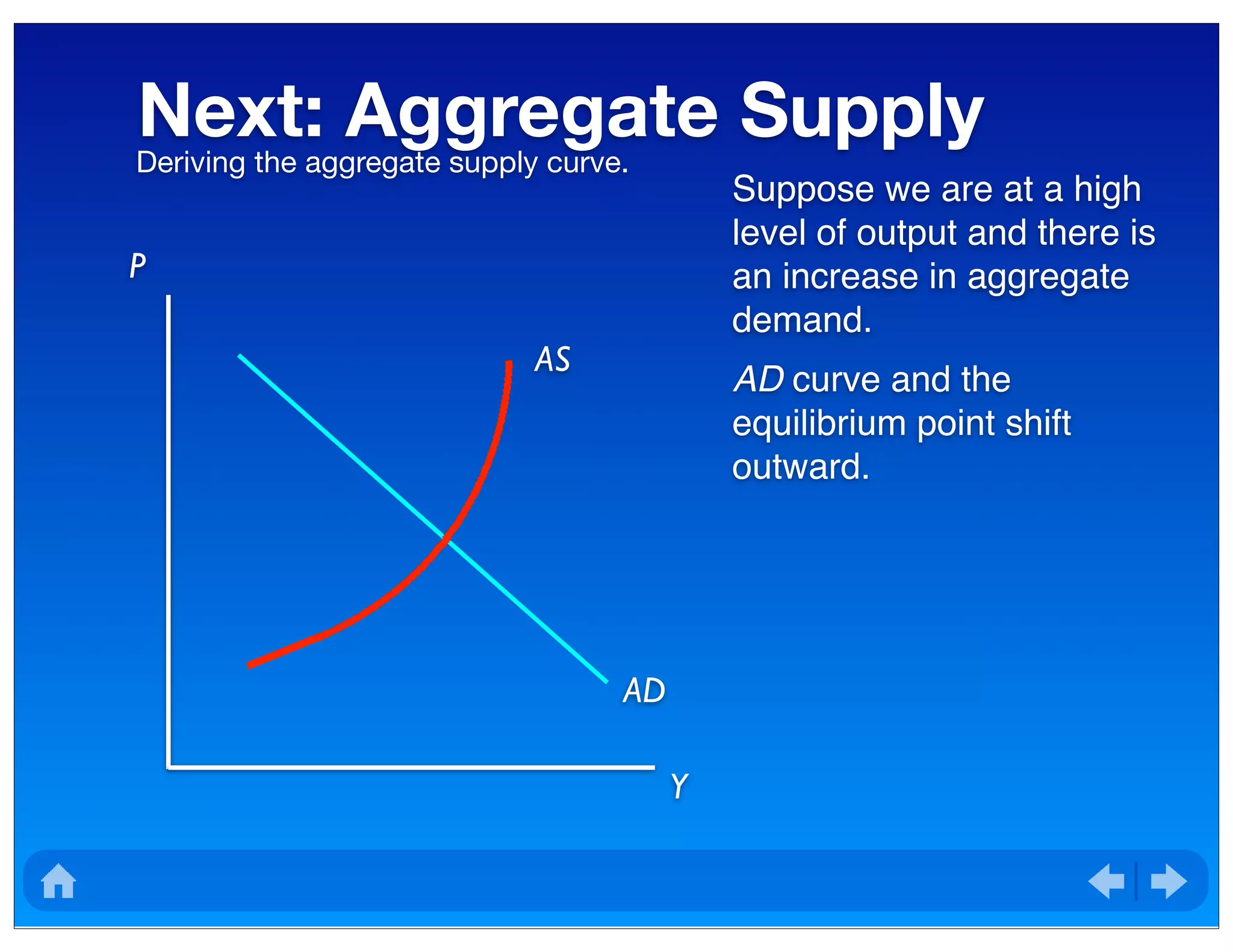
Next: Aggregate SupplyDeriving the aggregate supply curve.
P
Y
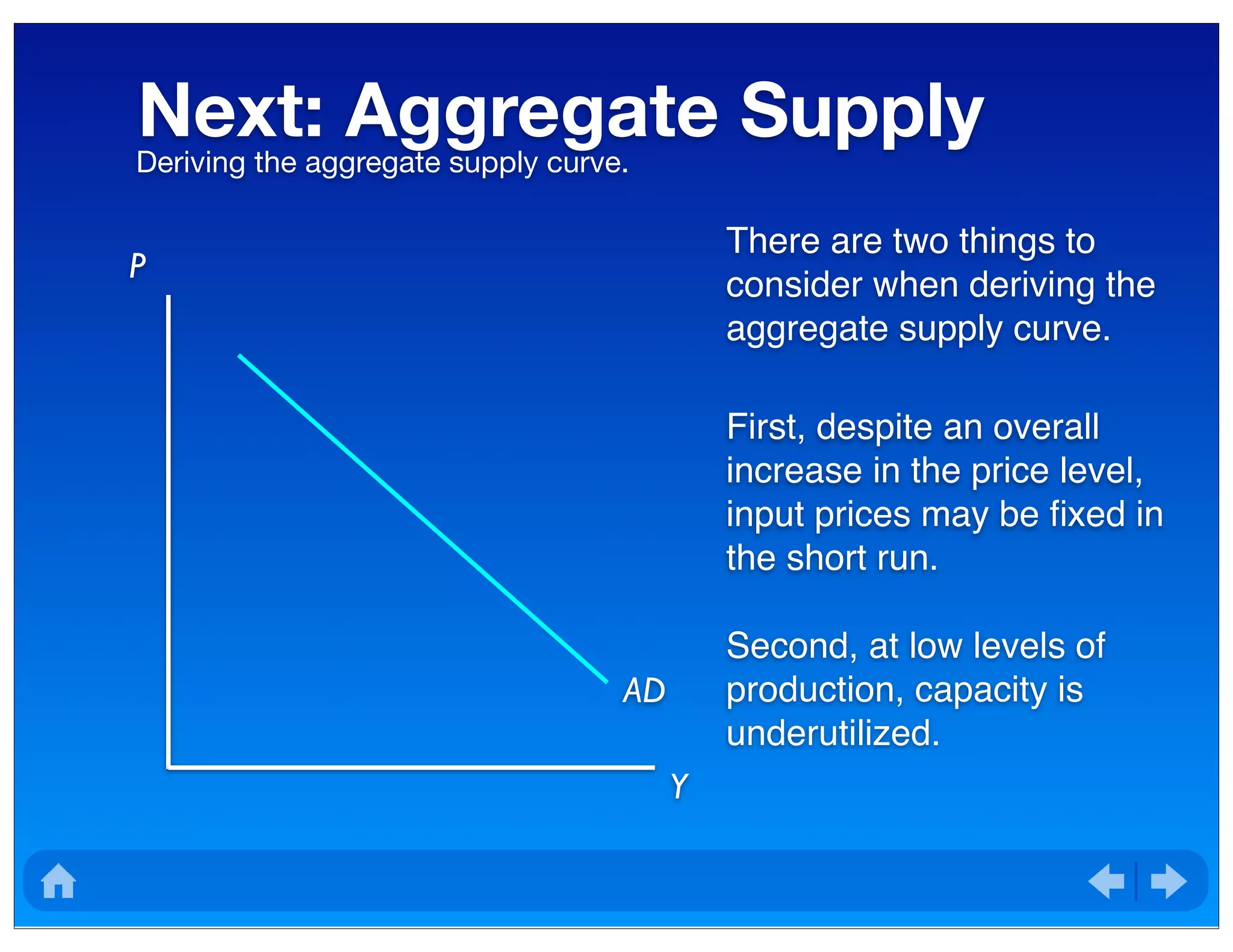
There are two things to
consider when deriving the
aggregate supply curve.
First, despite an overall
increase in the price level,
input prices may be fixed in
the short run.
Second, at low levels of
production, capacity is
underutilized.
AD
Next: Aggregate SupplyDeriving the aggregate supply curve.
P
Y
AD
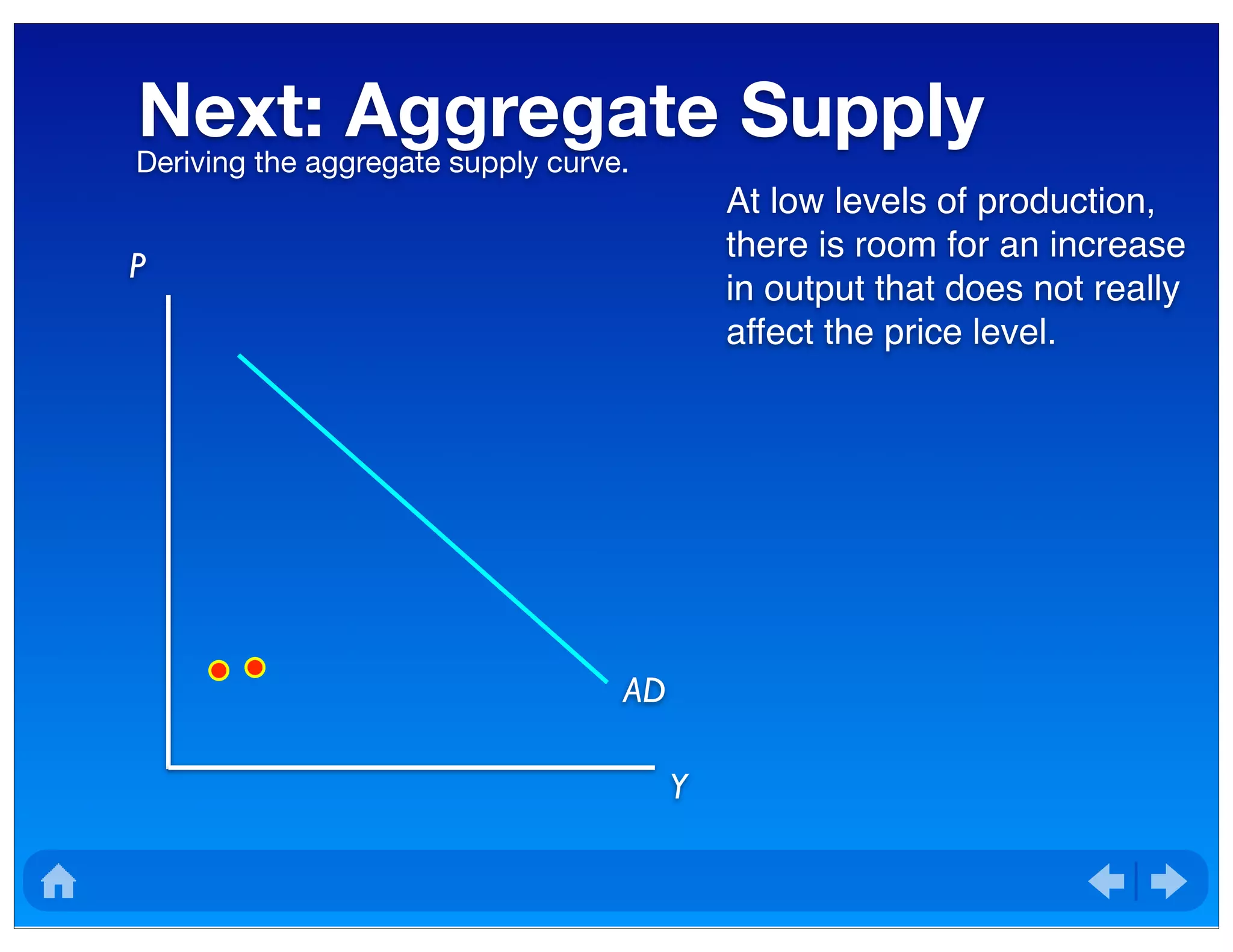
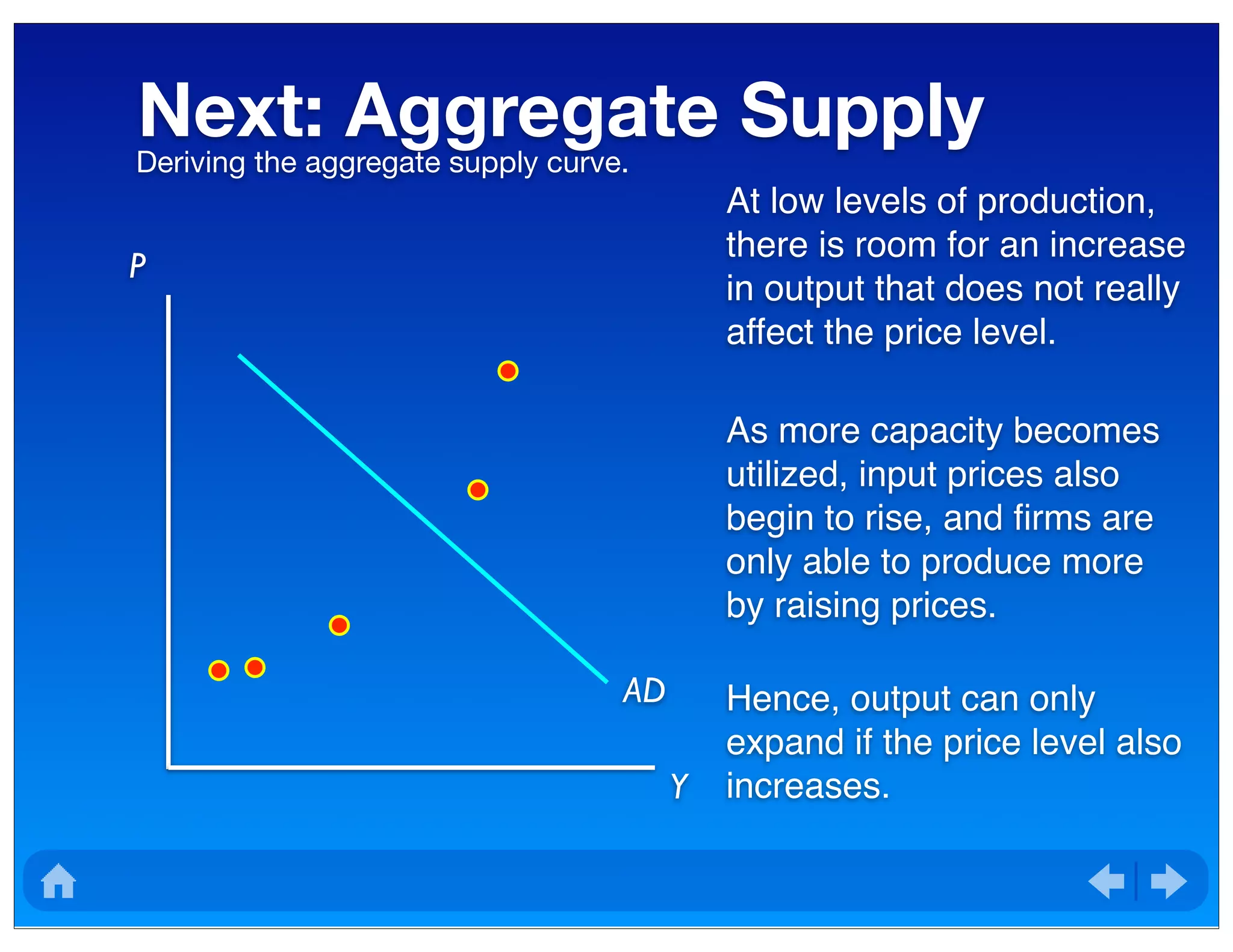
At low levels of production,
there is room for an increase
in output that does not really
affect the price level.
Next: Aggregate SupplyDeriving the aggregate supply curve.
P
Y
AD
At low levels of production,
there is room for an increase
in output that does not really
affect the price level.
As more capacity becomes
utilized, input prices also
begin to rise, and firms are
only able to produce more
by raising prices.
Hence, output can only
expand if the price level also
increases.
P
Y
AD
AS
Next: Aggregate SupplyDeriving the aggregate supply curve.
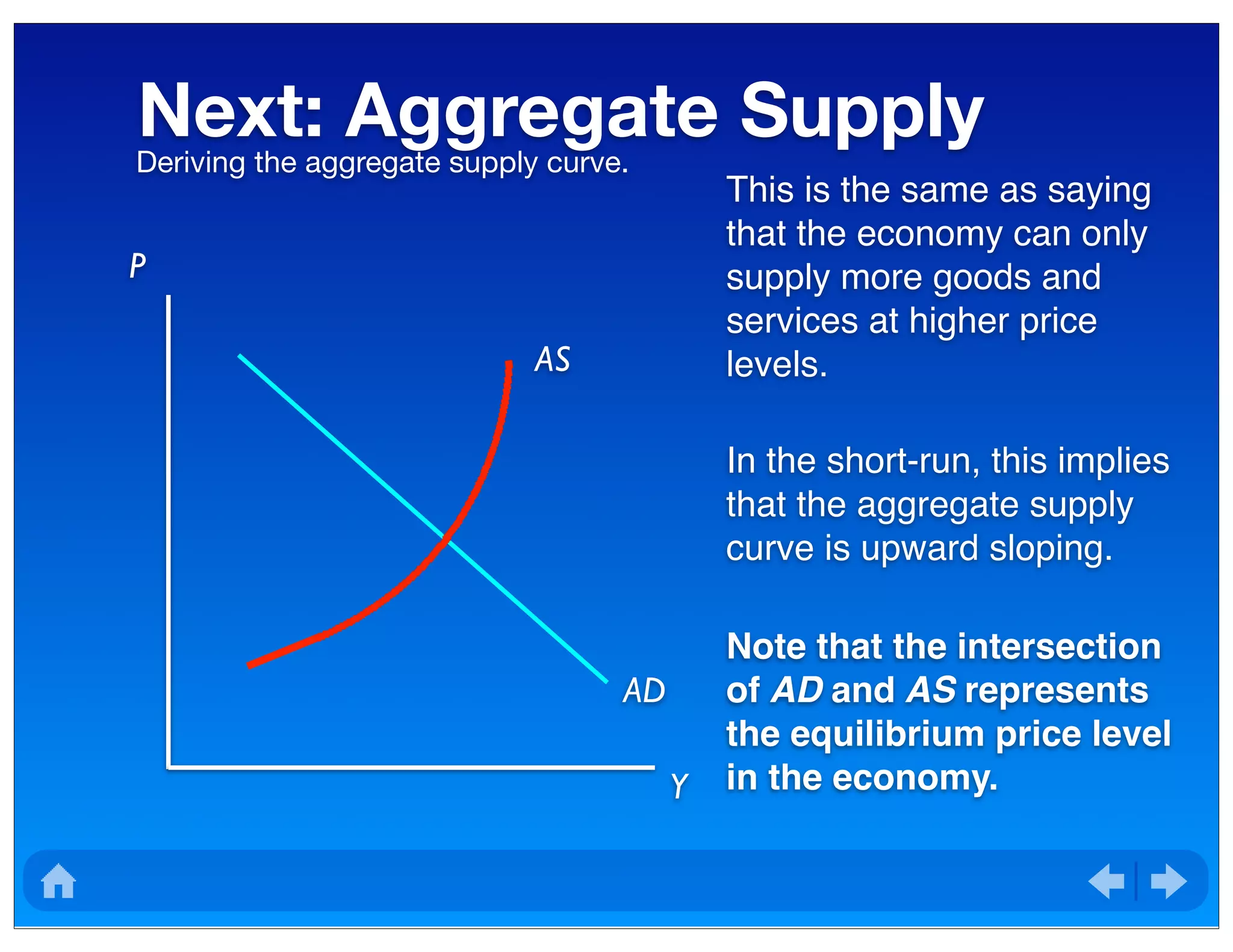
This is the same as saying
that the economy can only
supply more goods and
services at higher price
levels.
In the short-run, this implies
that the aggregate supply
curve is upward sloping.
Note that the intersection
of AD and AS represents
the equilibrium price level
in the economy.
Next: Aggregate SupplyDeriving the aggregate supply curve.
P
Y
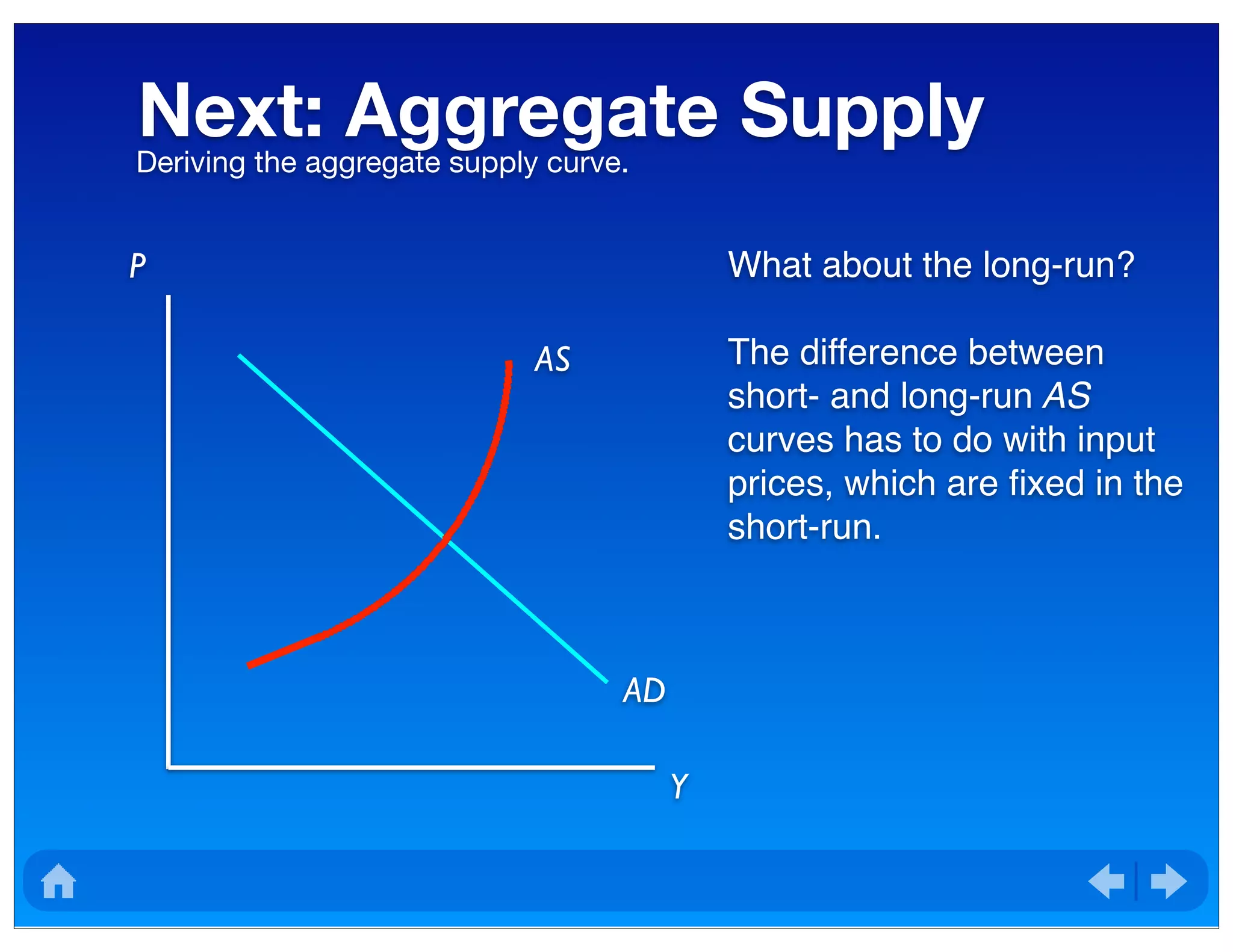
The difference between
short- and long-run AS
curves has to do with input
prices, which are fixed in the
short-run.
AS
What about the long-run?
AD
Next: Aggregate SupplyDeriving the aggregate supply curve.
P
Y
AS
AD
Next: Aggregate SupplyDeriving the aggregate supply curve.
P
Y
AS
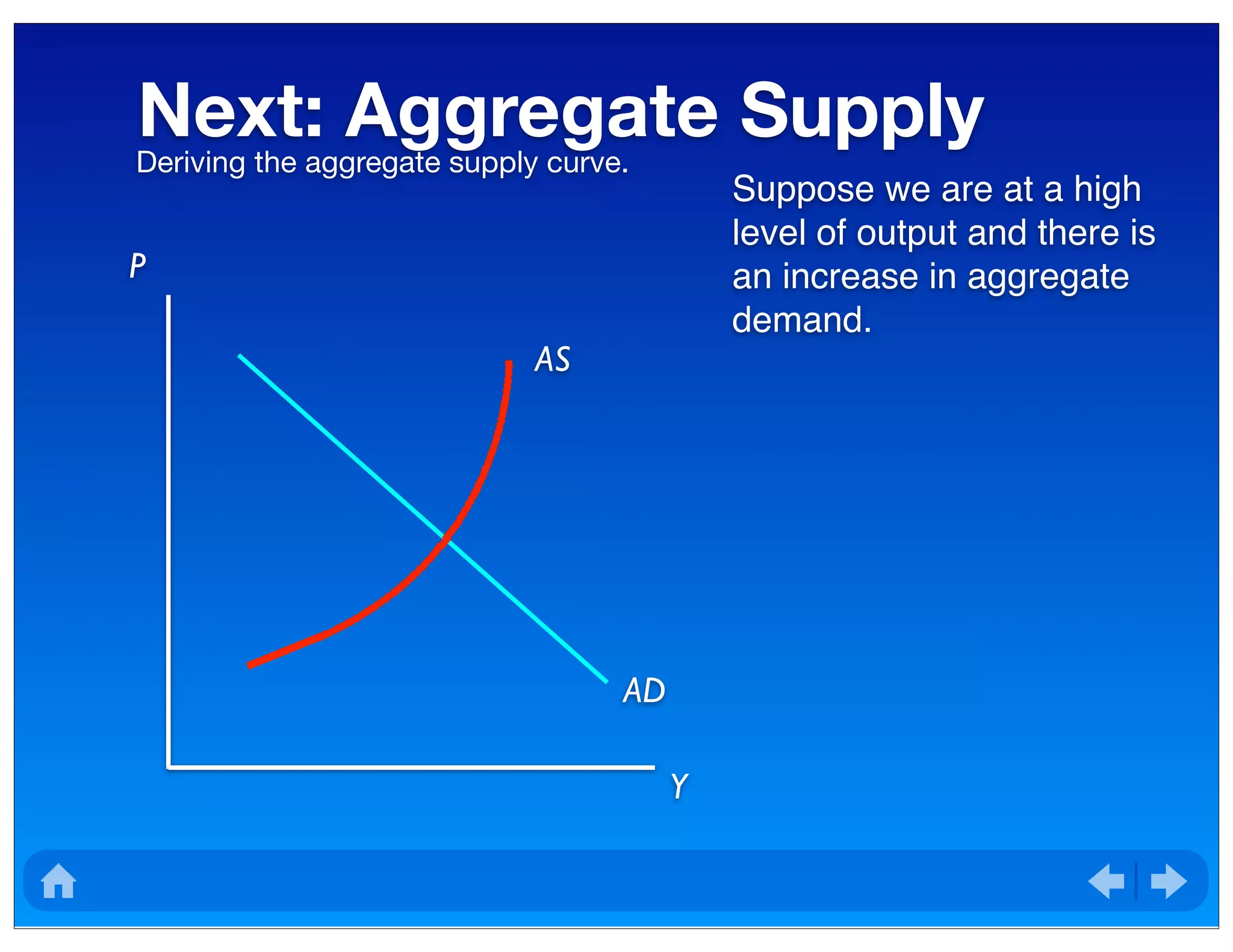
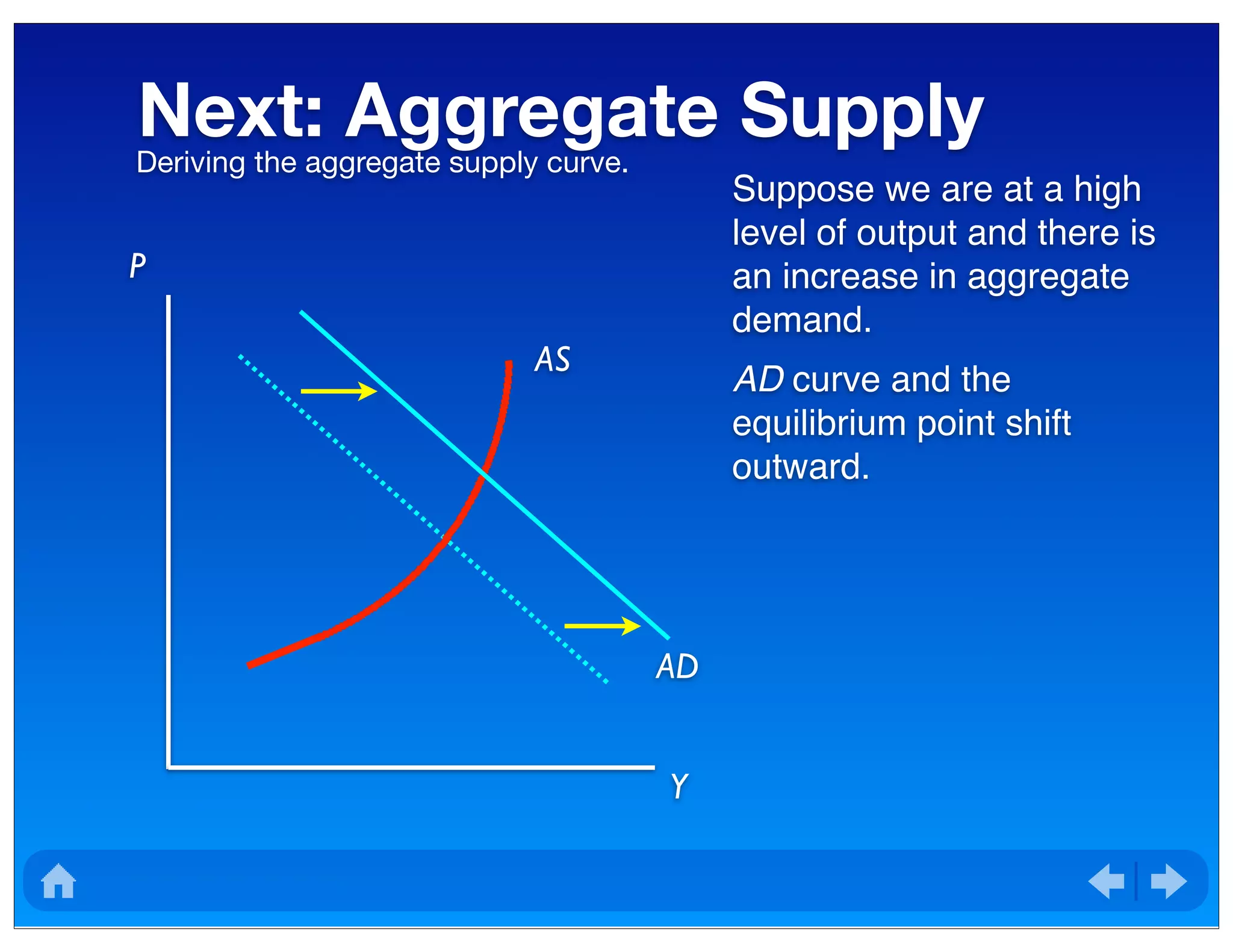
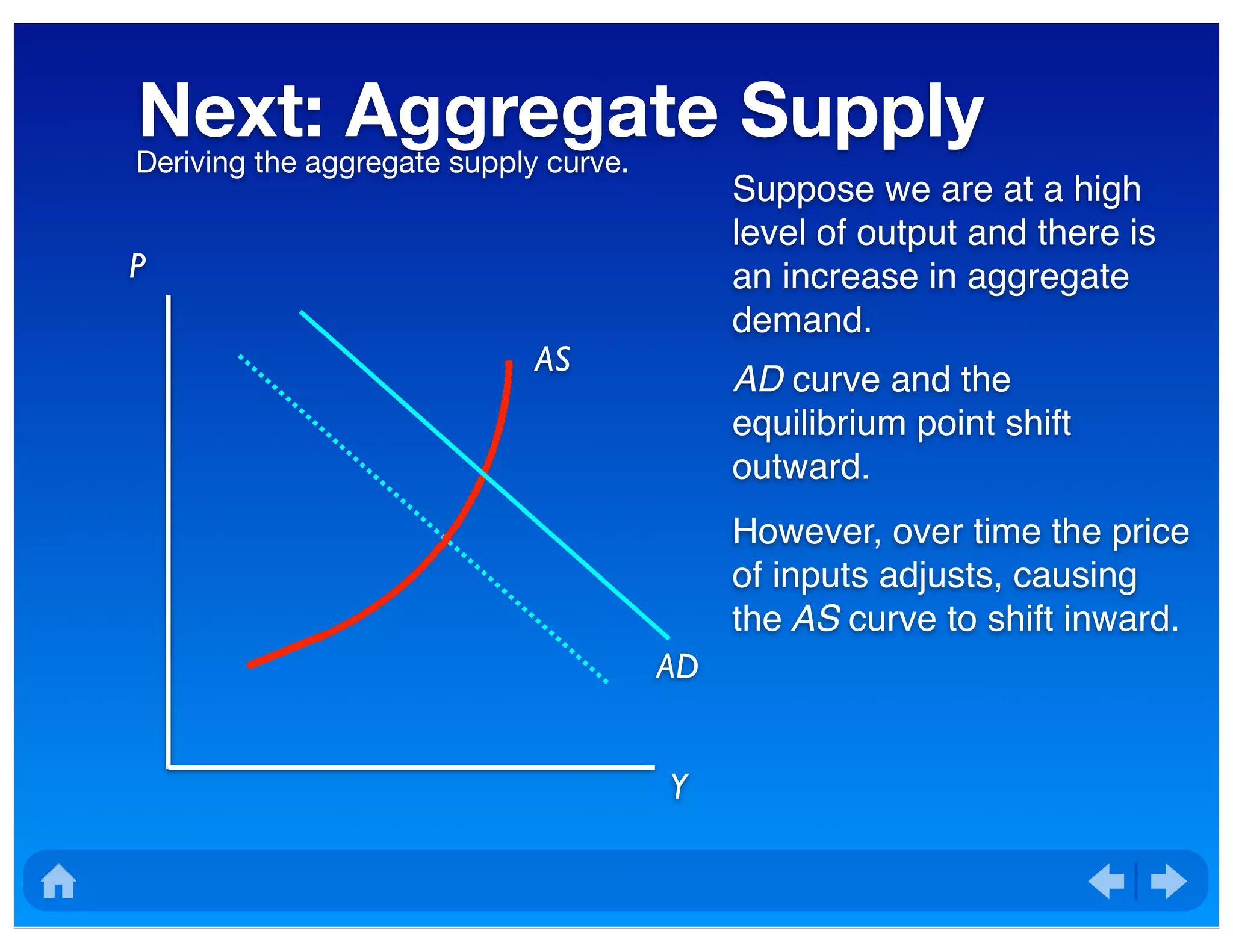
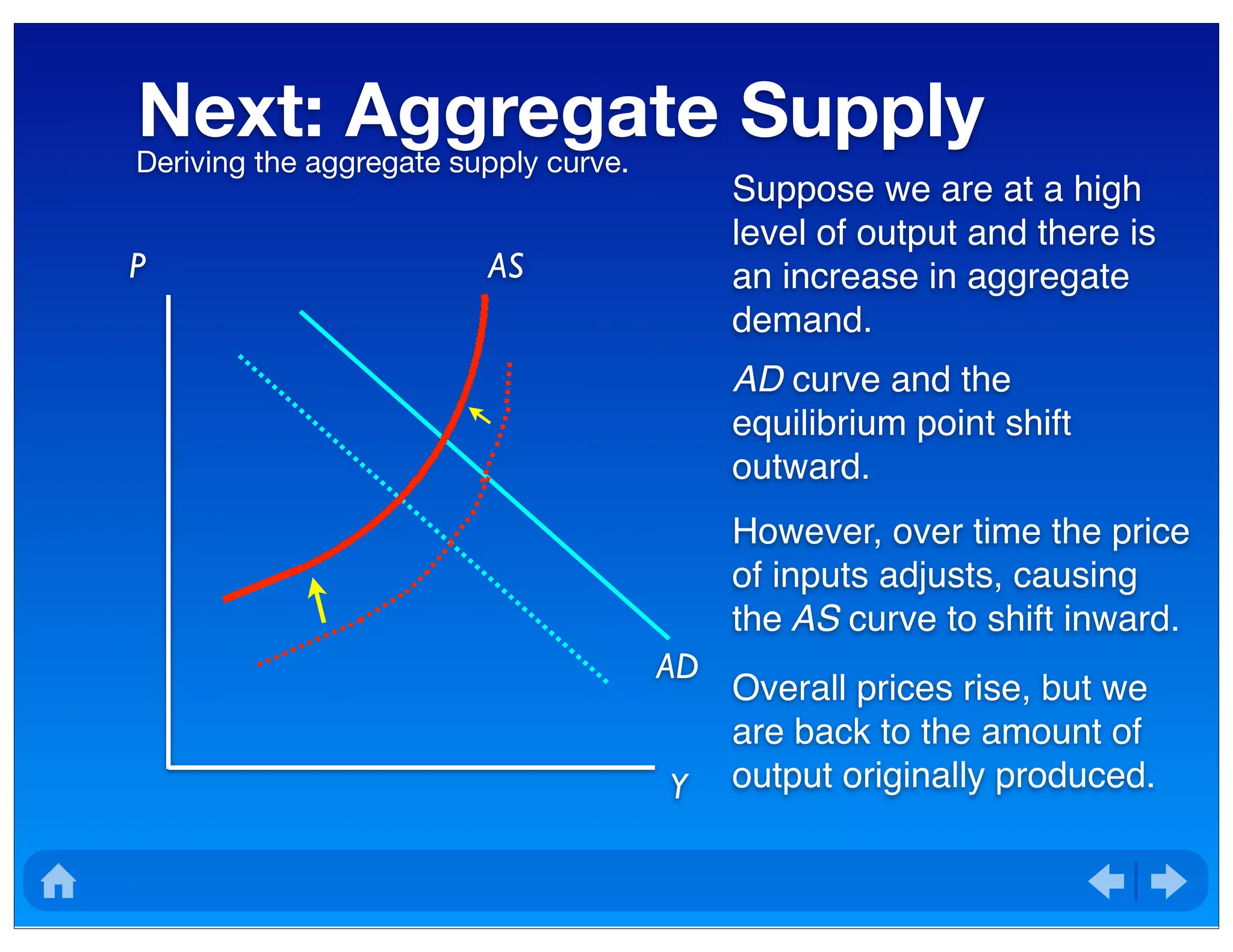
Suppose we are at a high
level of output and there is
an increase in aggregate
demand.
AD
Next: Aggregate SupplyDeriving the aggregate supply curve.
P
Y
AS
Suppose we are at a high
level of output and there is
an increase in aggregate
demand.
AD curve and the
equilibrium point shift
outward.
AD
Next: Aggregate SupplyDeriving the aggregate supply curve.
P
Y
AD
AS
Suppose we are at a high
level of output and there is
an increase in aggregate
demand.
AD curve and the
equilibrium point shift
outward.
Next: Aggregate SupplyDeriving the aggregate supply curve.
P
Y
AD
AS
Suppose we are at a high
level of output and there is
an increase in aggregate
demand.
AD curve and the
equilibrium point shift
outward.
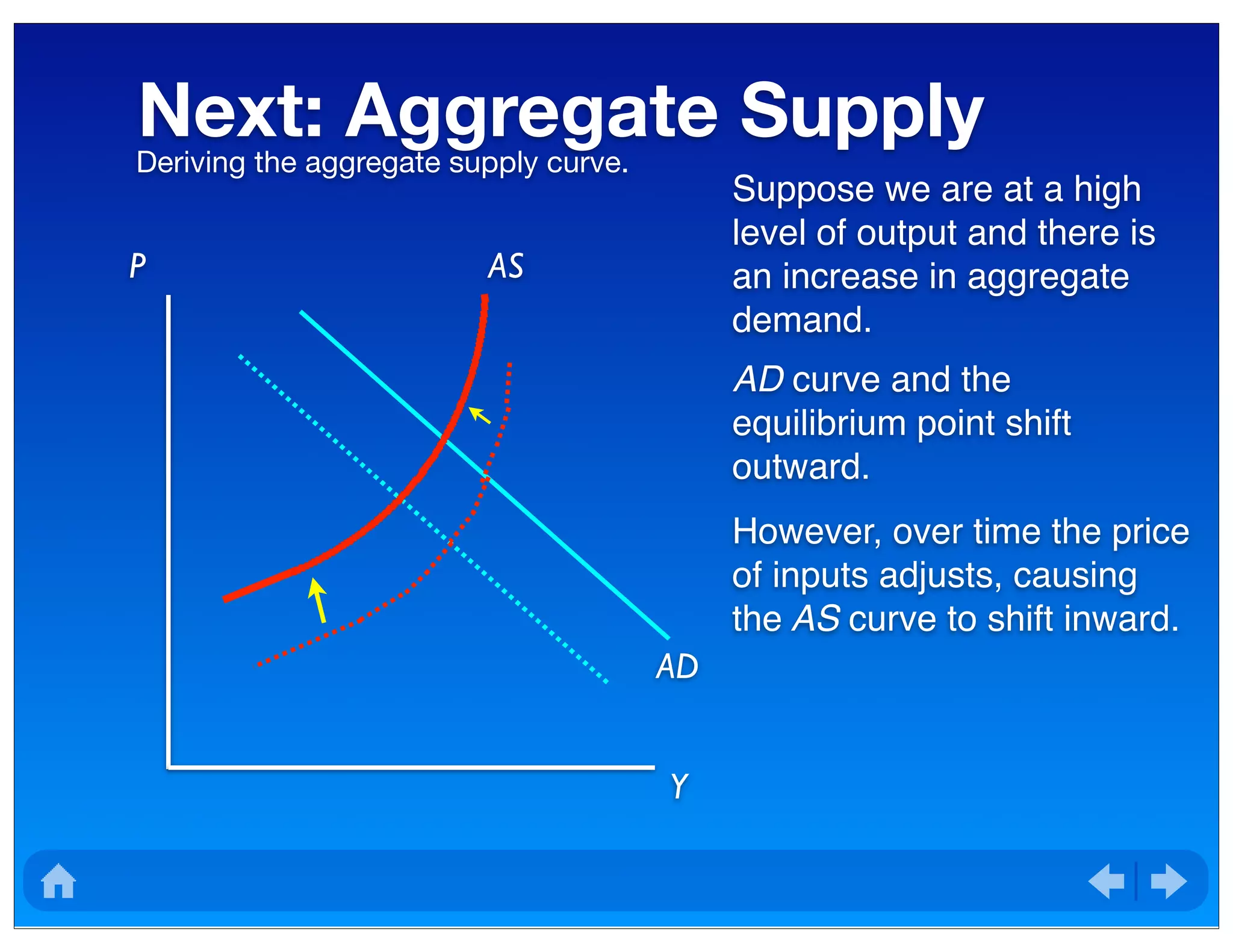
However, over time the price
of inputs adjusts, causing
the AS curve to shift inward.
Next: Aggregate SupplyDeriving the aggregate supply curve.
P
Y
AD
AS
Suppose we are at a high
level of output and there is
an increase in aggregate
demand.
AD curve and the
equilibrium point shift
outward.
However, over time the price
of inputs adjusts, causing
the AS curve to shift inward.
Next: Aggregate SupplyDeriving the aggregate supply curve.
P
Y
AD
AS
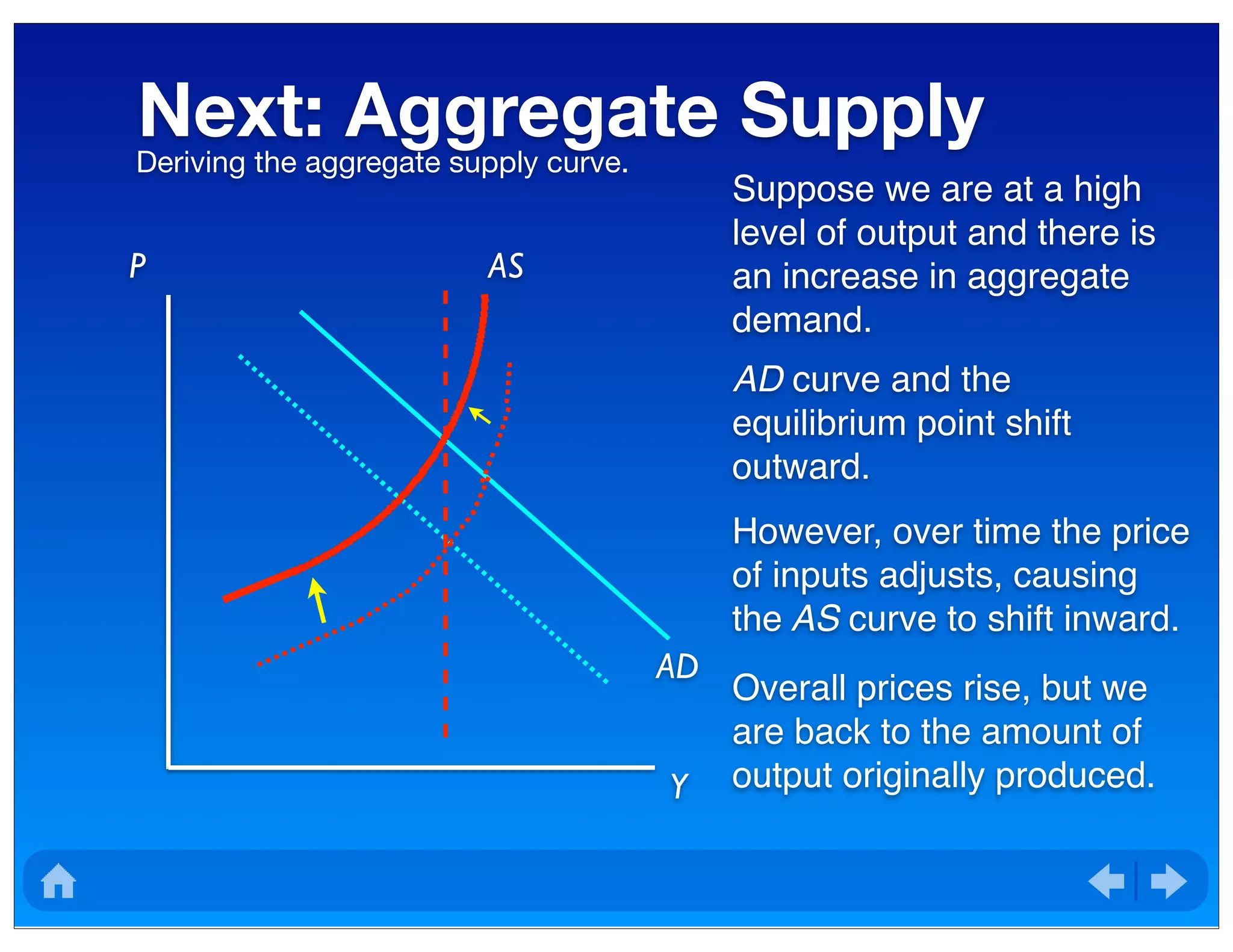
Overall prices rise, but we
are back to the amount of
output originally produced.
Suppose we are at a high
level of output and there is
an increase in aggregate
demand.
AD curve and the
equilibrium point shift
outward.
However, over time the price
of inputs adjusts, causing
the AS curve to shift inward.
Next: Aggregate SupplyDeriving the aggregate supply curve.
P
Y
AD
AS
Overall prices rise, but we
are back to the amount of
output originally produced.
Suppose we are at a high
level of output and there is
an increase in aggregate
demand.
AD curve and the
equilibrium point shift
outward.
However, over time the price
of inputs adjusts, causing
the AS curve to shift inward.
Next: Aggregate SupplyDeriving the aggregate supply curve.
P
Y
AD
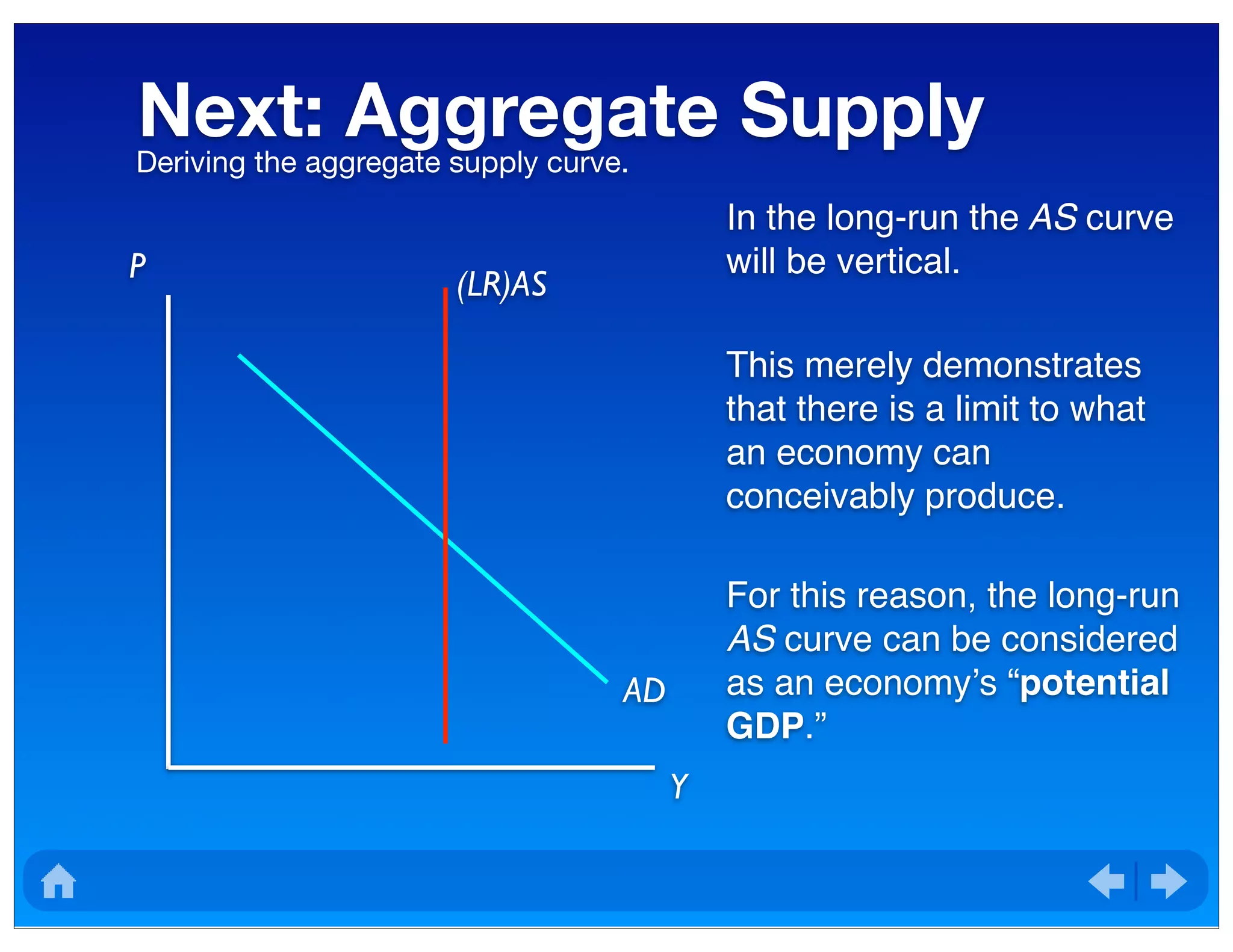
In the long-run the AS curve
will be vertical.
(LR)AS
This merely demonstrates
that there is a limit to what
an economy can
conceivably produce.
For this reason, the long-run
AS curve can be considered
as an economy’s “potential
GDP.”
AS–AD Analysis
• If we hold the price level fixed, then changes in other
variables will cause the aggregate demand and supply
curves to shift.
• Factors affecting aggregate demand:
• Money Supply (+)
• Government Spending (+)
• Taxes (–)
• Factors affecting aggregate supply:
• Input Prices/Costs (–)
• Economic Growth (+)
Taking stock of the interaction between aggregate demand and supply.
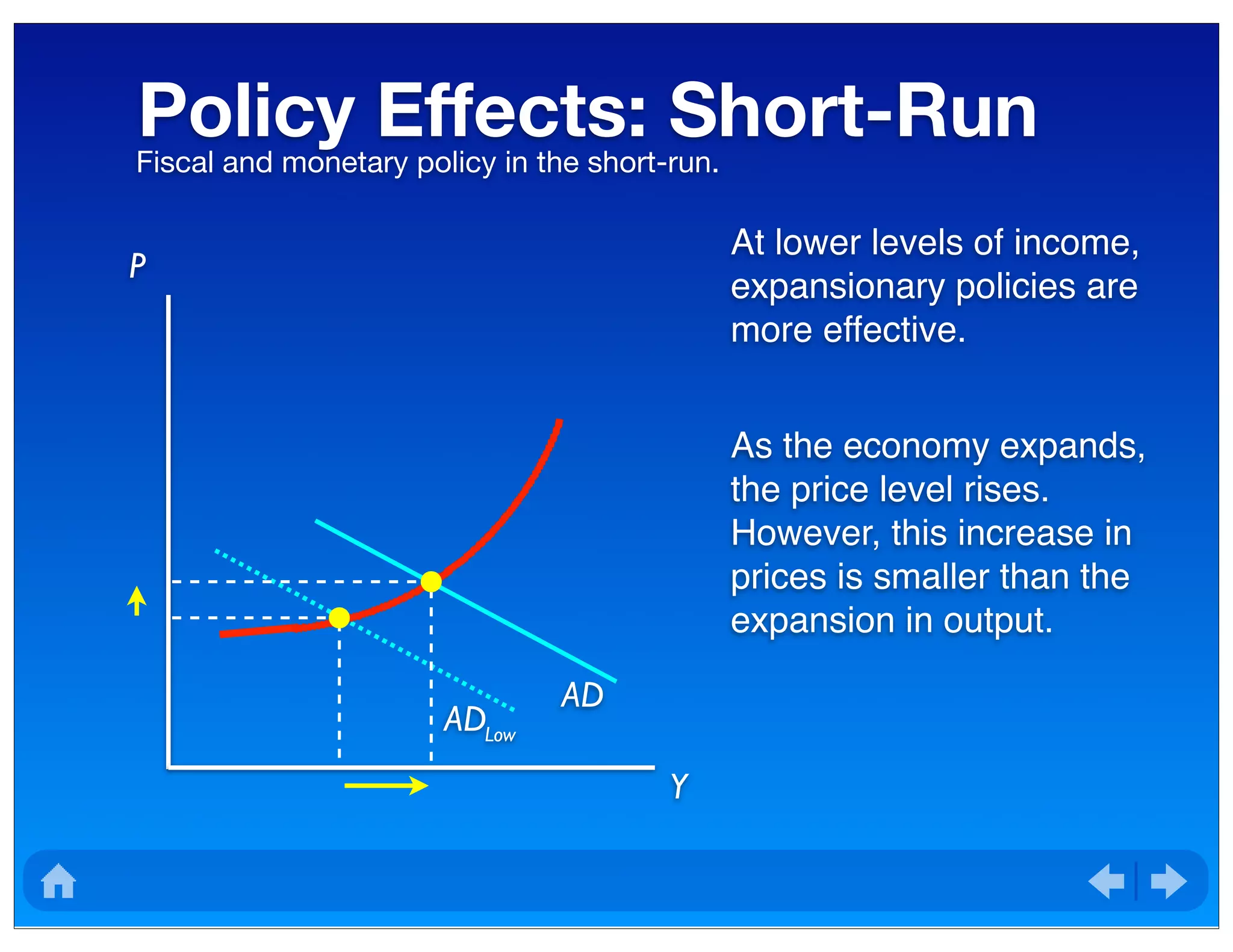
Policy Effects: Short-RunFiscal and monetary policy in the short-run.
P
Y
At lower levels of income,
expansionary policies are
more effective.
As the economy expands,
the price level rises.
However, this increase in
prices is smaller than the
expansion in output.
AD
ADLow
ADHigh
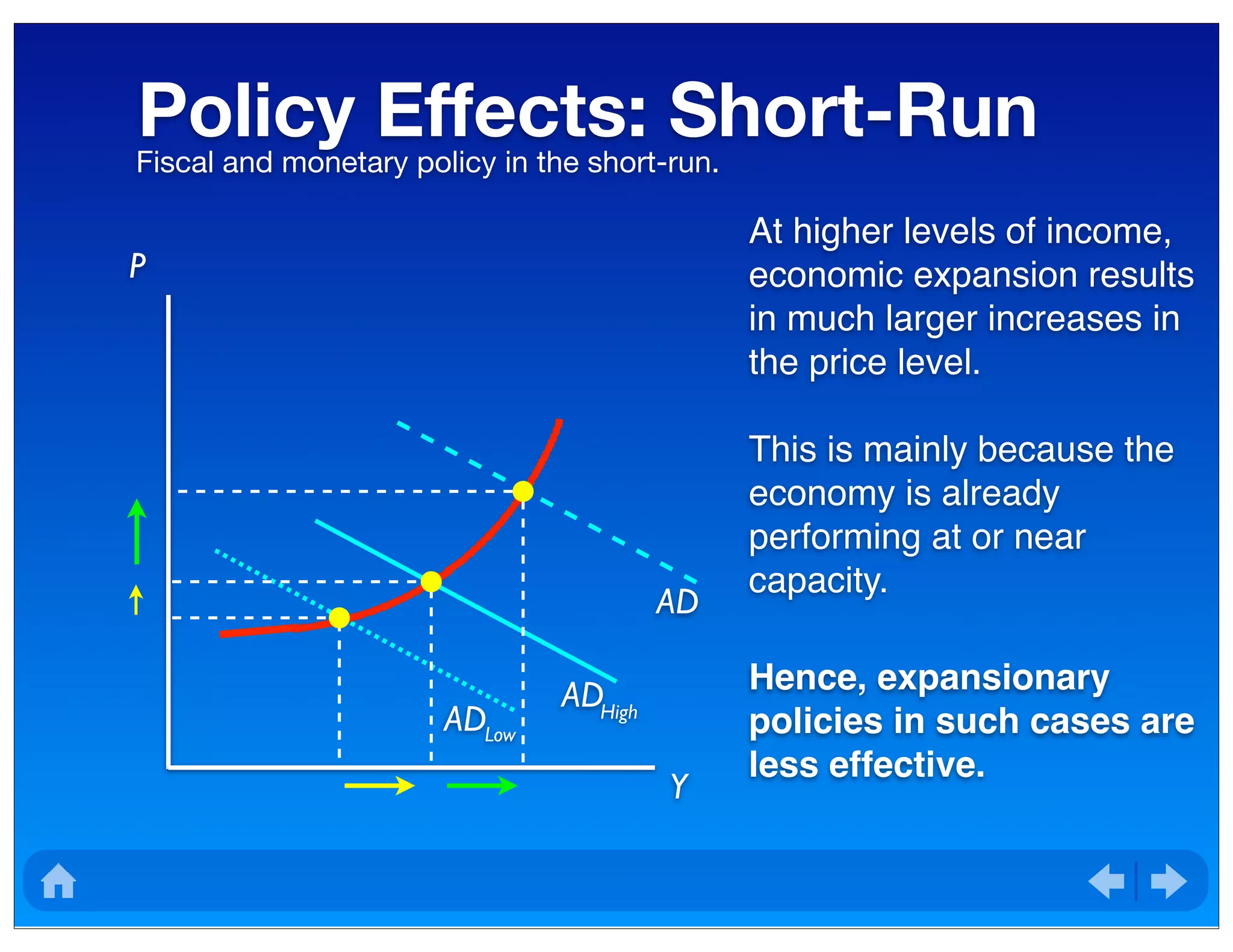
Policy Effects: Short-RunFiscal and monetary policy in the short-run.
P
Y
ADLow
AD
At higher levels of income,
economic expansion results
in much larger increases in
the price level.
This is mainly because the
economy is already
performing at or near
capacity.
Hence, expansionary
policies in such cases are
less effective.

Macroeconomics: Aggregate Demand and Supply

  • 1.
    AGGREgate supply anddemand Goods and Money Market Equilibrium: Bringing Everything Together
  • 2.
    Review • The goodsmarket is in equilibrium where Y = AE. • The money market is in equilibrium at that interest rate where money demanded is equal to money supplied. • The goods and money market are related because income affects our demand for money, and the interest rate determines the amount of investment. • There is an interest rate and a level of income at which both the goods and money markets are in equilibrium. • Fiscal and monetary policies affect the equilibrium amount of goods and services provided in the economy. What we know about macroeconomics.
  • 3.
    A Note onAD–AS Curves • Aggregate demand and aggregate supply curves resemble “traditional” demand and supply curves but are very different. • An individual or market supply curve depicts the quantities that are demanded or supplied for a given price level ceteris paribus. • At the economy-wide level, we are unable to fully make use of the assumption that everything else is constant. • Recall: the goods market and money market are intimately related through the demand for money and the interest rate. Points to ponder about aggregate demand and aggregate supply curves.
  • 4.
    First: Aggregate DemandDerivingthe aggregate demand curve (one perspective). AE Y r M s 45º M s M d AE
  • 5.
    First: Aggregate DemandDerivingthe aggregate demand curve (one perspective). AE Y 45º AE r M s M d M s
  • 6.
    First: Aggregate DemandDerivingthe aggregate demand curve (one perspective). AE Y 45º AE r M s M d M s
  • 7.
    First: Aggregate DemandDerivingthe aggregate demand curve (one perspective). P Y The aggregate demand (AD) curve depicts the demand for goods and services in the economy at any given price level. We have shown that as the price level rises, the interest rate rises. Consequently, the equilibrium amount of goods consumed in the economy will fall.
  • 8.
    First: Aggregate DemandDerivingthe aggregate demand curve (one perspective). P Y The aggregate demand (AD) curve depicts the demand for goods and services in the economy at any given price level. We have shown that as the price level rises, the interest rate rises. Consequently, the equilibrium amount of goods consumed in the economy will fall.Y0 P0
  • 9.
    First: Aggregate DemandDerivingthe aggregate demand curve (one perspective). P Y The aggregate demand (AD) curve depicts the demand for goods and services in the economy at any given price level. We have shown that as the price level rises, the interest rate rises. Consequently, the equilibrium amount of goods consumed in the economy will fall. P1 Y1 Y0 P0
  • 10.
    First: Aggregate DemandDerivingthe aggregate demand curve (one perspective). P Y The aggregate demand (AD) curve depicts the demand for goods and services in the economy at any given price level. We have shown that as the price level rises, the interest rate rises. Consequently, the equilibrium amount of goods consumed in the economy will fall. P1 Y1Y2 P2
  • 11.
    First: Aggregate DemandDerivingthe aggregate demand curve (one perspective). P Y The aggregate demand (AD) curve depicts the demand for goods and services in the economy at any given price level. We have shown that as the price level rises, the interest rate rises. Consequently, the equilibrium amount of goods consumed in the economy will fall.Y3 P3 Y2 P2
  • 12.
    First: Aggregate DemandDerivingthe aggregate demand curve (one perspective). P Y AD The aggregate demand (AD) curve depicts the demand for goods and services in the economy at any given price level. We have shown that as the price level rises, the interest rate rises. Consequently, the equilibrium amount of goods consumed in the economy will fall.
  • 13.
    Next: Aggregate SupplyDerivingthe aggregate supply curve. P Y There are two things to consider when deriving the aggregate supply curve. First, despite an overall increase in the price level, input prices may be fixed in the short run. Second, at low levels of production, capacity is underutilized. AD
  • 14.
    Next: Aggregate SupplyDerivingthe aggregate supply curve. P Y AD At low levels of production, there is room for an increase in output that does not really affect the price level.
  • 15.
    Next: Aggregate SupplyDerivingthe aggregate supply curve. P Y AD At low levels of production, there is room for an increase in output that does not really affect the price level. As more capacity becomes utilized, input prices also begin to rise, and firms are only able to produce more by raising prices. Hence, output can only expand if the price level also increases.
  • 16.
    P Y AD AS Next: Aggregate SupplyDerivingthe aggregate supply curve. This is the same as saying that the economy can only supply more goods and services at higher price levels. In the short-run, this implies that the aggregate supply curve is upward sloping. Note that the intersection of AD and AS represents the equilibrium price level in the economy.
  • 17.
    Next: Aggregate SupplyDerivingthe aggregate supply curve. P Y The difference between short- and long-run AS curves has to do with input prices, which are fixed in the short-run. AS What about the long-run? AD
  • 18.
    Next: Aggregate SupplyDerivingthe aggregate supply curve. P Y AS AD
  • 19.
    Next: Aggregate SupplyDerivingthe aggregate supply curve. P Y AS Suppose we are at a high level of output and there is an increase in aggregate demand. AD
  • 20.
    Next: Aggregate SupplyDerivingthe aggregate supply curve. P Y AS Suppose we are at a high level of output and there is an increase in aggregate demand. AD curve and the equilibrium point shift outward. AD
  • 21.
    Next: Aggregate SupplyDerivingthe aggregate supply curve. P Y AD AS Suppose we are at a high level of output and there is an increase in aggregate demand. AD curve and the equilibrium point shift outward.
  • 22.
    Next: Aggregate SupplyDerivingthe aggregate supply curve. P Y AD AS Suppose we are at a high level of output and there is an increase in aggregate demand. AD curve and the equilibrium point shift outward. However, over time the price of inputs adjusts, causing the AS curve to shift inward.
  • 23.
    Next: Aggregate SupplyDerivingthe aggregate supply curve. P Y AD AS Suppose we are at a high level of output and there is an increase in aggregate demand. AD curve and the equilibrium point shift outward. However, over time the price of inputs adjusts, causing the AS curve to shift inward.
  • 24.
    Next: Aggregate SupplyDerivingthe aggregate supply curve. P Y AD AS Overall prices rise, but we are back to the amount of output originally produced. Suppose we are at a high level of output and there is an increase in aggregate demand. AD curve and the equilibrium point shift outward. However, over time the price of inputs adjusts, causing the AS curve to shift inward.
  • 25.
    Next: Aggregate SupplyDerivingthe aggregate supply curve. P Y AD AS Overall prices rise, but we are back to the amount of output originally produced. Suppose we are at a high level of output and there is an increase in aggregate demand. AD curve and the equilibrium point shift outward. However, over time the price of inputs adjusts, causing the AS curve to shift inward.
  • 26.
    Next: Aggregate SupplyDerivingthe aggregate supply curve. P Y AD In the long-run the AS curve will be vertical. (LR)AS This merely demonstrates that there is a limit to what an economy can conceivably produce. For this reason, the long-run AS curve can be considered as an economy’s “potential GDP.”
  • 27.
    AS–AD Analysis • Ifwe hold the price level fixed, then changes in other variables will cause the aggregate demand and supply curves to shift. • Factors affecting aggregate demand: • Money Supply (+) • Government Spending (+) • Taxes (–) • Factors affecting aggregate supply: • Input Prices/Costs (–) • Economic Growth (+) Taking stock of the interaction between aggregate demand and supply.
  • 28.
    Policy Effects: Short-RunFiscaland monetary policy in the short-run. P Y At lower levels of income, expansionary policies are more effective. As the economy expands, the price level rises. However, this increase in prices is smaller than the expansion in output. AD ADLow
  • 29.
    ADHigh Policy Effects: Short-RunFiscaland monetary policy in the short-run. P Y ADLow AD At higher levels of income, economic expansion results in much larger increases in the price level. This is mainly because the economy is already performing at or near capacity. Hence, expansionary policies in such cases are less effective.