On the Local
Government Code
Overview
What is the local government code?
What is the structure of local
government in the Philippines?
What are the powers/responsibilities
of local governments?
What are some of the key provisions
of the code?
The Local Government Code
The Local Government Code of
1991 provides the overarching
framework of local governance in the
Philippines
Key principles:
–Local autonomy
–Decentralization
–Accountability
–Participative governance
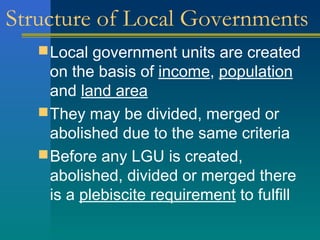
Structure of Local Governments
Local government units are created
on the basis of income, population
and land area
They may be divided, merged or
abolished due to the same criteria
Before any LGU is created,
abolished, divided or merged there
is a plebiscite requirement to fulfill
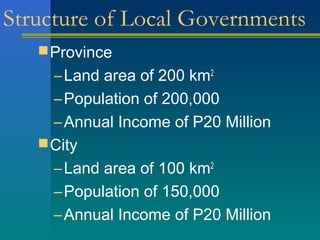
Structure of Local Governments
Province
–Land area of 200 km2
–Population of 200,000
–Annual Income of P20 Million
City
–Land area of 100 km2
–Population of 150,000
–Annual Income of P20 Million
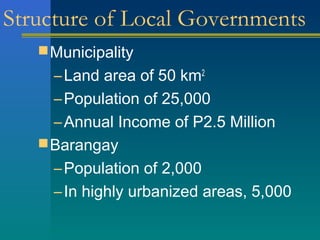
Structure of Local Governments
Municipality
–Land area of 50 km2
–Population of 25,000
–Annual Income of P2.5 Million
Barangay
–Population of 2,000
–In highly urbanized areas, 5,000
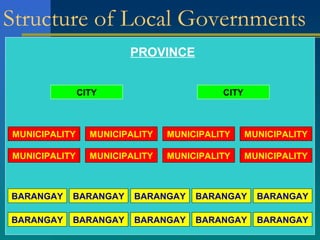
Structure of Local Governments
BARANGAY
BARANGAY
BARANGAY
BARANGAY
BARANGAY
BARANGAY
BARANGAY
BARANGAY
BARANGAY
BARANGAY
CITY CITY
PROVINCE
MUNICIPALITY
MUNICIPALITY
MUNICIPALITY
MUNICIPALITY
MUNICIPALITY
MUNICIPALITY
MUNICIPALITY
MUNICIPALITY
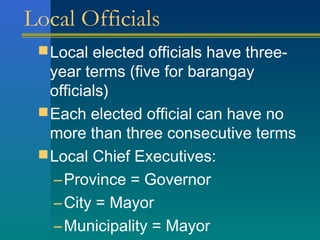
Local Officials
Local elected officials have three-
year terms (five for barangay
officials)
Each elected official can have no
more than three consecutive terms
Local Chief Executives:
–Province = Governor
–City = Mayor
–Municipality = Mayor
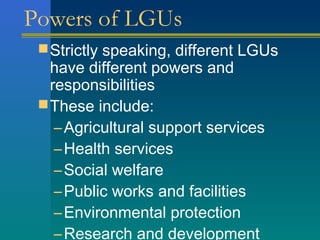
Powers of LGUs
Strictly speaking, different LGUs
have different powers and
responsibilities
These include:
–Agricultural support services
–Health services
–Social welfare
–Public works and facilities
–Environmental protection
–Research and development
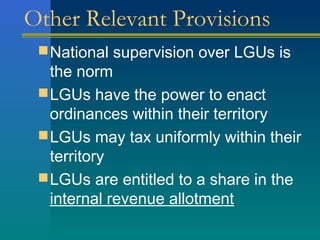
Other Relevant Provisions
National supervision over LGUs is
the norm
LGUs have the power to enact
ordinances within their territory
LGUs may tax uniformly within their
territory
LGUs are entitled to a share in the
internal revenue allotment

The Philippine Local Government Code

  • 1.
  • 2.
    Overview What is thelocal government code? What is the structure of local government in the Philippines? What are the powers/responsibilities of local governments? What are some of the key provisions of the code?
  • 3.
    The Local GovernmentCode The Local Government Code of 1991 provides the overarching framework of local governance in the Philippines Key principles: –Local autonomy –Decentralization –Accountability –Participative governance
  • 4.
    Structure of LocalGovernments Local government units are created on the basis of income, population and land area They may be divided, merged or abolished due to the same criteria Before any LGU is created, abolished, divided or merged there is a plebiscite requirement to fulfill
  • 5.
    Structure of LocalGovernments Province –Land area of 200 km2 –Population of 200,000 –Annual Income of P20 Million City –Land area of 100 km2 –Population of 150,000 –Annual Income of P20 Million
  • 6.
    Structure of LocalGovernments Municipality –Land area of 50 km2 –Population of 25,000 –Annual Income of P2.5 Million Barangay –Population of 2,000 –In highly urbanized areas, 5,000
  • 7.
    Structure of LocalGovernments BARANGAY BARANGAY BARANGAY BARANGAY BARANGAY BARANGAY BARANGAY BARANGAY BARANGAY BARANGAY CITY CITY PROVINCE MUNICIPALITY MUNICIPALITY MUNICIPALITY MUNICIPALITY MUNICIPALITY MUNICIPALITY MUNICIPALITY MUNICIPALITY
  • 8.
    Local Officials Local electedofficials have three- year terms (five for barangay officials) Each elected official can have no more than three consecutive terms Local Chief Executives: –Province = Governor –City = Mayor –Municipality = Mayor
  • 9.
    Powers of LGUs Strictlyspeaking, different LGUs have different powers and responsibilities These include: –Agricultural support services –Health services –Social welfare –Public works and facilities –Environmental protection –Research and development
  • 10.
    Other Relevant Provisions Nationalsupervision over LGUs is the norm LGUs have the power to enact ordinances within their territory LGUs may tax uniformly within their territory LGUs are entitled to a share in the internal revenue allotment

Editor's Notes

  • #5 Income: Must be sufficient to provide for all essential government services expected of it Population: There has to be a particular size in terms of the number of people within its territory Land Area: Must generally be contiguous, unless the LGU concerned is composed of islands
  • #11 National Supervision: The President possesses the right to supervise the activities of LGUs to ensure that they do not overstep their bounds and at the same time enact ordinances consistent with national policy On taxation: generally, taxes collected within an LGU are used in that LGU IRA: Internal revenue allotment is a share in the national budget Provinces: 23% Cities: 23% Municipalities: 34% Barangays: 20%