BPLN0302 : 
PLANNING THEORY - I 
GLOBALISATION 
COMPILED BY: 
 Aman Singh Rajput 
 Amruta Mahakalkar 
 Bhupendra Pratap Singh 
 Divya Holani 
 Rajesh P 
 Sarthak Verma
STRUCTURE OF PRESENTATION 
What is GLOBALIZATION? 
What are it’s IMPORTANCE in PLANNING? 
What are it’s POSITIVE impacts? 
What are it’s NEGATIVE impacts? 
What are it’s IMPACT on the CITY? 
CASE STUDIES
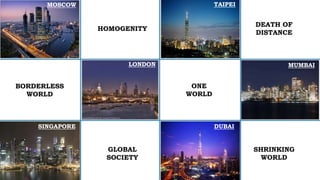
SHRINKING 
WORLD 
GLOBAL 
SOCIETY 
MOSCOW 
BORDERLESS 
WORLD 
HOMOGENITY 
DEATH OF 
DISTANCE 
TAIPEI 
LONDON MUMBAI 
ONE 
WORLD 
SINGAPORE DUBAI
What is Globalization? 
 Is a process which embodies a transformation 
in the spatial organisation of social relations 
and transactions – assessed in terms of their 
1. extensity – spatial/geographical reach 
2. Intensity – number & quantity of flow 
3. Velocity – speed of movement of flow 
4. impact – overall impact on the city 
generating transcontinental or interregional 
flows, and networks of activity, interaction, 
and the exercise of power 
 Globalization refers to all those processes by 
which the people of the world are incorporated 
into a single world society, global society 
 The process of continuing integration of the 
countries in the world
Broad sets of Division 
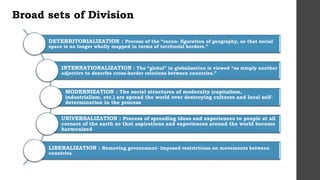
DETERRITORIALIZATION : Process of the “recon- figuration of geography, so that social 
space is no longer wholly mapped in terms of territorial borders.” 
INTERNATIONALIZATION : The “global” in globalization is viewed “as simply another 
adjective to describe cross-border relations between countries.” 
MODERNIZATION : The social structures of modernity (capitalism, 
industrialism, etc.) are spread the world over destroying cultures and local self-determination 
in the process 
UNIVERSALIZATION : Process of spreading ideas and experiences to people at all 
corners of the earth so that aspirations and experiences around the world become 
harmonized 
LIBERALIZATION : Removing government- imposed restrictions on movements between 
countries
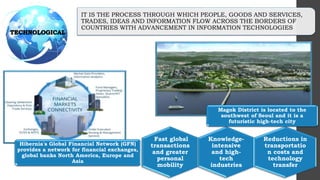
IT IS THE PROCESS THROUGH WHICH PEOPLE, GOODS AND SERVICES, 
TRADES, IDEAS AND INFORMATION FLOW ACROSS THE BORDERS OF 
COUNTRIES WITH ADVANCEMENT IN INFORMATION TECHNOLOGIES 
Fast global 
transactions 
and greater 
personal 
mobility 
Magok District is located to the 
southwest of Seoul and it is a 
futuristic high-tech city 
Reductions in 
transportatio 
n costs and 
technology 
transfer 
Knowledge-intensive 
and high-tech 
industries 
Hibernia's Global Financial Network (GFN) 
provides a network for financial exchanges, 
global banks North America, Europe and 
Asia
IS AN ECONOMIC CONCEPT WHERE CAPITAL, LABOUR AND COMMODITY, 
MARKET, INFORMATION, RAW MATERIAL, MANAGEMENT AND 
ORGANIZATION ARE INTERNATIONALIZED AND FULLY INTERDEPENDENT 
THROUGHOUT THE PLANET 
Golden age 
for business, 
commerce 
and trade 
Increases in 
trade and 
liberalization 
policies 
Export-based 
economies 
to propel 
American multinational retail 
corporation that runs chains of large 
discount department stores 
World's largest chain of hamburger fast 
food restaurants, serving more than 119 
countries
THE TRANSMISSION OF CULTURE GLOBALLY, FACILITATED BY THE 
MOVEMENT OF PEOPLE, OBJECTS, SIGNS AND SYMBOLS, BOOKS AND 
CULTURAL ARTIFACTS 
Common 
shape of 
local 
cultures 
Minimizing 
cultural 
diversity 
Formation 
of Global 
Culture 
 The process of globalization 
suggests simultaneously two 
images: 
STAGE 1 
 The compression of cultures. 
Things formerly held apart are 
now brought into contact and 
juxtaposition 
Berlin celebrating 
Movement organized by Holi 
WWF celebrated 
globally 
STAGE 2 
 Entails the extension of a particular culture to its 
limit, the globe. Heterogeneous cultures become 
incorporated and integrated into a dominant culture 
which eventually covers the whole world
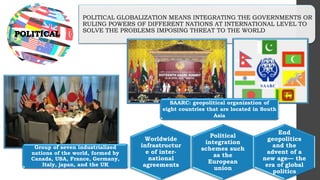
POLITICAL GLOBALIZATION MEANS INTEGRATING THE GOVERNMENTS OR 
RULING POWERS OF DIFFERENT NATIONS AT INTERNATIONAL LEVEL TO 
SOLVE THE PROBLEMS IMPOSING THREAT TO THE WORLD 
Worldwide 
infrastructur 
e of inter-national 
agreements 
End 
geopolitics 
and the 
advent of a 
new age— the 
era of global 
politics 
Political 
integration 
schemes such 
as the 
European 
union 
Group of seven industrialized 
nations of the world, formed by 
Canada, USA, France, Germany, 
Italy, japan, and the UK 
SAARC: geopolitical organization of 
eight countries that are located in South 
Asia
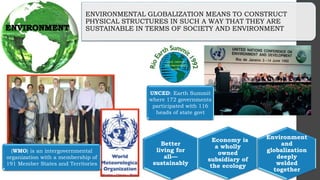
ENVIRONMENTAL GLOBALIZATION MEANS TO CONSTRUCT 
PHYSICAL STRUCTURES IN SUCH A WAY THAT THEY ARE 
SUSTAINABLE IN TERMS OF SOCIETY AND ENVIRONMENT 
Economy is 
a wholly 
owned 
subsidiary of 
the ecology 
Better 
living for 
all— 
sustainably 
Environment 
and 
globalization 
deeply 
welded 
together 
UNCED: Earth Summit 
where 172 governments 
participated with 116 
heads of state govt 
(WMO) is an intergovernmental 
organization with a membership of 
191 Member States and Territories
What are the EFFECTS of Globalization? 
DEATH OF DISTANCE 
 Distance – barrier against trade 
 The trade of goods and services has become feasible with 
technological developments and trade agreements that decrease or 
eliminate tariffs 
 Distance is the diffusion of production into the whole world 
 Currently, through FDI, MNC’s have diffused their productions to 
many countries 
END OF NATION STATE 
 As the development of modern nation-state depends on inter-state 
relations, the definition of state becomes more evident in 
the globalization process 
 Globalization increases the local awareness and solidifies ―auto-awareness 
instead of eliminating nation-state
DOMINANACE OF R & D 
 Investment on knowledge forms the basics of innovativeness and 
technologic development 
 Developing countries have significant R & D expenditures and 
expenditures on education is increasing in most OECD countries 
1700 1900 2000 & above 
ECONOMICS Agriculture Manufacture Information 
TECHNOLOGY Plough Machine Computer 
OUTPUT Food Good Information 
RESOURCE Land Capital Knowledge 
UNIT Family Company Network 
ENERGY Muscle Fossil Fuel Brain 
COMPETITION Local National Global 
DEMAND Minimal Remarkable Continuity 
10000 B.C 
4,000 BC 
14th century 
late 17th 
century 
1970s 
1980s 
1990s 
2000s 
AGRICULTURAL 
WRITING 
PRINTING PRESS 
INDUSTRIAL 
REVOLUTION 
SPACE ERA 
COMMUNICATION 
ERA 
KNOWLEDGE 
ERA 
INFORMATION 
ERA
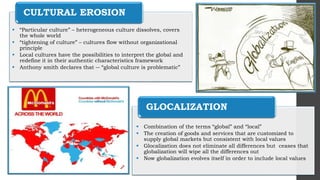
CULTURAL EROSION 
 “Particular culture” – heterogeneous culture dissolves, covers 
the whole world 
 “tightening of culture” – cultures flow without organizational 
principle 
 Local cultures have the possibilities to interpret the global and 
redefine it in their authentic characteristics framework 
 Anthony smith declares that ― “global culture is problematic” 
GLOCALIZATION 
 Combination of the terms “global” and “local” 
 The creation of goods and services that are customized to 
supply global markets but consistent with local values 
 Glocalization does not eliminate all differences but ceases that 
globalization will wipe all the differences out 
 Now globalization evolves itself in order to include local values
CONTEMPORARY THESIS 
OF GLOBALIZATION 
Hyperglobalist Transformationalists Sceptic 
 A new global era 
 Global civilization & 
government 
 Promote unrestricted & 
free international 
interactions 
 Extinction of nation-state 
 Increased regionalism 
 Internationalized political 
economy lead by world’s 
superpowers 
 Strengthening of nation-state 
 Unprecedented 
interconnectedness 
 National policies owned 
not only by nation but 
international governments 
 Transforming government 
pattern
What is it’s IMPORTANCE in PLANNING? 
 Planning can be said to be a subset of globalization 
 In planning we try to bring positive aspects of different 
societies into one by combining them 
 The planners’ location is in the middle of the ideological 
spectrum of hyperglobist and sceptic & are viewed to be a 
sign of weakness 
 Appreciate the potential for growth, development which 
globalization offers, at the same time concerned about 
it’s ill effects. 
COMPROMISE AS STRENGTH 
World cities - New York, Tokyo and London : impact of the spatial planning system w.r.t 
economic concepts. 
 Through advancement in communication and 
transport system planners try to evolve a society 
such that it sustains and remains in equilibrium 
between the past and future. 
 Incorporates a global society forming “ethnic 
enclaves”, within the complete mosaic of a city 
 A planner should be able to attract private 
investment without totally abandoning all labour 
and environmental standards of the city
What are it’s POSITIVE impacts? 
 A better economy – it introduces rapid development of the 
capital market 
 Introducing new technologies- the new technologies and 
progress in telecommunication, introduction of satellites, 
mobiles etc 
 The new scientific research patterns 
 Rise in living standards 
 Better trade, more employment & increase in productivity due 
to modern technology 
 In cultural context, globalization has brought in different 
ideologies, and thought process amongst people 
 In political context, onset of western democratic system has an 
impact on politics in eastern world 
 National policies control the extent of globalization in that 
country and vice versa.
What are it’s NEGATIVE impacts? 
 Loss of national integrity , too much exchange of trade, 
money etc. independent domestic policies are lost. 
 Unemployment , mental pressure on companies that causes 
many people to lose their jobs 
 Cultural homogenization , people start to get westernize in 
different culture lagging in their own heritage 
 Increasing gap between the rich and poor. 
 Developed countries are much benefited by this process rather 
than underdeveloped & developing countries. 
 Forfeiture among nations , Too much flow of capital amongst 
countries introduces unfair and immoral distribution of income. 
 Globalization also provides a chance to the evil society i.e. 
Terrorists and criminals to attack, also there are increasing 
number of cases of cyber crimes 
Cheaper synthetic bags 
overcoming jute 
industries in West Bengal 
United Nations is believed 
to be influenced by Global 
Superpower, USA 
Mumbai terror attack
What are it’s IMPACTS on the CITY? 
 The impact of global forces can be argued to have had a fundamental impact on 
the society. 
 W.r.t. planning, Inc. flow of immigrants may be more concerned with 
substantial economic and social advancements. 
 At city level actual question is access to jobs and services. 
 Economic and social change impacts on civil society and political expression in 
the city. 
 Globalisation impacts the socio-cultural beliefs of the city people; they start to 
adopt western culture 
 It also impacts the city environmentally; degrading it. 
 Pressures on planning comes both from the need to integrate city economics 
with global forces and need to integrate fragmented interest within the city
Case Study 
INDIA 
 The Impacts Of Globalization On Indian Cities and City Policies: 
 The post-1991 period has seen notable changes in India’s macroeconomic policies, with the 
result that the Indian economy today is far more open and far more integrated with the 
global system than anytime since the 1960s 
 The pick up in GDP growth has helped improve India’s global position. Consequently India’s 
position in the global economy has improved from the 8th position in 1991 to 4th place in 
2001 
 Changes have taken place during the same period in the nature and pattern of urban 
growth. 
 New townships with high quality infrastructure have sprung up on the periphery of large 
cities. 
 Globalization and INDIAN it outsourcing Industry : 
 The emergence of the software and services outsourcing industry in India is one of the most 
visible outcomes of globalization, stimulated by the spread of modern information and 
communication technologies. 
 low-end software services providers, such as India, have played a central role in the 
development of this economy by enabling work to be performed faster, cheaper and around 
the clock 
 The software and services industry in India has grown rapidly from small beginnings in the 
1980s, to generate total earnings of $ 13.5 billion in 2004-05, of which $ 10 billion were 
from exports
Case Study 
INDIA 
 Globalization of ADITYA BIRLA GROUP 
 Launched globalization journey four decades ago 
 Established first overseas company in Thailand in 1969 
 Anchored by 133,000 employees from 42 nationalities 
 Over 1.5 million shareholders 
 A metals powerhouse . One of the biggest producers 
of primary aluminum in Asia 
International establishments: 
1. Thailand 
2. Philippines 
3. Indonesia 
4. Egypt 
5. China 
6. Canada 
7. Australia 
8. Laos 
9. North and south America 
 Largest producer of carbon black 
 Fourth largest producer of insulators 
 Fifth largest producer of acrylic fiber. 
Globalization and INDIAN IT outsourcing Industry : 
 The emergence of the software and services outsourcing industry in India is one of the most 
visible outcomes of globalization, stimulated by the spread of modern information and 
communication technologies. 
 low-end software services providers, such as India, have played a central role in the 
development of this economy by enabling work to be performed faster, cheaper and around 
the clock 
 The software and services industry in India has grown rapidly from small beginnings in the 
1980s, to generate total earnings of $ 13.5 billion in 2004-05, of which $ 10 billion were 
from exports
Case Study 
INDIA 
 CULTURAL GLOBALIZATION IN INDIA 
 Indian culture which in effect means Hindu culture, Hindu religion, Hindu society, Hindu 
civilization 
 In the Colonial Era in India from 1700-1875: All native Hindus were despicable creatures who 
don't have to be treated like human beings till they take their fateful decision to embrace 
Christianity 
 Along with Christian religion came the rest of British or Western culture, thought and customs and 
the gradual end of traditional ways of life 
 The British rulers attempted to colonize our minds by eliminating all our traditional schools and 
education systems through a progressive system of Western education 
 After the end of colonization rule in India this western culture still flourished but now under 
the heading of globalization 
 Swami Vivekananda foresaw the dangers of Globalization as 
early as in 1893 when he spoke at the Parliament of World 
Religions in Chicago and asked “Would India die?”
INDIA 
 Land And Housing Market Impacts : 
 Globalization leads to emergence of global property market, dominated by global real estate 
firm. 
 Presence of global firms and global business class in the cities leads to demand for high 
quality office space and residential space and scare land and housing in the globalizing 
cities are diverted to catering to these new demands. 
 There is also another effect of globalization on land and housing markets. For making local 
economies competitive, the cities are in the process of improving city image and quality of 
life through infrastructure and city beautification projects. Finance for these activities gets 
raised locally through sale of lands 
 All of a sudden, the role of private sector in city affairs has increased. This has brought in 
corruption and promotion of vested interests through the process of contracting out the 
work to private sector 
 In the property markets, the vested interests are forcing the local governments to transfer 
public lands to the commercially lucrative projects. In instances where such lands are 
squatted upon by slums, local governments are expected to displace them and then resettle 
them under the guise of public-private partnership. The outcome of many of these 
processes has been eviction of the poor from prime lands and locations in many of the 
globalizing cities.
EGYPT 
Egypt’s , 2011, Revolution was however, prepared 
online, through the virtual political youth 
movements on Facebook and other social media 
sites. 
The movement adopted the non-violent resistance 
methodology, which they promoted through 
Facebook. As a result of this movement, President 
Mubarak stepped down after 30 years in power. 
INDIA 
Dec 2013: Media played an important role by 
providing coverage of this unfortunate incident. 
As the movement to bring the gang rape victim to 
justice went viral, the nation saw widespread protest 
that spilled on streets across the country . This 
inspired a whole generation to stand together for 
women’s rights and make the state answerable for its 
citizens.
THANK YOU

Globalisation

  • 1.
    BPLN0302 : PLANNINGTHEORY - I GLOBALISATION COMPILED BY:  Aman Singh Rajput  Amruta Mahakalkar  Bhupendra Pratap Singh  Divya Holani  Rajesh P  Sarthak Verma
  • 2.
    STRUCTURE OF PRESENTATION What is GLOBALIZATION? What are it’s IMPORTANCE in PLANNING? What are it’s POSITIVE impacts? What are it’s NEGATIVE impacts? What are it’s IMPACT on the CITY? CASE STUDIES
  • 3.
    SHRINKING WORLD GLOBAL SOCIETY MOSCOW BORDERLESS WORLD HOMOGENITY DEATH OF DISTANCE TAIPEI LONDON MUMBAI ONE WORLD SINGAPORE DUBAI
  • 4.
    What is Globalization?  Is a process which embodies a transformation in the spatial organisation of social relations and transactions – assessed in terms of their 1. extensity – spatial/geographical reach 2. Intensity – number & quantity of flow 3. Velocity – speed of movement of flow 4. impact – overall impact on the city generating transcontinental or interregional flows, and networks of activity, interaction, and the exercise of power  Globalization refers to all those processes by which the people of the world are incorporated into a single world society, global society  The process of continuing integration of the countries in the world
  • 5.
    Broad sets ofDivision DETERRITORIALIZATION : Process of the “recon- figuration of geography, so that social space is no longer wholly mapped in terms of territorial borders.” INTERNATIONALIZATION : The “global” in globalization is viewed “as simply another adjective to describe cross-border relations between countries.” MODERNIZATION : The social structures of modernity (capitalism, industrialism, etc.) are spread the world over destroying cultures and local self-determination in the process UNIVERSALIZATION : Process of spreading ideas and experiences to people at all corners of the earth so that aspirations and experiences around the world become harmonized LIBERALIZATION : Removing government- imposed restrictions on movements between countries
  • 6.
    IT IS THEPROCESS THROUGH WHICH PEOPLE, GOODS AND SERVICES, TRADES, IDEAS AND INFORMATION FLOW ACROSS THE BORDERS OF COUNTRIES WITH ADVANCEMENT IN INFORMATION TECHNOLOGIES Fast global transactions and greater personal mobility Magok District is located to the southwest of Seoul and it is a futuristic high-tech city Reductions in transportatio n costs and technology transfer Knowledge-intensive and high-tech industries Hibernia's Global Financial Network (GFN) provides a network for financial exchanges, global banks North America, Europe and Asia
  • 7.
    IS AN ECONOMICCONCEPT WHERE CAPITAL, LABOUR AND COMMODITY, MARKET, INFORMATION, RAW MATERIAL, MANAGEMENT AND ORGANIZATION ARE INTERNATIONALIZED AND FULLY INTERDEPENDENT THROUGHOUT THE PLANET Golden age for business, commerce and trade Increases in trade and liberalization policies Export-based economies to propel American multinational retail corporation that runs chains of large discount department stores World's largest chain of hamburger fast food restaurants, serving more than 119 countries
  • 8.
    THE TRANSMISSION OFCULTURE GLOBALLY, FACILITATED BY THE MOVEMENT OF PEOPLE, OBJECTS, SIGNS AND SYMBOLS, BOOKS AND CULTURAL ARTIFACTS Common shape of local cultures Minimizing cultural diversity Formation of Global Culture  The process of globalization suggests simultaneously two images: STAGE 1  The compression of cultures. Things formerly held apart are now brought into contact and juxtaposition Berlin celebrating Movement organized by Holi WWF celebrated globally STAGE 2  Entails the extension of a particular culture to its limit, the globe. Heterogeneous cultures become incorporated and integrated into a dominant culture which eventually covers the whole world
  • 9.
    POLITICAL GLOBALIZATION MEANSINTEGRATING THE GOVERNMENTS OR RULING POWERS OF DIFFERENT NATIONS AT INTERNATIONAL LEVEL TO SOLVE THE PROBLEMS IMPOSING THREAT TO THE WORLD Worldwide infrastructur e of inter-national agreements End geopolitics and the advent of a new age— the era of global politics Political integration schemes such as the European union Group of seven industrialized nations of the world, formed by Canada, USA, France, Germany, Italy, japan, and the UK SAARC: geopolitical organization of eight countries that are located in South Asia
  • 10.
    ENVIRONMENTAL GLOBALIZATION MEANSTO CONSTRUCT PHYSICAL STRUCTURES IN SUCH A WAY THAT THEY ARE SUSTAINABLE IN TERMS OF SOCIETY AND ENVIRONMENT Economy is a wholly owned subsidiary of the ecology Better living for all— sustainably Environment and globalization deeply welded together UNCED: Earth Summit where 172 governments participated with 116 heads of state govt (WMO) is an intergovernmental organization with a membership of 191 Member States and Territories
  • 11.
    What are theEFFECTS of Globalization? DEATH OF DISTANCE  Distance – barrier against trade  The trade of goods and services has become feasible with technological developments and trade agreements that decrease or eliminate tariffs  Distance is the diffusion of production into the whole world  Currently, through FDI, MNC’s have diffused their productions to many countries END OF NATION STATE  As the development of modern nation-state depends on inter-state relations, the definition of state becomes more evident in the globalization process  Globalization increases the local awareness and solidifies ―auto-awareness instead of eliminating nation-state
  • 12.
    DOMINANACE OF R& D  Investment on knowledge forms the basics of innovativeness and technologic development  Developing countries have significant R & D expenditures and expenditures on education is increasing in most OECD countries 1700 1900 2000 & above ECONOMICS Agriculture Manufacture Information TECHNOLOGY Plough Machine Computer OUTPUT Food Good Information RESOURCE Land Capital Knowledge UNIT Family Company Network ENERGY Muscle Fossil Fuel Brain COMPETITION Local National Global DEMAND Minimal Remarkable Continuity 10000 B.C 4,000 BC 14th century late 17th century 1970s 1980s 1990s 2000s AGRICULTURAL WRITING PRINTING PRESS INDUSTRIAL REVOLUTION SPACE ERA COMMUNICATION ERA KNOWLEDGE ERA INFORMATION ERA
  • 13.
    CULTURAL EROSION “Particular culture” – heterogeneous culture dissolves, covers the whole world  “tightening of culture” – cultures flow without organizational principle  Local cultures have the possibilities to interpret the global and redefine it in their authentic characteristics framework  Anthony smith declares that ― “global culture is problematic” GLOCALIZATION  Combination of the terms “global” and “local”  The creation of goods and services that are customized to supply global markets but consistent with local values  Glocalization does not eliminate all differences but ceases that globalization will wipe all the differences out  Now globalization evolves itself in order to include local values
  • 14.
    CONTEMPORARY THESIS OFGLOBALIZATION Hyperglobalist Transformationalists Sceptic  A new global era  Global civilization & government  Promote unrestricted & free international interactions  Extinction of nation-state  Increased regionalism  Internationalized political economy lead by world’s superpowers  Strengthening of nation-state  Unprecedented interconnectedness  National policies owned not only by nation but international governments  Transforming government pattern
  • 15.
    What is it’sIMPORTANCE in PLANNING?  Planning can be said to be a subset of globalization  In planning we try to bring positive aspects of different societies into one by combining them  The planners’ location is in the middle of the ideological spectrum of hyperglobist and sceptic & are viewed to be a sign of weakness  Appreciate the potential for growth, development which globalization offers, at the same time concerned about it’s ill effects. COMPROMISE AS STRENGTH World cities - New York, Tokyo and London : impact of the spatial planning system w.r.t economic concepts.  Through advancement in communication and transport system planners try to evolve a society such that it sustains and remains in equilibrium between the past and future.  Incorporates a global society forming “ethnic enclaves”, within the complete mosaic of a city  A planner should be able to attract private investment without totally abandoning all labour and environmental standards of the city
  • 16.
    What are it’sPOSITIVE impacts?  A better economy – it introduces rapid development of the capital market  Introducing new technologies- the new technologies and progress in telecommunication, introduction of satellites, mobiles etc  The new scientific research patterns  Rise in living standards  Better trade, more employment & increase in productivity due to modern technology  In cultural context, globalization has brought in different ideologies, and thought process amongst people  In political context, onset of western democratic system has an impact on politics in eastern world  National policies control the extent of globalization in that country and vice versa.
  • 17.
    What are it’sNEGATIVE impacts?  Loss of national integrity , too much exchange of trade, money etc. independent domestic policies are lost.  Unemployment , mental pressure on companies that causes many people to lose their jobs  Cultural homogenization , people start to get westernize in different culture lagging in their own heritage  Increasing gap between the rich and poor.  Developed countries are much benefited by this process rather than underdeveloped & developing countries.  Forfeiture among nations , Too much flow of capital amongst countries introduces unfair and immoral distribution of income.  Globalization also provides a chance to the evil society i.e. Terrorists and criminals to attack, also there are increasing number of cases of cyber crimes Cheaper synthetic bags overcoming jute industries in West Bengal United Nations is believed to be influenced by Global Superpower, USA Mumbai terror attack
  • 18.
    What are it’sIMPACTS on the CITY?  The impact of global forces can be argued to have had a fundamental impact on the society.  W.r.t. planning, Inc. flow of immigrants may be more concerned with substantial economic and social advancements.  At city level actual question is access to jobs and services.  Economic and social change impacts on civil society and political expression in the city.  Globalisation impacts the socio-cultural beliefs of the city people; they start to adopt western culture  It also impacts the city environmentally; degrading it.  Pressures on planning comes both from the need to integrate city economics with global forces and need to integrate fragmented interest within the city
  • 19.
    Case Study INDIA  The Impacts Of Globalization On Indian Cities and City Policies:  The post-1991 period has seen notable changes in India’s macroeconomic policies, with the result that the Indian economy today is far more open and far more integrated with the global system than anytime since the 1960s  The pick up in GDP growth has helped improve India’s global position. Consequently India’s position in the global economy has improved from the 8th position in 1991 to 4th place in 2001  Changes have taken place during the same period in the nature and pattern of urban growth.  New townships with high quality infrastructure have sprung up on the periphery of large cities.  Globalization and INDIAN it outsourcing Industry :  The emergence of the software and services outsourcing industry in India is one of the most visible outcomes of globalization, stimulated by the spread of modern information and communication technologies.  low-end software services providers, such as India, have played a central role in the development of this economy by enabling work to be performed faster, cheaper and around the clock  The software and services industry in India has grown rapidly from small beginnings in the 1980s, to generate total earnings of $ 13.5 billion in 2004-05, of which $ 10 billion were from exports
  • 20.
    Case Study INDIA  Globalization of ADITYA BIRLA GROUP  Launched globalization journey four decades ago  Established first overseas company in Thailand in 1969  Anchored by 133,000 employees from 42 nationalities  Over 1.5 million shareholders  A metals powerhouse . One of the biggest producers of primary aluminum in Asia International establishments: 1. Thailand 2. Philippines 3. Indonesia 4. Egypt 5. China 6. Canada 7. Australia 8. Laos 9. North and south America  Largest producer of carbon black  Fourth largest producer of insulators  Fifth largest producer of acrylic fiber. Globalization and INDIAN IT outsourcing Industry :  The emergence of the software and services outsourcing industry in India is one of the most visible outcomes of globalization, stimulated by the spread of modern information and communication technologies.  low-end software services providers, such as India, have played a central role in the development of this economy by enabling work to be performed faster, cheaper and around the clock  The software and services industry in India has grown rapidly from small beginnings in the 1980s, to generate total earnings of $ 13.5 billion in 2004-05, of which $ 10 billion were from exports
  • 21.
    Case Study INDIA  CULTURAL GLOBALIZATION IN INDIA  Indian culture which in effect means Hindu culture, Hindu religion, Hindu society, Hindu civilization  In the Colonial Era in India from 1700-1875: All native Hindus were despicable creatures who don't have to be treated like human beings till they take their fateful decision to embrace Christianity  Along with Christian religion came the rest of British or Western culture, thought and customs and the gradual end of traditional ways of life  The British rulers attempted to colonize our minds by eliminating all our traditional schools and education systems through a progressive system of Western education  After the end of colonization rule in India this western culture still flourished but now under the heading of globalization  Swami Vivekananda foresaw the dangers of Globalization as early as in 1893 when he spoke at the Parliament of World Religions in Chicago and asked “Would India die?”
  • 22.
    INDIA  LandAnd Housing Market Impacts :  Globalization leads to emergence of global property market, dominated by global real estate firm.  Presence of global firms and global business class in the cities leads to demand for high quality office space and residential space and scare land and housing in the globalizing cities are diverted to catering to these new demands.  There is also another effect of globalization on land and housing markets. For making local economies competitive, the cities are in the process of improving city image and quality of life through infrastructure and city beautification projects. Finance for these activities gets raised locally through sale of lands  All of a sudden, the role of private sector in city affairs has increased. This has brought in corruption and promotion of vested interests through the process of contracting out the work to private sector  In the property markets, the vested interests are forcing the local governments to transfer public lands to the commercially lucrative projects. In instances where such lands are squatted upon by slums, local governments are expected to displace them and then resettle them under the guise of public-private partnership. The outcome of many of these processes has been eviction of the poor from prime lands and locations in many of the globalizing cities.
  • 23.
    EGYPT Egypt’s ,2011, Revolution was however, prepared online, through the virtual political youth movements on Facebook and other social media sites. The movement adopted the non-violent resistance methodology, which they promoted through Facebook. As a result of this movement, President Mubarak stepped down after 30 years in power. INDIA Dec 2013: Media played an important role by providing coverage of this unfortunate incident. As the movement to bring the gang rape victim to justice went viral, the nation saw widespread protest that spilled on streets across the country . This inspired a whole generation to stand together for women’s rights and make the state answerable for its citizens.
  • 24.

Editor's Notes

  • #5 Economic, political, cultural and social dynamics are not simply different facets of a single ‘globalization', but each of the social sciences has its own conceptualization of globalization
  • #7 The knowledge-intensive and high-tech industries are the fastest- growing sectors in the global economy and successful economic development
  • #8  globalization have been the liberalization of international trade, the expansion of FDI, and the emergence of massive cross-border financial flows. This resulted in increased competition in global markets rapid integration of financial markets
  • #10 The South Asian Association for Regional Cooperation (SAARC) is an economic and geopolitical organization of eight countries that are primarily located in South Asia.
  • #11  Global environmental concerns were born out of the recognition that ecological processes do not always respect national boundaries and that environmental problems often have impacts beyond borders; sometimes globally The United Nations Conference on Environment and Development (UNCED), also known as the Rio Summit, Rio Conference, and Earth Summit  In 2012, the United Nations Conference on Sustainable Development was also held in Rio, and is also commonly called Rio+20 or Rio Earth Summit 2012. It was held from 20 to 22 June. 172 governments participated, with 116 sending their heads of state or government.[1] Some 2,400 representatives of non-governmental organizations (NGOs) attended, with 17,000 people at the parallel NGO "Global Forum" (also called Forum Global), who had Consultative Status. The World Meteorological Organization (WMO) is an intergovernmental organization with a membership of 191 Member States and Territories. It originated from the International Meteorological Organization (IMO), which was founded in 1873. Established in 1950, WMO became the specialised agency of the United Nations for meteorology (weather and climate), operational hydrology and relatedgeophysical sciences
  • #13 When Table 4 is examined, it can be seen that today economic activities depend on factors of production such as information, computer, knowledge, network and intelligence and that can be attained through R&D or that eases R&D.
  • #14  According to him ―global culture is impossible as the term ―culture refers to a plural fact
  • #16 As the constraints of geographical distance have become less important, the multinational companies search for locations worldwide to establish manufacturing plants where they have access to cheap labour and raw materials What is new, for our times, is the growing intensity and complexity of such interaction – particularly, the growing dominance of financial flows in and out of territories. Not only that the volume of such flows has increased, so has its volatility, creating chronic uncertain- ties and uneven distribution of benefits.. planners who deal with globalization as a complex phenomenon with both good and bad tendencies. These planners appreciate the potential for growth, development and modernization which globalization offers and, yet, at the same time, they are deeply concerned about globalization’s ill effects, such as increase in income inequality, and the vulnerability of working-class families The difficulty the planners face as they struggle to chart a path through muddy and moving water is not appreciated by ideological gurus, either on the left or the right of the ideological spectrum. On the contrary, the planners’ location in the middle of the ideological spectrum is viewed, both from the left and the right, to be a sign of weakness – both moral and intel- lectual weaknesses. They are viewed as compromising their principle, and are judged to be intellectually imprecise and confused; because the ways planners frame problems and recommend policies to address such problems often do not fit neatly into any well-defined theoretical constructs or moral code of conduc COMPROMISE AS STRENGTH Globalization has created many such uncertainties and unprece- dented situations which cannot be managed with a fixed code of conduct appropriate for all times and all places a planner was able to attract private investment without totally abandoning all labor/environmental standards
  • #17 Apart from economical aspect, globalization has also brought an impact on political and cultural domain.
  • #19 As a result the specific features of particular locales are becoming more important. Cities are constantly challenged to maintain skills, knowledge and systems that are relevant and competitive. Cities now compete with one another on a global scale to attract financial investment and the well-educated and mobile workforces. They have become centres for socio-economic development as well as sites for promoting global commerce.