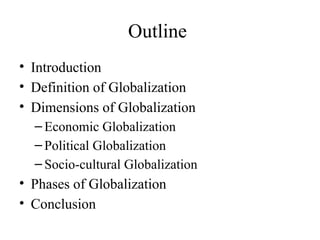
Outline
• Introduction
• Definitionof Globalization
• Dimensions of Globalization
– Economic Globalization
– Political Globalization
– Socio-cultural Globalization
• Phases of Globalization
• Conclusion
3.
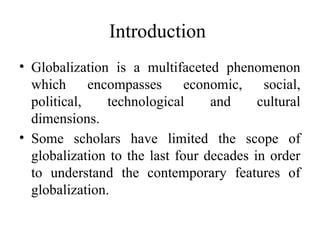
Introduction
• Globalization isa multifaceted phenomenon
which encompasses economic, social,
political, technological and cultural
dimensions.
• Some scholars have limited the scope of
globalization to the last four decades in order
to understand the contemporary features of
globalization.
4.
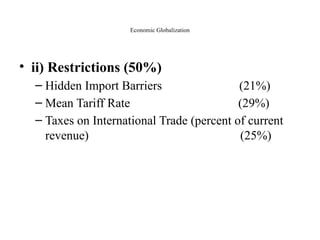
Introduction
• Others aretrying to find the linkages of
globalization in the ground breaking
developments of 19th century.
• Even some others are looking back into the
beginning of industrialism and capitalism for
understanding globalization.
5.
Introduction
• Finally, fewscholars reject the concept of
confining globalization in few decades, rather
according to them globalization is a process
which has been unfolding for millennia.
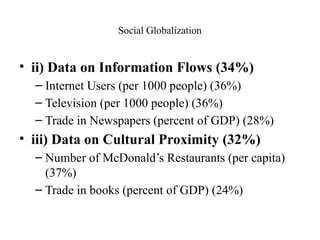
• History of globalization indicates that it is an
ongoing process.
• Intensity of globalization changes in the times
of boom and recession.
6.
Introduction
• Different scholarshave tried to define
globalization from various perspectives,
• It is important to know that globalization is not
a new phenomenon.
• It is part and parcel of the process of expansion
across continents based on migration, trade,
warfare, military alliances, conquest,
exploration, colonization and technological
advancement.
7.
Introduction
• Contacts amongstates, societies and people
from Stone Age till now have knitted the world
in the shape of interdependent patterns which
attenuated and intensified overtime.
• The outcome of the process of globalization is
characterized by unpredictable, far-reaching
and ongoing changes
8.
Introduction
• Being partof society, humans daily experience
globalization, its effects on the lives and on the
society, its power of changing social as well as
cultural structures and its blessings.
• Globalization has passed through many phases
throughout its history.
• There are ups and downs in the globalization
process.
9.
Introduction
• Globalization isa process which keeps on
increasing; may decrease for a while but it
never ends and it cannot be stopped.
• Human beings cannot live in isolation.
• They interact with each other; help one
another and share knowledge and experiences
with each other.
10.
Introduction
• Some indicatorsare highly in favor of growth in
globalization in future.
• WTO members have signed a ground breaking
agreement whose fruits may be visible in the
shape of prosperity of developing nations and
increase in economic globalization.
• Technology seems to be irreversible and there
are new technological inventions, like smart
phones, which facilitates social integrations.
11.
Introduction
• Tweeter, Facebookand other social media sites
also facilitated social interaction.
• MNCs and media have shaped up and boosted up
cultural homogeneity.
• Stage is set for increased globalization.
• Although, it has pros and cons, it is a work on our
part to support, facilitate and encourage positive
impacts of globalization simultaneously searching
ways to minimize or discourage its drawbacks.
12.
Definition of Globalization
•According to Albrow (1990), globalization
refers to
• “all those processes by which the people of the
world are incorporated into a single world
society”.
13.
Definition of Globalization
•McGrew (1992) stated: Globalization constitutes a
multiplicity of linkages and interconnections that
transcend the nation states (and by implication the
societies) which make up the modern world system.
• It defines a process through which events, decisions
and activities in one part of the world can come to
have a significant consequence for individuals and
communities in quite distant parts of the globe.
14.
Definition of Globalization
•Jones (1995) suggested
• “globalization may simply be an
intensification of the process of international
interdependence, a function of the growth of
competition in an international free trade
system intensified by the diffusion of
technology”.
15.
Definition of Globalization
•Hebron & Stack (2013) defined globalization
as
• “the further development of the process
initiated over many centuries, reflected in the
trade expansion, exploration, conquest,
migration, colonization, technological
advancement, and so on that have taken place
throughout world history”.
16.
Dimensions of Globalization
•Preceding definitions revealed that globalization
is comprised of multiple dimensions.
• These dimensions include economic, political,
cultural and social.
• Although economic globalization is an
important factor but one must not ignore
• other important factors like political, cultural
and social factors.
17.
Dimensions of Globalization
•So, from one aspect, globalization represents
unstoppable and relentless economic force
which integrated national markets, financial
services, labor and firms on an unprecedented
scale.
• This aspect can be characterized by unrestricted
and massive flow of financial information,
capital, goods and services in virtually every
part of the world.
18.
Dimensions of Globalization
•Other aspect focuses on the capacity and
sovereignty of states in the era of
globalization.
• Yet another aspect conceptualize globalization
as entanglement of diverse culture and social
structures.
• There are three main dimensions, economic,
political and socio-economic.
19.
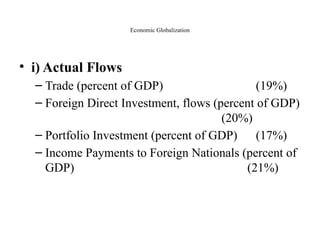
Economic Globalization
• i)Actual Flows
– Trade (percent of GDP) (19%)
– Foreign Direct Investment, flows (percent of GDP)
(20%)
– Portfolio Investment (percent of GDP) (17%)
– Income Payments to Foreign Nationals (percent of
GDP) (21%)
20.
Economic Globalization
• ii)Restrictions (50%)
– Hidden Import Barriers (21%)
– Mean Tariff Rate (29%)
– Taxes on International Trade (percent of current
revenue) (25%)
21.
Economic Globalization
• Contemporaryeconomic globalization is a
result of gradual emergence of international
economic order which started from economic
conference held at the end of World War II in
Bretton Woods, England.
• Major economic powers of global North
reversed their interwar (1918-1939) policy of
protectionism. America and England played
leading role in the success of that conference.
22.
Economic Globalization
• Otherthan reaching towards consensus on
increasing international trade, these countries
also agreed on establishing binding rules of
international activities.
• Bretton Wood’s conference laid foundation for
the establishment of other important
international organizations like IMF, World
Bank and World Trade Organization.
23.
Economic Globalization
• InternationalMonetary Fund was established to
handle international monetary systems.
• Similarly, World Bank was created to facilitate loan
facility for the reconstruction of post-war Europe, its
scope was expanded to provide loan for developing
countries of the world.
• General agreement on tariffs and trade was
established to cater the problems of international
trade in 1947 which was converted into World Trade
Organization in 1995.
24.
Economic Globalization
• Economicglobalization refers to “the
intensification and stretching of economic
interrelations across the globe”.
25.
Economic Globalization
• Economicglobalization refers to the
progressive “networking” of national market
economies into a single, tightly interconnected
global political economy whose accumulation
and distribution of resources are increasingly
governed by neoliberal principles-emphasizing
the role the market while minimizing
governmental involvement in economic
matters”.
26.
Political Globalization
i. Embassiesin Country [25%]
ii. Membership in International Organization
(28%)
iii. Participation in U.N. Security Council
Missions (22%)
iv. International Treaties (25%)
27.
Political Globalization
• Politicalglobalization refers to “the
intensification and expansion of political
interrelations across the globe”.
• For last few centuries, humans have developed
a sense of belongingness with a particular
nation and political differences were built on
these territories.
28.
Political Globalization
• Thisartificial division has nurtured a concept
of common “us” and unfamiliar “them” which
segregates the social space into foreign and
domestic spheres.
• It is the sovereignty which is most at risk from
globalization.
• States still are at the center of international
systems.
29.
Socio-cultural Globalization
• Talkingabout economic and political
globalization may represent a part of the story
as globalization is not comprised of
economic/political process only but affected
by social and cultural spheres, where people
confront major shifts.
30.
Socio-cultural Globalization
• Giddens(1990) tried to define social aspect of
globalization as,
• “worldwide social relations which link distant
localities in such a way that local happenings
are shaped by events occurring many miles
away and vice versa”.
• Similarly cultural globalization refers to, “the
intensification and expansion of cultural flows
across the globe”
31.
Socio-cultural Globalization
• Socialglobalization includes three aspects
which are
• personal contact,
• information flows and
• cultural proximity.
32.
Social Globalization
• i)Data on Personal Contact [39%]
– Telephone Traffic (26%)
– International Tourism (26%)
– Foreign Population (percent of total population)
(20%)
– International letters (per capita) (26%)
33.
Social Globalization
• ii)Data on Information Flows (34%)
– Internet Users (per 1000 people) (36%)
– Television (per 1000 people) (36%)
– Trade in Newspapers (percent of GDP) (28%)
• iii) Data on Cultural Proximity (32%)
– Number of McDonald’s Restaurants (per capita)
(37%)
– Trade in books (percent of GDP) (24%)
34.
Socio-cultural Globalization
• Peopleto people interaction facilitated by
immigration and tourism, cultural exchange,
information flows, technology dissemination
and exchange of ideas through the medium of
radio, TV channels, newspapers, telephone,
and internet helped in disseminating new idea
from developed to less developed countries
and this idea dissemination helped in more
social and cultural integration.
35.
Socio-cultural Globalization
• Onthe positive end, an accelerated march
towards homogeneous culture where linguistic,
ethnic and racial differences are washed away,
will leads towards institutionalized,
modernized and rationalized global culture.
• This kind of social arrangement may cause a
true transnationalism and give rise to more
peaceful and tolerate world order.
36.
Socio-cultural Globalization
• Butaccording to a contrary perspective,
homogeneous culture predominated by
western as well as American values and
symbols threaten the cultural identities.
• Therefore, globalization proves a challenge for
authentic culture communities through the
power of expanding interchange of values,
norms, identities, ideas and self-conceptions
37.
Phase-I of Globalization
•The process of economic integration
accelerated in 1989/90 with the fall of Berlin
Wall. Until then, only west had actively
participated and process developed with a
slower pace. After this historical event, a wave
of globalization came.
38.
Phase-I of Globalization
•Soviet Union has opened up trade,
• China has speeded up its reforms,
• India and Latin America has changed the policy
of import substitution, common market and
currency of European countries was created,
NAFTA was established,
• GATT was completed and resultantly world was
moving towards trade liberalization and free flow
of capital.
39.
Phase-II of Globalization
•First phase euphoria ended in 1994/95 with
Mexico crisis.
• Mexico had to take multi-billion dollar loan
from IMF to escape from insolvency caused by
short term capital.
• This crisis effect spilled over to US, Europe,
Portugal and Spain. Situation was calmed down
soon and a new wave of globalization started.
40.
Phase-II of Globalization
•In Asia, Indonesia and Thailand enjoyed rapid
growth.
• The process was disturbed again in 1997/98 due
to capital flight from emerging markets like
Asia, South Korea, Russia and Latin America.
• But situation was again ebbing rapidly.
• A new story of digitalization and networks
started and gave boom to globalization.
41.
Phase-III of Globalization
•All hopes of developments from boom of
1990s seemed to be symbolic.
• Terrorist attack in New York and Washington
DC in September 2011 resulted in market
crash and USA started an endless war on terror
with the help of few EU member states and
Russia.
42.
Phase-III of Globalization
•After all these happenings, still world did not come
across any big crisis. World economy again
approached towards boom and reached highest world
growth of 5% where China and India were able to
achieve 10% & 8% growth respectively during this
period.
• Although world has enjoyed increased growth but
benefits of globalization may not be equal and for
all. A question of equitable distribution of wealth
was a big question mark for the economists.
43.
Phase-III of Globalization
•There was a historic distortion in the process
of globalization in 2007 due to credit crisis
which caused the virtual break down of
banking industry.
• Credit crisis gave birth to many other
problems ranging from food shortage, hunger
to dramatic increase in prices.
44.
Phase-IV of globalization
•Muller (2010) in his article “Phase 4 of
globalization” has predicted fourth phase of
globalization, in which he predicted some
situations like slower growth ahead, political
destabilization and diffusion of power.
• He also suggested some remedies including
work, thrift, creating solidarity, openness,
cooperation, originality.
45.
Conclusion
• Globalization, amultifaceted phenomenon has
a history from the first interaction between the
people; it continues till now and will continue
in the future.
• As a process of integration, globalization
affects every aspect of human life ranging
from economic, cultural, and political to
social.

![Political Globalization
i. Embassies in Country [25%]
ii. Membership in International Organization
(28%)
iii. Participation in U.N. Security Council
Missions (22%)
iv. International Treaties (25%)](https://image.slidesharecdn.com/globalization-250904014016-c2cc4aad/85/Globalization-pptx-according-to-css-latest-syllabus-26-320.jpg)
![Social Globalization
• i) Data on Personal Contact [39%]
– Telephone Traffic (26%)
– International Tourism (26%)
– Foreign Population (percent of total population)
(20%)
– International letters (per capita) (26%)](https://image.slidesharecdn.com/globalization-250904014016-c2cc4aad/85/Globalization-pptx-according-to-css-latest-syllabus-32-320.jpg)