Long- and Short-run ISSUES
Part the Second: Inflation
“Up, Up, and Away!”
• Inflation is the increase in the overall price level.
• Note that we are dealing with the price level of all goods
and services in the economy and not individual goods.
• Thus, it measures the simultaneous and sustained
increase in prices in the economy.
• Deflation is the decrease in the overall price level.
• Hyperinflation refers to situations of rapid and extreme
rises in the price level over short periods of time.
Prices have a tendency to rise over time.
Causes of Inflation
Inflation can be demand-driven, supply-driven, or both.
Demand-driven (“demand-pull”) inflation occurs when there
is an increase in the aggregate demand for goods and
services in the economy.
• Example: if the national income of an economy
increases, there should be a commensurate increase in
the demand for goods and services.
Supply-driven (“cost-push”) inflation occurs when the costs
of production of goods and services rise, leading to a
decrease in aggregate supply.
• Examples: oil price hikes or crop failures.
Why do prices rise?
Measuring Inflation
• The GDP Deflator
• Because it is the ratio of nominal to real GDP, a rising
GDP deflator means that nominal GDP is rising.
• The Consumer Price Index (CPI)
• A fixed-weight index based on a “basket of goods”
typically purchased by the average consumer.
• The Producer Price Indices (PPI)
• Indices of the prices that producers received for
products at each stage of the production process.
Indicators and Indices.
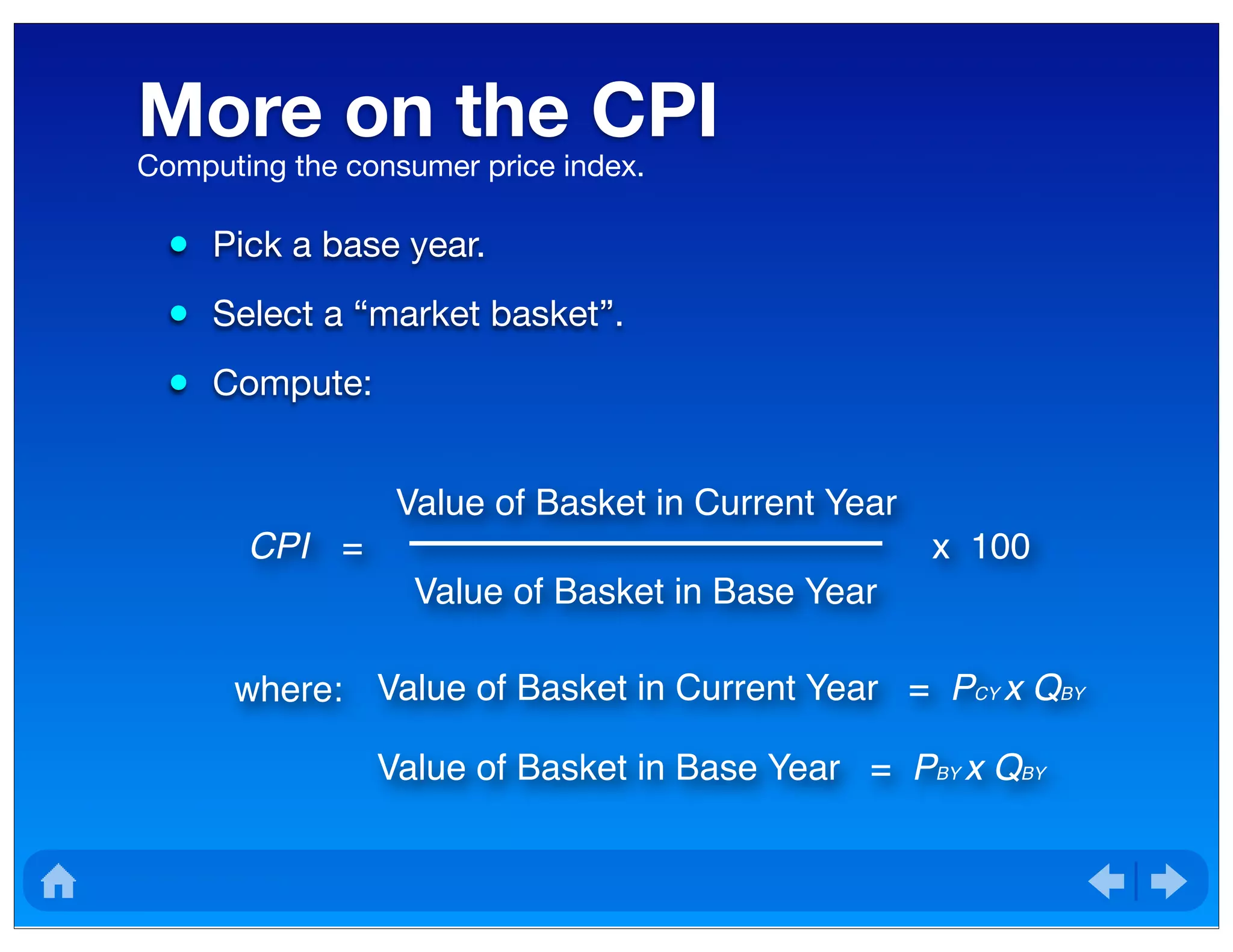
More on the CPI
• Pick a base year.
• Select a “market basket”.
• Compute:
Computing the consumer price index.
where: Value of Basket in Current Year = PCY x QBY
Value of Basket in Base Year = PBY x QBY
CPI =
Value of Basket in Current Year
Value of Basket in Base Year
x 100
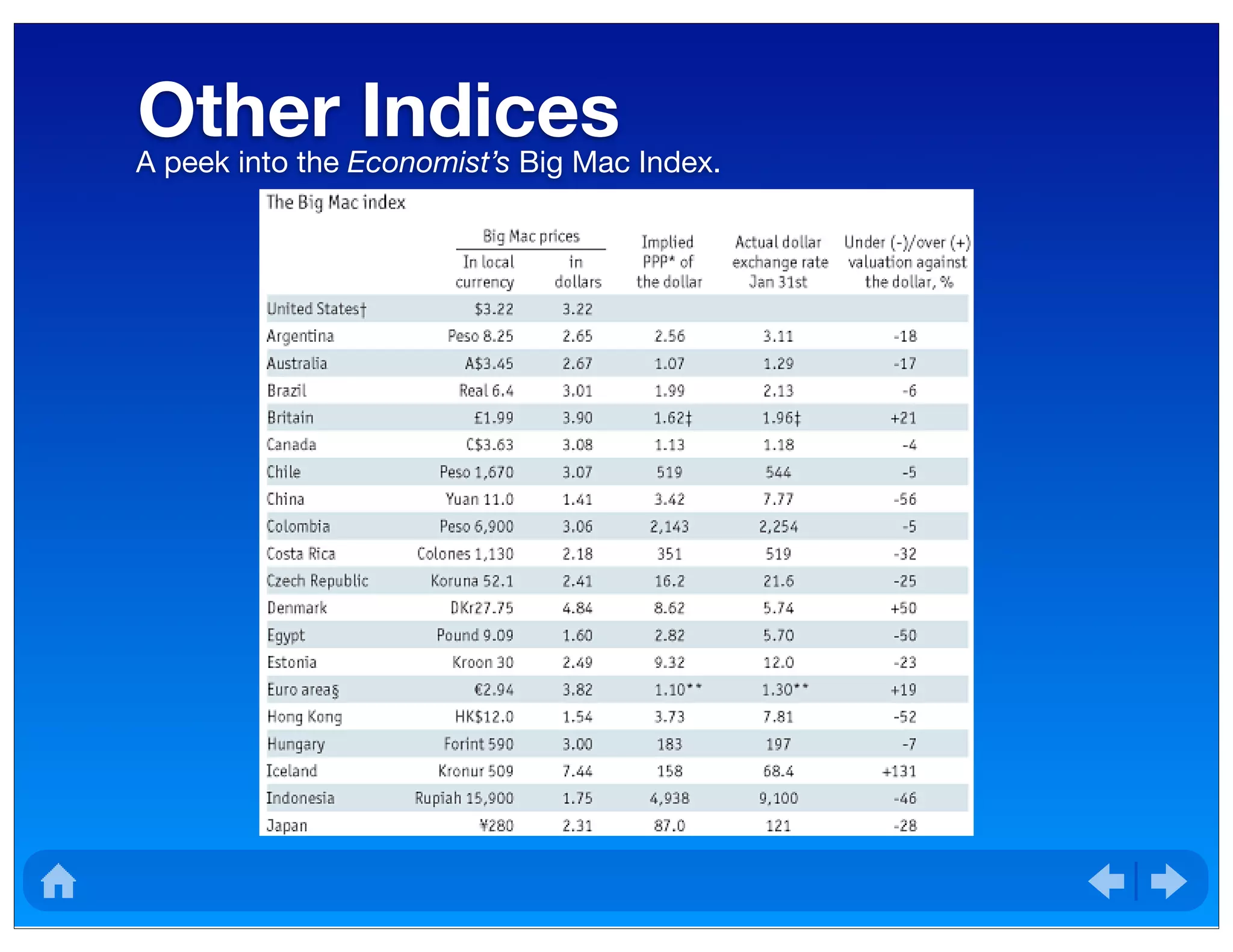
Other IndicesA peek into the Economist’s Big Mac Index.
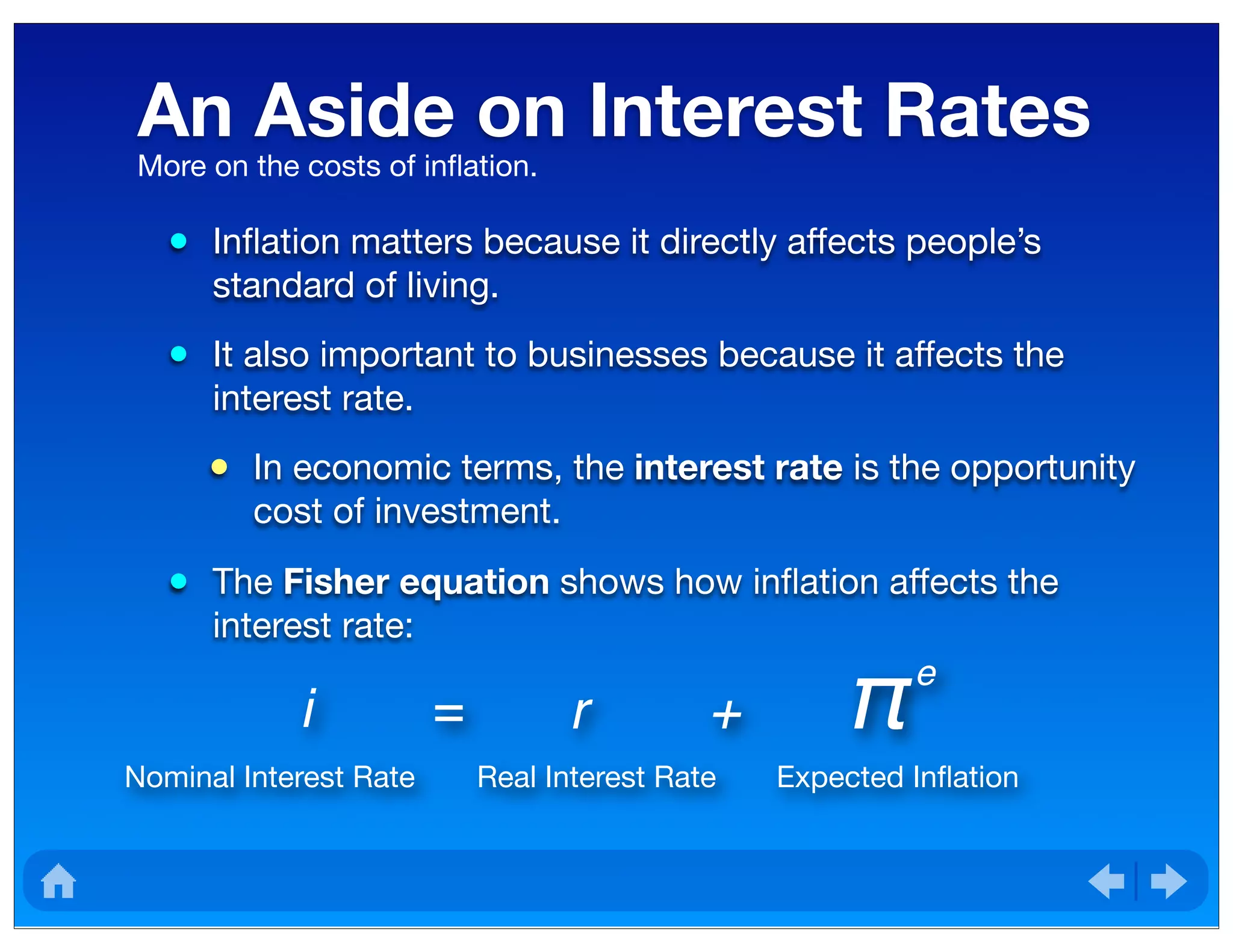
An Aside on Interest Rates
• Inflation matters because it directly affects people’s
standard of living.
• It also important to businesses because it affects the
interest rate.
• In economic terms, the interest rate is the opportunity
cost of investment.
• The Fisher equation shows how inflation affects the
interest rate:
More on the costs of inflation.
i = r + π e
Nominal Interest Rate Real Interest Rate Expected Inflation
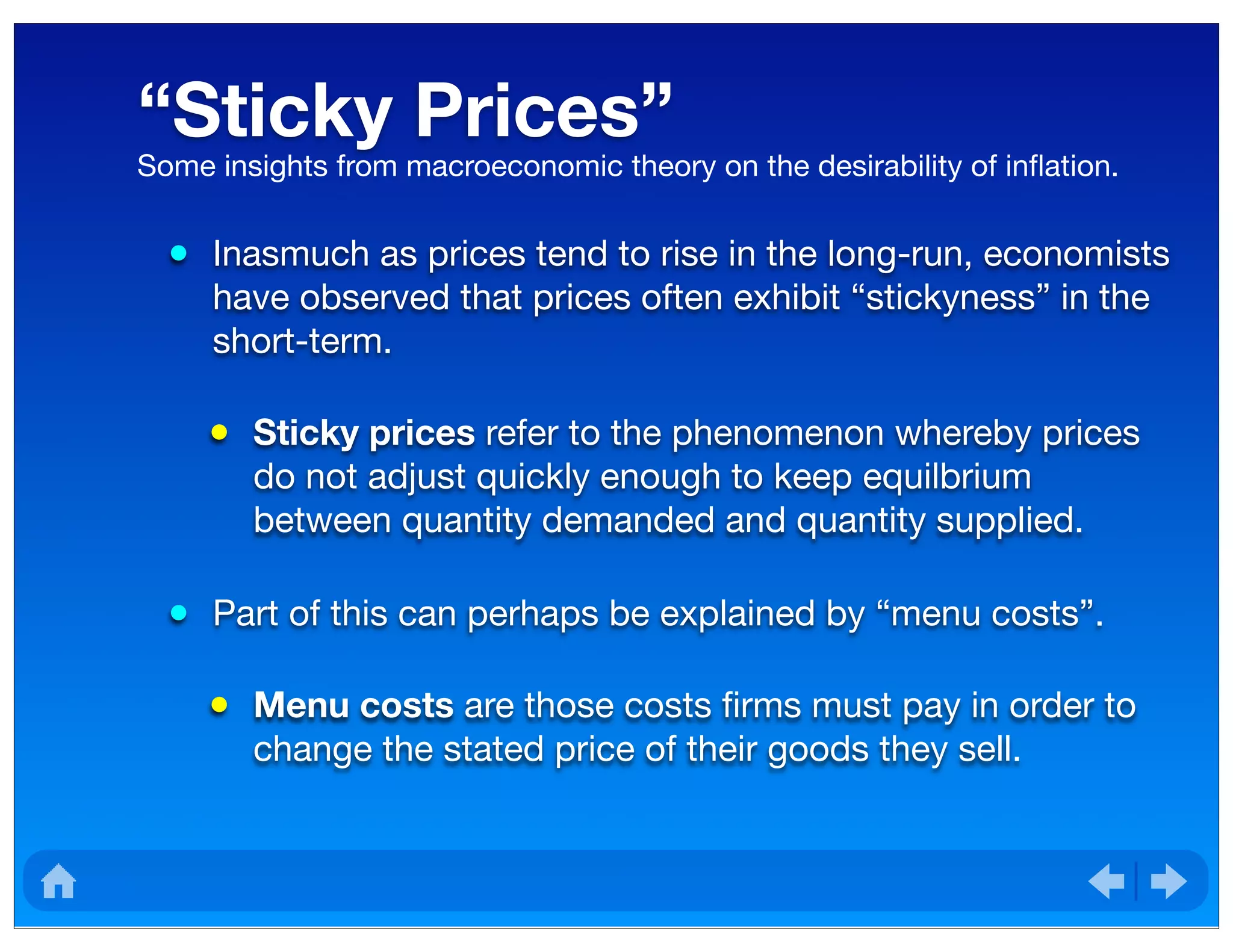
“Sticky Prices”
• Inasmuch as prices tend to rise in the long-run, economists
have observed that prices often exhibit “stickyness” in the
short-term.
• Sticky prices refer to the phenomenon whereby prices
do not adjust quickly enough to keep equilbrium
between quantity demanded and quantity supplied.
• Part of this can perhaps be explained by “menu costs”.
• Menu costs are those costs firms must pay in order to
change the stated price of their goods they sell.
Some insights from macroeconomic theory on the desirability of inflation.
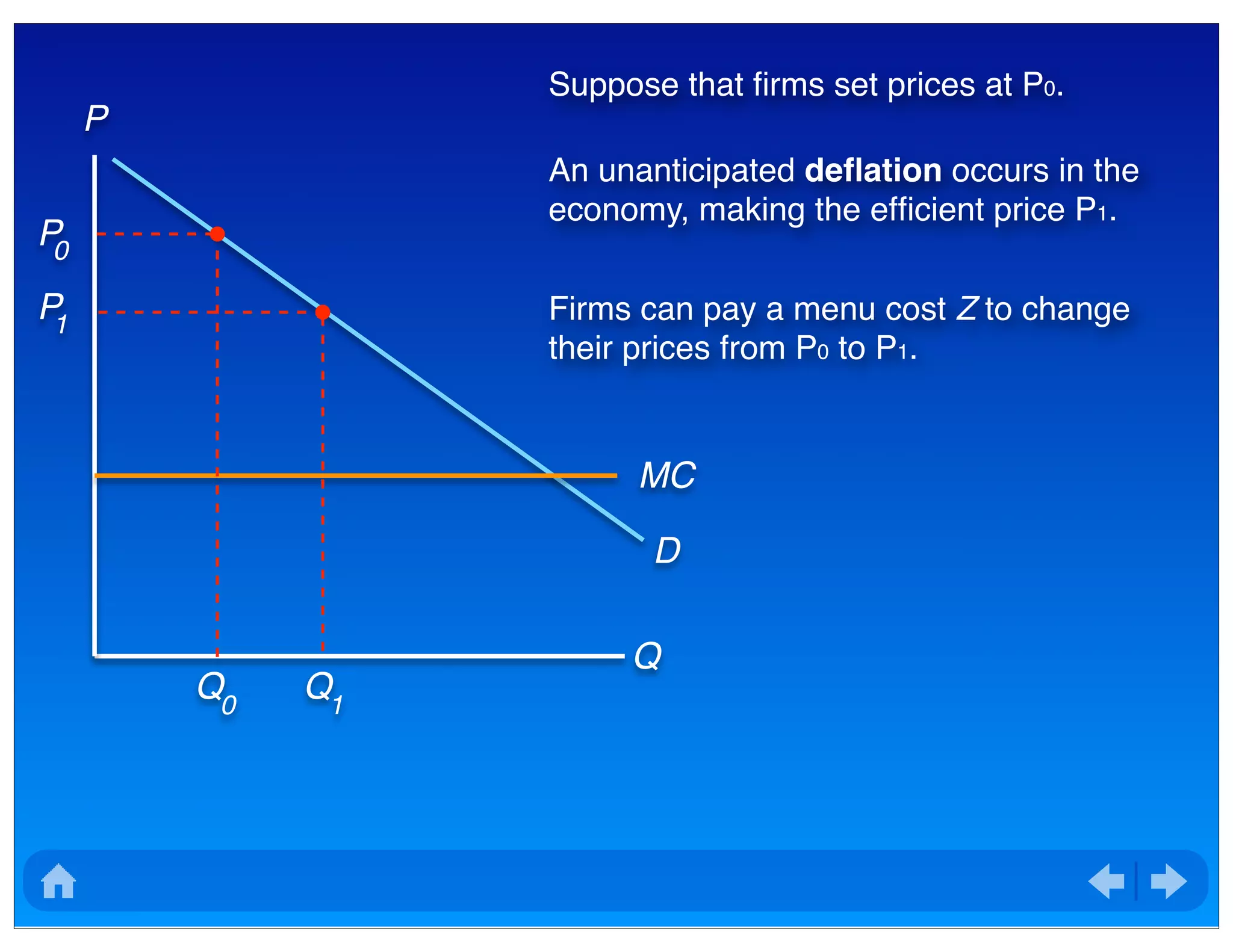
Suppose that firms set prices at P0.
An unanticipated deflation occurs in the
economy, making the efficient price P1.
Firms can pay a menu cost Z to change
their prices from P0 to P1.
D
P
Q
MC
0
P
0
Q
1
P
1
Q
P
Q
D
1
P
MC
0
P
A
C
B
By holding prices fixed, firms lose potential
profit in the amount of [C – A].
If prices are held fixed, consumers lose
potential consumer surplus in the amount of
[A + B].
As such, the total social loss is [C + B].
*If [C + B] > Z > [C – A],
firms will not pay the menu
cost even if society will be
better off if they do.
The unanticipated deflation unambiguously decreases social welfare.
0
Q 1
Q
P
Q
D
1
P
MC
0
P
D
F
E
By holding prices fixed, firms gain profit in
the amount of [F – D].
If prices are held fixed, consumers gain
consumer surplus in the amount of [D + E].
As such, the total social gain is [F + E].
*If – Z < [F – D] firms will
not pay the menu cost and
hold prices fixed.
The unanticipated inflation has increased social welfare.
0
Q1
Q
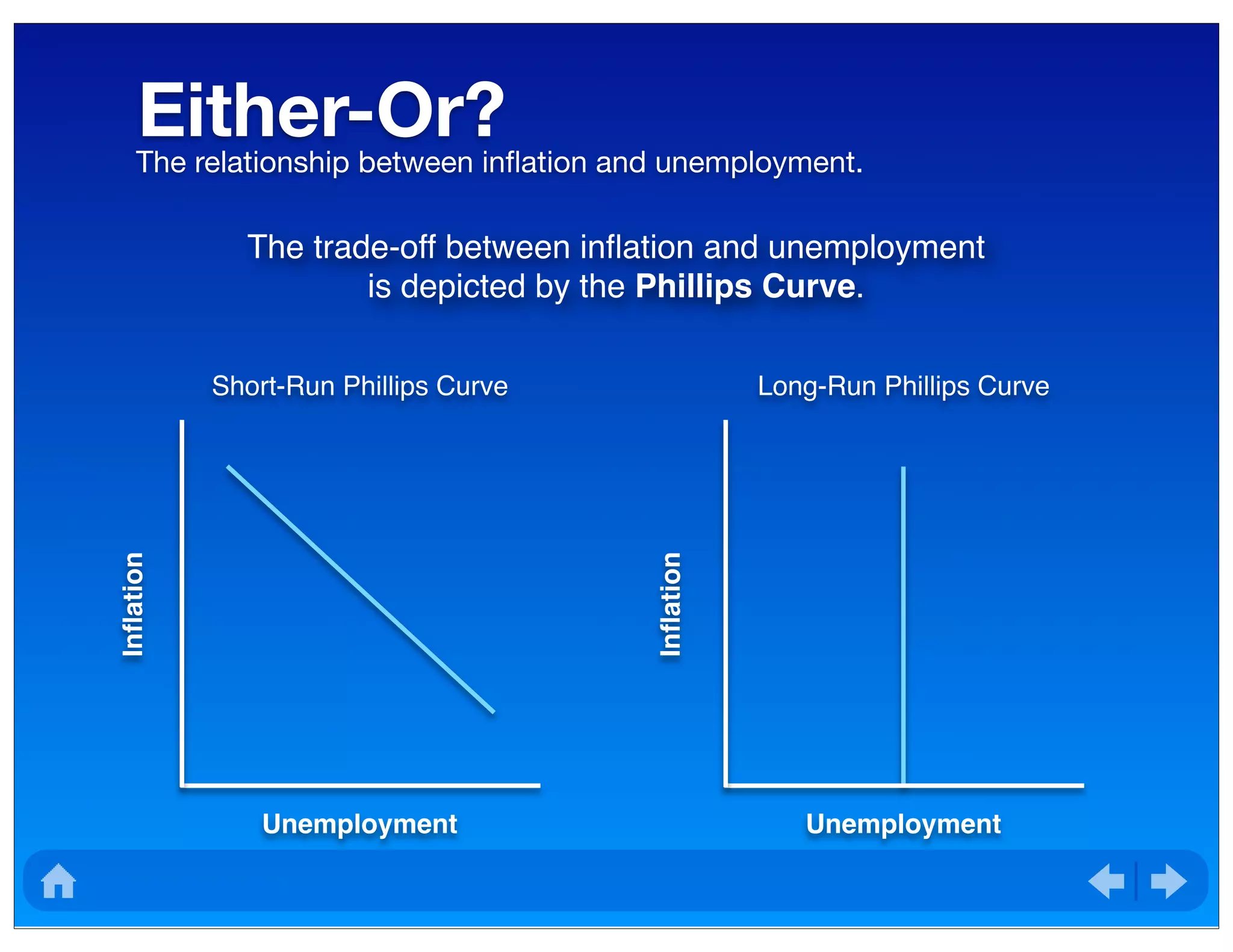
Either-Or?The relationship between inflation and unemployment.
The trade-off between inflation and unemployment
is depicted by the Phillips Curve.
Short-Run Phillips Curve Long-Run Phillips Curve
Inflation
Inflation
Unemployment Unemployment

Macroeconomics: Inflation

  • 1.
    Long- and Short-runISSUES Part the Second: Inflation
  • 2.
    “Up, Up, andAway!” • Inflation is the increase in the overall price level. • Note that we are dealing with the price level of all goods and services in the economy and not individual goods. • Thus, it measures the simultaneous and sustained increase in prices in the economy. • Deflation is the decrease in the overall price level. • Hyperinflation refers to situations of rapid and extreme rises in the price level over short periods of time. Prices have a tendency to rise over time.
  • 3.
    Causes of Inflation Inflationcan be demand-driven, supply-driven, or both. Demand-driven (“demand-pull”) inflation occurs when there is an increase in the aggregate demand for goods and services in the economy. • Example: if the national income of an economy increases, there should be a commensurate increase in the demand for goods and services. Supply-driven (“cost-push”) inflation occurs when the costs of production of goods and services rise, leading to a decrease in aggregate supply. • Examples: oil price hikes or crop failures. Why do prices rise?
  • 4.
    Measuring Inflation • TheGDP Deflator • Because it is the ratio of nominal to real GDP, a rising GDP deflator means that nominal GDP is rising. • The Consumer Price Index (CPI) • A fixed-weight index based on a “basket of goods” typically purchased by the average consumer. • The Producer Price Indices (PPI) • Indices of the prices that producers received for products at each stage of the production process. Indicators and Indices.
  • 5.
    More on theCPI • Pick a base year. • Select a “market basket”. • Compute: Computing the consumer price index. where: Value of Basket in Current Year = PCY x QBY Value of Basket in Base Year = PBY x QBY CPI = Value of Basket in Current Year Value of Basket in Base Year x 100
  • 6.
    Other IndicesA peekinto the Economist’s Big Mac Index.
  • 7.
    An Aside onInterest Rates • Inflation matters because it directly affects people’s standard of living. • It also important to businesses because it affects the interest rate. • In economic terms, the interest rate is the opportunity cost of investment. • The Fisher equation shows how inflation affects the interest rate: More on the costs of inflation. i = r + π e Nominal Interest Rate Real Interest Rate Expected Inflation
  • 8.
    “Sticky Prices” • Inasmuchas prices tend to rise in the long-run, economists have observed that prices often exhibit “stickyness” in the short-term. • Sticky prices refer to the phenomenon whereby prices do not adjust quickly enough to keep equilbrium between quantity demanded and quantity supplied. • Part of this can perhaps be explained by “menu costs”. • Menu costs are those costs firms must pay in order to change the stated price of their goods they sell. Some insights from macroeconomic theory on the desirability of inflation.
  • 9.
    Suppose that firmsset prices at P0. An unanticipated deflation occurs in the economy, making the efficient price P1. Firms can pay a menu cost Z to change their prices from P0 to P1. D P Q MC 0 P 0 Q 1 P 1 Q
  • 10.
    P Q D 1 P MC 0 P A C B By holding pricesfixed, firms lose potential profit in the amount of [C – A]. If prices are held fixed, consumers lose potential consumer surplus in the amount of [A + B]. As such, the total social loss is [C + B]. *If [C + B] > Z > [C – A], firms will not pay the menu cost even if society will be better off if they do. The unanticipated deflation unambiguously decreases social welfare. 0 Q 1 Q
  • 11.
    P Q D 1 P MC 0 P D F E By holding pricesfixed, firms gain profit in the amount of [F – D]. If prices are held fixed, consumers gain consumer surplus in the amount of [D + E]. As such, the total social gain is [F + E]. *If – Z < [F – D] firms will not pay the menu cost and hold prices fixed. The unanticipated inflation has increased social welfare. 0 Q1 Q
  • 12.
    Either-Or?The relationship betweeninflation and unemployment. The trade-off between inflation and unemployment is depicted by the Phillips Curve. Short-Run Phillips Curve Long-Run Phillips Curve Inflation Inflation Unemployment Unemployment