MACROECONOMICS
Looking at the Bigger Picture, in Broad Strokes
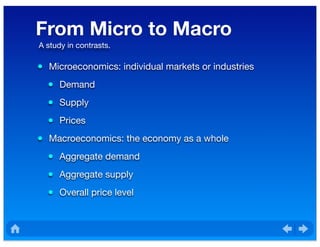
From Micro to Macro
• Microeconomics: individual markets or industries
• Demand
• Supply
• Prices
• Macroeconomics: the economy as a whole
• Aggregate demand
• Aggregate supply
• Overall price level
A study in contrasts.
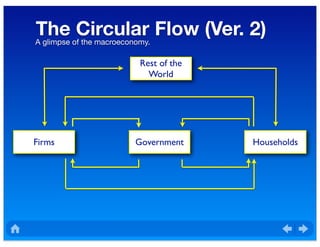
Government
Rest of the
World
HouseholdsFirms
The Circular Flow (Ver. 2)A glimpse of the macroeconomy.
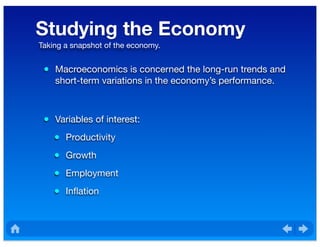
Studying the Economy
• Macroeconomics is concerned the long-run trends and
short-term variations in the economy’s performance.
• Variables of interest:
• Productivity
• Growth
• Employment
• Inflation
Taking a snapshot of the economy.
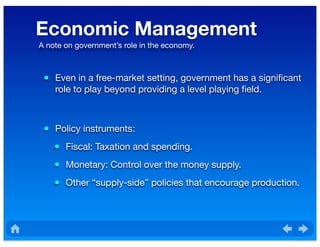
Economic Management
• Even in a free-market setting, government has a significant
role to play beyond providing a level playing field.
• Policy instruments:
• Fiscal: Taxation and spending.
• Monetary: Control over the money supply.
• Other “supply-side” policies that encourage production.
A note on government’s role in the economy.
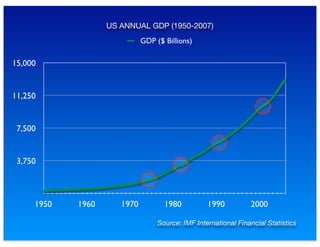
3,750
7,500
11,250
15,000
1950 1960 1970 1980 1990 2000
GDP ($ Billions)
US ANNUAL GDP (1950-2007)
Source: IMF International Financial Statistics
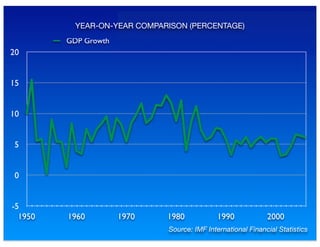
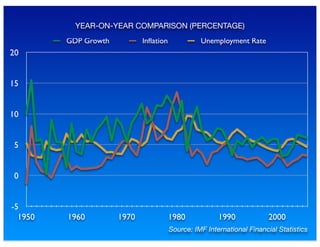
GDP Growth Inflation Unemployment Rate
1950 1960 1970 1980 1990 2000
-5
0
5
10
15
20
YEAR-ON-YEAR COMPARISON (PERCENTAGE)
Source: IMF International Financial Statistics
GDP Growth Inflation Unemployment Rate
-5
0
5
10
15
20
1950 1960 1970 1980 1990 2000
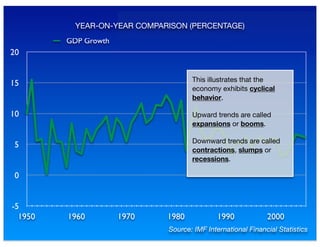
This illustrates that the
economy exhibits cyclical
behavior.
Upward trends are called
expansions or booms.
Downward trends are called
contractions, slumps or
recessions.
YEAR-ON-YEAR COMPARISON (PERCENTAGE)
Source: IMF International Financial Statistics
-5
0
5
10
15
20
1950 1960 1970 1980 1990 2000
GDP Growth Inflation Unemployment Rate
YEAR-ON-YEAR COMPARISON (PERCENTAGE)
Source: IMF International Financial Statistics
-5
0
5
10
15
20
1950 1960 1970 1980 1990 2000
GDP Growth Inflation Unemployment Rate
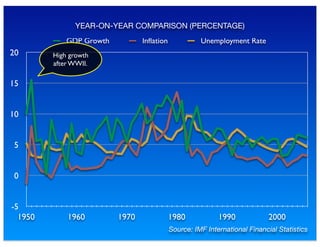
High growth
after WWII.
YEAR-ON-YEAR COMPARISON (PERCENTAGE)
Source: IMF International Financial Statistics
-5
0
5
10
15
20
1950 1960 1970 1980 1990 2000
GDP Growth Inflation Unemployment Rate
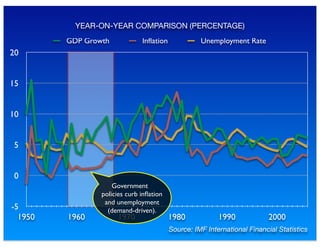
Government
policies curb inflation
and unemployment
(demand-driven).
YEAR-ON-YEAR COMPARISON (PERCENTAGE)
Source: IMF International Financial Statistics
-5
0
5
10
15
20
1950 1960 1970 1980 1990 2000
GDP Growth Inflation Unemployment Rate
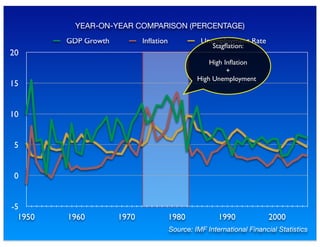
Stagflation:
High Inflation
+
High Unemployment
YEAR-ON-YEAR COMPARISON (PERCENTAGE)
Source: IMF International Financial Statistics
-5
0
5
10
15
20
1950 1960 1970 1980 1990 2000
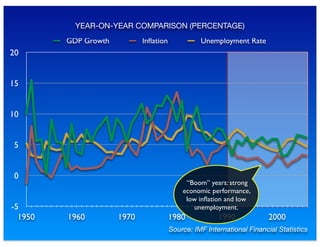
GDP Growth Inflation Unemployment Rate
“Boom” years: strong
economic performance,
low inflation and low
unemployment.
YEAR-ON-YEAR COMPARISON (PERCENTAGE)
Source: IMF International Financial Statistics

Macroeconomics

  • 1.
    MACROECONOMICS Looking at theBigger Picture, in Broad Strokes
  • 2.
    From Micro toMacro • Microeconomics: individual markets or industries • Demand • Supply • Prices • Macroeconomics: the economy as a whole • Aggregate demand • Aggregate supply • Overall price level A study in contrasts.
  • 3.
    Government Rest of the World HouseholdsFirms TheCircular Flow (Ver. 2)A glimpse of the macroeconomy.
  • 4.
    Studying the Economy •Macroeconomics is concerned the long-run trends and short-term variations in the economy’s performance. • Variables of interest: • Productivity • Growth • Employment • Inflation Taking a snapshot of the economy.
  • 5.
    Economic Management • Evenin a free-market setting, government has a significant role to play beyond providing a level playing field. • Policy instruments: • Fiscal: Taxation and spending. • Monetary: Control over the money supply. • Other “supply-side” policies that encourage production. A note on government’s role in the economy.
  • 6.
    3,750 7,500 11,250 15,000 1950 1960 19701980 1990 2000 GDP ($ Billions) US ANNUAL GDP (1950-2007) Source: IMF International Financial Statistics
  • 7.
    GDP Growth InflationUnemployment Rate 1950 1960 1970 1980 1990 2000 -5 0 5 10 15 20 YEAR-ON-YEAR COMPARISON (PERCENTAGE) Source: IMF International Financial Statistics
  • 8.
    GDP Growth InflationUnemployment Rate -5 0 5 10 15 20 1950 1960 1970 1980 1990 2000 This illustrates that the economy exhibits cyclical behavior. Upward trends are called expansions or booms. Downward trends are called contractions, slumps or recessions. YEAR-ON-YEAR COMPARISON (PERCENTAGE) Source: IMF International Financial Statistics
  • 9.
    -5 0 5 10 15 20 1950 1960 19701980 1990 2000 GDP Growth Inflation Unemployment Rate YEAR-ON-YEAR COMPARISON (PERCENTAGE) Source: IMF International Financial Statistics
  • 10.
    -5 0 5 10 15 20 1950 1960 19701980 1990 2000 GDP Growth Inflation Unemployment Rate High growth after WWII. YEAR-ON-YEAR COMPARISON (PERCENTAGE) Source: IMF International Financial Statistics
  • 11.
    -5 0 5 10 15 20 1950 1960 19701980 1990 2000 GDP Growth Inflation Unemployment Rate Government policies curb inflation and unemployment (demand-driven). YEAR-ON-YEAR COMPARISON (PERCENTAGE) Source: IMF International Financial Statistics
  • 12.
    -5 0 5 10 15 20 1950 1960 19701980 1990 2000 GDP Growth Inflation Unemployment Rate Stagflation: High Inflation + High Unemployment YEAR-ON-YEAR COMPARISON (PERCENTAGE) Source: IMF International Financial Statistics
  • 13.
    -5 0 5 10 15 20 1950 1960 19701980 1990 2000 GDP Growth Inflation Unemployment Rate “Boom” years: strong economic performance, low inflation and low unemployment. YEAR-ON-YEAR COMPARISON (PERCENTAGE) Source: IMF International Financial Statistics