The
Contemporary
World
Chapter 1
Globalization: An Introduction
Prepared by:
Neňa Divina D. Fevidal, RL
Brief
History
of
Globalization
Objectives:
At the end of the lesson, the students should be able to:
1. Define the term ‘globalization’;
2. Illustrate the concept of globalization;
3. Cite the essence of globalization;
4. Relate the effects of globalization in the economy;
5. Identify the underlying philosophies of the varying definitions of
globalization;
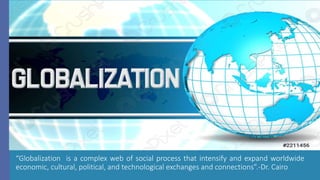
“Globalization is a complex web of social process that intensify and expand worldwide
economic, cultural, political, and technological exchanges and connections”.-Dr. Cairo
A B R I E F HISTORY OF
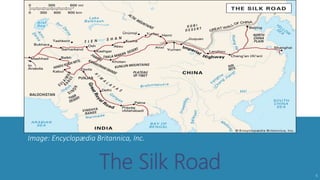
The Silk Road
Image: Encyclopædia Britannica, Inc.
5
Silk roads (1st century BC-5th century AD)
o luxury products from China started to appear on the other edge of
the Eurasian continent – in Rome.
o Trade had stopped being local or regional affair and started to
become global.
Brief
History
of
Globalization
Spice routes (7th-15th centuries)
o the new religion spread in all directions from its Arabian
heartland in the 7th century,
o By the early 9th century, Muslim traders already dominated
Mediterranean and Indian Ocean trade; afterwards, they could be
found as far east as Indonesia, which over time became a
Muslim-majority country, and as far west as Moorish Spain.
o In the 15th century, spices came to Europe via the Middle East
land and sea routes, and spices were in huge demand both for
food dishes and for use in medicines.
Age of Discovery (15th-18th centuries)
o It was in this era, from the end of the 15th century onwards, that
European explorers connected East and West – and accidentally
discovered the Americas.
o Aided by the discoveries of the so-called “Scientific Revolution” in the
fields of astronomy, mechanics, physics and shipping, the Portuguese,
Spanish and later the Dutch and the English first “discovered”, then
subjugated, and finally integrated new lands in their economies
o Potatoes, tomatoes, coffee and chocolate were introduced in Europe,
and the price of spices fell steeply.
o Trade certainly started to become global, and it had even been the
main reason for starting the Age of Discovery.
Brief
History
of
Globalization
First wave of globalization (19th century-1914)
o This started to change with the first wave of globalization, which roughly
occurred over the century ending in 1914.
o By the end of the 18th century, Great Britain had started to dominate the
world both geographically, through the establishment of the British
Empire, and technologically, with innovations like the steam engine, the
industrial weaving machine and more. It was the era of the First Industrial
Revolution.
o The “British” Industrial Revolution made for a fantastic twin engine of
global trade. On the one hand, steamships and trains could transport
goods over thousands of miles, both within countries and across
countries. On the other hand, its industrialization allowed Britain to make
products that were in demand all over the world, like iron, textiles and
manufactured goods.
o Britain was the country that benefited most from this globalization, as it
had the most capital and technology, others did too, by exporting other
goods.
Brief
History
of
Globalization
The world wars
o In 1914, the outbreak of World War I brought an end to just about
everything the burgeoning high society of the West had gotten so
used to, including globalization.
o Millions of soldiers died in battle, millions of civilians died as collateral
damage, war replaced trade, destruction replaced construction, and
countries closed their borders yet again.
o In the years between the world wars, the financial markets, which
were still connected in a global web, caused a further breakdown of
the global economy and its links.
Brief
History
of
Globalization
Second and third wave of globalization
o The end of the World War II marked a new beginning for the global
economy.
o Under the leadership of a new hegemon, the United States of
America, and aided by the technologies of the Second Industrial
Revolution, like the car and the plane, global trade started to rise
once again.
o In the early decades after World War II, institutions like the European
Union, and other free trade vehicles championed by the US were
responsible for much of the increase in international trade.
Brief
History
of
Globalization
Globalization 4.0
o In a world increasingly dominated by two global powers, the US and
China, the new frontier of globalization is the cyber world.
o The digital economy, in its infancy during the third wave of
globalization, is now becoming a force to reckon with through e-
commerce, digital services, 3D printing. It is further enabled by
artificial intelligence, but threatened by cross-border hacking and
cyberattacks.
Brief
History
of
Globalization
Globalization: Its Definition
 The term globalization is derived from the word “globalize”
which refers to the emergence of an international network of
economic systems.
 Globalization is a process of interaction and integration among
the people, companies, and governments of different nations,
a process driven by international trade and investments and
aided by information technology. (Levin Institute, 2016).
 Also, globalization defined as a process that, based on
international strategies, aims to expand business operations on
a worldwide level, and was participated by the facilitation of
global communication due to technological advancements, and
socioeconomic, political and environmental developments.
(Pologeorgis, 2017)
Globalization:
Its
Definition
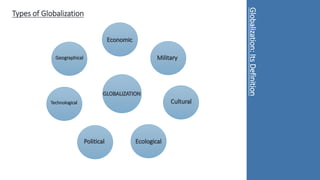
Types of Globalization
.
GLOBALIZATION
Economic
Military
Cultural
Ecological
Political
Technological
Geographical
Globalization:
Its
Definition
 Economic Globalization
o refers to the increasing interdependence of world economies as a result of the
growing scale of cross-border trade of commodities and services, flow
international capital and wide and rapid spread of technologies (Shangquan, 2000)
examples: Philippines’ major exports and imports products.
EXPORTS:
-coconut oil export to Indonesia and India, United States and Europe.
-The nation’s Department of Trade and Industry has identified electronic
products as one of the Philippine’s key export commodities.
-Mango export to Japan, South Korea, Singapore. Dried mango to
Hongk Hong and Canada
-Cacao seeds from Davao, export to Singapore, London and U.S.
IMPORTS:
The main trade partners of the Philippines include China, Japan, the
United States, Singapore and Hong Kong.
-refined petroleum import from the Russians and Saudi Arabian
- Rice from Vietnam and Thailand
Globalization:
Its
Definition
 Military Globalization
o According to David Held, military globalizations is ‘’the process which
embodies the growing extensity and intensity of military relations among
the political units of the world system. Understood as such, it reflects both
the expanding network of worldwide military ties and relations, as well as
the impact of key military technological innovations (from steamships to
satellites), which overtime, have, reconstituted the world into a single
geostrategic space.”
o While for Robert Keohane and Joseph Nye, military globalization entails
‘long-distance networks of interdependence in which force, and the threat
or promise of force, are employed.
Globalization:
Its
Definition
Cultural Globalization
o refers to the interpenetration of cultures which, as a consequence,
means nations adopt principles, beliefs, and costumes of other
nations, losing their unique culture to a unique, globalized supra-
culture;
o is the transmission of ideas, meanings and values around the world
in such way as to extend and intensify social relations.
-through globalization, cultures of a specific country can be shared or
spread within the countries. The downside of this is some cultures
that are exclusive on a certain country our slowly vanishing.
Examples:
-cultures from different countries, from Spain, China and
America. (Religion from Spain ; noodles dishes from China)
-Based on the article of David Volodzko, he stated that
“Putonghua and English are pushing many minority languages to
the brink of extinction”. (some dying languages)
Globalization:
Its
Definition
Ecological Globalizations.
o Based on an article published by ecological Society of America
(2008), entitle ‘’’Ecological Globalization’’, it is said that, because
of increasing globalization, people often inadvertently introduce
non-native plants, animals and diseases into new locations.
Examples:
-Natural resources
-big environmental consequences as they contribute to the
depletion of natural resources, deforestation and the
destruction of ecosystems and loss of biodiversity.
Globalization:
Its
Definition
Globalization and Politics
The globalization of political refers to the absence of the absolute
sovereignty of a state’s political borders over a certain area as well as
increased interaction between the systems of government and increased
external intervention and interaction on the basis of democracy, non-
governmental organizations, human rights, and freedoms.
Examples:
-issues such as the rights of women and children.
- Drug trafficking
- not crimes are globalized but also diseases.
Globalization:
Its
Definition
Technological globalization
o The advancement of technology we can now already communicate
with others despite the distance separates us. Through our
technology today, the process of globalization is now taking
place much faster.
o the phenomenon by which millions of people are interconnected
thanks to the power of the digital world via platforms such as
Facebook, Instagram, Skype or Youtube.
Examples:
-The social media, “facebook”, is one of the tools of globalization.
Because through facebook, we can communicate to the people of other
countries and give feedbacks on many issues all around the world.
- immoral usage of internet.
Globalization:
Its
Definition
Geographical globalizations
o In geography, globalization is defined as the set of processes
(economic, social, cultural, technological, institutional) that contribute
to the relationship between societies and individuals around the
world. It is a progressive process by which exchanges and flows
between different parts of the world are intensified.
-is the new organization and hierarchy of different regions of the world
that is constantly changing. Moreover, with transportation and flying
made so easy and affordable, apart from a few countries with demanding
visas, it is possible to travel the world without barely any restrictions
In general, globalization is the concept, which promotes the idea
of uniting all the countries in the world.
Globalization:
Its
Definition
REFERENCES:
Martinez, R. M., Jr., et al. (2018). The Contemporary World. Manila: Mindshapers Co., Inc.
Ang, J.M. (2018). The Contemporary World: A text manual for the 21st century Filipino
student. Manila: Mindshapers Co., Inc.
https://www.britannica.com/topic/Silk-Road-trade-route
https://www.nationalgeographic.org/encyclopedia/globalization/
https://youmatter.world/en/definition/definitions-globalization-definition-benefits-effects-
examples/
https://www.nationalgeographic.org/article/global-network/?utm_source=BibblioRCM_Row

The Contemporary World - CHAPTER 1.pptx

  • 1.
    The Contemporary World Chapter 1 Globalization: AnIntroduction Prepared by: Neňa Divina D. Fevidal, RL
  • 2.
    Brief History of Globalization Objectives: At the endof the lesson, the students should be able to: 1. Define the term ‘globalization’; 2. Illustrate the concept of globalization; 3. Cite the essence of globalization; 4. Relate the effects of globalization in the economy; 5. Identify the underlying philosophies of the varying definitions of globalization;
  • 3.
    “Globalization is acomplex web of social process that intensify and expand worldwide economic, cultural, political, and technological exchanges and connections”.-Dr. Cairo
  • 4.
    A B RI E F HISTORY OF
  • 5.
    The Silk Road Image:Encyclopædia Britannica, Inc. 5
  • 6.
    Silk roads (1stcentury BC-5th century AD) o luxury products from China started to appear on the other edge of the Eurasian continent – in Rome. o Trade had stopped being local or regional affair and started to become global. Brief History of Globalization Spice routes (7th-15th centuries) o the new religion spread in all directions from its Arabian heartland in the 7th century, o By the early 9th century, Muslim traders already dominated Mediterranean and Indian Ocean trade; afterwards, they could be found as far east as Indonesia, which over time became a Muslim-majority country, and as far west as Moorish Spain. o In the 15th century, spices came to Europe via the Middle East land and sea routes, and spices were in huge demand both for food dishes and for use in medicines.
  • 7.
    Age of Discovery(15th-18th centuries) o It was in this era, from the end of the 15th century onwards, that European explorers connected East and West – and accidentally discovered the Americas. o Aided by the discoveries of the so-called “Scientific Revolution” in the fields of astronomy, mechanics, physics and shipping, the Portuguese, Spanish and later the Dutch and the English first “discovered”, then subjugated, and finally integrated new lands in their economies o Potatoes, tomatoes, coffee and chocolate were introduced in Europe, and the price of spices fell steeply. o Trade certainly started to become global, and it had even been the main reason for starting the Age of Discovery. Brief History of Globalization
  • 8.
    First wave ofglobalization (19th century-1914) o This started to change with the first wave of globalization, which roughly occurred over the century ending in 1914. o By the end of the 18th century, Great Britain had started to dominate the world both geographically, through the establishment of the British Empire, and technologically, with innovations like the steam engine, the industrial weaving machine and more. It was the era of the First Industrial Revolution. o The “British” Industrial Revolution made for a fantastic twin engine of global trade. On the one hand, steamships and trains could transport goods over thousands of miles, both within countries and across countries. On the other hand, its industrialization allowed Britain to make products that were in demand all over the world, like iron, textiles and manufactured goods. o Britain was the country that benefited most from this globalization, as it had the most capital and technology, others did too, by exporting other goods. Brief History of Globalization
  • 9.
    The world wars oIn 1914, the outbreak of World War I brought an end to just about everything the burgeoning high society of the West had gotten so used to, including globalization. o Millions of soldiers died in battle, millions of civilians died as collateral damage, war replaced trade, destruction replaced construction, and countries closed their borders yet again. o In the years between the world wars, the financial markets, which were still connected in a global web, caused a further breakdown of the global economy and its links. Brief History of Globalization
  • 10.
    Second and thirdwave of globalization o The end of the World War II marked a new beginning for the global economy. o Under the leadership of a new hegemon, the United States of America, and aided by the technologies of the Second Industrial Revolution, like the car and the plane, global trade started to rise once again. o In the early decades after World War II, institutions like the European Union, and other free trade vehicles championed by the US were responsible for much of the increase in international trade. Brief History of Globalization
  • 11.
    Globalization 4.0 o Ina world increasingly dominated by two global powers, the US and China, the new frontier of globalization is the cyber world. o The digital economy, in its infancy during the third wave of globalization, is now becoming a force to reckon with through e- commerce, digital services, 3D printing. It is further enabled by artificial intelligence, but threatened by cross-border hacking and cyberattacks. Brief History of Globalization
  • 13.
    Globalization: Its Definition The term globalization is derived from the word “globalize” which refers to the emergence of an international network of economic systems.  Globalization is a process of interaction and integration among the people, companies, and governments of different nations, a process driven by international trade and investments and aided by information technology. (Levin Institute, 2016).  Also, globalization defined as a process that, based on international strategies, aims to expand business operations on a worldwide level, and was participated by the facilitation of global communication due to technological advancements, and socioeconomic, political and environmental developments. (Pologeorgis, 2017) Globalization: Its Definition
  • 14.
  • 15.
     Economic Globalization orefers to the increasing interdependence of world economies as a result of the growing scale of cross-border trade of commodities and services, flow international capital and wide and rapid spread of technologies (Shangquan, 2000) examples: Philippines’ major exports and imports products. EXPORTS: -coconut oil export to Indonesia and India, United States and Europe. -The nation’s Department of Trade and Industry has identified electronic products as one of the Philippine’s key export commodities. -Mango export to Japan, South Korea, Singapore. Dried mango to Hongk Hong and Canada -Cacao seeds from Davao, export to Singapore, London and U.S. IMPORTS: The main trade partners of the Philippines include China, Japan, the United States, Singapore and Hong Kong. -refined petroleum import from the Russians and Saudi Arabian - Rice from Vietnam and Thailand Globalization: Its Definition
  • 16.
     Military Globalization oAccording to David Held, military globalizations is ‘’the process which embodies the growing extensity and intensity of military relations among the political units of the world system. Understood as such, it reflects both the expanding network of worldwide military ties and relations, as well as the impact of key military technological innovations (from steamships to satellites), which overtime, have, reconstituted the world into a single geostrategic space.” o While for Robert Keohane and Joseph Nye, military globalization entails ‘long-distance networks of interdependence in which force, and the threat or promise of force, are employed. Globalization: Its Definition
  • 17.
    Cultural Globalization o refersto the interpenetration of cultures which, as a consequence, means nations adopt principles, beliefs, and costumes of other nations, losing their unique culture to a unique, globalized supra- culture; o is the transmission of ideas, meanings and values around the world in such way as to extend and intensify social relations. -through globalization, cultures of a specific country can be shared or spread within the countries. The downside of this is some cultures that are exclusive on a certain country our slowly vanishing. Examples: -cultures from different countries, from Spain, China and America. (Religion from Spain ; noodles dishes from China) -Based on the article of David Volodzko, he stated that “Putonghua and English are pushing many minority languages to the brink of extinction”. (some dying languages) Globalization: Its Definition
  • 18.
    Ecological Globalizations. o Basedon an article published by ecological Society of America (2008), entitle ‘’’Ecological Globalization’’, it is said that, because of increasing globalization, people often inadvertently introduce non-native plants, animals and diseases into new locations. Examples: -Natural resources -big environmental consequences as they contribute to the depletion of natural resources, deforestation and the destruction of ecosystems and loss of biodiversity. Globalization: Its Definition
  • 19.
    Globalization and Politics Theglobalization of political refers to the absence of the absolute sovereignty of a state’s political borders over a certain area as well as increased interaction between the systems of government and increased external intervention and interaction on the basis of democracy, non- governmental organizations, human rights, and freedoms. Examples: -issues such as the rights of women and children. - Drug trafficking - not crimes are globalized but also diseases. Globalization: Its Definition
  • 20.
    Technological globalization o Theadvancement of technology we can now already communicate with others despite the distance separates us. Through our technology today, the process of globalization is now taking place much faster. o the phenomenon by which millions of people are interconnected thanks to the power of the digital world via platforms such as Facebook, Instagram, Skype or Youtube. Examples: -The social media, “facebook”, is one of the tools of globalization. Because through facebook, we can communicate to the people of other countries and give feedbacks on many issues all around the world. - immoral usage of internet. Globalization: Its Definition
  • 21.
    Geographical globalizations o Ingeography, globalization is defined as the set of processes (economic, social, cultural, technological, institutional) that contribute to the relationship between societies and individuals around the world. It is a progressive process by which exchanges and flows between different parts of the world are intensified. -is the new organization and hierarchy of different regions of the world that is constantly changing. Moreover, with transportation and flying made so easy and affordable, apart from a few countries with demanding visas, it is possible to travel the world without barely any restrictions In general, globalization is the concept, which promotes the idea of uniting all the countries in the world. Globalization: Its Definition
  • 22.
    REFERENCES: Martinez, R. M.,Jr., et al. (2018). The Contemporary World. Manila: Mindshapers Co., Inc. Ang, J.M. (2018). The Contemporary World: A text manual for the 21st century Filipino student. Manila: Mindshapers Co., Inc. https://www.britannica.com/topic/Silk-Road-trade-route https://www.nationalgeographic.org/encyclopedia/globalization/ https://youmatter.world/en/definition/definitions-globalization-definition-benefits-effects- examples/ https://www.nationalgeographic.org/article/global-network/?utm_source=BibblioRCM_Row