COLLEGE OF ARTS& SCIENCES Department of Social Sciences
Introduction to
Globalization
3.
COLLEGE OF ARTS& SCIENCES Department of Social Sciences
Objectives
1. To write a personal definition of globalization based on a concept
map.
2. To differentiate the competing conceptions of globalization
3. To identify the underlying philosophies of the varying definitions of
globalization
4. To agree on a working definition of globalization for the course
4.
Definition
• It isa state of the world involving networks of interdependence at
multicontinental distances (Globalism).
• Globalization and deglobalization refer to the increase or decline of
globalism.
• It is the impact of changing technology on individual countries,
individual societies over time. It is very much technology-based
(Barfield, C. (2000).
• The integration of markets, politics, values, and environmental
concerns across borders (Payne, R. (2009)).
• Globalization is the intensification and expansion of social relations
and consciousness across world-time and world-space. (working
definition of the course) by Steger, M. (2010).
5.
Dimensions of Globalism
•Economic globalism
• Military globalism
• Environmental globalism
• Social and cultural globalism
• Political globalism
• Legal globalism
6.
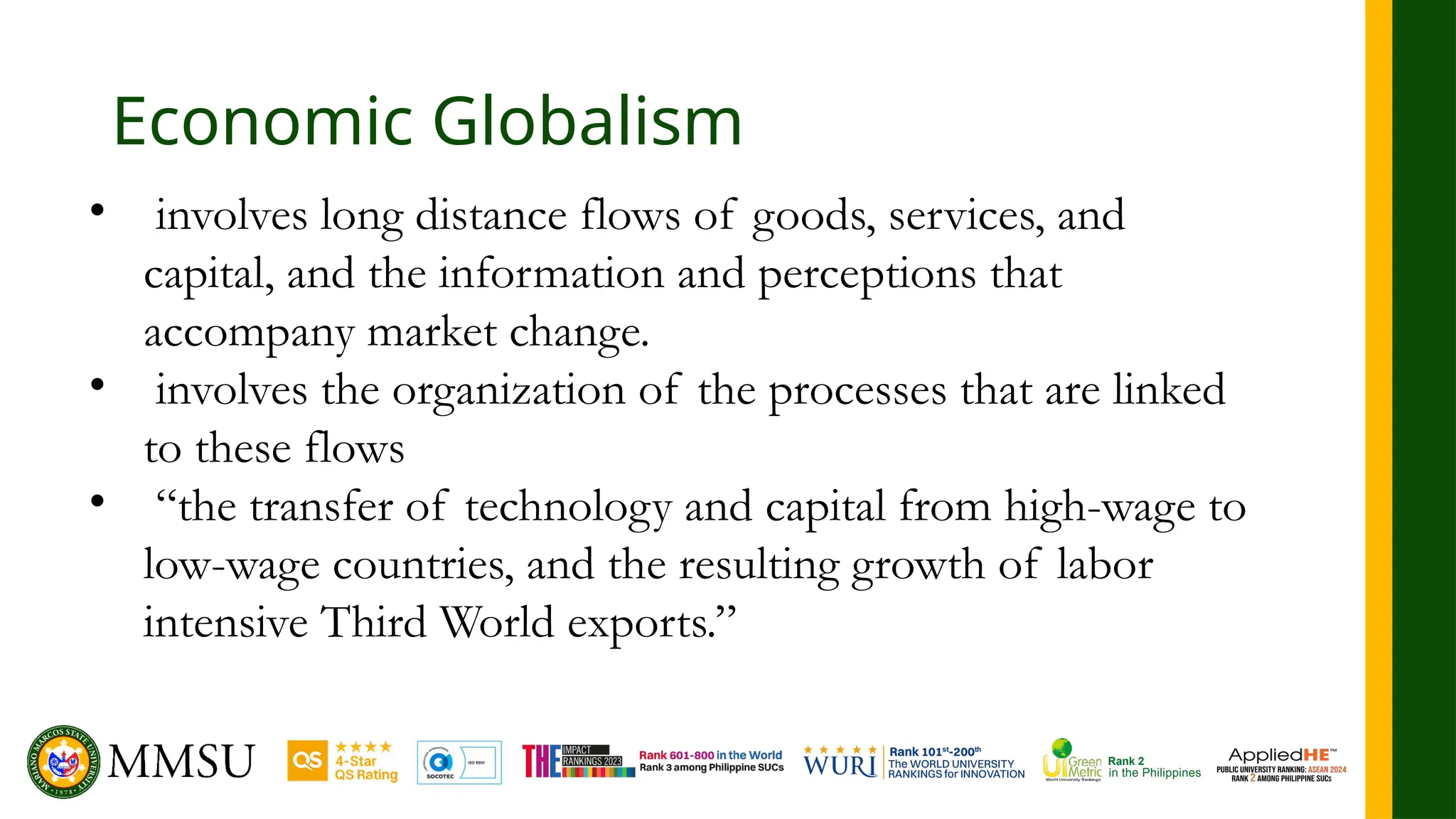
Economic Globalism
• involveslong distance flows of goods, services, and
capital, and the information and perceptions that
accompany market change.
• involves the organization of the processes that are linked
to these flows
• “the transfer of technology and capital from high-wage to
low-wage countries, and the resulting growth of labor
intensive Third World exports.”
7.
Military Globalism
• refersto a long distance networks of
interdependence in which force, and the
threats or promise of force are employed
8.
Environmental Globalism
• Refersto the long distance transport of materials in the
atmosphere or oceans or of biological substances such
as pathogens or genetic materials that affect human
health and well-being
9.
Social and CulturalGlobalism
• involves movements of ideas, information, and images,
and of people – who of course carry ideas and
information with them
• “isomorphism” - imitation of one society’s practices and
institutions by others
10.
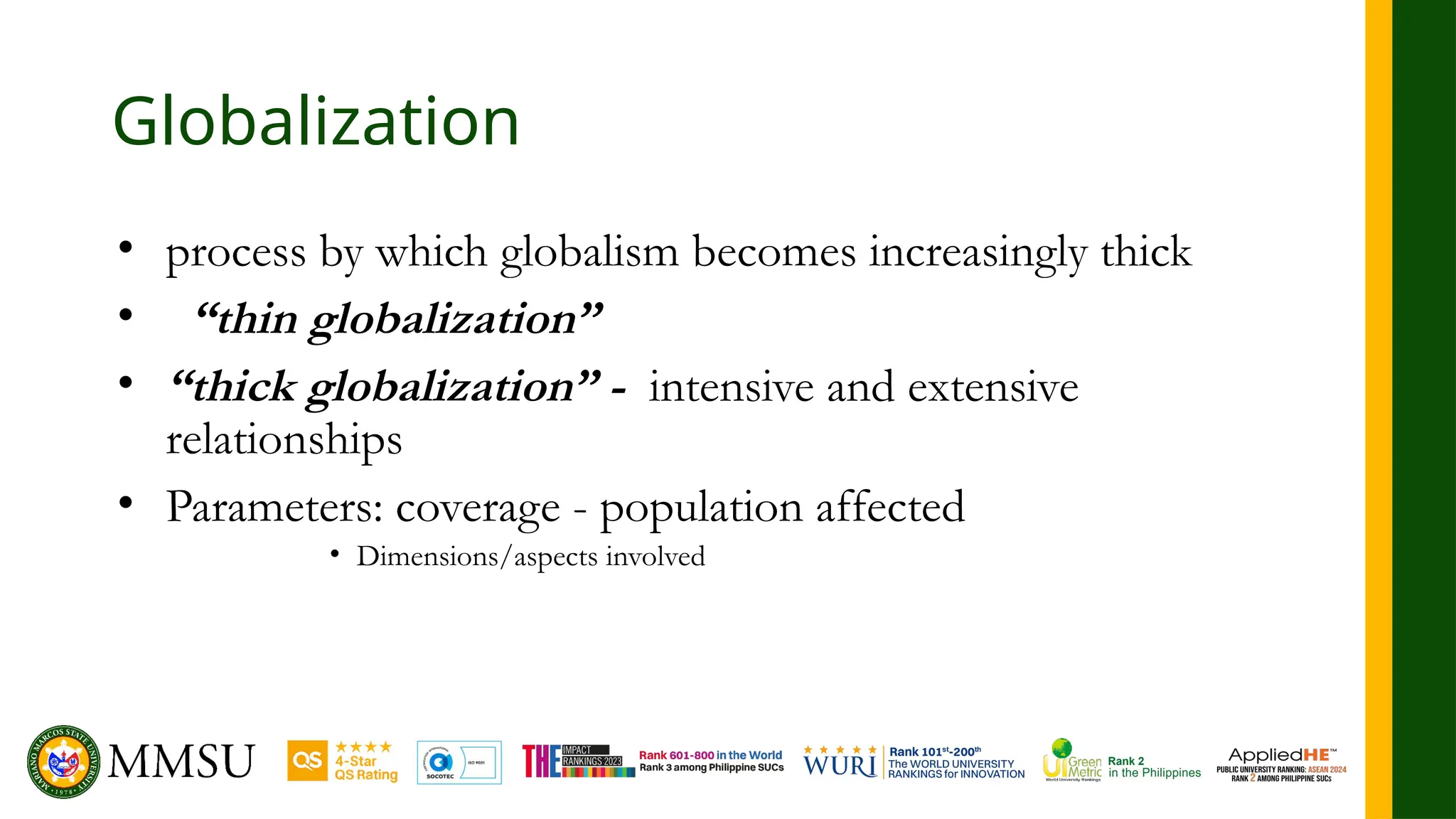
Globalization
• process bywhich globalism becomes increasingly thick
• “thin globalization”
• “thick globalization” - intensive and extensive
relationships
• Parameters: coverage - population affected
• Dimensions/aspects involved
11.
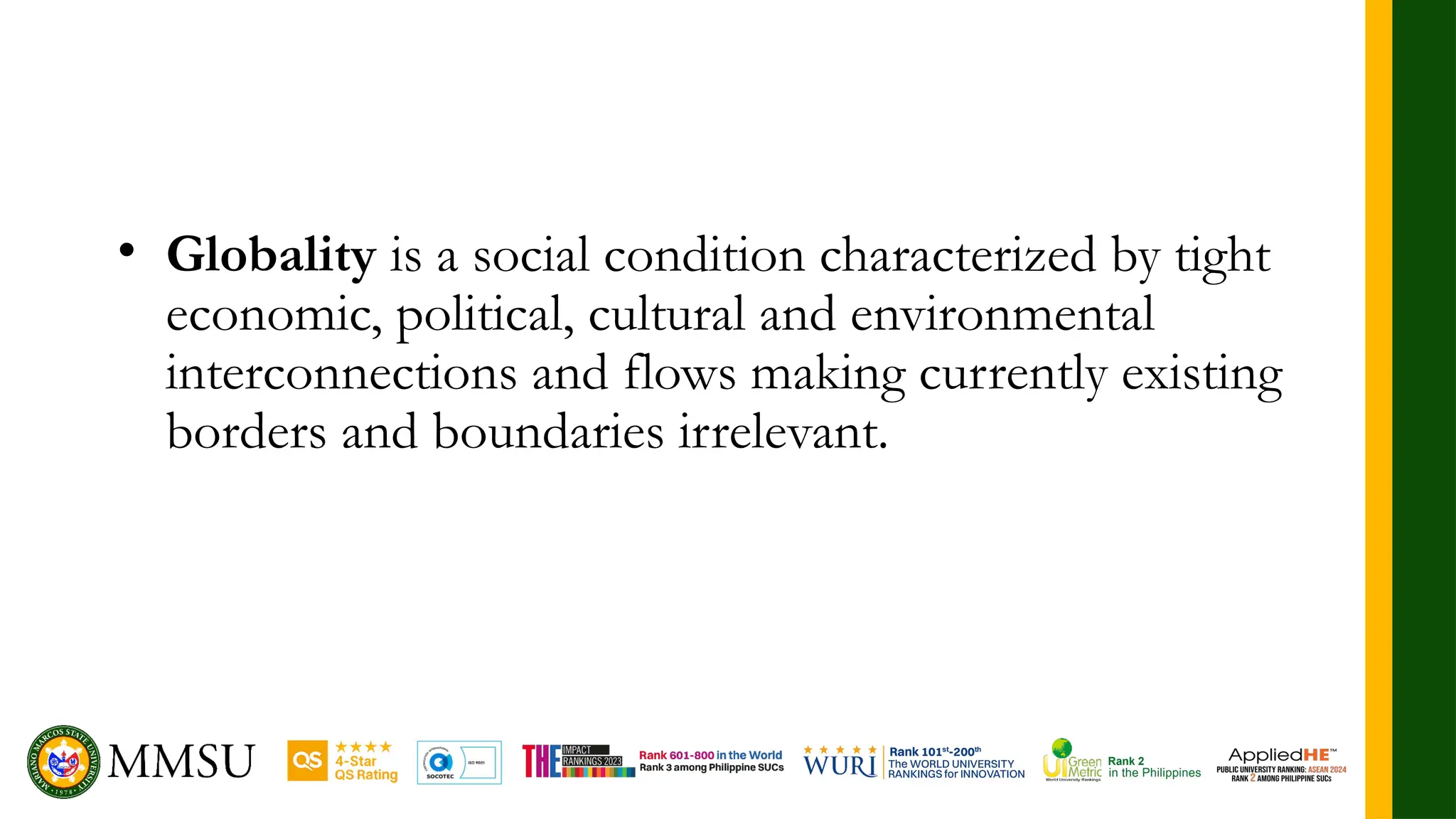
• Globality isa social condition characterized by tight
economic, political, cultural and environmental
interconnections and flows making currently existing
borders and boundaries irrelevant.
12.
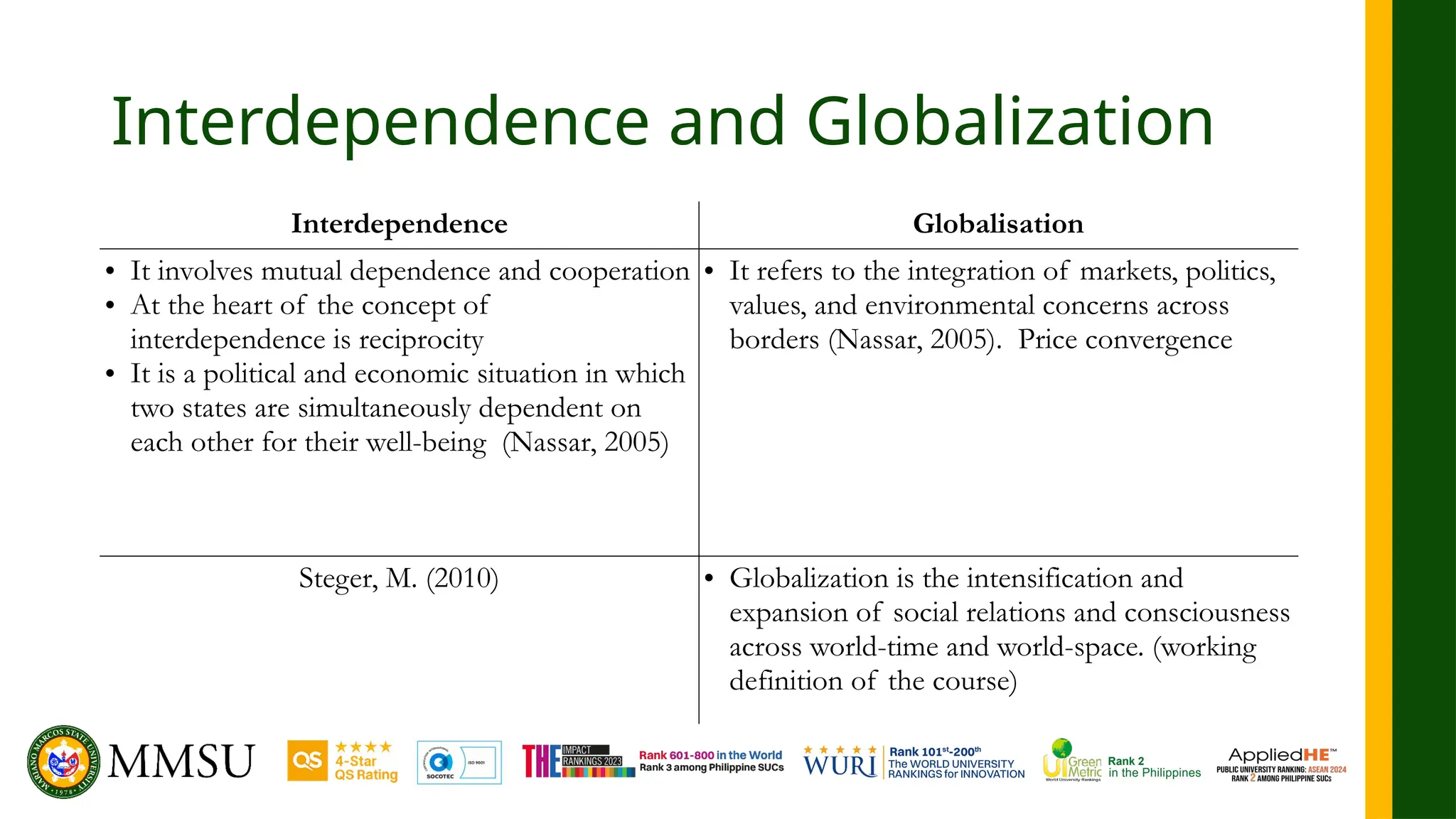
Interdependence and Globalization
InterdependenceGlobalisation
• It involves mutual dependence and cooperation
• At the heart of the concept of
interdependence is reciprocity
• It is a political and economic situation in which
two states are simultaneously dependent on
each other for their well-being (Nassar, 2005)
• It refers to the integration of markets, politics,
values, and environmental concerns across
borders (Nassar, 2005). Price convergence
Steger, M. (2010) • Globalization is the intensification and
expansion of social relations and consciousness
across world-time and world-space. (working
definition of the course)
13.
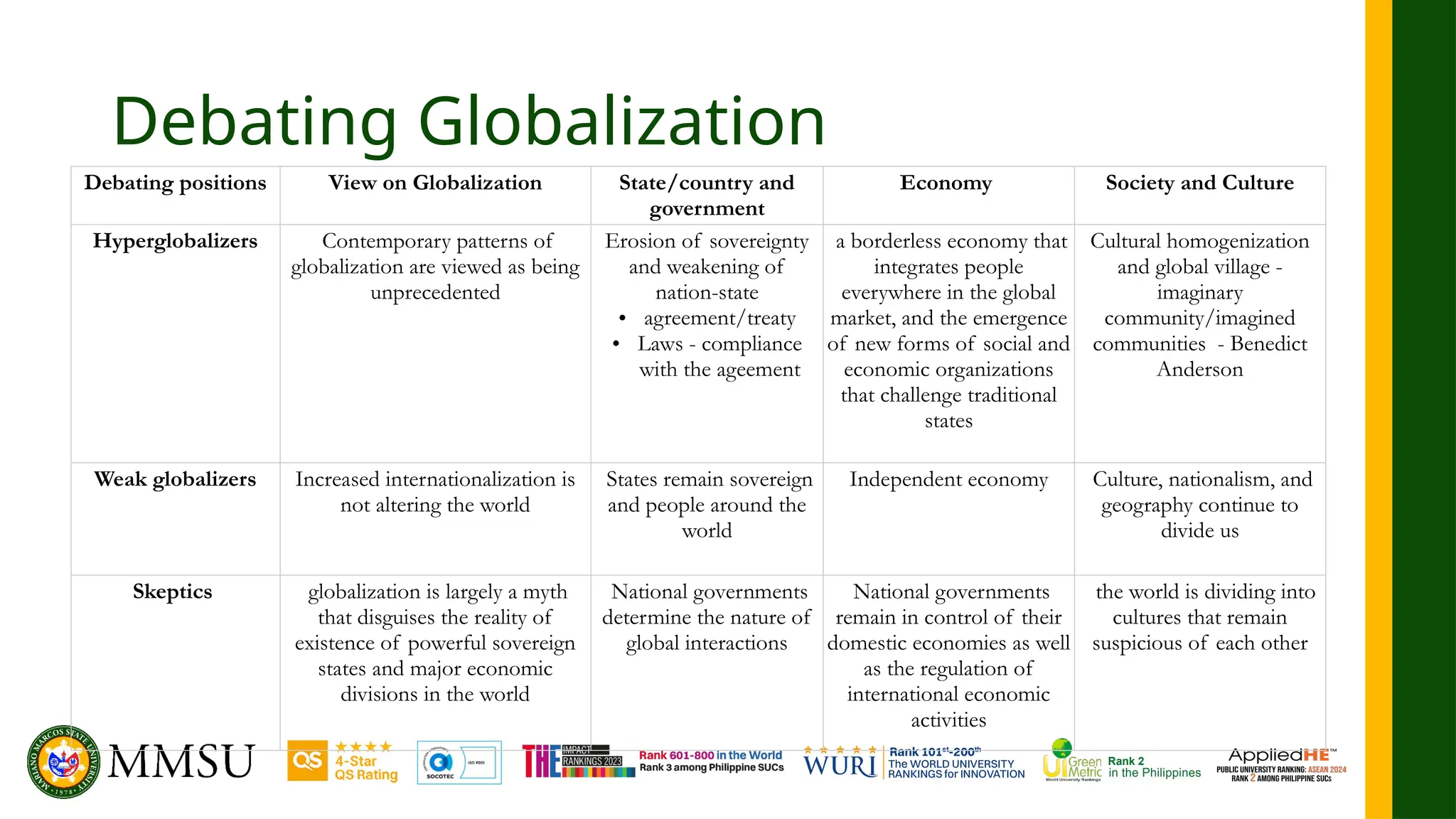
Debating Globalization
Debating positionsView on Globalization State/country and
government
Economy Society and Culture
Hyperglobalizers Contemporary patterns of
globalization are viewed as being
unprecedented
Erosion of sovereignty
and weakening of
nation-state
• agreement/treaty
• Laws - compliance
with the ageement
a borderless economy that
integrates people
everywhere in the global
market, and the emergence
of new forms of social and
economic organizations
that challenge traditional
states
Cultural homogenization
and global village -
imaginary
community/imagined
communities - Benedict
Anderson
Weak globalizers Increased internationalization is
not altering the world
States remain sovereign
and people around the
world
Independent economy Culture, nationalism, and
geography continue to
divide us
Skeptics globalization is largely a myth
that disguises the reality of
existence of powerful sovereign
states and major economic
divisions in the world
National governments
determine the nature of
global interactions
National governments
remain in control of their
domestic economies as well
as the regulation of
international economic
activities
the world is dividing into
cultures that remain
suspicious of each other
14.
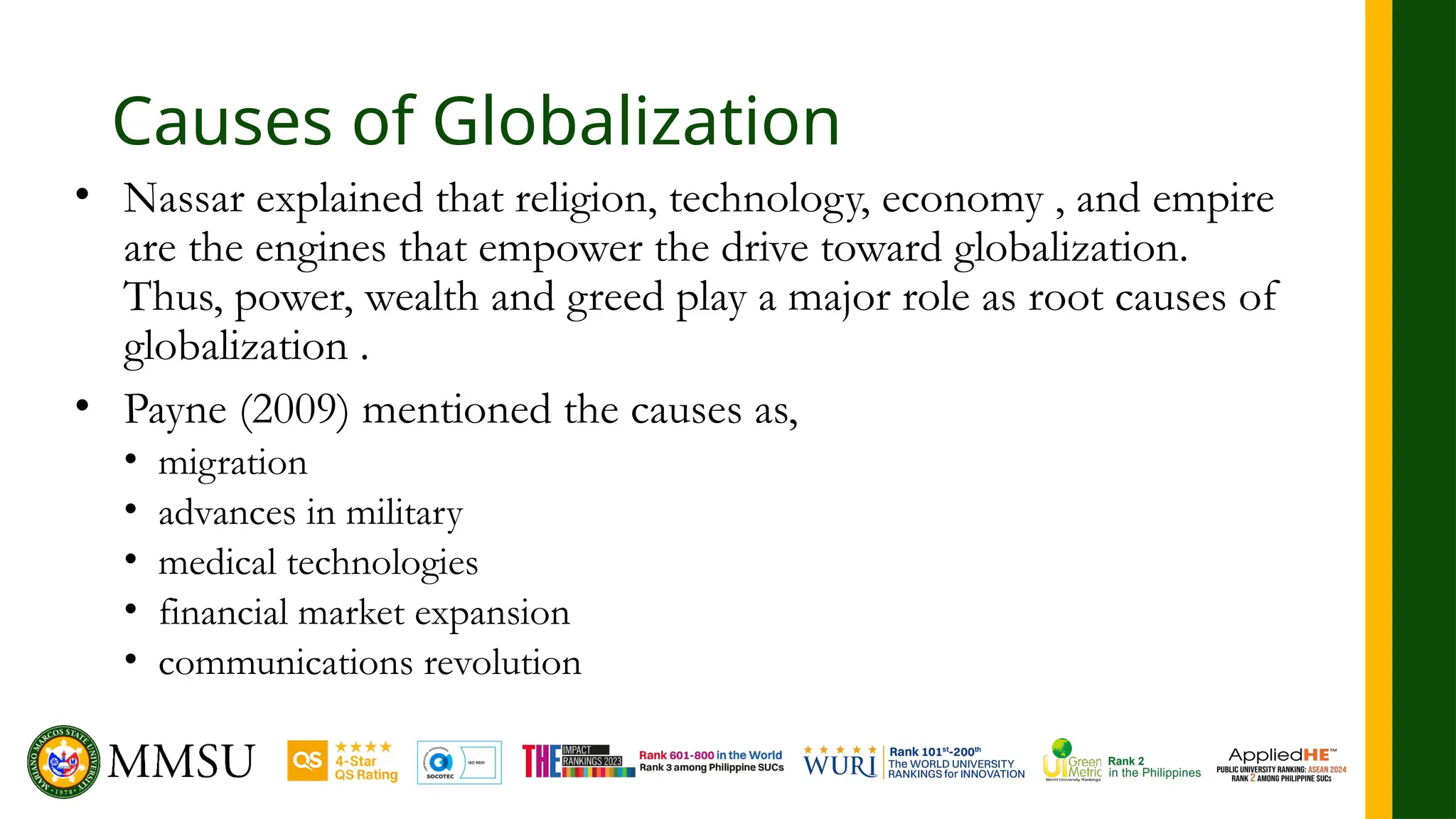
Causes of Globalization
•Nassar explained that religion, technology, economy , and empire
are the engines that empower the drive toward globalization.
Thus, power, wealth and greed play a major role as root causes of
globalization .
• Payne (2009) mentioned the causes as,
• migration
• advances in military
• medical technologies
• financial market expansion
• communications revolution
15.
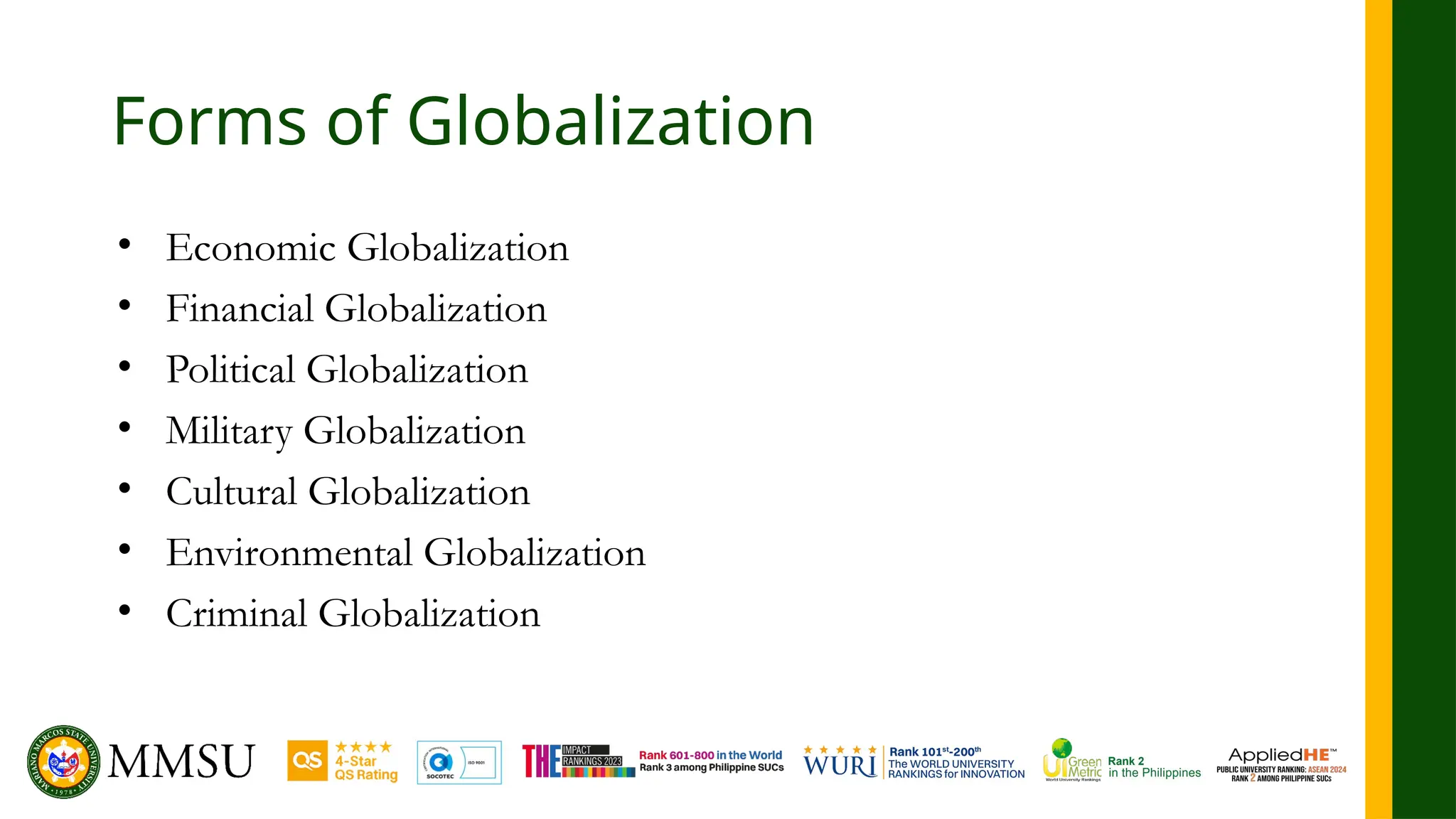
Forms of Globalization
•Economic Globalization
• Financial Globalization
• Political Globalization
• Military Globalization
• Cultural Globalization
• Environmental Globalization
• Criminal Globalization
16.
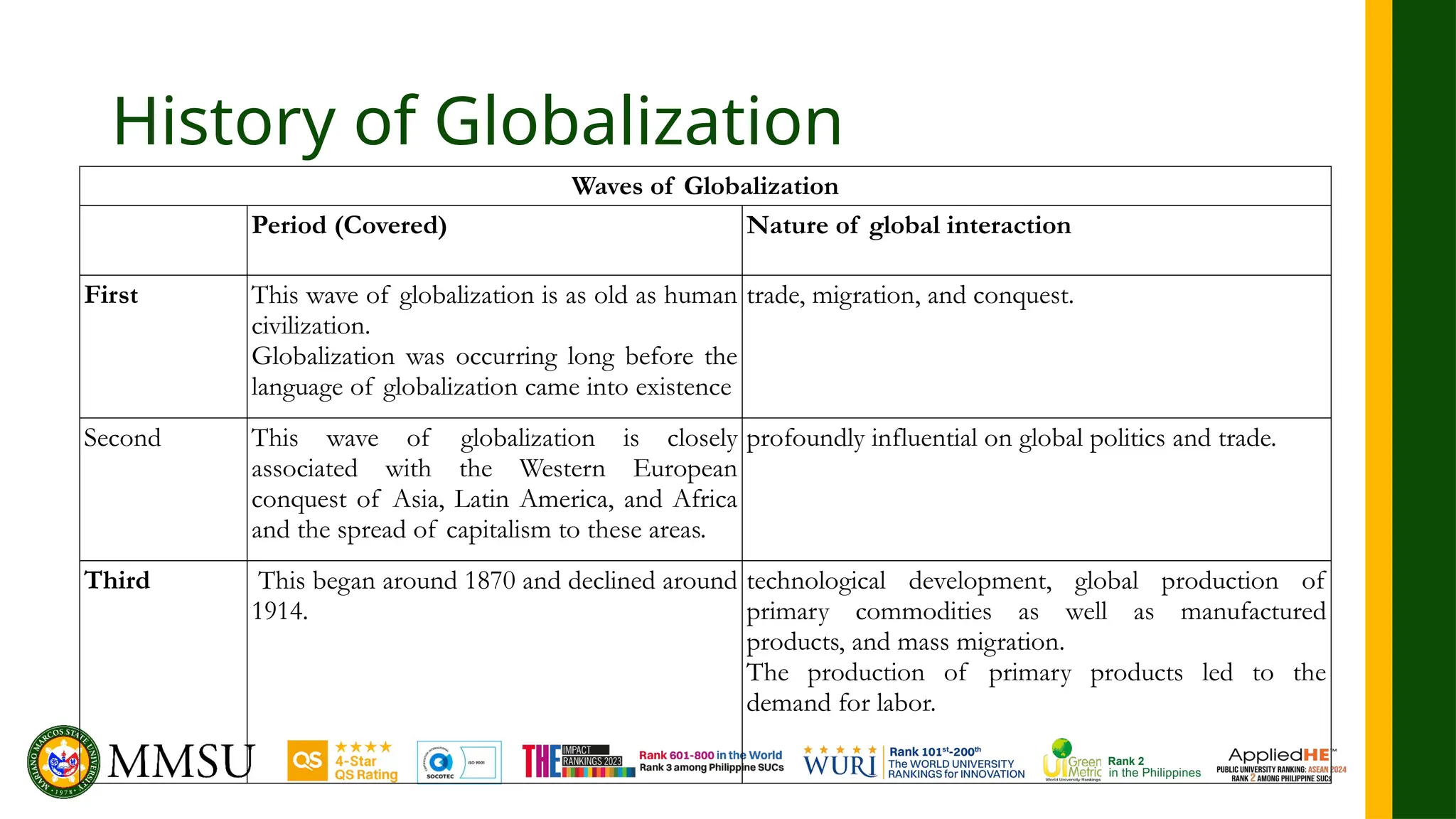
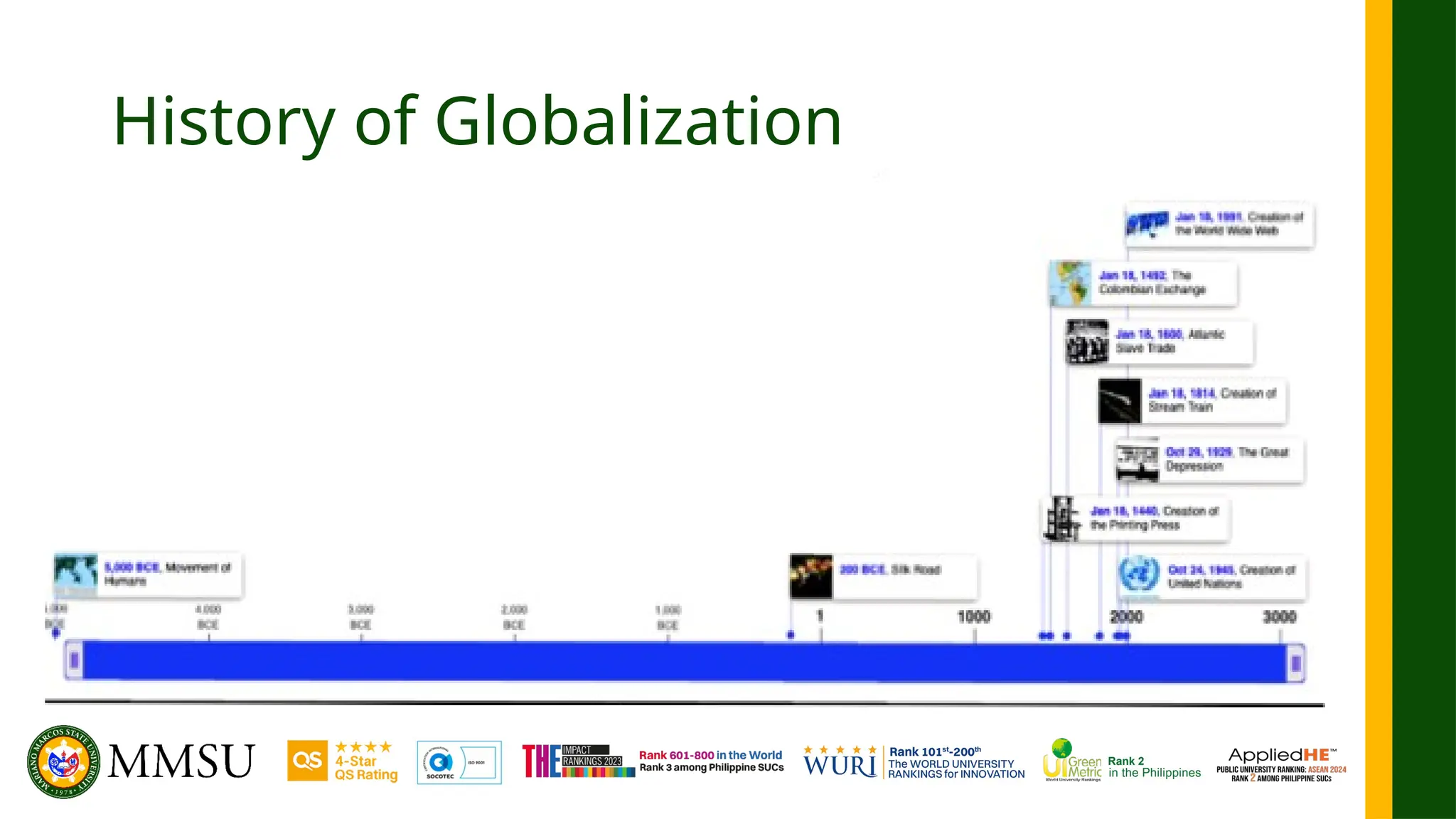
History of Globalization
Wavesof Globalization
Period (Covered) Nature of global interaction
First This wave of globalization is as old as human
civilization.
Globalization was occurring long before the
language of globalization came into existence
trade, migration, and conquest.
Second This wave of globalization is closely
associated with the Western European
conquest of Asia, Latin America, and Africa
and the spread of capitalism to these areas.
profoundly influential on global politics and trade.
Third This began around 1870 and declined around
1914.
technological development, global production of
primary commodities as well as manufactured
products, and mass migration.
The production of primary products led to the
demand for labor.
17.
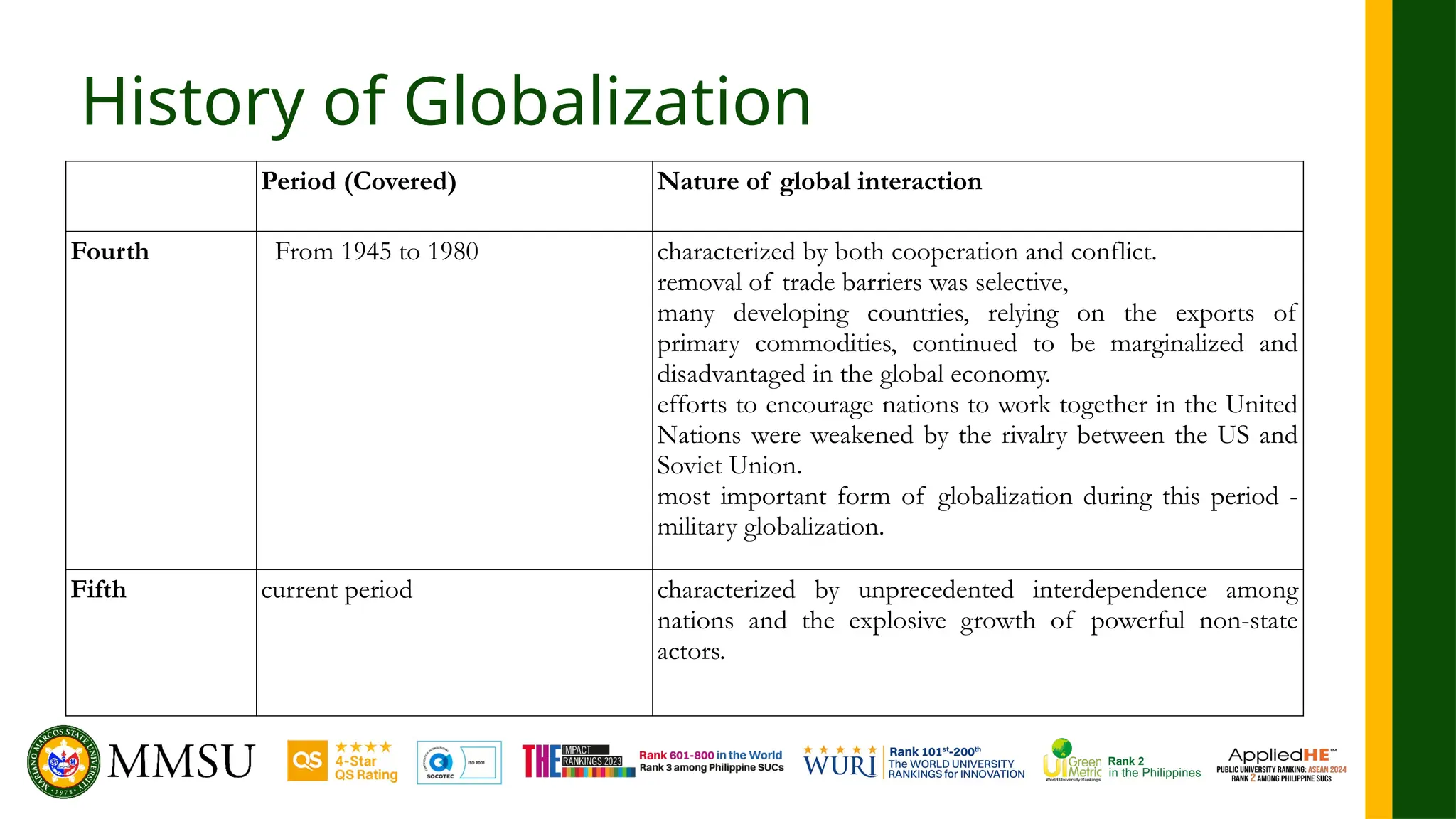
History of Globalization
Period(Covered) Nature of global interaction
Fourth From 1945 to 1980 characterized by both cooperation and conflict.
removal of trade barriers was selective,
many developing countries, relying on the exports of
primary commodities, continued to be marginalized and
disadvantaged in the global economy.
efforts to encourage nations to work together in the United
Nations were weakened by the rivalry between the US and
Soviet Union.
most important form of globalization during this period -
military globalization.
Fifth current period characterized by unprecedented interdependence among
nations and the explosive growth of powerful non-state
actors.
References
• Friedman, ThomasL. (2006) The World is Flat: A Brief History of the 21st
Century. Farrar,
Straus and Giroux.
• Gilpin, Robert. (2001) Global Political Economy: Understanding the International Economic
Order. Princeton, N.J.: Princeton University Press.
• Nassar, Jaml R. (2005) Globalization and Terrorism: The Migration of Dreams and Nightmares.
Rowman & Littlefield.
• Legrain, Philippe. (2004) Open World: The Truth About Globalization. Chicago: Ivan R. Dee.
• Payne, Richard J. (2009) Global Issues: Politics, Economics and Culture 2nd
edition. New York:
Longman.
• Steger, M., Battersby P., Siracusa, J. (2016) The SAGE Handbook of Globalization:
"Approaches to the Study of Globalization. SAGE: London.
• eJournal USA Global Issues: The Challenges of Globalization, 2006.
20.
Send us amessage or
visit us
City of Batac, Ilocos Norte,
Philippines
(63) 77-600-0459
op@mmsu.edu.ph
Get in Touch
With Us
facebook.com/MMSUofficial
www.mmsu.edu.ph
Follow us for updates




![Defining-Globalization [Autosaved].pptx](https://cdn.slidesharecdn.com/ss_thumbnails/defining-globalizationautosaved-230911022910-7acc566e-thumbnail.jpg?width=640&height=640&fit=bounds)
![Defining-Globaalization [Autosaved].pptx](https://cdn.slidesharecdn.com/ss_thumbnails/defining-globalizationautosaved-250325005435-526b3469-thumbnail.jpg?width=640&height=640&fit=bounds)


