Globalization
Globalization isa contested concept with
various interpretations in popular and academic
literature. Manfred Steger highlights that
globalization can be viewed as a process,
condition, system, force, or age, leading to
potential confusion due to its diverse meanings.
4.
The United NationsConference on Trade and
Development (UNCTAD) defines economic
globalization as the closer integration of national
economies through trade, financial flows, and
cross-border migration. As economies open up,
they become more exposed and vulnerable to
global forces.
Economic Globalization
5.
Liberalization: Facilitates thefree movement of
goods by abolishing tariff.
Deregulation: Allows the free movement of
capital by lifting financial regulation.
Free Movement of Persons: Achieved through
easing visa restrictions and migration barriers.
Economic Liberalization and Deregulation
6.
Conflicts in Globalization
Liberalizationand deregulation often lead to
conflicts, such as: -
1.Corporate vs. labor union disputes over
migration, outsourcing, and wages.
7.
2. Tensions betweendeveloped (First World) and
developing or underdeveloped nations (Third
World) over subsidies, industrialization, and land
ownership.
Conflicts in Globalization
8.
Historical Development ofGlobalization
Modern globalization began on October 30,
1947, with the General Agreement on Tariffs
and Trade (GATT). In 1995, the World Trade
Organization (WTO) succeeded GATT,
regulating global trade.
9.
Historical Development ofGlobalization
Criticisms arose post-2008 financial crisis,
leading to anti-globalization movements and
debates about globalization's future.
10.
Thomas Friedman's Definitionof Globalization
Thomas Friedman defines globalization in his
book Lexus and the Olive Tree as a dynamic
process involving the integration of markets,
nation-states, and technologies, enabling
broader and faster global connections while
also creating backlash from those adversely
affected.
11.
Early Globalization
Benedict Andersondescribes early globalization in the late
19th century, facilitated by:
1. The telegraph
2. The Universal Postal Union
3. Steamships
4. Railways connecting national and colonial
regions.Steamship
12.
Globalization vs. Internationalization
LeslieSklair distinguishes between globalization
and internationalization. Internationalization
pertains to relationships between nation-states,
while globalization involves global social
relations and interactions between transnational
entities, making it broader and more complex.
13.
1.2 Philosophies &
Ideologiesof
Globalization
Imperialism, Colonialism, Development,
Americanization, Neo-liberalism and Non
Neo-Marxian theories
14.
Philosophies and Ideologiesof/on/against
Globalization
Globalization is promoted through six core
claims: it involves market liberalization and
global integration, benefits everyone,
spreads democracy, and necessitates a war
on terror.
15.
Philosophies and Ideologiesof/on/against
Globalization
Capitalism, the dominant economic system
under globalization, is driven by the profit
motive, which influences behaviors such as
investing in profitable companies and allowing
resource exploitation even at environmental
costs.
16.
Neoliberalism
Core Beliefs
Free Markets:Markets should operate with minimal government
interference.
Profit Motive: Economic growth is driven by profit maximization.
Economic Efficiency: Belief in efficiency through competition
and deregulation.
Key Proponents: Milton Friedman, Friedrich Hayek
17.
Capitalism and Globalization
CapitalistIdeology
Profit Motive: Central role of profit in driving economic
activity.
Impact on Globalization: Encourages investment and
reduces costs through global trade.
Economic Framework: Capitalism as the dominant
system facilitating globalization.
18.
Ideologies Supporting Globalization
DemocraticExpansion
Claim: Globalization promotes democratic
values and institutions.
Philosophy: Democracies are believed to spread
and thrive in a globalized world.
19.
War on Terror
Claim:Globalization is linked to strategies for
combating terrorism.
Philosophy: Security measures are justified in a
globalized context.
Ideologies Supporting Globalization
20.
Anti-Globalization Philosophies
Core Criticisms
Imbalance:Globalization benefits the First World more than the
Third World.
Corporate vs. Citizen Interests: Prioritization of corporate profits
over public welfare.
Environmental Impact: Critique of the environmental
degradation caused by global trade.
Notable Critics: Naomi Klein, Arundhati Roy
21.
Alter-Globalization
Concept Overview
Goal: Reformglobalization to make it more equitable and
sustainable.
Focus Areas: Grassroots movements, environmental
sustainability, social justice.
Ideologies Supporting Change
Pro-Environment: Emphasis on eco-friendly practices.
Pro-Community: Support for local economies and community-
driven initiatives.
22.
Marxist Perspective
Karl Marx’sAnalysis
Exploitation of Labor: Focus on how globalization exacerbates
labor exploitation.
Surplus Value: Critique of profit maximization at the expense of
workers.
Outsourcing: Impact on global labor standards and race-to-
the-bottom effect.
Positive and NegativeAspects of Globalization
Multiculturalism and Multilingualism:
- Promotes cultural exchange.
- Necessitates learning multiple languages.
Free Trade:
- Reduces product costs globally.
- Increases profits for corporations.
Examples: Cheaper cell phones and computers.
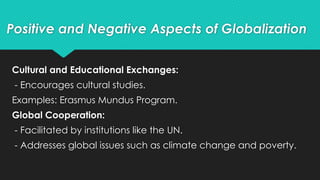
25.
Cultural and EducationalExchanges:
- Encourages cultural studies.
Examples: Erasmus Mundus Program.
Global Cooperation:
- Facilitated by institutions like the UN.
- Addresses global issues such as climate change and poverty.
Positive and Negative Aspects of Globalization
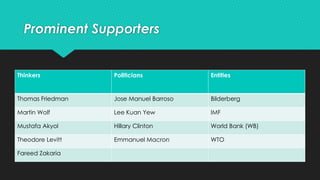
26.
Prominent Supporters
Thinkers PoliticiansEntities
Thomas Friedman Jose Manuel Barroso Bilderberg
Martin Wolf Lee Kuan Yew IMF
Mustafa Akyol Hillary Clinton World Bank (WB)
Theodore Levitt Emmanuel Macron WTO
Fareed Zakaria
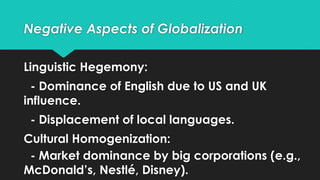
27.
Negative Aspects ofGlobalization
Linguistic Hegemony:
- Dominance of English due to US and UK
influence.
- Displacement of local languages.
Cultural Homogenization:
- Market dominance by big corporations (e.g.,
McDonald’s, Nestlé, Disney).
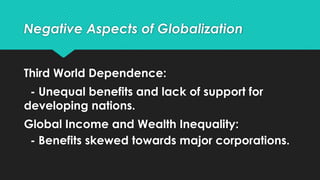
28.
Third World Dependence:
-Unequal benefits and lack of support for
developing nations.
Global Income and Wealth Inequality:
- Benefits skewed towards major corporations.
Negative Aspects of Globalization
29.
Tax Injustice:
- Taxcompetition reduces government
revenue.
Racism and Anti-Migrant Sentiment:
- Rising issues due to labor market dynamics.
Negative Aspects of Globalization
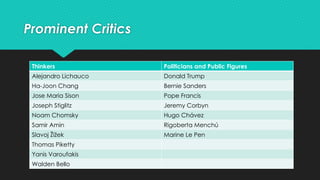
30.
Prominent Critics
Thinkers Politiciansand Public Figures
Alejandro Lichauco Donald Trump
Ha-Joon Chang Bernie Sanders
Jose Maria Sison Pope Francis
Joseph Stiglitz Jeremy Corbyn
Noam Chomsky Hugo Chávez
Samir Amin Rigoberta Menchú
Slavoj Žižek Marine Le Pen
Thomas Piketty
Yanis Varoufakis
Walden Bello
31.
REVIEW OF CONCEPTS:
✓Globalization has transcended its being an economic term and has
become a phenomenon whose impacts have altered social, cultural, and
political andscapes in an international scale.
✓ Globalization has spurred interconnection, and yet, at the same time, is
pointed at as cause of the widening gap between the richer and the
poorest of the world.
✓ Social movement is people and organizations advocating for positive
social change through a variety of means and approaches.
✓ Free trade where exchanges of goods or products between nations
without tariff or tax.
32.
✓ Deregulation isthe loosening or lifting of government regulations, usually it
favor private corporations’ flexibility of operations and profitability.
✓ Liberalization is the process or policy of removal or reduction of restrictions
or barriers on the free trade between nations.
✓ Privatization is subjecting an industry or service to private control and
ownership.
✓ The European Union (EU) is an economic and political organization
comprised of 28 member states. Originating from the European Coal and
Steel Community (ECSC) and the European Economic Community (EEC), the
EU was established with the intent to integrate European nations and
empower the region.
REVIEW OF CONCEPTS:




![Defining-Globalization [Autosaved].pptx](https://cdn.slidesharecdn.com/ss_thumbnails/defining-globalizationautosaved-230911022910-7acc566e-thumbnail.jpg?width=640&height=640&fit=bounds)


