licensed under a Creative Commons Attribution 3.0
Giving and Receiving
Constructive feedback
Communication Level 3
Delivered by Kim Thomas, Developed by Joelle Peters
Contents
licensed under a Creative Commons Attribution 3.0
What is constructive feedback?
Why give constructive feedback?
How to give effective constructive feedback.
The sandwich method.
How to effectively receive effective feedback.
2
licensed under a Creative Commons Attribution 3.0
What are Constructive Feedback ?
Feedback is information about reactions to a product or a person's
performance of a task which may be used as a basis for improvement.
Constructive feedback is meant to help improve the performance of an
individual or a team, and shouldn’t be used to tear them down.
3
licensed under a Creative Commons Attribution 3.0
Why give Constructive Feedback ?
Feedback is an essential element for everyone in a workplace. It is a
useful tool for indicating when things are going in the right direction, or
for improving an area which is having problems.
4
licensed under a Creative Commons Attribution 3.0
Constructive Feedback
Some situations which require giving constructive feedback include:
• Providing specific performance pointers.
• Giving corrective guidance.
• Letting someone know the consequences of their behaviour.
• Encouraging positive behaviour.
• Encouraging and supporting someone who is doing well.
• Letting team members know when they have done something
positive.
5(Enrolment Services Training, Staff Development and the Work-Study Office, Boston
University , n.d.)
licensed under a Creative Commons Attribution 3.0
Constructive Feedback
Some clues that constructive feedback is needed are when:
• Someone asks for your opinion about how they are doing>
• Errors occur again and again.
• A peer's work habits disturb you.
• Someone who is a high performer is doubting the level they work at.
• Someone has completed a task to high level .
• Someone has tried something new and it has gone well.
6(Enrolment Services Training, Staff Development and the Work-Study Office, Boston
University , n.d.)
licensed under a Creative Commons Attribution 3.0
Types of constructive feedback
• Critical feedback is given when something needs to be improved.
• Positive feedback is given when something has been done well.
7
licensed under a Creative Commons Attribution 3.0
How to give good Constructive Feedback
When giving Constructive Feedback , critical or positive, you should try
to do the following things:
• Focus on the situation, not the person
– Focus on the behaviour, action, situation, issue
– Comment on the issue, not the person.
– For example,“The report is late” not “You are late”, “The food is
oily” not “You are a bad cook”
– Don’t make personal attacks
– Share how a problem effects you, without going on and on about it
8(Pillay, 2015)
licensed under a Creative Commons Attribution 3.0
How to give effective Constructive Feedback
When giving Constructive Feedback , critical or positive, you should try
to do the following things:
• Be specific with your feedback as this will allow the receiver to know
what needs to be changed, or continued
– Break feedback into key points
• Vague “You tried really hard on the report, but I didn’t like it and you can do better”
• Specific “ Good effort, but there are some things which can be improved. 1)
formatting, your font should be the same through the whole document. 2) Images,
images should always have a caption that explain what is being shown.
9(Pillay, 2015)
licensed under a Creative Commons Attribution 3.0
How to give effective Constructive Feedback
When giving Constructive Feedback , critical or positive, you should try
to do the following things:
• Comment on things which can be done as the whole point of
feedback is to help someone improve. Think about what you can say
that a person can act on…for example
• If a friend has just signed a 12 month lease on a flat that is cold, and they
ask for your advice about how to keep warm saying “move to a warmer flat”
is not helpful because the lease has been signed. Things they could do
could be “Use a dehumidifier once a week”, “dry your laundry outside”, or
“Open the curtains during the day” are all things that can be done.
10(Pillay, 2015)
licensed under a Creative Commons Attribution 3.0
How to give effective Constructive Feedback
When giving Constructive Feedback , critical or positive, you should try
to do the following things:
• Give the feedback as close as possible to the event as delivering
feedback close to the time will help ensure everyone remembers
what is being discussed.
11
licensed under a Creative Commons Attribution 3.0
How to give effective Constructive Feedback
When giving Constructive Feedback , critical or positive, you should try
to do the following things:
• Give feedback face-to-face as this helps develop a connection and
make people feel more valued and it allows for questions and clarity.
12
licensed under a Creative Commons Attribution 3.0
How to give effective Constructive Feedback
When giving Constructive Feedback , critical or positive, you should try
to do the following things:
• Focus on the situation and not the person.
• Be specific with your feedback.
• Comment on things which can be done.
• Give feedback as close as possible to the time.
• Give feedback face-to-face.
13
licensed under a Creative Commons Attribution 3.0
How to give effective Constructive Feedback
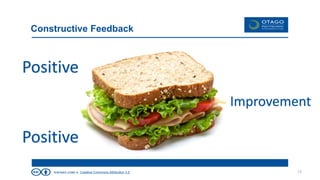
A good way to give constructive feedback is using the sandwich
method, it combines giving positive and critical feedback. It’s sometimes
referred to as PIP, Positive- Improvement - Positive.
Broken down into three segments
1. Focus on some strengths – what has be done well, what was
positive about the situation?
2. Provide the criticism – things that didn’t go well, things that could be
improved.
3. Finish off the feedback by restating the positive comments, and the
positive results that may be expected if the criticism is acted on.
14
licensed under a Creative Commons Attribution 3.0
Constructive Feedback
15
Positive
Positive
Improvement
licensed under a Creative Commons Attribution 3.0
How to effectively receive Constructive Feedback
Sometimes constructive feedback, particularly critical feedback can take us by
surprise. When receiving feedback try the following:
1. Consider your first reaction try not to be defensive or brush it off and try be calm
and listen.
2. Remember the benefits of getting feedback.
3. Listen actively.
4. Say thank you – thanking someone doesn’t mean you’re agreeing with what
they’re saying, but acknowledges the effort they took to share
5. Ask questions to help understand the feedback For Example,“How do you think
this could be done differently in the future?”
16(Lindsay, n.d.)
licensed under a Creative Commons Attribution 3.0
Constructive Feedback Practical
Exercise one:
• In groups of three we will practise giving and receiving both positive and critical
feedback using the scenarios on the handouts.
• Everyone will get a turn to give feedback, receive feedback, and observe the
process
Exercise two:
• In your teams from last week, give each other feedback based on how they
performed during the kawakawa balm exercise.
17(Lindsay, n.d.)
licensed under a Creative Commons Attribution 3.0
References
18
• Enrolment Services Training, Staff Development and the Work-Study Office, Boston
University . (n.d.). Giving Constructive Feedback . Retrieved from
https://www.cabrillo.edu/services/jobs/pdfs/giving-feedback.pdf
• Lindsay, N. (n.d.). taking constructive criticism like a champ. Retrieved from
themuse.com: https://www.themuse.com/advice/taking-constructive-criticism-like-a-
champ
• Pillay, N. (2015, April 9). Linkedin.com. Retrieved from how to give constructive criticism
6 helpful tips : https://www.linkedin.com/pulse/how-give-constructive-criticism-6-
helpful-tips-nishlan-pillay

Giving and Receiving Constructive Feedback Powerpoint

  • 1.
    licensed under aCreative Commons Attribution 3.0 Giving and Receiving Constructive feedback Communication Level 3 Delivered by Kim Thomas, Developed by Joelle Peters
  • 2.
    Contents licensed under aCreative Commons Attribution 3.0 What is constructive feedback? Why give constructive feedback? How to give effective constructive feedback. The sandwich method. How to effectively receive effective feedback. 2
  • 3.
    licensed under aCreative Commons Attribution 3.0 What are Constructive Feedback ? Feedback is information about reactions to a product or a person's performance of a task which may be used as a basis for improvement. Constructive feedback is meant to help improve the performance of an individual or a team, and shouldn’t be used to tear them down. 3
  • 4.
    licensed under aCreative Commons Attribution 3.0 Why give Constructive Feedback ? Feedback is an essential element for everyone in a workplace. It is a useful tool for indicating when things are going in the right direction, or for improving an area which is having problems. 4
  • 5.
    licensed under aCreative Commons Attribution 3.0 Constructive Feedback Some situations which require giving constructive feedback include: • Providing specific performance pointers. • Giving corrective guidance. • Letting someone know the consequences of their behaviour. • Encouraging positive behaviour. • Encouraging and supporting someone who is doing well. • Letting team members know when they have done something positive. 5(Enrolment Services Training, Staff Development and the Work-Study Office, Boston University , n.d.)
  • 6.
    licensed under aCreative Commons Attribution 3.0 Constructive Feedback Some clues that constructive feedback is needed are when: • Someone asks for your opinion about how they are doing> • Errors occur again and again. • A peer's work habits disturb you. • Someone who is a high performer is doubting the level they work at. • Someone has completed a task to high level . • Someone has tried something new and it has gone well. 6(Enrolment Services Training, Staff Development and the Work-Study Office, Boston University , n.d.)
  • 7.
    licensed under aCreative Commons Attribution 3.0 Types of constructive feedback • Critical feedback is given when something needs to be improved. • Positive feedback is given when something has been done well. 7
  • 8.
    licensed under aCreative Commons Attribution 3.0 How to give good Constructive Feedback When giving Constructive Feedback , critical or positive, you should try to do the following things: • Focus on the situation, not the person – Focus on the behaviour, action, situation, issue – Comment on the issue, not the person. – For example,“The report is late” not “You are late”, “The food is oily” not “You are a bad cook” – Don’t make personal attacks – Share how a problem effects you, without going on and on about it 8(Pillay, 2015)
  • 9.
    licensed under aCreative Commons Attribution 3.0 How to give effective Constructive Feedback When giving Constructive Feedback , critical or positive, you should try to do the following things: • Be specific with your feedback as this will allow the receiver to know what needs to be changed, or continued – Break feedback into key points • Vague “You tried really hard on the report, but I didn’t like it and you can do better” • Specific “ Good effort, but there are some things which can be improved. 1) formatting, your font should be the same through the whole document. 2) Images, images should always have a caption that explain what is being shown. 9(Pillay, 2015)
  • 10.
    licensed under aCreative Commons Attribution 3.0 How to give effective Constructive Feedback When giving Constructive Feedback , critical or positive, you should try to do the following things: • Comment on things which can be done as the whole point of feedback is to help someone improve. Think about what you can say that a person can act on…for example • If a friend has just signed a 12 month lease on a flat that is cold, and they ask for your advice about how to keep warm saying “move to a warmer flat” is not helpful because the lease has been signed. Things they could do could be “Use a dehumidifier once a week”, “dry your laundry outside”, or “Open the curtains during the day” are all things that can be done. 10(Pillay, 2015)
  • 11.
    licensed under aCreative Commons Attribution 3.0 How to give effective Constructive Feedback When giving Constructive Feedback , critical or positive, you should try to do the following things: • Give the feedback as close as possible to the event as delivering feedback close to the time will help ensure everyone remembers what is being discussed. 11
  • 12.
    licensed under aCreative Commons Attribution 3.0 How to give effective Constructive Feedback When giving Constructive Feedback , critical or positive, you should try to do the following things: • Give feedback face-to-face as this helps develop a connection and make people feel more valued and it allows for questions and clarity. 12
  • 13.
    licensed under aCreative Commons Attribution 3.0 How to give effective Constructive Feedback When giving Constructive Feedback , critical or positive, you should try to do the following things: • Focus on the situation and not the person. • Be specific with your feedback. • Comment on things which can be done. • Give feedback as close as possible to the time. • Give feedback face-to-face. 13
  • 14.
    licensed under aCreative Commons Attribution 3.0 How to give effective Constructive Feedback A good way to give constructive feedback is using the sandwich method, it combines giving positive and critical feedback. It’s sometimes referred to as PIP, Positive- Improvement - Positive. Broken down into three segments 1. Focus on some strengths – what has be done well, what was positive about the situation? 2. Provide the criticism – things that didn’t go well, things that could be improved. 3. Finish off the feedback by restating the positive comments, and the positive results that may be expected if the criticism is acted on. 14
  • 15.
    licensed under aCreative Commons Attribution 3.0 Constructive Feedback 15 Positive Positive Improvement
  • 16.
    licensed under aCreative Commons Attribution 3.0 How to effectively receive Constructive Feedback Sometimes constructive feedback, particularly critical feedback can take us by surprise. When receiving feedback try the following: 1. Consider your first reaction try not to be defensive or brush it off and try be calm and listen. 2. Remember the benefits of getting feedback. 3. Listen actively. 4. Say thank you – thanking someone doesn’t mean you’re agreeing with what they’re saying, but acknowledges the effort they took to share 5. Ask questions to help understand the feedback For Example,“How do you think this could be done differently in the future?” 16(Lindsay, n.d.)
  • 17.
    licensed under aCreative Commons Attribution 3.0 Constructive Feedback Practical Exercise one: • In groups of three we will practise giving and receiving both positive and critical feedback using the scenarios on the handouts. • Everyone will get a turn to give feedback, receive feedback, and observe the process Exercise two: • In your teams from last week, give each other feedback based on how they performed during the kawakawa balm exercise. 17(Lindsay, n.d.)
  • 18.
    licensed under aCreative Commons Attribution 3.0 References 18 • Enrolment Services Training, Staff Development and the Work-Study Office, Boston University . (n.d.). Giving Constructive Feedback . Retrieved from https://www.cabrillo.edu/services/jobs/pdfs/giving-feedback.pdf • Lindsay, N. (n.d.). taking constructive criticism like a champ. Retrieved from themuse.com: https://www.themuse.com/advice/taking-constructive-criticism-like-a- champ • Pillay, N. (2015, April 9). Linkedin.com. Retrieved from how to give constructive criticism 6 helpful tips : https://www.linkedin.com/pulse/how-give-constructive-criticism-6- helpful-tips-nishlan-pillay