licensed under a Creative Commons Attribution 3.0
Giving and Receiving
Instructions
Communication Lvl 3
Delivered by Kim Thomas, Developed by Joelle Peters
Contents
licensed under a Creative Commons Attribution 3.0
What are instructions?
Why give instructions
How to give good instructions
Following instructions
Instructions practice
2
licensed under a Creative Commons Attribution 3.0
What are instructions?
Instructions are detailed information about how something should be
done or operated.
3
licensed under a Creative Commons Attribution 3.0
Why give instructions?
• Instructions can help us…
– Understand how to complete a task
– Provide detailed information about a specific process
– Share our knowledge so others can complete a task
– Work towards a shared goal
– Make sure tasks are being carried out in a safe manner
4
licensed under a Creative Commons Attribution 3.0
How to give good instructions -
When giving instructions, written or oral, you need to consider the
following things:
• Context
• Purpose
• Content
• Order
• Feedback
5
licensed under a Creative Commons Attribution 3.0
How to give good instructions - Context
When giving instructions it is very important to think about the context
in which you are giving them.
• Who are you giving instructions to?
• What are they doing?
• Have they done something like this before?
• Why are they doing it, and not someone else?
Understanding the context means we will be able to give instructions
that meet the needs of our audience.
6
licensed under a Creative Commons Attribution 3.0
How to give good instructions - Purpose
When giving instructions it is very important to think about the purpose
for giving them.
• Why are these instructions important?
• What is the end goal?
• Does your audience know why you are giving these instructions?
When we make the purpose of our instructions clear, the person
carrying them out will often do a better job.
7
licensed under a Creative Commons Attribution 3.0
How to give good instructions - Purpose
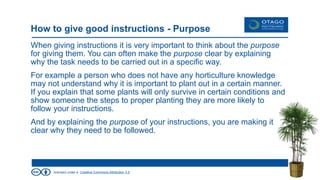
When giving instructions it is very important to think about the purpose
for giving them. You can often make the purpose clear by explaining
why the task needs to be carried out in a specific way.
For example a person who does not have any horticulture knowledge
may not understand why it is important to plant out in a certain manner.
If you explain that some plants will only survive in certain conditions and
show someone the steps to proper planting they are more likely to
follow your instructions.
And by explaining the purpose of your instructions, you are making it
clear why they need to be followed.
8
licensed under a Creative Commons Attribution 3.0
How to give good instructions - Content
When giving instructions it is very important to think about the content of
the instructions.
• How much detail have you given?
• Have you been specific enough?
• Are you using language they will understand?
• Can you use a diagram to help explain if you are writing instructions
By thinking carefully about the content of the instructions, you will make
sure a task can be completed accurately, with attention to detail. You will
also make sure your audience can understand the instructions.
9
licensed under a Creative Commons Attribution 3.0
How to give good instructions - Order
When giving instructions it is very important to think about the order of
the instructions, or the order that they are given.
• What needs to happen first?
• Is it important for some tasks to happen after others?
By thinking carefully about the order of the instructions, you will make
sure a task can be logically worked through from beginning to end.
10
licensed under a Creative Commons Attribution 3.0
How to give good instructions - Order
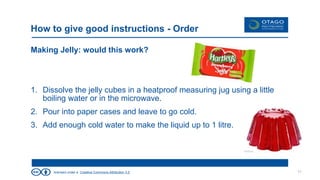
Making Jelly: would this work?
1. Dissolve the jelly cubes in a heatproof measuring jug using a little
boiling water or in the microwave.
2. Pour into paper cases and leave to go cold.
3. Add enough cold water to make the liquid up to 1 litre.
11
licensed under a Creative Commons Attribution 3.0
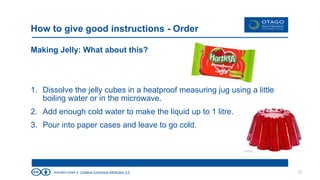
How to give good instructions - Order
Making Jelly: What about this?
1. Dissolve the jelly cubes in a heatproof measuring jug using a little
boiling water or in the microwave.
2. Add enough cold water to make the liquid up to 1 litre.
3. Pour into paper cases and leave to go cold.
12
licensed under a Creative Commons Attribution 3.0
How to give good instructions - Feedback
When giving oral instructions it is very important to think about how you
will get feedback.
• How do you know your instructions have been understood?
• Audience repetition
• Audience questions
You should always give your audience an opportunity to give you
feedback. This lets them clarify any steps they are unsure about, and
will result in a better finished product.
13
licensed under a Creative Commons Attribution 3.0
How to give good instructions - Summary
• Context
• Purpose
• Content
• Order
• Feedback
14
licensed under a Creative Commons Attribution 3.0
Following instructions
• Listen carefully
• Read/listen to all the instructions before you begin
• Take brief notes of what you need to do if you are receiving oral
instructions
• Ask questions before you start if you do not understand
• Re-read each step in your notes as you progress
15
licensed under a Creative Commons Attribution 3.0
Instructions Practical Assessment
• There are two elements of practical assessment that involve
instructions which we will be carrying out today
Pt 1 – Receiving Oral Instructions
• You will shortly be given a series of oral instructions on how to create
cyanotypes.
• You should take personal notes of the instructions as they are given
to you, so you can remember what to do at each step
• You should ask any questions you have about the process before
you begin
• You will be assessed on how well you understand and carry out these
instructions (see assessment task)
17
licensed under a Creative Commons Attribution 3.0
Instructions Practical Assessment
Pt 2 – Writing Instructions
• You will also be writing instructions on how to create cyanotypes as
you work through this process
• Your instructions should be targeted at someone who has never tried
to make a cyanotype before
• You should explain the context (what are they making), the purpose
(why are they making it), and the steps they will need to take
• You should make sure your instructions are detailed, in the correct
order, and include diagrams/drawings where useful
• You will be assessed on how clear your instructions are, and if they
would make a cyanotype if accurately followed (see assessment task)
18

Giving and Receiving Instructions Powerpoint Presentation

  • 1.
    licensed under aCreative Commons Attribution 3.0 Giving and Receiving Instructions Communication Lvl 3 Delivered by Kim Thomas, Developed by Joelle Peters
  • 2.
    Contents licensed under aCreative Commons Attribution 3.0 What are instructions? Why give instructions How to give good instructions Following instructions Instructions practice 2
  • 3.
    licensed under aCreative Commons Attribution 3.0 What are instructions? Instructions are detailed information about how something should be done or operated. 3
  • 4.
    licensed under aCreative Commons Attribution 3.0 Why give instructions? • Instructions can help us… – Understand how to complete a task – Provide detailed information about a specific process – Share our knowledge so others can complete a task – Work towards a shared goal – Make sure tasks are being carried out in a safe manner 4
  • 5.
    licensed under aCreative Commons Attribution 3.0 How to give good instructions - When giving instructions, written or oral, you need to consider the following things: • Context • Purpose • Content • Order • Feedback 5
  • 6.
    licensed under aCreative Commons Attribution 3.0 How to give good instructions - Context When giving instructions it is very important to think about the context in which you are giving them. • Who are you giving instructions to? • What are they doing? • Have they done something like this before? • Why are they doing it, and not someone else? Understanding the context means we will be able to give instructions that meet the needs of our audience. 6
  • 7.
    licensed under aCreative Commons Attribution 3.0 How to give good instructions - Purpose When giving instructions it is very important to think about the purpose for giving them. • Why are these instructions important? • What is the end goal? • Does your audience know why you are giving these instructions? When we make the purpose of our instructions clear, the person carrying them out will often do a better job. 7
  • 8.
    licensed under aCreative Commons Attribution 3.0 How to give good instructions - Purpose When giving instructions it is very important to think about the purpose for giving them. You can often make the purpose clear by explaining why the task needs to be carried out in a specific way. For example a person who does not have any horticulture knowledge may not understand why it is important to plant out in a certain manner. If you explain that some plants will only survive in certain conditions and show someone the steps to proper planting they are more likely to follow your instructions. And by explaining the purpose of your instructions, you are making it clear why they need to be followed. 8
  • 9.
    licensed under aCreative Commons Attribution 3.0 How to give good instructions - Content When giving instructions it is very important to think about the content of the instructions. • How much detail have you given? • Have you been specific enough? • Are you using language they will understand? • Can you use a diagram to help explain if you are writing instructions By thinking carefully about the content of the instructions, you will make sure a task can be completed accurately, with attention to detail. You will also make sure your audience can understand the instructions. 9
  • 10.
    licensed under aCreative Commons Attribution 3.0 How to give good instructions - Order When giving instructions it is very important to think about the order of the instructions, or the order that they are given. • What needs to happen first? • Is it important for some tasks to happen after others? By thinking carefully about the order of the instructions, you will make sure a task can be logically worked through from beginning to end. 10
  • 11.
    licensed under aCreative Commons Attribution 3.0 How to give good instructions - Order Making Jelly: would this work? 1. Dissolve the jelly cubes in a heatproof measuring jug using a little boiling water or in the microwave. 2. Pour into paper cases and leave to go cold. 3. Add enough cold water to make the liquid up to 1 litre. 11
  • 12.
    licensed under aCreative Commons Attribution 3.0 How to give good instructions - Order Making Jelly: What about this? 1. Dissolve the jelly cubes in a heatproof measuring jug using a little boiling water or in the microwave. 2. Add enough cold water to make the liquid up to 1 litre. 3. Pour into paper cases and leave to go cold. 12
  • 13.
    licensed under aCreative Commons Attribution 3.0 How to give good instructions - Feedback When giving oral instructions it is very important to think about how you will get feedback. • How do you know your instructions have been understood? • Audience repetition • Audience questions You should always give your audience an opportunity to give you feedback. This lets them clarify any steps they are unsure about, and will result in a better finished product. 13
  • 14.
    licensed under aCreative Commons Attribution 3.0 How to give good instructions - Summary • Context • Purpose • Content • Order • Feedback 14
  • 15.
    licensed under aCreative Commons Attribution 3.0 Following instructions • Listen carefully • Read/listen to all the instructions before you begin • Take brief notes of what you need to do if you are receiving oral instructions • Ask questions before you start if you do not understand • Re-read each step in your notes as you progress 15
  • 16.
    licensed under aCreative Commons Attribution 3.0 Instructions Practical Assessment • There are two elements of practical assessment that involve instructions which we will be carrying out today Pt 1 – Receiving Oral Instructions • You will shortly be given a series of oral instructions on how to create cyanotypes. • You should take personal notes of the instructions as they are given to you, so you can remember what to do at each step • You should ask any questions you have about the process before you begin • You will be assessed on how well you understand and carry out these instructions (see assessment task) 17
  • 17.
    licensed under aCreative Commons Attribution 3.0 Instructions Practical Assessment Pt 2 – Writing Instructions • You will also be writing instructions on how to create cyanotypes as you work through this process • Your instructions should be targeted at someone who has never tried to make a cyanotype before • You should explain the context (what are they making), the purpose (why are they making it), and the steps they will need to take • You should make sure your instructions are detailed, in the correct order, and include diagrams/drawings where useful • You will be assessed on how clear your instructions are, and if they would make a cyanotype if accurately followed (see assessment task) 18