Active Listening in
Communication
NZ Certificate in Horticulture - (Level 3)
Why we listen
• To obtain information
• To understand
• To learn
• For enjoyment
2
Active listening, different from
‘hearing’
• Making a conscious effort to hear the whole
message being sent
• Paying close attention to the person speaking
• Signalling that you are paying attention
• A form of two way communication
• Greatly increases retention of information and clear
communication
• Essential in team work as you need to ensure you
are communicating clearly
3
Active listening skills
1) Pay attention
Give your full attention to the speaker and their
message. Non-verbal communication also “speaks”
loudly.
• Look at the speaker directly
• Put aside distracting thoughts
• Avoid being distracted by things going on around
you
• “Listen” to the speakers body language
4
Active listening skills
2) Show that you’re listening
Be aware of how your body language and gestures
can convey your attention and affect the speaker.
• Use small gestures like nodding
• Keep a pleasant facial expression
• Keep your body language open and inviting
• Encourage the speaker to continue with non-verbal
prompts e.g. uh huh, mhhmm
• Take short notes of the conversation if appropriate
5
Active listening skills
3) Provide feedback
Personal views can distort what we hear. Providing
feedback and asking questions can help clarify what
has been said.
• Reflect what has been said back to the speaker
“What I’m hearing is…”
• Ask questions to clarify points.
“What do you mean when you say…”
• Summarise the speakers comments
6
Active listening skills
4) Defer judgment
Interrupting is a waste of time. It can frustrate the
speaker and limit your understanding of the message.
• Allow the speaker to finish each point before
asking questions
• Don’t interrupt with counter arguments
• Don’t mentally prepare a rebuttal
7
Active listening skills
5) Respond appropriately
It is important to be respectful, you gain nothing from
attacking or offending a speaker, even unintentionally.
• Be open and honest in your response
• Assert your opinions respectfully
• Treat the other person in a way that you think he or
she would want to be treated
8
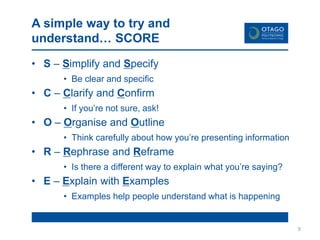
A simple way to try and
understand… SCORE
• S – Simplify and Specify
• Be clear and specific
• C – Clarify and Confirm
• If you’re not sure, ask!
• O – Organise and Outline
• Think carefully about how you’re presenting information
• R – Rephrase and Reframe
• Is there a different way to explain what you’re saying?
• E – Explain with Examples
• Examples help people understand what is happening
9
END

Active Listening in Communication

  • 1.
    Active Listening in Communication NZCertificate in Horticulture - (Level 3)
  • 2.
    Why we listen •To obtain information • To understand • To learn • For enjoyment 2
  • 3.
    Active listening, differentfrom ‘hearing’ • Making a conscious effort to hear the whole message being sent • Paying close attention to the person speaking • Signalling that you are paying attention • A form of two way communication • Greatly increases retention of information and clear communication • Essential in team work as you need to ensure you are communicating clearly 3
  • 4.
    Active listening skills 1)Pay attention Give your full attention to the speaker and their message. Non-verbal communication also “speaks” loudly. • Look at the speaker directly • Put aside distracting thoughts • Avoid being distracted by things going on around you • “Listen” to the speakers body language 4
  • 5.
    Active listening skills 2)Show that you’re listening Be aware of how your body language and gestures can convey your attention and affect the speaker. • Use small gestures like nodding • Keep a pleasant facial expression • Keep your body language open and inviting • Encourage the speaker to continue with non-verbal prompts e.g. uh huh, mhhmm • Take short notes of the conversation if appropriate 5
  • 6.
    Active listening skills 3)Provide feedback Personal views can distort what we hear. Providing feedback and asking questions can help clarify what has been said. • Reflect what has been said back to the speaker “What I’m hearing is…” • Ask questions to clarify points. “What do you mean when you say…” • Summarise the speakers comments 6
  • 7.
    Active listening skills 4)Defer judgment Interrupting is a waste of time. It can frustrate the speaker and limit your understanding of the message. • Allow the speaker to finish each point before asking questions • Don’t interrupt with counter arguments • Don’t mentally prepare a rebuttal 7
  • 8.
    Active listening skills 5)Respond appropriately It is important to be respectful, you gain nothing from attacking or offending a speaker, even unintentionally. • Be open and honest in your response • Assert your opinions respectfully • Treat the other person in a way that you think he or she would want to be treated 8
  • 9.
    A simple wayto try and understand… SCORE • S – Simplify and Specify • Be clear and specific • C – Clarify and Confirm • If you’re not sure, ask! • O – Organise and Outline • Think carefully about how you’re presenting information • R – Rephrase and Reframe • Is there a different way to explain what you’re saying? • E – Explain with Examples • Examples help people understand what is happening 9
  • 10.