TECHNIQUES OF GIVING
FEEDBACK
Presented By Group Milkyway
1
To Improve Performance
To Clarify Expectations
To Increase Learning
To Stop a Behavior
To Make Progress Toward Goals
THE GOALS OF FEEDBACK
2
3
4
5
6
 Be Direct not to be confused
 Express concern & appreciation
 Make sure NOT Personal, Hostile, Picky, Demeaning
 Make sure caring, clear and Focused on Improvement
GUIDELINES FOR PROVIDING EFFECTIVE FEEDBACK
7
Principles of Basic Feedback
• Feedback should be delivered in private.
• Feedback should be planned in advance.
• Feedback should be performance specific.
• Feedback should not pertain to personal characteristics.
• Feedback should be descriptive, not judgmental.
• Feedback should be given timely to the observation it
addresses.
• Feedback should be focused on specific observations.
• Feedback should be based on first-hand observation and/or
written evaluations.
• Feedback should balance positive and negative comments.
• Feedback should benefit the receiver, not soothe the giver.
8
WHY DO WE GIVE FEEDBACK?
Feedback has a direct impact on our work:
Gives us specific information to help us improve
Makes performance expectations clear from the start
Heightens efficiency by reducing resentment, buildup, etc.
Strengthens relationships
What are the benefits for getting positive feedback?
Constructive feedback?
9
TECHNIQUES FOR GIVING FEEDBACK
Isolate and address the Behavior
Speak at the Task Level not the Self Level
Use Comfortable and Open Body Language
 Explain Why the Issue Might Be Happening
Leave YOUR Solutions at the Door
Make it a Dialogue
Begin With and Use the Feedback Recipe Card
10
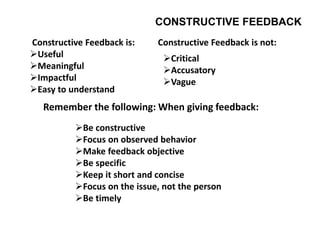
CONSTRUCTIVE FEEDBACK
Constructive Feedback is: Constructive Feedback is not:
Useful
Meaningful
Impactful
Easy to understand
Remember the following: When giving feedback:
Be constructive
Focus on observed behavior
Make feedback objective
Be specific
Keep it short and concise
Focus on the issue, not the person
Be timely
Critical
Accusatory
Vague
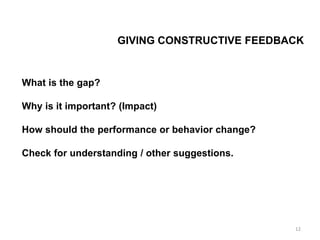
GIVING CONSTRUCTIVE FEEDBACK
What is the gap?
Why is it important? (Impact)
How should the performance or behavior change?
Check for understanding / other suggestions.
12
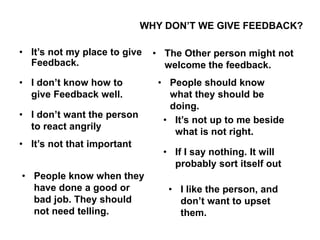
WHY DON’T WE GIVE FEEDBACK?
• It’s not my place to give
Feedback.
• The Other person might not
welcome the feedback.
• I don’t know how to
give Feedback well.
• People should know
what they should be
doing.
• I don’t want the person
to react angrily
• It’s not up to me beside
what is not right.
• It’s not that important
• If I say nothing. It will
probably sort itself out
• People know when they
have done a good or
bad job. They should
not need telling.
• I like the person, and
don’t want to upset
them.
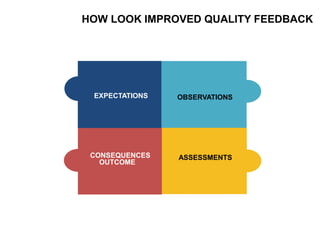
HOW LOOK IMPROVED QUALITY FEEDBACK
CONSEQUENCES
OUTCOME
ASSESSMENTS
OBSERVATIONSEXPECTATIONS
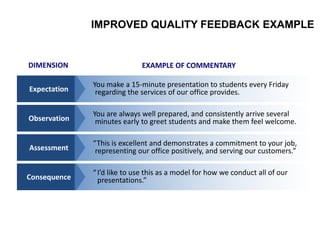
IMPROVED QUALITY FEEDBACK EXAMPLE
DIMENSION
Expectation
Observation
Assessment
Consequence
You make a 15-minute presentation to students every Friday
regarding the services of our office provides.
EXAMPLE OF COMMENTARY
You are always well prepared, and consistently arrive several
minutes early to greet students and make them feel welcome.
“This is excellent and demonstrates a commitment to your job,
representing our office positively, and serving our customers.”
“I’d like to use this as a model for how we conduct all of our
presentations.”
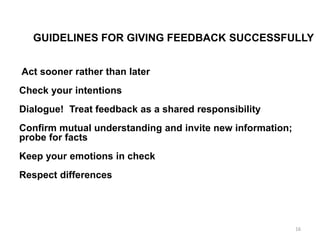
GUIDELINES FOR GIVING FEEDBACK SUCCESSFULLY
Act sooner rather than later
Check your intentions
Dialogue! Treat feedback as a shared responsibility
Confirm mutual understanding and invite new information;
probe for facts
Keep your emotions in check
Respect differences
16
BEFORE NEXT TIME...
Post your experience trying your new strategies to our
Milk way group.
THANK YOU.
17

Presentation for LCMC Final

  • 1.
  • 2.
    To Improve Performance ToClarify Expectations To Increase Learning To Stop a Behavior To Make Progress Toward Goals THE GOALS OF FEEDBACK 2
  • 3.
  • 4.
  • 5.
  • 6.
  • 7.
     Be Directnot to be confused  Express concern & appreciation  Make sure NOT Personal, Hostile, Picky, Demeaning  Make sure caring, clear and Focused on Improvement GUIDELINES FOR PROVIDING EFFECTIVE FEEDBACK 7
  • 8.
    Principles of BasicFeedback • Feedback should be delivered in private. • Feedback should be planned in advance. • Feedback should be performance specific. • Feedback should not pertain to personal characteristics. • Feedback should be descriptive, not judgmental. • Feedback should be given timely to the observation it addresses. • Feedback should be focused on specific observations. • Feedback should be based on first-hand observation and/or written evaluations. • Feedback should balance positive and negative comments. • Feedback should benefit the receiver, not soothe the giver. 8
  • 9.
    WHY DO WEGIVE FEEDBACK? Feedback has a direct impact on our work: Gives us specific information to help us improve Makes performance expectations clear from the start Heightens efficiency by reducing resentment, buildup, etc. Strengthens relationships What are the benefits for getting positive feedback? Constructive feedback? 9
  • 10.
    TECHNIQUES FOR GIVINGFEEDBACK Isolate and address the Behavior Speak at the Task Level not the Self Level Use Comfortable and Open Body Language  Explain Why the Issue Might Be Happening Leave YOUR Solutions at the Door Make it a Dialogue Begin With and Use the Feedback Recipe Card 10
  • 11.
    CONSTRUCTIVE FEEDBACK Constructive Feedbackis: Constructive Feedback is not: Useful Meaningful Impactful Easy to understand Remember the following: When giving feedback: Be constructive Focus on observed behavior Make feedback objective Be specific Keep it short and concise Focus on the issue, not the person Be timely Critical Accusatory Vague
  • 12.
    GIVING CONSTRUCTIVE FEEDBACK Whatis the gap? Why is it important? (Impact) How should the performance or behavior change? Check for understanding / other suggestions. 12
  • 13.
    WHY DON’T WEGIVE FEEDBACK? • It’s not my place to give Feedback. • The Other person might not welcome the feedback. • I don’t know how to give Feedback well. • People should know what they should be doing. • I don’t want the person to react angrily • It’s not up to me beside what is not right. • It’s not that important • If I say nothing. It will probably sort itself out • People know when they have done a good or bad job. They should not need telling. • I like the person, and don’t want to upset them.
  • 14.
    HOW LOOK IMPROVEDQUALITY FEEDBACK CONSEQUENCES OUTCOME ASSESSMENTS OBSERVATIONSEXPECTATIONS
  • 15.
    IMPROVED QUALITY FEEDBACKEXAMPLE DIMENSION Expectation Observation Assessment Consequence You make a 15-minute presentation to students every Friday regarding the services of our office provides. EXAMPLE OF COMMENTARY You are always well prepared, and consistently arrive several minutes early to greet students and make them feel welcome. “This is excellent and demonstrates a commitment to your job, representing our office positively, and serving our customers.” “I’d like to use this as a model for how we conduct all of our presentations.”
  • 16.
    GUIDELINES FOR GIVINGFEEDBACK SUCCESSFULLY Act sooner rather than later Check your intentions Dialogue! Treat feedback as a shared responsibility Confirm mutual understanding and invite new information; probe for facts Keep your emotions in check Respect differences 16
  • 17.
    BEFORE NEXT TIME... Postyour experience trying your new strategies to our Milk way group. THANK YOU. 17