Closing the Loop The Art Effective Feedback
Workshop Goals To describe principles and strategies for giving constructive feedback To provide opportunities to “Practice” giving and receiving feedback To discuss common problems in giving effective feedback To review the distinction between “feedback” and “evaluation”
What you’ll learn The theory behind effective feedback The Value of 360 degree evaluations A few Easy and fun ways to give feedback Levels of Feedback
Closing the Loop… Reasons for feedback… The speedometer in a car How fast you want to go How fast you are going How to move the gas pedal
Why Feedback? Effective tool for motivation Show you care! Encourage positive team interaction Promote both achievements and improvements
What is Feedback? Positive reinforcement Constructive criticism Comes in many different forms Everything from informal recognition to formal performance evaluations
Feedback Provides information Based on observations Descriptive Immediate “Formative”
Perceptions of Feedback   They don’t provide feedback. Nobody tells me how I’m doing. The comment “Keep up the good work” does not help me. I get more negative feedback than  anything else. The feedback I receive is often vague, inadequate, and non-specific. Its always the same feedback. How to improve myself.
What Makes for Effective Feedback?
Effective Feed back means … ? Performance reviews involve providing effective feedback to employees, where  effective means  that the feedback will a) be heard and listened to, and  b) the feedback will actually help employees improve their performance.  Providing feedback on performance is one of the critical aspects of appraisal.  Do it right and things improve. Do it wrong, and...well...things get worse. Here's how to do it right .
What Makes for Effective Feedback? Always constructive and objective Focus on pertinent behavior Pinpointing Use concrete examples Timely Consistent Based on changeable behaviors Related to learning goals Limited in quantity
Characteristics of Effective Feedback Specificity Frequency Timing Positive/Negative Learner Reaction Action Plan
Characteristics of Effective Feedback 1. Specificity Precise Specific examples or behaviors
Characteristics of Effective Feedback 2. Frequency Give as frequently as possible (not only at end of the rotation!)
Characteristics of Effective Feedback 3. Timing Deliver as close in time to the incident either individually or in group if applicable
Characteristics of Effective Feedback 4. Positive/Negative Giving both Positive (reinforcing) and Negative (corrective) can be useful for learners. “ Feedback sandwich”
Characteristics of Effective Feedback 5. Learner Reaction The learner can benefit from an opportunity to  react  to the feedback.
Characteristics of Effective Feedback 6. Action Plan Develop an action plan for improvement, preferably with learner input.
Pinpointing Exercise Examine the list of situations in your handout booklet Are these pinpointed behaviors? If not, what changes would make them pinpointed? Time – 5 minutes
Criteria for Effective Feedback  In general, feedback should be: Specific not  General  Immediate not Delayed Behavioral not Inferential Descriptive not Evaluative More or less   not    Either – Or Asked for not Pushed Upon
What ‘else’ makes up good feedback? Set goals for the future, don’t dwell on the past Cater your feedback to the needs of the person involved Be supportive Follow up!
The “Bottom” Line Set an agenda Diagnose appropriately Give positive feedback first Limit the information Check out your perceptions Suggest alternatives
Levels of Feedback Minimal Feedback Behavioral Feedback Interactive Feedback
Levels of Feedback 1. Minimal Feedback Tell learners that performance is correct or incorrect Agree or disagree with learners opinions Use nonverbal cues like nodding Examples: “That’s correct.” “You make a mistake.”
Levels of Feedback 2. Behavioral Feedback Describe learner performance as behaviors Tell learner why performance is correct or incorrect Give reasons for agreement or disagreement with leaner Offer behavioral suggestions for improvement Examples: “Your case presentation was clear and well-organized.”
Levels of Feedback 3. Interactive Feedback Acknowledge learner’s situation/admit limitations Agree on goals with learner Involve learner in self-assessment Give learner feedback on performance and self-assessment Elicit learner reaction to feedback Develop an action plan with feedback Prompts: “What do you want to change?”
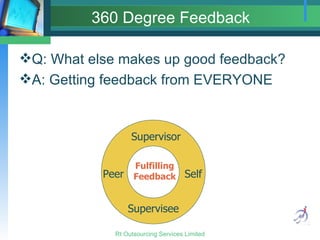
360 Degree Feedback Q: What else makes up good feedback? A: Getting feedback from EVERYONE Peer Supervisor Supervisee Self Fulfilling Feedback
Peer to Peer Feedback Key element of team communication Often overlooked Can be easy and informal… … or formal – It’s up to you! Great opportunity for mentorship and personal development
Feedback Brainstorming Get into groups of 4-5 Think of an effective way to give feedback to a peer – Be creative! Think of a time when you received feedback from a peer Was this feedback effective?  Why or why not?
Supervisee to Supervisor Feedback The scariest quadrant of all! How do you tell your boss what you really think? Be honest – but ALWAYS constructive Again, consider the person you are giving the feedback to Remember, this can make your working environment infinitely better
Feedback Role play Get into partners Imagine you are asked to give some “not-so good” feedback to a supervisor How would you go about this? Using the scenario in your handout, role play this situation with your partner Time – 5 minutes
Supervisor to Supervisee Feedback Look to get the best out of your team members Set SMART goals S – Specific M – Measurable A – Attainable R – Relevant T – Time Limited
Self Evaluations Forces you to motivate yourself A good kick in the pants, if you will Be honest and accurate A way to measure and realize your goals Sometimes the most useful of all!
Recognition
The Impact of Simple, Easy Recognition Never underestimate the power of recognition As cheap or as expensive as you want Formal or informal Private or public?
Ideas for Recognition Pat on the back High fives Bulletin board of fame Two stars and a wish Warm fuzzies Golden banana award Decorate their work space Do their least favorite task for the day Customized post-its Treasure Chest
One Minute Praising Step 1:   Tell people up front that you will be giving them feedback Step 2:   Praise people immediately Step 3:   Tell people what they are doing right – be specific Step 4:   Tell people how good you feel about what they did right and how it helps the organization and their peers Step 5:  Encourage them to do more of the same! (K. Blanchard & S. Johnson - Adapted from  The One Minute Manager )
The Feedback Sandwich Place a constructive comment between two positive reinforcing comments A Good – Bad – Good sandwich This helps maintain morale and keeps the conversation positive
Consequences of Not Giving Effective Feedback  Let’s take a look at some typical examples of what goes on in work environments when managers don’t give good feedback. CASESssss Example #1: John has been working at his new job for one month. On his first day at work, Wilma, his boss, showed him what to do and got him started on a project. Since then, Wilma has communicated with him mostly through voice mail and e-mail. She walks past his cubicle and says hello a few times each day, but there hasn’t been much other communication. John is assuming he is doing his job properly, but he really isn’t sure.
Analysis:  There is no feedback here. John has no idea whether he is doing his job properly. Solution: Wilma should have given John a detailed job description on the first day. She should have gone over his first project as soon as he finished it, making certain he understood the task and completed it properly. She also should have checked in with him regularly to make certain he was doing his job correctly and to see whether he had any questions.
Example #2:  Stella works in an office. Yesterday, she spent several hours filing a huge stack of folders that her boss had given her in the morning. When she got to work today, her boss came over to her desk and yelled, “Stella! You did those files all wrong! Don’t you listen?” He said it so loudly that Stella’s three office mates turned toward her in shock. He went back into his office and slammed the door.
Analysis: This manager’s behavior is abusive. It lowers her self-esteem and frightens her coworkers. An atmosphere of fear also lowers productivity and encourages sabotage and turnover. Solution:  He should have delivered the feedback calmly and in private. He should also have asked her for her understanding of the task; perhaps there was a reason for it being done the way it was. Third, he should have been specific about what she did wrong.
Example #3: Angela asked Steve, her assistant, to call a list of 20 clients and set up phone interviews for next Thursday and Friday (the 20th and 21st). She provided Steve with an updated list of phone numbers and told him the hours she would be available to speak with the clients. When Angela came back from lunch today, Steve had left a list of interviews on her desk. He has set them up for this Thursday and Friday (the 13th and 14th). He also has written, next to four of the clients’ names, “wrong phone number.” As she picks up the phone to reschedule the first client, she says to herself, “See, you just can’t get good help these days.”
Analysis: As far as we can tell, there was no feedback to this employee. Solution: Employees have a hard time learning if they are not given feedback. This manager should have talked to Steve calmly and in private. She should also have asked Steve what he understood the task to be and why he scheduled the interviews for the wrong dates. Finally, she should have asked Steve to reschedule the calls for the correct dates.
Steps for Giving Feedback The five simple steps are: Describe the situation. Ask the employee for his or her view of the situation. Come to an understanding of the situation. Develop an action plan to resolve the situation. Agree to follow up later to make certain the situation has been resolved.
Let’s use the third example above to illustrate how this might look. 1. Describe the situation. “Steve, these appointments are all scheduled for the 13th and 14th. I asked you to schedule them for the 20th and 21st.” 2. Ask the employee for his or her view of the situation. “Tell me, what was your understanding of what I asked you to do?” 3. Come to an understanding of the situation. “So you just misunderstood what I wanted. I had written the dates in my note to you, but you didn’t read it thoroughly before you started making the calls.” 4. Develop an action plan to resolve the situation. “I would like you to re-schedule all of these appointments before 5:00 today. What will it take for you to do that?” 5. Agree to follow up later to make certain the situation has been resolved. “I’ll check in with you at 4:30 to see how you are doing with this.” At 4:30, stop by Steve’s desk and ask, “How are you doing on your
In Closing Keep personal needs and feelings out Monitor your reactions Do not overload Time your feedback appropriately Teach self-critique
Summary for Effective Feedback: Find opportunities for giving feedback that is timely and ongoing Give frequent and specific feedback Provide reinforcing and corrective feedback Involve learner in self-assessment and reaction to feedback Develop an action plan on improving future performance in regards to knowledge, skills and attitudes.
There is no single recipe for success .
Questions? …

Effective feedback delivery

  • 1.
    Closing the LoopThe Art Effective Feedback
  • 2.
    Workshop Goals Todescribe principles and strategies for giving constructive feedback To provide opportunities to “Practice” giving and receiving feedback To discuss common problems in giving effective feedback To review the distinction between “feedback” and “evaluation”
  • 3.
    What you’ll learnThe theory behind effective feedback The Value of 360 degree evaluations A few Easy and fun ways to give feedback Levels of Feedback
  • 4.
    Closing the Loop…Reasons for feedback… The speedometer in a car How fast you want to go How fast you are going How to move the gas pedal
  • 5.
    Why Feedback? Effectivetool for motivation Show you care! Encourage positive team interaction Promote both achievements and improvements
  • 6.
    What is Feedback?Positive reinforcement Constructive criticism Comes in many different forms Everything from informal recognition to formal performance evaluations
  • 7.
    Feedback Provides informationBased on observations Descriptive Immediate “Formative”
  • 8.
    Perceptions of Feedback They don’t provide feedback. Nobody tells me how I’m doing. The comment “Keep up the good work” does not help me. I get more negative feedback than anything else. The feedback I receive is often vague, inadequate, and non-specific. Its always the same feedback. How to improve myself.
  • 9.
    What Makes forEffective Feedback?
  • 10.
    Effective Feed backmeans … ? Performance reviews involve providing effective feedback to employees, where effective means that the feedback will a) be heard and listened to, and b) the feedback will actually help employees improve their performance. Providing feedback on performance is one of the critical aspects of appraisal. Do it right and things improve. Do it wrong, and...well...things get worse. Here's how to do it right .
  • 11.
    What Makes forEffective Feedback? Always constructive and objective Focus on pertinent behavior Pinpointing Use concrete examples Timely Consistent Based on changeable behaviors Related to learning goals Limited in quantity
  • 12.
    Characteristics of EffectiveFeedback Specificity Frequency Timing Positive/Negative Learner Reaction Action Plan
  • 13.
    Characteristics of EffectiveFeedback 1. Specificity Precise Specific examples or behaviors
  • 14.
    Characteristics of EffectiveFeedback 2. Frequency Give as frequently as possible (not only at end of the rotation!)
  • 15.
    Characteristics of EffectiveFeedback 3. Timing Deliver as close in time to the incident either individually or in group if applicable
  • 16.
    Characteristics of EffectiveFeedback 4. Positive/Negative Giving both Positive (reinforcing) and Negative (corrective) can be useful for learners. “ Feedback sandwich”
  • 17.
    Characteristics of EffectiveFeedback 5. Learner Reaction The learner can benefit from an opportunity to react to the feedback.
  • 18.
    Characteristics of EffectiveFeedback 6. Action Plan Develop an action plan for improvement, preferably with learner input.
  • 19.
    Pinpointing Exercise Examinethe list of situations in your handout booklet Are these pinpointed behaviors? If not, what changes would make them pinpointed? Time – 5 minutes
  • 20.
    Criteria for EffectiveFeedback In general, feedback should be: Specific not General Immediate not Delayed Behavioral not Inferential Descriptive not Evaluative More or less not Either – Or Asked for not Pushed Upon
  • 21.
    What ‘else’ makesup good feedback? Set goals for the future, don’t dwell on the past Cater your feedback to the needs of the person involved Be supportive Follow up!
  • 22.
    The “Bottom” LineSet an agenda Diagnose appropriately Give positive feedback first Limit the information Check out your perceptions Suggest alternatives
  • 23.
    Levels of FeedbackMinimal Feedback Behavioral Feedback Interactive Feedback
  • 24.
    Levels of Feedback1. Minimal Feedback Tell learners that performance is correct or incorrect Agree or disagree with learners opinions Use nonverbal cues like nodding Examples: “That’s correct.” “You make a mistake.”
  • 25.
    Levels of Feedback2. Behavioral Feedback Describe learner performance as behaviors Tell learner why performance is correct or incorrect Give reasons for agreement or disagreement with leaner Offer behavioral suggestions for improvement Examples: “Your case presentation was clear and well-organized.”
  • 26.
    Levels of Feedback3. Interactive Feedback Acknowledge learner’s situation/admit limitations Agree on goals with learner Involve learner in self-assessment Give learner feedback on performance and self-assessment Elicit learner reaction to feedback Develop an action plan with feedback Prompts: “What do you want to change?”
  • 27.
    360 Degree FeedbackQ: What else makes up good feedback? A: Getting feedback from EVERYONE Peer Supervisor Supervisee Self Fulfilling Feedback
  • 28.
    Peer to PeerFeedback Key element of team communication Often overlooked Can be easy and informal… … or formal – It’s up to you! Great opportunity for mentorship and personal development
  • 29.
    Feedback Brainstorming Getinto groups of 4-5 Think of an effective way to give feedback to a peer – Be creative! Think of a time when you received feedback from a peer Was this feedback effective? Why or why not?
  • 30.
    Supervisee to SupervisorFeedback The scariest quadrant of all! How do you tell your boss what you really think? Be honest – but ALWAYS constructive Again, consider the person you are giving the feedback to Remember, this can make your working environment infinitely better
  • 31.
    Feedback Role playGet into partners Imagine you are asked to give some “not-so good” feedback to a supervisor How would you go about this? Using the scenario in your handout, role play this situation with your partner Time – 5 minutes
  • 32.
    Supervisor to SuperviseeFeedback Look to get the best out of your team members Set SMART goals S – Specific M – Measurable A – Attainable R – Relevant T – Time Limited
  • 33.
    Self Evaluations Forcesyou to motivate yourself A good kick in the pants, if you will Be honest and accurate A way to measure and realize your goals Sometimes the most useful of all!
  • 34.
  • 35.
    The Impact ofSimple, Easy Recognition Never underestimate the power of recognition As cheap or as expensive as you want Formal or informal Private or public?
  • 36.
    Ideas for RecognitionPat on the back High fives Bulletin board of fame Two stars and a wish Warm fuzzies Golden banana award Decorate their work space Do their least favorite task for the day Customized post-its Treasure Chest
  • 37.
    One Minute PraisingStep 1: Tell people up front that you will be giving them feedback Step 2: Praise people immediately Step 3: Tell people what they are doing right – be specific Step 4: Tell people how good you feel about what they did right and how it helps the organization and their peers Step 5: Encourage them to do more of the same! (K. Blanchard & S. Johnson - Adapted from The One Minute Manager )
  • 38.
    The Feedback SandwichPlace a constructive comment between two positive reinforcing comments A Good – Bad – Good sandwich This helps maintain morale and keeps the conversation positive
  • 39.
    Consequences of NotGiving Effective Feedback Let’s take a look at some typical examples of what goes on in work environments when managers don’t give good feedback. CASESssss Example #1: John has been working at his new job for one month. On his first day at work, Wilma, his boss, showed him what to do and got him started on a project. Since then, Wilma has communicated with him mostly through voice mail and e-mail. She walks past his cubicle and says hello a few times each day, but there hasn’t been much other communication. John is assuming he is doing his job properly, but he really isn’t sure.
  • 40.
    Analysis: Thereis no feedback here. John has no idea whether he is doing his job properly. Solution: Wilma should have given John a detailed job description on the first day. She should have gone over his first project as soon as he finished it, making certain he understood the task and completed it properly. She also should have checked in with him regularly to make certain he was doing his job correctly and to see whether he had any questions.
  • 41.
    Example #2: Stella works in an office. Yesterday, she spent several hours filing a huge stack of folders that her boss had given her in the morning. When she got to work today, her boss came over to her desk and yelled, “Stella! You did those files all wrong! Don’t you listen?” He said it so loudly that Stella’s three office mates turned toward her in shock. He went back into his office and slammed the door.
  • 42.
    Analysis: This manager’sbehavior is abusive. It lowers her self-esteem and frightens her coworkers. An atmosphere of fear also lowers productivity and encourages sabotage and turnover. Solution: He should have delivered the feedback calmly and in private. He should also have asked her for her understanding of the task; perhaps there was a reason for it being done the way it was. Third, he should have been specific about what she did wrong.
  • 43.
    Example #3: Angelaasked Steve, her assistant, to call a list of 20 clients and set up phone interviews for next Thursday and Friday (the 20th and 21st). She provided Steve with an updated list of phone numbers and told him the hours she would be available to speak with the clients. When Angela came back from lunch today, Steve had left a list of interviews on her desk. He has set them up for this Thursday and Friday (the 13th and 14th). He also has written, next to four of the clients’ names, “wrong phone number.” As she picks up the phone to reschedule the first client, she says to herself, “See, you just can’t get good help these days.”
  • 44.
    Analysis: As faras we can tell, there was no feedback to this employee. Solution: Employees have a hard time learning if they are not given feedback. This manager should have talked to Steve calmly and in private. She should also have asked Steve what he understood the task to be and why he scheduled the interviews for the wrong dates. Finally, she should have asked Steve to reschedule the calls for the correct dates.
  • 45.
    Steps for GivingFeedback The five simple steps are: Describe the situation. Ask the employee for his or her view of the situation. Come to an understanding of the situation. Develop an action plan to resolve the situation. Agree to follow up later to make certain the situation has been resolved.
  • 46.
    Let’s use thethird example above to illustrate how this might look. 1. Describe the situation. “Steve, these appointments are all scheduled for the 13th and 14th. I asked you to schedule them for the 20th and 21st.” 2. Ask the employee for his or her view of the situation. “Tell me, what was your understanding of what I asked you to do?” 3. Come to an understanding of the situation. “So you just misunderstood what I wanted. I had written the dates in my note to you, but you didn’t read it thoroughly before you started making the calls.” 4. Develop an action plan to resolve the situation. “I would like you to re-schedule all of these appointments before 5:00 today. What will it take for you to do that?” 5. Agree to follow up later to make certain the situation has been resolved. “I’ll check in with you at 4:30 to see how you are doing with this.” At 4:30, stop by Steve’s desk and ask, “How are you doing on your
  • 47.
    In Closing Keeppersonal needs and feelings out Monitor your reactions Do not overload Time your feedback appropriately Teach self-critique
  • 48.
    Summary for EffectiveFeedback: Find opportunities for giving feedback that is timely and ongoing Give frequent and specific feedback Provide reinforcing and corrective feedback Involve learner in self-assessment and reaction to feedback Develop an action plan on improving future performance in regards to knowledge, skills and attitudes.
  • 49.
    There is nosingle recipe for success .
  • 50.