

Satu Öystilä 2015
Constructive feedback in university teaching
Eduta Oy
Puh. +35850 564 4887
info@eduta.fi
www.eduta.fi
The feedback
Remember that giving feedback is the most
sensitive area of communication
Principles of giving feedback
What is the aim of the feedback? (Why?)
What kind of performance is the feedback based on?
What kind of observations and experiences are in the
background of the feedback giving?
When and where are you giving feedback?
The aim of the feedback
To support learning process
To support problem solving
To improve interpersonal skills
To develop self-esteem
To develop and work life competencies
The meaning of the giving and receiving feedback to
the teacher
Assessment
• Information about the skills and knowledge of the
students
• Information about the own teaching skills and
interventions
Motivation
• To motivate students
Facilitation
• Supporting the students to reflect new solutions
Examples of the feedback questions:
• What is the most important knowledge you learned
during the teaching session?
• How do you feel with your studies at the moment?
• What is especially well in the learning and group
process?
• Is there something you would like to change in the
group work?
• What else would you like to say?
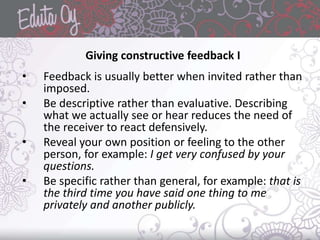
Giving constructive feedback I
• Feedback is usually better when invited rather than
imposed.
• Be descriptive rather than evaluative. Describing
what we actually see or hear reduces the need of
the receiver to react defensively.
• Reveal your own position or feeling to the other
person, for example: I get very confused by your
questions.
• Be specific rather than general, for example: that is
the third time you have said one thing to me
privately and another publicly.
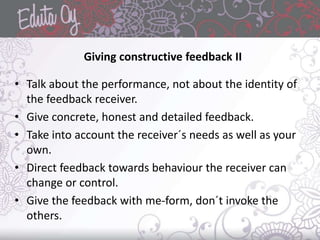
• Talk about the performance, not about the identity of
the feedback receiver.
• Give concrete, honest and detailed feedback.
• Take into account the receiver´s needs as well as your
own.
• Direct feedback towards behaviour the receiver can
change or control.
• Give the feedback with me-form, don´t invoke the
others.
Giving constructive feedback II
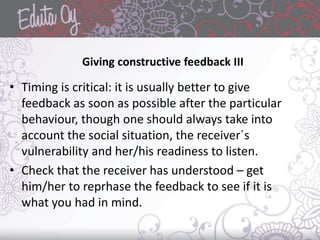
• Timing is critical: it is usually better to give
feedback as soon as possible after the particular
behaviour, though one should always take into
account the social situation, the receiver´s
vulnerability and her/his readiness to listen.
• Check that the receiver has understood – get
him/her to reprhase the feedback to see if it is
what you had in mind.
Giving constructive feedback III
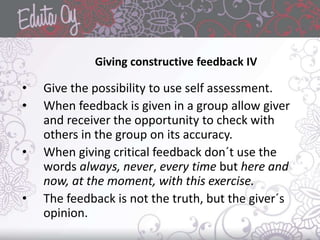
• Give the possibility to use self assessment.
• When feedback is given in a group allow giver
and receiver the opportunity to check with
others in the group on its accuracy.
• When giving critical feedback don´t use the
words always, never, every time but here and
now, at the moment, with this exercise.
• The feedback is not the truth, but the giver´s
opinion.
Giving constructive feedback IV
• Appreciate and be interested in the feedback
receiver and show it.
• Give feedback in the neutral voice and way.
• Don´t give feedback when you are provoked.
Giving constructive feedback V
Giving constructive feedback VI
• Remember the assessment criteria when giving
feedback.
• You can ask the receiver what kind of feedback
he/she especially wants to get.

Constructive feedback in university teaching

  • 1.
    Satu Öystilä 2015 Constructivefeedback in university teaching Eduta Oy Puh. +35850 564 4887 info@eduta.fi www.eduta.fi
  • 2.
    The feedback Remember thatgiving feedback is the most sensitive area of communication
  • 3.
    Principles of givingfeedback What is the aim of the feedback? (Why?) What kind of performance is the feedback based on? What kind of observations and experiences are in the background of the feedback giving? When and where are you giving feedback?
  • 4.
    The aim ofthe feedback To support learning process To support problem solving To improve interpersonal skills To develop self-esteem To develop and work life competencies
  • 5.
    The meaning ofthe giving and receiving feedback to the teacher Assessment • Information about the skills and knowledge of the students • Information about the own teaching skills and interventions Motivation • To motivate students Facilitation • Supporting the students to reflect new solutions
  • 6.
    Examples of thefeedback questions: • What is the most important knowledge you learned during the teaching session? • How do you feel with your studies at the moment? • What is especially well in the learning and group process? • Is there something you would like to change in the group work? • What else would you like to say?
  • 7.
    Giving constructive feedbackI • Feedback is usually better when invited rather than imposed. • Be descriptive rather than evaluative. Describing what we actually see or hear reduces the need of the receiver to react defensively. • Reveal your own position or feeling to the other person, for example: I get very confused by your questions. • Be specific rather than general, for example: that is the third time you have said one thing to me privately and another publicly.
  • 8.
    • Talk aboutthe performance, not about the identity of the feedback receiver. • Give concrete, honest and detailed feedback. • Take into account the receiver´s needs as well as your own. • Direct feedback towards behaviour the receiver can change or control. • Give the feedback with me-form, don´t invoke the others. Giving constructive feedback II
  • 9.
    • Timing iscritical: it is usually better to give feedback as soon as possible after the particular behaviour, though one should always take into account the social situation, the receiver´s vulnerability and her/his readiness to listen. • Check that the receiver has understood – get him/her to reprhase the feedback to see if it is what you had in mind. Giving constructive feedback III
  • 10.
    • Give thepossibility to use self assessment. • When feedback is given in a group allow giver and receiver the opportunity to check with others in the group on its accuracy. • When giving critical feedback don´t use the words always, never, every time but here and now, at the moment, with this exercise. • The feedback is not the truth, but the giver´s opinion. Giving constructive feedback IV
  • 11.
    • Appreciate andbe interested in the feedback receiver and show it. • Give feedback in the neutral voice and way. • Don´t give feedback when you are provoked. Giving constructive feedback V
  • 12.
    Giving constructive feedbackVI • Remember the assessment criteria when giving feedback. • You can ask the receiver what kind of feedback he/she especially wants to get.